
Free Practice Questions for the CIW Master CIW Enterprise Developer 1D0-437 Exam (2026 Updated)
At Marks4sure, we are dedicated to providing IT professionals with the most accurate and reliable preparation materials for the CIW 1D0-437 exam. To support your certification journey, we have made a selection of our premium 2026 Master CIW Enterprise Developer practice questions and answers available completely free. You can take this practice test as many times as you need. Every question includes a detailed, expertly verified explanation to ensure you fully grasp the core security concepts before test day.
Consider the following lines of code:
sub mySub {
($arg, @args) = @_;
foreach $val (@args) {
$returnVal .= "$arg, $val\n";
}
$returnVal . "" . @args;
}
print &mySub(1, "a value", "another value", "a parameter", "another parameter");
What is the output of these lines of code?
The filehandle INPUT is associated with the file represented by $file. Which statement will close the filehandle INPUT?
Consider the following program code:
@array = ("one", "two");
push(@array, "three");
shift(@array);
unshift(@array, "four");
pop(@array);
print($array[0]);
What is the output of this code?
Which one of the following while statements uses correct syntax and expressions?
Which one of the following choices is a unary operator that can apply to only a single variable?
Consider the following program code:
@array = ("ALPHA", "beta", "GaMmA");
@array = sort(@array);
print("@array");
What is the output of this code?
Consider the following assignments:
$x = 9
$y = 7
$z = 5
Given these assignments, which one of the following expressions evaluates as true?
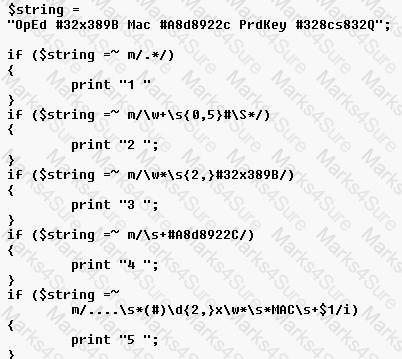
Consider the program code in the attached exhibit. What is the result of executing this program code?
Which of the following choices demonstrates the correct syntax to pass the argument $arg2 to the subroutine getpass?
Consider the following lines of code:
$_ = "This is a test";
s/^([^ ]*)\s*([^ ]*)/$2 $1/;
print;
What is the output of these lines of code?
Consider the following program code:
$Animal = Dogs bark;
package Cat;
$Animal = Cats purr;
{
package Fish;
$Animal = Fish swim;
} p
ackage main;
print $Animal;
What is the result of executing this program code?
Which one of the following choices will replace all occurrences of the word perl with the word Perl?
Consider the following program code:
@stack = (10, 10..25);
push(@stack, yellow);
shift(@stack);
push(@stack, white);
print shift(@stack);
What is the result of executing this program code?
Consider the following program code:
if ("Apple" gt "Pear")
{
print("True ");
}
else
{
print("False ");
}
if ("Banana" le "Banana")
{
print("True ");
}
else
{
print("False ");
}
What is the result of executing this program code?
Consider the following program code:
$x = 5;
$y = 10;
while (++$x < 10 && ++$y < 15)
{
print ($x $y );
}
print ($x $y );
What is the result of executing this program code?
Consider the following program code:
%employees = ("Lucy", "Accounting", "Armando", "Finance",
"Adrienne", "Marketing");
delete($employees{"Lucy"});
Which of the following lines of code has the same effect as the preceding code?
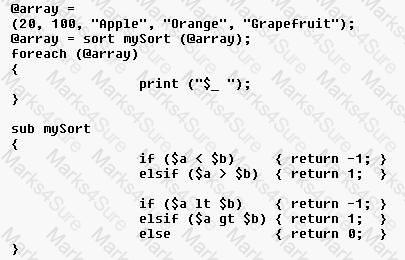
Consider the program code in the attached exhibit. What is the result of executing this program code?
Which of the following code segments correctly readies a database query, creating a valid statement handle and a result set? Assume $dbh represents a valid database handle.
Consider the following program code:
@array = (10, Masami, 10..13, Niklas);
for ($i = 1; $i < $#array; $i++)
{
print($array[$i] );
}
What is the result of executing this program code?
Consider the following code:
%chars = ("a", "100", "b", "90", "c", "80");
Which one of the following choices will reverse the key/value pairing of the code?
In the context of Perl user-defined subroutines, which statement is the most accurate?
Which line of code represents the correct syntax to establish a reference to a database handle?
Which of the following accurately describes the roles of the Database Interface Module (DBI) and the Database Driver Module (DBD)?
Consider the following statement:
for ($count=0; $count < 5; $count++) {print "$count "}
What will be the output from the given statement?
Consider that a file named test.txt contains this line of text:
One line of test text.
What is the output of the following lines of code?
$file = "test.txt";
open (OUT, "<$file") || (die "cannot open $file: $!");
seek(OUT, 15, 0);
read(OUT, $buffer, 5);
print $buffer . "\n";
print tell(OUT);
Consider the following program code:
$var = 10;
package Alpha;
$var = 20;
{
package Beta;
$var = 30;
}
package Gamma;
$var = 40;
{
print $var;
}
What is the output of this code?
Consider the following program code:
$Animal = Dogs bark;
package Cat;
$Animal = Cats purr;
{
package Fish;
$Animal = Fish swim;
}
package main;
print $Animal;
What is the result of executing this program code?
Consider the following program code:
$val = 5;
if ($val++ == 6)
{
print("True ");
}
else
{
print("False ");
}
if ($val++ == 6)
{
print("True ");
}
else
{
print("False ");
}
What is the output of this code?
Consider the following program code:
%hash = (small => 8oz,
medium => 16oz,
large => 32oz);
@keys = sort(keys(%hash));
for ($i = 0; $i < 3; $i++) {
print($hash{$keys[$i]}\n);
}
What is the result of executing this program code?
Consider the following program code:
$x = 150;
$y = "250";
if (($x + 100) == $y) { print("1 "); }
if ("250" == $y) { print("2 "); }
if ("250" eq $y) { print("3 "); }
if ($x lt $y) { print("4 "); }
if ($x ge $y) { print("5 "); }
What is the result of executing this program code?
Consider the following program code:
print(1 );
BEGIN { print(2 ); }
END { print(3 ); }
BEGIN { print(4 ); }
END
{
package MyPackage;
print(5 );
}
What is the result of executing this program code?
PDF + Testing Engine

Testing Engine
PDF (Q&A)