Pre-Summer Sale Limited Time 65% Discount Offer - Ends in 0d 00h 00m 00s - Coupon code: pass65

3V0-21.25 Advanced VMware Cloud Foundation 9.0 Automation Questions and Answers

Questions 4

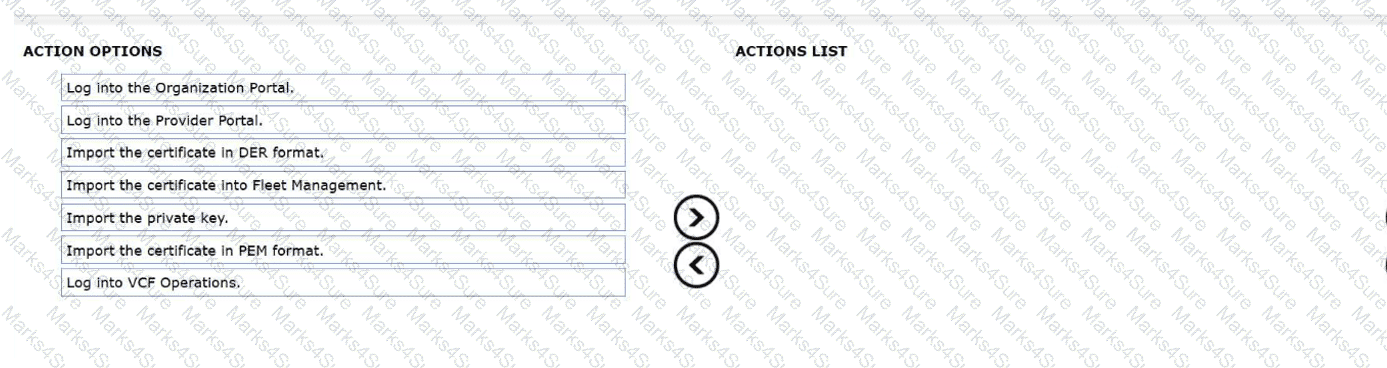
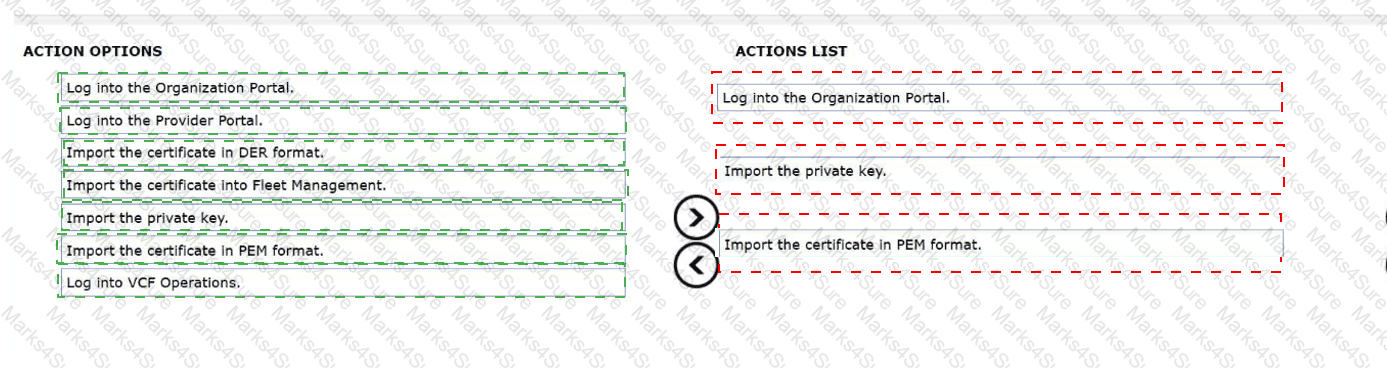
An administrator has been tasked with configuring tenant branding with the following requirements:

    Organization branding should only appear when a user has logged in to the organization portal.

Select the three steps involved in configuring branding. (Choose three.)

3V0-21.25 Question 4

Options:

Buy Now
Questions 5

An administrator has been tasked to enable developers to utilize Terraform to configure resources within VMware Cloud Foundation (VCF) Automation. The solution must:

• enable developers to configure Content Libraries.

• enable developers to configure Cloud Zones.

• enable developers to create flavor and image mappings.

What solution satisfies the requirements?

Options:

A.

Terraform provider for VCF Automation.

B.

System Administrator role.

C.

Organization Administrator role.

D.

Terraform configuration in VCF Automation.

Buy Now
Questions 6

What are two prerequisites to enable provisioning VMs via kubectl against tenant resources? (Choose two.)

Options:

A.

Ask the Provider to generate a token via the system APIs.

B.

Create a new extensibility Action.

C.

Generate an API token from the VCF Automation UI.

D.

Create a context via kubectl.

E.

Create a context via VCF CLI.

Buy Now
Questions 7

In VMware Cloud Foundation (VCF) Automation, which two statements identify the relationship between a storage policy and a region? (Choose two.)

Options:

A.

Regions can only use the default vSphere storage policy.

B.

Storage policies determine which datastores are available in a region.

C.

Regions automatically create storage policies based on cluster configuration.

D.

Storage policies must be replicated across all regions using the VCF Automation REST API.

E.

A storage policy can be associated with one or more regions.

Buy Now
Questions 8

An administrator has been tasked with configuring tenant branding with the following requirements:

• Organization branding should only appear when a user has logged in to the organization portal.

Select the three steps involved in configuring branding. (Choose three.)

Options:

A.

Log into the Provider Management Portal.

B.

Log into the Organization Portal.

C.

Disable the Enable Login and Logout Page Branding setting.

D.

Navigate to Branding.

E.

Import a branding theme.

F.

Enable the Enable Login and Logout Page Branding setting.

Buy Now
Questions 9

An administrator is deploying a Supervisor cluster in VMware Cloud Foundation (VCF) Automation and notices that only one vSphere zone is configured in the deployment workflow.

Which statement best describes the capabilities of the Supervisor cluster being deployed?

Options:

A.

The cluster enables the use of a single control plane across multiple vCenter instances.

B.

The cluster will automatically upgrade to multi-zone when additional zones are provided.

C.

The cluster will span multiple vSphere clusters for high availability.

D.

The cluster will not have zone-level fault isolation.

Buy Now
Questions 10

An administrator is tasked with configuring a multi-tenant environment within the organization's VMware Cloud Foundation (VCF) deployment. Requirements are:

• isolated network spaces for development and testing.

• dedicated resources.

• role-based access control.

Which of the actions satisfies the requirement?

Options:

A.

Define and allocate IP blocks and quotas at the organization level, which will then be selected and consumed by users at deployment.

B.

Configure firewall rules at the datacenter edge level to isolate traffic between departments.

C.

Create an NSX backed VLAN segment per department.

D.

Define and allocate IP blocks and quotas at the organization level, which will then be consumed by the NSX VPCs created by the different departments.

E.

Grant full administrative access for one responsible user in each department to create and manage their own network configurations.

Buy Now
Questions 11

An administrator has been tasked with creating a workflow in VCF Operations orchestrator. The workflow will be used to take a snapshot before planned maintenance work

is carried out within the virtual machine, and then automatically remove the snapshot at the end of the maintenance window. The following information has been provided

for the workflow:

. The workflow must allow a user to specify a virtual machine on which a snapshot should be taken.

. The workflow must take a snapshot of the virtual machine specified by the user.

. The workflow must name the snapshot based on the current date and time.

. The workflow must delete all snapshots on the virtual machine after a cooling off period of 5 days has elapsed.

. The workflow must stop running after the snapshot is created, a second workflow should automatically start when the 5 day cooling off period has elapsed.

The administrator creates a new workflow for this task and adds an input parameter to allow the user to specify the virtual machine.

Drag and drop the additional five steps the administrator should perform to continue configuring the workflow from the Possible Steps list on the left and place them into the

Selected Steps list on the right in any order (Choose five.)

3V0-21.25 Question 11

Options:

Buy Now
Questions 12

An organization uses VMware Cloud Foundation (VCF) and requires the following across the private cloud environment:

• monitor IP space utilization.

• detect network anomalies.

• enforce consistent network policies.

What three capabilities are required? (Choose three.)

Options:

A.

NSX Traceflows

B.

Integrated Security with VCF Operations

C.

vDefend

D.

VCF Operations lifecycle management

E.

NSX Subnetting

Buy Now
Questions 13

A system administrator is tasked to create a region for use within an AIIApps organization. How would the administrator determine which vCenter Servers are available in the infrastructure?

Options:

A.

Verify connections in the Organization portal.

B.

Verify connections in the Provider Management portal.

C.

Manually look up the UUID of the vCenter Server(s) in the VMware Kubernetes Service (VKS).

D.

Manually look up the UUID of the vCenter Server(s) in the vSphere Client.

Buy Now
Questions 14

An administrator is configuring RBAC policies in VMware Cloud Foundation (VCF) Automation to delegate access across multiple clusters. The administrator must ensure that:

• Cluster lifecycle operations (e.g., scaling) can only be performed by a designated operations group.

• Security policies at the NSX project level remain restricted to network administrators' group.

Which two role assignments meet these requirements? (Choose two.)

Options:

A.

Assign the Organization Owner role to the network administrators group at the tenant organization level.

B.

Assign the Security Administrator role in NSX to the network administrators group at the project scope.

C.

Assign the Service Viewer role in VCF Automation to the operations group at the cluster scope.

D.

Assign the Service User role in VCF Automation to the operations group at the cluster scope.

E.

Assign the Cluster Administrator role in VCF Automation to the operations group at the cluster scope.

Buy Now
Questions 15

The product development team is rolling out several new application stacks and require a self-service option to deploy their applications quickly and consistently. The requirements are:

• Present only approved application configurations.

• No manual configuration within a blueprint.

Which VMware Cloud Foundation (VCF) Automation approach meets these requirements?

Options:

A.

Publish pre-approved blueprints to a catalog and allow the team to choose infrastructure options such as compute cluster and storage policy during deployment.

B.

Publish all available blueprints to a catalog so team members can choose what is required and adjust configurations as needed at request time.

C.

Integrate VCFA with a Git repository containing blueprint YAML files and train the team to update infrastructure parameters properly before committing changes.

D.

Publish pre-approved blueprints with all required inputs preconfigured to a catalog so team members can deploy them directly.

Buy Now
Questions 16

An administrator is reviewing the network topology of an AllApps Organization. They notice that while each Virtual Private Cloud (VPC) has its own private address space, there is a common component that handles the routing between these VPCs and the corporate backbone.

What is this component?

Options:

A.

NSX Tier-1 Gateway

B.

NSX Edge Cluster

C.

NSX Transit Gateway

D.

Distributed Logical Router

Buy Now
Questions 17

A VMware Cloud Foundation (VCF) Automation administrator manages two organizations:

• Finance is a VMApps Organization.

• Development is an AllApps Organization.

When creating a new project in the Development organization, the administrator notices that the available network options differ from those seen in the Finance organization.

Which two factors explain this difference? (Choose two.)

Options:

A.

VMApps Organizations provide access to Supervisor networks while AllApps Organizations restrict networking to isolated VPC networks.

B.

AllApps Organizations support only ephemeral Kubernetes ingress networks, so persistent routed networks are not available.

C.

Both Organization types use the same network options, but AllApps Organizations require enabling DHCP before routed networks are visible.

D.

VMApps Organizations rely on traditional vSphere-backed or NSX-backed networks for virtual machine connectivity.

E.

AllApps Organization networking includes VPC-based networks.

Buy Now
Questions 18

An administrator clicks on Orchestrator to create a workflow in a VM Apps organization as shown.

Where would the administrator go next to enable Orchestrator?

3V0-21.25 Question 18

Options:

Buy Now
Exam Code: 3V0-21.25
Exam Name: Advanced VMware Cloud Foundation 9.0 Automation
Last Update: Apr 12, 2026
Questions: 62

PDF + Testing Engine

$63.52  $181.49

Testing Engine

$50.57  $144.49
buy now 3V0-21.25 testing engine

PDF (Q&A)

$43.57  $124.49
buy now 3V0-21.25 pdf