Spring Sale Limited Time 65% Discount Offer - Ends in 0d 00h 00m 00s - Coupon code: pass65

4A0-103 Alcatel-Lucent Multi Protocol Label Switching Questions and Answers

Questions 4

During node protection signaling, the PLR knows the address of the MP from which of the following methods?

Options:

A.

The PLR issues a RSVP path message to the destination router to request the address of the MP.

B.

The PLR learns the address of the MP from the ERO.

C.

The PLR learns the address of the MP from the RRO

D.

The PLR learns the address of the MP from the targeted RSVP hello message.

E.

The PLR does not need to know the address of the MP.

Buy Now
Questions 5

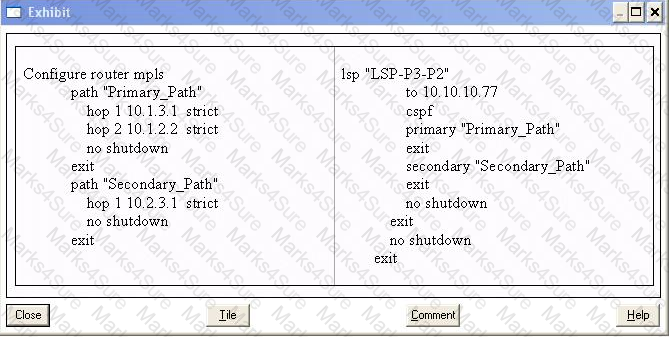
Click on the exhibit button below.

4A0-103 Question 5

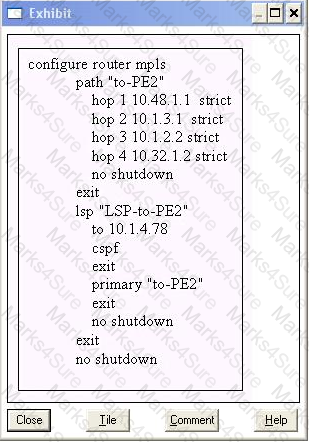
Given the configuration below, which of the following scenarios is FALSE?

Options:

A.

Both the primary and secondary paths are explicitly defined.

B.

The primary path is active and the secondary path is in hot standby.

C.

The LSP defined will use the primary path and will signal the secondary path to become active if the primary path fails.

D.

The LSP has the same source and destination for both primary and secondary paths.

Buy Now
Questions 6

Which of the following statements regarding RSVP refresh reduction are true1? (Choose two)

Options:

A.

Message-IDs replace individual refresh messages.

B.

Refresh reduction applies only to reservation messages.

C.

RSVP generates a summary-refresh message for each LSP.

D.

An LSP state change causes an incremented Message-ID.

Buy Now
Questions 7

Which of the following statements regarding LSPs are true? (Choose two)

Options:

A.

IGP-based LSPs are established solely from information contained in routing tables.

B.

The constraint-based routed LSP is calculated at the ingress of the network, based on the router database and user defined constraints.

C.

The constraint-based routed LSP is calculated at each hop of the LSP, based on the route table and user defined constraints.

D.

IGP-based LSPs must use LDP signaling.

Buy Now
Questions 8

Which of the following statements regarding DiffServ-TE LSPs is true?

Options:

A.

The Maximum Allocation Model (MAM) provides the most efficient bandwidth utilization model

B.

In the Maximum Allocation Model (MAM), each CT receives dedicated bandwidth constraints.

C.

In the Russian Doll Model (RDM), a CT2 LSP automatically preempts a CT1 LSP.

D.

Using the Russian Doll Mode! (RDM), a CT1 LSP may use unreserved CTO bandwidth.

Buy Now
Questions 9

Which of the following commands may only be used on the head end router to verify the status of an LSP named "LSP 1"? (Choose two)

Options:

A.

show router mpls Isp "LSP 1" originate

B.

show router mpls Isp "LSP 1" path detail

C.

show router rsvp session originate

D.

show router rsvp session "LSP 1"

Buy Now
Questions 10

Which of the following statements regarding RSVP-TE is FALSE?

Options:

A.

RSVP-TE operates in a downstream unsolicited label advertisement mode.

B.

RSVP-TE makes use of ordered control mode.

C.

RSVP-TE is an MPLS signaling protocol, based on the resource reservation protocol.

D.

RSVP-TE enables the establishment of explicitly routed LSPs that can be automatically routed away from network failures

E.

RSVP-TE supports explicitly routed LSPs using either loose or strict route definitions.

Buy Now
Questions 11

You wish to advertise LDP labels for all local networks; which is the most effective policy statement to use?

Options:

A.

from prefix-list direct

B.

match local

C.

from protocol direct

D.

match protocol direct

E.

from protocol local

Buy Now
Questions 12

Which of the following statements regarding LSP path configuration are true? (Choose three)

Options:

A.

The path must include at least one hop.

B.

The path may be used multiple times in a single LSP.

C.

The path may comprise loose hop entries only.

D.

The path must define the LSP's tail end.

E.

The path may be used for multiple LSPs.

Buy Now
Questions 13

Which approach to LSP path diversity provides the most control, but the least flexibility?

Options:

A.

Administrative Groups

B.

Shared Risk Link Groups

C.

Strict hop LSP paths

D.

Fast reroute

Buy Now
Questions 14

You wish to build an LSP originating on router R1, transiting the path R1-R2-R4-R5-R6, and terminating on router R6. How many strict hops would you define in your path statement?

Options:

A.

4

B.

1

C.

5

D.

6

Buy Now
Questions 15

If an LSP's loose primary path includes the statement "include green" and "exclude red;" how does CSPF choose the LSP's path?

Options:

A.

CSPF chooses a link that is a member of both administrative groups

B.

CSPF chooses only those links that are NOT members of the green admin group

C.

CSPF prunes the green links and uses these links for the secondary path

D.

CSPF signals the LSP path over the green links only, and prunes all other links

Buy Now
Questions 16

An LSP path is configured as follows:

- Shared-explicit reservation style

- Make-before-break (MBB) enabled

- 500Mpbs bandwidth reserved on a 1Gbps link

With 100Mbps of unreserved bandwidth remaining, the operator increases the LSP-path's bandwidth reservation to 900Mbps. What happens to the existing LSP?

Options:

A.

CSPF looks for the delta bandwidth, taking down the first path if necessary.

B.

CSPF looks for the delta bandwidth, implementing make-before-break.

C.

After 5 failed attempts to find the bandwidth requested, the head end disables the LSP.

D.

CSPF looks for the entire bandwidth requested, implementing MBB.

Buy Now
Questions 17

Which default LDP parameter are you able to change with CLI?

Options:

A.

Label space mode

B.

Label retention

C.

Control mode

D.

Keepalive factor

Buy Now
Questions 18

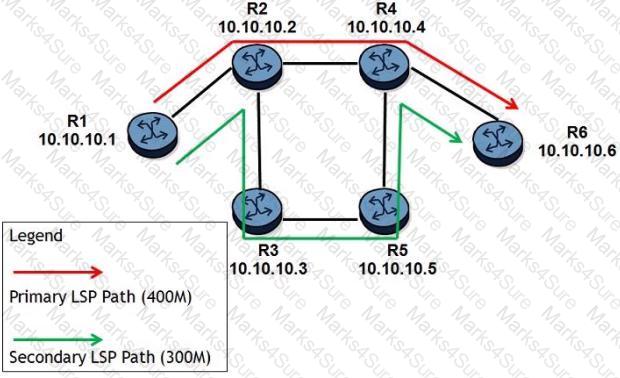
Click on the exhibit.

4A0-103 Question 18

All links have 1 Gbps unreserved bandwidth initially. After the LSP's primary and standby secondary paths are signaled, how much bandwidth is reserved on the link between routers R1 and R2?

Options:

A.

If Shared Explicit reservation style is used, 400Mbps is reserved.

B.

If Shared Explicit reservation style is used, 700Mbps is reserved.

C.

If Fixed Filter reservation style is used, 400Mbps is reserved.

D.

If Fixed Filter reservation style is used, 300Mbps is reserved.

Buy Now
Questions 19

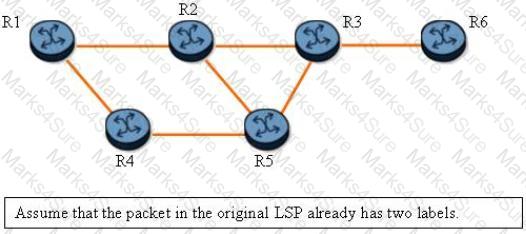
Click on the exhibit.

4A0-103 Question 19

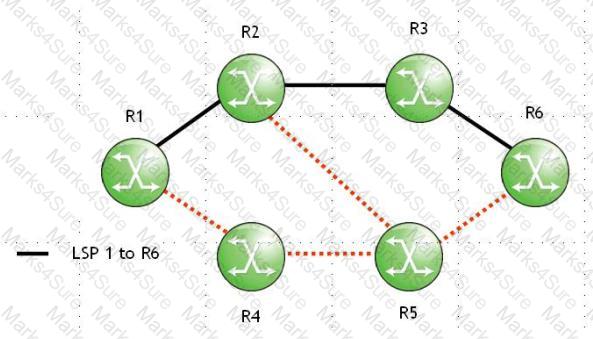
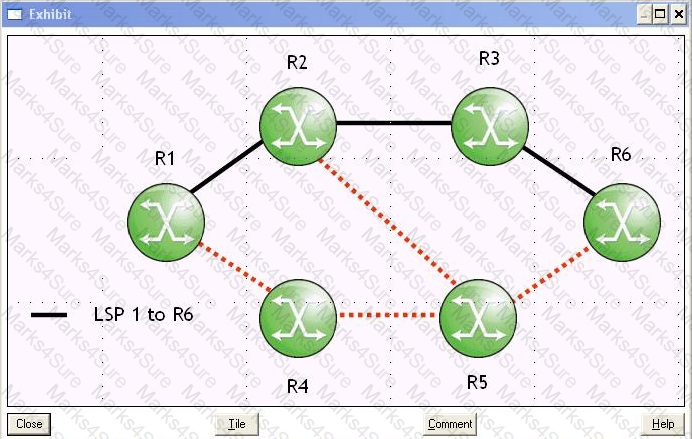
An LSP traverses the path R1-R2-R3-R6 and facility fast reroute is enabled. If the protected LSP carries one transport label and one service label, how many labels will be on the bypass tunnel if router R2 fails?

Options:

A.

1

B.

2

C.

3

D.

4

Buy Now
Questions 20

Which of the following modes are used by RSVP-TE on an Alcatel-Lucent 7750 SR?

Options:

A.

Independent control mode, downstream on demand

B.

Independent control mode, downstream unsolicited

C.

Ordered control mode, downstream on demand

D.

Ordered control mode, downstream unsolicited

Buy Now
Questions 21

Which of the following is a function of the control plane in an MPLS router?

Options:

A.

Label swapping

B.

Pushing a label on an unlabeled packet

C.

Label allocation

D.

Routing lookups

Buy Now
Questions 22

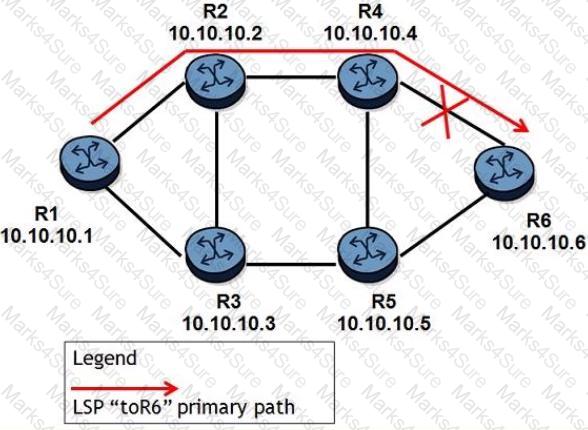
Click on the exhibit.

4A0-103 Question 22

An LSP path is established on router R1 toward router R6. After router R4 detects that the link between routers R4 and R6 goes down, which of the following will affect the failure propagation time?

Options:

A.

The time router R4 takes to send a PATH Error message toward the head-end router.

B.

The time router R4 takes to detect RSVP Hello message timeout from router R6.

C.

The time router R4 takes to send a RESV Error message to the head-end router.

D.

The time router R1 takes to signal an alternate path through router R3.

Buy Now
Questions 23

Which of the following about LDP-over-RSVP is TRUE?

Options:

A.

RSVP LSPs must exist between each PE-ABR pair, or ABR-ABR pair in each area.

B.

When LDP-over-RSVP is active, the LDP prefixes are resolved to a physical egress interface.

C.

Targeted sessions must exist between all routers along the tunnel path.

D.

Link LDP sessions must exist between each ABR-ABR pair in each area.

Buy Now
Questions 24

Which of the following about an LSP protected with one-to-one FRR is TRUE?

Options:

A.

The LSP can use facility and one-to-one FRR simultaneously.

B.

The LSP is limited to node protection.

C.

A single protection tunnel is used for all LSPs with the same path.

D.

A detour protection tunnel is created for the LSP.

Buy Now
Questions 25

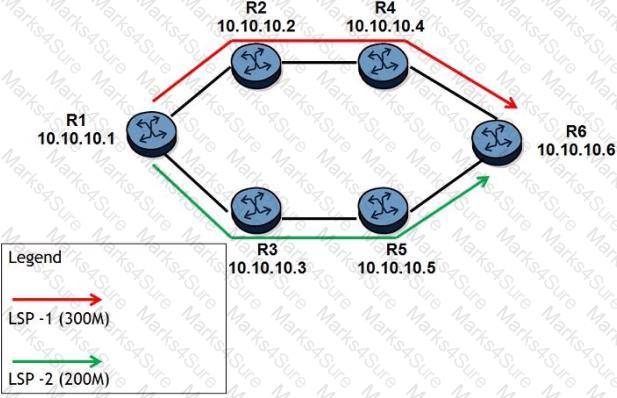
Click on the exhibit.

4A0-103 Question 25

All links have 1 Gbps unreserved bandwidth initially and all LSPs have the least-fill feature enabled. After the two LSPs have been signaled as shown, two additional LSPs are configured.

LSP-3 is signaled first with 50Mbps reserved. LSP-4 is signaled after with 400Mbps reserved.

Which paths will CSPF choose for LSP-3 and LSP-4?

Options:

A.

Both LSP-3 and LSP-4 take R1-R2-R4-R6.

B.

Both LSP-3 and LSP-4 take R1-R3-R5-R6.

C.

LSP-3 takes R1-R3-R5-R6 and LSP-4 takes R1-R2-R4-R6.

D.

LSP-3 takes R1-R2-R4-R6 and LSP-4 takes R1-R3-R5-R6.

E.

CSPF randomly chooses one of the equal cost paths for the two LSPs.

Buy Now
Questions 26

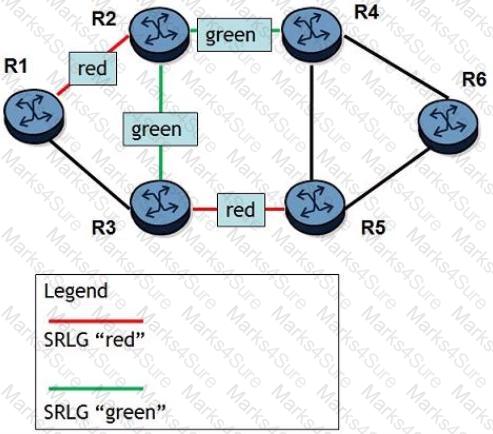
Click on the exhibit.

4A0-103 Question 26

An LSP's primary path takes R1-R3-R5-R6. Its fully loose secondary path is configured for SRLG. All links are of equal cost. Which path will the secondary path take?

Options:

A.

The secondary path will take R1-R3-R2-R4-R6.

B.

The secondary path will take R1-R2-R4-R6.

C.

The secondary path will take R1-R2-R3-R5-R6.

D.

The secondary path will take R1-R3-R2-R4-R5-R6.

Buy Now
Questions 27

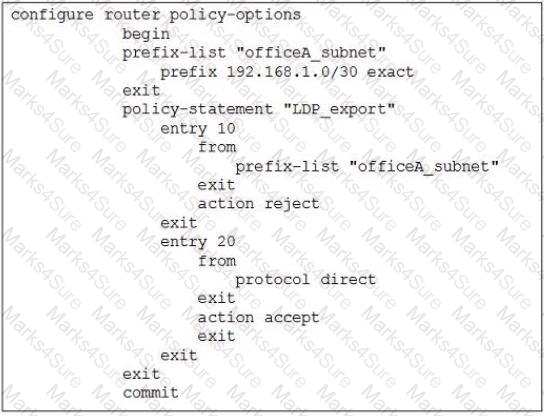
Click on the exhibit.

4A0-103 Question 27

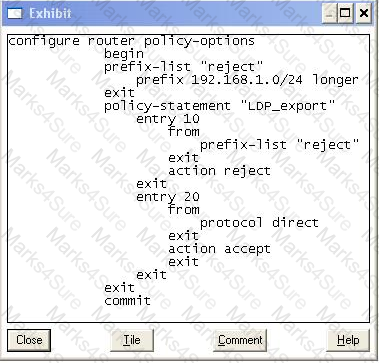
This policy is applied as an LDP export policy. In addition to the FECs learned from its neighbors, which FECs will appear in this router's LIB?

Options:

A.

All FECs with a prefix of 192.168.1.0/30.

B.

Local FECs with a prefix of 192.168.1.0/30.

C.

All FECs excluding 192.168.1.0/30.

D.

Local FECs excluding 192.168.1.0/30.

Buy Now
Questions 28

Which of the following about LSPs is FALSE?

Options:

A.

IGP-based LSPs are calculated based on information contained in routing tables.

B.

Constraint-based LSPs are calculated using the head-end router's TED.

C.

Constraint-based LSPs must use RSVP-TE signaling.

D.

IGP-based LSPs must use LDP signaling.

Buy Now
Questions 29

Which of the following about the Alcatel-Lucent 7750 SR command "own Isp-trace" is FALSE?

Options:

A.

The MPLS TTL values are incremented at each request.

B.

The router uses MPLS Echo Request packets that are IP-routed.

C.

The router collects hop information along the tunnel's path.

D.

The router performs an unidirectional LSP test.

Buy Now
Questions 30

What MPLS function should be performed by a router that receives a data packet with an MPLS label value of 0?

Options:

A.

Push an additional label onto the label stack.

B.

Pop the label.

C.

Swap the label.

D.

Pop the label and push an additional label onto the label stack.

Buy Now
Questions 31

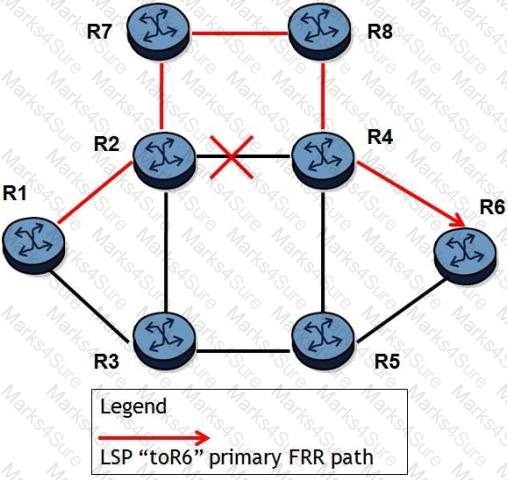
Click on the exhibit.

4A0-103 Question 31

A fully loose LSP "toR6" is enabled with FRR protection. All links have the same cost. After the link between R2 and R4 goes down, FRR protection repairs the LSP and traffic traverses on R1-R2-R7-R8-R4-R6. Which of the following about this CSPF-enabled LSP on an Alcatel-Lucent 7750 SR is TRUE?

Options:

A.

The LSP will stay on the current path indefinitely unless another failure occurs.

B.

The LSP will stay on the current path until the resignal timer expires.

C.

The LSP will switchover to R1-R2-R3-R5-R6 after the resignal timer expires.

D.

The LSP will switchover to R1-R3-R5-R6 after the retry timer expires.

Buy Now
Questions 32

Click on the exhibit.

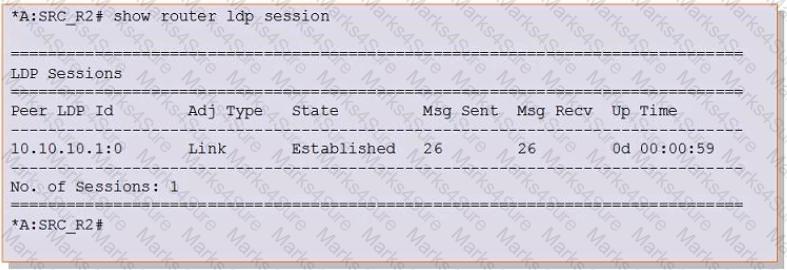
4A0-103 Question 32

Why might router R2 have a Link LDP session to R1 (10.10.10.1:0) but not to R3 (10.10.10.3:0)?

Options:

A.

LDP is not configured on R2.

B.

R2 does not have a route to 10.10.10.3.

C.

LDP is not configured on R3's interface to R2.

D.

The targeted session is not configured on R2.

Buy Now
Questions 33

Click on the exhibit.

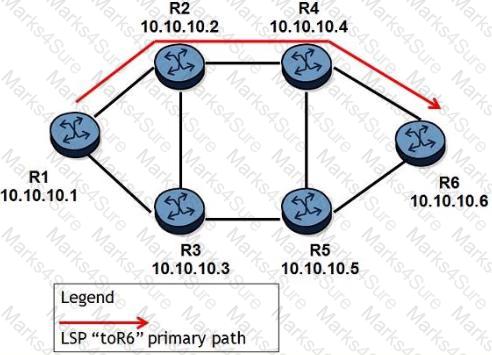
4A0-103 Question 33

Which of the following CANNOT be used to ensure the LSP toR6" will follow the path R1-R2-R4-R6?

Options:

A.

Admin groups

B.

Hop-limit

C.

Strict hops

D.

TE-Metric

Buy Now
Questions 34

An Alcatel-Lucent 7750 SR has its TE update threshold enabled with the up threshold set to 40%. The maximum reservable bandwidth on the link is 200M and 30M have already been reserved. When will a TE update be sent on this link?

Options:

A.

When the reserved bandwidth goes above 80M.

B.

When the reserved bandwidth goes above 40M.

C.

When an additional 80M bandwidth is reserved.

D.

When an additional 40M bandwidth is reserved.

Buy Now
Questions 35

Which of the following about configuring an LSP path definition on an Alcatel-Lucent 7750 SR is FALSE?

Options:

A.

A path definition can have both loose and strict hops.

B.

A path definition can be configured with loose hops only.

C.

A path definition is configured on the head-end router only,

D.

A path definition is not required if CSPF is enabled on an LSP.

Buy Now
Questions 36

An IS-IS TE enabled router has an interface on a 500Mbps link and it is configured with a 25% subscription. If this interface is not used by any LSPs. what value will be shown in the Reservable Bandwidth sub-TLV?

Options:

A.

125 Mbps

B.

500 Mbps

C.

625 Mbps

D.

2000 Mbps

Buy Now
Questions 37

Using facility mode fast reroute, how does the PLR learn the address of the MP?

Options:

A.

The PLR issues an RSVP PATH message to the tail-end requesting the address of the MP.

B.

The PLR learns the address of the MP from the ERO.

C.

The PLR learns the address of the MP from the RRO.

D.

The PLR learns the address of the MP from the targeted RSVP Hello message.

E.

The PLR knows the address of the MP is the same as the tail-end router.

Buy Now
Questions 38

Which of the following about RSVP-TE is FALSE?

Options:

A.

It supports traffic protection using IGP equal cost paths.

B.

It supports CAC to prevent resource overbooking.

C.

It supports LSPs with traffic engineering constraints.

D.

It supports LSPs that follow the IGP best path.

Buy Now
Questions 39

Which of the following about an ERO in an RSVP PATH message is FALSE?

Options:

A.

ERO is used by downstream routers to determine the next-hop for the LSP.

B.

ERO contains label information used to signal an LSP path.

C.

ERO is not always present in the PATH message.

D.

Each downstream router updates information inside the ERO.

Buy Now
Questions 40

Click on the exhibit.

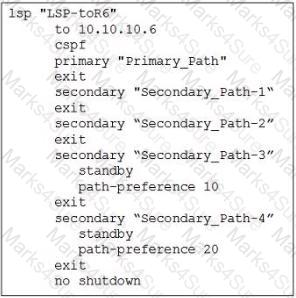
4A0-103 Question 40

If the primary path goes down, which secondary LSP path will the head-end router select first?

Options:

A.

Secondary_Path-1

B.

Secondary_Path-2

C.

Secondary_Path-3

D.

Secondary_Path-4

Buy Now
Questions 41

Click on the exhibit.

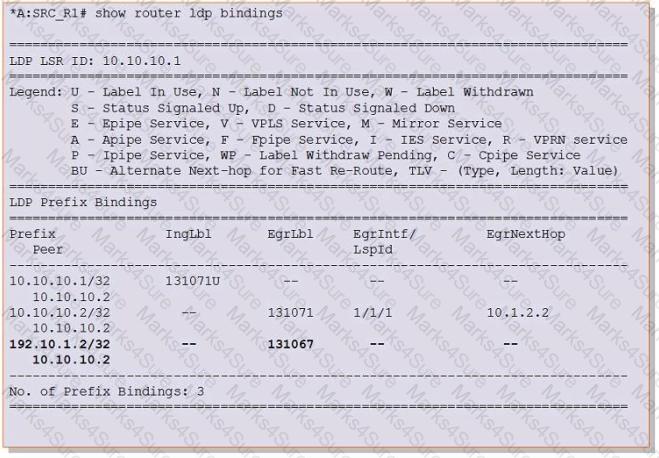
4A0-103 Question 41

What is the possible reason that the label for prefix 192.10.1.2/32 is not active?

Options:

A.

The router does not have a route to reach to the peer 10.10.10.2/32.

B.

The router does not have a route to reach to the prefix 192.10.1.2/32.

C.

The router does not have an export policy defined to export the prefix 192.10.1.2/32 into LDP.

D.

The router receives an invalid label for the prefix 192.10.1.2/32 from its peer.

Buy Now
Questions 42

Which LSA type is used for OSPF-TE?

Options:

A.

Type 8 LSA — Link Local LSA

B.

Type 9 LSA — Link local Opaque LSA

C.

Type 10 LSA — Area local Opaque LSA

D.

Type 11 LSA —AS Opaque LSA

Buy Now
Questions 43

Which of the following devices assumes the active role during the establishment of an LDP session?

Options:

A.

The peer with the higher physical address.

B.

The peer with the higher transport address.

C.

The peer with the lower physical address.

D.

The peer with the lower transport address.

E.

The peer that generated the first Hello message.

Buy Now
Questions 44

Click on the exhibit.

4A0-103 Question 44

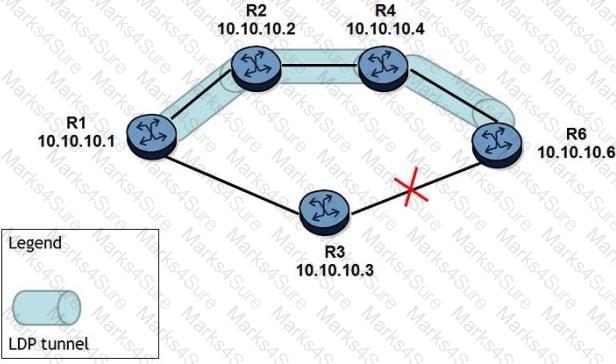
An LDP tunnel is established on R1-R2-R4-R6 because the link between routers R3 and R6 is down. With the LDP-IGP Sync feature enabled, what happens immediately after the link is restored?

Options:

A.

A new LDP session is established on R1-R3-R6 as soon as the FIB is updated.

B.

The LDP session remains unchanged until the existing path R1-R2-R4-R6 goes down.

C.

A new LDP session is established on R1-R3-R6 as soon as router R1 receives a new label for router R6.

D.

The LDP session remains unchanged until router R3 stops advertising the maximum metric for the link to router R6.

Buy Now
Questions 45

Which of the following about LDP sessions is TRUE?

Options:

A.

Frame mode requires multiple sessions between peers.

B.

The lower transport address initiates the session.

C.

Established LDP sessions run over a TCP connection.

D.

An LDP session is established immediately after Init messages are exchanged between peers.

Buy Now
Questions 46

Which MPLS mode saves only active label mappings received from peer LSRs?

Options:

A.

Conservative label retention

B.

Liberal label retention

C.

Downstream on demand

D.

Downstream unsolicited

Buy Now
Questions 47

If an Alcatel-Lucent 7750 SR is an iLER operating in pipe mode, which of the following regarding the TC field (EXP bits) is TRUE?

Options:

A.

The TC field is set based on the value of the DSCP field inside the customer packet.

B.

The TC field is set to a specific value via explicit administrative configuration.

C.

The TC field is set to a system generated random number.

D.

The TC field is set by the eLER.

Buy Now
Questions 48

Click on the exhibit.

4A0-103 Question 48

LSP 1's link between routers R3 and R6 has failed, and the RESV state at router R3 has timed out. Which of the following actions will router R3 initiate?

Options:

A.

Send a PathTear message towards router R6.

B.

Send a PathTear message towards router R1.

C.

Send a ResvTear message toward router R6.

D.

Send a ResvTear message toward router R1.

Buy Now
Questions 49

Which of the following about CSPF is TRUE?

Options:

A.

The tail-end router performs the CSPF calculation for an LSP.

B.

CSPF calculations are always performed on RSVP-TE based LSPs.

C.

The head-end router performs the CSPF calculation for an LSP.

D.

Each downstream router performs its own CSPF calculation for an LSP.

Buy Now
Questions 50

What are the default settings for RSVP-TE on the Alcatel-Lucent 7750 SR?

Options:

A.

Per-interface label space, liberal retention mode

B.

Per-platform label space; liberal retention mode

C.

Per-interface label space, conservative retention mode

D.

Per-platform label space, conservative retention mode

Buy Now
Questions 51

Which of the following about RSVP-TE summary refresh messages is TRUE?

Options:

A.

They list the RSVP session names that the router is refreshing,

B.

They list the Message IDs that the router is refreshing,

C.

They list the Tunnel IDs that the router is refreshing.

D.

They list the LSP I Ds that the router is refreshing.

Buy Now
Questions 52

Which of the following about Type 10 opaque LSAs is TRUE?

Options:

A.

Type 10 opaque LSAs are supported by IS-IS.

B.

Type 10 opaque LSAs are flooded to all areas of the routing domain.

C.

Type 10 opaque LSAs are stored in an LSDB.

D.

Type 10 opaque LSAs are used for traffic engineering support.

Buy Now
Questions 53

Which of the following about Fast Reroute link protection tunnels is FALSE?

Options:

A.

Link protection tunnels are established if a router is unable to establish node protection tunnels.

B.

Link protection tunnels are only requested for a primary LSP path.

C.

Link protection tunnels can be created for both one-to-one or facility Fast Reroute.

D.

Link protection tunnels detour around a failed next downstream router.

Buy Now
Questions 54

An LSP is configured with one-to-one FRR and node protection on a Alcatel-Lucent 7750 SR. Which of the following is FALSE?

Options:

A.

Each PLR signals a protection tunnel that avoids the downstream node.

B.

A single protection tunnel can protect all LSPs that go through the same hop.

C.

A link protection tunnel is signaled if a node protection tunnel cannot be established.

D.

Protection tunnels used in this LSP are also detour tunnels.

Buy Now
Questions 55

How does a DMP inform the downstream routers that it has merged detour tunnels?

Options:

A.

The DMP sends the DMP_Object in each detour's PATH messages.

B.

The DMP summarizes PATH messages, giving each detour its own MSGJD.

C.

The DMP identifies itself as the previous hop in each detour's PATH message.

D.

The DMP sends a single PATH message containing the merged DETOUR_Objects.

Buy Now
Questions 56

Which of the following statements regarding per-platform label space are true? Choose two answers.

Options:

A.

A separate label is used for each interface that the FEC is advertised on.

B.

It uses fewer label resources than a per-interface label space.

C.

It is typically used when the device has ATM or Frame Relay interfaces.

D.

It uses more label resources than a per-interface label space.

E.

A single label may be assigned to an FEC and used across all interfaces of the same router.

F.

It is only valid when the LDP peers are directly connected over an interface, and the label is only going to be used for traffic sent over that interface.

Buy Now
Questions 57

Which of the following are characteristics of ECMP LSPs in LDP? Choose three answers

Options:

A.

Liberal label retention mode

B.

T-LDP enabled with peers to which load balancing is desired.

C.

ECMP enabled in the config > router context.

D.

Hashing used to select the egress label.

E.

Export policy applied to advertise multiple labels for a given FEC.

Buy Now
Questions 58

Which of the following about RSVP-TE on an Alcatel-Lucent 7750 SR is TRUE?

Options:

A.

Label bindings are distributed to other routers when explicitly requested.

B.

Label bindings are distributed to all neighbors including non-downstream routers.

C.

Label bindings are distributed if labels have not been received from downstream routers.

D.

All labels received from downstream neighbors are stored in the LIB.

Buy Now
Questions 59

An Alcatel-Lucent 7750 SR label switches a packet it receives. The packet has an outer label TTL of 250 and an inner label TTL of 251. Which of the following is TRUE?

Options:

A.

The outer label TTL will be 249 and the inner label TTL will be 250.

B.

The outer label TTL will be 249 and the inner label TTL will be 251.

C.

The outer label TTL will be 251 and the inner label TTL will be 251.

D.

The outer label TTL will be 251 and the inner label TTL will be 252.

Buy Now
Questions 60

Which of the following are the default settings for the Alcatel-Lucent 7750 SR when using LDP?

Options:

A.

Per-platform label space, conservative retention mode

B.

Per-interface label space, conservative retention mode

C.

Per-platform label space, liberal retention mode

D.

Per-interface label space, liberal retention mode

Buy Now
Questions 61

Click on the exhibit button below.

4A0-103 Question 61

LSP 1's link between routers R3 and R6 has failed, and the RESV state at router R3 has timed out. Which of the following actions will router R3 initiate?

Options:

A.

Send a Path Tear message towards router R6.

B.

Send a Path Tear message towards router R1.

C.

Send a Resv Tear message toward router R6.

D.

Send a Resv Tear message toward router R1.

Buy Now
Questions 62

Which of the following describes how a router sets the destination IP address for an RSVP RESV message?

Options:

A.

It sets the address to the system address of the head-end router.

B.

It sets the address to the next upstream hop from the ERO.

C.

It sets the address to the next upstream hop from the PSB.

D.

It sets the address to the next upstream hop from the RRO.

Buy Now
Questions 63

Two directly connected routers set different interface Hello timeout values. Router R1 uses 15 seconds, while router R2 uses 30 seconds. Which of the following best describes the LDP adjacency?

Options:

A.

The adjacency forms with the lower timeout value.

B.

The adjacency forms with the higher timeout value.

C.

The adjacency is in init state.

D.

The adjacency times out after 30 seconds.

Buy Now
Questions 64

Which of the following configurations allow a router to periodically attempt to move LSP traffic to a better path, if the head end can find one?

Options:

A.

configure router mpls retry-timer 30

B.

configure router mpls resignal-timer 30

C.

configure router mpls retry-attempts 30

D.

configure router mpls global-revertive 30

Buy Now
Questions 65

Which one of the following statements regarding RSVP LSP configuration is true?
Options:

A.

LSPs must always terminate on a system ID.

B.

MPLS and RSVP must be enabled on all routers.

C.

Interfaces must be individually created in RSVP.

D.

Path definitions must include at least one hop entry.

Buy Now
Questions 66

Which of the following regarding MPLS Encapsulation is FALSE?

Options:

A.

The customer's Layer 2 header is preserved at the iLER for Layer 2 services.

B.

The customer's Layer 2 Header is preserved at the iLER for Layer 3 services.

C.

The service provider's Layer 2 header is added at the iLER for Layer 2 services.

D.

The service provider's Layer 2 header is added at the iLER for Layer 3 services.

Buy Now
Questions 67

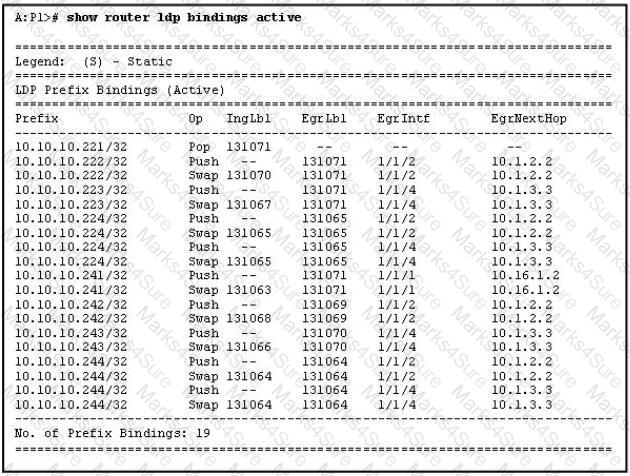
Click on the exhibit.

4A0-103 Question 67

Given the output below, which of the following is FALSE?

Options:

A.

A packet arriving with label 131066 will be forwarded out interface 1 /1 /4 with label 131070.

B.

The router is an egress router for FEC 10.10.10.221/32.

C.

There are multiple LSPs to reach FEC 10.10.10.244/32.

D.

The router's system address is 10.10.10.242/32.

Buy Now
Questions 68

What MPLS function should be performed by a router that receives a data packet containing an MPLS label value of 3?

Options:

A.

A router will never receive a packet containing this label value.

B.

Request a new label from the peer that provided this label.

C.

Pop the label.

D.

PUSH an additional label onto the label stack.

E.

Signal a new label to the peer that sent the packet.

Buy Now
Questions 69

Click on the exhibit button below.

4A0-103 Question 69

Given the configuration below, which of the following commands would enable fast reroute on the LSP? Choose two answers

Options:

A.

This configuration already is configured for FRR.

B.

fast-reroute facility

C.

fast-reroute one-to-one

D.

secondary < name >

E.

standby

Buy Now
Questions 70

Click on the exhibit button.

4A0-103 Question 70

The policy on router R2 is applied as an LDP export policy. What FECs now appear in router R2's LIB?

Options:

A.

Local FECs, not including those in the 192.168.1.0/24 address space.

B.

Only system ID FECs may appear in the LIB.

C.

Any local FECs, except those with a 24 bit mask.

D.

Local FECs in the 192.168.1.0/24 address space

Buy Now
Questions 71

In MPLS, how is the label range 0 ?15 used?

Options:

A.

Static LSPs

B.

Reserved use

C.

Vendor proprietary use

D.

Management LSPs

E.

Dynamic LSPs

Buy Now
Questions 72

Which LSA is used for OSPF-TE purposes?

Options:

A.

Type 9 LSA ?Link local LSA

B.

Type 10 LSA ?Area local LSA

C.

Type 8 LSA ?TE router LSA

D.

Type 11 LSA ?Network LSA

Buy Now
Questions 73

Router R3 signals an LSP, reserving 1Gbps bandwidth on a 10Gbps link. RSVP configuration limits reservable bandwidth to 20 percent on the egress interface. Which of the following statements is true?

Options:

A.

The egress RSVP interface has 80 percent bandwidth unreserved.

B.

LSPs can reserve an additional 9.9 Gbps bandwidth on this RSVP interface.

C.

The head end reserves 100Mbps for the LSP.

D.

The egress RSVP interface has 1Gbps bandwidth unreserved.

Buy Now
Questions 74

Which one of the following statements regarding the detour object transported in the detour path message is true?

Options:

A.

The PLR sends it downstream with the RRO.

B.

The PLR sends it downstream with the ERO.

C.

It associates all detours with the source PLR.

D.

The MP sends it upstream with the RESV message.

Buy Now
Exam Code: 4A0-103
Exam Name: Alcatel-Lucent Multi Protocol Label Switching
Last Update: Apr 30, 2026
Questions: 249

PDF + Testing Engine

$63.52  $181.49

Testing Engine

$50.57  $144.49
buy now 4A0-103 testing engine

PDF (Q&A)

$43.57  $124.49
buy now 4A0-103 pdf