Spring Sale Limited Time 65% Discount Offer - Ends in 0d 00h 00m 00s - Coupon code: pass65

4A0-107 Nokia Quality of Service Questions and Answers

Questions 4

Which of the following statements are TRUE? (Choose two)

Options:

A.

The primary contributors to latency are distance, scheduling, and congestion.

B.

The weighted round robin scheduling algorithm will result in more delay for high priority traffic than the regular round robin algorithm.

C.

The round robin scheduling algorithm will result in less jitter for low priority traffic than a strict priority scheduler.

D.

Packet loss can be reduced by decreasing the amount of buffer space available to a queue.

E.

Latency can be reduced by increasing the amount of buffer space available to a queue.

Buy Now
Questions 5

Which of the following self-generated traffic applications is considered “management” traffic, as opposed to “protocol” traffic?

Options:

A.

IS-IS

B.

RSVP

C.

ICMP

D.

BGP

Buy Now
Questions 6

A physical port has three associated buffer pools. Which of the following buffer pool combinations is associated to a physical port?

Options:

A.

Access ingress, access egress, network egress

B.

Access ingress, network ingress, network egress

C.

Port ingress, port egress, shared bi-directional

D.

Port ingress, port egress, network egress

E.

Port ingress, network ingress, network egress

Buy Now
Questions 7

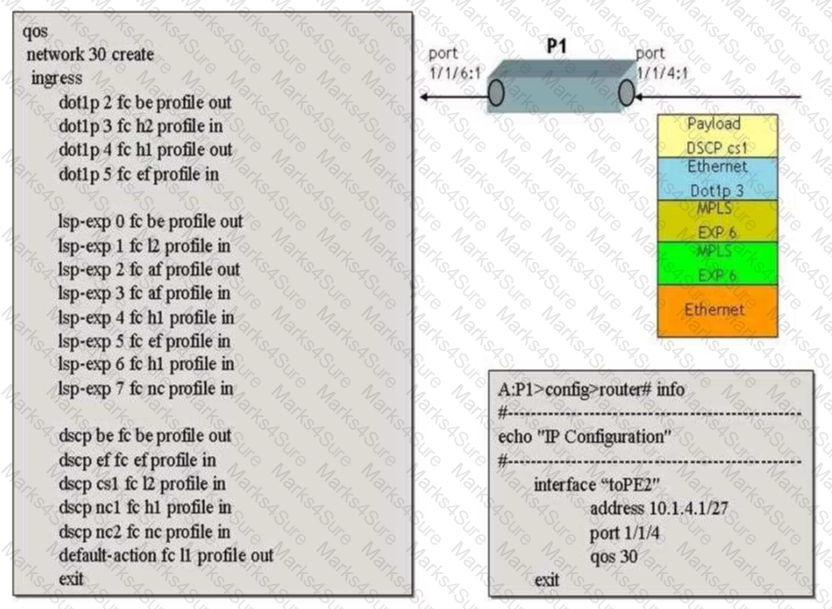
Click the exhibit button below.

4A0-107 Question 7

Based on the configuration of the network policy (below), what will be the forwarding class associated with a MPLS encapsulated customer packet that arrives on a dotlQ encapsulated network port 1/1/4:1 on P1 with the following characteristics:

EXP value = 6

DSCP value = cs1

Dot1pvalue = 3

Options:

A.

EF

B.

H1

C.

L1

D.

H2

E.

L2

Buy Now
Questions 8

Which of the following are the minimum requirements needed to classify traffic marked with DSCP AF11, AF12, and AF13 into the AF forwarding class and provide fair treatment to the drop precedence settings? (Choose three)
Options:

A.

Profile mode queues

B.

Priority mode queues

C.

1 queue

D.

3 queues

E.

3 forwarding classes

F.

1 forwarding class, with 2 subclasses

G.

1 forwarding class, with 3 subclasses

Buy Now
Questions 9

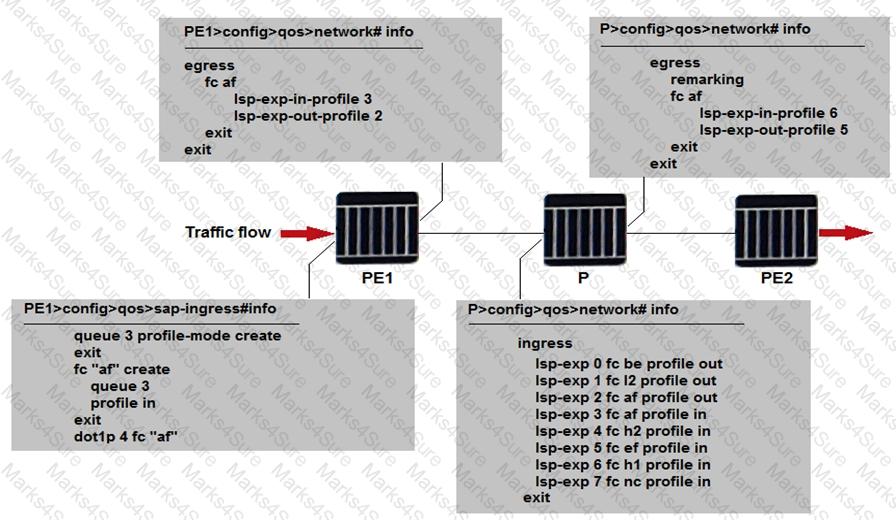
4A0-107 Question 9

Traffic corresponding to a layer-3 VPN arrives at router PE1 marked with a dot1p value of 4. The SDP carrying the traffic uses an MPLS transport tunnel. Given the policies applied on the routers in the diagram, what is the EXP value of packets arriving at router PE2?

Options:

A.

2

B.

3

C.

5

D.

6

Buy Now
Questions 10

Which of the following is NOT a factor when deciding if a packet can be accepted into a queue?

Options:

A.

Profile/priority state of a packet

B.

Forwarding class

C.

Queue depth

D.

HPO setting

Buy Now
Questions 11

Which of the following should be performed if a service provider does not want packets to make use of the shared buffer space when queued?

Options:

A.

Set the CBS to 0.

B.

Set the MBS equal to the CBS.

C.

Set the high-priority-only equal to the MBS.

D.

Set the MBS to 0.

E.

Set the high-priority-only to 0.

Buy Now
Questions 12

Which of the following statements about network QoS policies is FALSE?

Options:

A.

Classification rules must specify both an FC and a profile for the packets.

B.

A network policy is applied at a physical port.

C.

Classification is performed with behavior-aggregate statements only.

D.

Match criteria can be chosen from dot1p, DSCP, and EXP fields in the packet.

Buy Now
Questions 13

A SAP-ingress policy is configured so that ping traffic is classified as FC L1 and mapped to queue 3; however, all traffic is placed in queue 1. What is the most probable reason for this?

Options:

A.

The default forwarding class for ICMP traffic is BE and cannot be changed.

B.

The SAP has been shut down.

C.

Queue 3 has no PIR or CIR configured, and thus cannot hold any packets.

D.

The SAP-ingress policy has not been applied to the SAP.

Buy Now
Questions 14

Which of the following criteria is NOT used in the behavior aggregate classification option?

Options:

A.

dot1p

B.

dst-mac

C.

lsp-exp

D.

dscp

Buy Now
Questions 15

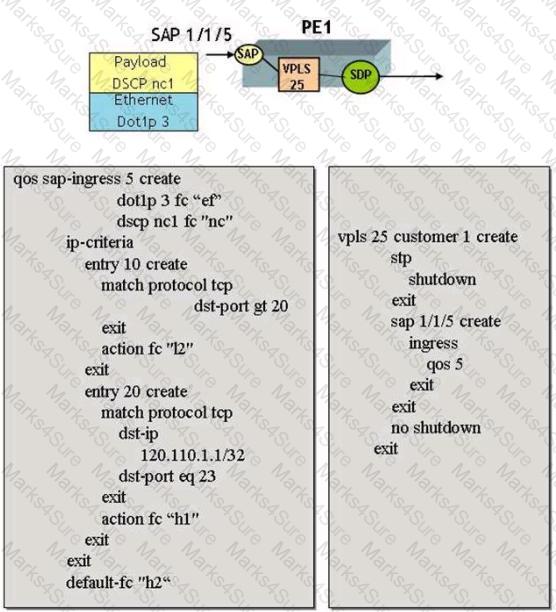
Click the exhibit button below.

4A0-107 Question 15

Based on the configuration shown below, name the forwarding class to be associated with a TCP packet encapsulated inside an Ethernet frame that arrives on SAP 1/1/5 with the following characteristics:

Destination IP address = 120.110.1.1

TCP port number = 23

DSCP value = nc1

Dot1pvalue = 3

Options:

A.

H2

B.

NC

C.

L2

D.

EF

E.

H1

F.

BE

Buy Now
Questions 16

A queue is configured with the following attributes:

MBS = 10KB

CBS = 5KB

High-Priority-Only = 30%

Assume that there is no CBS overbooking and that the slope-policy is disabled. If the current queue depth is 8KB, what will happen to an in-profile packet arriving in the queue?

Options:

A.

It will be discarded because the high-priority-only threshold is exceeded.

B.

It will be queued but re-marked as " out-of-profile. "

C.

It will be queued in the reserved portion of the buffer pool and remain " in-profile. "

D.

It will be queued in the shared portion of the buffer pool but contend for shared buffer space with packets from other queues.

E.

It will be queued in the shared portion of the buffer pool but may be dropped if the buffer utilization exceeds the start-average value of the low slope.

Buy Now
Questions 17

Which of the following statements about the default scheduler in the Nokia 7750 SR is FALSE?

Options:

A.

The default scheduler spends an equal amount of time servicing each queue that has traffic to be sent out.

B.

Queue-type can be configured as best-effort, expedite, or auto-expedite.

C.

A queue will be serviced as expedited if its type is configured as expedited, regardless of the forwarding classes mapped to it.

D.

A queue configured as auto-expedited will be an expedited queue as long as no Best Effort FC is mapped to it.

Buy Now
Questions 18

Why are the four QoS steps (classification, queuing, scheduling, and marking/remarking) executed twice for every packet entering a 7750 SR router?

Options:

A.

Once before going through each of the redundant switching fabrics.

B.

To protect against failure of either ingress or egress card.

C.

Once before going through the switching fabric, and once more before going onto the egress port.

D.

Once to decide if the packet is in-profile or out-of-profile, and once more to process the packet according to its profile.

Buy Now
Questions 19

Which of the following statements describes a queue’s weight parameter that is used in the hierarchical scheduling?

Options:

A.

The weight specifies the priority of the queue during scheduling up to its CIR.

B.

The weight specifies the priority of the queue during scheduling above-CIR, up to its PIR.

C.

The weight is used to determine how this queue and other queues or schedulers at the same CIR-level share available CIR bandwidth at that level.

D.

The weight is used to determine how this queue and other queues or schedulers at the same level share available above CIR bandwidth at that level.

Buy Now
Questions 20

On the Nokia 7750 SR, what is a slope policy used for?

Options:

A.

Defining the slope of the TCP slow-start mechanism for self generated traffic.

B.

Defining the slope of the scheduling rate per forwarding class when using HQoS.

C.

Defining the high and low slope values when deploying buffer admission control for UDP traffic in the committed buffer pool.

D.

Defining the high and low slope values when deploying buffer admission control for TCP traffic in the shared buffer pool.

E.

Defining the high and low slope values when deploying buffer admission control for TCP traffic in the committed buffer pool.

Buy Now
Questions 21

A profile-mode queue is configured with MBS = 100 KB, CBS = 50 KB and High-Priority-Only = 40%. Assume there is no CBS overbooking, and the slope-policy is disabled. If the current queue depth is 70 KB, what will happen to an out-of-profile packet when it is transmitted to the queue?

Options:

A.

It will be stored in the reserved buffer space and remain out-of-profile.

B.

It will be stored in the reserved buffer space and become in-profile.

C.

It will contend for shared buffer space with packets from other queues.

D.

It will be discarded because the high-priority-only threshold has been reached.

Buy Now
Questions 22

Click the exhibit button below. Given the scheduler-policy (below), which of the following can be done to guarantee that the best-effort traffic receives its configured CIR value?
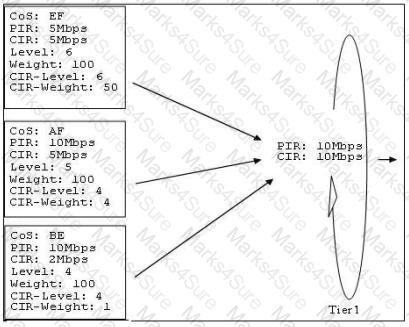
4A0-107 Question 22

Options:

A.

Change the CIR-level value for the best-effort queue to 8.

B.

Do not change anything; it is already guaranteed to receive its CIR

C.

Change the CIR-level value for the best-effort queue to 1.

D.

Change the CIR-weight value of the AF queue to 0.

Buy Now
Questions 23

Which of the following statements BEST describes an MBS parameter?

Options:

A.

It specifies the maximum rate at which a queue can be serviced.

B.

It specifies the maximum depth of a queue beyond which packets will be dropped.

C.

It specifies the portion of a queue that is taken from the reserved buffer pool.

D.

It specifies the threshold beyond which only in-profile packets will be queued.

E.

It specifies the peak bandwidth that can be attained by the incoming traffic.

Buy Now
Questions 24

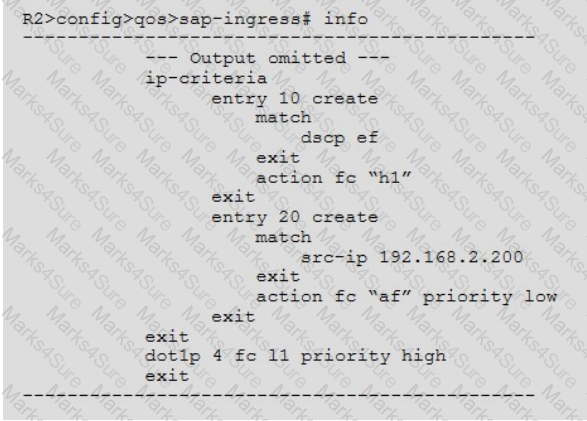
The SAP-ingress policy shown below is applied properly to a Nokia 7750 SR. A traffic stream is received from an IP address of 192.168.2.200 with DSCP and dot1p set to EF and 4, respectively. Which forwarding class and priority level is used for this traffic stream?
4A0-107 Question 24

Options:

A.

FC H1, high

B.

FCH1, low

C.

FCAF, high

D.

FCAF, low

Buy Now
Questions 25

When using an egress port scheduler, which scheduling loop priority are orphaned queues serviced on?

Options:

A.

1st

B.

8th

C.

9th

D.

17th

Buy Now
Questions 26

Which of the following are entities of the Nokia 7750 SR on which you can NOT apply a network-queue policy? (Choose three)

Options:

A.

Router interfaces

B.

Ingress MDA

C.

Ingress Ethernet network ports

D.

Egress Ethernet network ports

E.

Service SAPs

Buy Now
Questions 27

Which of the following parameters are used in a hierarchical scheduler-policy to specify the priority of the child scheduler/queue for allocating bandwidth beyond its committed rate? (Choose two)

Options:

A.

CIR

B.

CIR level

C.

CIR weight

D.

Rate

E.

Level

F.

Weight

Buy Now
Questions 28

On the Nokia 7750 SR, what is the maximum number of ingress queues that a single network queue policy can support in a VPLS?

Options:

A.

8

B.

16

C.

32

D.

48

Buy Now
Questions 29

Which of the following can be used as classifiers of customer traffic? (Choose three)

Options:

A.

DSCP value

B.

802.1p value

C.

IP DF bit

D.

TCP/UDP port numbers

E.

HTML version number

Buy Now
Questions 30

Which of the following is a forwarding class type that is intended for network control traffic on a Nokia 7750 SR?

Options:

A.

High-1

B.

Assured

C.

Best Effort

D.

Expedited

Buy Now
Questions 31

Which of the following statements describes an advantage of the DiffServ QoS model over the IntServ QoS model?

Options:

A.

DiffServ reserves resources dynamically using the RSVP protocol.

B.

DiffServ only requires packets to be classified into forwarding classes at the first network hop.

C.

DiffServ provides granular differentiation and superior fairness because it processes traffic streams individually.

D.

DiffServ is more scalable it treats traffic streams as aggregates.

Buy Now
Questions 32

A profile-mode queue is configured with the following attributes: MBS = 10 KB, CBS = 5 KB and High-Priority- Only = 30%. Assume there is no CBS overbooking, and the slope-policy is disabled. If the current queue depth is 8 KB, what will happen to an in-profile packet?

Options:

A.

It will be discarded because the high-priority-only threshold is exceeded.

B.

It will be stored in the queue’s reserved buffer space and become out-of-profile.

C.

It will be stored in the queue’s reserved buffer space and remain in-profile.

D.

It will contend for shared buffer space with packets from other queues.

Buy Now
Questions 33

Which of the following are major components of QoS functionality on the Nokia 7750 SR? (Choose three)

Options:

A.

Microflow reservations using RSVP

B.

DSCP to EXP translation

C.

Traffic classification

D.

Automatic profiling and policy configuration

E.

Buffer memory management

F.

Traffic scheduling

Buy Now
Questions 34

How many queues are available for use on service egress within a VPLS service?

Options:

A.

1 multipoint and 8 unicast.

B.

8 queues, regardless of traffic type.

C.

8 unicast and 24 multipoint.

D.

8 unicast and 8 multipoint.

E.

16 queues, distributed as desired.

Buy Now
Questions 35

Which of the following entities can scheduler policies be applied to? (Choose two)

Options:

A.

Network ingress port

B.

Epipe ingress SAP

C.

ES egress SAP

D.

Ingress MDA

E.

VPRN ingress interface

F.

Shared buffer space

Buy Now
Questions 36

How does an IOM3 improve the queue usage over an IOM2 in an Nokia 7750 SR? (Choose two)

Options:

A.

The IOM3 adds more memory to both forwarding complexes which increases the total number of queues available.

B.

The IOM3 only contains a single forwarding complex which reduces the number of queues used.

C.

The IOM3 allows multiple forwarding classes to be assigned to a single queue.

D.

The IOM3 allows queues to be dynamically allocated between ingress and egress.

E.

The IOM3 has a larger CPU capable of tracking active hardware queue utilization and adjusting memory allocation accordingly.

Buy Now
Questions 37

Which of the following rate-limiting approaches are used on the Nokia 7750 SR? (Choose two)

Options:

A.

Shapeless policing at SAP-ingress only.

B.

Shapeless policing at SAP-ingress and egress.

C.

Biased round robin queuing at ingress only.

D.

Soft shaping at all network interfaces.

E.

Soft shaping at network ingress only.

Buy Now
Questions 38

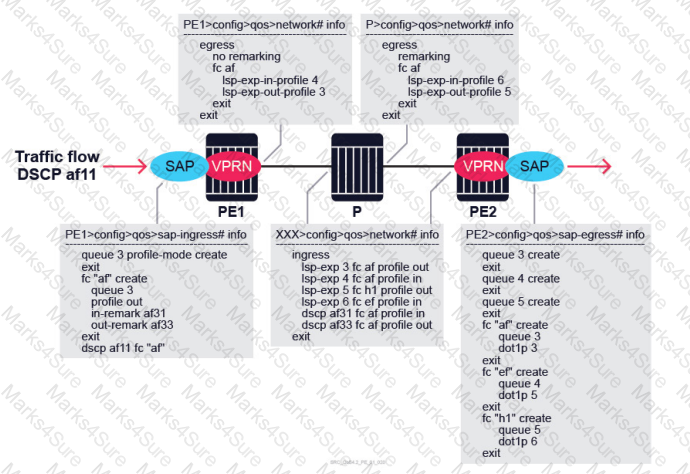
Packets arrive at the VPRN SAP on PE1 with DSCP marking of af11 and Dot1p of 2. According to the QoS policies applied at routers PE1, P, and PE2, what is the dot1p value of packets egressing routerPE2? (All the SDPs are MPLS-encapsulated, and all interfaces are using their default trust states).
4A0-107 Question 38

Options:

A.

2

B.

3

C.

5

D.

6

Buy Now
Questions 39

A packet is to be encapsulated inside an MPLS tunnel which consists of two MPLS headers at the first network egress. Which of the MPLS EXP fields will be marked?

Options:

A.

The EXP field in the bottom MPLS header will be marked.

B.

The EXP field in both the top and bottom MPLS headers will be marked.

C.

For Layer 2 services, the top MPLS header will be marked; for Layer 3 services, the bottom MPLS header will be marked.

D.

The EXP field in the top MPLS header will be marked.

E.

Neither the top nor the bottom EXP field will be marked since EXP remarking can only be done on the network ingress.

Buy Now
Questions 40

Which of the following statements is considered best practice when changing a network policy that has been associated with an interface?

Options:

A.

The policy should be placed in a " shutdown " state before changes are made.

B.

A new network policy should be created and applied to the interface, overwriting the previous policy.

C.

The policy must first be removed from the interface, then modified and re-applied to the interface.

D.

Before the policy can be changed, it must be deleted with the no network qos < policy-id > command.

E.

Before any changes are made to the policy, all network interfaces where the policy is applied have to be shut down.

Buy Now
Questions 41

Which of the following statements regarding scheduling are TRUE? (Choose two)

Options:

A.

Scheduler policies cannot be children of an egress port-scheduler.

B.

HQoS provides a static method of allocating scheduling resources to each queue and/or child.

C.

Scheduler policies can be applied to the MDA to schedule network ingress traffic.

D.

Every time a scheduler-policy is assigned to a SAP, a new hardware scheduler is created to service the SAP.

E.

A scheduler applied to multiple SAPs within the same service will result in a single hardware scheduler operating across all SAPs within the service.

Buy Now
Questions 42

Which of the following are NOT ingress matching criteria for a network policy? (Choose two)

Options:

A.

TCP port numbers

B.

LSP EXP

C.

DSCP

D.

Source and destination IP addresses

E.

Dot1p priority

Buy Now
Questions 43

What is the maximum number of SAP-ingress policies that can be applied on a SAP?

Options:

A.

1

B.

2

C.

3

D.

4

E.

5

F.

8

Buy Now
Questions 44

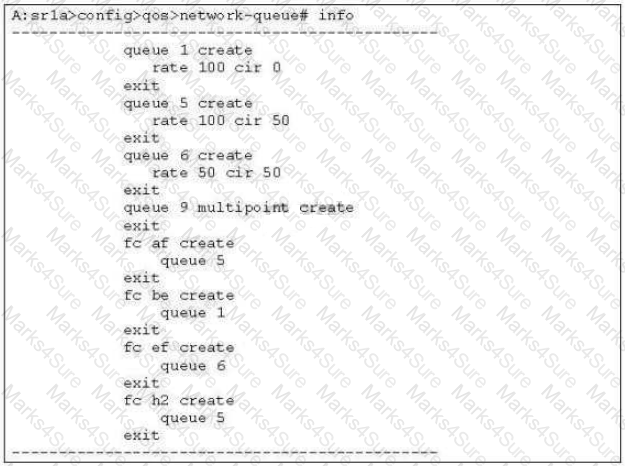
Click the exhibit button below. A network operator has configured a network-queue policy to map forwarding classes to queues, as shown in the exhibit below. Based on the default scheduling behavior of the Nokia 7750 SR, in which order will packets be serviced?
4A0-107 Question 44

Options:

A.

All in-profile packets in round-robin, then all out-of-profile packets in biased round-robin.

B.

In-profile EF packets, then in-profile H2 packets, then in-profile AF packets, then out-of-profile EF packets, then out-of-profile H2 and AF packets, and then out-of-profile BE packets.

C.

In-profile EF, H2 and AF packets, then out-of-profile H2, AF and BE packets in biased round-robin.

D.

In-profile EF packets, then in-profile H2 and AF packets, then out-of-profile H2, AF and BE packets in biased round-robin.

E.

In-profile EF and H2 packets, then in-profile AF packets, then out-of-profile H2, AF and BE packets in biased round-robin.

Buy Now
Questions 45

Which of the following statements describe the operation of WRED on the Nokia 7750 SR? (Choose three)

Options:

A.

WRED monitors the shared buffer space utilization over a period of time.

B.

WRED disables the TCP slow-start congestion control mechanism.

C.

WRED uses two configurable slopes for each buffer pool: a high slope and a low slope.

D.

WRED uses the shared buffer utilization, instead of the individual queue depth, to get a better picture of the average resource utilization of the shared buffer space.

E.

WRED polices the shared buffer pool and marks all packets above a certain rate as " discard eligible. "

Buy Now
Questions 46

Which of the following fields can be marked or remarked for frames belonging to a Layer 2 service?

Options:

A.

DSCP

B.

PREC

C.

Dot1p

D.

ToS

E.

Q-in-Q

Buy Now
Questions 47

Which of the following statements regarding scheduling on the Nokia 7750 SR is TRUE? (Choose two)

Options:

A.

When using profile-mode queues, traffic that is marked as in-profile on ingress and scheduled in the above-CIR loop will still be considered as in-profile at egress.

B.

When an HQoS strategy using an egress port-scheduler has been deployed, Tier 1 receives its scheduling rates based on the amount of egress bandwidth available for each forwarding class.

C.

The greater the difference between PIR and CIR rates in a queue, the less likely a CIR will be provided.

D.

Packets scheduled out of high-priority queues in the default scheduler will have a lower chance of packet loss at the expense of incurring a higher probability of delay.

E.

When using priority-mode queues, traffic that is marked as in-profile on ingress and scheduled in the above-CIR loop will be considered as in-profile at egress.

Buy Now
Questions 48

Which of the following statements about a SAP-ingress policy is FALSE?

Options:

A.

It maps customer traffic to forwarding classes on ingress.

B.

It can use customer QoS markings to do the mapping.

C.

The default SAP-ingress policy classifies all traffic into FC “be” with low priority.

D.

It serves the classification, queuing, and marking functions of QoS but does not serve scheduling

Buy Now
Questions 49

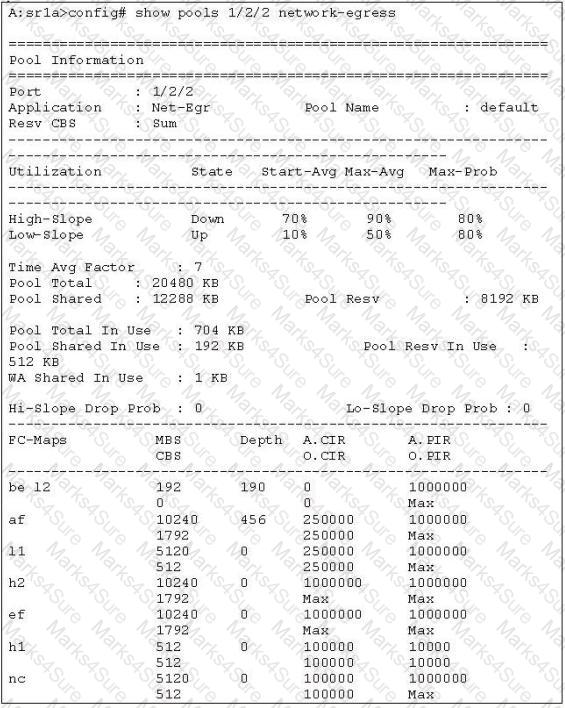
Click the exhibit button below. Given the output of the #show pools 1/2/2 network-egress command on a GigE port, what can the service provider deduce? (Choose two)
4A0-107 Question 49

Options:

A.

QoS is not configured on the router.

B.

Packets in forwarding classes " be " and " 12 " are being queued.

C.

Traffic belonging to forwarding class " ef " is not experiencing queuing delays.

D.

Traffic belonging to forwarding class " 11 " will never make use of the shared buffer pool.

E.

Out-of-profile traffic in the shared buffer pool is being dropped.

Buy Now
Questions 50

Which of the following are examples of metrics for QoS?

Options:

A.

Signal degradation, attenuation, line loss

B.

Latency, FIFO, WRED

C.

Delay, jitter, packet loss

D.

SNR, queue depth, latency

E.

Attenuation, dispersion, latency

Buy Now
Questions 51

A queue-group template can only contain policers (no queues) when applied under which conditions?

Options:

A.

When applied at the FP (Forwarding Path) level for access egress

B.

When applied at an access port for ingress or egress

C.

When applied at the FP (Forwarding Pass) level for access ingress

D.

When applied at the port level for network egress

Buy Now
Questions 52

Based on queue usage, which of the following QoS-policies when combined will allow queue rates to be dynamically allocated? (Choose two)

Options:

A.

The slope-policy

B.

The SAP-ingress policy

C.

The network-queue policy

D.

The scheduler-policy

E.

The network-policy

F.

The WRED-policy

G.

The arbitrator-policy

Buy Now
Questions 53

Which action should be taken to ensure that packets do not use the shared buffer space when put into a queue?

Options:

A.

Set the queue’s CBS to 0

B.

Set the queue’s MBS equal to the CBS

C.

Set the queue’s high-priority-only equal to the MBS

D.

Set the queue’s MBS to 0

E.

Set the queue’s high-priority-only to 0

Buy Now
Questions 54

Which of the following are characteristics of DSCP? (Choose two)

Options:

A.

DSCP is part of the Layer 3 header.

B.

DSCP is a 6-bit field.

C.

DSCP specifies eight different priorities.

D.

DSCP specifies four precedence levels.

E.

DSCP is part of the Layer 2 header

F.

DSCP specifies 128 different per-hop behaviors.

Buy Now
Questions 55

Which of the following statements about the token buckets of a policer is FALSE?
Options:

A.

The CIR has no influence on the forwarding rate of the policer traffic.

B.

The CIR influences whether a packet is considered high-profile or low-profile.

C.

The policer discards all incoming packets when PIR bucket reaches the MBS level.

D.

PIR bucket forwards packets that arrive with rates above PIR as out-of-profile.

Buy Now
Questions 56

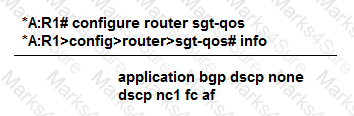
4A0-107 Question 56

According to the configuration shown above, which of the following about the classification and marking of self- generated BGP traffic is TRUE?

Options:

A.

It will be marked as DSCP BE and classified into forwarding class BE.

B.

It will be marked as DSCP NC1 and classified into forwarding class BE.

C.

It will be marked as DSCP NC1 and classified into forwarding class NC.

D.

It will be marked as DSCP NC1 and classified into forwarding class AF.

Buy Now
Questions 57

It is necessary for Tier 1 schedulers to obtain bandwidth from a higher tier scheduler.

Options:

A.

TRUE

B.

FALSE

Buy Now
Questions 58

Which of the following statements about CIR of a queue is TRUE?

Options:

A.

It may exceed PIR of the queue.

B.

It may be exceeded by the average servicing rate of the queue.

C.

It varies depending on the traffic characteristics.

D.

It is the rate at which packets are forwarded out of the queue.

Buy Now
Questions 59

Which of the following about the process of queuing self-generated traffic in the Nokia 7750 SR is TRUE?

Options:

A.

Ingress traffic is stored in IOM queues and egress traffic is stored in CPM queues.

B.

Ingress traffic is stored in CPM queues and egress traffic is stored in IOM queues.

C.

It is always stored in CPM queues.

D.

It is always stored in IOM queues.

Buy Now
Questions 60

Which of the following statements about the default scheduler in the Nokia 7750 SR is TRUE?

Options:

A.

A queue will be serviced as expedited if all of the forwarding classes mapped to it are expedited, regardless of its configured type.

B.

A queue will be serviced as best-effort if all of the forwarding classes mapped to it are best-effort, regardless of its configured type.

C.

A queue will be serviced as expedited if at least one of the forwarding classes mapped to it is expedited, regardless of its configured type.

D.

A queue will be serviced as expedited if its type is configured as expedited, regardless of the forwarding classes mapped to it.

Buy Now
Questions 61

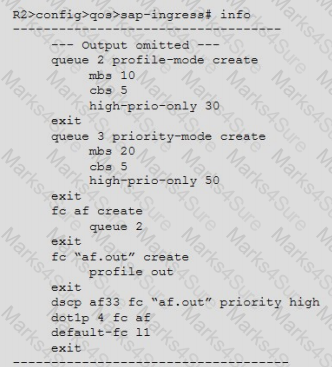
According to the SAP-ingress QoS policy shown, which packets have a higher priority to enter queue 2?
4A0-107 Question 61

Options:

A.

Packets marked with dscp = af33

B.

Packets marked with dot1p = 4

C.

All packets mapped to queue 2 have the same priority to enter this queue.

D.

There are no packets mapped to queue 2.

Buy Now
Questions 62

Which of the following criteria is an IP multi-field classification option?

Options:

A.

prec

B.

lsp-exp

C.

src-ip

D.

do1p

Buy Now
Questions 63

A queue-group template can contain both queues and policers when applied under which conditions?
Options:

A.

When applied at the port level for access ingress.

B.

When applied at the FP (Forwarding Pass) level for access ingress.

C.

When applied at the FP (Forwarding Pass) level for network ingress.

D.

When applied at the port level for network egress.

Buy Now
Questions 64

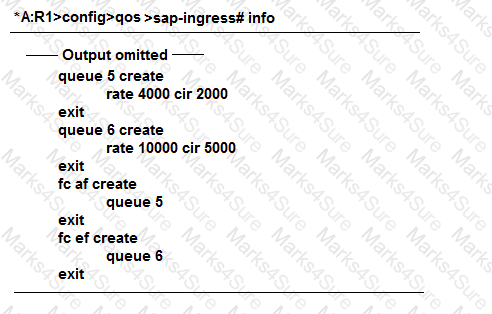
4A0-107 Question 64

Based on the image shown above, and assuming that the default scheduler of the Nokia 7750 SR is on an IOM2 card, in which order will packets be scheduled?

Options:

A.

Queue 6 within-CIR packets, then queue 5 within-CIR packets, then queue 5 and queue 6 above-CIR packets in round-robin.

B.

Queue 6 within-CIR packets, then queue 5 within-CIR packets, then queue 5 and queue 6 above-CIR packets in biased round-robin.

C.

Queue 6 within-CIR packets, then queue 5 within-CIR packets, then queue 6 above-CIR packets, and finally queue 5 above-CIR packets.

D.

Queue 6 and queue 5 within-CIR packets in biased round-robin, then queue 5 and queue 6 above-CIR packets in round-robin.

Buy Now
Questions 65

Which of the following statements regarding the egress port scheduler is TRUE?

Options:

A.

The egress port scheduler can have up to 17 children spread across 8 levels.

B.

Multiple egress port schedulers can be assigned to a single port with many HQoS children.

C.

Multiple HQoS policies can be children of a single port scheduler.

D.

Multiple egress port schedulers can be children of a single HQoS scheduler.

Buy Now
Questions 66

The IP ToS field consists of ________ bits, of which ________are used. The _________most significant (first) bits define precedence.

Options:

A.

8, 6, 3

B.

8, 8, 6

C.

16, 8, 4

D.

8, 6, 4

E.

24, 16, 8

Buy Now
Questions 67

Packets enter the network via the ePipe SAP on PE1 with dot1p marking of 6. The VC type of the SDP interconnecting PE1 and PE2 is vlan. All network interfaces use the default network QoS policy. According to the configuration shown above, what is the inner dot1p value of the BE traffic egressing router PE2?
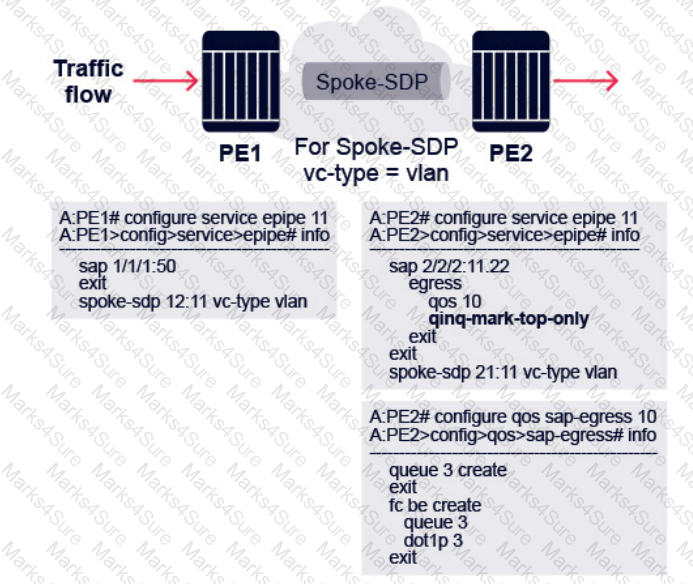
4A0-107 Question 67

Options:

A.

0

B.

3

C.

6

D.

22

Buy Now
Questions 68

To implement Hierarchical-QoS (Multi-tiered scheduling), which of the following actions must be undertaken? (Choose three)

Options:

A.

H-QoS capabilities must be enabled globally on the router

B.

A scheduler-policy must be configured.

C.

The queues in the SAP-ingress and SAP-egress policies do not require additional configuration attributes to make use of the hierarchical schedulers.

D.

The network queue policy must be configured to make use of the scheduler-policy.

E.

The scheduler-policy must be referenced in the SAP-ingress and SAP-egress policies.

F.

The scheduler-policy must be applied on the service SAP.

Buy Now
Questions 69

Which of the following statements about behavior aggregate classification is TRUE?

Options:

A.

It sets both the forwarding class and the packet’s dot1p, lsp-exp, precedence, or dscp field to the same value.

B.

It groups all packets together into a single aggregate stream, and gives all packets the same treatment.

C.

It copies the three most significant bits in the packet’s dscp field into the forwarding class.

D.

It assigns a forwarding class based on the packet’s dot1p, lsp-exp, precedence, or dscp value.

Buy Now
Exam Code: 4A0-107
Exam Name: Nokia Quality of Service
Last Update: Apr 30, 2026
Questions: 231

PDF + Testing Engine

$63.52  $181.49

Testing Engine

$50.57  $144.49
buy now 4A0-107 testing engine

PDF (Q&A)

$43.57  $124.49
buy now 4A0-107 pdf