Spring Sale Limited Time 65% Discount Offer - Ends in 0d 00h 00m 00s - Coupon code: pass65

4A0-112 Nokia IS-IS Routing Protocol Questions and Answers

Questions 4

When using IS-IS in native mode for routing in a dual-stack IPv4/IPv6 environment, which of the following statements is FALSE?

Options:

A.

All links are assumed to be IPv4- and IPv6-capable.

B.

The same topology information is used to calculate the shortest path tree for both IPv4 and IPv6.

C.

In a multi-area environment, the SPF algorithm needs to be run four times on each L1/L2 router.

D.

It may lead to traffic black-holing if not properly designed.

Buy Now
Questions 5

There are several differences between IS-IS Hello packets used on broadcast interfaces and on point-to-point interfaces.

Which of the following statements is FALSE?

Options:

A.

On broadcast interfaces there are different Hello packet types for level-1 and level-2 adjacencies, whereas on point-to-point interfaces there is a single Hello packet type.

B.

The multicast MAC addresses to which the Hello messages are sent are different on broadcast interfaces and on point-to-point interfaces.

C.

The neighbors are identified using their interface MAC addresses on broadcast Hello messages and using their system IDs on point-to-point Hello messages.

D.

Broadcast Hello messages identify the elected designed IS (DIS) and point-to-point Hello messages do not.

Buy Now
Questions 6

For a link-state routing protocol, which of the following statements about link-state updates is FALSE?
Options:

A.

When a link-state update reaches its maximum age on a router, the router will flood that update to its neighbors.

B.

When a router detects that a link-state update has reached its maximum age, it will request a new update from the source router.

C.

Aging helps ensure that routers that are no longer part of the topology will eventually get removed from the link-state database.

D.

The age value is updated as the link-state update is flooded throughout the network and when it is in the link-state database

Buy Now
Questions 7

A router running a link-state routing protocol detects that one of its neighbors is no longer connected to it. The router generates a new link-state advertisement to inform other routers of the topology change. Which of the following is NOT an action that is triggered by this event?

Options:

A.

If a router receives the new link-state advertisement, it acknowledges it, stores it, and forwards it to its own neighbors.

B.

If a router receives multiple copies of the new link-state advertisement, it will simply ignore all copies received after the first one.

C.

Every router that receives the new link-state advertisement updates its age field before forwarding it.

D.

Every router that receives the new link-state advertisement runs the SPF algorithm to recalculate its shortest-path tree and its forwarding database.

Buy Now
Questions 8

A series of actions are triggered on a router as a result of enabling both loopfree-alternate for a link-state routing protocol and ip-fast-reroute. Which of the following is NOT one of those actions?

Options:

A.

Calculating the shortest-path next hop for each known IP prefix.

B.

Calculating a backup next hop for each known IP prefix, if it exists, that would not create a routing loop if used without informing other routers.

C.

Installing two entries in the FIB for IP prefixes, one active and one in standby mode.

D.

Enabling the router to locally repair the active path to an IP prefix in case of failure.

Buy Now
Questions 9

Two IS-IS routers are exchanging Hello packets. One is configured to use authentication and the other is not. Which of the following statements is TRUE?

Options:

A.

An adjacency will be established with authentication using the default parameters defined for IS-IS routers.

B.

The two routers will negotiate the authentication parameters and the establish an adjacency.

C.

An adjacency will be established without authentication.

D.

An adjacency will not be established.

Buy Now
Questions 10

4A0-112 Question 10

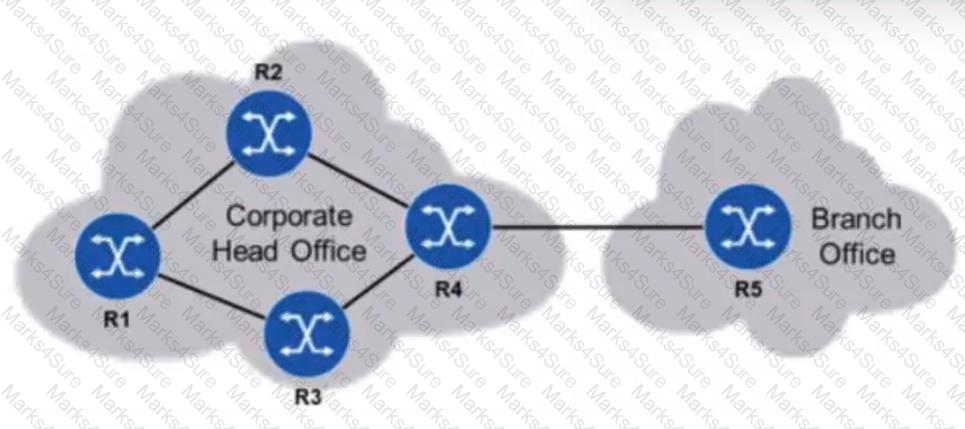
A static route has been configured on router R1 to reach the PC at 139.120.121.2.

What might be causing the ping to fail?

Options:

A.

Router R2 needs a static route to the PC.

B.

Router R1 needs a static route to router R2.

C.

The configured next hop does not belong to a subnet adjacent to R1.

D.

The configured static route needs to be a default route.

Buy Now
Questions 11

4A0-112 Question 11

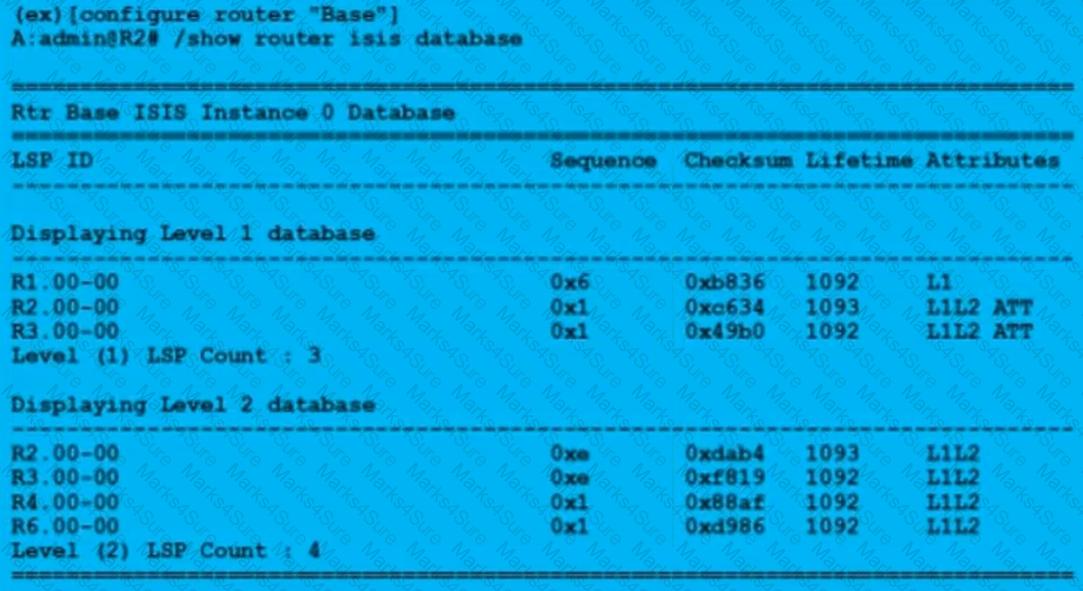
Routers R1 through R4 in the diagram have established IS-IS adjacencies. Router R1 is L1/L2 and is the DIS of its two broadcast interfaces. How many LSPs will it generate?

Options:

A.

2

B.

3

C.

4

D.

5

Buy Now
Questions 12

4A0-112 Question 12

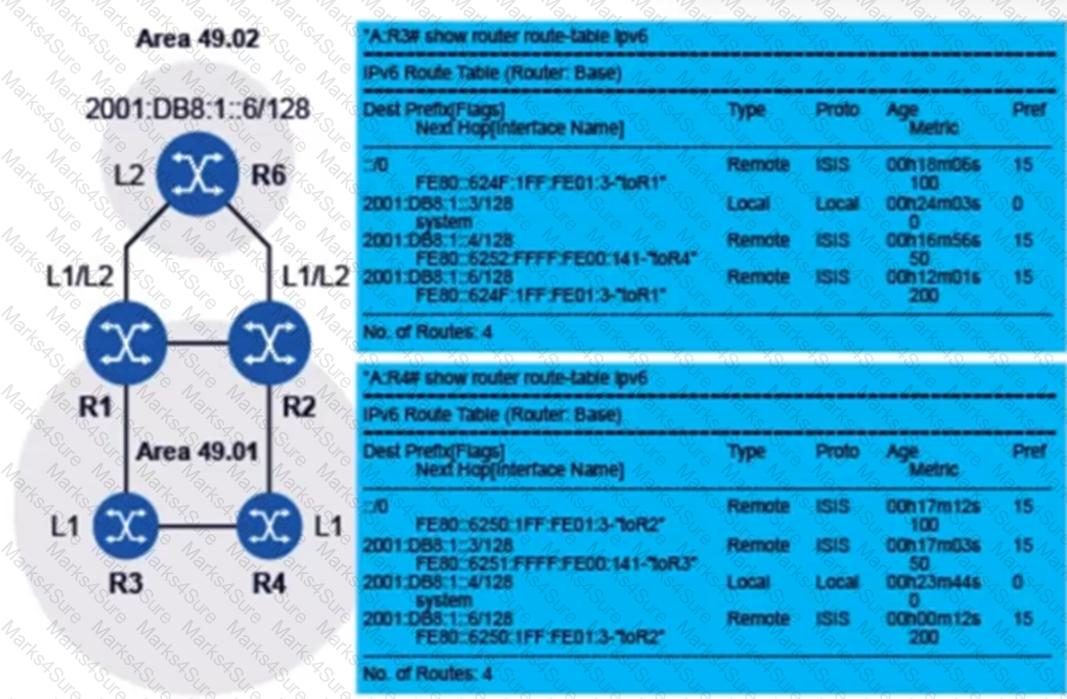
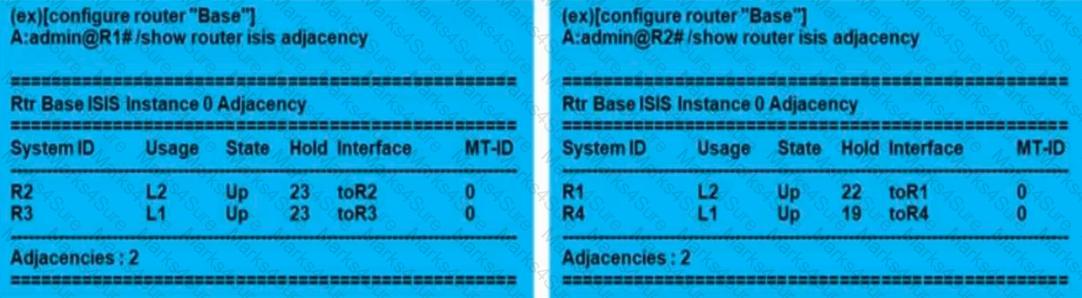
Routers R1, R2, R3, and R4 are running IS-IS. Assuming all interfaces are added to IS-IS as point-to-point and no commands are issued at the interface level to restrict adjacencies, which of the following statements is TRUE?

Options:

A.

Routers R1 and R2 are L2 routers. Routers R3 and R4 are L1 routers.

B.

Routers R1 and R2 are L2 routers. Routers R3 and R4 are L1/L2 routers.

C.

Routers R1 and R2 are L1/L2 routers. Routers R3 and R4 are L1 routers.

D.

All four routers are L1/L2.

Buy Now
Exam Code: 4A0-112
Exam Name: Nokia IS-IS Routing Protocol
Last Update: May 17, 2026
Questions: 40

PDF + Testing Engine

$64.99   $185.69

Testing Engine

$49.99   $142.83

PDF (Q&A)

$54.99   $157.11