
Spring Sale Limited Time 65% Discount Offer - Ends in 0d 00h 00m 00s - Coupon code: pass65

4A0-265 Nokia Optical Diagnostics and Troubleshooting Exam Questions and Answers

Questions 4

What is the typical severity level of a "Loss of Signal" (LOS) alarm?

Options:

A.

Critical

B.

Major

C.

Minor

D.

Warning

Buy Now
Questions 5

Which of the following is NOT a characteristic of an Optical Supervisory Channel Loss of Signal (OSC LOS) issue, in case that no "LD Input LOS" alarms are raised against the involved amplifiers?

Options:

A.

An "Incoming SUPVY LOS" alarm is raised on the local node.

B.

A "Data Link Down" alarm is raised on the adjacent node.

C.

A "Power Adjustment Required" alarm is eventually raised on the local node.

D.

Traffic does not pass between the local and adjacent nodes.

Buy Now
Questions 6

When troubleshooting possible generic fiber cuts, the recommended first step is to: 1. Review alarms at nodes where power loss occurs.

What is the next recommended step?

Options:

A.

Review PM data to determine if the problem is intermittent.

B.

Perform network power traces to attempt to determine the point of power loss.

C.

Monitor amplifier total power in/out to isolate the direction of a possible cut.

D.

Review EPT design for calculated span loss.

Buy Now
Questions 7

Which of the following statements correctly describes where power adjustments can be performed?

Options:

A.

In bidirectional configurations, ingress power adjustments are performed against the ingress amplifiers, while egress power adjustments are performed against the egress amplifiers.

B.

In bidirectional configurations, both ingress and egress power adjustments are performed against the ingress amplifiers only.

C.

In unidirectional configurations, both ingress and egress power adjustments are performed against the ingress amplifiers only.

D.

When Raman pumps are used, both ingress and egress power adjustments are performed against the Raman pump directly.

Buy Now
Questions 8

Which of the following correctly describes how a unidirectional amplification stage works?

Options:

A.

• Incoming optical signals are boosted by the ingress amplifier.

• Outgoing optical signals do not pass through the ingress amplifier.

B.

• Incoming optical signals are boosted by the ingress amplifier.

• Outgoing optical signals pass through the ingress amplifier but are not boosted.

C.

• Incoming optical signals pass through the ingress amplifier but are not boosted.

• Outgoing optical signals are boosted by the ingress amplifier.

D.

• Incoming optical signals are boosted by the ingress amplifier.

• Outgoing optical signals are also boosted by the ingress amplifier.

Buy Now
Questions 9

Which of the following is a passive component in a CDC-F network configuration?

Options:

A.

130SCX10 Optical Transponder

B.

MSH4-FSB Fiber Shuffle Module

C.

WR20-TFM Wavelength Router

D.

IRDM20 Integrated ROADM

Buy Now
Questions 10

Which of the following statements about the alarm masking mechanism is TRUE?

Options:

A.

The alarm masking mechanism makes sure that alarms are always present on the downstream interfaces to facilitate the troubleshooting process.

B.

The alarm masking mechanism updates the events' original time stamps when it masks/shows alarms, so that when an alarm is not masked anymore, the user can see the updated date and time associated with the original issue.

C.

The alarm masking mechanism always forwards masked alarms to an external Network Management System (NMS) for alarm correlation.

D.

The alarm masking mechanism preserves the events' original time stamps, when related alarms gets hidden and then eventually displayed because of the mechanism itself, so that the user can still know the date and time of the original issue.

Buy Now
Questions 11

Suppose a network operator needs to configure the 10GbE client interface 1/7/C1 with a GFP-F encapsulation mode. Which command should be used?

Options:

A.

config interface 1/7/C1 tenGige encmode gfp-f

B.

config encmode interface 1/7/C1 10client gfp-f

C.

config interface 1/7/C1 encmode 10client gfp-f

D.

config encmode interface 1/7/C1 tenGige gfp-f

Buy Now
Questions 12

Consider the exhibit which shows an EPT Power Management Report referring to an ingress amplifier. What is the available output optical power range?
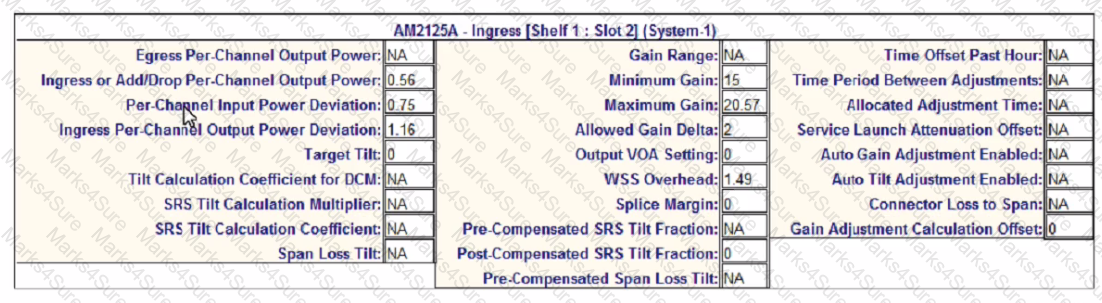
4A0-265 Question 12

Options:

A.

-0.6 to 1.72 dB

B.

-0.02 to 1.14 dB

C.

0.56 to 1.14 dB

D.

0.56 to 1.72 dB

Buy Now
Exam Code: 4A0-265
Exam Name: Nokia Optical Diagnostics and Troubleshooting Exam
Last Update: May 5, 2026
Questions: 40

PDF + Testing Engine

$63.52  $181.49

Testing Engine

$50.57  $144.49
buy now 4A0-265 testing engine

PDF (Q&A)

$43.57  $124.49
buy now 4A0-265 pdf