
Free Practice Questions for the Microsoft MOS-Microsoft Office Specialist 77-725 Exam (2026 Updated)
At Marks4sure, we are dedicated to providing IT professionals with the most accurate and reliable preparation materials for the Microsoft 77-725 exam. To support your certification journey, we have made a selection of our premium 2026 MOS-Microsoft Office Specialist practice questions and answers available completely free. You can take this practice test as many times as you need. Every question includes a detailed, expertly verified explanation to ensure you fully grasp the core security concepts before test day.
Project 6 of 7: Recall
Overview
You work in Customer Communications at Northwind Traders. You are preparing a product recall announcement.
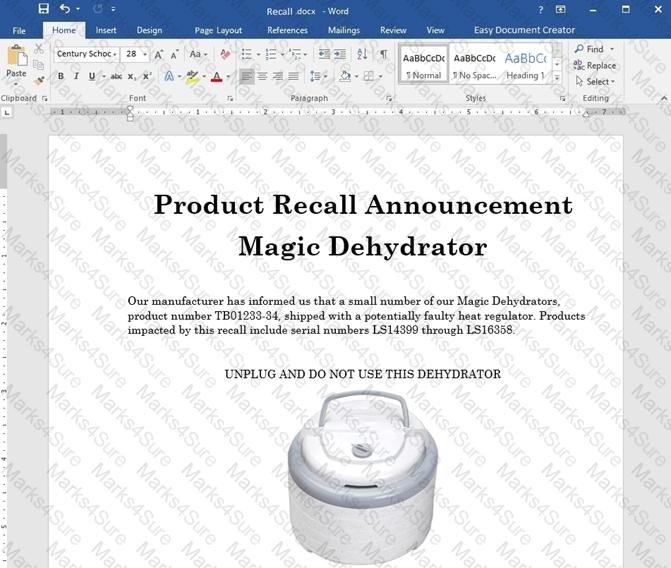
We regret any inconvenience that this might cause you. Northwind Traders is dedicated to providing you with reliable, high-quality, and safe products.
The product sticker on the bottom of the dehydrator can determine whether or not your dehydrator is included in the recall. For affected models, there is a slight risk that the product might overheat when used, resulting in a potential burn hazard.
DO NOT RETURN TO YOUR RETAILER. Go to the Northwind traders web site at http://www.northwindtraders.com/ and click on the “Product Recall” banner at the top of the page for return instructions. You will receive a full refund for the dehydrator and we will also ship you a replacement dehydrator.
REMINDER:
Change the line spacing to 1.15 lines for the entire document.
Project 4 of 7: Member
Overview
You are preparing a letter to museum members announcing a new exhibit and urging them to renew their membership.
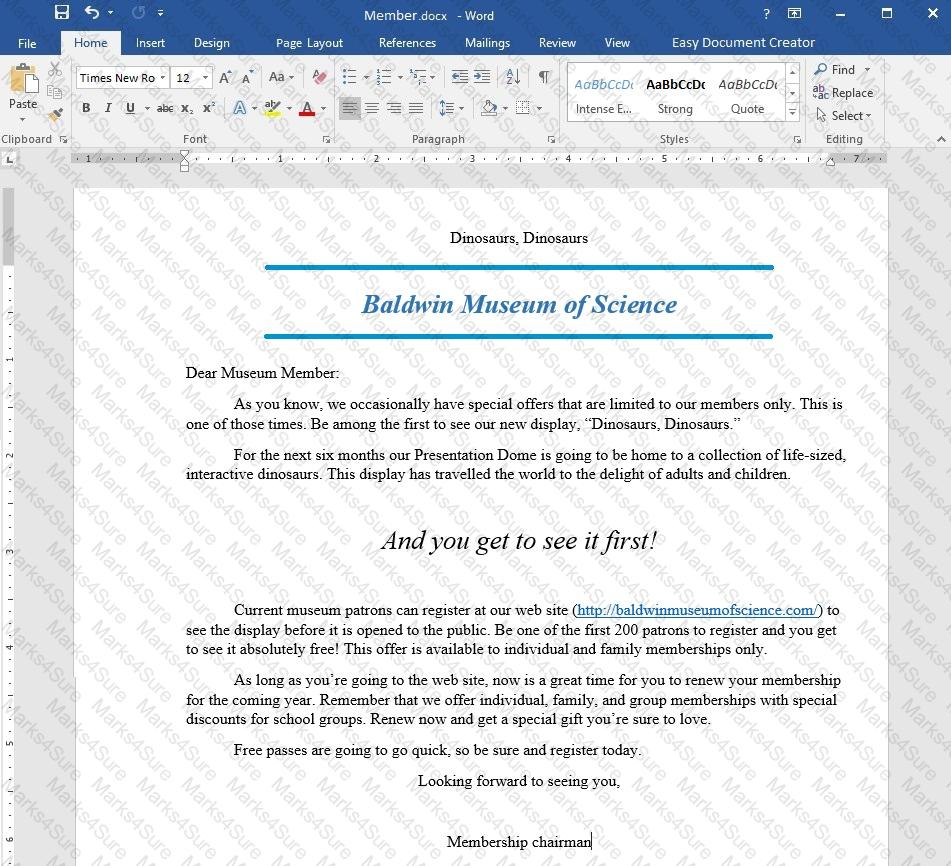
Apply a Bright Green text highlight to the text string “And you get to see it first!”.
Project 6 of 7: Recall
Overview
You work in Customer Communications at Northwind Traders. You are preparing a product recall announcement.
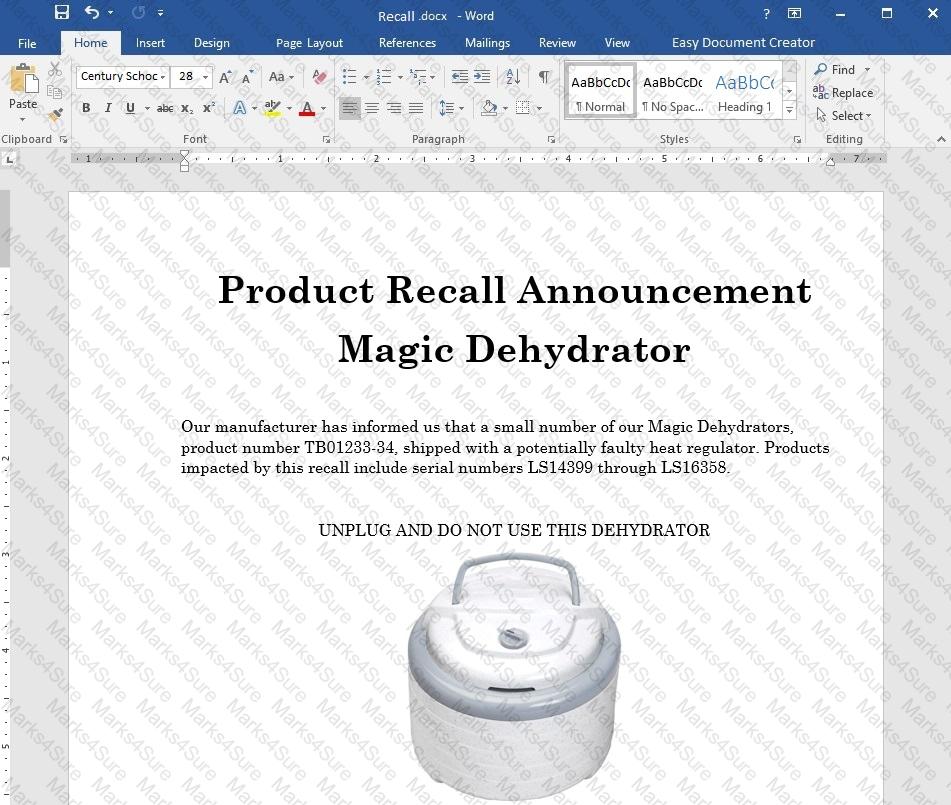
We regret any inconvenience that this might cause you. Northwind Traders is dedicated to providing you with reliable, high-quality, and safe products.
The product sticker on the bottom of the dehydrator can determine whether or not your dehydrator is included in the recall. For affected models, there is a slight risk that the product might overheat when used, resulting in a potential burn hazard.
DO NOT RETURN TO YOUR RETAILER. Go to the Northwind traders web site at http://www.northwindtraders.com/ and click on the “Product Recall” banner at the top of the page for return instructions. You will receive a full refund for the dehydrator and we will also ship you a replacement dehydrator.
REMINDER:
Apply the Intense Emphasis style to the text “UNPLUG AND DO NOT USE THIS DEHYDRATOR” that is located above the image.
Project 1 of 7: Observation
Overview
You are a member of the Barstow College Observation Project committee. You are preparing the initial summary report for this year’s count, but have not received all of the data you need to complete the report.

Introduction
The multi-departmental Wildlife Observation Project has completed its wildlife population counts for this year. The counts were made between May 5 and May 7 for both the wilderness and cultivated land areas. This is in line with the count periods for all previous years. The species used for the counts have been identified as common for the region (central Missouri) in which the counts were taken. (Author, 2009)
As in previous years, five observation blinds were set up two weeks before the counts were to take place. Counters worked eight-hour shifts providing 24-hour coverage of the count areas for two days. Weather for both observation days was clear and mild (varying between 50-70 degrees F).
The results presented here are summary total results only, which counts from five and ten years ago provided for comparison. Detailed observation results will be available as soon as they are completed. We estimate that they will be available some time in the next two weeks.
Wilderness Summary
The wilderness observation area is a five-acre section of unimproved forest land. The most common trees in the area are maple, red oak, cedar, sweet gum, and hickory. The area also includes a small spring. The area is not enclosed by a fence or other man-made barrier.
The area is located eight miles from the nearest paved road and twelve miles from the nearest residence. Off-road vehicles were used to bring counters close to, but not entering, the count area. The nearest approach by off-road vehicles was one mile.
The table below lists the summary counts.
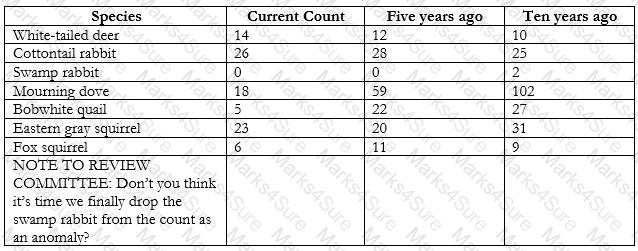
Though further research any analysis is needed, the drop in mourning dove and bobwhite quail counts could be significant. The detailed count data shows these numbers failing off each year.
Cultivated Land Summary
The cultivated land observation area is a five-acre section of cultivated land near the center of a 50-acre field. The field is used to grow corn, wheat, soybeans, and clover, with the crop rotated annually. In the fifth year of the cycle, the field is left fallow.
The area is located two miles from the nearest paved road and one mile from the nearest residence. A storage barn is located at the southern border of the field.
The table below lists the summary counts.
Additional Notes
This project was initially scheduled to run for ten years, so we are currently in our last year. The committee needs to decide if it is worth the time and expense to continue the project. The landowners have experience that they would be happy to let us continue. Costs relating to the project is minimal and it does provide an opportunity to offer extra credit to students volunteering as counters.
A suggestion has been made by some committee members that we should increase the count frequency, counting on a quarterly schedule instead of an annual schedule. This would need to be coordinated with the owner of the cultivated field so that we do not interfere with planting or harvesting schedules.
Special Thanks
Once again, we would like to offer special thanks to:
We couldn’t do this without you.
The spacing between words in the first two paragraphs is off. View only the tab and space formatting symbols to troubleshoot the problem. You do not need to remove the extra tabs or spaces.
Project 5 of 7: Housekeeping
Overview
You are helping to write training program modules for Contoso Suites. You are editing the second module for housekeeping associates.

Start of Shift
The first thing you should do when you start your shift is check your schedule. The shift supervisor will provide you with a printed schedule listing the rooms for which you are responsible, and a recommended order for cleaning the rooms. Unless an early cleaning is requested by the guest, check-out rooms are given priority so that we can prepare them for the next guests.
Use the inventory checklist attached to your cleaning cart to make sure that your cart is fully stocked before you begin your rounds.
Room Cleaning
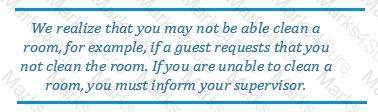
When you are ready to clean a room, knock and announce yourself as “Housekeeping.” Give the guest sufficient time to respond (10 to 15 seconds). If the guest does not respond, let yourself into the room and begin cleaning.
Start by cleaning the common room and sleeping areas. It is best to follow consistent steps when cleaning rooms. This will help to prevent you from missing anything. In the common room and sleeping area:
Pick up and dispose of any trash.
Empty trash cans.
If the guest has checked out, replace the sheets on each bed with fresh sheets.
Make the bed.
Leave a “Contoso Special Treat” on each pillow.
Dust all wooden furniture.
Clean the coffee station (if necessary) and restock coffee, cups, and condiment packs.
Vacuum the common room and sleeping areas.
Do not open the courtesy bar . Checking and restocking the courtesy bar is the shift supervisor’s responsibility.
It is important that you give special attention to the restrooms. The most common guest complaint is about restroom cleanliness. We recommend a “top-down” cleaning method for restrooms:
Clean all mirrors.
Clean countertops and sinks.
If damp, wipe down the shower and shower curtain.
If necessary, replace toilet paper.
Replace used towels and wash cloths.
Pick up any trash and empty trash cans.
Sweep the restroom floor and mop if necessary.
Final Check
Make a final check of the room before leaving.
Are the lights turned off?
Are the TV and coffee station turned off?
Is all trash picked up and disposed of?
Is the restroom door closed?
Close the door firmly and make sure that it locks behind you. Text your supervisor with the room number.
End-of-Shift
When you are finished, dispose of all trash in the large receptacles. Drop all sheets, towels, and other lines into the laundry carts. Restock your cart so that it is ready for the next shift.
If you have more than 30 minutes left after you have completed your assigned rooms, contact your supervisor for additional assignments.

Add a Page Break immediately before the heading “Room Cleaning”.
Project 1 of 7: Observation
Overview
You are a member of the Barstow College Observation Project committee. You are preparing the initial summary report for this year’s count, but have not received all of the data you need to complete the report.

Introduction
The multi-departmental Wildlife Observation Project has completed its wildlife population counts for this year. The counts were made between May 5 and May 7 for both the wilderness and cultivated land areas. This is in line with the count periods for all previous years. The species used for the counts have been identified as common for the region (central Missouri) in which the counts were taken. (Author, 2009)
As in previous years, five observation blinds were set up two weeks before the counts were to take place. Counters worked eight-hour shifts providing 24-hour coverage of the count areas for two days. Weather for both observation days was clear and mild (varying between 50-70 degrees F).
The results presented here are summary total results only, which counts from five and ten years ago provided for comparison. Detailed observation results will be available as soon as they are completed. We estimate that they will be available some time in the next two weeks.
Wilderness Summary
The wilderness observation area is a five-acre section of unimproved forest land. The most common trees in the area are maple, red oak, cedar, sweet gum, and hickory. The area also includes a small spring. The area is not enclosed by a fence or other man-made barrier.
The area is located eight miles from the nearest paved road and twelve miles from the nearest residence. Off-road vehicles were used to bring counters close to, but not entering, the count area. The nearest approach by off-road vehicles was one mile.
The table below lists the summary counts.
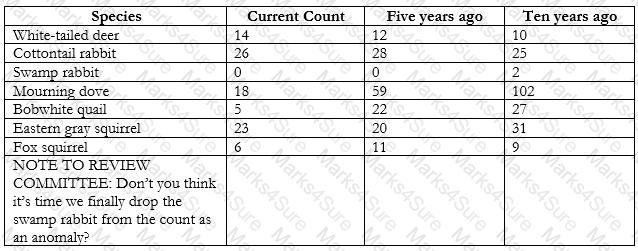
Though further research any analysis is needed, the drop in mourning dove and bobwhite quail counts could be significant. The detailed count data shows these numbers failing off each year.
Cultivated Land Summary
The cultivated land observation area is a five-acre section of cultivated land near the center of a 50-acre field. The field is used to grow corn, wheat, soybeans, and clover, with the crop rotated annually. In the fifth year of the cycle, the field is left fallow.
The area is located two miles from the nearest paved road and one mile from the nearest residence. A storage barn is located at the southern border of the field.
The table below lists the summary counts.
Additional Notes
This project was initially scheduled to run for ten years, so we are currently in our last year. The committee needs to decide if it is worth the time and expense to continue the project. The landowners have experience that they would be happy to let us continue. Costs relating to the project is minimal and it does provide an opportunity to offer extra credit to students volunteering as counters.
A suggestion has been made by some committee members that we should increase the count frequency, counting on a quarterly schedule instead of an annual schedule. This would need to be coordinated with the owner of the cultivated field so that we do not interfere with planting or harvesting schedules.
Special Thanks
Once again, we would like to offer special thanks to:
We couldn’t do this without you.
Add a SmartArt Vertical Bullet List below the text “Once again, we would like to offer special thanks to: “. Add the text “ Frank Miller ” to the top green shape.
Project 1 of 7: Observation
Overview
You are a member of the Barstow College Observation Project committee. You are preparing the initial summary report for this year’s count, but have not received all of the data you need to complete the report.

Introduction
The multi-departmental Wildlife Observation Project has completed its wildlife population counts for this year. The counts were made between May 5 and May 7 for both the wilderness and cultivated land areas. This is in line with the count periods for all previous years. The species used for the counts have been identified as common for the region (central Missouri) in which the counts were taken. (Author, 2009)
As in previous years, five observation blinds were set up two weeks before the counts were to take place. Counters worked eight-hour shifts providing 24-hour coverage of the count areas for two days. Weather for both observation days was clear and mild (varying between 50-70 degrees F).
The results presented here are summary total results only, which counts from five and ten years ago provided for comparison. Detailed observation results will be available as soon as they are completed. We estimate that they will be available some time in the next two weeks.
Wilderness Summary
The wilderness observation area is a five-acre section of unimproved forest land. The most common trees in the area are maple, red oak, cedar, sweet gum, and hickory. The area also includes a small spring. The area is not enclosed by a fence or other man-made barrier.
The area is located eight miles from the nearest paved road and twelve miles from the nearest residence. Off-road vehicles were used to bring counters close to, but not entering, the count area. The nearest approach by off-road vehicles was one mile.
The table below lists the summary counts.
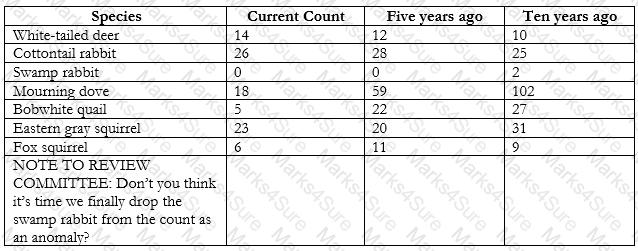
Though further research any analysis is needed, the drop in mourning dove and bobwhite quail counts could be significant. The detailed count data shows these numbers failing off each year.
Cultivated Land Summary
The cultivated land observation area is a five-acre section of cultivated land near the center of a 50-acre field. The field is used to grow corn, wheat, soybeans, and clover, with the crop rotated annually. In the fifth year of the cycle, the field is left fallow.
The area is located two miles from the nearest paved road and one mile from the nearest residence. A storage barn is located at the southern border of the field.
The table below lists the summary counts.
Additional Notes
This project was initially scheduled to run for ten years, so we are currently in our last year. The committee needs to decide if it is worth the time and expense to continue the project. The landowners have experience that they would be happy to let us continue. Costs relating to the project is minimal and it does provide an opportunity to offer extra credit to students volunteering as counters.
A suggestion has been made by some committee members that we should increase the count frequency, counting on a quarterly schedule instead of an annual schedule. This would need to be coordinated with the owner of the cultivated field so that we do not interfere with planting or harvesting schedules.
Special Thanks
Once again, we would like to offer special thanks to:
We couldn’t do this without you.
Add a table with eight rows and four columns in the “Cultivated Land Summary” section, below the text “The table below lists the summary counts.”
PDF + Testing Engine

Testing Engine
PDF (Q&A)