
Spring Sale Limited Time 65% Discount Offer - Ends in 0d 00h 00m 00s - Coupon code: pass65

A00-260 SAS Data Integration Development Questions and Answers

Questions 4

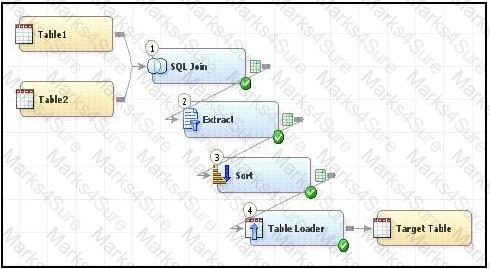
In the following display, can status handling be enabled for both the Extract transformation and the Sort transformation?
A00-260 Question 4

Options:

A.

Yes. The Return Code Check transformation can be added to the job flow immediately following the Sort transformation - the Status Handling tab in this Return Code Check transformation properties can then establish the desired status handling for both the Extract and Sort transformations.

B.

No. Both the Extract and the Sort transformations do not have a Status Handling tab in their corresponding properties window, therefore it is not possible to establish status handling for these transformations.

C.

Yes. The Return Code Check transformation can be added to the job flow twice, once immediately following the Extract, and again immediately following the Sort - the Status Handling tab in each of the Return Code Check transformations properties can then establish the desired status handling.

D.

Yes. The status handling tab in the job properties window will allow you to select which transformation (or even several transformations) that you want to define status handling for.

Buy Now
Questions 5

Within SAS Data Integration Studio, how is the internal code of a SAS Code transformation assigned to its options?

Options:

A.

SAS macro variables

B.

columns of SAS datasets

C.

SAS formats

D.

SAS macro calls

Buy Now
Questions 6

Which statement best describes the DataFlux Integration Server?

Options:

A.

An application server that executes service requests based on Simple Object Access Protocol (SOAP) to call

dfPower Architect or dfPower Profile jobs.

B.

A plug-in to SAS Data Integration Studio allowing you to design jobs specialized for data cleansing

operations.

C.

An application interface that allows you to build dfPower Architect and dfPower Profile jobs specialized for

data cleansing operations.

D.

A third party server defined in the SAS metadata repository that allows you to build flows integrating

multiple jobs and establishing job dependencies within the flow.

Buy Now
Questions 7

Within SAS Data Integration Studio, automatic mappings are disabled for a job. A transformation has defined source columns and defined target columns. One of the source columns, named COL1, is character with a length of 50. One of the target columns, named COL1, is also character but of length 25. What will happen if the COL1 columns are mapped?

Options:

A.

The COL1 columns are successfully mapped, one-to-one, with no warnings.

B.

The COL1 columns are not mapped because the lengths are different.

C.

The COL1 columns are mapped but an expression is defined for the target COL1 that uses a generic specification

of the LENGTH function.

D.

The COL1 columns are successfully mapped, one-to-one, but a warning occurs.

Buy Now
Questions 8

How do you enable performance statistics for a SAS Data Integration Studio job?

Options:

A.

Define Collect Runtime Statistics on the SAS Data Integration Studio job.

B.

Define Collect Table Statistics on the SAS Data Integration Studio job.

C.

Define Collect Diagnostics on the SAS Data Integration Studio job.

D.

Define Collect Table Statistics on the SAS Data Integration Studio options.

Buy Now
Questions 9

Which action is required for enabling performance statistics on the executing SAS Workspace Server?

Options:

A.

Define a logfile for output.

B.

Define Collect Diagnostics for the SAS Data Integration Studio job.

C.

Define Collect Runtime statistics for the SAS Data Integration Studio job.

D.

Enable the logging facility of the SAS Workspace Server.

Buy Now
Questions 10

Which action is performed by the Lookup transformation in SAS Data Integration Studio?

Options:

A.

combines rows from multiple tables into a single row

B.

combines rows from multiple tables into multiple rows

C.

validates that values are unique

D.

validates that values are not null

Buy Now
Questions 11

In order to use the SAS Data Integration Studio ' s Apply Lookup Standardization transformation, Data Quality options must be setup. Select the valid Scheme Repository Types. (Choose two.)

Options:

A.

A comma delimited flat file that contains the field names in the first row.

B.

Power scheme that is generated by Data Flux.

C.

A SAS table scheme that is generated by SAS.

D.

A third party RDBMS table that has been generated by the SAS system.

Buy Now
Questions 12

Within SAS Data Integration Studio, which type of expression can be created using the Expression Builder window in the Where tab of SAS Extract transformation? 1) a SAS expression 2) an SQL expression 3) an XML expression 4) a constant

Options:

A.

1 and 2 only

B.

1 and 3 only

C.

1, 2 and 4 only

D.

1, 2, 3, and 4

Buy Now
Questions 13

In SAS Data Integration Studio, where must the columns included in a business key exist?

Options:

A.

in the source and standardization tables

B.

in the source and dimension tables

C.

in the target and fact tables

D.

in the source, dimension and standardization tables

Buy Now
Questions 14

Consider the job flow diagram in the display. Assume the inner job has a parameter defined specifying a table name. Which statement is FALSE?

A00-260 Question 14

Options:

A.

The Inner Job can be successfully executed by itself, but only if the defined parameter has been assigned a valid default value.

B.

The Inner Job cannot be successfully executed by itself unless it is disassociated from the loop job.

C.

The Control Table column is mapped to the parameter defined for the Inner Job using the Loop transformation properties window.

D.

If the server that executes the job has multiple CPUs, parallel processing can be enabled in the Loop transformation properties window.

Buy Now
Questions 15

SAS Data Integration Studio is dependent on which administration functions?

Options:

A.

Setting up of SAS Information Map environment.

B.

Setting up of SAS Web and SAS Portal environments.

C.

Setting up of SAS Application Servers.

D.

Setting up of SAS Libraries definitions.

Buy Now
Questions 16

Which statement correctly defines a System DSN?

Options:

A.

Not specific to an individual user. Anyone with permission to access the data source can use it.

B.

Specific to an individual user. It is available only to the user who creates it.

C.

Not specific to an individual user. It can be shared among users even though it is created locally.

D.

Specific to an individual user. But it can be shared among users.

Buy Now
Questions 17

When writing postcode in the Precode and Postcode tab of the Transpose transformation in SAS Data Integration Studio, which symbol allows you to reference the transformation output table regardless of the actual physical name for that target table?

Options:

A.

& syslast

B.

syslast

C.

& target

D.

%target

Buy Now
Questions 18

Within SAS Data Integration Studio, which one of the following is NOT an option available from the File- > New menu choice under External File grouping?

Options:

A.

Delimited

B.

Fixed Width

C.

User Written

D.

COBOL Copybook

Buy Now
Questions 19

The purpose of change management in SAS Data Integration Studio is to manage:

Options:

A.

metadata objects across metadata servers

B.

metadata objects within a logged on user ' s personal folder

C.

metadata objects within a metadata server

D.

metadata objects within a logged on user ' s Checkouts Tree

Buy Now
Questions 20

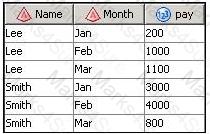
Given the table below as a source table for the Transpose transformation in SAS Data Integration Studio:
A00-260 Question 20

In the Options tab in the Properties window for the Transpose transformation, if the columns are assigned as follows:

Select columns to transpose (VAR statement): Payment

Select a column for Output column names (ID statement): Month

Select columns whose values define groups of records to transpose (BY statement): Name

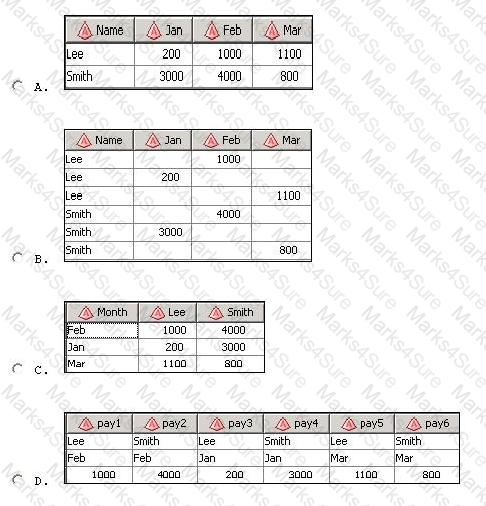
Which of the following tables is a possible resulting target table?
A00-260 Question 20

Options:

A.

Exhibit A

B.

Exhibit B

C.

Exhibit C

D.

Exhibit D

Buy Now
Questions 21

A user needs to find out who has the SAS Data Integration Studio job " Create Tables " checked out. What action should the user perform?

Options:

A.

They need to select the " Properties " menu option and then the " Advanced " tab for the SAS Data Integration

Studio job " Create Tables " within Data Integration studio.

B.

They need to select the History menu option for the SAS Data Integration Studio job " Create Tables " once it

has been checked in.

C.

They need to select the History menu option for the SAS Data Integration Studio job " Create Tables " .

D.

They are not able to find out who has the SAS Data Integration Studio job " Create Tables " in checked out

status because they are not an administrator.

Buy Now
Exam Code: A00-260
Exam Name: SAS Data Integration Development
Last Update: Apr 30, 2026
Questions: 70

PDF + Testing Engine

$63.52  $181.49

Testing Engine

$50.57  $144.49
buy now A00-260 testing engine

PDF (Q&A)

$43.57  $124.49
buy now A00-260 pdf