
Free Practice Questions for the Anthropic Claude Certified Architect CCAR-F Exam (2026 Updated)
At Marks4sure, we are dedicated to providing IT professionals with the most accurate and reliable preparation materials for the Anthropic CCAR-F exam. To support your certification journey, we have made a selection of our premium 2026 Claude Certified Architect practice questions and answers available completely free. You can take this practice test as many times as you need. Every question includes a detailed, expertly verified explanation to ensure you fully grasp the core security concepts before test day.
In production, you observe that simple fact-checking queries—for example, “What year was the Paris Climate Agreement signed?”—traverse all four subagents sequentially, consuming more than 40 seconds and significant tokens per query. Complex comparative research benefits from the full pipeline. Your query distribution is diverse and evolving as users discover new applications. What is the most effective approach to optimize for varying query complexity?
You are integrating Claude Code into your Continuous Integration/Continuous Deployment (CI/CD) pipeline. The system runs automated code reviews, generates test cases, and provides feedback on pull requests. You need to design prompts that provide actionable feedback and minimize false positives.
In addition to your CI pipeline, your organization has enabled Claude’s managed Code Review through the Claude GitHub App on this repository, and reviews run automatically on every pull request. Reviews average 18 findings per pull request. Developer feedback reveals three categories of unwanted noise: (1) style and formatting issues already enforced by your linter in CI, (2) findings on automatically generated template code under src/gen/, and (3) rendering-helper patterns that are intentional project conventions but get flagged because they resemble common anti-patterns. Only approximately four findings per pull request are genuine logic bugs.
What is the most effective way to reduce this noise while preserving the detection of genuine issues?
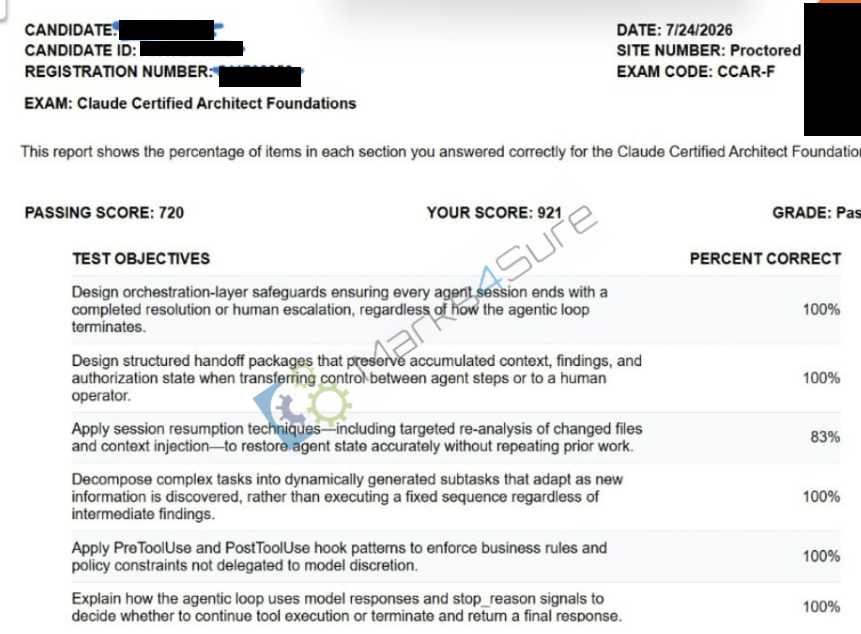
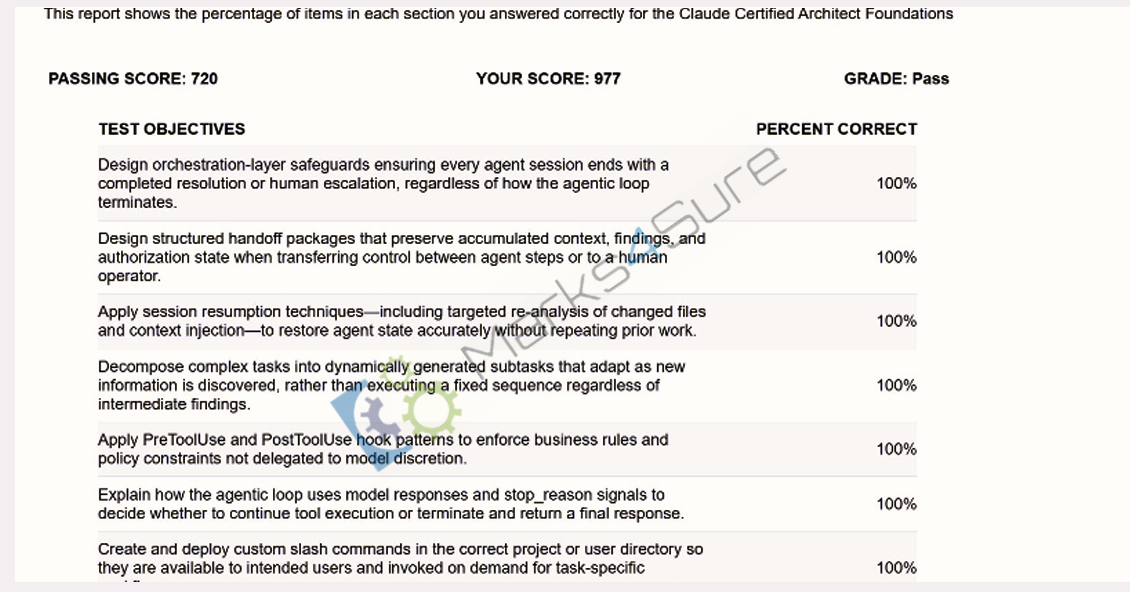
CCAR-F Report Card
Your CI pipeline performs security-focused code reviews on approximately 50 pull requests daily, currently costing $150 per day through the synchronous API. Reviews are non-blocking—developers merge after tests pass and address findings in follow-up commits. You are evaluating the Message Batches API because it offers a 50% cost reduction. What factor most determines whether batch processing is appropriate for this use case?
The synthesis agent completes its initial pass but flags that three key research questions remain unanswered because the web-search and document-analysis agents did not find relevant information on those specific subtopics. The coordinator currently proceeds directly to report generation, producing reports with incomplete coverage. What change would most effectively improve research completeness?
You are using Claude Code to accelerate software development. Your team uses it for code generation, refactoring, debugging, and documentation. You need to integrate it into your development workflow with custom slash commands, CLAUDE.md configurations, and understand when to use plan mode vs direct execution.
You’ve asked Claude Code to build a PDF report generation feature. The initial implementation queries the database correctly, but the output has formatting issues: table columns are too narrow causing content truncation, dates display without proper formatting, and page break handling is incorrect. You’ve noticed these issues interact—changing column widths affects how dates render, and page breaks depend on content height.
What’s the most effective approach for iterating toward a working solution?
You are building a customer support resolution agent using the Claude Agent SDK. The agent handles high-ambiguity requests like returns, billing disputes, and account issues. It has access to your backend systems through custom Model Context Protocol (MCP) tools ( get_customer , lookup_order , process_refund , escalate_to_human ). Your target is 80%+ first-contact resolution while knowing when to escalate.
The agent verifies customer identity through a multi-step process before resetting passwords. During testing, you notice that after the customer answers the third verification question, the agent asks them to provide their name again, as if the earlier exchange never happened.
What’s the most likely cause of this behavior?
You have configured the system so that all four subagents have access to the complete set of 18 tools. During testing, agents frequently call tools outside their specialization—the synthesis agent attempts web searches, and the report generator tries to analyze documents. What is the primary cause of this poor tool-selection behavior?
You are integrating Claude Code into your Continuous Integration/Continuous Deployment (CI/CD) pipeline. The system runs automated code reviews, generates test cases, and provides feedback on pull requests. You need to design prompts that provide actionable feedback and minimize false positives.
Your automated reviewer uses a single prompt covering security issues, API design, and business-logic correctness. Your evaluation suite shows strong recall for API-design findings at 82% but poor recall for business-logic edge cases in quiz scoring at 34%. When you add few-shot examples of logic bugs to the prompt, logic recall improves to 41%, but API-design recall drops to 68%.
How should you address this trade-off to improve detection across both categories?
Your pipeline reviews approximately 200 database-migration scripts daily using the Message Batches API. Each request includes a shared 8,000-token system prompt containing migration-review guidelines and schema documentation, followed by an individual migration script. You added cache_control breakpoints to the shared system prompt in every request, but monitoring shows cache-hit rates of only 32%, with misses concentrated among requests processed later in the batch window. Which change addresses the root cause without adding sequential-processing latency?
You are using Claude Code to accelerate software development. Your team uses it for code generation, refactoring, debugging, and documentation. You need to integrate it into your development workflow with custom slash commands, CLAUDE.md configurations, and understand when to use plan mode vs direct execution.
Your infrastructure-as-code repository includes Terraform modules ( /terraform/ ), Kubernetes manifests ( /kubernetes/ ), and CI/CD pipeline scripts ( /pipelines/ ). Each requires different conventions, but your single root CLAUDE.md has grown to 500+ lines. When developers work on Kubernetes files, Terraform-specific rules load into context unnecessarily, consuming tokens.
What is the best approach to reorganize so only relevant guidance loads when editing specific file types?
You are building developer productivity tools using the Claude Agent SDK. The agent helps engineers explore unfamiliar codebases, understand legacy systems, generate boilerplate code, and automate repetitive tasks. It uses the built-in tools (Read, Write, Bash, Grep, Glob) and integrates with Model Context Protocol (MCP) servers.
An engineer asks the agent to find all callers of a function before removing it. The function is defined in a core library but is also exposed through wrapper modules that rename the function for domain-specific use (e.g., calculateTax in the library becomes computeOrderTax in the orders module).
What exploration strategy will most reliably identify all callers?
You are building a structured data extraction system using Claude. The system extracts information from unstructured documents, validates the output using JavaScript Object Notation (JSON) schemas, and maintains high accuracy. It must handle edge cases gracefully and integrate with downstream systems.
Testing reveals that when source documents are missing certain specifications, the model fabricates plausible-sounding values to satisfy your schema’s required fields. For example, a document mentioning only dimensions receives a fabricated “weight: 2.3 kg” in the extraction output.
What schema design change most effectively addresses this hallucination behavior?
You are using Claude Code to accelerate software development. Your team uses it for code generation, refactoring, debugging, and documentation. You need to integrate it into your development workflow with custom slash commands, CLAUDE.md configurations, and understand when to use plan mode vs direct execution.
You’ve asked Claude to write a data migration script, but the initial output doesn’t correctly handle records with null values in required fields.
What’s the most effective way to iterate toward a working solution?
You are building a structured data extraction system using Claude. The system extracts information from unstructured documents, validates the output using JSON schemas, and maintains high accuracy. It must handle edge cases gracefully and integrate with downstream systems.
After implementing tool use with strict schema definitions, JSON syntax errors are eliminated, but 5% of extractions still contain empty arrays or null values for required fields such as citations and methodology. Spot-checking reveals that the source documents contain this information, but in varied formats—inline citations versus bibliographies, and methodology sections versus details embedded in introductions.
What is the most effective way to address these failures?
Your pipeline runs:
PROMPT= " You are a code reviewer. "
PROMPT= " $PROMPT Analyze the provided diff "
PROMPT= " $PROMPT for bugs, security issues, "
PROMPT= " $PROMPT and style violations. "
claude -p \
--dangerously-skip-permissions \
--system-prompt " $PROMPT " < diff.txt
The reviews complete and return feedback, but Claude comments only on the piped diff—it never reads surrounding files in the checked-out repository to understand broader context, even when the diff modifies a function called by many other modules. Which change to the invocation will cause Claude to read related repository files while still applying your custom review instructions?
You are using Claude Code to accelerate software development. Your team uses it for code generation, refactoring, debugging, and documentation. You need to integrate it into your development workflow with custom slash commands, CLAUDE.md configurations, and understand when to use plan mode vs direct execution.
You’re implementing a caching layer for API responses to speed up the /products endpoint. You have a rough idea—Redis with a 5-minute TTL—but you’re new to production caching and aren’t sure what other considerations a robust implementation requires.
What’s the most effective way to start your iterative workflow?
Your automated review generates many findings per pull request, but developer feedback shows that roughly half are dismissed as “not worth addressing.” Analysis reveals that dismissed findings are often technically accurate but involve minor style preferences or patterns that are acceptable in your codebase. Before adding infrastructure complexity, what prompt-design change could most effectively reduce dismissals while maintaining the detection of genuine issues?
You are building a multi-agent research system using the Claude Agent SDK. A coordinator agent delegates to specialized subagents: one searches the web, one analyzes documents, one synthesizes findings, and one generates reports. The system researches topics and produces comprehensive, cited reports.
Your multi-agent research pipeline crashes after processing 12 of 28 documents. The web-search agent had identified relevant sources, the document analyzer had partially completed extraction, and the synthesizer had begun identifying patterns. You need to resume processing without repeating work or losing fidelity in the prior findings.
What state-management approach best balances information fidelity with context efficiency when restoring agent state?
You are building a customer support resolution agent using the Claude Agent SDK. The agent handles high-ambiguity requests like returns, billing disputes, and account issues. It has access to your backend systems through custom Model Context Protocol (MCP) tools ( get_customer , lookup_order , process_refund , escalate_to_human ). Your target is 80%+ first-contact resolution while knowing when to escalate.
You’re implementing the escalation logic for when the agent should call escalate_to_human . Your team proposes four different approaches for triggering escalation.
Which approach will most reliably identify cases that genuinely require human intervention?
You are building a customer support resolution agent using the Claude Agent SDK. The agent handles high-ambiguity requests like returns, billing disputes, and account issues. It has access to your backend systems through custom Model Context Protocol (MCP) tools ( get_customer , lookup_order , process_refund , escalate_to_human ). Your target is 80%+ first-contact resolution while knowing when to escalate.
During a billing dispute resolution, your agent successfully retrieves customer info via get_customer and order details via lookup_order , but when attempting to call process_refund , the tool returns a timeout error. The agent has enough information to explain the charges and verify refund eligibility, but cannot actually process the refund due to the backend failure.
What approach best balances first-contact resolution with appropriate error handling?
Your code-review prompts include both implementation changes and the corresponding test file, but the review comments fail to identify untested code paths. The model correctly flags functions that have no tests at all, but it fails to recognize when conditional branches or error-handling paths within tested functions lack coverage. What is the most effective way to improve branch-level gap detection without overcomplicating the pipeline?
You are building a customer support resolution agent using the Claude Agent SDK. The agent handles high-ambiguity requests like returns, billing disputes, and account issues. It has access to your backend systems through custom Model Context Protocol (MCP) tools ( get_customer , lookup_order , process_refund , escalate_to_human ). Your target is 80%+ first-contact resolution while knowing when to escalate.
Anthropic’s tool use documentation states: “Write instructive error messages. Instead of generic errors like ‘failed’, include what went wrong and what Claude should try next.” A billing dispute agent uses lookup_order , which catches all exceptions and returns a tool_result with is_error: true and the message “Tool execution failed”. Monitoring shows two failure modes: the agent retries the identical call until hitting the turn limit, or it immediately calls escalate_to_human without trying alternative tools.
Which change follows the documented recommendation and gives Claude the information it needs to select the correct recovery action for each error type?
You are building a structured data extraction system using Claude. The system extracts information from unstructured documents, validates the output using JSON schemas, and maintains high accuracy. It must handle edge cases gracefully and integrate with downstream systems.
Your extraction pipeline occasionally receives responses that cannot be parsed as valid JSON, causing downstream processing failures. The current implementation prompts Claude to return JSON in the response text and then parses it.
What is the most reliable approach to ensure Claude returns valid, schema-compliant structured data?
You are building a multi-agent research system using the Claude Agent SDK. A coordinator agent delegates to specialized subagents: one searches the web, one analyzes documents, one synthesizes findings, and one generates reports. The system researches topics and produces comprehensive, cited reports.
When analyzing complex legal cases that cite multiple precedents, the document-analysis subagent processes each precedent sequentially. A landmark case citing 12 precedents takes more than three minutes to analyze completely.
What is the most effective way to reduce this latency while preserving the coordinator’s ability to monitor and debug the system?
Production monitoring shows that the research phase takes longer than expected. Analysis reveals that the coordinator invokes the web-search subagent, waits for its response, and then invokes the document-analysis subagent. These tasks are independent; neither requires the other’s output. How should you modify the system to run these subagents concurrently?
You are integrating Claude Code into your Continuous Integration/Continuous Deployment (CI/CD) pipeline. The system runs automated code reviews, generates test cases, and provides feedback on pull requests. You need to design prompts that provide actionable feedback and minimize false positives.
Your pipeline includes a release-notes generation step that classifies and summarizes approximately 200 commits at the end of each weekly release cycle. Each commit is currently sent as a separate Messages API request using a Sonnet-tier Claude model. The release notes are not needed until the following morning, providing approximately 12 hours of acceptable latency.
Your team must reduce the per-token API cost while retaining the same model, prompts, and output quality.
Which approach satisfies all these constraints?
You are building a customer support resolution agent using the Claude Agent SDK. The agent handles high-ambiguity requests like returns, billing disputes, and account issues. It has access to your backend systems through custom Model Context Protocol (MCP) tools ( get_customer , lookup_order , process_refund , escalate_to_human ). Your target is 80%+ first-contact resolution while knowing when to escalate.
Your process_refund tool returns two types of errors: technical errors (“503 Service Unavailable”, “Connection timeout”) that are transient (~5% of calls), and business errors (“Order exceeds 30-day return window”, “Item already refunded”) that are permanent (~12% of calls). Monitoring shows the agent wastes 3–4 turns retrying business errors that can never succeed. Currently, both error types return only a plain text message to Claude.
What’s the most effective way to reduce wasted retries while improving customer-facing response quality?
You are building a customer support resolution agent using the Claude Agent SDK. The agent handles high-ambiguity requests like returns, billing disputes, and account issues. It has access to your backend systems through custom Model Context Protocol (MCP) tools ( get_customer , lookup_order , process_refund , escalate_to_human ). Your target is 80%+ first-contact resolution while knowing when to escalate.
Your agent is handling a billing dispute. After calling get_customer and lookup_order , it identifies that the dispute involves a promotional pricing error requiring manager approval—beyond the agent’s authorization level.
How should the workflow handle this mid-process escalation?
You are integrating Claude Code into your Continuous Integration/Continuous Deployment (CI/CD) pipeline. The system runs automated code reviews, generates test cases, and provides feedback on pull requests. You need to design prompts that provide actionable feedback and minimize false positives.
Your CI pipeline performs security-focused code reviews on approximately 50 pull requests daily, currently costing $150 per day using the synchronous API. Reviews are non-blocking—developers merge after tests pass and address findings in follow-up commits. You are evaluating the Message Batches API for its 50% cost reduction.
What factor most determines whether batch processing is appropriate for this use case?
You are building a customer support resolution agent using the Claude Agent SDK. The agent handles high-ambiguity requests like returns, billing disputes, and account issues. It has access to your backend systems through custom Model Context Protocol (MCP) tools ( get_customer , lookup_order , process_refund , escalate_to_human ). Your target is 80%+ first-contact resolution while knowing when to escalate.
A customer raises three separate issues during one session: a refund inquiry (turns 1–15), a subscription question (turns 16–30), and a payment method update (turns 31–45). At turn 48, the customer asks “What happened with my refund?” The conversation is approaching context limits.
What strategy best maintains the agent’s ability to address all issues throughout the session?
You are building a multi-agent research system using the Claude Agent SDK. A coordinator agent delegates to specialized subagents: one searches the web, one analyzes documents, one synthesizes findings, and one generates reports. The system researches topics and produces comprehensive, cited reports.
The synthesis agent completes its initial pass but flags that three key research questions remain unanswered because the web-search and document-analysis agents did not find relevant information on those specific subtopics. The coordinator currently proceeds directly to report generation, producing reports with incomplete coverage.
What change would most effectively improve research completeness?
Your pipeline includes a release-notes generation step that classifies and summarizes approximately 200 commits at the end of each weekly release cycle. Each commit is currently sent as a separate Messages API call using a Sonnet-tier Claude model. The release notes are not needed until the following morning, so results have approximately 12 hours of acceptable latency. Your team needs to reduce per-token API cost for this step while keeping the same model and prompts, with no change to the model tier or output quality. Which approach satisfies all these constraints?
You are building a multi-agent research system using the Claude Agent SDK. A coordinator agent delegates to specialized subagents: one searches the web, one analyzes documents, one synthesizes findings, and one generates reports. The system researches topics and produces comprehensive, cited reports.
In production, you observe that simple fact-checking queries, such as “In what year was the Paris Climate Agreement signed?”, traverse all four subagents sequentially, consuming more than 40 seconds and significant tokens per query. Complex comparative research benefits from the complete pipeline. Your query distribution is diverse and continues to evolve as users discover new applications.
What is the most effective approach to optimize for varying query complexity?
You are using Claude Code to accelerate software development. Your team uses it for code generation, refactoring, debugging, and documentation. You need to integrate it into your development workflow with custom slash commands, CLAUDE.md configurations, and understand when to use plan mode vs direct execution.
You’re tasked with adding real-time updates to the application. This could be implemented using WebSockets, Server-Sent Events, or polling, each with different complexity, browser support, and infrastructure requirements.
What’s the most effective way to begin this task?
You are building a structured data extraction system using Claude. The system extracts information from unstructured documents, validates the output using JavaScript Object Notation (JSON) schemas, and maintains high accuracy. It must handle edge cases gracefully and integrate with downstream systems.
Your extraction pipeline processes invoices and extracts line items, subtotals, tax amounts, and grand totals. During evaluation, you discover that in 18% of extractions, the sum of extracted line item amounts doesn’t match the extracted grand total—sometimes due to OCR errors in the source document, sometimes due to extraction mistakes by the model. Downstream accounting systems reject records with mismatched totals.
What’s the most effective approach to improve extraction reliability?
You are building developer productivity tools using the Claude Agent SDK. The agent helps engineers explore unfamiliar codebases, understand legacy systems, generate boilerplate code, and automate repetitive tasks. It uses the built-in tools (Read, Write, Bash, Grep, Glob) and integrates with Model Context Protocol (MCP) servers.
You’ve configured your Claude agent with three MCP servers: one for git operations, one for Jira ticket management, and one for documentation search.
When a user asks the agent to “create a branch for JIRA-123 and add documentation links to the ticket,” how does the agent access tools across these servers?
You are building developer productivity tools using the Claude Agent SDK. The agent helps engineers explore unfamiliar codebases, understand legacy systems, generate boilerplate code, and automate repetitive tasks. It uses the built-in tools (Read, Write, Bash, Grep, Glob) and integrates with Model Context Protocol (MCP) servers.
1.5An engineer asks the agent to understand how the caching layer works before adding a new cache invalidation trigger. After initial Grep searches, the agent has identified that caching logic spans 15 files including decorators, middleware, and service classes (~6,000 lines total).
What’s the most effective next step for building understanding while managing context constraints?
In addition to your CI pipeline, your organization has enabled Claude’s managed Code Review through the Claude GitHub App on this repository, and reviews run automatically on every pull request. Reviews average 18 findings per pull request. Developer feedback reveals three categories of unwanted noise: (1) style and formatting issues already enforced by your CI linter, (2) findings on automatically generated template code under src/gen/*, and (3) rendering-helper patterns that are intentional project conventions but are flagged because they resemble common anti-patterns. Only approximately four findings per pull request are genuine logic bugs. What is the most effective way to reduce this noise while preserving the detection of real issues?
You are building developer productivity tools using the Claude Agent SDK. The agent helps engineers explore unfamiliar codebases, understand legacy systems, generate boilerplate code, and automate repetitive tasks. It uses the built-in tools (Read, Write, Bash, Grep, Glob) and integrates with Model Context Protocol (MCP) servers.
Your agent has spent 25 minutes exploring a game engine’s rendering subsystem—reading shader code, buffer management, and frame synchronization logic. An engineer now asks it to understand how the physics engine integrates with rendering for collision debug overlays. You notice recent responses reference “typical rendering patterns” rather than the specific VulkanPipeline and FrameGraph classes it discovered earlier.
What’s the most effective approach?
You are integrating Claude Code into your Continuous Integration/Continuous Deployment (CI/CD) pipeline. The system runs automated code reviews, generates test cases, and provides feedback on pull requests. You need to design prompts that provide actionable feedback and minimize false positives.
Your pipeline reviews every pull request using a single API call with a static prompt containing the diff and the full text of each changed file. Unchanged files are not included. Developers report that reviews consistently miss cross-file bugs—for example, a pull request renames a function’s parameters, but the review does not identify callers in unchanged files that still use the old argument order.
Evaluation shows that cross-file bugs account for 35% of production incidents originating from reviewed pull requests.
What is the most effective change to the review design?
You are building a multi-agent research system using the Claude Agent SDK. A coordinator agent delegates to specialized subagents: one searches the web, one analyzes documents, one synthesizes findings, and one generates reports. The system researches topics and produces comprehensive, cited reports.
The coordinator agent has AgentDefinition objects configured for all four specialized subagents, each with appropriate descriptions, prompts, and tool restrictions. During testing, you notice that the coordinator correctly reasons about when to delegate—it generates messages such as, “I’ll ask the web-search agent to find sources on this topic”—but no subagent execution ever occurs. The coordinator then proceeds as if the delegation happened and continues with incomplete information. Logs show no errors.
What is the most likely cause?
The web-search agent has gathered several relevant sources for a research topic. The document-analysis agent now needs to examine those sources. How does information typically flow between these two specialized subagents?
PDF + Testing Engine

Testing Engine
PDF (Q&A)