
Free Practice Questions for the AIWMI CCRA CCRA-L2 Exam (2026 Updated)
At Marks4sure, we are dedicated to providing IT professionals with the most accurate and reliable preparation materials for the AIWMI CCRA-L2 exam. To support your certification journey, we have made a selection of our premium 2026 CCRA practice questions and answers available completely free. You can take this practice test as many times as you need. Every question includes a detailed, expertly verified explanation to ensure you fully grasp the core security concepts before test day.
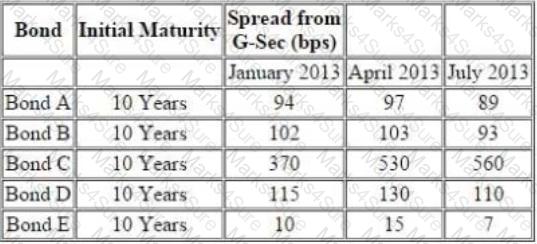
The following information pertains to bonds:
Further following information is available about a particular bond ‘Bond F’
There is a 10.25% risky bond with a maturity of 2.25% year(s) its current price is INR105.31, which corresponds to YTM of 9.22%. The following are the benchmark YTMs.

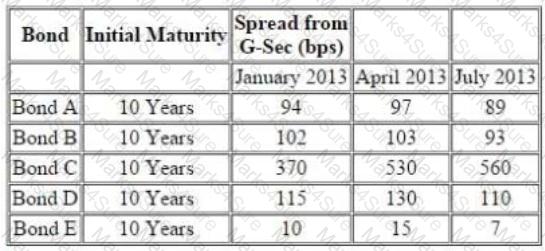
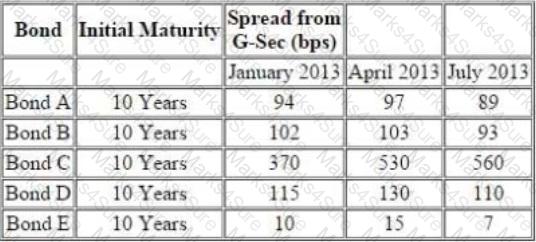
From the time January 2013 to April 2013, what can you predict about the market conditions, assuming the GSec has not changed?
An increase in the salaries of the bank employees due to new bank employee pay commission implemented by the Central Government will lead to deterioration of which of the following ratios:
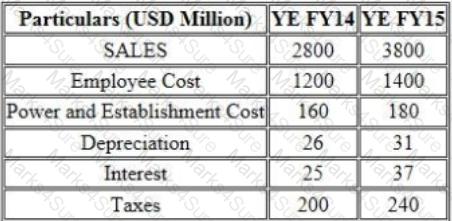
Based on the common size statement analysis which of the following statement regarding employee cost is correct?
A coupon bond is trading at 110% of the USD 1000 par value. If the last interest payment was made one month ago and the coupon rate is 12%, the accrued interest on this bond is_______
Satish Dhawan, a veteran fixed income trader is conducting interviews for the post of a junior fixed income trader. He interviewed four candidates Adam, Balkrishnan, Catherine and Deepak and following are the answers to his questions.
Question 1: Tell something about Option Adjusted Spread
Adam: OAS is applicable only to bond which do not have any options attached to it. It is for the plain bonds.
Balkishna: In bonds with embedded options, AS reflects not only the credit risk but also reflects prepayment risk over and above the benchmark.Catherine: Sincespreads are calculated to know the level of credit risk in the bound, OAS is difference between in the Z spread and price of a call option for a callable bond.
Deepark: For callable bond OAS will be lower than Z Spread.
Question 2: This is a spread that must be added to the benchmark zero rate curve in a parallel shift so that the sum of the risky bond’s discounted cash flows equals its current market price. Which Spread I am talking about?
Adam: Z Spread
Balkrishna: Nominal Spread
Catherine: Option Adjusted Spread
Deepark: Asset Swap Spread
Question 3: What do you know about Interpolated spread and yield spread?
Adam: Yield spread is the difference between the YTM of a risky bond and the YTM of an on-the-run treasury benchmark bond whose maturity is closest, but not identical to that of risky bond. Interpolated spread is the spread between the YTM of risky bond and the YTM of same maturity treasury benchmark, which is interpolated from the two nearest on-the-run treasury securities.
Balkrishna: Interpolated spread is preferred to yield spread because the latter has the maturity mismatch, which leads to error if the yield curve is not flat and the benchmark security changes over time, leading to inconsistency.
Catherine: Interpolated spread takes account the shape of the benchmark yield curve and therefore better than yield spread.
Deepak: Both Interpolated Spread and Yield Spread rely on YTM which suffers from drawbacks and inconsistencies such as the assumption of flat yield curve and reinvestment at YTM itself.
Then Satish gave following information related to the benchmark YTMs:

An investor decides to invest in the bond futures and has an outlook that the term structure curve would steepen. What should be his trading strategy?
Satish Dhawan, a veteran fixed income trader is conducting interviews for the post of a junior fixed income trader. He interviewed four candidates Adam, Balkrishnan, Catherine and Deepak and following are the answers to his questions.
Question 1: Tell something about Option Adjusted Spread
Adam: OAS is applicable only to bond which do not have any options attached to it. It is for the plain bonds.
Balkishna: In bonds with embedded options, AS reflects not only the credit risk but also reflects prepayment risk over and above the benchmark.
Catherine: Sincespreads are calculated to know the level of credit risk in the bound, OAS is difference between in the Z spread and price of a call option for a callable bond.
Deepark: For callable bond OAS will be lower than Z Spread.
Question 2: This is a spread that must be added to the benchmark zero rate curve in a parallel shift so that the sum of the risky bond’s discounted cash flows equals its current market price. Which Spread I am talkingabout?
Adam: Z Spread
Balkrishna: Nominal Spread
Catherine: Option Adjusted Spread
Deepark: Asset Swap Spread
Question 3: What do you know about Interpolated spread and yield spread?
Adam: Yield spread is the difference between the YTM of a risky bond and the YTM of an on-the-run treasury benchmark bond whose maturity is closest, but not identical to that of risky bond. Interpolated spread is the spread between the YTM of risky bond and the YTM of same maturity treasury benchmark, which is interpolated from the two nearest on-the-run treasury securities.
Balkrishna: Interpolated spread is preferred to yield spread because the latter has the maturity mismatch, which leads to error if the yield curve is not flat and the benchmark security changes over time, leading to inconsistency.
Catherine: Interpolated spread takes account the shape of the benchmark yield curve and therefore better
than yield spread.
Deepak: Both Interpolated Spread and Yield Spread rely on YTM which suffers from drawbacks and inconsistencies such as the assumption of flat yield curve and reinvestment at YTM itself.
Then Satish gave following information related to the benchmark YTMs:

There is a 10.25% risky bond with a maturity of 4.75 year(s). Its current price is INR105.31, which corresponds
to YTM of 9.22%. Compute Interpolated Spread from the information provided in the vignette:
Awesome Mobile Ltd is a leading mobile seller who manufactures mobile phone under own brand Awesome.
Which of the following is the biggest business risk for Awesome?
The most important metric for a bank is the Net Interest Income (NII) which is the difference
between____income and____expense.
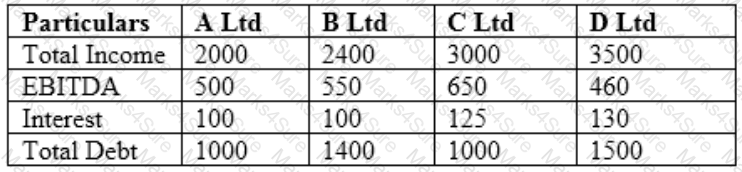
Scott is a credit analyst with one of the credit rating agencies in India. He was looking in Oil and Gas Industry companies and has presented brief financials for following 4 entities:
From the data given below, calculate the standard deviation of the credit portfolio assuming that facility’s exposure is known with certainty, customer defaults and LGDs are independent of one another and LGDs are independent across borrower(s).
Credit Facility A – Loss Equivalent Exposure of $60m, expected Default frequency of 1.5%, loss given default
of 30%, Std Deviation of LGD – 5% and Correlation to portfolio – 0.10
Credit Facility B – Loss Equivalent Exposure of $25m, expected Default frequency of 2%, loss given default of 12%, Std Deviation of LGD – 12% and Correlation to portfolio – 0.45
Credit Facility C – Loss Equivalent Exposure of $15m, expected Default frequency of 5%, loss given default of 85%, Std Deviation of LGD – 18% and Correlation to portfolio – 0.22
Following is information related banks:
Auckland Ltd is a public sector bank operating with about 120 branches across India. The bank has been in business since 1971 and has about 40% branches in rural areas and about 75% of all branches are in
Western India. On the basis of the size, Auckland Ltd will be ranked at number 31 amongst 40 banks in India.
Although top management has appointment period of 5 years, generally they retire on ach sieving age of 60 years with an average tenure of only 2 years at the top job.
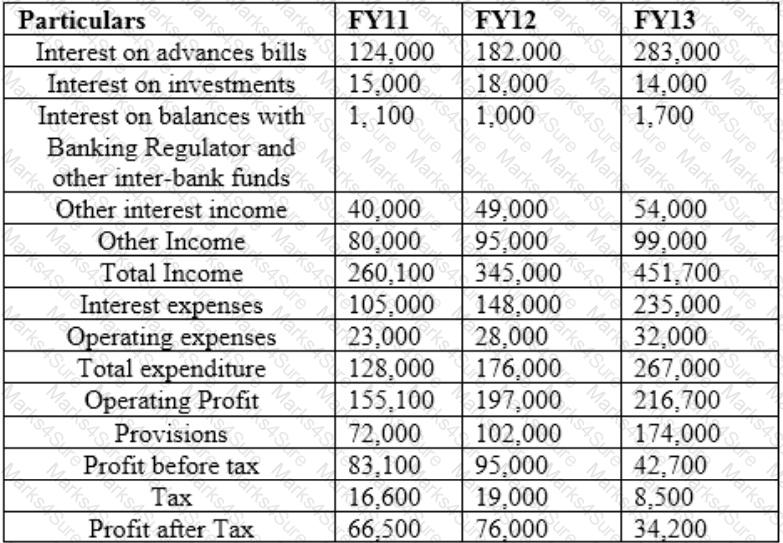
Profit and Loss Account
Balance Sheet
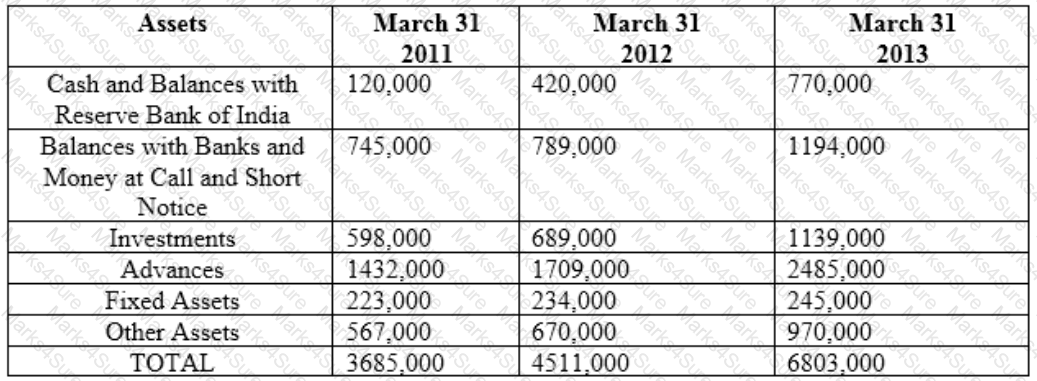
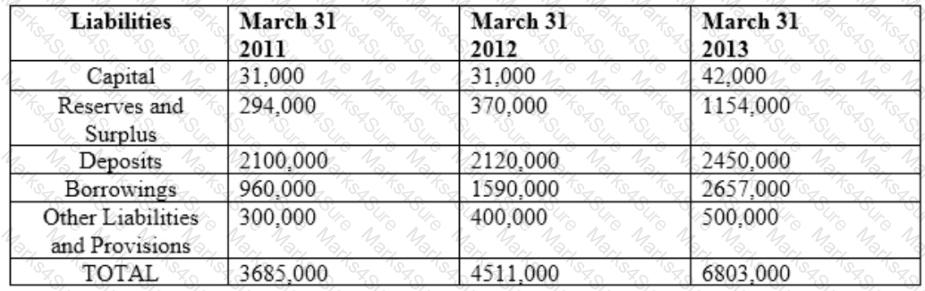
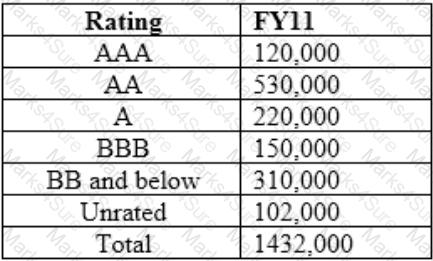
The rating wise break-up of assets for FY11 is as follows:
During which year amongst the three, was the overall financial profile of bank most string?
The following information pertains to bonds:
Further following information is available about a particular bond ‘Bond F’
There is a 10.25% risky bond with a maturity of 2.25% year(s) its current price is INR105.31, which ccorresponds to YTM of 9.22%. The following are the benchmark YTMs.

Assume that the general market rates have increased. An issuer, Revolution Ltd has plans to roll over its existing commercial paper and forth coming reset dates for its floating rate bonds are very near. Which of the following ratios for revolution will get impacted?
Mark Construction Company (MCC) has bagged a contract for construction of a large dam and hydro power project on river Shivna in Madhya Pradesh (MP). The project is also of relevance from the irrigation perspective due to its location and as per the agreement MCC will have to undertake construction of web of canals, approach road to dam, power house and other ancillary units. MCC is promoted by Mr. Thomas Mark, who is a MP from the ruling party which recently formed government in MP. Historically, MCC has been engaged into construction of rural roads, small bridges and railway platforms on contract basis for the Government. MCC will have a separate special purpose vehicle (SPV) floated for this venture.
The hydro power project comes under the public private partnership scheme of the Government of MP, where in the private partner builds owns operates and transfers (BOOT) the hydro power plant. The detailed terms of the hydro power project agreement are as follows:
1. The construction of the dam, canals and hydro power plant shall be undertaken by the contractor. The
Government of MP will have to acquire land which will submerge on construction of dam and shall rehabilitate the owners of land.
2. MCC shall have right to operate the hydro power project from date of commencement of commercial operations (DCCO) for a period of 20 years and shall transfer the project to Government thereafter. Further,
SPV shall be tax exempt for a period of five years from DCCO i.e. FY17-FY21.
3. The power project is of 600 megawatts (MW) shall comprise 4 units of 150 MW each. The estimated cost of project is about INR3, 500 Million to be spent over a period of 4 year(s) the project is estimated to be commercially operational by April 1, 2016 with two units operational om same day and one unit each will be operational on April 1, 2017 and April 1, 2018.
4. Means of finance:

Means of Finance INR Million
Government Aid (To be classified as Equity) 500Equity 900 Debt 2100
5. Amount if expenditure estimated in various years is as follows:

Debt shall bear a fixed rate of interest of 10% and all interest till DCCO shall be added to the principal. The expected principal along with capitalized interest is expected to be INR2, 400 Million (i.e.INR2100 Million debt plus INR300 Million capitalized interest). The repayment of the same shall be in 12 equated annual installments starting from FY17.
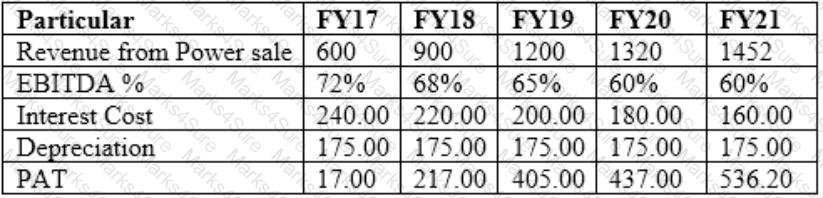
Brief projections for the period of FY17 to FY21 are given below:
Developments as on March 31, 2015
The project manager for the SPV made following comments at a press conferee on March 31, 2015:
As you all are aware, we were running bang on schedule till we last met on December 21, 2014. From today we are just left with one more year to complete the project in time. However, the flash floods which struck our dam site on this March 15, 2015 have created havoc in the region. I shall not point out the loss of lives in the region as you all are well aware of those. Our project has also been badly hit due to the same and we have been assessing the damage over the last one week. After analyzing damage, we have made changes in project schedule. Now we will be making only one unit of 150 MW operational on April 1, 2016 and 1 unit each will be added in each of subsequent year(s).
Development as on September 30, 2015
Post the flash floods, lot of environmentalists started raising issues of changes in environment due to construction of large number of dams. A few Public Interest Litigations (PILs) have been filed in various courts.
Honorable High Court of MP on September 27, 2015, banned construction of any dams in the region and banned permissions for new dams till next hearing scheduled on November 30, 2015. MCC in its press release has indicated that they will apply to the higher court on the matter.
After the developments of March 31, 2015, assuming revenues are directly linked to the power production and the EBITDA margins remain intact for the year, as were projected, compute the revised interest coverage ratio dfor FY17 and FY18?
Mark Construction Company (MCC) has bagged a contract for construction of a large dam and hydro power project on river Shiva in Madhya Pradesh (MP). The project is also of relevance from the irrigation perspective due to its location and as per the agreement MCC will have to undertake construction of web of canals, approach road to dam, power house and other ancillary units. MCC is promoted by Mr. Thomas Mark, who is a MP from the ruling party which recently formed government in MP. Historically, MCC has been engaged into construction of rural roads, small bridges and railway platforms on contract basis for the Government. MCC will have a separate special purpose vehicle (SPV) floated for this venture.
The hydro power project comes under the public private partnership scheme of the Government of MP, where in the private partner builds owns operates and transfers (BOOT) the hydro power plant. The detailed terms of the hydro power project agreement are as follows:1. The construction of the dam, canals and hydro power plant shall be undertaken by the contractor. The
Government of MP will have to acquire land which will submerge on construction of dam and shall rehabilitate the owners of land.
2. MCC shall have right to operate the hydro power project from date of commencement of commercial operations (DCCO) for a period of 20 years and shall transfer the project to Government thereafter. Further,
SPV shall be tax exempt for a period of five years from DCCO i.e. FY17-FY21.
3. The power project is of 600 megawatts (MW) shall comprise 4 units of 150 MW each. The estimated cost of project is about INR3, 500 Million to be spent over a period of 4 year(s) the project is estimated to be commercially operational by April 1, 2016 with two units operational om same day and one unit each will be operational on April 1, 2017 and April 1, 2018.
4. Means of finance:

Means of Finance INR Million
Government Aid (To be classified as Equity) 500Equity 900 Debt 2100
5. Amount if expenditure estimated in various years is as follows:

Debt shall bear a fixed rate of interest of 10% and all interest till DCCO shall be added to the principal. The expected principal along with capitalized interest is expected to be INR2, 400 Million (i.e.INR2100 Million debt plus INR300 Million capitalized interest). The repayment of the same shall be in 12 equated annual installments starting from FY17.
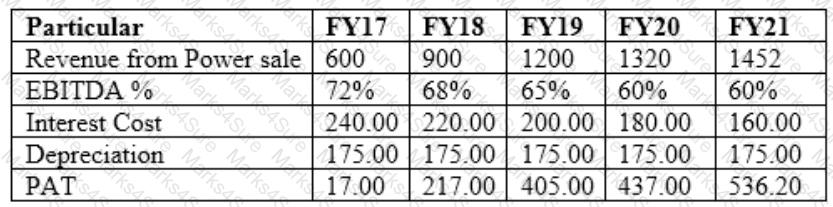
Brief projections for the period of FY17 to FY21 are given below:
Developments as on March 31, 2015
The project manager for the SPV made following comments at a press conferee on March 31, 2015:
As you all are aware, we were running bang on schedule till we last met on December 21, 2014. From today we are just left with one more year to complete the project in time. However, the flash floods which struck our dam site on this March 15, 2015 have created havoc in the region. I shall not point out the loss of lives in the region as you all are well aware of those. Our project has also been badly hit due to the same and we have been assessing the damage over the last one week. After analyzing damage, we have made changes in project schedule. Now we will be making only one unit of 150 MW operational on April 1, 2016 and 1 unit each will be added in each of subsequent year(s).
Development as on September 30, 2015
Post the flash floods, lot of environmentalists started raising issues of changes in environment due to construction of large number of dams. A few Public Interest Litigations (PILs) have been filed in various courts.
Honorable High Court of MP on September 27, 2015, banned construction of any dams in the region and banned permissions for new dams till next hearing scheduled on November 30, 2015. MCC in its press release has indicated that they will apply to the higher court on the matter.
Based on the initial projections, do scenario analysis assuming only 75% capacity is utilized in FY17 and FY18 and thereby revenues will be proportionally reduced.
Compute DSCR under such scenario for FY17 and FY18, assuming other things remain constant?
The following information pertains to bonds:
Further following information is available about a particular bond ‘Bond F’
There is a 10.25% risky bond with a maturity of 2.25% year(s) its current price is INR105.31, which corresponds to YTM of 9.22%. The following are the benchmark YTMs.

Compute interpolated spread for Bond F based on the information provided in the vignette:
Which of the following is NOT a conceptual definition of credit risk on which credit models are based?
__________Strategy consists of buying a bond with maturity longer than the investment horizon (for investor)
or buying a long-maturity bond with short-term funding through repo (for speculator).
Mr. A shares details of two bonds as follows:
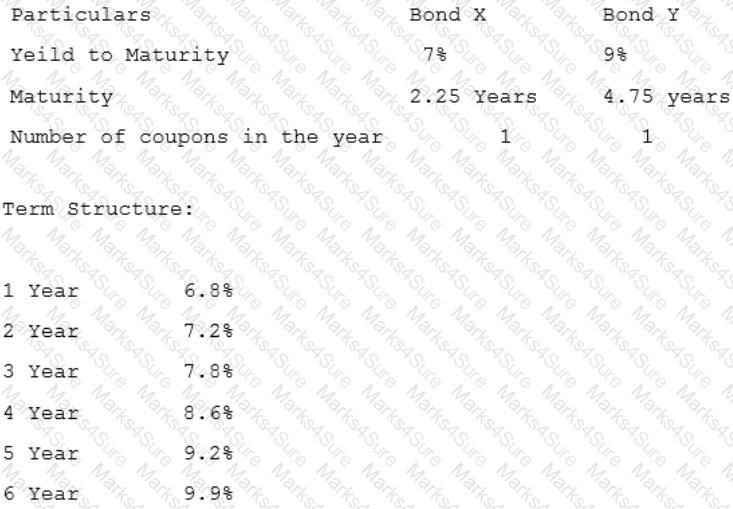
Determine the interpolated spread for Bond X and Bond Y?
Which of the following statement is (are) correct?
Statement 1: Industry analysis is the first and foremost step in the bottom up approach of analysis.
Statement 2: Industry analysis would enable an analyst to figure out the relative positions of various market players and thereby make informed investment decisions.
Mark Construction Company (MCC) has bagged a contract for construction of a large dam and hydro power project on river Shivna in Madhya Pradesh (MP). The project is also of relevance from the irrigation perspective due to its location and as per the agreement MCC will have to undertake construction of web of canals, approach road to dam, power house and other ancillary units. MCC is promoted by Mr. Thomas Mark, who is a MP from the ruling party which recently formed government in MP. Historically, MCC has been engaged into construction of rural roads, small bridges and railway platforms on contract basis for the Government. MCC will have a separate special purpose vehicle (SPV) floated for this venture. The hydro power project comes under the public private partnership scheme of the Government of MP, where in the private partner builds owns operates and transfers (BOOT) the hydro power plant. The detailed terms of the hydro power project agreement are as follows:
1. The construction of the dam, canals and hydro power plant shall be undertaken by the contractor. The
Government of MP will have to acquire land which will submerge on construction of dam and shall rehabilitate the owners of land.
2. MCC shall have right to operate the hydro power project from date of commencement of commercial operations (DCCO) for a period of 20 years and shall transfer the project to Government thereafter. Further,
SPV shall be tax exempt for a period of five years from DCCO i.e. FY17-FY21.
3. The power project is of 600 megawatts (MW) shall comprise 4 units of 150 MW each. The estimated cost of project is about INR3, 500 Million to be spent over a period of 4 year(s) the project is estimated to be commercially operational by April 1, 2016 with two units operational om same day and one unit each will be operational on April 1, 2017 and April 1, 2018.
4. Means of finance:

Means of Finance INR Million
Government Aid (To be classified as Equity) 500Equity 900 Debt 2100
5. Amount if expenditure estimated in various years is as follows:

Debt shall bear a fixed rate of interest of 10% and all interest till DCCO shall be added to the principal. The expected principal along with capitalized interest is expected to be INR2, 400 Million (i.e.INR2100 Million debt plus INR300 Million capitalized interest). The repayment of the same shall be in 12 equated annual installments starting from FY17.
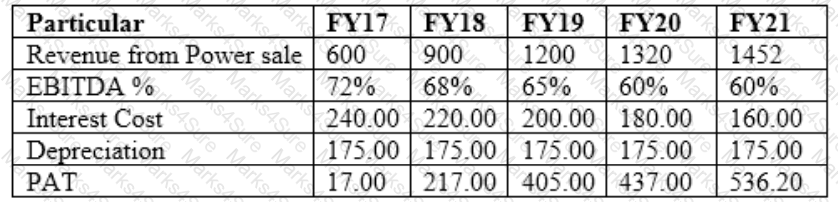
Brief projections for the period of FY17 to FY21 are given below:
Developments as on March 31, 2015
The project manager for the SPV made following comments at a press conferee on March 31, 2015:
As you all are aware, we were running bang on schedule till we last met on December 21, 2014. From today we are just left with one more year to complete the project in time. However, the flash floods which struck our dam site on this March 15, 2015 have created havoc in the region. I shall not point out the loss of lives in the region as you all are well aware of those. Our project has also been badly hit due to the same and we havebeen assessing the damage over the last one week. After analyzing damage, we have made changes in project schedule. Now we will be making only one unit of 150 MW operational on April 1, 2016 and 1 unit each will be added in each of subsequent year(s).
Development as on September 30, 2015
Post the flash floods, lot of environmentalists started raising issues of changes in environment due to construction of large number of dams. A few Public Interest Litigations (PILs) have been filed in various courts.
Honorable High Court of MP on September 27, 2015, banned construction of any dams in the region and banned permissions for new dams till next hearing scheduled on November 30, 2015. MCC in its press release has indicated that they will apply to the higher court on the matter.
On receiving the credit proposal, the banker informed the company that in FY17 the DSCR is below unity, which is not acceptable to bank. Which of the following is correct?
The extension of a guarantee by company A to company B can lower the rating of___________
PDF + Testing Engine

Testing Engine
PDF (Q&A)