
- Home
- ISC
- ISC 2 Credentials
- CISSP
- Certified Information Systems Security Professional (CISSP) Questions and Answers
Free Practice Questions for the ISC 2 Credentials CISSP Exam (2026 Updated)
At Marks4sure, we are dedicated to providing IT professionals with the most accurate and reliable preparation materials for the ISC CISSP exam. To support your certification journey, we have made a selection of our premium 2026 ISC 2 Credentials practice questions and answers available completely free. You can take this practice test as many times as you need. Every question includes a detailed, expertly verified explanation to ensure you fully grasp the core security concepts before test day.
What is the PRIMARY reason for implementing change management?
Options:
Certify and approve releases to the environment
Provide version rollbacks for system changes
Ensure that all applications are approved
Ensure accountability for changes to the environment
Answer:
DExplanation:
Ensuring accountability for changes to the environment is the primary reason for implementing change management. Change management is a process that ensures that any changes to the system or network environment, such as the hardware, software, configuration, or documentation, are planned, approved, implemented, and documented in a controlled and consistent manner. Change management can provide several benefits, such as:
Improving the security and reliability of the system or network environment by preventing or reducing the errors, conflicts, or disruptions that might occur due to the changes
Enhancing the performance and efficiency of the system or network environment by optimizing the resources and functions
Increasing the compliance and alignment of the system or network environment with the internal or external requirements and standards
Facilitating the monitoring and improvement of the system or network environment by tracking and logging the changes and their outcomes
Ensuring accountability for changes to the environment is the primary reason for implementing change management, because it can ensure that the changes are authorized, justified, and traceable, and that the parties involved in the changes are responsible and accountable for their actions and results. Accountability can also help to deter or detect any unauthorized or malicious changes that might compromise the system or network environment.
The other options are not the primary reasons for implementing change management, but rather secondary or specific reasons for different aspects or phases of change management. Certifying and approving releases to the environment is a reason for implementing change management, but it is more relevant for the approval phase of change management, which is the phase that involves reviewing and validating the changes and their impacts, and granting or denying the permission to proceed with the changes. Providing version rollbacks for system changes is a reason for implementing change management, but it is more relevant for the implementation phase of change management, which is the phase that involves executing and monitoring the changes and their effects, and providing the backup and recovery options for the changes. Ensuring that all applications are approved is a reason for implementing change management, but it is more relevant for the application changes, which are the changes that affect the software components or services that provide the functionality or logic of the system or network environment.
Which of the following BEST describes an access control method utilizing cryptographic keys derived from a smart card private key that is embedded within mobile devices?
Options:
Derived credential
Temporary security credential
Mobile device credentialing service
Digest authentication
Answer:
AExplanation:
Derived credential is the best description of an access control method utilizing cryptographic keys derived from a smart card private key that is embedded within mobile devices. A smart card is a device that contains a microchip that stores a private key and a digital certificate that are used for authentication and encryption. A smart card is typically inserted into a reader that is attached to a computer or a terminal, and the user enters a personal identification number (PIN) to unlock the smart card and access the private key and the certificate. A smart card can provide a high level of security and convenience for the user, as it implements a two-factor authentication method that combines something the user has (the smart card) and something the user knows (the PIN).
However, a smart card may not be compatible or convenient for mobile devices, such as smartphones or tablets, that do not have a smart card reader or a USB port. To address this issue, a derived credential is a solution that allows the user to use a mobile device as an alternative to a smart card for authentication and encryption. A derived credential is a cryptographic key and a certificate that are derived from the smart card private key and certificate, and that are stored on the mobile device. A derived credential works as follows:
The user inserts the smart card into a reader that is connected to a computer or a terminal, and enters the PIN to unlock the smart card
The user connects the mobile device to the computer or the terminal via a cable, Bluetooth, or Wi-Fi
The user initiates a request to generate a derived credential on the mobile device
The computer or the terminal verifies the smart card certificate with a trusted CA, and generates a derived credential that contains a cryptographic key and a certificate that are derived from the smart card private key and certificate
The computer or the terminal transfers the derived credential to the mobile device, and stores it in a secure element or a trusted platform module on the device
The user disconnects the mobile device from the computer or the terminal, and removes the smart card from the reader
The user can use the derived credential on the mobile device to authenticate and encrypt the communication with other parties, without requiring the smart card or the PIN
A derived credential can provide a secure and convenient way to use a mobile device as an alternative to a smart card for authentication and encryption, as it implements a two-factor authentication method that combines something the user has (the mobile device) and something the user is (the biometric feature). A derived credential can also comply with the standards and policies for the use of smart cards, such as the Personal Identity Verification (PIV) or the Common Access Card (CAC) programs.
The other options are not the best descriptions of an access control method utilizing cryptographic keys derived from a smart card private key that is embedded within mobile devices, but rather descriptions of other methods or concepts. Temporary security credential is a method that involves issuing a short-lived credential, such as a token or a password, that can be used for a limited time or a specific purpose. Temporary security credential can provide a flexible and dynamic way to grant access to the users or entities, but it does not involve deriving a cryptographic key from a smart card private key. Mobile device credentialing service is a concept that involves providing a service that can issue, manage, or revoke credentials for mobile devices, such as certificates, tokens, or passwords. Mobile device credentialing service can provide a centralized and standardized way to control the access of mobile devices, but it does not involve deriving a cryptographic key from a smart card private key. Digest authentication is a method that involves using a hash function, such as MD5, to generate a digest or a fingerprint of the user’s credentials, such as the username and password, and sending it to the server for verification. Digest authentication can provide a more secure way to authenticate the user than the basic authentication, which sends the credentials in plain text, but it does not involve deriving a cryptographic key from a smart card private key.
Users require access rights that allow them to view the average salary of groups of employees. Which control would prevent the users from obtaining an individual employee’s salary?
Options:
Limit access to predefined queries
Segregate the database into a small number of partitions each with a separate security level
Implement Role Based Access Control (RBAC)
Reduce the number of people who have access to the system for statistical purposes
Answer:
AExplanation:
Limiting access to predefined queries is the control that would prevent the users from obtaining an individual employee’s salary, if they only require access rights that allow them to view the average salary of groups of employees. A query is a request for information from a database, which can be expressed in a structured query language (SQL) or a graphical user interface (GUI). A query can spec ify the criteria, conditions, and operations for selecting, filtering, sorting, grouping, and aggregating the data from the database. A predefined query is a query that has been created and stored in advance by the database administrator or the data owner, and that can be executed by the authorized users without any modification. A predefined query can provide several benefits, such as:
Improving the performance and efficiency of the database by reducing the processing time and resources required for executing the queries
Enhancing the security and confidentiality of the database by restricting the access and exposure of the sensitive data to the authorized users and purposes
Increasing the accuracy and reliability of the database by preventing the errors or inconsistencies that might occur due to the user input or modification of the queries
Reducing the cost and complexity of the database by simplifying the query design and management
Limiting access to predefined queries is the control that would prevent the users from obtaining an individual employee’s salary, if they only require access rights that allow them to view the average salary of groups of employees, because it can ensure that the users can only access the data that is relevant and necessary for their tasks, and that they cannot access or manipulate the data that is beyond their scope or authority. For example, a predefined query can be created and stored that calculates and displays the average salary of groups of employees based on certain criteria, such as department, position, or experience. The users who need to view this information can execute this predefined query, but they cannot modify it or create their own queries that might reveal the individual employee’s salary or other sensitive data.
The other options are not the controls that would prevent the users from obtaining an individual employee’s salary, if they only require access rights that allow them to view the average salary of groups of employees, but rather controls that have other purposes or effects. Segregating the database into a small number of partitions each with a separate security level is a control that would improve the performance and security of the database by dividing it into smaller and manageable segments that can be accessed and processed independently and concurrently. However, this control would not prevent the users from obtaining an individual employee’s salary, if they have access to the partition that contains the salary data, and if they can create or modify their own queries. Implementing Role Based Access Control (RBAC) is a control that would enforce the access rights and permissions of the users based on their roles or functions within the organization, rather than their identities or attributes. However, this control would not prevent the users from obtaining an individual employee’s salary, if their roles or functions require them to access the salary data, and if they can create or modify their own queries. Reducing the number of people who have access to the system for statistical purposes is a control that would reduce the risk and impact of unauthorized access or disclosure of the sensitive data by minimizing the exposure and distribution of the data. However, this control would not prevent the users from obtaining an individual employee’s salary, if they are among the people who have access to the system, and if they can create or modify their own queries.
A Java program is being developed to read a file from computer A and write it to computer B, using a third computer C. The program is not working as expected. What is the MOST probable security feature of Java preventing the program from operating as intended?
Options:
Least privilege
Privilege escalation
Defense in depth
Privilege bracketing
Answer:
AExplanation:
The most probable security feature of Java preventing the program from operating as intended is least privilege. Least privilege is a principle that states that a subject (such as a user, a process, or a program) should only have the minimum amount of access or permissions that are necessary to per form its function or task. Least privilege can help to reduce the attack surface and the potential damage of a system or network, by limiting the exposure and impact of a subject in case of a compromise or misuse.
Java implements the principle of least privilege through its security model, which consists of several components, such as:
The Java Virtual Machine (JVM): a software layer that executes the Java bytecode and provides an abstraction from the underlying hardware and operating system. The JVM enforces the security rules and restrictions on the Java programs, such as the memory protection, the bytecode verification, and the exception handling.
The Java Security Manager: a class that defines and controls the security policy and permissions for the Java programs. The Java Security Manager can be configured and customized by the system administrator or the user, and can grant or deny the access or actions of the Java programs, such as the file I/O, the network communication, or the system properties.
The Java Security Policy: a file that specifies the security permissions for the Java programs, based on the code source and the code signer. The Java Security Policy can be defined and modified by the system administrator or the user, and can assign different levels of permissions to different Java programs, such as the trusted or the untrusted ones.
The Java Security Sandbox: a mechanism that isolates and restricts the Java programs that are downloaded or executed from untrusted sources, such as the web or the network. The Java Security Sandbox applies the default or the minimal security permissions to the untrusted Java programs, and prevents them from accessing or modifying the local resources or data, such as the files, the databases, or the registry.
In this question, the Java program is being developed to read a file from computer A and write it to computer B, using a third computer C. This means that the Java program needs to have the permissions to perform the file I/O and the network communication operations, which are considered as sensitive or risky actions by the Java security model. However, if the Java program is running on computer C with the default or the minimal security permissions, such as in the Java Security Sandbox, then it will not be able to perform these operations, and the program will not work as expected. Therefore, the most probable security feature of Java preventing the program from operating as intended is least privilege, which limits the access or permissions of the Java program based on its source, signer, or policy.
The other options are not the security features of Java preventing the program from operating as intended, but rather concepts or techniques that are related to security in general or in other contexts. Privilege escalation is a technique that allows a subject to gain higher or unauthorized access or permissions than what it is supposed to have, by exploiting a vulnerability or a flaw in a system or network. Privilege escalation can help an attacker to perform malicious actions or to access sensitive resources or data, by bypassing the security controls or restrictions. Defense in depth is a concept that states that a system or network should have multiple layers or levels of security, to provide redundancy and resilience in case of a breach or an attack. Defense in depth can help to protect a system or network from various threats and risks, by using different types of security measures and controls, such as the physical, the technical, or the administrative ones. Privilege bracketing is a technique that allows a subject to temporarily elevate or lower its access or permissions, to perform a specific function or task, and then return to its original or normal level. Privilege bracketing can help to reduce the exposure and impact of a subject, by minimizing the time and scope of its higher or lower access or permissions.
A manufacturing organization wants to establish a Federated Identity Management (FIM) system with its 20 different supplier companies. Which of the following is the BEST solution for the manufacturing organization?
Options:
Trusted third-party certification
Lightweight Directory Access Protocol (LDAP)
Security Assertion Markup language (SAML)
Cross-certification
Answer:
CExplanation:
Security Assertion Markup Language (SAML) is the best solution for the manufacturing organization that wants to establish a Federated Identity Management (FIM) system with its 20 different supplier companies. FIM is a process that allows the sharing and recognition of identities across different organizations that have a trust relationship. FIM enables the users of one organization to access the resources or services of another organization without having to create or maintain multiple accounts or credentials. FIM can provide several benefits, such as:
Improving the user experience and convenience by reducing the need for multiple logins and passwords
Enhancing the security and privacy by minimizing the exposure and duplication of sensitive information
Increasing the efficiency and productivity by streamlining the authentication and authorization processes
Reducing the cost and complexity by simplifying the identity management and administration
SAML is a standard protocol that supports FIM by allowing the exchange of authentication and authorization information between different parties. SAML uses XML-based messages, called assertions, to convey the identity, attributes, and entitlements of a user to a service provider. SAML defines three roles for the parties involved in FIM:
Identity provider (IdP): the party that authenticates the user and issues the SAML assertion
Service provider (SP): the party that provides the resource or service that the user wants to access
User or principal: the party that requests access to the resource or service
SAML works as follows:
The user requests access to a resource or service from the SP
The SP redirects the user to the IdP for authentication
The IdP authenticates the user and generates a SAML assertion that contains the user’s identity, attributes, and entitlements
The IdP sends the SAML assertion to the SP
The SP validates the SAML assertion and grants or denies access to the user based on the information in the assertion
SAML is the best solution for the manufacturing organization that wants to establish a FIM system with its 20 different supplier companies, because it can enable the seamless and secure access to the resources or services across the different organizations, without requiring the users to create or maintain multiple accounts or credentials. SAML can also provide interoperability and compatibility between different platforms and technologies, as it is based on a standard and open protocol.
The other options are not the best solutions for the manufacturing organization that wants to establish a FIM system with its 20 different supplier companies, but rather solutions that have other limitations or drawbacks. Trusted third-party certification is a process that involves a third party, such as a certificate authority (CA), that issues and verifies digital certificates that contain the public key and identity information of a user or an entity. Trusted third-party certification can provide authentication and encryption for the communication between different parties, but it does not provide authorization or entitlement information for the access to the resources or services. Lightweight Directory Access Protocol (LDAP) is a protocol that allows the access and management of directory services, such as Active Directory, that store the identity and attribute information of users and entities. LDAP can provide a centralized and standardized way to store and retrieve identity and attribute information, but it does not provide a mechanism to exchange or federate the information across different organizations. Cross-certification is a process that involves two or more CAs that establish a trust relationship and recognize each other’s certificates. Cross-certification can extend the trust and validity of the certificates across different domains or organizations, but it does not provide a mechanism to exchange or federate the identity, attribute, or entitlement information.
Which of the following is the BEST method to prevent malware from being introduced into a production environment?
Options:
Purchase software from a limited list of retailers
Verify the hash key or certificate key of all updates
Do not permit programs, patches, or updates from the Internet
Test all new software in a segregated environment
Answer:
DExplanation:
Testing all new software in a segregated environment is the best method to prevent malware from being introduced into a production environment. Malware is any malicious software that can harm or compromise the security, availability, integrity, or confidentiality of a system or data. Malware can be introduced into a production environment through various sources, such as software downloads, updates, patches, or installations. Testing all new software in a segregated environment involves verifying and validating the functionality and security of the software before deploying it to the production environment, using a separate system or network that is isolated and protected from the production environment. Testing all new software in a segregated environment can provide several benefits, such as:
Preventing the infection or propagation of malware to the production environment
Detecting and resolving any issues or risks caused by the software
Ensuring the compatibility and interoperability of the software with the production environment
Supporting and enabling the quality assurance and improvement of the software
The other options are not the best methods to prevent malware from being introduced into a production environment, but rather methods that can reduce or mitigate the risk of malware, but not eliminate it. Purchasing software from a limited list of retailers is a method that can reduce the risk of malware from being introduced into a production environment, but not prevent it. This method involves obtaining software only from trusted and reputable sources, such as official vendors or distributors, that can provide some assurance of the quality and security of the software. However, this method does not guarantee that the software is free of malware, as it may still contain hidden or embedded malware, or it may be tampered with or compromised during the delivery or installation process. Verifying the hash key or certificate key of all updates is a method that can reduce the risk of malware from being introduced into a production environment, but not prevent it. This method involves checking the authenticity and integrity of the software updates, patches, or installations, by comparing the hash key or certificate key of the software with the expected or published value, using cryptographic techniques and tools. However, this method does not guarantee that the software is free of malware, as it may still contain malware that is not detected or altered by the hash key or certificate key, or it may be subject to a man-in-the-middle attack or a replay attack that can intercept or modify the software or the key. Not permitting programs, patches, or updates from the Internet is a method that can reduce the risk of malware from being introduced into a production environment, but not prevent it. This method involves restricting or blocking the access or download of software from the Internet, which is a common and convenient source of malware, by applying and enforcing the appropriate security policies and controls, such as firewall rules, antivirus software, or web filters. However, this method does not guarantee that the software is free of malware, as it may still be obtained or infected from other sources, such as removable media, email attachments, or network shares.
Which of the following is a web application control that should be put into place to prevent exploitation of Operating System (OS) bugs?
Options:
Check arguments in function calls
Test for the security patch level of the environment
Include logging functions
Digitally sign each application module
Answer:
BExplanation:
Testing for the security patch level of the environment is the web application control that should be put into place to prevent exploitation of Operating System (OS) bugs. OS bugs are errors or defects in the code or logic of the OS that can cause the OS to malfunction or behave unexpectedly. OS bugs can be exploited by attackers to gain unauthorized access, disrupt business operations, or steal or leak sensitive data. Testing for the security patch level of the environment is the web application control that should be put into place to prevent exploitation of OS bugs, because it can provide several benefits, such as:
Detecting and resolving any vulnerabilities or issues caused by the OS bugs by applying the latest security patches or updates from the OS developers or vendors
Enhancing the security and performance of the web applications by using the most secure and efficient version of the OS that supports the web applications
Increasing the compliance and alignment of the web applications with the security policies and regulations that are applicable to the web applications
Improving the compatibility and interoperability of the web applications with the other systems or platforms that interact with the web applications
The other options are not the web application controls that should be put into place to prevent exploitation of OS bugs, but rather web application controls that can prevent or mitigate other types of web application attacks or issues. Checking arguments in function calls is a web application control that can prevent or mitigate buffer overflow attacks, which are attacks that exploit the vulnerability of the web application code that does not properly check the size or length of the input data that is passed to a function or a variable, and overwrite the adjacent memory locations with malicious code or data. Including logging functions is a web application control that can prevent or mitigate unauthorized access or modification attacks, which are attacks that exploit the lack of or weak authentication or authorization mechanisms of the web applications, and access or modify the web application data or functionality without proper permission or verification. Digitally signing each application module is a web application control that can prevent or mitigate code injection or tampering attacks, which are attacks that exploit the vulnerability of the web application code that does not properly validate or sanitize the input data that is executed or interpreted by the web application, and inject or modify the web application code with malicious code or data.
What is the BEST approach to addressing security issues in legacy web applications?
Options:
Debug the security issues
Migrate to newer, supported applications where possible
Conduct a security assessment
Protect the legacy application with a web application firewall
Answer:
BExplanation:
Migrating to newer, supported applications where possible is the best approach to addressing security issues in legacy web applications. Legacy web applications are web applications that are outdated, unsupported, or incompatible with the current technologies and standards. Legacy web applications may have various security issues, such as:
Vulnerabilities and bugs that are not fixed or patched by the developers or vendors
Weak or obsolete encryption and authentication mechanisms that are easily broken or bypassed by attackers
Lack of compliance with the security policies and regulations that are applicable to the web applications
Incompatibility or interoperability issues with the newer web browsers, operating systems, or platforms that are used by the users or clients
Migrating to newer, supported applications where possible is the best approach to addressing security issues in legacy web applications, because it can provide several benefits, such as:
Enhancing the security and performance of the web applications by using the latest technologies and standards that are more secure and efficient
Reducing the risk and impact of the web application attacks by eliminating or minimizing the vulnerabilities and bugs that are present in the legacy web applications
Increasing the compliance and alignment of the web applications with the security policies and regulations that are applicable to the web applications
Improving the compatibility and interoperability of the web applications with the newer web browsers, operating systems, or platforms that are used by the users or clients
The other options are not the best approaches to addressing security issues in legacy web applications, but rather approaches that can mitigate or remediate the security issues, but not eliminate or prevent them. Debugging the security issues is an approach that can mitigate the security issues in legacy web applications, but not the best approach, because it involves identifying and fixing the errors or defects in the code or logic of the web applications, which may be difficult or impossible to do for the legacy web applications that are outdated or unsupported. Conducting a security assess ment is an approach that can remediate the security issues in legacy web applications, but not the best approach, because it involves evaluating and testing the security effectiveness and compliance of the web applications, using various techniques and tools, such as audits, reviews, scans, or penetration tests, and identifying and reporting any security weaknesses or gaps, which may not be sufficient or feasible to do for the legacy web applications that are incompatible or obsolete. Protecting the legacy application with a web application firewall is an approach that can mitigate the security issues in legacy web applications, but not the best approach, because it involves deploying and configuring a web application firewall, which is a security device or software that monitors and filters the web traffic between the web applications and the users or clients, and blocks or allows the web requests or responses based on the predefined rules or policies, which may not be effective or efficient to do for the legacy web applications that have weak or outdated encryption or authentication mechanisms.
When in the Software Development Life Cycle (SDLC) MUST software security functional requirements be defined?
Options:
After the system preliminary design has been developed and the data security categorization has been performed
After the vulnerability analysis has been performed and before the system detailed design begins
After the system preliminary design has been developed and before the data security categorization begins
After the business functional analysis and the data security categorization have been performed
Answer:
DExplanation:
Software security functional requirements must be defined after the business functional analysis and the data security categorization have been performed in the Software Development Life Cycle (SDLC). The SDLC is a process that involves planning, designing, developing, testing, deploying, operating, and maintaining a system, using various models and methodologies, such as waterfall, spiral, agile, or DevSecOps. The SDLC can be divided into several phases, each with its own objectives and activities, such as:
System initiation: This phase involves defining the scope, purpose, and objectives of the system, identifying the stakeholders and their needs and expectations, and establishing the project plan and budget.
System acquisition and development: This phase involves designing the architecture and components of the system, selecting and procuring the hardware and software resources, developing and coding the system functionality and features, and integrating and testing the system modules and interfaces.
System implementation: This phase involves deploying and installing the system to the production environment, migrating and converting the data and applications from the legacy system, training and educating the users and staff on the system operation and maintenance, and evaluating and validating the system performance and effectiveness.
System operations and maintenance: This phase involves operating and monitoring the system functionality and availability, maintaining and updating the system hardware and software, resolving and troubleshooting any issues or problems, and enhancing and optimizing the system features and capabilities.
Software security functional requirements are the specific and measurable security features and capabilities that the system must provide to meet the security objectives and requirements. Software security functional requirements are derived from the business functional analysis and the data security categorization, which are two tasks that are performed in the system initiation phase of the SDLC. The business functional analysis is the process of identifying and documenting the business functions and processes that the system must support and enable, such as the inputs, outputs, workflows, and tasks. The data security categorization is the process of determining the security level and impact of the system and its data, based on the confidentiality, integrity, and availability criteria, and applying the appropriate security controls and measures. Software security functional requirements must be defined after the business functional analysis and the data security categorization have been performed, because they can ensure that the system design and development are consistent and compliant with the security objectives and requirements, and that the system security is aligned and integrated with the business functions and processes.
The other options are not the phases of the SDLC when the software security functional requirements must be defined, but rather phases that involve other tasks or activities related to the system design and development. After the system preliminary design has been developed and the data security categorization has been performed is not the phase when the software security functional re quirements must be defined, but rather the phase when the system architecture and components are designed, based on the system scope and objectives, and the data security categorization is verified and validated. After the vulnerability analysis has been performed and before the system detailed design begins is not the phase when the software security functional requirements must be defined, but rather the phase when the system design and components are evaluated and tested for the security effectiveness and compliance, and the system detailed design is developed, based on the system architecture and components. After the system preliminary design has been developed and before the data security categorization begins is not the phase when the software security functional requirements must be defined, but rather the phase when the system architecture and components are designed, based on the system scope and objectives, and the data security categorization is initiated and planned.
Which of the following is the PRIMARY risk with using open source software in a commercial software construction?
Options:
Lack of software documentation
License agreements requiring release of modified code
Expiration of the license agreement
Costs associated with support of the software
Answer:
BExplanation:
The primary risk with using open source software in a commercial software construction is license agreements requiring release of modified code. Open source software is software that uses publicly available source code, which can be seen, modified, and distributed by anyone. Open source software has some advantages, such as being affordable and flexible, but it also has some disadvantages, such as being potentially insecure or unsupported.
One of the main disadvantages of using open source software in a commercial software construction is the license agreements that govern the use and distribution of the open source software. License agreements are legal contracts that specify the rights and obligations of the parties involved in the software, such as the original authors, the developers, and the users. License agreements can vary in terms of their terms and conditions, such as the scope, the duration, or the fees of the software.
Some of the common types of license agreements for open source software are:
Permissive licenses: license agreements that allow the developers and users to freely use, modify, and distribute the open source software, with minimal or no restrictions. Examples of permissive licenses are the MIT License, the Apache License, or the BSD License.
Copyleft licenses: license agreements that require the developers and users to share and distribute the open source software and any modifications or derivatives of it, under the same or compatible license terms and conditions. Examples of copyleft licenses are the GNU General Public License (GPL), the GNU Lesser General Public License (LGPL), or the Mozilla Public License (MPL).
Mixed licenses: license agreements that combine the elements of permissive and copyleft licenses, and may apply different license terms and conditions to different parts or components of the open source software. Examples of mixed licenses are the Eclipse Public License (EPL), the Common Development and Distribution License (CDDL), or the GNU Affero General Public License (AGPL).
The primary risk with using open source software in a commercial software construction is license agreements requiring release of modified code, which are usually associated with copyleft licenses. This means that if a commercial software construction uses or incorporates open source software that is licensed under a copyleft license, then it must also release its own source code and any modifications or derivatives of it, under the same or compatible copyleft license. This can pose a significant risk for the commercial software construction, as it may lose its competitive advantage, intellectual property, or revenue, by disclosing its source code and allowing others to use, modify, or distribute it.
The other options are not the primary risks with using open source software in a commercial software construction, but rather secondary or minor risks that may or may not apply to the open source software. Lack of software documentation is a secondary risk with using open source software in a commercial software construction, as it may affect the quality, usability, or maintainability of the open source software, but it does not necessarily affect the rights or obligations of the commercial software construction. Expiration of the license agreement is a minor risk with using open source software in a commercial software construction, as it may affect the availability or continuity of the open source software, but it is unlikely to happen, as most open source software licenses are perpetual or indefinite. Costs associated with support of the software is a secondary risk with using open source software in a commercial software construction, as it may affect the reliability, security, or performance of the open source software, but it can be mitigated or avoided by choosing the open source software that has adequate or alternative support options.
Which software defined networking (SDN) architectural component is responsible for translating network requirements?
Options:
SDN Application
SDN Data path
SDN Controller
SDN Northbound Interfaces
Answer:
CExplanation:
Software defined networking (SDN) is a network architecture that decouples the control plane from the data plane, allowing for more flexibility and programmability of network functions. The SDN controller is the architectural component that acts as the brain of the SDN network, communicating with both the SDN applications and the SDN data paths. The SDN controller is responsible for translating the network requirements from the SDN applications, such as security policies, routing rules, or load balancing, into instructions for the SDN data paths, such as switches, routers, or firewalls, to implement them. The SDN controller also monitors the network state and provides feedback to the SDN applications. References : CISSP All-in-One Exam Guide, Eighth Edition , Chapter 9: Communication and Network Security, page 573. Official (ISC)² CISSP CBK Reference, Fifth Edition , Domain 4: Communication and Network Security, page 663.
The configuration management and control task of the certification and accreditation process is incorporated in which phase of the System Development Life Cycle (SDLC)?
Options:
System acquisition and development
System operations and maintenance
System initiation
System implementation
Answer:
AExplanation:
The configuration management and control task of the certification and accreditation process is incorporated in the system acquisition and development phase of the System Development Life Cycle (SDLC). The SDLC is a process that involves planning, designing, developing, testing, deploying, oper ating, and maintaining a system, using various models and methodologies, such as waterfall, spiral, agile, or DevSecOps. The SDLC can be divided into several phases, each with its own objectives and activities, such as:
System initiation: This phase involves defining the scope, purpose, and objectives of the system, identifying the stakeholders and their needs and expectations, and establishing the project plan and budget.
System acquisition and development: This phase involves designing the architecture and components of the system, selecting and procuring the hardware and software resources, developing and coding the system functionality and features, and integrating and testing the system modules and interfaces.
System implementation: This phase involves deploying and installing the system to the production environment, migrating and converting the data and applications from the legacy system, training and educating the users and staff on the system operation and maintenance, and evaluating and validating the system performance and effectiveness.
System operations and maintenance: This phase involves operating and monitoring the system functionality and availability, maintaining and updating the system hardware and software, resolving and troubleshooting any issues or problems, and enhancing and optimizing the system features and capabilities.
The certification and accreditation process is a process that involves assessing and verifying the security and compliance of a system, and authorizing and approving the system operation and maintenance, using various standards and frameworks, such as NIST SP 800-37 or ISO/IEC 27001. The certification and accreditation process can be divided into several tasks, each with its own objectives and activities, such as:
Security categorization: This task involves determining the security level and impact of the system and its data, based on the confidentiality, integrity, and availability criteria, and applying the appropriate security controls and measures.
Security planning: This task involves defining the security objectives and requirements of the system, identifying the roles and responsibilities of the security stakeholders, and developing and documenting the security plan and policy.
Security implementation: This task involves implementing and enforcing the security controls and measures for the system, according to the security plan and policy, and ensuring the security functionality and compatibility of the system.
Security assessment: This task involves evaluating and testing the security effectiveness and compliance of the system, using various techniques and tools, such as audits, reviews, scans, or penetration tests, and identifying and reporting any security weaknesses or gaps.
Security authorization: This task involves reviewing and approving the security assessment results and recommendations, and granting or denying the authorization for the system operation and maintenance, based on the risk and impact analysis and the security objectives and requirements.
Security monitoring: This task involves monitoring and updating the security status and activities of the system, using various methods and tools, such as logs, alerts, or reports, and addressing and resolving any security issues or changes.
The configuration management and control task of the certification and accreditation process is incorporated in the system acquisition and development phase of the SDLC, because it can ensure that the system design and development are consistent and compliant with the security objectives and requirements, and that the system changes are controlled and documented. Configuration management and control is a process that involves establishing and maintaining the baseline and the inventory of the system components and resources, such as hardware, software, data, or documentation, and tracking and recording any modifications or updates to the system components and resources, using various techniques and tools, such as version control, change control, or configuration audits. Configuration management and control can provide several benefits, such as:
Improving the quality and security of the system design and development by identifying and addressing any errors or inconsistencies
Enhancing the performance and efficiency of the system design and development by optimizing the use and allocation of the system components and resources
Increasing the compliance and alignment of the system design and development with the security objectives and requirements by applying and enforcing the security controls and measures
Facilitating the monitoring and improvement of the system design and development by providing the evidence and information for the security assessment and authorization
The other options are not the phases of the SDLC that incorporate the configuration management and control task of the certification and accreditation process, but rather phases that involve other tasks of the certification and accreditation process. System operations and maintenance is a phase of the SDLC that incorporates the security monitoring task of the certification and accreditation process, because it can ensure that the system operation and maintenance are consistent and compliant with the security objectives and requirements, and that the system security is updated and improved. System initiation is a phase of the SDLC that incorporates the security categorization and security planning tasks of the certification and accreditation process, because it can ensure that the system scope and objectives are defined and aligned with the security objectives and requirements, and that the security plan and policy are developed and documented. System implementation is a phase of the SDLC that incorporates the security assessment and security authorization tasks of the certification and accreditation process, because it can ensure that the system deployment and installation are evaluated and verified for the security effectiveness and compliance, and that the system operation and maintenance are authorized and approved based on the risk and impact analysis and the security objectives and requirements.
Why are packet filtering routers used in low-risk environments?
Options:
They are high-resolution source discrimination and identification tools.
They are fast and flexible, and protect against Internet Protocol (IP) spoofing.
They are fast, flexible, and transparent.
They enforce strong user authentication and audit tog generation.
Answer:
CExplanation:
Packet filtering routers are used in low-risk environments because they offer speed, flexibility, and transparency in filtering traffic based on IP protocol, source/destination IP address, or port number without adding significant overhead or complexity. References : Unable to provide specific references due to browsing limitations.
Which of the following are all elements of a disaster recovery plan (DRP)?
Options:
Document the actual location of the ORP, developing an incident notification procedure, evaluating costs of critical components
Document the actual location of the ORP, developing an incident notification procedure, establishing recovery locations
Maintain proper documentation of all server logs, developing an incident notification procedure, establishing recovery locations
Document the actual location of the ORP, recording minutes at all ORP planning sessions, establishing recovery locations
Answer:
BExplanation:
The elements of a disaster recovery plan (DRP) are document the actual location of the ORP, developing an incident notification procedure, and establishing recovery locations. A DRP is a plan that defines the procedures and resources for restoring the critical business functions and systems after a disaster or an outage. A DRP should include the following elements:
Document the actual location of the ORP: The ORP is the operational recovery plan, which is a plan that defines the procedures and resources for restoring the operational functions and systems after a disaster or an outage. The ORP should be documented and stored in a secure and accessible location, such as a cloud storage service, a remote data center, or a fireproof safe, and it should be updated and reviewed regularly. The actual location of the ORP should be documented in the DRP, so that the relevant stakeholders, such as the management, the staff, or the vendors, can access and execute the ORP in the event of a disaster or an outage.
Developing an incident notification procedure: The incident notification procedure is a procedure that defines the roles, responsibilities, and actions of the stakeholders involved in the disaster recovery process, and the methods and channels of communication and information exchange among them. The incident notification procedure should be developed and documented in the DRP, and it should include the following information:
The incident response team, which is the group of people who are responsible for initiating, coordinating, and managing the disaster recovery process, and who have the authority and the skills to make decisions and take actions.
The incident escalation process, which is the process of notifying and involving the higher-level or external stakeholders, such as the management, the customers, or the authorities, about the occurrence and the details of the disaster or the outage, and seeking their approval, support, or guidance.
The incident communication plan, which is the plan that defines the methods and channels of communication and information exchange among the stakeholders, such as the phone, the email, or the social media, and the frequency and the content of the communication and information, such as the status, the impact, or the resolution of the disaster or the outage.
Establishing recovery locations: The recovery locations are the alternative sites or facilities where the organization can resume its critical business functions and systems after a disaster or an outage. The recovery locations should be established and documented in the DRP, and they should include the following information:
The type and the level of the recovery locations, such as the hot site, which is a fully equipped and operational site that can provide immediate recovery, the warm site, which is a partially equipped and operational site that can provide rapid recovery, or the cold site, which is a basic and non-operational site that can provide delayed recovery.
The location and the distance of the recovery locations, such as the local, which is within the same city or region as the primary site, the regional, which is within the same country or continent as the primary site, or the global, which is in a different country or continent than the primary site.
An information technology (IT) employee who travels frequently to various ies remotely to an organization’
the following solutions BEST serves as a secure control mechanism to meet the organization ' s requirements?
to troubleshoot p Which of the following solutions BEST serves as a secure control mechanisn to meet the organization ' s requirements?
Options:
Update the firewall rules to include the static Internet Protocol (IP) addresses of the locations where the employee connects from.
Install a third-party screen sharing solution that provides remote connection from a public website.
Implement a Dynamic Domain Name Services (DDNS) account to initiate a virtual private network (VPN) using the DDNS record.
Install a bastion host in the demilitarized zone (DMZ) and allow multi-factor authentication (MFA) access.
Answer:
DExplanation:
A bastion host is a hardened server that is placed in the demilitarized zone (DMZ), a network segment that is exposed to the internet and separated from the internal network by firewalls. A bastion host provides a secure and controlled access point for remote users or administrators who need to connect to the internal network or systems. A bastion host can also act as a proxy server, a VPN gateway, or a jump server, depending on the configuration and the purpose. A bastion host should be protected by multiple layers of security, such as multi-factor authentication (MFA), encryption, logging, monitoring, and patching. A bastion host is the best solution to allow an IT employee who travels frequently to various locations to troubleshoot problems remotely, as it minimizes the exposure and the risk of unauthorized access. The other options are not as secure or feasible as a bastion host. Updating the firewall rules to include the static IP addresses of the locations where the employee connects from is not a good practice, as it creates unnecessary firewall rules and it assumes that the employee always connects from the same locations. Installing a third-party screen sharing solution that provides remote connection from a public website is not a secure option, as it relies on an external service that may not be trustworthy or compliant with the organization’s policies. Implementing a Dynamic Domain Name Services (DDNS) account to initiate a VPN using the DDNS record is not a practical option, as it requires the employee to have a dynamic IP address and a DDNS client on their device, and it may not work with some firewalls or routers that block DDNS traffic. References : CISSP All-in-One Exam Guide, Eighth Edition , Chapter 5: Communication and Network Security, page 597. Official (ISC)2 CISSP CBK Reference, Fifth Edition , Chapter 5: Communication and Network Security, page 598.
A development operations team would like to start building new applications delegating the cybersecurity responsibility as much as possible to the service provider. Which of the following environments BEST fits their need?
Options:
Cloud Virtual Machines (VM)
Cloud application container within a Virtual Machine (VM)
On premises Virtual Machine (VM)
Self-hosted Virtual Machine (VM)
Answer:
BExplanation:
A cloud application container within a Virtual Machine (VM) is the environment that best fits the need of a development operations team that would like to start building new applications delegating the cybersecurity responsibility as much as possible to the service provider. A cloud application container within a VM is a type of cloud computing service that allows the development operations team to deploy and run their applications in isolated and lightweight environments that are hosted on a VM in the cloud. A cloud application container within a VM can provide several benefits to the development operations team, such as improving the portability, the scalability, the efficiency, and the performance of their applications. A cloud application container within a VM can also delegate the cybersecurity responsibility as much as possible to the service provider, as the service provider is responsible for managing and securing the underlying infrastructure, platform, and VM that host the application container. The development operations team only needs to focus on securing their application container and the data that is stored and processed within it, and rely on the service provider to provide the security controls and the protection for the rest of the cloud environment. References : CISSP All-in-One Exam Guide, Eighth Edition , Chapter 4: Communication and Network Security, page 154. CISSP Practice Exam | Boson , Question 15.
Which of the following is a risk matrix?
Options:
A database of risks associated with a specific information system.
A table of risk management factors for management to consider.
A two-dimensional picture of risk for organizations, products, projects, or other items of interest.
A tool for determining risk management decisions for an activity or system.
Answer:
CExplanation:
A risk matrix is a graphical tool that helps visualize and prioritize the risks associated with a specific context, such as an organization, a product, a project, or an activity. A risk matrix typically plots the likelihood of a risk occurring on one axis and the impact of the risk on the other axis. The resulting matrix is divided into cells that indicate the level of risk for each combination of likelihood and impact. The level of risk can be color-coded or labeled as low, medium, high, or extreme. A risk matrix can help identify the most significant risks that need to be addressed or mitigated. References : Official (ISC)2 CISSP CBK Reference , Chapter 1: Security and Risk Management, Section: Risk Management Concepts, pp. 43-44.
A Chief Information Officer (CIO) has delegated responsibility of their system security to the head of the information technology (IT) department. While corporate policy dictates that only the CIO can make decisions on the level of data protection required, technical implementation decisions are done by the head of the IT department. Which of the following BEST describes the security role filled by the head of the IT department?
Options:
System analyst
System security officer
System processor
System custodian
Answer:
DExplanation:
The security role filled by the head of the IT department is the system custodian. A system custodian is a person who is responsible for the technical implementation and maintenance of the security controls and procedures for a system or a network, as delegated by the system owner or the senior management. A system custodian performs tasks such as installing, configuring, updating, testing, monitoring, and troubleshooting the system or the network, and ensuring its compliance with the security policies and standards. A system custodian also reports and escalates any security incidents or issues to the system owner or the senior management. The other options are not the security role filled by the head of the IT department, as they either do not involve technical implementation, do not report to the system owner, or do not exist. References : CISSP - Certified Information Systems Security Professional , Domain 1. Security and Risk Management, 1.5 Understand and apply security governance principles, 1.5.1 Align security function to business strategy, goals, mission, and objectives, 1.5.1.1 Organizational processes; CISSP Exam Outline , Domain 1. Security and Risk Management, 1.5 Understand and apply security governance principles, 1.5.1 Align security function to business strategy, goals, mission, and objectives, 1.5.1.1 Organizational processes
A network security engineer needs to ensure that a security solution analyzes traffic for protocol manipulation and various sorts of common attacks. In addition, all Uniform Resource Locator (URL) traffic must be inspected and users prevented from browsing inappropriate websites. Which of the following solutions should be implemented to enable administrators the capability to analyze traffic, blacklist external sites, and log user traffic for later analysis?
Options:
Intrusion detection system (IDS)
Circuit-Level Proxy
Application-Level Proxy
Host-based Firewall
Answer:
CExplanation:
An application-level proxy is a type of proxy server that operates at the application layer of the OSI model and acts as an intermediary between the client and the server. An application-level proxy can analyze traffic for protocol manipulation and various sorts of common attacks, such as buffer overflow, SQL injection, and cross-site scripting. An application-level proxy can also inspect all URL traffic and prevent users from browsing inappropriate websites by using blacklists, whitelists, or content filtering. An application-level proxy can also log user traffic for later analysis and provide audit trails. An intrusion detection system (IDS) is a type of security device that monitors network or system activities and detects malicious or anomalous behavior. However, an IDS does not inspect URL traffic or prevent users from browsing inappropriate websites. A circuit-level proxy is a type of proxy server that operates at the transport layer of the OSI model and establishes a connection between the client and the server. However, a circuit-level proxy does not analyze or inspect the traffic content or prevent users from browsing inappropriate websites. A host-based firewall is a type of firewall that is installed on a host and controls the incoming and outgoing traffic to and from that host. However, a host-based firewall does not analyze traffic for protocol manipulation or common attacks, nor does it inspect URL traffic or prevent users from browsing inappropriate websites. References : CISSP All-in-One Exam Guide, Eighth Edition , Chapter 4: Communication and Network Security, page 274.
Which of the following explains why classifying data is an important step in performing a Risk assessment?
Options:
To provide a framework for developing good security metrics
To justify the selection of costly security controls
To classify the security controls sensitivity that helps scope the risk assessment
To help determine the appropriate level of data security controls
Answer:
DExplanation:
Classifying data is an important step in performing a risk assessment, because it helps to determine the appropriate level of data security controls. Data classification is a process of assigning labels or categories to data based on their sensitivity, value, or criticality. Data classification helps to identify the potential impact of data loss, disclosure, or modification, and the corresponding level of protection required. Data classification also helps to prioritize the data assets and allocate the resources for risk management. The other options are not the main reasons why data classification is important for risk assessment. Data classification may provide a framework for developing security metrics, justify the selection of costly security controls, or classify the security controls sensitivity, but these are secondary benefits or outcomes of data classification, not the primary purpose. References : Official (ISC)2 CISSP CBK Reference, Fifth Edition , Domain 1: Security and Risk Management, p. 75-76; CISSP All-in-One Exam Guide, Eighth Edition , Chapter 1: Security and Risk Management, p. 53-54.
A Certified Information Systems Security Professional (CISSP) with identity and access management (IAM) responsibilities is asked by the Chief Information Security Officer (CISO) to4 perform a vulnerability assessment on a web application to pass a Payment Card Industry (PCI) audit. The CISSP has never performed this before. According to the (ISC)? Code of Professional Ethics, which of the following should the CISSP do?
Options:
Review the CISSP guidelines for performing a vulnerability assessment before proceeding to complete it
Review the PCI requirements before performing the vulnerability assessment
Inform the CISO that they are unable to perform the task because they should render only those services for which they are fully competent and qualified
Since they are CISSP certified, they have enough knowledge to assist with the request, but will need assistance in order to complete it in a timely manner
Answer:
CExplanation:
According to the (ISC)2 Code of Professional Ethics, the CISSP should inform the CISO that they are unable to perform the task because they should render only those services for which they are fully competent and qualified. The (ISC)2 Code of Professional Ethics is a set of principles and rules that guide the professional and ethical conduct of the (ISC)2 members and certificate holders, such as the CISSP. The (ISC)2 Code of Professional Ethics consists of four canons, which are:
Protect society, the common good, necessary public trust and confidence, and the infrastructure.
Act honorably, honestly, justly, responsibly, and legally.
Provide diligent and competent service to principals.
Advance and protect the profession. One of the rules under the second canon states that the (ISC)2 members and certificate holders shall not provide any professional services or advice unless they are competent and qualified in those areas. This means that the CISSP should not perform a vulnerability assessment on a web application if they have never done it before, and if they do not have the necessary knowledge, skills, and experience to do it properly and effectively. Performing a vulnerability assessment without the proper competence and qualification could result in inaccurate, incomplete, or misleading results, and could cause harm or damage to the web application, the organization, or the customers. Therefore, the CISSP should inform the CISO that they are unable to perform the task, and should seek the assistance or guidance of someone who is competent and qualified in performing a vulnerability assessment. The other options are not what the CISSP should do according to the (ISC)2 Code of Professional Ethics, as they either do not comply with the rule of rendering only those services for which they are fully competent and qualified, or do not address the issue of performing a vulnerability assessment. References : CISSP - Certified Information Systems Security Professional , Domain 1. Security and Risk Management, 1.6 Understand legal and regulatory issues that pertain to information security in a global context, 1.6.3 Understand, adhere to, and promote professional ethics, 1.6.3.1 (ISC)2 Code of Professional Ethics; CISSP Exam Outline , Domain 1. Security and Risk Management, 1.6 Understand legal and regulatory issues that pertain to information security in a global context, 1.6.3 Understand, adhere to, and promote professional ethics, 1.6.3.1 (ISC)2 Code of Professional Ethics
Within a large organization, what business unit is BEST positioned to initiate provisioning and deprovisioning of user accounts?
Options:
Training department
Internal audit
Human resources
Information technology (IT)
Answer:
CExplanation:
The business unit that is best positioned to initiate provisioning and deprovisioning of user accounts within a large organization is human resources. Provisioning and deprovisioning are the processes that involve granting or revoking the access rights and privileges for the users or employees of an organization, based on their roles and responsibilities. Human resources is the business unit that is responsible for managing the human resources of the organization, and for ensuring that the users or employees have the appropriate access rights and privileges to perform their duties and functions. Human resources can initiate provisioning and deprovisioning of user accounts by creating, updating, or terminating the user or employee accounts, and by communicating the access requirements and changes to the other business units, such as IT, security, or operations 5 6 . References : CISSP CBK, Fifth Edition, Chapter 5, page 458 ; CISSP Practice Exam – FREE 20 Questions and Answers, Question 14 .
Which of the following is PRIMARILY adopted for ensuring the integrity of information is preserved?
Options:
Data at rest protection
Transport Layer Security (TLS)
Role Based Access Control (RBAC)
One-way encryption
Answer:
BExplanation:
Transport Layer Security (TLS) is the protocol that is primarily adopted for ensuring the integrity of information is preserved. Integrity is the property that ensures that the information is not modified, corrupted, or destroyed by unauthorized or accidental means, and that it remains consistent and accurate throughout its lifecycle. TLS is a protocol that provides security and privacy for the communication and the exchange of information over the internet, such as the web, the email, the instant messaging, or the voice over IP. TLS operates at the transport layer of the network model, and it uses encryption, authentication, and integrity mechanisms to protect the data and the messages that are transmitted between the parties. TLS is primarily adopted for ensuring the integrity of information is preserved, as it uses various techniques and algorithms to verify and confirm that the data and the messages have not been altered, tampered, or compromised during the transmission. Some of the techniques and algorithms that TLS uses for ensuring the integrity of information are:
Hashing: TLS uses hashing functions, such as SHA-256 or SHA-384, to generate a fixed-length and unique value, called a hash or a digest, for the data or the message. The hash is then appended to the data or the message, and sent along with it. The receiver can then compute the hash of the received data or message, and compare it with the hash that was sent. If the hashes match, it means that the data or the message has not been modified or corrupted. If the hashes do not match, it means that the data or the message has been altered or tampered.
Message Authentication Code (MAC): TLS uses MAC algorithms, such as HMAC-SHA256 or HMAC-SHA384, to generate a code or a tag, called a MAC, for the data or the message, using a secret key that is shared and agreed upon by both parties. The MAC is then appended to the data or the message, and sent along with it. The receiver can then compute the MAC of the received data or message, using the same secret key, and compare it with the MAC that was sent. If the MACs match, it means that the data or the message has not been modified or corrupted, and that it came from the legitimate and trusted source. If the MACs do not match, it means that the data or the message has been altered, tampered, or spoofed.
Digital Signature: TLS uses digital signature algorithms, such as RSA or ECDSA, to generate a signature or a value, called a digital signature, for the data or the message, using the private key of the sender. The digital signature is then appended to the data or the message, and sent along with it. The receiver can then verify the digital signature of the received data or message, using the public key of the sender. If the digital signature is valid, it means that the data or the message has not been modified or corrupted, and that it came from the legitimate and trusted source. If the digital signature is invalid, it means that the data or the message has been altered, tampered, or spoofed.
Therefore, TLS is the protocol that is primarily adopted for ensuring the integrity of information is preserved, as it uses hashing, MAC, and digital signature techniques and algorithms to verify and confirm that the data and the messages have not been modified, corrupted, or compromised during the transmission. References : CISSP All-in-One Exam Guide, Eighth Edition , Chapter 4: Communication and Network Security, page 187. CISSP Practice Exam | Boson , Question 18.
Which of the following is a PRIMARY benefit of using a formalized security testing report format and structure?
Options:
Executive audiences will understand the outcomes of testing and most appropriate next steps for corrective actions to be taken
Technical teams will understand the testing objectives, testing strategies applied, and business risk associated with each vulnerability
Management teams will understand the testing objectives and reputational risk to the organization
Technical and management teams will better understand the testing objectives, results of each test phase, and potential impact levels
Answer:
DExplanation:
Technical and management teams will better understand the testing objectives, results of each test phase, and potential impact levels is the primary benefit of using a formalized security testing report format and structure. Security testing is a process that involves evaluating and verifying the security posture, vulnerabilities, and threats of a system or a network, using various methods and techniques, such as vulnerability assessment, penetration testing, code review, and compliance checks. Security testing can provide several benefits, such as:
Improving the security and risk management of the system or network by identifying and addressing the security weaknesses and gaps
Enhancing the security and decision making of the system or network by providing the evidence and information for the security analysis, evaluation, and reporting
Increasing the security and improvement of the system or network by providing the feedback and input for the security response, remediation, and optimization
A security testing report is a document that summarizes and communicates the findings and recommendations of the security testing process to the relevant stakeholders, such as the technical and management teams. A security testing report can have various formats and structures, depending on the scope, purpose, and audience of the report. However, a formalized security testing report format and structure is one that follows a standard and consistent template, such as the one proposed by the National Institute of Standards and Technology (NIST) in the Special Publication 800-115, Technical Guide to Information Security Testing and Assessment. A formalized security testing report format and structure can have several components, such as:
Executive summary: a brief overview of the security testing objectives, scope, methodology, results, and conclusions
Introduction: a detailed description of the security testing background, purpose, scope, assumptions, limitations, and constraints
Methodology: a detailed explanation of the security testing approach, techniques, tools, and procedures
Results: a detailed presentation of the security testing findings, such as the vulnerabilities, threats, risks, and impact levels, organized by test phases or categories
Recommendations: a detailed proposal of the security testing suggestions, such as the remediation, mitigation, or prevention strategies, prioritized by impact levels or risk ratings
Conclusion: a brief summary of the security testing outcomes, implications, and future steps
Technical and management teams will better understand the testing objectives, results of each test phase, and potential impact levels is the primary benefit of using a formalized security testing report format and structure, because it can ensure that the security testing report is clear, comprehensive, and consistent, and that it provides the relevant and useful information for the technical and management teams to make informed and effective decisions and actions regarding the system or network security.
The other options are not the primary benefits of using a formalized security testing report format and structure, but rather secondary or specific benefits for different audiences or purposes. Executive audiences will understand the outcomes of testing and most appropriate next steps for corrective actions to be taken is a benefit of using a formalized security testing report format and structure, but it is not the primary benefit, because it is more relevant for the executive summary component of the report, which is a brief and high-level overview of the report, rather than the entire report. Technical teams will understand the testing objectives, testing strategies applied, and business risk associated with each vulnerability is a benefit of using a formalized security testing report format and structure, but it is not the primary benefit, because it is more relevant for the methodology and results components of the report, which are more technical and detailed parts of the report, rather than the entire report. Management teams will understand the testing objectives and reputational risk to the organization is a benefit of using a formalized security testing report format and structure, but it is not the primary benefit, because it is more relevant for the introduction and conclusion components of the report, which are more contextual and strategic parts of the report, rather than the entire report.
When assessing an organization’s security policy according to standards established by the International Organization for Standardization (ISO) 27001 and 27002, when can management responsibilities be defined?
Options:
Only when assets are clearly defined
Only when standards are defined
Only when controls are put in place
Only procedures are defined
Answer:
BExplanation:
When assessing an organization’s security policy according to standards established by the ISO 27001 and 27002, management responsibilities can be defined only when standards are defined. Standards are the specific rules, guidelines, or procedures that support the implementation of the security policy. Standards define the minimum level of security that must be achieved by the organization, and provide the basis for measuring compliance and performance. Standards also assign roles and responsibilities to different levels of management and staff, and specify the reporting and escalation procedures.
Management responsibilities are the duties and obligations that managers have to ensure the effective and efficient execution of the security policy and standards. Management responsibilities include providing leadership, direction, support, and resources for the security program, establishing and communicating the security objectives and expectations, ensuring compliance with the legal and regulatory requirements, monitoring and reviewing the security performance and incidents, and initiating corrective and preventive actions when needed.
Management responsibilities cannot be defined without standards, as standards provide the framework and criteria for defining what managers need to do and how they need to do it. Management responsibilities also depend on the scope and complexity of the security policy and standards, which may vary depending on the size, nature, and context of the organization. Therefore, standards must be defined before management responsibilities can be defined.
The other options are not correct, as they are not prerequisites for defining management responsibilities. Assets are the resources that need to be protected by the security policy and standards, but they do not determine the management responsibilities. Controls are the measures that are implemented to reduce the security risks and achieve the security objectives, but they do not determine the management responsibilities. Procedures are the detailed instructions that describe how to perform the security tasks and activities, but they do not determine the management responsibilities.
All of the following items should be included in a Business Impact Analysis (BIA) questionnaire EXCEPT questions that
Options:
determine the risk of a business interruption occurring
determine the technological dependence of the business processes
Identify the operational impacts of a business interruption
Identify the financial impacts of a business interruption
Answer:
AExplanation:
A Business Impact Analysis (BIA) is a process that identifies and evaluates the potential effects of natural and man-made disasters on business operations. The BIA questionnaire is a tool that collects information from business process owners and stakeholders about the criticality, dependencies, recovery objectives, and resources of their processes. The BIA questionnaire should include questions that:
Identify the operational impacts of a business interruption, such as loss of revenue, customer satisfaction, reputation, legal obligations, etc.
Identify the financial impacts of a business interruption, such as direct and indirect costs, fines, penalties, etc.
Determine the technological dependence of the business processes, such as hardware, software, network, data, etc.
Establish the recovery time objectives (RTO) and recovery point objectives (RPO) for each business process, which indicate the maximum acceptable downtime and data loss, respectively.
The BIA questionnaire should not include questions that determine the risk of a business interruption occurring, as this is part of the risk assessment process, which is a separate activity from the BIA. The risk assessment process identifies and analyzes the threats and vulnerabilities that could cause a business interruption, and estimates the likelihood and impact of such events. The risk assessment process also evaluates the existing controls and mitigation strategies, and recommends additional measures to reduce the risk to an acceptable level.
Intellectual property rights are PRIMARY concerned with which of the following?
Options:
Owner’s ability to realize financial gain
Owner’s ability to maintain copyright
Right of the owner to enjoy their creation
Right of the owner to control delivery method
Answer:
AExplanation:
Intellectual property rights are primarily concerned with the owner’s ability to realize financial gain from their creation. Intellectual property is a category of intangible assets that are the result of human creativity and innovation, such as inventions, designs, artworks, literature, music, software, etc. Intellectual property rights are the legal rights that grant the owner the exclusive control over the use, reproduction, distribution, and modification of their intellectual property. Intellectual property rights aim to protect the owner’s interests and incentives, and to reward them for their contribution to the society and economy.
The other options are not the primary concern of intellectual property rights, but rather the secondary or incidental benefits or aspects of them. The owner’s ability to maintain copyright is a means of enforcing intellectual property rights, but not the end goal of them. The right of the owner to enjoy their creation is a personal or moral right, but not a legal or economic one. The right of the owner to control the delivery method is a specific or technical aspect of intellectual property rights, but not a general or fundamental one.
Which of the following is security control volatility?
Options:
A reference to the stability of the security control.
A reference to how unpredictable the security control is.
A reference to the impact of the security control.
A reference to the likelihood of change in the security control.
Answer:
DExplanation:
Security control volatility is a reference to the likelihood of change in the security control. Security control volatility is a factor that affects the selection, implementation, and maintenance of security controls in an organization. Security control volatility can be influenced by various internal and external factors, such as business needs, technology trends, regulatory requirements, threat landscape, and risk appetite. Security control volatility can have implications for the security posture, performance, and cost of the organization. The other options are not definitions of security control volatility, as they either do not relate to the change in the security control, or do not reflect the volatility aspect. References : CISSP - Certified Information Systems Security Professional , Domain 1. Security and Risk Management, 1.4 Understand and apply risk management concepts, 1.4.3 Determine risk management strategy, 1.4.3.1 Security control volatility; CISSP Exam Outline , Domain 1. Security and Risk Management, 1.4 Understand and apply risk management concepts, 1.4.3 Determine risk management strategy, 1.4.3.1 Security control volatility
Recovery strategies of a Disaster Recovery planning (DRIP) MUST be aligned with which of the following?
Options:
Hardware and software compatibility issues
Applications’ critically and downtime tolerance
Budget constraints and requirements
Cost/benefit analysis and business objectives
Answer:
DExplanation:
Recovery strategies of a Disaster Recovery planning (DRP) must be aligned with the cost/benefit analysis and business objectives. A DRP is a part of a BCP/DRP that focuses on restoring the normal operation of the organization’s IT systems and infrastructure after a disruption or disaster. A DRP should include various components, such as:
Risk assessment: a process that identifies and evaluates the potential threats and vulnerabilities that might affect the IT systems and infrastructure, and estimates the likelihood and impact of a disruption or disaster
Recovery objectives: a process that defines and quantifies the acceptable levels of recovery for the IT systems and infrastructure, such as the recovery point objective (RPO), which is the maximum amount of data loss that can be tolerated, and the recovery time objective (RTO), which is the maximum amount of downtime that can be tolerated
Recovery strategies: a process that selects and implements the appropriate methods and resources to recover the IT systems and infrastructure, such as backup, replication, redundancy, or failover
DRP document: a document that outlines and details the scope, purpose, and features of the DRP, such as the roles and responsibilities, the recovery procedures, and the contact information
Testing, training, and exercises: a process that evaluates and validates the effectiveness and readiness of the DRP, and educates and trains the relevant stakeholders, such as the IT staff, the management, and the users, on the DRP and their roles and responsibilities
Maintenance and review: a process that monitors and updates the DRP, and addresses any changes or issues that might affect the DRP, such as the IT requirements, the threat landscape, or the feedback and lessons learned
Recovery strategies of a DRP must be aligned with the cost/benefit analysis and business objectives, because it can ensure that the DRP is feasible and suitable, and that it can achieve the desired outcomes and objectives in a cost-effective and efficient manner. A cost/benefit analysis is a technique that compares the costs and benefits of different recovery strategies, and determines the optimal one that provides the best value for money. A business objective is a goal or a target that the organization wants to achieve through its IT systems and infrastructure, such as increasing the productivity, profitability, or customer satisfaction. A recovery strategy that is aligned with the cost/benefit analysis and business objectives can help to:
Optimize the use and allocation of the IT resources and funds for the recovery
Minimize the negative impacts and risks of a disruption or disaster on the IT systems and infrastructure
Maximize the positive outcomes and benefits of the recovery for the IT systems and infrastructure
Support and enable the achievement of the organizational goals and targets through the IT systems and infrastructure
The other options are not the factors that the recovery strategies of a DRP must be aligned with, but rather factors that should be considered or addressed when developing or implementing the recovery strategies of a DRP. Hardware and software compatibility issues are factors that should be considered when developing the recovery strategies of a DRP, because they can affect the functionality and interoperability of the IT systems and infrastructure, and may require additional resources or adjustments to resolve them. Applications’ criticality and downtime tolerance are factors that should be addressed when implementing the recovery strategies of a DRP, because they can determine the priority and urgency of the recovery for different applications, and may require different levels of recovery objectives and resources. Budget constraints and requirements are factors that should be considered when developing the recovery strategies of a DRP, because they can limit the availability and affordability of the IT resources and funds for the recovery, and may require trade-offs or compromises to balance them.
Continuity of operations is BEST supported by which of the following?
Options:
Confidentiality, availability, and reliability
Connectivity, reliability, and redundancy
Connectivity, reliability, and recovery
Confidentiality, integrity, and availability
Answer:
CExplanation:
Connectivity, reliability, and recovery are the factors that best support continuity of operations. Continuity of operations is the ability of an organization to maintain or resume its essential functions and services in the event of a disruption or disaster. Connectivity is the availability and accessibility of the network and communication resources that enable the exchange of information and data among the organization’s stakeholders, partners, and customers. Reliability is the dependability and consistency of the system and service performance, and the avoidance or minimization of failures or errors. Recovery is the restoration and resumption of the normal operations and services after a disruption or disaster, and the implementation of the lessons learned and improvement plans. Connectivity, reliability, and recovery are essential for ensuring the continuity of operations and meeting the organization’s objectives and obligations. References : CISSP All-in-One Exam Guide, Eighth Edition , Chapter 7: Security Operations, page 402. CISSP Testking ISC Exam Questions , Question 14.
Individuals have been identified and determined as having a need-to-know for the information. Which of the following access control methods MUST include a consistent set of rules for controlling and limiting access?
Options:
Attribute Based Access Control (ABAC)
Role-Based Access Control (RBAC)
Discretionary Access Control (DAC)
Mandatory Access Control (MAC)
Answer:
BExplanation:
Role-Based Access Control (RBAC) is an access control method that assigns permissions to users based on their roles or functions within an organization. RBAC requires a consistent set of rules for controlling and limiting access, as each role is defined by a set of access rights that correspond to the level of authority and responsibility of the role. RBAC can simplify access management, enforce the principle of least privilege, improve security and compliance, and reduce administrative overhead. References:
Access Control Models and Methods
What Are the Different Types of Access Control?
3 Types of Access Control: IT Security Models Explained
When determining data and information asset handling, regardless of the specific toolset being used, which of the following is one of the common components of big data?
Options:
Consolidated data collection
Distributed storage locations
Distributed data collection
Centralized processing location
Answer:
CExplanation:
Distributed data collection is one of the common components of big data. Big data is a term that describes the large volume, variety, and velocity of data that is generated, collected, stored, processed, and analyzed by various sources and applications. Distributed data collection refers to the process of collecting data from multiple and diverse sources, such as sensors, devices, social media, web logs, or transactions, and transferring the data to a centralized or distributed storage location. Distributed data collection enables the capture and aggregation of different types of data, such as structured, unstructured, or semi-structured data, and it can improve the scalability, performance, and reliability of the data collection process. The other options are not correct. Consolidated data collection is not a common component of big data, as it implies that the data is collected from a single or homogeneous source, which may limit the volume, variety, and velocity of the data. Distributed storage locations and centralized processing location are not components of big data, but rather possible architectures or designs for big data systems. Distributed storage locations refer to the use of multiple and geographically dispersed servers or nodes to store the data, which can improve the availability, redundancy, and fault tolerance of the data storage. Centralized processing location refers to the use of a single or clustered server or node to process the data, which can improve the efficiency, consistency, and security of the data processing. References : CISSP All-in-One Exam Guide, Eighth Edition , Chapter 3: Asset Security, page 263. Official (ISC)2 CISSP CBK Reference, Fifth Edition , Chapter 3: Asset Security, page 264.
Which of the following models uses unique groups contained in unique conflict classes?
Options:
Chinese Wall
Bell-LaPadula
Clark-Wilson
Biba
Answer:
AExplanation:
The model that uses unique groups contained in unique conflict classes is the Chinese Wall model. The Chinese Wall model is a type of security model that is designed to prevent the conflict of interest or the leakage of sensitive information in a multi-level and multi-client environment, such as a consulting firm or a law firm. The Chinese Wall model uses unique groups contained in unique conflict classes to represent the different types or categories of information or clients that may have a potential or actual conflict with each other. A unique group is a collection of information or clients that belong to the same type or category, such as the same industry or sector. A unique conflict class is a collection of unique groups that have a conflict with each other, such as the competitors or rivals in the same industry or sector. The Chinese Wall model uses a dynamic and context-based access control mechanism to enforce the security policy and rules based on the unique groups and conflict classes. The access control mechanism allows a subject to access any object that belongs to any unique group, as long as the subject has not accessed any object that belongs to another unique group in the same conflict class. Once the subject has accessed an object that belongs to a unique group, the subject is restricted to access only the objects that belong to the same unique group, and is prohibited to access any object that belongs to another unique group in the same conflict class. The access control mechanism can help to prevent the subject from accessing or disclosing the information or clients that may have a conflict of interest or a competitive advantage with the information or clients that the subject has already accessed or represented. Bell-LaPadula, Clark-Wilson, or Biba are not the models that use unique groups contained in unique conflict classes, as they are either more focused on the confidentiality, integrity, or integrity of the information, rather than the conflict of interest or the leakage of the information. References : CISSP All-in-One Exam Guide, Eighth Edition , Chapter 3: Security Models and Frameworks, page 142; CISSP Official (ISC)2 Practice Tests, Third Edition , Domain 3: Security Engineering, Question 3.9, page 135.
A security engineer is required to integrate security into a software project that is implemented by small groups test quickly, continuously, and independently develop, test, and deploy code to the cloud. The engineer will MOST likely integrate with which software development process’
Options:
Service-oriented architecture (SOA)
Spiral Methodology
Structured Waterfall Programming Development
Devops Integrated Product Team (IPT)
Answer:
DExplanation:
Devops Integrated Product Team (IPT) is a software development process that integrates development, testing, and deployment into a continuous and collaborative cycle, using agile methodologies, automation tools, and cloud services. A security engineer who is required to integrate security into a software project that is implemented by small groups that quickly, continuously, and independently develop, test, and deploy code to the cloud will most likely integrate with the Devops IPT process. This process can enable the security engineer to embed security practices and controls into each stage of the software development life cycle, such as code analysis, vulnerability scanning, configuration management, and incident response. The other options are not software development processes that match the description of the project. References : Official (ISC)2 CISSP CBK Reference, Fifth Edition , Domain 8: Software Development Security, pp. 1405-1406; CISSP All-in-One Exam Guide, Eighth Edition , Chapter 21: Software Development Security, pp. 2099-2100.
An organization needs a general purpose document to prove that its internal controls properly address security, availability, processing integrity, confidentiality or privacy risks. Which of the following reports is required?
Options:
A Service Organization Control (SOC) 3 report
The Statement on Standards for Attestation Engagements No. 18 (SSAE 18)
A Service Organization Control (SOC) 2 report
The International Organization for Standardization (ISO) 27001
Answer:
CExplanation:
A Service Organization Control (SOC) 2 report is a general purpose document that proves that an organization’s internal controls properly address security, availability, processing integrity, confidentiality or privacy risks. A SOC 2 report is a type of attestation report that provides an independent and objective evaluation of the design and operating effectiveness of the internal controls of a service organization, such as a cloud provider, a data center, or a software-as-a-service provider. A SOC 2 report is based on the Trust Services Criteria, which are a set of standards that define the requirements for security, availability, processing integrity, confidentiality or privacy of the information and systems of a service organization. A SOC 2 report can be used by the service organization’s customers, regulators, or other stakeholders to gain assurance and confidence in the service organization’s internal controls. The other options are not general purpose documents that prove that an organization’s internal controls properly address security, availability, processing integrity, confidentiality or privacy risks, as they either have a different scope, purpose, or audience, or do not exist. References : CISSP - Certified Information Systems Security Professional , Domain 1. Security and Risk Management, 1.6 Understand legal and regulatory issues that pertain to information security in a global context, 1.6.2 Understand, adhere to, and promote professional ethics, 1.6.2.1 ISC2 Code of Professional Ethics; CISSP Exam Outline , Domain 1. Security and Risk Management, 1.6 Understand legal and regulatory issues that pertain to information security in a global context, 1.6.2 Understand, adhere to, and promote professional ethics, 1.6.2.1 ISC2 Code of Professional Ethics
Which of the following examples is BEST to minimize the attack surface for a customer ' s private information?
Options:
Obfuscation
Collection limitation
Authentication
Data masking
Answer:
BExplanation:
The best example to minimize the attack surface for a customer’s private information is collection limitation. Collection limitation is a principle of data protection that states that the collection of personal data should be limited to the minimum necessary for the specified purpose, and that the data should be obtained by lawful and fair means, with the consent of the data subject. Collection limitation reduces the attack surface for a customer’s private information, as it reduces the amount and scope of the data that is exposed to potential threats, and ensures that the data is collected in a legitimate and transparent manner. Obfuscation, authentication, and data masking are not examples of minimizing the attack surface, but rather examples of protecting the data that is already collected. Obfuscation is a technique of obscuring or hiding the meaning or intent of the data, such as by using encryption, hashing, or encoding. Authentication is a process of verifying the identity or credentials of a user or a system that requests access to the data. Data masking is a technique of replacing or modifying the sensitive data with fictitious or anonymized data, such as by using pseudonymization, tokenization, or generalization. References : Official (ISC)2 Guide to the CISSP CBK, Fifth Edition , Chapter 2: Asset Security, page 115.
Which of the following is true of Service Organization Control (SOC) reports?
Options:
SOC 1 Type 2 reports assess the security, confidentiality, integrity, and availability of an organization’s controls
SOC 2 Type 2 reports include information of interest to the service organization’s management
SOC 2 Type 2 reports assess internal controls for financial reporting
SOC 3 Type 2 reports assess internal controls for financial reporting
Answer:
BExplanation:
SOC 2 Type 2 reports include information of interest to the service organization’s management is the true statement about Service Organization Control (SOC) reports. SOC reports are reports that provide assurance and transparency about the controls and processes of a service organization, such as a cloud service provider, a data center, or a payroll service. SOC reports are based on the standards and guidelines issued by the American Institute of Certified Public Accountants (AICPA). There are three types of SOC reports: SOC 1, SOC 2, and SOC 3. Each type of SOC report has two subtypes: Type 1 and Type 2. Type 1 reports describe the design and suitability of the controls at a point in time, while Type 2 reports also include the operating effectiveness of the controls over a period of time. SOC 1 reports focus on the internal controls over financial reporting, and are intended for the auditors of the user entities. SOC 2 reports focus on the security, availability, processing integrity, confidentiality, and privacy of the service organization’s systems and services, and are intended for the stakeholders of the user entities. SOC 3 reports are similar to SOC 2 reports, but are less detailed and more general, and are intended for the general public. SOC 2 Type 2 reports include information of interest to the service organization’s management, such as the description of the system, the assertion of the management, the opinion of the auditor, and the results of the tests of controls. References : CISSP All-in-One Exam Guide, Eighth Edition , Chapter 1: Security and Risk Management, page 20. CISSP Practice Exam | Boson , Question 13.
Which of the following provides the GREATEST level of data security for a Virtual
Private Network (VPN) connection?
Options:
Internet Protocol Payload Compression (IPComp)
Internet Protocol Security (IPSec)
Extensible Authentication Protocol (EAP)
Remote Authentication Dial-In User Service (RADIUS)
Answer:
BExplanation:
Internet Protocol Security (IPSec) is a network protocol that provides the greatest level of data security for a Virtual Private Network (VPN) connection. A VPN is a type of connection that creates a secure and encrypted tunnel between two hosts over an unsecured network, such as the internet. A VPN can be used for various purposes, such as remote access, site-to-site, or network-to-network communication. IPSec is a protocol that can secure the VPN connection by using various security features, such as authentication, encryption, integrity, and replay protection. Authentication is the process of verifying the identity and credential of the hosts or users involved in the connection. Encryption is the process of transforming the data into an unreadable form to prevent unauthorized access or disclosure of the data. Integrity is the process of ensuring that the data is not modified or corrupted during the transmission. Replay protection is the process of preventing the attacker from capturing and retransmitting the data to impersonate or disrupt the connection. IPSec can help to protect the VPN connection from various threats, such as eavesdropping, spoofing, or hijacking, by using these security features, as well as by using various protocols, such as Authentication Header (AH) or Encapsulating Security Payload (ESP). Internet Protocol Payload Compression (IPComp), Extensible Authentication Protocol (EAP), or Remote Authentication Dial-In User Service (RADIUS) are not the protocols that provide the greatest level of data security for a VPN connection, as they are either less secure, less comprehensive, or less applicable than IPSec. References : CISSP All-in-One Exam Guide, Eighth Edition , Chapter 6: Secure Network Architecture and Securing Network Components, page 346; CISSP Official (ISC)2 Practice Tests, Third Edition , Domain 4: Communication and Network Security, Question 4.15, page 189.
A security professional recommends that a company integrate threat modeling into its Agile development processes. Which of the following BEST describes the benefits of this approach?
Options:
Reduce application development costs.
Potential threats are addressed later in the Software Development Life Cycle (SDLC).
Improve user acceptance of implemented security controls.
Potential threats are addressed earlier in the Software Development Life Cycle (SDLC).
Answer:
DExplanation:
The benefit of integrating threat modeling into the Agile development processes is that potential threats are addressed earlier in the Software Development Life Cycle (SDLC). Threat modeling is a technique that involves identifying, analyzing, and prioritizing the potential threats that may affect a system or an application, and designing and implementing the appropriate countermeasures to mitigate or eliminate the threats. Agile development is a methodology that involves developing a system or an application incrementally and iteratively, using short and frequent cycles of planning, designing, coding, testing, and feedback. Integrating threat modeling into the Agile development processes can help improve the security and the quality of the system or the application, as it enables the developers and the security professionals to collaborate and communicate effectively, and to incorporate the security requirements and the controls into each cycle of the development. Integrating threat modeling into the Agile development processes can also help address the potential threats earlier in the SDLC, as it allows the developers and the security professionals to identify and resolve the threats as soon as they emerge, and to prevent or reduce the impact of the threats on the later stages of the development. References : CISSP All-in-One Exam Guide, Eighth Edition , Chapter 8: Software Development Security, page 456. Free daily CISSP practice questions , Question 2.
What is the MAIN reason to ensure the appropriate retention periods are enforced for data stored on electronic media?
Options:
To reduce the carbon footprint by eliminating paper
To create an inventory of data assets stored on disk for backup and recovery
To declassify information that has been improperly classified
To reduce the risk of loss, unauthorized access, use, modification, and disclosure
Answer:
DExplanation:
Data stored on electronic media, such as hard disks, flash drives, or optical disks, are subject to various security risks, such as loss, unauthorized access, use, modification, or disclosure. These risks can compromise the confidentiality, integrity, or availability of the data, as well as the reputation, compliance, or liability of the organization or the data owner. Therefore, the main reason to ensure the appropriate retention periods are enforced for data stored on electronic media is to reduce these risks. Retention periods are the duration of time that the data must be kept or preserved on the electronic media, based on the value, sensitivity, or legal requirements of the data. Enforcing the appropriate retention periods can help to minimize the exposure or vulnerability of the data to the security risks, as well as to optimize the storage capacity and performance of the electronic media. Reducing the carbon footprint by eliminating paper, creating an inventory of data assets stored on disk for backup and recovery, or declassifying information that has been improperly classified are not the main reasons to ensure the appropriate retention periods are enforced for data stored on electronic media, as they are more related to environmental, operational, or compliance objectives. References : CISSP All-in-One Exam Guide, Eighth Edition , Chapter 4: Data Security, page 179; CISSP Official (ISC)2 Practice Tests, Third Edition , Domain 2: Asset Security, Question 2.14, page 80.
Which of the following factors contributes to the weakness of Wired Equivalent Privacy (WEP) protocol?
Options:
WEP uses a small range Initialization Vector (IV)
WEP uses Message Digest 5 (MD5)
WEP uses Diffie-Hellman
WEP does not use any Initialization Vector (IV)
Answer:
AExplanation:
WEP uses a small range Initialization Vector (IV) is the factor that contributes to the weakness of Wired Equivalent Privacy (WEP) protocol. WEP is a security protocol that provides encryption and authentication for wireless networks, such as Wi-Fi. WEP uses the RC4 stream cipher to encrypt the data packets, and the CRC-32 checksum to verify the data integrity. WEP also uses a shared secret key, which is concatenated with a 24-bit Initialization Vector (IV), to generate the keystream for the RC4 encryption. WEP has several weaknesses and vulnerabilities, such as:
WEP uses a small range Initialization Vector (IV), which results in 16,777,216 (2^24) possible values. This might seem large, but it is not enough for a high-volume wireless network, where the same IV can be reused frequently, creating keystream reuse and collisions. An attacker can capture and analyze the encrypted data packets that use the same IV, and recover the keystream and the secret key, using techniques such as the Fluhrer, Mantin, and Shamir (FMS) attack, or the KoreK attack.
WEP uses a weak integrity check, which is the CRC-32 checksum. The CRC-32 checksum is a linear function that can be easily computed and manipulated by anyone who knows the keystream. An attacker can modify the encrypted data packets and the checksum, without being detected, using techniques such as the bit-flipping attack, or the chop-chop attack.
WEP uses a static and shared secret key, which is manually configured and distributed among all the wireless devices that use the same network. The secret key is not changed or refreshed automatically, unless the administrator does it manually. This means that the secret key can be exposed or compromised over time, and that all the wireless devices can be affected by a single key breach. An attacker can also exploit the weak authentication mechanism of WEP, which is based on the secret key, and gain unauthorized access to the network, using techniques such as the authentication spoofing attack, or the shared key authentication attack.
WEP has been deprecated and replaced by more secure protocols, such as Wi-Fi Protected Access (WPA) or Wi-Fi Protected Access II (WPA2), which use stronger encryption and authentication methods, such as the Temporal Key Integrity Protocol (TKIP), the Advanced Encryption Standard (AES), or the Extensible Authentication Protocol (EAP).
The other options are not factors that contribute to the weakness of WEP, but rather factors that are irrelevant or incorrect. WEP does not use Message Digest 5 (MD5), which is a hash function that produces a 128-bit output from a variable-length input. WEP does not use Diffie-Hellman, which is a method for generating a shared secret key between two parties. WEP does use an Initialization Vector (IV), which is a 24-bit value that is concatenated with the secret key.
In a Transmission Control Protocol/Internet Protocol (TCP/IP) stack, which layer is responsible for negotiating and establishing a connection with another node?
Options:
Transport layer
Application layer
Network layer
Session layer
Answer:
AExplanation:
The transport layer of the Transmission Control Protocol/Internet Protocol (TCP/IP) stack is responsible for negotiating and establishing a connection with another node. The TCP/IP stack is a simplified version of the OSI model, and it consists of four layers: application, transport, internet, and link. The transport layer is the third layer of the TCP/IP stack, and it is responsible for providing reliable and efficient end-to-end data transfer between two nodes on a network. The transport layer uses protocols, such as Transmission Control Protocol (TCP) or User Datagram Protocol (UDP), to segment, sequence, acknowledge, and reassemble the data packets, and to handle error detection and correction, flow control, and congestion control. The transport layer also provides connection-oriented or connectionless services, depending on the protocol used.
TCP is a connection-oriented protocol, which means that it establishes a logical connection between two nodes before exchanging data, and it maintains the connection until the data transfer is complete. TCP uses a three-way handshake to negotiate and establish a connection with another node. The three-way handshake works as follows:
The client sends a SYN (synchronize) packet to the server, indicating its initial sequence number and requesting a connection.
The server responds with a SYN-ACK (synchronize-acknowledge) packet, indicating its initial sequence number and acknowledging the client’s request.
The client responds with an ACK (acknowledge) packet, acknowledging the server’s response and completing the connection.
UDP is a connectionless protocol, which means that it does not establish or maintain a connection between two nodes, but rather sends data packets independently and without any guarantee of delivery, order, or integrity. UDP does not use a handshake or any other mechanism to negotiate and establish a connection with another node, but rather relies on the application layer to handle any connection-related issues.
What access control scheme uses fine-grained rules to specify the conditions under which access to each data item or applications is granted?
Options:
Mandatory Access Control (MAC)
Discretionary Access Control (DAC)
Role Based Access Control (RBAC)
Attribute Based Access Control (ABAC)
Answer:
DExplanation:
Attribute Based Access Control (ABAC) is the access control scheme that uses fine-grained rules to specify the conditions under which access to each data item or application is granted. ABAC is a type of access control that grants or denies access to a system or a resource based on the attributes of the subject, the object, the environment, and the action. Attributes are the characteristics or the properties that describe the entities involved in the access request, such as the identity, the role, the location, the time, the device, the sensitivity, or the purpose. Rules are the logical expressions that define the relationships and the constraints between the attributes, and that determine the access decision. ABAC can provide fine-grained access control, as it can specify the conditions for access at the level of individual data items or applications, and it can dynamically adjust the access based on the context and the situation. ABAC can also provide flexible and scalable access control, as it can support multiple policies and scenarios, and it can accommodate the changes in the attributes or the rules without requiring manual intervention. References : CISSP All-in-One Exam Guide, Eighth Edition , Chapter 5: Identity and Access Management, page 215. CISSP Practice Exam – FREE 20 Questions and Answers , Question 20.
What requirement MUST be met during internal security audits to ensure that all information provided is expressed as an objective assessment without risk of retaliation?
Options:
The auditor must be independent and report directly to the management.
The auditor must utilize automated tools to back their findings.
The auditor must work closely with both the information Technology (IT) and security sections of an organization.
The auditor must perform manual reviews of systems and processes.
Answer:
AExplanation:
The requirement that must be met during internal security audits to ensure that all information provided is expressed as an objective assessment without risk of retaliation is that the auditor must be independent and report directly to the management. An internal security audit is a process that involves the examination or evaluation of the security policies, procedures, or practices of an organization, by an internal auditor or a team of internal auditors, to identify or detect any security gaps, weaknesses, or issues, as well as to provide or recommend any security improvements, enhancements, or solutions. An internal security audit can help to ensure the security, compliance, or performance of the organization, as well as to protect the organization from various security threats or risks, such as unauthorized access, data leakage, or malware infection. However, an internal security audit can also face various challenges, difficulties, or biases, such as conflicts of interest, lack of cooperation, or resistance to change, that may affect the quality, accuracy, or reliability of the audit results or findings, as well as the implementation, acceptance, or effectiveness of the audit recommendations or suggestions. Therefore, an internal security audit should be conducted with integrity, objectivity, or professionalism, by following various security standards, guidelines, or best practices. The requirement that must be met during internal security audits to ensure that all information provided is expressed as an objective assessment without risk of retaliation is that the auditor must be independent and report directly to the management. The auditor must be independent, which means that the auditor must not have any personal, professional, or financial relationship or interest with the auditee or the subject of the audit, that may compromise or influence the auditor’s judgment, opinion, or decision. The auditor must also report directly to the management, which means that the auditor must communicate or deliver the audit results or findings to the highest level of authority or responsibility in the organization, such as the board of directors, the executive committee, or the senior management, without any interference, manipulation, or censorship from any other party or stakeholder. The auditor must be independent and report directly to the management, to ensure that all information provided is expressed as an objective assessment, which means that the information is based on facts, evidence, or data, rather than on opinions, assumptions, or emotions, and without risk of retaliation, which means that the information is provided without fear, pressure, or intimidation from any party or stakeholder, that may harm, punish, or discourage the auditor for providing the information. The auditor must utilize automated tools to back their findings, the auditor must work closely with both the information technology (IT) and security sections of an organization, or the auditor must perform manual reviews of systems and processes are not the requirements that must be met during internal security audits to ensure that all information provided is expressed as an objective assessment without risk of retaliation, as they are either more related to the methods, techniques, or tools that are used or applied by the auditor during the audit process, rather than the principles, standards, or practices that are followed or adhered by the auditor during the audit process, or to the relationships, interactions, or collaborations that are established or maintained by the auditor with the other parties or stakeholders during the audit process, rather than the independence, objectivity, or professionalism that are demonstrated or exhibited by the auditor during the audit process. References : CISSP All-in-One Exam Guide, Eighth Edition , Chapter 7: Security Operations, page 484; CISSP Official (ISC)2 Practice Tests, Third Edition , Domain 7: Security Operations, Question 7.13, page 276.
An input validation and exception handling vulnerability has been discovered on a critical web-based system. Which of the following is MOST suited to quickly implement a control?
Options:
Add a new rule to the application layer firewall
Block access to the service
Install an Intrusion Detection System (IDS)
Patch the application source code
Answer:
AExplanation:
Adding a new rule to the application layer firewall is the most suited to quickly implement a control for an input validation and exception handling vulnerability on a critical web-based system. An input validation and exception handling vulnerability is a type of vulnerability that occurs when a web-based system does not properly check, filter, or sanitize the input data that is received from the users or other sources, or does not properly handle the errors or exceptions that are generated by the system. An input validation and exception handling vulnerability can lead to various attacks, such as:
Injection attacks, such as SQL injection, command injection, or cross-site scripting (XSS), where the attacker inserts malicious code or commands into the input data that are executed by the system or the browser, resulting in data theft, data manipulation, or remote code execution.
Buffer overflow attacks, where the attacker sends more input data than the system can handle, causing the system to overwrite the adjacent memory locations, resulting in data corruption, system crash, or arbitrary code execution.
Denial-of-service (DoS) attacks, where the attacker sends malformed or invalid input data that cause the system to generate excessive errors or exceptions, resulting in system overload, resource exhaustion, or system failure.
An application layer firewall is a device or software that operates at the application layer of the OSI model and inspects the application layer payload or the content of the data packets. An application layer firewall can provide various functions, such as:
Filtering the data packets based on the application layer protocols, such as HTTP, FTP, or SMTP, and the application layer attributes, such as URLs, cookies, or headers.
Blocking or allowing the data packets based on the predefined rules or policies that specify the criteria for the application layer protocols and attributes.
Logging and auditing the data packets for the application layer protocols and attributes.
Modifying or transforming the data packets for the application layer protocols and attributes.
Adding a new rule to the application layer firewall is the most suited to quickly implement a control for an input validation and exception handling vulnerability on a critical web-based system, because it can prevent or reduce the impact of the attacks by filtering or blocking the malicious or invalid input data that exploit the vulnerability. For example, a new rule can be added to the application layer firewall to:
Reject or drop the data packets that contain SQL statements, shell commands, or script tags in the input data, which can prevent or reduce the injection attacks.
Reject or drop the data packets that exceed a certain size or length in the input data, which can prevent or reduce the buffer overflow attacks.
Reject or drop the data packets that contain malformed or invalid syntax or characters in the input data, which can prevent or reduce the DoS attacks.
Adding a new rule to the application layer firewall can be done quickly and easily, without requiring any changes or patches to the web-based system, which can be time-consuming and risky, especially for a critical system. Adding a new rule to the application layer firewall can also be done remotely and centrally, without requiring any physical access or installation on the web-based system, which can be inconvenient and costly, especially for a distributed system.
The other options are not the most suited to quickly implement a control for an input validation and exception handling vulnerability on a critical web-based system, but rather options that have other limitations or drawbacks. Blocking access to the service is not the most suited option, because it can cause disruption and unavailability of the service, which can affect the business operations and customer satisfaction, especially for a critical system. Blocking access to the service can also be a temporary and incomplete solution, as it does not address the root cause of the vulnerability or prevent the attacks from occurring again. Installing an Intrusion Detection System (IDS) is not the most suited option, because IDS only monitors and detects the attacks, and does not prevent or respond to them. IDS can also generate false positives or false negatives, which can affect the accuracy and reliability of the detection. IDS can also be overwhelmed or evaded by the attacks, which can affect the effectiveness and efficiency of the detection. Patching the application source code is not the most suited option, because it can take a long time and require a lot of resources and testing to identify, fix, and deploy the patch, especially for a complex and critical system. Patching the application source code can also introduce new errors or vulnerabilities, which can affect the functionality and security of the system. Patching the application source code can also be difficult or impossible, if the system is proprietary or legacy, which can affect the feasibility and compatibility of the patch.
A continuous information security-monitoring program can BEST reduce risk through which of the following?
Options:
Collecting security events and correlating them to identify anomalies
Facilitating system-wide visibility into the activities of critical user accounts
Encompassing people, process, and technology
Logging both scheduled and unscheduled system changes
Answer:
CExplanation:
A continuous information security monitoring program can best reduce risk through encompassing people, process, and technology. A continuous information security monitoring program is a process that involves maintaining the ongoing awareness of the security status, events, and activities of a system or network, by collecting, analyzing, and reporting the security data and information, using various methods and tools. A continuous information security monitoring program can provide several benefits, such as:
Improving the security and risk management of the system or network by identifying and addressing the security weaknesses and gaps
Enhancing the security and decision making of the system or network by providing the evidence and information for the security analysis, evaluation, and reporting
Increasing the security and improvement of the system or network by providing the feedback and input for the security response, remediation, and optimization
Facilitating the compliance and alignment of the system or network with the internal or external requirements and standards
A continuous information security monitoring program can best reduce risk through encompassing people, process, and technology, because it can ensure that the continuous information security monitoring program is holistic and comprehensive, and that it covers all the aspects and elements of the system or network security. People, process, and technology are the three pillars of a continuous information security monitoring program, and they represent the following:
People: the human resources that are involved in the continuous information security monitoring program, such as the security analysts, the system administrators, the management, and the users. People are responsible for defining the security objectives and requirements, implementing and operating the security tools and controls, and monitoring and responding to the security events and incidents.
Process: the procedures and policies that are followed in the continuous information security monitoring program, such as the security standards and guidelines, the security roles and responsibilities, the security workflows and tasks, and the security metrics and indicators. Process is responsible for establishing and maintaining the security governance and compliance, ensuring the security consistency and efficiency, and measuring and evaluating the security performance and effectiveness.
Technology: the tools and systems that are used in the continuous information security monitoring program, such as the security sensors and agents, the security loggers and collectors, the security analyzers and correlators, and the security dashboards and reports. Technology is responsible for supporting and enabling the security functions and capabilities, providing the security visibility and awareness, and delivering the security data and information.
The other options are not the best ways to reduce risk through a continuous information security monitoring program, but rather specific or partial ways that can contribute to the risk reduction. Collecting security events and correlating them to identify anomalies is a specific way to reduce risk through a continuous information security monitoring program, but it is not the best way, because it only focuses on one aspect of the security data and information, and it does not address the other aspects, such as the security objectives and requirements, the security controls and measures, and the security feedback and improvement. Facilitating system-wide visibility into the activities of critical user accounts is a partial way to reduce risk through a continuous information security monitoring program, but it is not the best way, because it only covers one element of the system or network security, and it does not cover the other elements, such as the security threats and vulnerabilities, the security incidents and impacts, and the security response and remediation. Logging both scheduled and unscheduled system changes is a specific way to reduce risk through a continuous information security monitoring program, but it is not the best way, because it only focuses on one type of the security events and activities, and it does not focus on the other types, such as the security alerts and notifications, the security analysis and correlation, and the security reporting and documentation.
A Business Continuity Plan/Disaster Recovery Plan (BCP/DRP) will provide which of the following?
Options:
Guaranteed recovery of all business functions
Minimization of the need decision making during a crisis
Insurance against litigation following a disaster
Protection from loss of organization resources
Answer:
BExplanation:
Minimization of the need for decision making during a crisis is the main benefit that a Business Continuity Plan/Disaster Recovery Plan (BCP/DRP) will provide. A BCP/DRP is a set of policies, procedures, and resources that enable an organization to continue or resume its critical functions and operations in the event of a disruption or disaster. A BCP/DRP can provide several benefits, such as:
Improving the resilience and preparedness of the organization and its staff in handling a disruption or disaster
Enhancing the performance and efficiency of the organization and its systems in recovering from a disruption or disaster
Increasing the compliance and alignment of the organization and its plans with the internal or external requirements and standards
Facilitating the monitoring and improvement of the organization and its plans by identifying and addressing any gaps, issues, or risks
Minimization of the need for decision making during a crisis is the main benefit that a BCP/DRP will provide, because it can ensure that the organization and its staff have a clear and consistent guidance and direction on how to respond and act during a disruption or disaster, and avoid any confusion, uncertainty, or inconsistency that might worsen the situation or impact. A BCP/DRP can also help to reduce the stress and pressure on the organization and its staff during a crisis, and increase their confidence and competence in executing the plans.
The other options are not the benefits that a BCP/DRP will provide, but rather unrealistic or incorrect expectations or outcomes of a BCP/DRP. Guaranteed recovery of all business functions is not a benefit that a BCP/DRP will provide, because it is not possible or feasible to recover all business functions after a disruption or disaster, especially if the disruption or disaster is severe or prolonged. A BCP/DRP can only prioritize and recover the most critical or essential business functions, and may have to suspend or terminate the less critical or non-essential business functions. Insurance against litigation following a disaster is not a benefit that a BCP/DRP will provide, because it is not a guarantee or protection that the organization will not face any legal or regulatory consequences or liabilities after a disruption or disaster, especially if the disruption or disaster is caused by the organization’s negligence or misconduct. A BCP/DRP can only help to mitigate or reduce the legal or regulatory risks, and may have to comply with or report to the relevant authorities or parties. Protection from loss of organization resources is not a benefit that a BCP/DRP will provide, because it is not a prevention or avoidance of any damage or destruction of the organization’s assets or resources during a disruption or disaster, especially if the disruption or disaster is physical or natural. A BCP/DRP can only help to restore or replace the lost or damaged assets or resources, and may have to incur some costs or losses.
A systems engineer is designing a wide area network (WAN) environment for a new organization. The WAN will connect sites holding information at various levels of sensitivity, from publicly available to highly confidential. The organization requires a high degree of interconnectedness to support existing business processes. What is the BEST design approach to securing this environment?
Options:
Place firewalls around critical devices, isolating them from the rest of the environment.
Layer multiple detective and preventative technologies at the environment perimeter.
Use reverse proxies to create a secondary " shadow " environment for critical systems.
Align risk across all interconnected elements to ensure critical threats are detected and handled.
Answer:
DExplanation:
The best design approach to securing a WAN environment that connects sites holding information at various levels of sensitivity, and that requires a high degree of interconnectedness, is to align risk across all interconnected elements to ensure critical threats are detected and handled. A WAN is a type of network that spans a large geographic area, such as a country or a continent, and that connects multiple local area networks (LANs) or metropolitan area networks (MANs), using various technologies, such as routers, switches, or gateways. A WAN can enable the communication and collaboration among the sites or the users that are located in different locations, and that share the same organization or the same purpose. A WAN can also pose a security challenge, as it can expose the sites or the users to various threats, such as eavesdropping, interception, modification, or denial of service, and as it can involve different levels of sensitivity, such as public, private, or confidential, for the information or the data that are transmitted or stored over the WAN. A design approach to securing a WAN environment that connects sites holding information at various levels of sensitivity, and that requires a high degree of interconnectedness, is to align risk across all interconnected elements to ensure critical threats are detected and handled. This design approach involves identifying, assessing, and prioritizing the risks that affect the WAN environment, and applying the appropriate security controls and measures to mitigate or reduce the risks, according to the level of sensitivity and the degree of interconnectedness of the WAN elements, such as the sites, the users, the information, or the data. This design approach can improve the security, performance, and reliability of the WAN environment, and ensure the protection and availability of the information or the data that are transmitted or stored over the WAN . References : [CISSP CBK, Fifth Edition, Chapter 4, page 351]; [100 CISSP Questions, Answers and Explanations, Question 17] .
Which of the following is a Key Performance Indicator (KPI) for a security training and awareness program?
Options:
The number of security audits performed
The number of attendees at security training events
The number of security training materials created
The number of security controls implemented
Answer:
BExplanation:
The Key Performance Indicator (KPI) for a security training and awareness program is the number of attendees at security training events. A KPI is a measurable value that indicates the progress and performance of a process, activity, or function, against a predefined goal or objective. A KPI can help to evaluate the effectiveness and efficiency of the process, activity, or function, as well as to identify and resolve any issues or gaps. A security training and awareness program is a program that educates and informs the employees, users, or stakeholders of an organization, system, or network, about the security policies, procedures, standards, and best practices, as well as the security threats, risks, and incidents, that affect the security of the organization, system, or network. A security training and awareness program can help to improve the security posture and culture of the organization, system, or network, by enhancing the security knowledge, skills, and behavior of the employees, users, or stakeholders. The number of attendees at security training events is a KPI for a security training and awareness program, as it measures the participation and engagement of the employees, users, or stakeholders in the security training and awareness program, as well as the coverage and reach of the security training and awareness program. The number of attendees at security training events can help to evaluate the effectiveness and efficiency of the security training and awareness program, by indicating the level of interest, awareness, and commitment of the employees, users, or stakeholders in the security of the organization, system, or network, as well as the quality, relevance, and attractiveness of the security training and awareness program. The number of security audits performed, the number of security training materials created, or the number of security controls implemented are not the KPIs for a security training and awareness program, as they are more related to the security assessment, development, or implementation processes, rather than the security education or information processes. References : CISSP All-in-One Exam Guide, Eighth Edition , Chapter 1: Security Governance Through Principles and Policies, page 38; CISSP Official (ISC)2 Practice Tests, Third Edition , Domain 1: Security and Risk Management, Question 1.10, page 64.
Which of the following addresses requirements of security assessments during software acquisition?
Options:
Software configuration management (SCM)
Data loss prevention (DLP) policy
Continuous monitoring
Software assurance policy
Answer:
DExplanation:
The software assurance policy is the best option that addresses the requirements of security assessments during software acquisition. The software assurance policy is a policy that defines the standards, guidelines, and procedures for ensuring the security, quality, and reliability of the software acquired by the organization. The software assurance policy should include the security requirements and specifications for the software, the security evaluation criteria and methods for the software, the roles and responsibilities of the stakeholders involved in the software acquisition, and the security monitoring and reporting mechanisms for the software. The software assurance policy should also align with the organization’s security policies and objectives, and comply with the relevant laws and regulations . References : [CISSP CBK, Fifth Edition, Chapter 3, page 211]; [100 CISSP Questions, Answers and Explanations, Question 10] .
Options:
Verify the camera ' s log for recent logins outside of the Internet Technology (IT) department.
Verify the security and encryption protocol the camera uses.
Verify the security camera requires authentication to log into the management console.
Verify the most recent firmware version is installed on the camera.
Answer:
CExplanation:
Verifying the security camera requires authentication to log into the management console is the best way to ensure the security of the camera. Authentication is the process of verifying the identity of a user or device that attempts to access a system or resource. Authentication prevents unauthorized access, modification, or misuse of the camera and its data. Authentication can be done using different factors, such as passwords, tokens, biometrics, or certificates. References : CISSP All-in-One Exam Guide, Eighth Edition , Chapter 5: Identity and Access Management, page 201. Free daily CISSP practice questions , Question 2.
What are the first two components of logical access control?
Options:
Confidentiality and authentication
Authentication and identification
Identification and confidentiality
Authentication and availability
Answer:
BExplanation:
Authentication and identification are the first two components of logical access control, which is the process of granting or denying access to resources based on the identity and credentials of a user or a device. Identification is the process of verifying the identity of a user or a device, such as by using a username, an email address, or a certificate. Authentication is the process of verifying the validity of the credentials of a user or a device, such as by using a password, a token, or a biometric factor. Confidentiality and availability are not components of logical access control, but rather properties or objectives of information security. Confidentiality is the property of preventing unauthorized disclosure of information, while availability is the property of ensuring timely and reliable access to information.
Which of the following is a common measure within a Local Area Network (LAN) to provide en additional level of security through segmentation?
Options:
Building Virtual Local Area Networks (VLAN)
Building Demilitarized Zones (DMZ)
Implementing a virus scanner
Implementing an Intrusion Detection System (IDS)
Answer:
AExplanation:
Building Virtual Local Area Networks (VLAN) is a common measure within a Local Area Network (LAN) to provide an additional level of security through segmentation. A VLAN is a logical grouping of network devices that share the same broadcast domain, regardless of their physical location or connection. A VLAN can be used to segment a LAN into smaller subnetworks based on criteria such as function, department, or security level. A VLAN can enhance the security of a LAN by isolating the traffic and data of different groups, preventing unauthorized access or communication, reducing the attack surface, and improving the performance and manageability of the network. References: CISSP All-in-One Exam Guide, Eighth Edition, Chapter 4: Communication and Network Security, page 170; [Official (ISC)2 CISSP CBK Reference, Fifth Edition, Chapter 4: Communication and Network Security, page 244]
Which of the following is the FIRST requirement a data owner should consider before implementing a data retention policy?
Options:
Training
Legal
Business
Storage
Answer:
BExplanation:
The first requirement a data owner should consider before implementing a data retention policy is the legal requirement. A data retention policy is a document that defines the rules and procedures for retaining, storing, and disposing of data, based on its type, value, and purpose. A data owner is a person or an entity that has the authority and responsibility for the creation, classification, and management of data. A data owner should consider the legal requirement before implementing a data retention policy, as there may be laws, regulations, or contracts that mandate the minimum or maximum retention periods for certain types of data, as well as the methods and standards for data preservation and destruction. A data owner should also consider the business, storage, and training requirements for implementing a data retention policy, but these are not the first or the most important factors to consider.
An organization that has achieved a Capability Maturity model Integration (CMMI) level of 4 has done which of the following?
Options:
Addressed continuous innovative process improvement
Addressed the causes of common process variance
Achieved optimized process performance
Achieved predictable process performance
Answer:
DExplanation:
An organization that has achieved a Capability Maturity Model Integration (CMMI) level of 4 has done the following: achieved predictable process performance. CMMI is a framework that provides a set of best practices and guidelines for improving the capability and maturity of the processes of an organization, such as software development, service delivery, or project management. CMMI consists of five levels, each of which represents a different stage or degree of process improvement, from initial to optimized. The five levels of CMMI are:
Level 1: Initial. This level indicates that the processes of the organization are ad hoc, chaotic, or inconsistent, and that the outcomes of the processes are unpredictable, unreliable, or unrepeatable.
Level 2: Managed. This level indicates that the processes of the organization are planned, performed, measured, and controlled, and that the outcomes of the processes are manageable, stable, or repeatable.
Level 3: Defined. This level indicates that the processes of the organization are well-defined, documented, standardized, and integrated, and that the outcomes of the processes are aligned with the goals and objectives of the organization.
Level 4: Quantitatively Managed. This level indicates that the processes of the organization are quantitatively measured, analyzed, and optimized, and that the outcomes of the processes are predictable, consistent, or high-quality.
Level 5: Optimizing. This level indicates that the processes of the organization are continuously monitored, evaluated, and improved, and that the outcomes of the processes are innovative, adaptive, or excellent.
An organization that has achieved a CMMI level of 4 has done the following: achieved predictable process performance, meaning that the organization has established quantitative objectives and metrics for the processes, and has used statistical and analytical techniques to monitor and control the variation and performance of the processes, and to ensure that the processes meet the expected or desired outcomes. An organization that has achieved a CMMI level of 4 has not done the following: addressed continuous innovative process improvement, addressed the causes of common process variance, or achieved optimized process performance, as these are the characteristics or achievements of a CMMI level of 5, which is the highest and most mature level of CMMI. References :
CMMI
CMMI Levels
CMMI Level 4
A security architect is reviewing plans for an application with a Recovery Point Objective (RPO) of 15 minutes. The current design has all of the application infrastructure located within one co-location data center. Which security principle is the architect currently assessing?
Options:
Availability
Disaster recovery (DR)
Redundancy
Business continuity (BC)
Answer:
AExplanation:
Availability is a security principle that ensures that information and systems are accessible and usable by authorized parties when needed. Availability is one of the three components of the CIA triad, along with confidentiality and integrity. A security architect is assessing the availability of an application by reviewing its Recovery Point Objective (RPO), which is the maximum amount of data loss that is acceptable in the event of a disaster or disruption. The RPO determines how frequently the data should be backed up or replicated. The current design of having all of the application infrastructure located within one co-location data center poses a risk to the availability of the application, as it creates a single point of failure. If the data center suffers a power outage, a fire, a flood, or any other disaster, the application may not be able to meet its RPO of 15 minutes. The security architect may recommend adding another data center in a different location to provide redundancy and resilience for the application. The other options are not security principles, but rather related concepts or processes. Disaster recovery (DR) is the process of restoring the normal operations of an organization after a disaster or disruption. DR involves the implementation of a DR plan, which defines the roles, responsibilities, procedures, and resources for recovering the critical functions and systems of the organization. Redundancy is a technique that provides duplication or backup of information and systems to ensure availability and reliability. Redundancy can be implemented at different levels, such as data, hardware, software, network, or site. Business continuity (BC) is the process of ensuring the continuity of the essential functions and operations of an organization during and after a disaster or disruption. BC involves the implementation of a BC plan, which defines the scope, objectives, strategies, and actions for maintaining the business processes and services of the organization. References : CISSP All-in-One Exam Guide, Eighth Edition , Chapter 1: Security and Risk Management, pp. 17-18, 23-24; CISSP Practice Exam | Boson , Question 9
Which of the following is the PRIMARY security concern associated with the implementation of smart cards?
Options:
The cards have limited memory
Vendor application compatibility
The cards can be misplaced
Mobile code can be embedded in the card
Answer:
CExplanation:
The primary security concern associated with the implementation of smart cards is that the cards can be misplaced, lost, stolen, or damaged, resulting in the compromise of the user’s identity, credentials, or data stored on the card. The other options are not the primary security concern, but rather secondary or minor issues. The cards have limited memory, which may affect the performance or functionality of the card, but not the security. Vendor application compatibility may affect the interoperability or usability of the card, but not the security. Mobile code can be embedded in the card, which may introduce malicious or unauthorized functionality, but this is a rare and sophisticated attack that requires physical access to the card and specialized equipment. References : CISSP All-in-One Exam Guide, Eighth Edition , Chapter 5, p. 275; Official (ISC)2 CISSP CBK Reference, Fifth Edition , Chapter 6, p. 348.
Which of the following media sanitization techniques is MOST likely to be effective for an organization using public cloud services?
Options:
Low-level formatting
Secure-grade overwrite erasure
Cryptographic erasure
Drive degaussing
Answer:
CExplanation:
Media sanitization is the process of rendering the data on a storage device inaccessible or unrecoverable by a given level of effort. For an organization using public cloud services, the most effective media sanitization technique is cryptographic erasure, which involves encrypting the data on the device with a strong key and then deleting the key, making the data unreadable. Cryptographic erasure is suitable for cloud environments because it does not require physical access to the device, it can be performed remotely and quickly, and it does not affect the performance or lifespan of the device. Low-level formatting, secure-grade overwrite erasure, and drive degaussing are media sanitization techniques that require physical access to the device, which may not be possible or feasible for cloud users. Additionally, these techniques may not be compatible with some cloud storage technologies, such as solid-state drives (SSDs) or flash memory, and they may reduce the performance or lifespan of the device.
An organization lacks a data retention policy. Of the following, who is the BEST person to consult for such requirement?
Options:
Application Manager
Database Administrator
Privacy Officer
Finance Manager
Answer:
CExplanation:
The best person to consult for a data retention policy requirement is the privacy officer, who is responsible for ensuring that the organization complies with the applicable privacy laws, regulations, and standards. A data retention policy defines the criteria and procedures for retaining, storing, and disposing of data, especially personal data, in accordance with the legal and business requirements. The privacy officer can advise on the data retention policy by identifying the relevant privacy mandates, assessing the data types and categories, determining the retention periods and disposal methods, and implementing the appropriate controls and measures. The other options are not the best person to consult, but rather stakeholders or contributors to the data retention policy. An application manager is responsible for managing the development, maintenance, and operation of applications, but not the data retention policy. A database administrator is responsible for managing the design, implementation, and performance of databases, but not the data retention policy. A finance manager is responsible for managing the financial resources and activities of the organization, but not the data retention policy. References : CISSP All-in-One Exam Guide, Eighth Edition , Chapter 3, p. 118; Official (ISC)2 CISSP CBK Reference, Fifth Edition , Chapter 5, p. 292; CISSP practice exam questions and answers , Question 8.
Which of the following standards/guidelines requires an Information Security Management System (ISMS) to be defined?
Options:
International Organization for Standardization (ISO) 27000 family
Information Technology Infrastructure Library (ITIL)
Payment Card Industry Data Security Standard (PCIDSS)
ISO/IEC 20000
Answer:
AExplanation:
The International Organization for Standardization (ISO) 27000 family of standards/guidelines requires an Information Security Management System (ISMS) to be defined. An ISMS is a systematic approach to managing the security of information assets, such as data, systems, processes, and people. An ISMS includes policies, procedures, controls, and activities that aim to protect the confidentiality, integrity, and availability of information, as well as to comply with the legal and regulatory requirements. The ISO 27000 family provides best practices and guidance for establishing, implementing, maintaining, and improving an ISMS. The ISO 27001 standard specifies the requirements for an ISMS, while the other standards in the family provide more detailed or specific guidance on different aspects of information security 3 4 References: CISSP All-in-One Exam Guide, Eighth Edition , Chapter 1: Security and Risk Management, p. 23; Official (ISC)2 CISSP CBK Reference, Fifth Edition , Domain 1: Security and Risk Management, p. 25.
Which of the following statements is TRUE regarding value boundary analysis as a functional software testing technique?
Options:
It is useful for testing communications protocols and graphical user interfaces.
It is characterized by the stateless behavior of a process implemented in a function.
Test inputs are obtained from the derived threshold of the given functional specifications.
An entire partition can be covered by considering only one representative value from that partition.
Answer:
CExplanation:
Value boundary analysis is a functional software testing technique that tests the behavior of a software system or component when it receives inputs that are at the boundary or edge of the expected range of values. Value boundary analysis is based on the assumption that errors are more likely to occur at the boundary values than at the normal values. Test inputs are obtained from the derived threshold of the given functional specifications, such as the minimum, maximum, or just above or below the boundary values. Value boundary analysis can help identify errors or defects in the software system or component that may cause unexpected or incorrect outputs, crashes, or failures 3 4 References: CISSP All-in-One Exam Guide, Eighth Edition , Chapter 8: Software Development Security, p. 497; Official (ISC)2 CISSP CBK Reference, Fifth Edition , Domain 8: Software Development Security, p. 1015.
The goal of a Business Continuity Plan (BCP) training and awareness program is to
Options:
enhance the skills required to create, maintain, and execute the plan.
provide for a high level of recovery in case of disaster.
describe the recovery organization to new employees.
provide each recovery team with checklists and procedures.
Answer:
AExplanation:
A Business Continuity Plan (BCP) is a document that outlines the processes and procedures that an organization will follow in the event of a disruption or disaster, such as a fire, flood, cyberattack, etc. The BCP aims to ensure the continuity of the organization’s critical functions and minimize the impact of the disruption or disaster on the organization’s operations, assets, and stakeholders. A BCP training and awareness program is a set of activities that educate the organization’s staff and management on the BCP, its objectives, scope, roles, and responsibilities. The goal of a BCP training and awareness program is to enhance the skills required to create, maintain, and execute the plan, as well as to increase the awareness and commitment of the organization’s staff and management to the BCP. Providing for a high level of recovery in case of disaster is not the goal of a BCP training and awareness program, but rather the goal of the BCP itself. Describing the recovery organization to new employees is not the goal of a BCP training and awareness program, but rather a specific task within the program. Providing each recovery team with checklists and procedures is not the goal of a BCP training and awareness program, but rather a specific task within the program. References : Business Continuity Plan (BCP) , [CISSP All-in-One Exam Guide, Eighth Edition, Chapter 7: Security Operations] 2
To protect auditable information, which of the following MUST be configured to only allow read access?
Options:
Logging configurations
Transaction log files
User account configurations
Access control lists (ACL)
Answer:
BExplanation:
To protect auditable information, transaction log files must be configured to only allow read access. Transaction log files are files that record and store the details or the history of the transactions or the activities that occur within a system or a database, such as the date, the time, the user, the action, or the outcome. Transaction log files are important for auditing purposes, as they can provide the evidence or the proof of the transactions or the activities that occur within a system or a database, and they can also support the recovery or the restoration of the system or the database in case of a failure or a corruption. To protect auditable information, transaction log files must be configured to only allow read access, which means that only authorized users or devices can view or access the transaction log files, but they cannot modify, delete, or overwrite the transaction log files. This can prevent or reduce the risk of tampering, alteration, or destruction of the auditable information, and it can also ensure the integrity, the accuracy, or the reliability of the auditable information.
A. Logging configurations are not the files that must be configured to only allow read access to protect auditable information, but rather the settings or the parameters that determine or control how the logging or the recording of the transactions or the activities within a system or a database is performed, such as the frequency, the format, the location, or the retention of the log files. Logging configurations can affect the quality or the quantity of the auditable information, but they are not the auditable information themselves.
C. User account configurations are not the files that must be configured to only allow read access to protect auditable information, but rather the settings or the parameters that define or manage the user accounts or the identities of the users or the devices that access or use a system or a database, such as the username, the password, the role, or the permissions. User account configurations can affect the security or the access of the system or the database, but they are not the auditable information themselves.
D. Access control lists (ACL) are not the files that must be configured to only allow read access to protect auditable information, but rather the data structures or the files that store and manage the access control rules or policies for a system or a resource, such as a file, a folder, or a network. An ACL specifies the permissions or the privileges that the users or the devices have or do not have for the system or the resource, such as read, write, execute, or delete. ACLs can affect the security or the access of the system or the resource, but they are not the auditable information themselves.
Place in order, from BEST (1) to WORST (4), the following methods to reduce the risk of data remanence on magnetic media.
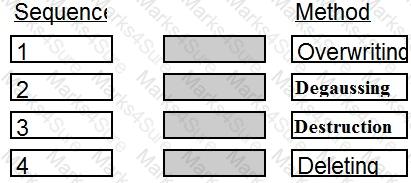
Options:
Answer:
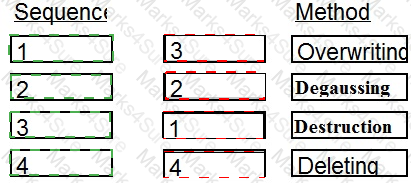
Explanation:
Degaussing
Overwriting
Destruction
Deleting
Comprehensive Explanation : Degaussing is the process of decreasing or eliminating a remnant magnetic field to reduce the risk of data remanence on magnetic media, making it the best method among the options provided. Overwriting involves replacing old data with new data, which can also be effective but not as thorough as degaussing. Destruction refers to physically destroying the media, which is effective but not always practical or environmentally friendly. Deleting is simply removing data pointers and does not actually erase the data from the media, making it the worst option.
Which of the following is a document that identifies each item seized in an investigation, including date and time seized, full name and signature or initials of the person who seized the item, and a detailed description of the item?
Options:
Property book
Chain of custody form
Search warrant return
Evidence tag
Answer:
BExplanation:
According to the CISSP CBK Official Study Guide 1 , a chain of custody form is a document that identifies each item seized in an investigation, including date and time seized, full name and signature or initials of the person who seized the item, and a detailed description of the item. A chain of custody form is used to maintain the integrity and admissibility of the evidence, by documenting the history and handling of the evidence, such as the location, possession, transfer, or disposition of the evidence. A chain of custody form helps to prevent or detect any tampering, alteration, or loss of the evidence, as well as to support the authenticity and reliability of the evidence. A property book is not a document that identifies each item seized in an investigation, although it may be a document that records the inventory of the items. A property book is a document that lists the property or assets that belong to an organization or a person, such as the equipment, tools, or materials. A property book may help to manage or account for the property or assets, but it does not document the history and handling of the evidence. A search warrant return is not a document that identifies each item seized in an investigation, although it may be a document that reports the result of the investigation. A search warrant return is a document that summarizes the outcome and findings of the execution of a search warrant, such as the date, time, place, and manner of the search, the items seized, and the persons arrested. A search warrant return may help to inform or update the court or the authority that issued the search warrant, but it does not document the history and handling of the evidence. An evidence tag is not a document that identifies each item seized in an investigation, although it may be a label or a marker that is attached to the item. An evidence tag is a piece of paper or a sticker that contains information about the item, such as the case number, the item number, the description, or the barcode of the item. An evidence tag may help to identify or track the item, but it does not document the history and handling of the evidence.
When building a data classification scheme, which of the following is the PRIMARY concern?
Options:
Purpose
Cost effectiveness
Availability
Authenticity
Answer:
AExplanation:
A data classification scheme is a framework that defines the categories and levels of data sensitivity, as well as the policies and procedures for handling them. The primary concern when building a data classification scheme is the purpose of the data, i.e., why it is collected, processed, stored, and shared, and what are the risks and benefits associated with it. The purpose of the data determines its value, impact, and protection requirements.
Cost effectiveness (B) is a secondary concern that affects the implementation and maintenance of a data classification scheme, but it is not the primary driver for creating one. Availability © and authenticity (D) are two aspects of data security that depend on the data classification scheme, but they are not the main factors for designing one. Therefore, B, C, and D are incorrect answers.
What does an organization FIRST review to assure compliance with privacy requirements?
Options:
Best practices
Business objectives
Legal and regulatory mandates
Employee ' s compliance to policies and standards
Answer:
CExplanation:
The first thing that an organization reviews to assure compliance with privacy requirements is the legal and regulatory mandates that apply to its business operations and data processing activities. Legal and regulatory mandates are the laws, regulations, standards, and contracts that govern how an organization must protect the privacy of personal information and the rights of data subjects. An organization must identify and understand the relevant mandates that affect its jurisdiction, industry, and data types, and implement the appropriate controls and measures to comply with them. The other options are not the first thing that an organization reviews, but rather part of the privacy compliance program. Best practices are the recommended methods and techniques for achieving privacy objectives, but they are not mandatory or binding. Business objectives are the goals and strategies that an organization pursues to create value and competitive advantage, but they may not align with privacy requirements. Employee’s compliance to policies and standards is the degree to which the organization’s staff adhere to the internal rules and guidelines for privacy protection, but it is not a review activity, but rather a measurement and enforcement activity. References : CISSP All-in-One Exam Guide, Eighth Edition , Chapter 3, p. 105; Official (ISC)2 CISSP CBK Reference, Fifth Edition , Chapter 5, p. 287.
Which technology is a prerequisite for populating the cloud-based directory in a federated identity solution?
Options:
Notification tool
Message queuing tool
Security token tool
Synchronization tool
Answer:
DExplanation:
A federated identity solution is a system that allows users to access multiple applications and domains using a single set of credentials. A cloud-based directory is a centralized repository of user identities and attributes that can be accessed by different service providers over the internet. A synchronization tool is a technology that enables the transfer and update of user data between the cloud-based directory and the local or on-premises directory. A synchronization tool is a prerequisite for populating the cloud-based directory in a federated identity solution, as it ensures that the user information is consistent and accurate across the federated domains.
A notification tool (A) is a technology that sends alerts or messages to users or administrators about events or changes in the federated identity solution, such as password resets, account lockouts, or security breaches. A message queuing tool (B) is a technology that enables asynchronous communication between applications or services in the federated identity solution, such as requests, responses, or acknowledgments. A security token tool © is a technology that generates and validates digital tokens that contain user credentials and attributes for authentication and authorization purposes in the federated identity solution. These technologies are not prerequisites for populating the cloud-based directory, but they are components or features of a federated identity solution. Therefore, A, B, and C are incorrect answers.
Which of the following would BEST describe the role directly responsible for data within an organization?
Options:
Data custodian
Information owner
Database administrator
Quality control
Answer:
BExplanation:
According to the CISSP For Dummies, the role that is directly responsible for data within an organization is the information owner. The information owner is the person or role that has the authority and accountability for the data or information that the organization owns, creates, uses, or maintains, such as data, documents, records, or intellectual property. The information owner is responsible for defining the classification, value, and sensitivity of the data or information, as well as the security requirements, policies, and standards for the data or information. The information owner is also responsible for granting or revoking the access rights and permissions to the data or information, as well as for monitoring and auditing the compliance and effectiveness of the security controls and mechanisms for the data or information. The data custodian is not the role that is directly responsible for data within an organization, although it may be a role that supports or assists the information owner. The data custodian is the person or role that has the responsibility for implementing and maintaining the security controls and mechanisms for the data or information, as defined by the information owner. The data custodian is responsible for performing the technical and operational tasks and activities for the data or information, such as backup, recovery, encryption, or disposal. The database administrator is not the role that is directly responsible for data within an organization, although it may be a role that supports or assists the information owner or the data custodian. The database administrator is the person or role that has the responsibility for managing and administering the database system that stores and processes the data or information. The database administrator is responsible for performing the technical and operational tasks and activities for the database system, such as installation, configuration, optimization, or troubleshooting.
Which of the following is the BIGGEST weakness when using native Lightweight Directory Access Protocol (LDAP) for authentication?
Options:
Authorizations are not included in the server response
Unsalted hashes are passed over the network
The authentication session can be replayed
Passwords are passed in clear text
Answer:
DExplanation:
The biggest weakness when using native Lightweight Directory Access Protocol (LDAP) for authentication is that passwords are passed in clear text over the network, exposing them to eavesdropping and interception attacks. To mitigate this risk, LDAP should be used with encryption protocols, such as Secure Sockets Layer (SSL) or Transport Layer Security (TLS), or with authentication protocols, such as Kerberos or Simple Authentication and Security Layer (SASL).
A. Authorizations are not included in the server response is not the biggest weakness when using native LDAP for authentication, but rather a limitation of the protocol that requires additional mechanisms to implement access control policies.
B. Unsalted hashes are passed over the network is not the biggest weakness when using native LDAP for authentication, but rather a potential vulnerability of the password storage scheme that could expose passwords to brute-force or dictionary attacks.
C. The authentication session can be replayed is not the biggest weakness when using native LDAP for authentication, but rather a possible threat that could compromise the confidentiality and integrity of the session data.
Who is ultimately responsible to ensure that information assets are categorized and adequate measures are taken to protect them?
Options:
Data Custodian
Executive Management
Chief Information Security Officer
Data/Information/Business Owners
Answer:
DExplanation:
The individuals who are ultimately responsible to ensure that information assets are categorized and adequate measures are taken to protect them are the data/information/business owners. Data/information/business owners are the individuals who have the authority or accountability for the information assets of an organization, such as data, systems, or processes. Data/information/business owners are ultimately responsible to ensure that information assets are categorized and adequate measures are taken to protect them, which means that they have to define and implement the rules and guidelines for classifying and securing the information assets according to their sensitivity, value, or criticality. Data/information/business owners also have to assign and oversee the roles and responsibilities of the data custodians and users, who are the individuals who have the duty or privilege to maintain or access the information assets of the organization. The other options are not the individuals who are ultimately responsible to ensure that information assets are categorized and adequate measures are taken to protect them, but rather different or subordinate roles. A data custodian is an individual who has the duty to maintain or safeguard the information assets of an organization, such as backup, restore, or encryption. A data custodian is responsible to follow the instructions or directions of the data/information/business owner, but not to make the decisions or policies for the information assets. Executive management is the group of individuals who have the highest level of authority or leadership in an organization, such as board of directors, chief executive officer, or chief financial officer. Executive management is responsible to provide the support or approval for the information security strategy, policies, and programs of the organization, but not to directly manage or control the information assets. A chief information security officer is an individual who has the senior executive responsibility for overseeing and managing the information security strategy, policies, and programs of an organization. A chief information security officer is responsible to advise and assist the data/information/business owners, executive management, and other stakeholders on the information security matters, but not to own or operate the information assets. References : CISSP All-in-One Exam Guide, Eighth Edition , Chapter 1, p. 28; Official (ISC)2 CISSP CBK Reference, Fifth Edition , Chapter 5, p. 286.
Which of the following is most helpful in applying the principle of LEAST privilege?
Options:
Establishing a sandboxing environment
Setting up a Virtual Private Network (VPN) tunnel
Monitoring and reviewing privileged sessions
Introducing a job rotation program
Answer:
CExplanation:
Monitoring and reviewing privileged sessions helps in applying the principle of least privilege by ensuring that users with higher privileges are only accessing resources necessary for their roles, thus reducing the risk of misuse or exploitation. References : CISSP Official (ISC)2 Practice Tests, Chapter 5, page 138 ; Official (ISC)2 CISSP CBK Reference, Fifth Edition, Chapter 5, page 249
An application developer is deciding on the amount of idle session time that the application allows before a timeout. The BEST reason for determining the session timeout requirement is
Options:
organization policy.
industry best practices.
industry laws and regulations.
management feedback.
Answer:
AExplanation:
The session timeout requirement is the maximum amount of time that a user can be inactive on an application before the session is terminated and the user is required to re-authenticate. The best reason for determining the session timeout requirement is the organization policy, as it reflects the organization’s risk appetite, security objectives, and compliance obligations. The organization policy should specify the appropriate session timeout value for different types of applications and data, based on their sensitivity and criticality 1 2 . References :
Session Management - OWASP Cheat Sheet Series , Section: Session Timeout Implementation
WSTG - Latest | OWASP Foundation , Section: Testing for Session Timeout
At which layer of the Open Systems Interconnect (OSI) model are the source and destination address for a datagram handled?
Options:
Transport Layer
Data-Link Layer
Network Layer
Application Layer
Answer:
CExplanation:
According to the CISSP Official (ISC)2 Practice Tests 3 , the layer of the Open Systems Interconnect (OSI) model that handles the source and destination address for a datagram is the Network Layer. The OSI model is a conceptual framework that defines the functions, services, and protocols of the communication system or network, as well as the interactions and interfaces among them. The OSI model consists of seven layers, each of which performs a specific function or service for the communication system or network, such as the Physical Layer, the Data-Link Layer, the Network Layer, the Transport Layer, the Session Layer, the Presentation Layer, or the Application Layer. The Network Layer is the third layer of the OSI model, which provides the functionality and service of routing and forwarding the data or information across the communication system or network, such as the Internet Protocol (IP) or the Internet Control Message Protocol (ICMP). The Network Layer handles the source and destination address for a datagram, which is a unit or a packet of data or information that is transmitted or received over the communication system or network. The source and destination address for a datagram are the logical or numerical identifiers that specify the origin and the destination of the datagram, such as the IP address or the host name of the sender and the receiver of the datagram. The Network Layer uses the source and destination address for a datagram to determine the best path or route for the datagram to travel from the sender to the receiver, as well as to deliver the datagram to the correct destination. The Transport Layer is not the layer of the OSI model that handles the source and destination address for a datagram, although it may be the layer that handles the source and destination port for a segment. The Transport Layer is the fourth layer of the OSI model, which provides the functionality and service of ensuring the reliable and efficient transmission and reception of the data or information across the communication system or network, such as the Transmission Control Protocol (TCP) or the User Datagram Protocol (UDP). The Transport Layer handles the source and destination port for a segment, which is a unit or a packet of data or information that is transmitted or received over the communication system or network. The source and destination port for a segment are the logical or numerical identifiers that specify the application or the service that is sending or receiving the segment, such as the port number or the socket number of the application or the service. The Transport Layer uses the source and destination port for a segment to establish, maintain, and terminate the connection or the session between the sender and the receiver, as well as to deliver the segment to the correct application or service. The Data-Link Layer is not the layer of the OSI model that handles the source and destination address for a datagram, although , it may be the layer that handles the source and destination address for a frame. The Data-Link Layer is the second layer of the OSI model, which provides the functionality and service of transferring and exchanging the data or information between the adjacent nodes or devices on the communication system or network, such as the Ethernet, the Wi-Fi, or the Bluetooth. The Data-Link Layer handles the source and destination address for a frame, which is a unit or a packet of data or information that is transmitted or received over the communication system or network. The source and destination address for a frame are the physical or hardware identifiers that specify the node or the device that is sending or receiving the frame, such as the Media Access Control (MAC) address or the Physical Address of the node or the device. The Data-Link Layer uses the source and destination address for a frame to identify, locate, and access the node or the device that is sending or receiving the frame, as well as to deliver the frame to the correct node or device. The Application Layer is not the layer of the OSI model that handles the source and destination address for a datagram, although it may be the layer that handles the source and destination address for a message.
During the risk assessment phase of the project the CISO discovered that a college within the University is collecting Protected Health Information (PHI) data via an application that was developed in-house. The college collecting this data is fully aware of the regulations for Health Insurance Portability and Accountability Act (HIPAA) and is fully compliant.
What is the best approach for the CISO?
Below are the common phases to creating a Business Continuity/Disaster Recovery (BC/DR) plan. Drag the remaining BC\DR phases to the appropriate corresponding location.
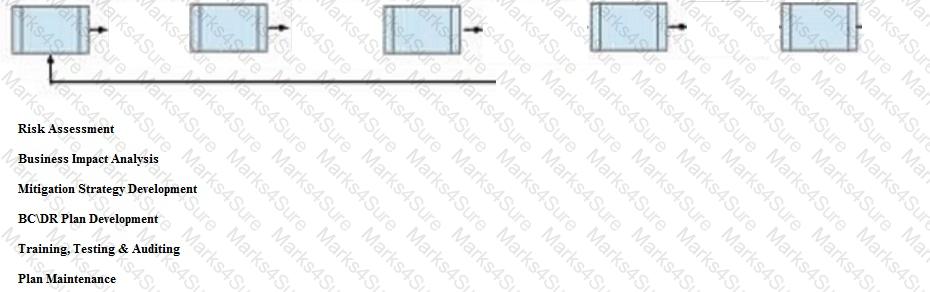
Options:
Answer:
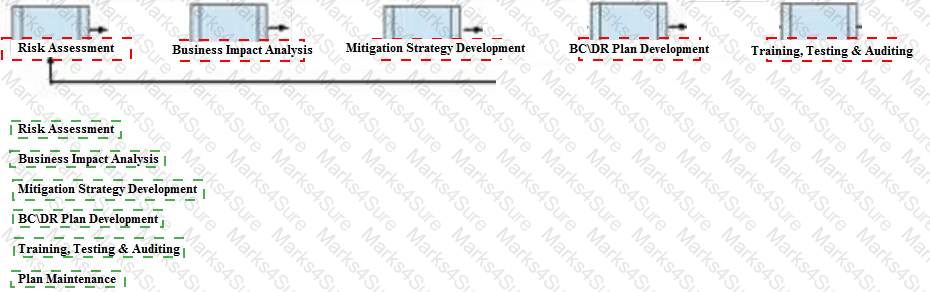
Explanation:

The common phases to creating a Business Continuity/Disaster Recovery (BC/DR) plan are as follows:
Risk Assessment: This is the phase of identifying and quantifying the potential impacts of disruptive events on the organization’s critical business functions and processes. This phase involves determining the recovery objectives, such as the recovery time objective (RTO) and the recovery point objective (RPO), as well as the recovery priorities, dependencies, and resources.
Business Impact Analysis: This is the phase of selecting and implementing the appropriate recovery methods and solutions for the organization’s critical business functions and processes. This phase involves evaluating the costs and benefits of different recovery options, such as backup, redundancy, alternate sites, or outsourcing, and choosing the ones that meet the recovery objectives and budget.
Mitigation Strategy Development: This is the phase of documenting and communicating the procedures and actions to be taken before, during, and after a disaster to restore the normal operations of the organization. This phase involves defining the roles and responsibilities of the staff and stakeholders, establishing the communication and escalation channels, and outlining the steps for activation, execution, and termination of the plan.
BCDR Plan Development: This is the phase of verifying and updating the effectiveness and efficiency of the BC/DR plan. This phase involves conducting regular tests and exercises to validate the functionality, usability, and reliability of the plan, and performing periodic reviews and audits to identify and address any gaps, weaknesses, or changes in the plan.
Training, Testing & Auditing: This is the phase of ensuring the awareness and readiness of the staff and stakeholders for the BC/DR plan. This phase involves providing the training and education on the BC/DR plan, conducting the testing and auditing of the BC/DR plan, and collecting the feedback and lessons learned from the BC/DR plan.
Plan Maintenance: This is the phase of maintaining and improving the BC/DR plan. This phase involves updating and revising the BC/DR plan according to the changes in the organization, environment, or technology, and ensuring the compliance and alignment of the BC/DR plan with the legal, regulatory, operational, or business requirements.
The image that you sent shows a flowchart or process diagram with five empty boxes connected by arrows, indicating a sequence of steps. The boxes are placeholders for the phases of the BC/DR plan. Below the image, there is a list of the phases of the BC/DR plan. To complete the image, you need to drag the phases from the list to the appropriate boxes in the diagram. The correct order of the phases is as follows:
Box 1: Risk Assessment
Box 2: Business Impact Analysis
Box 3: Mitigation Strategy Development
Box 4: BCDR Plan Development
Box 5: Training, Testing & Auditing
The phase of Plan Maintenance is not shown in the image, but it is an ongoing and continuous phase that should be performed after the completion of the other phases.
After a thorough analysis, it was discovered that a perpetrator compromised a network by gaining access to the network through a Secure Socket Layer (SSL) Virtual Private Network (VPN) gateway. The perpetrator guessed a username and brute forced the password to gain access. Which of the following BEST mitigates this issue?
Options:
Implement strong passwords authentication for VPN
Integrate the VPN with centralized credential stores
Implement an Internet Protocol Security (IPSec) client
Use two-factor authentication mechanisms
Answer:
DExplanation:
The best way to mitigate the issue of a perpetrator compromising a network by gaining access to the network through an SSL VPN gateway by guessing a username and brute forcing the password is to use two-factor authentication mechanisms. Two-factor authentication is a method of verifying the identity of a user or device by requiring two different types of factors, such as something the user knows (e.g., password, PIN, etc.), something the user has (e.g., token, smart card, etc.), or something the user is (e.g., biometric, fingerprint, etc.). Two-factor authentication can enhance the security of the network access by making it harder for attackers to impersonate or compromise the legitimate users or devices. If the perpetrator only knows the username and password, they will not be able to access the network without the second factor, such as a token or a biometric 3 4 References: CISSP All-in-One Exam Guide, Eighth Edition , Chapter 6: Communication and Network Security, p. 321; Official (ISC)2 CISSP CBK Reference, Fifth Edition , Domain 4: Communication and Network Security, p. 449.
What should happen when an emergency change to a system must be performed?
Options:
The change must be given priority at the next meeting of the change control board.
Testing and approvals must be performed quickly.
The change must be performed immediately and then submitted to the change board.
The change is performed and a notation is made in the system log.
Answer:
CExplanation:
In cases of emergency changes, the priority is to address the issue at hand immediately to prevent any potential impacts on the system or organization. After implementing the change, it should then be documented and submitted to the change control board for review and approval post-implementation. References : CISSP Official (ISC)2 Practice Tests, Chapter 7, page 187 ; Official (ISC)2 CISSP CBK Reference, Fifth Edition, Chapter 7, page 346
A Virtual Machine (VM) environment has five guest Operating Systems (OS) and provides strong isolation. What MUST an administrator review to audit a user’s access to data files?
Options:
Host VM monitor audit logs
Guest OS access controls
Host VM access controls
Guest OS audit logs
Answer:
DExplanation:
Guest OS audit logs are what an administrator must review to audit a user’s access to data files in a VM environment that has five guest OS and provides strong isolation. A VM environment is a system that allows multiple virtual machines (VMs) to run on a single physical machine, each with its own OS and applications. A VM environment can provide several benefits, such as:
Improving the utilization and efficiency of the physical resources by sharing them among multiple VMs
Enhancing the security and isolation of the VMs by preventing or limiting the interference or communication between them
Increasing the flexibility and scalability of the VMs by allowing them to be created, modified, deleted, or migrated easily and quickly
A guest OS is the OS that runs on a VM, which is different from the host OS that runs on the physical machine. A guest OS can have its own security controls and mechanisms, such as access controls, encryption, authentication, and audit logs. Audit logs are records that capture and store the information about the events and activities that occur within a system or a network, such as the access and usage of the data files. Audit logs can provide a reactive and detective layer of security by enabling the monitoring and analysis of the system or network behavior, and facilitating the investigation and response of the incidents.
Guest OS audit logs are what an administrator must review to audit a user’s access to data files in a VM environment that has five guest OS and provides strong isolation, because they can provide the most accurate and relevant information about the user’s actions and interactions with the data files on the VM. Guest OS audit logs can also help the administrator to identify and report any unauthorized or suspicious access or disclosure of the data files, and to recommend or implement any corrective or preventive actions.
The other options are not what an administrator must review to audit a user’s access to data files in a VM environment that has five guest OS and provides strong isolation, but rather what an administrator might review for other purposes or aspects. Host VM monitor audit logs are records that capture and store the information about the events and activities that occur on the host VM monitor, which is the software or hardware component that manages and controls the VMs on the physical machine. Host VM monitor audit logs can provide information about the performance, status, and configuration of the VMs, but they cannot provide information about the user’s access to data files on the VMs. Guest OS access controls are rules and mechanisms that regulate and restrict the access and permissions of the users and processes to the resources and services on the guest OS. Guest OS access controls can provide a proactive and preventive layer of security by enforcing the principles of least privilege, separation of duties, and need to know. However, guest OS access controls are not what an administrator must review to audit a user’s access to data files, but rather what an administrator must configure and implement to protect the data files. Host VM access controls are rules and mechanisms that regulate and restrict the access and permissions of the users and processes to the VMs on the physical machine. Host VM access controls can provide a granular and dynamic layer of security by defining and assigning the roles and permissions according to the organizational structure and policies. However, host VM access controls are not what an administrator must review to audit a user’s access to data files, but rather what an administrator must configure and implement to protect the VMs.
In which of the following programs is it MOST important to include the collection of security process data?
Options:
Quarterly access reviews
Security continuous monitoring
Business continuity testing
Annual security training
Answer:
BExplanation:
Security continuous monitoring is the program in which it is most important to include the collection of security process data. Security process data is the data that reflects the performance, effectiveness, and compliance of the security processes, such as the security policies, standards, procedures, and guidelines. Security process data can include metrics, indicators, logs, reports, and assessments. Security process data can provide several benefits, such as:
Improving the security and risk management of the system by providing the visibility and awareness of the security posture, vulnerabilities, and threats
Enhancing the security and decision making of the system by providing the evidence and information for the security analysis, evaluation, and reporting
Increasing the security and improvement of the system by providing the feedback and input for the security response, remediation, and optimization
Security continuous monitoring is the program in which it is most important to include the collection of security process data, because it is the program that involves maintaining the ongoing awareness of the security status, events, and activities of the system. Security continuous monitoring can enable the system to detect and respond to any security issues or incidents in a timely and effective manner, and to adjust and improve the security controls and processes accordingly. Security continuous monitoring can also help the system to comply with the security requirements and standards from the internal or external authorities or frameworks.
The other options are not the programs in which it is most important to include the collection of security process data, but rather programs that have other objectives or scopes. Quarterly access reviews are programs that involve reviewing and verifying the user accounts and access rights on a quarterly basis. Quarterly access reviews can ensure that the user accounts and access rights are valid, authorized, and up to date, and that any inactive, expired, or unauthorized accounts or rights are removed or revoked. However, quarterly access reviews are not the programs in which it is most important to include the collection of security process data, because they are not focused on the security status, events, and activities of the system, but rather on the user accounts and access rights. Business continuity testing is a program that involves testing and validating the business continuity plan (BCP) and the disaster recovery plan (DRP) of the system. Business continuity testing can ensure that the system can continue or resume its critical functions and operations in case of a disruption or disaster, and that the system can meet the recovery objectives and requirements. However, business continuity testing is not the program in which it is most important to include the collection of secu rity process data, because it is not focused on the security status, events, and activities of the system, but rather on the continuity and recovery of the system. Annual security training is a program that involves providing and updating the security knowledge and skills of the system users and staff on an annual basis. Annual security training can increase the security awareness and competence of the system users and staff, and reduce the human errors or risks that might compromise the system security. However, annual security training is not the program in which it is most important to include the collection of security process data, because it is not focused on the security status, events, and activities of the system, but rather on the security education and training of the system users and staff.
Which of the following could cause a Denial of Service (DoS) against an authentication system?
Options:
Encryption of audit logs
No archiving of audit logs
Hashing of audit logs
Remote access audit logs
Answer:
DExplanation:
Remote access audit logs could cause a Denial of Service (DoS) against an authentication system. A DoS attack is a type of attack that aims to disrupt or degrade the availability or performance of a system or a network by overwhelming it with excessive or malicious traffic or requests. An authentica tion system is a system that verifies the identity and credentials of the users or entities that want to access the system or network resources or services. An authentication system can use various methods or factors to authenticate the users or entities, such as passwords, tokens, certificates, biometrics, or behavioral patterns.
Remote access audit logs are records that capture and store the information about the events and activities that occur when the users or entities access the system or network remotely, such as via the internet, VPN, or dial-up. Remote access audit logs can provide a reactive and detective layer of security by enabling the monitoring and analysis of the remote access behavior, and facilitating the investigation and response of the incidents.
Remote access audit logs could cause a DoS against an authentication system, because they could consume a large amount of disk space, memory, or bandwidth on the authentication system, especially if the remote access is frequent, intensive, or malicious. This could affect the performance or functionality of the authentication system, and prevent or delay the legitimate users or entities from accessing the system or network resources or services. For example, an attacker could launch a DoS attack against an authentication system by sending a large number of fake or invalid remote access requests, and generating a large amount of remote access audit logs that fill up the disk space or memory of the authentication system, and cause it to crash or slow down.
The other options are not the factors that could cause a DoS against an authentication system, but rather the factors that could improve or protect the authentication system. Encryption of audit logs is a technique that involves using a cryptographic algorithm and a key to transform the audit logs into an unreadable or unintelligible format, that can only be reversed or decrypted by authorized parties. Encryption of audit logs can enhance the security and confidentiality of the audit logs by preventing unauthorized access or disclosure of the sensitive information in the audit logs. However, encryption of audit logs could not cause a DoS against an authentication system, because it does not affect the availability or performance of the authentication system, but rather the integrity or privacy of the audit logs. No archiving of audit logs is a practice that involves not storing or transferring the audit logs to a separate or external storage device or location, such as a tape, disk, or cloud. No archiving of audit logs can reduce the security and availability of the audit logs by increasing the risk of loss or damage of the audit logs, and limiting the access or retrieval of the audit logs. However, no archiving of audit logs could not cause a DoS against an authentication system, because it does not affect the availability or performance of the authentication system, but rather the availability or preservation of the audit logs. Hashing of audit logs is a technique that involves using a hash function, such as MD5 or SHA, to generate a fixed-length and unique value, called a hash or a digest, that represents the audit logs. Hashing of audit logs can improve the security and integrity of the audit logs by verifying the authenticity or consistency of the audit logs, and detecting any modification or tampering of the audit logs. However, hashing of audit logs could not cause a DoS against an authentication system, because it does not affect the availability or performance of the authentication system, but rather the integrity or verification of the audit logs.
Which of the following is of GREATEST assistance to auditors when reviewing system configurations?
Options:
Change management processes
User administration procedures
Operating System (OS) baselines
System backup documentation
Answer:
CExplanation:
Operating System (OS) baselines are of greatest assistance to auditors when reviewing system configurations. OS baselines are standard or reference configurations that define the desired and secure state of an OS, including the settings, parameters, patches, and updates. OS baselines can provide several benefits, such as:
Improving the security and compliance of the OS by applying the best practices and recommendations from the vendors, authorities, or frameworks
Enhancing the performance and efficiency of the OS by optimizing the resources and functions
Increasing the consistency and uniformity of the OS by reducing the variations and deviations
Facilitating the monitoring and auditing of the OS by providing a baseline for comparison and measurement
OS baselines are of greatest assistance to auditors when reviewing system configurations, because they can enable the auditors to evaluate and verify the current and actual state of the OS against the desired and secure state of the OS. OS baselines can also help the auditors to identify and report any gaps, issues, or risks in the OS configurations, and to recommend or implement any corrective or preventive actions.
The other options are not of greatest assistance to auditors when reviewing system configurations, but rather of assistance for other purposes or aspects. Change management processes are processes that ensure that any changes to the system configurations are planned, approved, implemented, and documented in a controlled and consistent manner. Change management processes can improve the security and reliability of the system configurations by preventing or reducing the errors, conflicts, or disruptions that might occur due to the changes. However, change management processes are not of greatest assistance to auditors when reviewing system configurations, because they do not define the desired and secure state of the system configurations, but rather the procedures and controls for managing the changes. User administration procedures are procedures that define the roles, responsibilities, and activities for creating, modifying, deleting, and managing the user accounts and access rights. User administration procedures can enhance the security and accountability of the user accounts and access rights by enforcing the principles of least privilege, separation of duties, and need to know. However, user administration procedures are not of greatest assistance to auditors when reviewing system configurations, because they do not define the desired and secure state of the system configurations, but rather the rules and tasks for administering the users. System backup documentation is documentation that records the information and details about the system backup processes, such as the backup frequency, type, location, retention, and recovery. System backup documentation can increase the availability and resilience of the system by ensuring that the system data and configurations can be restored in case of a loss or damage. However, system backup documentation is not of greatest assistance to auditors when reviewing system configurations, because it does not define the desired and secure state of the system configurations, but rather the backup and recovery of the system configurations.
A post-implementation review has identified that the Voice Over Internet Protocol (VoIP) system was designed
to have gratuitous Address Resolution Protocol (ARP) disabled.
Why did the network architect likely design the VoIP system with gratuitous ARP disabled?
Options:
Gratuitous ARP requires the use of Virtual Local Area Network (VLAN) 1.
Gratuitous ARP requires the use of insecure layer 3 protocols.
Gratuitous ARP requires the likelihood of a successful brute-force attack on the phone.
Gratuitous ARP requires the risk of a Man-in-the-Middle (MITM) attack.
Answer:
DExplanation:
Gratuitous ARP is a special type of ARP message that a sender device broadcasts on the network without any other device requesting it. It can be useful for updating the ARP table, changing the address of an interface, or informing the network of the sender’s own MAC address. However, it also introduces the risk of a Man-in-the-Middle (MITM) attack, where an attacker can send a spoofed gratuitous ARP message to trick other devices into associating a legitimate IP address with a malicious MAC address. This way, the attacker can intercept, modify, or redirect the traffic intended for the legitimate device. Therefore, the network architect likely designed the VoIP system with gratuitous ARP disabled to prevent such attacks and ensure the security and integrity of the voice communication. References : Gratuitous ARP – Definition and Use Cases - Practical Networking .net ; Gratuitous_ARP - Wireshark
Match the functional roles in an external audit to their responsibilities.
Drag each role on the left to its corresponding responsibility on the right.
Select and Place:
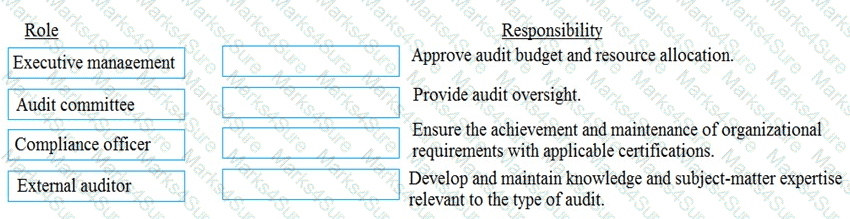
Options:
Answer:
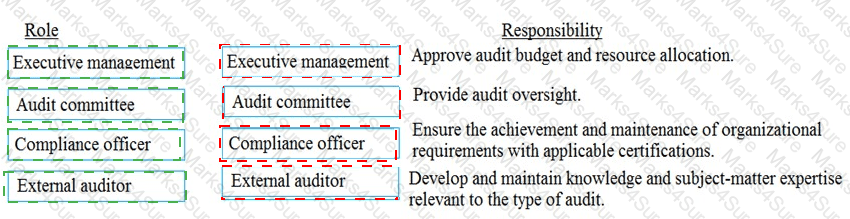
Explanation:
The correct matching of the functional roles and their responsibilities in an external audit is:
Executive management: Approve audit budget and resource allocation
Audit committee: Provide audit oversight
Compliance officer: Ensure the achievement and maintenance of organizational requirements with applicable certifications
External auditor: Develop and maintain knowledge and subject-matter expertise relevant to the type of audit
Comprehensive Explanation : An external audit is an independent and objective examination of an organization’s financial statements, systems, processes, or performance by an external party. The functional roles and their responsibilities in an external audit are:
Executive management: The highest-ranking executives in the organization, who have the authority and responsibility for the overall direction and performance of the organization. They approve the audit budget and resource allocation, as well as the scope and objectives of the audit.
Audit committee: A subcommittee of the board of directors, who oversee the audit activities and ensure the quality and integrity of the audit process. They provide audit oversight, such as selecting and appointing the external auditor, reviewing and approving the audit plan and report, and monitoring the implementation of the audit recommendations.
Compliance officer: A person who is responsible for ensuring that the organization complies with the applicable laws, regulations, standards, and policies. They ensure the achievement and maintenance of organizational requirements with applicable certifications, such as ISO, PCI, or HIPAA, and coordinate with the external auditor to provide the necessary evidence and documentation.
External auditor: A person who is hired by the audit committee or the executive management to conduct the external audit. They develop and maintain knowledge and subject-matter expertise relevant to the type of audit, such as financial, operational, or security audit, and follow the professional standards and guidelines for conducting the audit.
What is the MOST significant benefit of an application upgrade that replaces randomly generated session keys with certificate based encryption for communications with backend servers?
Options:
Non-repudiation
Efficiency
Confidentially
Privacy
Answer:
AExplanation:
The most significant benefit of an application upgrade that replaces randomly generated session keys with certificate based encryption for communications with backend servers is non-repudiation. Non-repudiation is a security property that ensures that the parties involved in a communication or transaction cannot deny their participation or the validity of the data. Non-repudiation can provide some benefits for web security, such as enhancing the accountability and trustworthiness of the parties, preventing fraud or disputes, and enabling legal or forensic evidence. Certificate based encryption is a technique that uses digital certificates to encrypt and decrypt data. Digital certificates are issued by a trusted certificate authority (CA), and contain the public key and other information of the owner. Certificate based encryption can provide non-repudiation by using the public key and the private key of the parties to perform encryption and decryption, and by using digital signatures to verify the identity and the integrity of the data. Certificate based encryption can also provide confidentiality, integrity, and authentication for the communication. Session keys are temporary keys that are used to encrypt and decrypt data for a single session or communication. Session keys are usually randomly generated and exchanged between the parties using a key exchange protocol, such as Diffie-Hellman or RSA. Session keys can provide confidentiality and integrity for the communication, but they cannot provide non-repudiation, as the parties can deny their possession or usage of the session keys, or claim that the session keys were compromised or tampered with. Efficiency, confidentiality, and privacy are not the most significant benefits of an application upgrade that replaces randomly generated session keys with certificate based encryption for communications with backend servers, although they may be related or useful properties. Efficiency is a performance property that measures how well a system or a process uses the available resources, such as time, space, or energy. Efficiency can be affected by various factors, such as the design, the implementation, the optimization, or the maintenance of the system or the process. Efficiency may or may not be improved by an application upgrade that replaces randomly generated session keys with certificate based encryption for communications with backend servers, depending on the trade-offs between the security and the performance of the encryption techniques. Confidentiality is a security property that ensures that the data is only accessible or disclosed to the authorized parties. Confidentiality can be provided by both session keys and certificate based encryption, as they both use encryption to protect the data from unauthorized access or disclosure. However, confidentiality is not the most significant benefit of an application upgrade that replaces randomly generated session keys with certificate based encryption for communications with backend servers, as it is not a new or enhanced property that is introduced by the upgrade. Privacy is a security property that ensures that the personal or sensitive information of the parties is protected from unauthorized collection, processing, or sharing. Privacy can be affected by various factors, such as the policies, the regulations, the technologies, or the behaviors of the parties involved in the communication or transaction. Privacy may or may not be improved by an application upgrade that replaces randomly generated session keys with certificate based encryption for communications with backend servers, depending on the type and the amount of information that is encrypted and transmitted. However, privacy is not the most significant benefit of an application upgrade that replaces randomly generated session keys with certificate based encryption for communications with backend servers, as it is not a direct or specific property that is provided by the encryption techniques.
Who is responsible for the protection of information when it is shared with or provided to other organizations?
Options:
Systems owner
Authorizing Official (AO)
Information owner
Security officer
Answer:
CExplanation:
The information owner is the person who has the authority and responsibility for the information within an Information System (IS). The information owner is responsible for the protection of information when it is shared with or provided to other organizations, such as by defining the classification, sensitivity, retention, and disposal of the information, as well as by approving or denying the access requests and periodically reviewing the access rights. The system owner, the authorizing official, and the security officer are not responsible for the protection of information when it is shared with or provided to other organizations, although they may have roles and responsibilities related to the security and operation of the IS. References : CISSP All-in-One Exam Guide, Eighth Edition , Chapter 1: Security and Risk Management, page 48; Official (ISC)2 Guide to the CISSP CBK, Fifth Edition , Chapter 1: Security and Risk Management, page 40.
Which of the following is the MOST effective method to mitigate Cross-Site Scripting (XSS) attacks?
Options:
Use Software as a Service (SaaS)
Whitelist input validation
Require client certificates
Validate data output
Answer:
BExplanation:
The most effective method to mitigate Cross-Site Scripting (XSS) attacks is to use whitelist input validation. XSS attacks occur when an attacker injects malicious code, usually in the form of a script, into a web application that is then executed by the browser of an unsuspecting user. XSS attacks can compromise the confidentiality, integrity, and availability of the web application and the user’s data. Whitelist input validation is a technique that checks the user input against a predefined set of acceptable values or characters, and rejects any input that does not match the whitelist. Whitelist input validation can prevent XSS attacks by filtering out any malicious or unexpected input that may contain harmful scripts. Whitelist input validation should be applied at the point of entry of the user input, and should be combined with output encoding or sanitization to ensure that any input that is displayed back to the user is safe and harmless. Use Software as a Service (SaaS), require client certificates, and validate data output are not the most effective methods to mitigate XSS attacks, although they may be related or useful techniques. Use Software as a Service (SaaS) is a model that delivers software applications over the Internet, usually on a subscription or pay-per-use basis. SaaS can provide some benefits for web security, such as reducing the attack surface, outsourcing the maintenance and patching of the software, and leveraging the expertise and resources of the service provider. However, SaaS does not directly address the issue of XSS attacks, as the service provider may still have vulnerabilities or flaws in their web applications that can be exploited by XSS attackers. Require client certificates is a technique that uses digital certificates to authenticate the identity of the clients who access a web application. Client certificates are issued by a trusted certificate authority (CA), and contain the public key and other information of the client. Client certificates can provide some benefits for web security, such as enhancing the confidentiality and integrity of the communication, preventing unauthorized access, and enabling mutual authentication. However, client certificates do not directly address the issue of XSS attacks, as the client may still be vulnerable to XSS attacks if the web application does not properly validate and encode the user input. Validate data output is a technique that checks the data that is sent from the web application to the client browser, and ensures that it is correct, consistent, and safe. Validate data output can provide some benefits for web security, such as detecting and correcting any errors or anomalies in the data, preventing data leakage or corruption, and enhancing the quality and reliability of the web application. However, validate data output is not sufficient to prevent XSS attacks, as the data output may still contain malicious scripts that can be executed by the client browser. Validate data output should be complemented with output encoding or sanitization to ensure that any data output that is displayed to the user is safe and harmless.
Which of the following alarm systems is recommended to detect intrusions through windows in a high-noise, occupied environment?
Options:
Acoustic sensor
Motion sensor
Shock sensor
Photoelectric sensor
Answer:
CExplanation:
A shock sensor is a type of alarm system that detects intrusions through windows by sensing the vibrations or impacts caused by breaking glass or forced entry. A shock sensor is recommended for a high-noise, occupied environment, as it is less prone to false alarms caused by ambient noise or movement. A shock sensor can be mounted on the window frame or glass, and can be configured to trigger an alarm or a notification when a certain threshold of vibration or impact is exceeded. A shock sensor can also be combined with other types of sensors, such as magnetic contacts or glass break detectors, to provide a layered defense. An acoustic sensor is a type of alarm system that detects intrusions through windows by listening to the sound of breaking glass or forced entry. An acoustic sensor is not recommended for a high-noise, occupied environment, as it can be easily triggered by other sources of noise, such as music, conversation, or traffic. An acoustic sensor can be placed near the window or in the room, and can be tuned to recognize the frequency and pattern of glass breaking sounds. A motion sensor is a type of alarm system that detects intrusions by sensing the movement or presence of an intruder in a protected area. A motion sensor is not recommended for a high-noise, occupied environment, as it can be triggered by legitimate occupants or authorized visitors. A motion sensor can be installed on the wall, ceiling, or floor, and can use different technologies, such as infrared, ultrasonic, microwave, or video, to detect motion. A photoelectric sensor is a type of alarm system that detects intrusions by sensing the interruption of a beam of light between a transmitter and a receiver. A photoelectric sensor is not recommended for a high-noise, occupied environment, as it can be triggered by objects or animals that cross the beam. A photoelectric sensor can be placed on the window or across the room, and can be configured to trigger an alarm or a notification when the beam is broken.
Which one of the following data integrity models assumes a lattice of integrity levels?
Options:
Take-Grant
Biba
Harrison-Ruzzo
Bell-LaPadula
Answer:
BExplanation:
The Biba model is a data integrity model that assumes a lattice of integrity levels, where each subject and object has a fixed integrity level. The model enforces two rules: the simple integrity property and the *-integrity property. The simple integrity property states that a subject can only read an object with an equal or lower integrity level. The *-integrity property states that a subject can only write to an object with an equal or higher integrity level. These rules prevent data corruption from low-integrity sources and unauthorized modification from high-integrity sources. References : Official (ISC)2 CISSP CBK Reference, Fifth Edition , page 316; CISSP For Dummies, 7th Edition , page 113.
What is the BEST location in a network to place Virtual Private Network (VPN) devices when an internal review reveals network design flaws in remote access?
Options:
In a dedicated Demilitarized Zone (DMZ)
In its own separate Virtual Local Area Network (VLAN)
At the Internet Service Provider (ISP)
Outside the external firewall
Answer:
AExplanation:
The best location in a network to place Virtual Private Network (VPN) devices when an internal review reveals network design flaws in remote access is in a dedicated Demilitarized Zone (DMZ). A DMZ is a network segment that is located between the internal network and the external network, such as the internet. A DMZ is used to host the services or devices that need to be accessed by both the internal and external users, such as web servers, email servers, or VPN devices. A VPN device is a device that enables the establishment of a VPN, which is a secure and encrypted connection between two networks or endpoints over a public network, such as the internet. Placing the VPN devices in a dedicated DMZ can help to improve the security and performance of the remote access, as well as to isolate the VPN devices from the internal network and the external network. Placing the VPN devices in its own separate VLAN, at the ISP, or outside the external firewall are not the best locations, as they may expose the VPN devices to more risks, reduce the control over the VPN devices, or create a single point of failure for the remote access. References : CISSP All-in-One Exam Guide, Eighth Edition , Chapter 6: Communication and Network Security, page 729; Official (ISC)2 Guide to the CISSP CBK, Fifth Edition , Chapter 4: Communication and Network Security, page 509.
Which of the following entails identification of data and links to business processes, applications, and data
stores as well as assignment of ownership responsibilities?
Options:
Security governance
Risk management
Security portfolio management
Risk assessment
Answer:
DExplanation:
Risk assessment is the process that entails identification of data and links to business processes, applications, and data stores as well as assignment of ownership responsibilities. Risk assessment is a key component of risk management, which is the process of identifying, analyzing, and treating the risks that affect the security and objectives of an organization. Risk assessment involves the following steps: identifying the assets and their value, identifying the threats and their sources, identifying the vulnerabilities and their causes, identifying the existing controls and their effectiveness, identifying the impact and likelihood of the risk events, and identifying the risk owners and their roles. Risk assessment helps to determine the level of risk and the appropriate risk response for each asset and process. Security governance, risk management, and security portfolio management are not the same as risk assessment, although they are related or complementary concepts. Security governance is the framework that defines the roles, responsibilities, policies, standards, and procedures for security management within an organization. Security governance provides the direction, oversight, and accountability for security activities and decisions. Risk management is the process of identifying, analyzing, and treating the risks that affect the security and objectives of an organization. Risk management includes risk assessment, risk mitigation, risk monitoring, and risk communication. Security portfolio management is the process of managing the security investments and initiatives within an organization. Security portfolio management involves aligning the security projects and programs with the organizational strategy, prioritizing the security resources and budget, and measuring the security performance and value.
What MUST each information owner do when a system contains data from multiple information owners?
Options:
Provide input to the Information System (IS) owner regarding the security requirements of the data
Review the Security Assessment report (SAR) for the Information System (IS) and authorize the IS to
operate.
Develop and maintain the System Security Plan (SSP) for the Information System (IS) containing the data
Move the data to an Information System (IS) that does not contain data owned by other information
owners
Answer:
AExplanation:
The information owner is the person who has the authority and responsibility for the data stored, processed, or transmitted by an Information System (IS). When a system contains data from multiple information owners, each information owner must provide input to the IS owner regarding the security requirements of the data, such as the classification, sensitivity, retention, and disposal of the data. The IS owner is the person who has the authority and responsibility for the operation and maintenance of the IS. The IS owner must ensure that the security requirements of the data are met and that the IS complies with the applicable laws and regulations. Reviewing the Security Assessment Report (SAR), developing and maintaining the System Security Plan (SSP), and moving the data to another IS are not the responsibilities of the information owner, but they may involve the information owner’s participation or approval. References : CISSP All-in-One Exam Guide, Eighth Edition , Chapter 1: Security and Risk Management, page 48; Official (ISC)2 Guide to the CISSP CBK, Fifth Edition , Chapter 1: Security and Risk Management, page 40.
It is MOST important to perform which of the following to minimize potential impact when implementing a new vulnerability scanning tool in a production environment?
Options:
Negotiate schedule with the Information Technology (IT) operation’s team
Log vulnerability summary reports to a secured server
Enable scanning during off-peak hours
Establish access for Information Technology (IT) management
Answer:
AExplanation:
It is most important to perform a schedule negotiation with the IT operation’s team to minimize the potential impact when implementing a new vulnerability scanning tool in a production environment. This is because a vulnerability scan can cause network congestion, performance degradation, or system instability, which can affect the availability and functionality of the production systems. Therefore, it is essential to coordinate with the IT operation’s team to determine the best time and frequency for the scan, as well as the scope and intensity of the scan. Logging vulnerability summary reports, enabling scanning during off-peak hours, and establishing access for IT management are also good practices for vulnerability scanning, but they are not as important as negotiating the schedule with the IT operation’s team. References : CISSP All-in-One Exam Guide, Eighth Edition , Chapter 7: Security Assessment and Testing, page 858; Official (ISC)2 Guide to the CISSP CBK, Fifth Edition , Chapter 6: Security Assessment and Testing, page 794.
A chemical plan wants to upgrade the Industrial Control System (ICS) to transmit data using Ethernet instead of RS422. The project manager wants to simplify administration and maintenance by utilizing the office network infrastructure and staff to implement this upgrade.
Which of the following is the GREATEST impact on security for the network?
Options:
The network administrators have no knowledge of ICS
The ICS is now accessible from the office network
The ICS does not support the office password policy
RS422 is more reliable than Ethernet
Answer:
BExplanation:
The greatest impact on security for the network is that the ICS is now accessible from the office network. This means that the ICS is exposed to more potential threats and vulnerabilities from the internet and the office network, such as malware, unauthorized access, data leakage, or denial-of-service attacks. The ICS may also have different security requirements and standards than the office network, such as availability, reliability, and safety. Therefore, connecting the ICS to the office network increases the risk of compromising the confidentiality, integrity, and availability of the ICS and the critical infrastructure it controls. The other options are not as significant as the increased attack surface and complexity of the network. References : Guide to Industrial Control Systems (ICS) Security | NIST , page 2-1; Industrial Control Systems | Cybersecurity and Infrastructure Security Agency , page 1.
Which of the following is the BEST way to reduce the impact of an externally sourced flood attack?
Options:
Have the service provider block the soiree address.
Have the soiree service provider block the address.
Block the source address at the firewall.
Block all inbound traffic until the flood ends.
Answer:
AExplanation:
The best way to reduce the impact of an externally sourced flood attack is to have the service provider block the source address. A flood attack is a type of denial-of-service attack that aims to overwhelm the target system or network with a large amount of traffic, such as SYN packets, ICMP packets, or UDP packets. An externally sourced flood attack is a flood attack that originates from outside the target’s network, such as from the internet. Having the service provider block the source address can help to reduce the impact of an externally sourced flood attack, as it can prevent the malicious traffic from reaching the target’s network, and thus conserve the network bandwidth and resources. Having the source service provider block the address, blocking the source address at the firewall, or blocking all inbound traffic until the flood ends are not the best ways to reduce the impact of an externally sourced flood attack, as they may not be feasible, effective, or efficient, respectively. References : CISSP All-in-One Exam Guide, Eighth Edition , Chapter 6: Communication and Network Security, page 745; Official (ISC)2 Guide to the CISSP CBK, Fifth Edition , Chapter 4: Communication and Network Security, page 525.
Which of the following is the MOST appropriate action when reusing media that contains sensitive data?
Options:
Erase
Sanitize
Encrypt
Degauss
Answer:
BExplanation:
The most appropriate action when reusing media that contains sensitive data is to sanitize the media. Sanitization is the process of removing or destroying all data from the media in such a way that it cannot be recovered by any means. Sanitization can be achieved by various methods, such as overwriting, degaussing, or physical destruction. Sanitization ensures that the sensitive data is not exposed or compromised when the media is reused or disposed of. Erase, encrypt, and degauss are not the most appropriate actions when reusing media that contains sensitive data, although they may be related or useful steps. Erase is the process of deleting data from the media by using the operating system or application commands or functions. Erase does not guarantee that the data is completely removed from the media, as it may leave traces or remnants that can be recovered by using special tools or techniques. Encrypt is the process of transforming data into an unreadable form by using a cryptographic algorithm and a key. Encrypt can protect the data from unauthorized access or disclosure, but it does not remove the data from the media. Encrypt also requires that the key is securely managed and stored, and that the encryption algorithm is strong and reliable. Degauss is the process of applying a strong magnetic field to the media to erase or scramble the data. Degauss can effectively sanitize magnetic media, such as hard disks or tapes, but it does not work on optical media, such as CDs or DVDs. Degauss also renders the media unusable, as it destroys the servo tracks and the firmware that are needed for the media to function properly.
In an organization where Network Access Control (NAC) has been deployed, a device trying to connect to the network is being placed into an isolated domain. What could be done on this device in order to obtain proper
connectivity?
Options:
Connect the device to another network jack
Apply remediation’s according to security requirements
Apply Operating System (OS) patches
Change the Message Authentication Code (MAC) address of the network interface
Answer:
BExplanation:
Network Access Control (NAC) is a technology that enforces security policies and controls on the devices that attempt to access a network. NAC can verify the identity and compliance of the devices, and grant or deny access based on predefined rules and criteria. NAC can also place the devices into different domains or segments, depending on their security posture and role. One of the domains that NAC can create is the isolated domain, which is a restricted network segment that isolates the devices that do not meet the security requirements or pose a potential threat to the network. The devices in the isolated domain have limited or no access to the network resources, and are subject to remediation actions. Remediation is the process of fixing or improving the security status of the devices, by applying the necessary updates, patches, configurations, or software. Remediation can be performed automatically by the NAC system, or manually by the device owner or administrator. Therefore, the best thing that can be done on a device that is placed into an isolated domain by NAC is to apply remediation’s according to the security requirements, which can restore the device’s compliance and enable it to access the network normally.
An organization has doubled in size due to a rapid market share increase. The size of the Information Technology (IT) staff has maintained pace with this growth. The organization hires several contractors whose onsite time is limited. The IT department has pushed its limits building servers and rolling out workstations and has a backlog of account management requests.
Which contract is BEST in offloading the task from the IT staff?
Options:
Platform as a Service (PaaS)
Identity as a Service (IDaaS)
Desktop as a Service (DaaS)
Software as a Service (SaaS)
Answer:
BExplanation:
Identity as a Service (IDaaS) is the best contract in offloading the task of account management from the IT staff. IDaaS is a cloud-based service that provides identity and access management (IAM) functions, such as user authentication, authorization, provisioning, deprovisioning, password management, single sign-on (SSO), and multifactor authentication (MFA). IDaaS can help the organization to streamline and automate the account management process, reduce the workload and costs of the IT staff, and improve the security and compliance of the user accounts. IDaaS can also support the contractors who have limited onsite time, as they can access the organization’s resources remotely and securely through the IDaaS provider.
The other options are not as effective as IDaaS in offloading the task of account management from the IT staff, as they do not provide IAM functions. Platform as a Service (PaaS) is a cloud-based service that provides a platform for developing, testing, and deploying applications, but it does not manage the user accounts for the applications. Desktop as a Service (DaaS) is a cloud-based service that provides virtual desktops for users to access applications and data, but it does not manage the user accounts for the virtual desktops. Software as a Service (SaaS) is a cloud-based service that provides software applications for users to use, but it does not manage the user accounts for the software applications.
Which of the following BEST describes the responsibilities of a data owner?
Options:
Ensuring quality and validation through periodic audits for ongoing data integrity
Maintaining fundamental data availability, including data storage and archiving
Ensuring accessibility to appropriate users, maintaining appropriate levels of data security
Determining the impact the information has on the mission of the organization
Answer:
DExplanation:
The best description of the responsibilities of a data owner is determining the impact the information has on the mission of the organization. A data owner is a person or entity that has the authority and accountability for the creation, collection, processing, and disposal of a set of data. A data owner is also responsible for defining the purpose, value, and classification of the data, as well as the security requirements and controls for the data. A data owner should be able to determine the impact the information has on the mission of the organization, which means assessing the potential consequences of losing, compromising, or disclosing the data. The impact of the information on the mission of the organization is one of the main criteria for data classification, which helps to establish the appropriate level of protection and handling for the data.
The other options are not the best descriptions of the responsibilities of a data owner, but rather the responsibilities of other roles or functions related to data management. Ensuring quality and validation through periodic audits for ongoing data integrity is a responsibility of a data steward, who is a person or entity that oversees the quality, consistency, and usability of the data. Maintaining fundamental data availability, including data storage and archiving is a responsibility of a data custodian, who is a person or entity that implements and maintains the technical and physical security of the data. Ensuring accessibility to appropriate users, maintaining appropriate levels of data security is a responsibility of a data controller, who is a person or entity that determines the purposes and means of processing the data.
In a data classification scheme, the data is owned by the
Options:
system security managers
business managers
Information Technology (IT) managers
end users
Answer:
BExplanation:
In a data classification scheme, the data is owned by the business managers. Business managers are the persons or entities that have the authority and accountability for the creation, collection, processing, and disposal of a set of data. Business managers are also responsible for defining the purpose, value, and classification of the data, as well as the security requirements and controls for the data. Business managers should be able to determine the impact the information has on the mission of the organization, which means assessing the potential consequences of losing, compromising, or disclosing the data. The impact of the information on the mission of the organization is one of the main criteria for data classification, which helps to establish the appropriate level of protection and handling for the data.
The other options are not the data owners in a data classification scheme, but rather the other roles or functions related to data management. System security managers are the persons or entities that oversee the security of the information systems and networks that store, process, and transmit the data. They are responsible for implementing and maintaining the technical and physical security of the data, as well as monitoring and auditing the security performance and incidents. Information Technology (IT) managers are the persons or entities that manage the IT resources and services that support the business processes and functions that use the data. They are responsible for ensuring the availability, reliability, and scalability of the IT infrastructure and applications, as well as providing technical support and guidance to the users and stakeholders. End users are the persons or entities that access and use the data for their legitimate purposes and needs. They are responsible for complying with the security policies and procedures for the data, as well as reporting any security issues or violations.
Which of the following is an initial consideration when developing an information security management system?
Options:
Identify the contractual security obligations that apply to the organizations
Understand the value of the information assets
Identify the level of residual risk that is tolerable to management
Identify relevant legislative and regulatory compliance requirements
Answer:
BExplanation:
When developing an information security management system (ISMS), an initial consideration is to understand the value of the information assets that the organization owns or processes. An information asset is any data, information, or knowledge that has value to the organization and supports its mission, objectives, and operations. Understanding the value of the information assets helps to determine the appropriate level of protection and investment for them, as well as the potential impact and consequences of losing, compromising, or disclosing them. Understanding the value of the information assets also helps to identify the stakeholders, owners, and custodians of the information assets, and their roles and responsibilities in the ISMS.
The other options are not initial considerations, but rather subsequent or concurrent considerations when developing an ISMS. Identifying the contractual security obligations that apply to the organizations is a consideration that depends on the nature, scope, and context of the information assets, as well as the relationships and agreements with the external parties. Identifying the level of residual risk that is tolerable to management is a consideration that depends on the risk appetite and tolerance of the organization, as well as the risk assessment and analysis of the information assets. Identifying relevant legislative and regulatory compliance requirements is a consideration that depends on the legal and ethical obligations and expectations of the organization, as well as the jurisdiction and industry of the information assets.
Which of the following is an effective control in preventing electronic cloning of Radio Frequency Identification (RFID) based access cards?
Options:
Personal Identity Verification (PIV)
Cardholder Unique Identifier (CHUID) authentication
Physical Access Control System (PACS) repeated attempt detection
Asymmetric Card Authentication Key (CAK) challenge-response
Answer:
DExplanation:
Asymmetric Card Authentication Key (CAK) challenge-response is an effective control in preventing electronic cloning of RFID based access cards. RFID based access cards are contactless cards that use radio frequency identification (RFID) technology to communicate with a reader and grant access to a physical or logical resource. RFID based access cards are vulnerable to electronic cloning, which is the process of copying the data and identity of a legitimate card to a counterfeit card, and using it to impersonate the original cardholder and gain unauthorized access. Asymmetric CAK challenge-response is a cryptographic technique that prevents electronic cloning by using public key cryptography and digital signatures to verify the authenticity and integrity of the card and the reader. Asymmetric CAK challenge-response works as follows:
The card and the reader each have a pair of public and private keys, and the public keys are exchanged and stored in advance.
When the card is presented to the reader, the reader generates a random number (nonce) and sends it to the card.
The card signs the nonce with its private key and sends the signature back to the reader.
The reader verifies the signature with the card’s public key and grants access if the verification is successful.
The card also verifies the reader’s identity by requesting its signature on the nonce and checking it with the reader’s public key.
Asymmetric CAK challenge-response prevents electronic cloning because the private keys of the card and the reader are never transmitted or exposed, and the signatures are unique and non-reusable for each transaction. Therefore, a cloned card cannot produce a valid signature without knowing the private key of the original card, and a rogue reader cannot impersonate a legitimate reader without knowing its private key.
The other options are not as effective as asymmetric CAK challenge-response in preventing electronic cloning of RFID based access cards. Personal Identity Verification (PIV) is a standard for federal employees and contractors to use smart cards for physical and logical access, but it does not specify the cryptographic technique for RFID based access cards. Cardholder Unique Identifier (CHUID) authentication is a technique that uses a unique number and a digital certificate to identify the card and the cardholder, but it does not prevent replay attacks or verify the reader’s identity. Physical Access Control System (PACS) repeated attempt detection is a technique that monitors and alerts on multiple failed or suspicious attempts to access a resource, but it does not prevent the cloning of the card or the impersonation of the reader.
Which one of the following affects the classification of data?
Options:
Assigned security label
Multilevel Security (MLS) architecture
Minimum query size
Passage of time
Answer:
DExplanation:
The passage of time is one of the factors that affects the classification of data. Data classification is the process of assigning a level of sensitivity or criticality to data based on its value, impact, and legal requirements. Data classification helps to determine the appropriate security controls and handling procedures for the data. However, data classification is not static, but dynamic, meaning that it can change over time depending on various factors. One of these factors is the passage of time, which can affect the relevance, usefulness, or sensitivity of the data. For example, data that is classified as confidential or secret at one point in time may become obsolete, outdated, or declassified at a later point in time, and thus require a lower level of protection. Conversely, data that is classified as public or unclassified at one point in time may become more valuable, sensitive, or regulated at a later point in time, and thus require a higher level of protection. Therefore, data classification should be reviewed and updated periodically to reflect the changes in the data over time.
The other options are not factors that affect the classification of data, but rather the outcomes or components of data classification. Assigned security label is the result of data classification, which indicates the level of sensitivity or criticality of the data. Multilevel Security (MLS) architecture is a system that supports data classification, which allows different levels of access to data based on the clearance and need-to-know of the users. Minimum query size is a parameter that can be used to enforce data classification, which limits the amount of data that can be retrieved or displayed at a time.
When implementing a data classification program, why is it important to avoid too much granularity?
Options:
The process will require too many resources
It will be difficult to apply to both hardware and software
It will be difficult to assign ownership to the data
The process will be perceived as having value
Answer:
AExplanation:
When implementing a data classification program, it is important to avoid too much granularity, because the process will require too many resources. Data classification is the process of assigning a level of sensitivity or criticality to data based on its value, impact, and legal requirements. Data classification helps to determine the appropriate security controls and handling procedures for the data. However, data classification is not a simple or straightforward process, as it involves many factors, such as the nature, context, and scope of the data, the stakeholders, the regulations, and the standards. If the data classification program has too many levels or categories of data, it will increase the complexity, cost, and time of the process, and reduce the efficiency and effectiveness of the data protection. Therefore, data classification should be done with a balance between granularity and simplicity, and follow the principle of proportionality, which means that the level of protection should be proportional to the level of risk.
The other options are not the main reasons to avoid too much granularity in data classification, but rather the potential challenges or benefits of data classification. It will be difficult to apply to both hardware and software is a challenge of data classification, as it requires consistent and compatible methods and tools for labeling and protecting data across different types of media and devices. It will be difficult to assign ownership to the data is a challenge of data classification, as it requires clear and accountable roles and responsibilities for the creation, collection, processing, and disposal of data. The process will be perceived as having value is a benefit of data classification, as it demonstrates the commitment and awareness of the organization to protect its data assets and comply with its obligations.
A business has implemented Payment Card Industry Data Security Standard (PCI-DSS) compliant handheld credit card processing on their Wireless Local Area Network (WLAN) topology. The network team partitioned the WLAN to create a private segment for credit card processing using a firewall to control device access and route traffic to the card processor on the Internet. What components are in the scope of PCI-DSS?
Options:
The entire enterprise network infrastructure.
The handheld devices, wireless access points and border gateway.
The end devices, wireless access points, WLAN, switches, management console, and firewall.
The end devices, wireless access points, WLAN, switches, management console, and Internet
Answer:
CExplanation:
The components that are in the scope of PCI-DSS are the end devices, wireless access points, WLAN, switches, management console, and firewall. PCI-DSS is a set of standards and requirements that aim to ensure the security of the cardholder data and the payment transactions. PCI-DSS applies to any entity that stores, processes, or transmits cardholder data, or that provides services or devices that affect the security of the cardholder data. The scope of PCI-DSS includes all the system components that are connected to or support the cardholder data environment, such as the hardware, the software, the network, or the personnel. In this question, the end devices, wireless access points, WLAN, switches, management console, and firewall are all part of the system components that are connected to or support the cardholder data environment, as they are used to process the credit card transactions on the WLAN. Therefore, they are in the scope of PCI-DSS, and they must comply with the PCI-DSS requirements. The entire enterprise network infrastructure and the Internet are not in the scope of PCI-DSS, as they are not directly connected to or support the cardholder data environment, and they are separated from the private segment for credit card processing by the firewall. The border gateway is not a system component, but a term that refers to a device that connects two networks with different protocols, such as a router or a proxy server. References : CISSP All-in-One Exam Guide, Eighth Edition , Chapter 4, Communication and Network Security, page 548. Official (ISC)2 CISSP CBK Reference, Fifth Edition , Chapter 4, Communication and Network Security, page 564.
Which of the following is MOST important when assigning ownership of an asset to a department?
Options:
The department should report to the business owner
Ownership of the asset should be periodically reviewed
Individual accountability should be ensured
All members should be trained on their responsibilities
Answer:
CExplanation:
When assigning ownership of an asset to a department, the most important factor is to ensure individual accountability for the asset. Individual accountability means that each person who has access to or uses the asset is responsible for its protection and proper handling. Individual accountability also implies that each person who causes or contributes to a security breach or incident involving the asset can be identified and held liable. Individual accountability can be achieved by implementing security controls such as authentication, authorization, auditing, and logging.
The other options are not as important as ensuring individual accountability, as they do not directly address the security risks associated with the asset. The department should report to the business owner is a management issue, not a security issue. Ownership of the asset should be periodically reviewed is a good practice, but it does not prevent misuse or abuse of the asset. All members should be trained on their responsibilities is a preventive measure, but it does not guarantee compliance or enforcement of the responsibilities.
Which item below is a federated identity standard?
Options:
802.11i
Kerberos
Lightweight Directory Access Protocol (LDAP)
Security Assertion Markup Language (SAML)
Answer:
DExplanation:
A federated identity standard is Security Assertion Markup Language (SAML). SAML is a standard that enables the exchange of authentication and authorization information between different parties, such as service providers and identity providers, using XML-based messages called assertions. SAML can facilitate the single sign-on (SSO) process, which allows a user to access multiple services or applications with a single login session, without having to provide their credentials multiple times. SAML can also support the federated identity management, which allows a user to use their identity or credentials from one domain or organization to access the services or applications from another domain or organization, without having to create or maintain separate accounts. 802.11i, Kerberos, and LDAP are not federated identity standards, as they are related to the wireless network security, the network authentication protocol, or the directory service protocol, not the exchange of authentication and authorization information between different parties. References : CISSP All-in-One Exam Guide, Eighth Edition , Chapter 5, Identity and Access Management, page 692. Official (ISC)2 CISSP CBK Reference, Fifth Edition , Chapter 5, Identity and Access Management, page 708.
Multi-Factor Authentication (MFA) is necessary in many systems given common types of password attacks. Which of the following is a correct list of password attacks?
Options:
Masquerading, salami, malware, polymorphism
Brute force, dictionary, phishing, keylogger
Zeus, netbus, rabbit, turtle
Token, biometrics, IDS, DLP
Answer:
BExplanation:
The correct list of password attacks is brute force, dictionary, phishing, and keylogger. Password attacks are the attacks that aim to guess, crack, or steal the passwords or the credentials of the users or the systems, and to gain unauthorized or malicious access to the information or the resources. Password attacks can include the following methods: - Brute force is a method that tries all possible combinations of characters or symbols until the correct password is found. - Dictionary is a method that uses a list of common or likely words or phrases as the input for guessing the password. - Phishing is a method that uses fraudulent emails or websites that impersonate legitimate entities or parties, and that trick the users into revealing their passwords or credentials. - Keylogger is a method that uses a software or a hardware device that records the keystrokes of the users, and that captures or transmits their passwords or credentials. Masquerading, salami, malware, and polymorphism are not password attacks, as they are related to the impersonation, manipulation, infection, or mutation of the data or the systems, not the guessing, cracking, or stealing of the passwords or the credentials. Zeus, netbus, rabbit, and turtle are not password attacks, as they are the names of specific types of malware, such as trojans, worms, or viruses, not the methods of attacking the passwords or the credentials. Token, biometrics, IDS, and DLP are not password attacks, as they are the types of security controls or technologies, such as authentication, identification, detection, or prevention, not the attacks on the passwords or the credentials. References : CISSP All-in-One Exam Guide, Eighth Edition , Chapter 5, Identity and Access Management, page 684. Official (ISC)2 CISSP CBK Reference, Fifth Edition , Chapter 5, Identity and Access Management, page 700.
Refer to the information below to answer the question.
A large organization uses unique identifiers and requires them at the start of every system session. Application access is based on job classification. The organization is subject to periodic independent reviews of access controls and violations. The organization uses wired and wireless networks and remote access. The organization also uses secure connections to branch offices and secure backup and recovery strategies for selected information and processes.
What MUST the access control logs contain in addition to the identifier?
Options:
Time of the access
Security classification
Denied access attempts
Associated clearance
Answer:
AExplanation:
The access control logs must contain the time of the access, in addition to the identifier. Access control logs are the records or the files that capture and store the information or the data related to the access control events or activities, such as the authentication, the authorization, the audit, or the accountability. Access control logs can help to monitor and analyze the access control performance and effectiveness, to detect and investigate any security incidents or breaches, and to provide evidence or proof for any legal or regulatory actions. The access control logs must contain the time of the access, as it can help to identify and verify when the access control event or activity occurred, and to correlate and compare it with other events or activities, such as the network traffic, the system activity, or the user behavior. The time of the access can also help to determine the duration and the frequency of the access control event or activity, and to measure and evaluate the access control efficiency and quality. The security classification, the denied access attempts, and the associated clearance are not the information that must be contained in the access control logs, as they are related to the level of sensitivity or protection of the data or the resource, the unsuccessful or rejected access control requests, or the level of authorization or permission of the user or the device, not the time of the access control event or activity. References : CISSP All-in-One Exam Guide, Eighth Edition , Chapter 5, Identity and Access Management, page 671. Official (ISC)2 CISSP CBK Reference, Fifth Edition , Chapter 5, Identity and Access Management, page 687.
What does secure authentication with logging provide?
Options:
Data integrity
Access accountability
Encryption logging format
Segregation of duties
Answer:
BExplanation:
Secure authentication with logging provides access accountability, which means that the actions of users can be traced and audited. Logging can help identify unauthorized or malicious activities, enforce policies, and support investigations 1 2
Which of the following assures that rules are followed in an identity management architecture?
Options:
Policy database
Digital signature
Policy decision point
Policy enforcement point
Answer:
DExplanation:
The component that assures that rules are followed in an identity management architecture is the policy enforcement point. A policy enforcement point is a device or software that implements and enforces the security policies and rules defined by the policy decision point. A policy decision point is a device or software that evaluates and makes decisions about the access requests and privileges of the users or devices based on the security policies and rules. A policy enforcement point can be a firewall, a router, a switch, a proxy, or an application that controls the access to the network or system resources. A policy database, a digital signature, and a policy decision point are not the components that assure that rules are followed in an identity management architecture, as they are related to the storage, verification, or definition of the security policies and rules, not the implementation or enforcement of them. References : CISSP All-in-One Exam Guide, Eighth Edition , Chapter 5, Identity and Access Management, page 664. Official (ISC)2 CISSP CBK Reference, Fifth Edition , Chapter 5, Identity and Access Management, page 680.
Without proper signal protection, embedded systems may be prone to which type of attack?
Options:
Brute force
Tampering
Information disclosure
Denial of Service (DoS)
Answer:
CExplanation:
The type of attack that embedded systems may be prone to without proper signal protection is information disclosure. Information disclosure is a type of attack that exposes or reveals sensitive or confidential information to unauthorized parties, such as attackers, competitors, or the public. Information disclosure can occur through various means, such as interception, leakage, or theft of the information. Embedded systems are systems that are integrated into other devices or machines, such as cars, medical devices, or industrial controllers, and perform specific functions or tasks. Embedded systems may communicate with other systems or devices through signals, such as radio frequency, infrared, or sound waves. Without proper signal protection, such as encryption, authentication, or shielding, embedded systems may be vulnerable to information disclosure, as the signals may be captured, analyzed, or modified by attackers, and the information contained in the signals may be compromised. Brute force, tampering, and denial of service are not the types of attack that embedded systems may be prone to without proper signal protection, as they are related to the guessing, alteration, or prevention of the access or functionality of the systems, not the exposure or revelation of the information. References : CISSP All-in-One Exam Guide, Eighth Edition , Chapter 3, Security Architecture and Engineering, page 311. Official (ISC)2 CISSP CBK Reference, Fifth Edition , Chapter 3, Security Architecture and Engineering, page 327.
Which of the following is required to determine classification and ownership?
Options:
System and data resources are properly identified
Access violations are logged and audited
Data file references are identified and linked
System security controls are fully integrated
Answer:
AExplanation:
The required step to determine classification and ownership is to ensure that the system and data resources are properly identified. Identification is the process of assigning unique names or labels to the system and data resources, such as hardware, software, files, databases, or networks. Identification helps to distinguish the system and data resources from each other, and to associate them with their respective owners, custodians, or users. Identification is a prerequisite for classification and ownership, which are the processes of assigning the value, sensitivity, and criticality of the system and data resources, and the roles and responsibilities of the parties involved in their protection and management. Logging and auditing access violations, identifying and linking data file references, and integrating system security controls are not required steps to determine classification and ownership, as they are related to the implementation and monitoring of the security policies and measures, not the identification of the system and data resources. References : CISSP All-in-One Exam Guide, Eighth Edition , Chapter 1, Security and Risk Management, page 39. Official (ISC)2 CISSP CBK Reference, Fifth Edition , Chapter 1, Security and Risk Management, page 52.
Refer to the information below to answer the question.
A security practitioner detects client-based attacks on the organization’s network. A plan will be necessary to address these concerns.
In the plan, what is the BEST approach to mitigate future internal client-based attacks?
Options:
Block all client side web exploits at the perimeter.
Remove all non-essential client-side web services from the network.
Screen for harmful exploits of client-side services before implementation.
Harden the client image before deployment.
Answer:
DExplanation:
The best approach to mitigate future internal client-based attacks is to harden the client image before deployment. Hardening the client image means to apply the security configurations and measures to the client operating system and applications, such as disabling unnecessary services, installing patches and updates, enforcing strong passwords, and enabling encryption and firewall. Hardening the client image can help to reduce the attack surface and the vulnerabilities of the client, and to prevent or resist the client-based attacks, such as web exploits, malware, or phishing. Blocking all client side web exploits at the perimeter, removing all non-essential client-side web services from the network, and screening for harmful exploits of client-side services before implementation are not the best approaches to mitigate future internal client-based attacks, as they are related to the network or the server level, not the client level, and they may not address all the possible types or sources of the client-based attacks. References : CISSP All-in-One Exam Guide, Eighth Edition , Chapter 3, Security Architecture and Engineering, page 295. Official (ISC)2 CISSP CBK Reference, Fifth Edition , Chapter 3, Security Architecture and Engineering, page 311.
Refer to the information below to answer the question.
A new employee is given a laptop computer with full administrator access. This employee does not have a personal computer at home and has a child that uses the computer to send and receive e-mail, search the web, and use instant messaging. The organization’s Information Technology (IT) department discovers that a peer-to-peer program has been installed on the computer using the employee ' s access.
Which of the following documents explains the proper use of the organization ' s assets?
Options:
Human resources policy
Acceptable use policy
Code of ethics
Access control policy
Answer:
BExplanation:
The document that explains the proper use of the organization’s assets is the acceptable use policy. An acceptable use policy is a document that defines the rules and guidelines for the appropriate and responsible use of the organization’s information systems and resources, such as computers, networks, or devices. An acceptable use policy can help to prevent or reduce the misuse, abuse, or damage of the organization’s assets, and to protect the security, privacy, and reputation of the organization and its users. An acceptable use policy can also specify the consequences or penalties for violating the policy, such as disciplinary actions, termination, or legal actions. A human resources policy, a code of ethics, and an access control policy are not the documents that explain the proper use of the organization’s assets, as they are related to the management, values, or authorization of the organization’s employees or users, not the usage or responsibility of the organization’s information systems or resources. References : CISSP All-in-One Exam Guide, Eighth Edition , Chapter 1, Security and Risk Management, page 47. Official (ISC)2 CISSP CBK Reference, Fifth Edition , Chapter 1, Security and Risk Management, page 62.
From a security perspective, which of the following is a best practice to configure a Domain Name Service (DNS) system?
Options:
Configure secondary servers to use the primary server as a zone forwarder.
Block all Transmission Control Protocol (TCP) connections.
Disable all recursive queries on the name servers.
Limit zone transfers to authorized devices.
Answer:
DExplanation:
From a security perspective, the best practice to configure a DNS system is to limit zone transfers to authorized devices. Zone transfers are the processes of replicating the DNS data from one server to another, usually from a primary server to a secondary server. Zone transfers can expose sensitive information about the network topology, hosts, and services to attackers, who can use this information to launch further attacks. Therefore, zone transfers should be restricted to only the devices that need them, and authenticated and encrypted to prevent unauthorized access or modification. The other options are not as good as limiting zone transfers, as they either do not provide sufficient security for the DNS system (A and B), or do not address the zone transfer issue ©. References : CISSP All-in-One Exam Guide, Eighth Edition , Chapter 4, page 156; Official (ISC)2 CISSP CBK Reference, Fifth Edition , Chapter 4, page 166.
Which of the following is the MOST beneficial to review when performing an IT audit?
Options:
Audit policy
Security log
Security policies
Configuration settings
Answer:
BExplanation:
The most beneficial item to review when performing an IT audit is the security log. The security log is a record of the events and activities that occur on a system or network, such as logins, logouts, file accesses, policy changes, or security incidents. The security log can provide valuable information for the auditor to assess the security posture, performance, and compliance of the system or network, and to identify any anomalies, vulnerabilities, or breaches that need to be addressed. The other options are not as beneficial as the security log, as they either do not provide enough information for the audit (A and C), or do not reflect the actual state of the system or network (D). References : CISSP All-in-One Exam Guide, Eighth Edition , Chapter 7, page 405; Official (ISC)2 CISSP CBK Reference, Fifth Edition , Chapter 7, page 465.
A large university needs to enable student access to university resources from their homes. Which of the following provides the BEST option for low maintenance and ease of deployment?
Options:
Provide students with Internet Protocol Security (IPSec) Virtual Private Network (VPN) client software.
Use Secure Sockets Layer (SSL) VPN technology.
Use Secure Shell (SSH) with public/private keys.
Require students to purchase home router capable of VPN.
Answer:
BExplanation:
The best option for low maintenance and ease of deployment to enable student access to university resources from their homes is to use Secure Sockets Layer (SSL) VPN technology. SSL VPN is a type of virtual private network that uses the SSL protocol to provide secure and remote access to the network resources over the internet. SSL VPN does not require the installation or configuration of any special client software or hardware on the student’s device, as it can use the web browser as the client interface. SSL VPN can also support various types of devices, operating systems, and applications, and can provide granular access control and encryption for the network traffic. Providing students with Internet Protocol Security (IPSec) VPN client software, using Secure Shell (SSH) with public/private keys, and requiring students to purchase home router capable of VPN are not the best options for low maintenance and ease of deployment, as they involve more complexity, cost, and compatibility issues for the students and the university. References : CISSP All-in-One Exam Guide, Eighth Edition , Chapter 4, Communication and Network Security, page 507. Official (ISC)2 CISSP CBK Reference, Fifth Edition , Chapter 4, Communication and Network Security, page 523.
What is the PRIMARY advantage of using automated application security testing tools?
Options:
The application can be protected in the production environment.
Large amounts of code can be tested using fewer resources.
The application will fail less when tested using these tools.
Detailed testing of code functions can be performed.
Answer:
BExplanation:
Automated application security testing tools are software tools that can scan, analyze, and test the code of an application for vulnerabilities, errors, or flaws. The primary advantage of using these tools is that they can test large amounts of code using fewer resources, such as time, money, and human effort, than manual testing. This can improve the efficiency, effectiveness, and coverage of the testing process. The application can be protected in the production environment, the application will fail less when tested using these tools, and detailed testing of code functions can be performed are all possible outcomes of using automated application security testing tools, but they are not the primary advantage of using them. References : CISSP All-in-One Exam Guide, Eighth Edition , Chapter 8, Software Development Security, page 1017. Official (ISC)2 CISSP CBK Reference, Fifth Edition , Chapter 8, Software Development Security, page 1039.
A security manager has noticed an inconsistent application of server security controls resulting in vulnerabilities on critical systems. What is the MOST likely cause of this issue?
Options:
A lack of baseline standards
Improper documentation of security guidelines
A poorly designed security policy communication program
Host-based Intrusion Prevention System (HIPS) policies are ineffective
Answer:
AExplanation:
The most likely cause of the inconsistent application of server security controls resulting in vulnerabilities on critical systems is a lack of baseline standards. Baseline standards are the minimum level of security controls and measures that must be applied to the servers or other assets to ensure their protection and compliance. Baseline standards help to establish a consistent and uniform security posture across the organization, and to prevent or reduce the exposure to threats and risks. If there is a lack of baseline standards, the server security controls may vary in quality, effectiveness, or completeness, resulting in vulnerabilities on critical systems. Improper documentation of security guidelines, a poorly designed security policy communication program, and ineffective Host-based Intrusion Prevention System (HIPS) policies are not the most likely causes of this issue, as they do not directly affect the application of server security controls or the existence of baseline standards. References : CISSP All-in-One Exam Guide, Eighth Edition , Chapter 1, Security and Risk Management, page 35. Official (ISC)2 CISSP CBK Reference, Fifth Edition , Chapter 1, Security and Risk Management, page 48.
A Business Continuity Plan (BCP) is based on
Options:
the policy and procedures manual.
an existing BCP from a similar organization.
a review of the business processes and procedures.
a standard checklist of required items and objectives.
Answer:
CExplanation:
A Business Continuity Plan (BCP) is based on a review of the business processes and procedures. A BCP is a document that describes the strategies, actions, and resources that an organization will use to ensure the continuity of its critical business functions in the event of a disruption or disaster. A review of the business processes and procedures is a process that analyzes the current state of the organization’s operations, such as the inputs, outputs, dependencies, resources, and risks of each business process or procedure. A review of the business processes and procedures helps to identify the critical business functions, the recovery objectives, the recovery strategies, and the recovery roles and responsibilities that form the basis of the BCP. The policy and procedures manual, an existing BCP from a similar organization, and a standard checklist of required items and objectives are not the best sources for basing a BCP, as they may not reflect the specific needs, goals, and context of the organization or its business processes and procedures. References : CISSP All-in-One Exam Guide, Eighth Edition , Chapter 7, Security Operations, page 899. Official (ISC)2 CISSP CBK Reference, Fifth Edition , Chapter 7, Security Operations, page 915.
What is a common challenge when implementing Security Assertion Markup Language (SAML) for identity integration between on-premise environment and an external identity provider service?
Options:
Some users are not provisioned into the service.
SAML tokens are provided by the on-premise identity provider.
Single users cannot be revoked from the service.
SAML tokens contain user information.
Answer:
AExplanation:
A common challenge when implementing SAML for identity integration between on-premise environment and an external identity provider service is that some users are not provisioned into the service. Provisioning is a process of creating, updating, or deleting the user accounts or profiles in a service or an application, based on the user identity or credentials. When implementing SAML for identity integration, the on-premise environment acts as the identity provider, which authenticates the user and issues the SAML assertion, and the external service acts as the service provider, which receives the SAML assertion and grants access to the user. However, if the user account or profile is not provisioned or synchronized in the external service, the user may not be able to access the service, even if they have a valid SAML assertion. Therefore, a common challenge when implementing SAML for identity integration is to ensure that the user provisioning is consistent and accurate between the on-premise environment and the external service. SAML tokens are provided by the on-premise identity provider, single users can be revoked from the service, and SAML tokens contain user information are not common challenges when implementing SAML for identity integration, as they are related to the functionality, granularity, or content of the SAML protocol, not the provisioning of the user accounts or profiles. References : CISSP All-in-One Exam Guide, Eighth Edition , Chapter 5, Identity and Access Management, page 693. Official (ISC)2 CISSP CBK Reference, Fifth Edition , Chapter 5, Identity and Access Management, page 709.
Refer to the information below to answer the question.
A security practitioner detects client-based attacks on the organization’s network. A plan will be necessary to address these concerns.
In addition to web browsers, what PRIMARY areas need to be addressed concerning mobile code used for malicious purposes?
Options:
Text editors, database, and Internet phone applications
Email, presentation, and database applications
Image libraries, presentation and spreadsheet applications
Email, media players, and instant messaging applications
Answer:
DExplanation:
The primary areas that need to be addressed concerning mobile code used for malicious purposes, in addition to web browsers, are email, media players, and instant messaging applications. Mobile code is a type of code that can be transferred or executed over a network, such as the internet, without the user’s knowledge or consent, and that can perform various functions or tasks on the user’s system, such as displaying advertisements, collecting information, or installing malware. Mobile code can be embedded or attached in various types of applications or files, such as web browsers, email, media players, or instant messaging applications, and can pose a serious security threat to the user’s system or data. Text editors, database, and internet phone applications are not the primary areas that need to be addressed concerning mobile code used for malicious purposes, as they are not the common or likely sources or targets of the mobile code attacks, and they may not support or execute the mobile code as easily or frequently as the other applications. References : CISSP All-in-One Exam Guide, Eighth Edition , Chapter 8, Software Development Security, page 1050. Official (ISC)2 CISSP CBK Reference, Fifth Edition , Chapter 8, Software Development Security, page 1066.
What is the MOST important reason to configure unique user IDs?
Options:
Supporting accountability
Reducing authentication errors
Preventing password compromise
Supporting Single Sign On (SSO)
Answer:
AExplanation:
Unique user IDs are essential for supporting accountability, which is the ability to trace actions or events to their source. Accountability is a key principle of security and helps to deter, detect, and correct unauthorized or malicious activities. Without unique user IDs, it would be difficult or impossible to identify who performed what action on a system or network. Reducing authentication errors, preventing password compromise, and supporting Single Sign On (SSO) are all possible benefits of using unique user IDs, but they are not the most important reason for configuring them. References : CISSP All-in-One Exam Guide, Eighth Edition , Chapter 1, Security and Risk Management, page 25. Official (ISC)2 CISSP CBK Reference, Fifth Edition , Chapter 1, Security and Risk Management, page 38.
Refer to the information below to answer the question.
An organization has hired an information security officer to lead their security department. The officer has adequate people resources but is lacking the other necessary components to have an effective security program. There are numerous initiatives requiring security involvement.
The effectiveness of the security program can PRIMARILY be measured through
Options:
audit findings.
risk elimination.
audit requirements.
customer satisfaction.
Answer:
AExplanation:
The primary way to measure the effectiveness of the security program is through the audit findings. The audit findings are the results or the outcomes of the audit process, which is a systematic and independent examination of the security activities and initiatives, to determine whether they comply with the security policies and standards, and whether they achieve the security objectives and goals. The audit findings can help to evaluate the effectiveness of the security program, as they can identify and report the strengths and the weaknesses, the successes and the failures, and the gaps and the risks of the security program, and they can provide the recommendations and the feedback for the improvement and the enhancement of the security program. Risk elimination, audit requirements, and customer satisfaction are not the primary ways to measure the effectiveness of the security program, as they are related to the impossibility, the necessity, or the quality of the security program, not the evaluation or the assessment of the security program. References : CISSP All-in-One Exam Guide, Eighth Edition , Chapter 1, Security and Risk Management, page 39. Official (ISC)2 CISSP CBK Reference, Fifth Edition , Chapter 1, Security and Risk Management, page 54.
Refer to the information below to answer the question.
An organization has hired an information security officer to lead their security department. The officer has adequate people resources but is lacking the other necessary components to have an effective security program. There are numerous initiatives requiring security involvement.
Which of the following is considered the MOST important priority for the information security officer?
Options:
Formal acceptance of the security strategy
Disciplinary actions taken against unethical behavior
Development of an awareness program for new employees
Audit of all organization system configurations for faults
Answer:
AExplanation:
The most important priority for the information security officer is to obtain the formal acceptance of the security strategy. The security strategy is a document that defines the vision, mission, goals, and objectives of the security program, and that aligns the security activities and initiatives with the business needs and requirements. The formal acceptance of the security strategy means that the security strategy is approved and supported by the senior management and the key stakeholders of the organization, and that it is communicated and understood by the employees and the users. The formal acceptance of the security strategy can help to ensure the success and the effectiveness of the security program, as it can provide the authority, the resources, the guidance, and the accountability for the security officer and the security department. Disciplinary actions taken against unethical behavior, development of an awareness program for new employees, and audit of all organization system configurations for faults are not the most important priorities for the information security officer, as they are related to the enforcement, the education, or the evaluation of the security policies and procedures, not the definition or the approval of the security strategy. References : CISSP All-in-One Exam Guide, Eighth Edition , Chapter 1, Security and Risk Management, page 32. Official (ISC)2 CISSP CBK Reference, Fifth Edition , Chapter 1, Security and Risk Management, page 47.
Which of the following is a MAJOR consideration in implementing a Voice over IP (VoIP) network?
Options:
Use of a unified messaging.
Use of separation for the voice network.
Use of Network Access Control (NAC) on switches.
Use of Request for Comments (RFC) 1918 addressing.
Answer:
CExplanation:
The use of Network Access Control (NAC) on switches is a major consideration in implementing a Voice over IP (VoIP) network. NAC is a mechanism that enforces security policies on the network devices, such as switches, routers, firewalls, and servers. NAC can prevent unauthorized or compromised devices from accessing the network, or limit their access to specific segments or resources. NAC can also monitor and remediate the devices for compliance with the security policies, such as patch level, antivirus status, or configuration settings. NAC can enhance the security and performance of a VoIP network, as well as reduce the operational costs and risks. References: Official (ISC)2 CISSP CBK Reference, Fifth Edition , Domain 4: Communication and Network Security, p. 473; CISSP All-in-One Exam Guide, Eighth Edition , Chapter 6: Communication and Network Security, p. 353.
When using third-party software developers, which of the following is the MOST effective method of providing software development Quality Assurance (QA)?
Options:
Retain intellectual property rights through contractual wording.
Perform overlapping code reviews by both parties.
Verify that the contractors attend development planning meetings.
Create a separate contractor development environment.
Answer:
BExplanation:
When using third-party software developers, the most effective method of providing software development Quality Assurance (QA) is to perform overlapping code reviews by both parties. Code reviews are the process of examining the source code of an application for quality, functionality, security, and compliance. Overlapping code reviews by both parties means that the code is reviewed by both the third-party developers and the contracting organization, and that the reviews cover the same or similar aspects of the code. This can ensure that the code meets the requirements and specifications, that the code is free of defects or vulnerabilities, and that the code is consistent and compatible with the existing system or environment. Retaining intellectual property rights through contractual wording, verifying that the contractors attend development planning meetings, and creating a separate contractor development environment are all possible methods of providing software development QA, but they are not the most effective method of doing so. References : CISSP All-in-One Exam Guide, Eighth Edition , Chapter 8, Software Development Security, page 1026. Official (ISC)2 CISSP CBK Reference, Fifth Edition , Chapter 8, Software Development Security, page 1050.
Which of the following describes the concept of a Single Sign -On (SSO) system?
Options:
Users are authenticated to one system at a time.
Users are identified to multiple systems with several credentials.
Users are authenticated to multiple systems with one login.
Only one user is using the system at a time.
Answer:
CExplanation:
Single Sign-On (SSO) is a technology that allows users to securely access multiple applications and services using just one set of credentials, such as a username and a password 5 6
With SSO, users do not have to remember and enter multiple passwords for different applications and services, which can improve their convenience and productivity. SSO also enhances security, as users can use stronger passwords, avoid reusing passwords, and comply with password policies more easily. Moreover, SSO reduces the risk of phishing, credential theft, and password fatigue 5 6
SSO is based on the concept of federated identity, which means that the identity of a user is shared and trusted across different systems that have established a trust relationship. SSO uses various protocols and standards, such as SAML, OAuth, OIDC, and Kerberos, to enable the exchange of identity information and authentication tokens between the systems 5 6
With data labeling, which of the following MUST be the key decision maker?
Options:
Information security
Departmental management
Data custodian
Data owner
Answer:
DExplanation:
With data labeling, the data owner must be the key decision maker. The data owner is the person or entity that has the authority and responsibility for the data, including its classification, protection, and usage. The data owner must decide how to label the data according to its sensitivity, criticality, and value, and communicate the labeling scheme to the data custodians and users. The data owner must also review and update the data labels as needed. The other options are not the key decision makers for data labeling, as they either do not have the authority or responsibility for the data (A, B, and C), or do not have the knowledge or interest in the data (B and C). References : CISSP All-in-One Exam Guide, Eighth Edition , Chapter 2, page 63; Official (ISC)2 CISSP CBK Reference, Fifth Edition , Chapter 2, page 69.
Refer to the information below to answer the question.
A large organization uses unique identifiers and requires them at the start of every system session. Application access is based on job classification. The organization is subject to periodic independent reviews of access controls and violations. The organization uses wired and wireless networks and remote access. The organization also uses secure connections to branch offices and secure backup and recovery strategies for selected information and processes.
Following best practice, where should the permitted access for each department and job classification combination be specified?
Options:
Security procedures
Security standards
Human resource policy
Human resource standards
Answer:
BExplanation:
The best place to specify the permitted access for each department and job classification combination is the security standards. Security standards are the documents that define the specific and measurable requirements or rules for the implementation and maintenance of the security policies and procedures. Security standards can help to ensure the consistency and the compliance of the security controls and measures across the organization, and to support the security objectives and principles, such as the least privilege and the separation of duties. Specifying the permitted access for each department and job classification combination in the security standards can help to enforce the role-based access control (RBAC) methodology, which assigns the permissions and privileges to the users or the devices based on their roles or functions in the organization. Security procedures, human resource policy, and human resource standards are not the best places to specify the permitted access for each department and job classification combination, as they are related to the steps or actions for the execution or operation of the security controls or measures, the general and strategic guidelines or objectives for the management or administration of the human resources, or the specific and measurable requirements or rules for the implementation and maintenance of the human resource policy, not the role-based access control methodology. References : CISSP All-in-One Exam Guide, Eighth Edition , Chapter 1, Security and Risk Management, page 46. Official (ISC)2 CISSP CBK Reference, Fifth Edition , Chapter 1, Security and Risk Management, page 61.
Refer to the information below to answer the question.
A security practitioner detects client-based attacks on the organization’s network. A plan will be necessary to address these concerns.
What MUST the plan include in order to reduce client-side exploitation?
Options:
Approved web browsers
Network firewall procedures
Proxy configuration
Employee education
Answer:
DExplanation:
The plan must include employee education in order to reduce client-side exploitation. Employee education is a process of providing the employees with the necessary knowledge, skills, and awareness to follow the security policies and procedures, and to prevent or avoid the common security threats or risks, such as client-side exploitation. Client-side exploitation is a type of attack that targets the vulnerabilities or weaknesses of the client applications or systems, such as web browsers, email clients, or media players, and that can compromise the client data or functionality, or allow the attacker to gain access to the network or the server. Employee education can help to reduce client-side exploitation by teaching the employees how to recognize and avoid the malicious or suspicious links, attachments, or downloads, how to update and patch their client applications or systems, how to use the security tools or features, such as antivirus or firewall, and how to report or respond to any security incidents or breaches. Approved web browsers, network firewall procedures, and proxy configuration are not the plan components that must be included in order to reduce client-side exploitation, as they are related to the technical or administrative controls or measures, not the human or behavioral factors, that can affect the client-side security. References : CISSP All-in-One Exam Guide, Eighth Edition , Chapter 1, Security and Risk Management, page 47. Official (ISC)2 CISSP CBK Reference, Fifth Edition , Chapter 1, Security and Risk Management, page 62.
Which of the following provides the MOST protection against data theft of sensitive information when a laptop is stolen?
Options:
Set up a BIOS and operating system password
Encrypt the virtual drive where confidential files can be stored
Implement a mandatory policy in which sensitive data cannot be stored on laptops, but only on the corporate network
Encrypt the entire disk and delete contents after a set number of failed access attempts
Answer:
DExplanation:
Encrypting the entire disk and deleting the contents after a set number of failed access attempts provides the most protection against data theft of sensitive information when a laptop is stolen. This method ensures that the data is unreadable without the correct decryption key, and that the data is erased if someone tries to guess the key or bypass the encryption. Setting up a BIOS and operating system password, encrypting the virtual drive, or implementing a policy are less effective methods, as they can be circumvented by physical access, booting from another device, or copying the data to another location. References: CISSP All-in-One Exam Guide, Eighth Edition , Chapter 5: Identity and Access Management, p. 269; Official (ISC)2 CISSP CBK Reference, Fifth Edition , Domain 5: Identity and Access Management (IAM), p. 521.
The use of private and public encryption keys is fundamental in the implementation of which of the following?
Options:
Diffie-Hellman algorithm
Secure Sockets Layer (SSL)
Advanced Encryption Standard (AES)
Message Digest 5 (MD5)
Answer:
BExplanation:
The use of private and public encryption keys is fundamental in the implementation of Secure Sockets Layer (SSL). SSL is a protocol that provides secure communication over the Internet by using public key cryptography and digital certificates. SSL works as follows:
The client initiates a connection to the server and requests its digital certificate, which contains its public key and identity information.
The server sends its digital certificate to the client, and optionally requests the client’s digital certificate as well.
The client verifies the server’s digital certificate with a trusted third party, such as a certificate authority (CA), and optionally sends its own digital certificate to the server.
The server verifies the client’s digital certificate with a trusted third party, if applicable.
The client and the server use the Diffie-Hellman algorithm to generate a shared secret key, which is used to encrypt and decrypt the data exchanged between them.
The client and the server use the shared secret key and a symmetric encryption algorithm, such as Advanced Encryption Standard (AES), to establish a secure session and communicate confidentially and reliably.
The use of private and public encryption keys is fundamental in the implementation of SSL because it enables the authentication of the parties, the establishment of the shared secret key, and the protection of the data from eavesdropping, tampering, and replay attacks.
The other options are not protocols or algorithms that use private and public encryption keys in their implementation. Diffie-Hellman algorithm is a method for generating a shared secret key between two parties, but it does not use private and public encryption keys, but rather public and private parameters. Advanced Encryption Standard (AES) is a symmetric encryption algorithm that uses the same key for encryption and decryption, but it does not use private and public encryption keys, but rather a single secret key. Message Digest 5 (MD5) is a hash function that produces a fixed-length output from a variable-length input, but it does not use private and public encryption keys, but rather a one-way mathematical function.
Which technique can be used to make an encryption scheme more resistant to a known plaintext attack?
Options:
Hashing the data before encryption
Hashing the data after encryption
Compressing the data after encryption
Compressing the data before encryption
Answer:
DExplanation:
Compressing the data before encryption is a technique that can be used to make an encryption scheme more resistant to a known plaintext attack. A known plaintext attack is a type of cryptanalysis where the attacker has access to some pairs of plaintext and ciphertext encrypted with the same key, and tries to recover the key or decrypt other ciphertexts. A known plaintext attack can exploit the statistical properties or patterns of the plaintext or the ciphertext to reduce the search space or guess the key. Compressing the data before encryption can reduce the redundancy and increase the entropy of the plaintext, making it harder for the attacker to find any correlations or similarities between the plaintext and the ciphertext. Compressing the data before encryption can also reduce the size of the plaintext, making it more difficult for the attacker to obtain enough plaintext-ciphertext pairs for a successful attack.
The other options are not techniques that can be used to make an encryption scheme more resistant to a known plaintext attack, but rather techniques that can introduce other security issues or inefficiencies. Hashing the data before encryption is not a useful technique, as hashing is a one-way function that cannot be reversed, and the encrypted hash cannot be decrypted to recover the original data. Hashing the data after encryption is also not a useful technique, as hashing does not add any security to the encryption, and the hash can be easily computed by anyone who has access to the ciphertext. Compressing the data after encryption is not a recommended technique, as compression algorithms usually work better on uncompressed data, and compressing the ciphertext can introduce errors or vulnerabilities that can compromise the encryption.
Which component of the Security Content Automation Protocol (SCAP) specification contains the data required to estimate the severity of vulnerabilities identified automated vulnerability assessments?
Options:
Common Vulnerabilities and Exposures (CVE)
Common Vulnerability Scoring System (CVSS)
Asset Reporting Format (ARF)
Open Vulnerability and Assessment Language (OVAL)
Answer:
BExplanation:
The component of the Security Content Automation Protocol (SCAP) specification that contains the data required to estimate the severity of vulnerabilities identified by automated vulnerability assessments is the Common Vulnerability Scoring System (CVSS). CVSS is a framework that provides a standardized and objective way to measure and communicate the characteristics and impacts of vul nerabilities. CVSS consists of three metric groups: base, temporal, and environmental. The base metric group captures the intrinsic and fundamental properties of a vulnerability that are constant over time and across user environments. The temporal metric group captures the characteristics of a vulnerability that change over time, such as the availability and effectiveness of exploits, patches, and workarounds. The environmental metric group captures the characteristics of a vulnerability that are relevant and unique to a user’s environment, such as the configuration and importance of the affected system. Each metric group has a set of metrics that are assigned values based on the vulnerability’s attributes. The values are then combined using a formula to produce a numerical score that ranges from 0 to 10, where 0 means no impact and 10 means critical impact. The score can also be translated into a qualitative rating that ranges from none to low, medium, high, and critical. CVSS provides a consistent and comprehensive way to estimate the severity of vulnerabilities and prioritize their remediation.
The other options are not components of the SCAP specification that contain the data required to estimate the severity of vulnerabilities identified by automated vulnerability assessments, but rather components that serve other purposes. Common Vulnerabilities and Exposures (CVE) is a component that provides a standardized and unique identifier and description for each publicly known vulnerability. CVE facilitates the sharing and comparison of vulnerability information across different sources and tools. Asset Reporting Format (ARF) is a component that provides a standardized and extensible format for expressing the information about the assets and their characteristics, such as configuration, vulnerabilities, and compliance. ARF enables the aggregation and correlation of asset information from different sources and tools. Open Vulnerability and Assessment Language (OVAL) is a component that provides a standardized and expressive language for defining and testing the state of a system for the presence of vulnerabilities, configuration issues, patches, and other aspects. OVAL enables the automation and interoperability of vulnerability assessment and management.
Who in the organization is accountable for classification of data information assets?
Options:
Data owner
Data architect
Chief Information Security Officer (CISO)
Chief Information Officer (CIO)
Answer:
AExplanation:
The person in the organization who is accountable for the classification of data information assets is the data owner. The data owner is the person or entity that has the authority and responsibility for the creation, collection, processing, and disposal of a set of data. The data owner is also responsible for defining the purpose, value, and classification of the data, as well as the security requirements and controls for the data. The data owner should be able to determine the impact of the data on the mission of the organization, which means assessing the potential consequences of losing, compro mising, or disclosing the data. The impact of the data on the mission of the organization is one of the main criteria for data classification, which helps to establish the appropriate level of protection and handling for the data. The data owner should also ensure that the data is properly labeled, stored, accessed, shared, and destroyed according to the data classification policy and procedures.
The other options are not the persons in the organization who are accountable for the classification of data information assets, but rather persons who have other roles or functions related to data management. The data architect is the person or entity that designs and models the structure, format, and relationships of the data, as well as the data standards, specifications, and lifecycle. The data architect supports the data owner by providing technical guidance and expertise on the data architecture and quality. The Chief Information Security Officer (CISO) is the person or entity that oversees the security strategy, policies, and programs of the organization, as well as the security performance and incidents. The CISO supports the data owner by providing security leadership and governance, as well as ensuring the compliance and alignment of the data security with the organizational objectives and regulations. The Chief Information Officer (CIO) is the person or entity that manages the information technology (IT) resources and services of the organization, as well as the IT strategy and innovation. The CIO supports the data owner by providing IT management and direction, as well as ensuring the availability, reliability, and scalability of the IT infrastructure and applications.
Which of the following mobile code security models relies only on trust?
Options:
Code signing
Class authentication
Sandboxing
Type safety
Answer:
AExplanation:
Code signing is the mobile code security model that relies only on trust. Mobile code is a type of software that can be transferred from one system to another and executed without installation or compilation. Mobile code can be used for various purposes, such as web applications, applets, scripts, macros, etc. Mobile code can also pose various security risks, such as malicious code, unauthorized access, data leakage, etc. Mobile code security models are the techniques that are used to protect the systems and users from the threats of mobile code. Code signing is a mobile code secu rity model that relies only on trust, which means that the security of the mobile code depends on the reputation and credibility of the code provider. Code signing works as follows:
The code provider has a pair of public and private keys, and obtains a digital certificate from a trusted third party, such as a certificate authority (CA), that binds the public key to the identity of the code provider.
The code provider signs the mobile code with its private key and attaches the digital certificate to the mobile code.
The code consumer receives the mobile code and verifies the signature and the certificate with the public key of the code provider and the CA, respectively.
The code consumer decides whether to trust and execute the mobile code based on the identity and reputation of the code provider.
Code signing relies only on trust because it does not enforce any security restrictions or controls on the mobile code, but rather leaves the decision to the code consumer. Code signing also does not guarantee the quality or functionality of the mobile code, but rather the authenticity and integrity of the code provider. Code signing can be effective if the code consumer knows and trusts the code provider, and if the code provider follows the security standards and best practices. However, code signing can also be ineffective if the code consumer is unaware or careless of the code provider, or if the code provider is compromised or malicious.
The other options are not mobile code security models that rely only on trust, but rather on other techniques that limit or isolate the mobile code. Class authentication is a mobile code security model that verifies the permissions and capabilities of the mobile code based on its class or type, and allows or denies the execution of the mobile code accordingly. Sandboxing is a mobile code security model that executes the mobile code in a separate and restricted environment, and prevents the mobile code from accessing or affecting the system resources or data. Type safety is a mobile code security model that checks the validity and consistency of the mobile code, and prevents the mobile code from performing illegal or unsafe operations.
Which security service is served by the process of encryption plaintext with the sender’s private key and decrypting cipher text with the sender’s public key?
Options:
Confidentiality
Integrity
Identification
Availability
Answer:
CExplanation:
The security service that is served by the process of encrypting plaintext with the sender’s private key and decrypting ciphertext with the sender’s public key is identification. Identification is the process of verifying the identity of a person or entity that claims to be who or what it is. Identification can be achieved by using public key cryptography and digital signatures, which are based on the process of encrypting plaintext with the sender’s private key and decrypting ciphertext with the sender’s public key. This process works as follows:
The sender has a pair of public and private keys, and the public key is shared with the receiver in advance.
The sender encrypts the plaintext message with its private key, which produces a ciphertext that is also a digital signature of the message.
The sender sends the ciphertext to the receiver, along with the plaintext message or a hash of the message.
The receiver decrypts the ciphertext with the sender’s public key, which produces the same plaintext message or hash of the message.
The receiver compares the decrypted message or hash with the original message or hash, and verifies the identity of the sender if they match.
The process of encrypting plaintext with the sender’s private key and decrypting ciphertext with the sender’s public key serves identification because it ensures that only the sender can produce a valid ciphertext that can be decrypted by the receiver, and that the receiver can verify the sender’s identity by using the sender’s public key. This process also provides non-repudiation, which means that the sender cannot deny sending the message or the receiver cannot deny receiving the message, as the ciphertext serves as a proof of origin and delivery.
The other options are not the security services that are served by the process of encrypting plaintext with the sender’s private key and decrypting ciphertext with the sender’s public key. Confidentiality is the process of ensuring that the message is only readable by the intended parties, and it is achieved by encrypting plaintext with the receiver’s public key and decrypting ciphertext with the receiver’s private key. Integrity is the process of ensuring that the message is not modified or corrupted during transmission, and it is achieved by using hash functions and message authentication codes. Availability is the process of ensuring that the message is accessible and usable by the authorized parties, and it is achieved by using redundancy, backup, and recovery mechanisms.
What is the second phase of Public Key Infrastructure (PKI) key/certificate life-cycle management?
Options:
Implementation Phase
Initialization Phase
Cancellation Phase
Issued Phase
Answer:
BExplanation:
The second phase of Public Key Infrastructure (PKI) key/certificate life-cycle management is the initialization phase. PKI is a system that uses public key cryptography and digital certificates to provide authentication, confidentiality, integrity, and non-repudiation for electronic transactions. PKI key/certificate life-cycle management is the process of managing the creation, distribution, usage, storage, revocation, and expiration of keys and certificates in a PKI system. The key/certificate life-cycle management consists of six phases: pre-certification, initialization, certification, operational, suspension, and termination. The initialization phase is the second phase, where the key pair and the certificate request are generated by the end entity or the registration authority (RA). The initialization phase involves the following steps:
The end entity or the RA generates a key pair, consisting of a public key and a private key, using a secure and random method.
The end entity or the RA creates a certificate request, which contains the public key and other identity information of the end entity, such as the name, email, organization, etc.
The end entity or the RA submits the certificate request to the certification authority (CA), which is the trusted entity that issues and signs the certificates in the PKI system.
The end entity or the RA securely stores the private key and protects it from unauthorized access, loss, or compromise.
The other options are not the second phase of PKI key/certificate life-cycle management, but rather other phases. The implementation phase is not a phase of PKI key/certificate life-cycle management, but rather a phase of PKI system deployment, where the PKI components and policies are installed and configured. The cancellation phase is not a phase of PKI key/certificate life-cycle management, but rather a possible outcome of the termination phase, where the key pair and the certificate are permanently revoked and deleted. The issued phase is not a phase of PKI key/certificate life-cycle management, but rather a possible outcome of the certification phase, where the CA verifies and approves the certificate request and issues the certificate to the end entity or the RA.
An organization is found lacking the ability to properly establish performance indicators for its Web hosting solution during an audit. What would be the MOST probable cause?
Options:
Absence of a Business Intelligence (BI) solution
Inadequate cost modeling
Improper deployment of the Service-Oriented Architecture (SOA)
Insufficient Service Level Agreement (SLA)
Answer:
DExplanation:
Insufficient Service Level Agreement (SLA) would be the most probable cause for an organization to lack the ability to properly establish performance indicators for its Web hosting solution during an audit. A Web hosting solution is a service that provides the infrastructure, resources, and tools for hosting and maintaining a website or a web application on the internet. A Web hosting solution can offer various benefits, such as:
Improving the availability and accessibility of the website or web application by ensuring that it is online and reachable at all times
Enhancing the performance and scalability of the website or web application by optimizing the speed, load, and capacity of the web server
Increasing the security and reliability of the website or web application by providing the backup, recovery, and protection of the web data and content
Reducing the cost and complexity of the website or web application by outsourcing the web hosting and management to a third-party provider
A Service Level Agreement (SLA) is a contract or an agreement that defines the expectations, responsibilities, and obligations of the parties involved in a service, such as the service provider and the service consumer. An SLA can include various components, such as:
Service description: a detailed explanation of the scope, purpose, and features of the service
Service level objectives: a set of measurable and quantifiable goals or targets for the service quality, performance, and availability
Service level indicators: a set of metrics or parameters that are used to monitor and evaluate the service level objectives
Service level reporting: a process that involves collecting, analyzing, and communicating the service level indicators and objectives
Service level penalties: a set of consequences or actions that are applied when the service level objectives are not met or violated
Insufficient SLA would be the most probable cause for an organization to lack the ability to properly establish performance indicators for its Web hosting solution during an audit, because it could mean that the SLA does not include or specify the appropriate service level indicators or objectives for the Web hosting solution, or that the SLA does not provide or enforce the adequate service level reporting or penalties for the Web hosting solution. This could affect the ability of the organization to measure and assess the Web hosting solution quality, performance, and availability, and to identify and address any issues or risks in the Web hosting solution.
The other options are not the most probable causes for an organization to lack the ability to properly establish performance indicators for its Web hosting solution during an audit, but rather the factors that could affect or improve the Web hosting solution in other ways. Absence of a Business Intelligence (BI) solution is a factor that could affect the ability of the organization to analyze and utilize the data and information from the Web hosting solution, such as the web traffic, behavior, or conversion. A BI solution is a system that involves the collection, integration, processing, and presentation of the data and information from various sources, such as the Web hosting solution, to support the decision making and planning of the organization. However, absence of a BI solution is not the most probable cause for an organization to lack the ability to properly establish performance indicators for its Web hosting solution during an audit, because it does not affect the definition or specification of the performance indicators for the Web hosting solution, but rather the analysis or usage of the performance indicators for the Web hosting solution. Inadequate cost modeling is a factor that could affect the ability of the organization to estimate and optimize the cost and value of the Web hosting solution, such as the web hosting fees, maintenance costs, or return on investment. A cost model is a tool or a method that helps the organization to calculate and compare the cost and value of the Web hosting solution, and to identify and implement the best or most efficient Web hosting solution. However, inadequate cost modeling is not the most probable cause for an organization to lack the ability to properly establish performance indicators for its Web hosting solution during an audit, because it does not affect the definition or specification of the performance indicators for the Web hosting solution, but rather the estimation or optimization of the cost and value of the Web hosting solution. Improper deployment of the Service-Oriented Architecture (SOA) is a factor that could affect the ability of the organization to design and develop the Web hosting solution, such as the web services, components, or interfaces. A SOA is a software architecture that involves the modularization, standardization, and integration of the software components or services that provide the functionality or logic of the Web hosting solution. A SOA can offer various benefits, such as:
Improving the flexibility and scalability of the Web hosting solution by allowing the addition, modification, or removal of the software components or services without affecting the whole Web hosting solution
Enhancing the interoperability and compatibility of the Web hosting solution by enabling the communication and interaction of the software components or services across different platforms and technologies
Increasing the reusability and maintainability of the Web hosting solution by reducing the duplication and complexity of the software components or services
However, improper deployment of the SOA is not the most probable cause for an organization to lack the ability to properly establish performance indicators for its Web hosting solution during an audit, because it does not affect the definition or specification of the performance indicators for the Web hosting solution, but rather the design or development of the Web hosting solution.
With what frequency should monitoring of a control occur when implementing Information Security Continuous Monitoring (ISCM) solutions?
Options:
Continuously without exception for all security controls
Before and after each change of the control
At a rate concurrent with the volatility of the security control
Only during system implementation and decommissioning
Answer:
CExplanation:
Monitoring of a control should occur at a rate concurrent with the volatility of the security control when implementing Information Security Continuous Monitoring (ISCM) solutions. ISCM is a process that involves maintaining the ongoing awareness of the security status, events, and activities of a system or network, by collecting, analyzing, and reporting the security data and information, using various methods and tools. ISCM can provide several benefits, such as:
Improving the security and risk management of the system or network by identifying and addressing the security weaknesses and gaps
Enhancing the security and decision making of the system or network by providing the evidence and information for the security analysis, evaluation, and reporting
Increasing the security and improvement of the system or network by providing the feedback and input for the security response, remediation, and optimization
Facilitating the compliance and alignment of the system or network with the internal or external requirements and standards
A security control is a measure or mechanism that is implemented to protect the system or network from the security threats or risks, by preventing, detecting, or correcting the security incidents or impacts. A security control can have various types, such as administrative, technical, or physical, and various attributes, such as preventive, detective, or corrective. A security control can also have different levels of volatility, which is the degree or frequency of change or variation of the security control, due to various factors, such as the security requirements, the threat landscape, or the system or network environment.
Monitoring of a control should occur at a rate concurrent with the volatility of the security control when implementing ISCM solutions, because it can ensure that the ISCM solutions can capture and reflect the current and accurate state and performance of the security control, and can identify and report any issues or risks that might affect the security control. Monitoring of a control at a rate concurrent with the volatility of the security control can also help to optimize the ISCM resources and efforts, by allocating them according to the priority and urgency of the security control.
The other options are not the correct frequencies for monitoring of a control when implementing ISCM solutions, but rather incorrect or unrealistic frequencies that might cause problems or inefficiencies for the ISCM solutions. Continuously without exception for all security controls is an incorrect frequency for monitoring of a control when implementing ISCM solutions, because it is not feasible or necessary to monitor all security controls at the same and constant rate, regardless of their volatility or importance. Continuously monitoring all security controls without exception might cause the ISCM solutions to consume excessive or wasteful resources and efforts, and might overwhelm or overload the ISCM solutions with too much or irrelevant data and information. Before and after each change of the control is an incorrect frequency for monitoring of a control when implementing ISCM solutions, because it is not sufficient or timely to monitor the security control only when there is a change of the security control, and not during the normal operation of the security control. Monitoring the security control only before and after each change might cause the ISCM solutions to miss or ignore the security status, events, and activities that occur between the changes of the security control, and might delay or hinder the ISCM solutions from detecting and responding to the security issues or incidents that affect the security control. Only during system implementation and decommissioning is an incorrect frequency for monitoring of a control when implementing ISCM solutions, because it is not appropriate or effective to monitor the security control only during the initial or final stages of the system or network lifecycle, and not during the operational or maintenance stages of the system or network lifecycle. Monitoring the security control only during system implementation and decommissioning might cause the ISCM solutions to neglect or overlook the security status, events, and activities that occur during the regular or ongoing operation of the system or network, and might prevent or limit the ISCM solutions from improving and optimizing the security control.
What is the MOST important step during forensic analysis when trying to learn the purpose of an unknown application?
Options:
Disable all unnecessary services
Ensure chain of custody
Prepare another backup of the system
Isolate the system from the network
Answer:
DExplanation:
Isolating the system from the network is the most important step during forensic analysis when trying to learn the purpose of an unknown application. An unknown application is an application that is not recognized or authorized by the system or network administrator, and that may have been installed or executed without the user’s knowledge or consent. An unknown application may have various purposes, such as:
Providing a legitimate or useful function or service for the user, such as a utility or a tool
Providing an illegitimate or malicious function or service for the attacker, such as a malware or a backdoor
Providing a neutral or benign function or service for the developer, such as a trial or a demo
Forensic analysis is a process that involves examining and investigating the system or network for any evidence or traces of the unknown application, such as its origin, nature, behavior, and impact. Forensic analysis can provide several benefits, such as:
Identifying and classifying the unknown application as legitimate, malicious, or neutral
Determining and assessing the purpose and function of the unknown application
Detecting and resolving any issues or risks caused by the unknown application
Preventing and mitigating any future incidents or attacks involving the unknown application
Isolating the system from the network is the most important step during forensic analysis when trying to learn the purpose of an unknown application, because it can ensure that the system is isolated and protected from any external or internal influences or interferences, and that the forensic analysis is conducted in a safe and controlled environment. Isolating the system from the network can also help to:
Prevent the unknown application from communicating or connecting with any other system or network, and potentially spreading or escalating the attack
Prevent the unknown application from receiving or sending any commands or data, and potentially altering or deleting the evidence
Prevent the unknown application from detecting or evading the forensic analysis, and potentially hiding or destroying itself
The other options are not the most important steps during forensic analysis when trying to learn the purpose of an unknown application, but rather steps that should be done after or along with isolating the system from the network. Disabling all unnecessary services is a step that should be done after isolating the system from the network, because it can ensure that the system is optimized and simplified for the forensic analysis, and that the system resources and functions are not consumed or affected by any irrelevant or redundant services. Ensuring chain of custody is a step that should be done along with isolating the system from the network, because it can ensure that the integrity and authenticity of the evidence are maintained and documented throughout the forensic process, and that the evidence can be traced and verified. Preparing another backup of the system is a step that should be done after isolating the system from the network, because it can ensure that the system data and configuration are preserved and replicated for the forensic analysis, and that the system can be restored and recovered in case of any damage or loss.
Which of the following types of business continuity tests includes assessment of resilience to internal and external risks without endangering live operations?
Options:
Walkthrough
Simulation
Parallel
White box
Answer:
BExplanation:
Simulation is the type of business continuity test that includes assessment of resilience to internal and external risks without endangering live operations. Business continuity is the ability of an organization to maintain or resume its critical functions and operations in the event of a disruption or disaster. Business continuity testing is the process of evaluating and validating the effectiveness and readiness of the business continuity plan (BCP) and the disaster recovery plan (DRP) through various methods and scenarios. Business continuity testing can provide several benefits, such as:
Improving the confidence and competence of the organization and its staff in handling a disruption or disaster
Enhancing the performance and efficiency of the organization and its systems in recovering from a disruption or disaster
Increasing the compliance and alignment of the organization and its plans with the internal or external requirements and standards
Facilitating the monitoring and improvement of the organization and its plans by identifying and addressing any gaps, issues, or risks
There are different types of business continuity tests, depending on the scope, purpose, and complexity of the test. Some of the common types are:
Walkthrough: a type of business continuity test that involves reviewing and discussing the BCP and DRP with the relevant stakeholders, such as the business continuity team, the management, and the staff. A walkthrough can provide a basic and qualitative assessment of the BCP and DRP, and can help to familiarize and educate the stakeholders with the plans and their roles and responsibilities.
Simulation: a type of business continuity test that involves performing and practicing the BCP and DRP with the relevant stakeholders, using simulated or hypothetical scenarios, such as a fire drill, a power outage, or a cyberattack. A simulation can provide a realistic and quantitative assessment of the BCP and DRP, and can help to test and train the stakeholders with the plans and their actions and reactions.
Parallel: a type of business continuity test that involves activating and operating the alternate site or system, while maintaining the normal operations at the primary site or system. A parallel test can provide a comprehensive and comparative assessment of the BCP and DRP, and can help to verify and validate the functionality and compatibility of the alternate site or system.
Full interruption: a type of business continuity test that involves shutting down and transferring the normal operations from the primary site or system to the alternate site or system. A full interruption test can provide a conclusive and definitive assessment of the BCP and DRP, and can help to evaluate and measure the impact and effectiveness of the plans.
Simulation is the type of business continuity test that includes assessment of resilience to internal and external risks without endangering live operations, because it can simulate various types of risks, such as natural, human, or technical, and assess how the organization and its systems can cope and recover from them, without actually causing any harm or disruption to the live operations. Simulation can also help to identify and mitigate any potential risks that might affect the live operations, and to improve the resilience and preparedness of the organization and its systems.
The other options are not the types of business continuity tests that include assessment of resilience to internal and external risks without endangering live operations, but rather types that have other objectives or effects. Walkthrough is a type of business continuity test that does not include assessment of resilience to internal and external risks, but rather a review and discussion of the BCP and DRP, without any actual testing or practice. Parallel is a type of business continuity test that does not endanger live operations, but rather maintains them, while activating and operating the alternate site or system. Full interruption is a type of business continuity test that does endanger live operations, by shutting them down and transferring them to the alternate site or system.
When is a Business Continuity Plan (BCP) considered to be valid?
Options:
When it has been validated by the Business Continuity (BC) manager
When it has been validated by the board of directors
When it has been validated by all threat scenarios
When it has been validated by realistic exercises
Answer:
DExplanation:
A Business Continuity Plan (BCP) is considered to be valid when it has been validated by realistic exercises. A BCP is a part of a BCP/DRP that focuses on ensuring the continuous operation of the organization’s critical business functions and processes during and after a disruption or disaster. A BCP should include various components, such as:
Business impact analysis: a process that identifies and prioritizes the critical business functions and processes, and assesses the potential impacts and risks of a disruption or disaster on them
Recovery strategies: a process that defines and selects the appropriate methods and resources to recover the critical business functions and processes, such as alternate sites, backup systems, or recovery teams
BCP document: a document that outlines and details the scope, purpose, and features of the BCP, such as the roles and responsibilities, the recovery procedures, and the contact information
Testing, training, and exercises: a process that evaluates and validates the effectiveness and readiness of the BCP, and educates and trains the relevant stakeholders, such as the staff, the management, and the customers, on the BCP and their roles and responsibilities
Maintenance and review: a process that monitors and updates the BCP, and addresses any changes or issues that might affect the BCP, such as the business requirements, the threat landscape, or the feedback and lessons learned
A BCP is considered to be valid when it has been validated by realistic exercises, because it can ensure that the BCP is practical and applicable, and that it can achieve the desired outcomes and objectives in a real-life scenario. Realistic exercises are a type of testing, training, and exercises that involve performing and practicing the BCP with the relevant stakeholders, using simulated or hypothetical scenarios, such as a fire drill, a power outage, or a cyberattack. Realistic exercises can provide several benefits, such as:
Improving the confidence and competence of the organization and its staff in handling a disruption or disaster
Enhancing the performance and efficiency of the organization and its systems in recovering from a disruption or disaster
Increasing the compliance and alignment of the organization and its plans with the internal or external requirements and standards
Facilitating the monitoring and improvement of the organization and its plans by identifying and addressing any gaps, issues, or risks
The other options are not the criteria for considering a BCP to be valid, but rather the steps or parties that are involved in developing or approving a BCP. When it has been validated by the Business Continuity (BC) manager is not a criterion for considering a BCP to be valid, but rather a step that is involved in developing a BCP. The BC manager is the person who is responsible for overseeing and coordinating the BCP activities and processes, such as the business impact analysis, the recovery strategies, the BCP document, the testing, training, and exercises, and the maintenance and review. The BC manager can validate the BCP by reviewing and verifying the BCP components and outcomes, and ensuring that they meet the BCP standards and objectives. However, the validation by the BC manager is not enough to consider the BCP to be valid, as it does not test or demonstrate the BCP in a realistic scenario. When it has been validated by the board of directors is not a criterion for considering a BCP to be valid, but rather a party that is involved in approving a BCP. The board of directors is the group of people who are elected by the shareholders to represent their interests and to oversee the strategic direction and governance of the organization. The board of directors can approve the BCP by endorsing and supporting the BCP components and outcomes, and allocating the necessary resources and funds for the BCP. However, the approval by the board of directors is not enough to consider the BCP to be valid, as it does not test or demonstrate the BCP in a realistic scenario. When it has been validated by all threat scenarios is not a criterion for considering a BCP to be valid, but rather an unrealistic or impossible expectation for validating a BCP. A threat scenario is a description or a simulation of a possible or potential disruption or disaster that might affect the organization’s critical business functions and processes, such as a natural hazard, a human error, or a technical failure. A threat scenario can be used to test and validate the BCP by measuring and evaluating the BCP’s performance and effectiveness in responding and recovering from the disruption or disaster. However, it is not possible or feasible to validate the BCP by all threat scenarios, as there are too many or unknown threat scenarios that might occur, and some threat scenarios might be too severe or complex to simulate or test. Therefore, the BCP should be validated by the most likely or relevant threat scenarios, and not by all threat scenarios.
What should be the FIRST action to protect the chain of evidence when a desktop computer is involved?
Options:
Take the computer to a forensic lab
Make a copy of the hard drive
Start documenting
Turn off the computer
Answer:
BExplanation:
Making a copy of the hard drive should be the first action to protect the chain of evidence when a desktop computer is involved. A chain of evidence, also known as a chain of custody, is a process that documents and preserves the integrity and authenticity of the evidence collected from a crime scene, such as a desktop computer. A chain of evidence should include information such as:
The identity and role of the person who collected, handled, or transferred the evidence
The date and time of the collection, handling, or transfer of the evidence
The location and condition of the evidence
The method and tool used to collect, handle, or transfer the evidence
The signature or seal of the person who collected, handled, or transferred the evidence
Making a copy of the hard drive should be the first action to protect the chain of evidence when a desktop computer is involved, because it can ensure that the original hard drive is not altered, damaged, or destroyed during the forensic analysis, and that the copy can be used as a reliable and admissible source of evidence. Making a copy of the hard drive should also involve using a write blocker, which is a device or a software that prevents any modification or deletion of the data on the hard drive, and generating a hash value, which is a unique and fixed identifier that can verify the integrity and consistency of the data on the hard drive.
The other options are not the first actions to protect the chain of evidence when a desktop computer is involved, but rather actions that should be done after or along with making a copy of the hard drive. Taking the computer to a forensic lab is an action that should be done after making a copy of the hard drive, because it can ensure that the computer is transported and stored in a secure and controlled environment, and that the forensic analysis is conducted by qualified and authorized personnel. Starting documenting is an action that should be done along with making a copy of the hard drive, because it can ensure that the chain of evidence is maintained and recorded throughout the forensic process, and that the evidence can be traced and verified. Turning off the computer is an action that should be done after making a copy of the hard drive, because it can ensure that the computer is powered down and disconnected from any network or device, and that the computer is protected from any further damage or tampering.
What would be the MOST cost effective solution for a Disaster Recovery (DR) site given that the organization’s systems cannot be unavailable for more than 24 hours?
Options:
Warm site
Hot site
Mirror site
Cold site
Answer:
AExplanation:
A warm site is the most cost effective solution for a disaster recovery (DR) site given that the organization’s systems cannot be unavailable for more than 24 hours. A DR site is a backup facility that can be used to restore the normal operation of the organization’s IT systems and infrastructure after a disruption or disaster. A DR site can have different levels of readiness and functionality, depending on the organization’s recovery objectives and budget. The main types of DR sites are:
Hot site: a DR site that is fully operational and equipped with the necessary hardware, software, telecommunication lines, and network connectivity to allow the organization to be up and running almost immediately. A hot site has all the required servers, workstations, and communications links, and can function as a branch office or data center that is online and connected to the production network. A hot site also has a backup of the data from the systems at the primary site, which may be replicated in real time or near real time. A hot site greatly reduces or eliminates downtime for the organization, but it is also very expensive to maintain and operate.
Warm site: a DR site that is partially operational and equipped with some of the hardware, software, telecommunication lines, and network connectivity to allow the organization to be up and running within a short time. A warm site has some of the required servers, workstations, and communications links, and can function as a temporary office or data center that is offline or partially connected to the production network. A warm site may have a backup of the data from the systems at the primary site, but it is not updated or synchronized as frequently as a hot site. A warm site reduces downtime for the organization, but it is also less expensive than a hot site.
Cold site: a DR site that is not operational and equipped with only the basic infrastructure and environmental support systems to allow the organization to be up and running within a long time. A cold site has none of the required servers, workstations, and communications links, and cannot function as an office or data center until they are installed and configured. A cold site does not have a backup of the data from the systems at the primary site, and it has to be restored from other sources, such as tapes or disks. A cold site increases downtime for the organization, but it is also the cheapest option among the DR sites.
Mirror site: a DR site that is an exact replica of the primary site, with the same hardware, software, telecommunication lines, and network connectivity, and with the same data and applications. A mirror site is always online and synchronized with the primary site, and can take over the operation of the organization seamlessly in the event of a disruption or disaster. A mirror site eliminates downtime for the organization, but it is also the most expensive option among the DR sites.
A warm site is the most cost effective solution for a disaster recovery (DR) site given that the organization’s systems cannot be unavailable for more than 24 hours, because it can provide a balance between the recovery time and the recovery cost. A warm site can enable the organization to resume its critical functions and operations within a reasonable time frame, without spending too much on the DR site maintenance and operation. A warm site can also provide some flexibility and scalability for the organization to adjust its recovery strategies and resources according to its needs and priorities.
The other options are not the most cost effective solutions for a disaster recovery (DR) site given that the organization’s systems cannot be unavailable for more than 24 hours, but rather solutions that are either too costly or too slow for the organization’s recovery objectives and budget. A hot site is a solution that is too costly for a disaster recovery (DR) site given that the organization’s systems cannot be unavailable for more than 24 hours, because it requires the organization to invest a lot of money on the DR site equipment, software, and services, and to pay for the ongoing operational and maintenance costs. A hot site may be more suitable for the organization’s systems that cannot be unavailable for more than a few hours or minutes, or that have very high availability and performance requirements. A mirror site is a solution that is too costly for a disaster recovery (DR) site given that the organization’s systems cannot be unavailable for more than 24 hours, because it requires the organization to duplicate its entire primary site, with the same hardware, software, data, and applications, and to keep them online and synchronized at all times. A mirror site may be more suitable for the organization’s systems that cannot afford any downtime or data loss, or that have very strict compliance and regulatory requirements. A cold site is a solution that is too slow for a disaster recovery (DR) site given that the organization’s systems cannot be unavailable for more than 24 hours, because it requires the organization to spend a lot of time and effort on the DR site installation, configuration, and restoration, and to rely on other sources of backup data and applications. A cold site may be more suitable for the organization’s systems that can be unavailable for more than a few days or weeks, or that have very low criticality and priority.
Which of the following is the FIRST step in the incident response process?
Options:
Determine the cause of the incident
Disconnect the system involved from the network
Isolate and contain the system involved
Investigate all symptoms to confirm the incident
Answer:
DExplanation:
Investigating all symptoms to confirm the incident is the first step in the incident response process. An incident is an event that violates or threatens the security, availability, integrity, or confidentiality of the IT systems or data. An incident response is a process that involves detecting, analyzing, containing, eradicating, recovering, and learning from an incident, using various methods and tools. An incident response can provide several benefits, such as:
Improving the security and risk management of the IT systems and data by identifying and addressing the security weaknesses and gaps
Enhancing the security and decision making of the IT systems and data by providing the evidence and information for the security analysis, evaluation, and reporting
Increasing the security and improvement of the IT systems and data by providing the feedback and input for the security response, remediation, and optimization
Facilitating the compliance and alignment of the IT systems and data with the internal or external requirements and standards
Investigating all symptoms to confirm the incident is the first step in the incident response process, because it can ensure that the incident is verified and validated, and that the incident response is initiated and escalated. A symptom is a sign or an indication that an incident may have occurred or is occurring, such as an alert, a log, or a report. Investigating all symptoms to confirm the incident involves collecting and analyzing the relevant data and information from various sources, such as the IT systems, the network, the users, or the external parties, and determining whether an incident has actually happened or is happening, and how serious or urgent it is. Investigating all symptoms to confirm the incident can also help to:
Prevent the false positives or negatives that might cause the incident response to be delayed or unnecessary
Identify the scope and impact of the incident on the IT systems and data
Notify and inform the appropriate stakeholders and authorities about the incident
Activate and coordinate the incident response team and resources
The other options are not the first steps in the incident response process, but rather steps that should be done after or along with investigating all symptoms to confirm the incident. Determining the cause of the incident is a step that should be done after investigating all symptoms to confirm the incident, because it can ensure that the root cause and source of the incident are identified and analyzed, and that the incident response is directed and focused. Determining the cause of the incident involves examining and testing the affected IT systems and data, and tracing and tracking the origin and path of the incident, using various techniques and tools, such as forensics, malware analysis, or reverse engineering. Determining the cause of the incident can also help to:
Understand the nature and behavior of the incident and the attacker
Detect and resolve any issues or risks caused by the incident
Prevent and mitigate any future incidents or attacks involving the same or similar cause
Support and enable the legal or regulatory actions or investigations against the incident or the attacker
Disconnecting the system involved from the network is a step that should be done along with investigating all symptoms to confirm the incident, because it can ensure that the system is isolated and protected from any external or internal influences or interferences, and that the incident response is conducted in a safe and controlled environment. Disconnecting the system involved from the network can also help to:
Prevent the incident from communicating or connecting with any other system or network, and potentially spreading or escalating the attack
Prevent the incident from receiving or sending any commands or data, and potentially altering or deleting the evidence
Prevent the incident from detecting or evading the incident response, and potentially hiding or destroying itself
Isolating and containing the system involved is a step that should be done after investigating all symptoms to confirm the incident, because it can ensure that the incident is confined and restricted, and that the incident response is continued and maintained. Isolating and containing the system involved involves applying and enforcing the appropriate security measures and controls to limit or stop the activity and impact of the incident on the IT systems and data, such as firewall rules, access policies, or encryption keys. Isolating and containing the system involved can also help to:
Minimize the damage and loss caused by the incident on the IT systems and data
Maximize the recovery and restoration of the IT systems and data
Support and enable the eradication and removal of the incident from the IT systems and data
Facilitate the learning and improvement of the IT systems and data from the incident
What capability would typically be included in a commercially available software package designed for access control?
Options:
Password encryption
File encryption
Source library control
File authentication
Answer:
AExplanation:
Password encryption is a capability that would typically be included in a commercially available software package designed for access control. Password encryption is a technique that transforms the plain text passwords into unreadable ciphertexts, using a cryptographic algorithm and a key. Password encryption can help to protect the passwords from unauthorized access, disclosure, or modification, as well as to prevent password cracking or guessing attacks. File encryption, source library control, and file authentication are not capabilities related to access control, but to data protection, configuration management, and data integrity, respectively. References : CISSP All-in-One Exam Guide, Eighth Edition , Chapter 5: Security Engineering, page 605; Official (ISC)2 Guide to the CISSP CBK, Fifth Edition , Chapter 3: Security Architecture and Engineering, page 386.
Digital certificates used in Transport Layer Security (TLS) support which of the following?
Options:
Information input validation
Non-repudiation controls and data encryption
Multi-Factor Authentication (MFA)
Server identity and data confidentially
Answer:
BExplanation:
Digital certificates are electronic documents that contain the public key of an entity and are signed by a trusted third party, called a Certificate Authority (CA). Digital certificates are used in Transport Layer Security (TLS), a protocol that provides secure communication over the Internet, by enabling the following functions:
Server identity: The client can verify the identity of the server by checking the validity of its digital certificate and the signature of the CA.
Data confidentiality: The client and the server can use the public keys in their digital certificates to establish a symmetric key for encrypting the data exchanged between them.
Non-repudiation controls: The client and the server can use their private keys to digitally sign the data they send, which provides proof of origin and integrity of the data, and prevents the sender from denying the transmission.
An Information Technology (IT) professional attends a cybersecurity seminar on current incident response methodologies.
What code of ethics canon is being observed?
Options:
Provide diligent and competent service to principals
Protect society, the commonwealth, and the infrastructure
Advance and protect the profession
Act honorable, honesty, justly, responsibly, and legally
Answer:
CExplanation:
Attending a cybersecurity seminar to learn about current incident response methodologies aligns with the ethical canon of advancing and protecting the profession. It involves enhancing one’s knowledge and skills, contributing to the growth and integrity of the field, and staying abreast of the latest developments and best practices in information security. References : ISC² Code of Ethics
What can happen when an Intrusion Detection System (IDS) is installed inside a firewall-protected internal network?
Options:
The IDS can detect failed administrator logon attempts from servers.
The IDS can increase the number of packets to analyze.
The firewall can increase the number of packets to analyze.
The firewall can detect failed administrator login attempts from servers
Answer:
AExplanation:
An Intrusion Detection System (IDS) is a monitoring system that detects suspicious activities and generates alerts when they are detected. An IDS can be installed inside a firewall-protected internal network to monitor the traffic within the network and identify any potential threats or anomalies. One of the scenarios that an IDS can detect is failed administrator logon attempts from servers. This could indicate that an attacker has compromised a server and is trying to escalate privileges or access sensitive data. An IDS can alert the security team of such attempts and help them to investigate and respond to the incident. The other options are not valid consequences of installing an IDS inside a firewall-protected internal network. An IDS does not increase the number of packets to analyze, as it only passively observes the traffic that is already flowing in the network. An IDS does not affect the firewall’s functionality or performance, as it operates independently from the firewall. An IDS does not enable the firewall to detect failed administrator login attempts from servers, as the firewall is not designed to inspect the content or the behavior of the traffic, but only to filter it based on predefined rules. References : Intrusion Detection System (IDS) - GeeksforGeeks ; Exploring Firewalls & Intrusion Detection Systems in Network Security … .
Which of the following is the MOST efficient mechanism to account for all staff during a speedy nonemergency evacuation from a large security facility?
Options:
Large mantrap where groups of individuals leaving are identified using facial recognition technology
Radio Frequency Identification (RFID) sensors worn by each employee scanned by sensors at each exitdoor
Emergency exits with push bars with coordinates at each exit checking off the individual against a
predefined list
Card-activated turnstile where individuals are validated upon exit
Answer:
BExplanation:
Section: Security Operations
As part of the security assessment plan, the security professional has been asked to use a negative testing strategy on a new website. Which of the following actions would be performed?
Options:
Use a web scanner to scan for vulnerabilities within the website.
Perform a code review to ensure that the database references are properly addressed.
Establish a secure connection to the web server to validate that only the approved ports are open.
Enter only numbers in the web form and verify that the website prompts the user to enter a valid input.
Answer:
DExplanation:
A negative testing strategy is a type of software testing that aims to verify how the system handles invalid or unexpected inputs, errors, or conditions. A negative testing strategy can help identify potential bugs, vulnerabilities, or failures that could compromise the functionality, security, or usability of the system. One example of a negative testing strategy is to enter only numbers in a web form that expects a text input, such as a name or an email address, and verify that the website prompts the user to enter a valid input. This can help ensure that the website has proper input validation and error handling mechanisms, and that it does not accept or process any malicious or malformed data. A web scanner, a code review, and a secure connection are not examples of a negative testing strategy, as they do not involve providing invalid or unexpected inputs to the system.
Transport Layer Security (TLS) provides which of the following capabilities for a remote access server?
Options:
Transport layer handshake compression
Application layer negotiation
Peer identity authentication
Digital certificate revocation
Answer:
CExplanation:
Transport Layer Security (TLS) provides peer identity authentication as one of its capabilities for a remote access server. TLS is a cryptographic protocol that provides secure communication over a network. It operates at the transport layer of the OSI model, between the application layer and the network layer. TLS uses asymmetric encryption to establish a secure session key between the client and the server, and then uses symmetric encryption to encrypt the data exchanged during the session. TLS also uses digital certificates to verify the identity of the client and the server, and to prevent impersonation or spoofing attacks. This process is known as peer identity authentication, and it ensures that the client and the server are communicating with the intended parties and not with an attacker. TLS also provides other capabilities for a remote access server, such as data integrity, confidentiality, and forward secrecy. References : Enable TLS 1.2 on servers - Configuration Manager ; How to Secure Remote Desktop Connection with TLS 1.2. - Microsoft Q & A ; Enable remote access from intranet with TLS/SSL certificate (Advanced …
A minima l implementation of endpoint security includes which of the following?
Options:
Trusted platforms
Host-based firewalls
Token-based authentication
Wireless Access Points (AP)
Answer:
BExplanation:
A minimal implementation of endpoint security includes host-based firewalls. Endpoint security is the practice of protecting the devices that connect to a network, such as laptops, smartphones, tablets, or servers, from malicious attacks or unauthorized access. Endpoint security can involve various technologies and techniques, such as antivirus, encryption, authentication, patch management, or device control. Host-based firewalls are one of the basic and essential components of endpoint security, as they provide network-level protection for the individual devices. Host-based firewalls are software applications that monitor and filter the incoming and outgoing network traffic on a device, based on a set of rules or policies. Host-based firewalls can prevent or mitigate some types of attacks, such as denial-of-service, port scanning, or unauthorized connections, by blocking or allowing the packets that match or violate the firewall rules. Host-based firewalls can also provide some benefits for endpoint security, such as enhancing the visibility and the auditability of the network activities, enforcing the compliance and the consistency of the firewall policies, and reducing the reliance and the burden on the network-based firewalls. Trusted platforms, token-based authentication, and wireless access points (AP) are not the components that are included in a minimal implementation of endpoint security, although they may be related or useful technologies. Trusted platforms are hardware or software components that provide a secure and trustworthy environment for the execution of applications or processes on a device. Trusted platforms can involve various mechanisms, such as trusted platform modules (TPM), secure boot, or trusted execution technology (TXT). Trusted platforms can provide some benefits for endpoint security, such as enhancing the confidentiality and integrity of the data and the code, preventing unauthorized modifications or tampering, and enabling remote attestation or verification. However, trusted platforms are not a minimal or essential component of endpoint security, as they are not widely available or supported on all types of devices, and they may not be compatible or interoperable with some applications or processes. Token-based authentication is a technique that uses a physical or logical device, such as a smart card, a one-time password generator, or a mobile app, to generate or store a credential that is used to verify the identity of the user who accesses a network or a system. Token-based authentication can provide some benefits for endpoint security, such as enhancing the security and reliability of the authentication process, preventing password theft or reuse, and enabling multi-factor authentication (MFA). However, token-based authentication is not a minimal or essential component of endpoint security, as it does not provide protection for the device itself, but only for the user access credentials, and it may require additional infrastructure or support to implement and manage. Wireless access points (AP) are hardware devices that allow wireless devices, such as laptops, smartphones, or tablets, to connect to a wired network, such as the Internet or a local area network (LAN). Wireless access points (AP) can provide some benefits for endpoint security, such as extending the network coverage and accessibility, supporting the encryption and authentication mechanisms, and enabling the segmentation and isolation of the wireless network. However, wireless access points (AP) are not a component of endpoint security, as they are not installed or configured on the individual devices, but on the network infrastructure, and they may introduce some security risks, such as signal interception, rogue access points, or unauthorized connections.
Which of the following combinations would MOST negatively affect availability?
Options:
Denial of Service (DoS) attacks and outdated hardware
Unauthorized transactions and outdated hardware
Fire and accidental changes to data
Unauthorized transactions and denial of service attacks
Answer:
AExplanation:
The combination that would most negatively affect availability is denial of service (DoS) attacks and outdated hardware. Availability is the property or the condition of a system or a network to be accessible and usable by the authorized users or customers, whenever and wherever they need it. Availability can be measured by various metrics, such as uptime, downtime, response time, or reliability. Availability can be affected by various factors, such as hardware, software, network, human, or environmental factors. Denial of service (DoS) attacks and outdated hardware are two factors that can negatively affect availability, as they can cause or contribute to the following consequences:
Denial of service (DoS) attacks are malicious attacks that aim to disrupt or degrade the availability of a system or a network, by overwhelming or exhausting its resources, such as bandwidth, memory, or processing power, with a large number or a high frequency of requests or packets. Denial of service (DoS) attacks can prevent or delay the legitimate users or customers from accessing or using the system or the network, and they can cause errors, failures, or crashes to the system or the network.
Outdated hardware are hardware components that are old, obsolete, or unsupported, and that do not meet the current or the expected requirements or standards of the system or the network, such as performance, functionality, or security. Outdated hardware can reduce or limit the availability of the system or the network, as they can cause malfunctions, breakdowns, or incompatibilities to the system or the network, and they can be difficult or costly to maintain, repair, or replace.
The combination of denial of service (DoS) attacks and outdated hardware would most negatively affect availability, as they can have a synergistic or a cumulative effect on the system or the network, and they can exacerbate or amplify each other’s impact. For example, denial of service (DoS) attacks can exploit or target the vulnerabilities or the weaknesses of the outdated hardware, and they can cause more damage or disruption to the system or the network. Outdated hardware can increase or prolong the susceptibility or the recovery of the system or the network to the denial of service (DoS) attacks, and they can reduce or hinder the resilience or the mitigation of the system or the network to the denial of service (DoS) attacks. Unauthorized transactions and outdated hardware, fire and accidental changes to data, and unauthorized transactions and denial of service attacks are not the combinations that would most negatively affect availability, although they may be related or possible combinations. Unauthorized transactions and outdated hardware are two factors that can negatively affect the confidentiality and the integrity of the data, rather than the availability of the system or the network, as they can cause or contribute to the following consequences:
Unauthorized transactions are malicious or improper activities that involve accessing, modifying, or transferring the data on a system or a network, without the permission or the consent of the owner or the custodian of the data, such as theft, fraud, or sabotage. Unauthorized transactions can compromise or damage the confidentiality and the integrity of the data, as they can expose or disclose the data to unauthorized parties, or they can alter or destroy the data.
Outdated hardware are hardware components that are old, obsolete, or unsupported, and that do not meet the current or the expected requirements or standards of the system or the network, such as performance, functionality, or security. Outdated hardware can compromise or damage the confidentiality and the integrity of the data, as they can be vulnerable or susceptible to attacks or errors, or they can be incompatible or inconsistent with the data.
Fire and accidental changes to data are two factors that can negatively affect the availability and the integrity of the data, rather than the availability of the system or the network, as they can cause or contribute to the following consequences:
Fire is a physical or an environmental hazard that involves the combustion or the burning of a material or a substance, such as wood, paper, or plastic, and that produces heat, light, or smoke. Fire can damage or destroy the availability and the integrity of the data, as it can consume or melt the physical media or devices that store the data, such as hard disks, tapes, or CDs, or it can corrupt or erase the data on the media or devices.
Accidental changes to data are human or operational errors that involve modifying or altering the data on a system or a network, without the intention or the awareness of the user or the operator, such as typos, misconfigurations, or overwrites. Accidental changes to data can damage or destroy the availability and the integrity of the data, as they can make the data inaccessible or unusable, or they can make the data inaccurate or unreliable.
Unauthorized transactions and denial of service attacks are two factors that can negatively affect the confidentiality and the availability of the system or the network, rather than the availability of the system or the network, as they can cause or contribute to the following consequences:
Unauthorized transactions are malicious or improper activities that involve accessing, modifying, or transferring the data on a system or a network, without the permission or the consent of the owner or the custodian of the data, such as theft, fraud, or sabotage. Unauthorized transactions can compromise or damage the confidentiality and the availability of the system or the network, as they can expose or disclose the data to unauthorized parties, or they can consume or divert the resources of the system or the network.
Denial of service (DoS) attacks are malicious attacks that aim to disrupt or degrade the availability of a system or a network, by overwhelming or exhausting its resources, such as bandwidth, memory, or processing power, with a large number or a high frequency of requests or packets. Denial of service (DoS) attacks can compromise or damage the confidentiality and the availability of the system or the network, as they can prevent or delay the legitimate users or customers from accessing or using the system or the network, and they can cause errors, failures, or crashes to the system or the network.
Proven application security principles include which of the following?
Options:
Minimizing attack surface area
Hardening the network perimeter
Accepting infrastructure security controls
Developing independent modules
Answer:
AExplanation:
Minimizing attack surface area is a proven application security principle that aims to reduce the exposure or the vulnerability of an application to potential attacks, by limiting or eliminating the unnecessary or unused features, functions, or services of the application, as well as the access or the interaction of the application with other applications, systems, or networks. Minimizing attack surface area can provide some benefits for security, such as enhancing the performance and the functionality of the application, preventing or mitigating some types of attacks or vulnerabilities, and supporting the audit and the compliance activities. Hardening the network perimeter, accepting infrastructure security controls, and developing independent modules are not proven application security principles, although they may be related or useful concepts or techniques. Hardening the network perimeter is a network security concept or technique that aims to protect the network from external or unauthorized attacks, by strengthening or enhancing the security controls or mechanisms at the boundary or the edge of the network, such as firewalls, routers, or gateways. Hardening the network perimeter can provide some benefits for security, such as enhancing the performance and the functionality of the network, preventing or mitigating some types of attacks or vulnerabilities, and supporting the audit and the compliance activities. However, hardening the network perimeter is not an application security principle, as it is not specific or applicable to the application layer, and it does not address the internal or the inherent security of the application. Accepting infrastructure security controls is a risk management concept or technique that involves accepting the residual risk of an application after applying the security controls or mechanisms provided by the underlying infrastructure, such as the hardware, the software, the network, or the cloud. Accepting infrastructure security controls can provide some benefits for security, such as reducing the cost and the complexity of the security implementation, leveraging the expertise and the resources of the infrastructure providers, and supporting the audit and the compliance activities. However, accepting infrastructure security controls is not an application security principle, as it is not a proactive or a preventive measure to enhance the security of the application, and it may introduce or increase the dependency or the vulnerability of the application on the infrastructure. Developing independent modules is a software engineering concept or technique that involves designing or creating the application as a collection or a composition of discrete or separate components or units, each with a specific function or purpose, and each with a well-defined interface or contract. Developing independent modules can provide some benefits for security, such as enhancing the usability and the maintainability of the application, preventing or isolating some types of errors or bugs, and supporting the testing and the verification activities. However, developing independent modules is not an application security principle, as it is not a direct or a deliberate measure to improve the security of the application, and it may not address or prevent some types of attacks or vulnerabilities that affect the application as a whole or the interaction between the modules.
Which type of test would an organization perform in order to locate and target exploitable defects?
Options:
Penetration
System
Performance
Vulnerability
Answer:
AExplanation:
Penetration testing is a type of test that an organization performs in order to locate and target exploitable defects in its information systems and networks. Penetration testing simulates a real-world attack scenario, where a tester, also known as a penetration tester or ethical hacker, tries to find and exploit the vulnerabilities in the system or network, using the same tools and techniques as a malicious attacker. The goal of penetration testing is to identify the weaknesses and gaps in the security posture of the organization, and to provide recommendations and solutions to mitigate or eliminate them. Penetration testing can help the organization improve its security awareness, compliance, and resilience, and prevent potential breaches or incidents.
When developing solutions for mobile devices, in which phase of the Software Development Life Cycle (SDLC) should technical limitations related to devices be specified?
Options:
Implementation
Initiation
Review
Development
Answer:
BExplanation:
The technical limitations related to devices should be specified in the initiation phase of the Software Development Life Cycle (SDLC) when developing solutions for mobile devices. The initiation phase is the first phase of the SDLC, where the project scope, objectives, requirements, and constraints are defined and documented. The technical limitations related to devices are part of the constraints that affect the design and development of the software solutions for mobile devices, such as the screen size, memory capacity, battery life, network connectivity, or security features. The technical limitations should be identified and addressed early in the SDLC, to avoid rework, delays, or failures in the later phases. The implementation, review, and development phases are not the phases where the technical limitations should be specified, but where they should be considered and tested. References : CISSP All-in-One Exam Guide, Eighth Edition , Chapter 8: Software Development Security, page 922; Official (ISC)2 Guide to the CISSP CBK, Fifth Edition , Chapter 7: Software Development Security, page 844.
Which of the following is a PRIMARY advantage of using a third-party identity service?
Options:
Consolidation of multiple providers
Directory synchronization
Web based logon
Automated account management
Answer:
DExplanation:
Consolidation of multiple providers is the primary advantage of using a third-party identity service. A third-party identity service is a service that provides identity and access management (IAM) functions, such as authentication, authorization, and federation, for multiple applications or systems, using a single identity provider (IdP). A third-party identity service can offer various benefits, such as:
Improving the user experience and convenience by allowing the users to access multiple applications or systems with a single sign-on (SSO) or a federated identity
Enhancing the security and compliance by applying the consistent and standardized IAM policies and controls across multiple applications or systems
Increasing the scalability and flexibility by enabling the integration and interoperability of multiple applications or systems with different platforms and technologies
Reducing the cost and complexity by outsourcing the IAM functions to a third-party provider, and avoiding the duplication and maintenance of multiple IAM systems
Consolidation of multiple providers is the primary advantage of using a third-party identity service, because it can simplify and streamline the IAM architecture and processes, by reducing the number of IdPs and IAM systems that are involved in managing the identities and access for multiple applications or systems. Consolidation of multiple providers can also help to avoid the issues or risks that might arise from having multiple IdPs and IAM systems, such as the inconsistency, redundancy, or conflict of the IAM policies and controls, or the inefficiency, vulnerability, or disruption of the IAM functions.
The other options are not the primary advantages of using a third-party identity service, but rather secondary or specific advantages for different aspects or scenarios of using a third-party identity service. Directory synchronization is an advantage of using a third-party identity service, but it is more relevant for the scenario where the organization has an existing directory service, such as LDAP or Active Directory, that stores and manages the user accounts and attributes, and wants to synchronize them with the third-party identity service, to enable the SSO or federation for the users. Web based logon is an advantage of using a third-party identity service, but it is more relevant for the aspect where the third-party identity service uses a web-based protocol, such as SAML or OAuth, to facilitate the SSO or federation for the users, by redirecting them to a web-based logon page, where they can enter their credentials or consent. Automated account management is an advantage of using a third-party identity service, but it is more relevant for the aspect where the third-party identity ser vice provides the IAM functions, such as provisioning, deprovisioning, or updating, for the user accounts and access rights, using an automated or self-service mechanism, such as SCIM or JIT.
Which of the following operates at the Network Layer of the Open System Interconnection (OSI) model?
Options:
Packet filtering
Port services filtering
Content filtering
Application access control
Answer:
AExplanation:
Packet filtering operates at the network layer of the Open System Interconnection (OSI) model. The OSI model is a conceptual framework that describes how data is transmitted and processed across different layers of a network. The OSI model consists of seven layers: application, presentation, session, transport, network, data link, and physical. The network layer is the third layer from the bottom of the OSI model, and it is responsible for routing and forwarding data packets between different networks or subnets. The network layer uses logical addresses, such as IP addresses, to identify the source and destination of the data packets, and it uses protocols, such as IP, ICMP, or ARP, to perform the routing and forwarding functions.
Packet filtering is a technique that controls the access to a network or a host by inspecting the incoming and outgoing data packets and applying a set of rules or policies to allow or deny them. Packet filtering can be performed by devices, such as routers, firewalls, or proxies, that operate at the network layer of the OSI model. Packet filtering typically examines the network layer header of the data packets, such as the source and destination IP addresses, the protocol type, or the fragmentation flags, and compares them with the predefined rules or policies. Packet filtering can also examine the transport layer header of the data packets, such as the source and destination port numbers, the TCP flags, or the sequence numbers, and compare them with the rules or policies. Packet filtering can provide a basic level of security and performance for a network or a host, but it also has some limitations, such as the inability to inspect the payload or the content of the data packets, the vulnerability to spoofing or fragmentation attacks, or the complexity and maintenance of the rules or policies.
The other options are not techniques that operate at the network layer of the OSI model, but rather at other layers. Port services filtering is a technique that controls the access to a network or a host by inspecting the transport layer header of the data packets and applying a set of rules or policies to allow or deny them based on the port numbers or the services. Port services filtering operates at the transport layer of the OSI model, which is the fourth layer from the bottom. Content filtering is a technique that controls the access to a network or a host by inspecting the application layer payload or the content of the data packets and applying a set of rules or policies to allow or deny them based on the keywords, URLs, file types, or other criteria. Content filtering operates at the application layer of the OSI model, which is the seventh and the topmost layer. Application access control is a technique that controls the access to a network or a host by inspecting the application layer identity or the credentials of the users or the processes and applying a set of rules or policies to allow or deny them based on the roles, permissions, or other attributes. Application access control operates at the application layer of the OSI model, which is the seventh and the topmost layer.
At what level of the Open System Interconnection (OSI) model is data at rest on a Storage Area Network (SAN) located?
Options:
Link layer
Physical layer
Session layer
Application layer
Answer:
BExplanation:
Data at rest on a Storage Area Network (SAN) is located at the physical layer of the Open System Interconnection (OSI) model. The OSI model is a conceptual framework that describes how data is transmitted and processed across different layers of a network. The OSI model consists of seven lay ers: application, presentation, session, transport, network, data link, and physical. The physical layer is the lowest layer of the OSI model, and it is responsible for the transmission and reception of raw bits over a physical medium, such as cables, wires, or optical fibers. The physical layer defines the physical characteristics of the medium, such as voltage, frequency, modulation, connectors, etc. The physical layer also deals with the physical topology of the network, such as bus, ring, star, mesh, etc.
A Storage Area Network (SAN) is a dedicated network that provides access to consolidated and block-level data storage. A SAN consists of storage devices, such as disks, tapes, or arrays, that are connected to servers or clients via a network infrastructure, such as switches, routers, or hubs. A SAN allows multiple servers or clients to share the same storage devices, and it provides high performance, availability, scalability, and security for data storage. Data at rest on a SAN is located at the physical layer of the OSI model, because it is stored as raw bits on the physical medium of the storage devices, and it is accessed by the servers or clients through the physical medium of the network infrastructure.
An external attacker has compromised an organization’s network security perimeter and installed a sniffer onto an inside computer. Which of the following is the MOST effective layer of security the organization could have implemented to mitigate the attacker’s ability to gain further information?
Options:
Implement packet filtering on the network firewalls
Install Host Based Intrusion Detection Systems (HIDS)
Require strong authentication for administrators
Implement logical network segmentation at the switches
Answer:
DExplanation:
Implementing logical network segmentation at the switches is the most effective layer of security the organization could have implemented to mitigate the attacker’s ability to gain further information. Logical network segmentation is the process of dividing a network into smaller subnetworks or segments based on criteria such as function, location, or security level. Logical network segmentation can be implemented at the switches, which are devices that operate at the data link layer of the OSI model and forward data packets based on the MAC addresses. Logical network segmentation can provide several benefits, such as:
Isolating network traffic and reducing congestion and collisions
Enhancing performance and efficiency of the network
Improving security and confidentiality of the network
Restricting the scope and impact of attacks
Enforcing access control and security policies
Facilitating monitoring and auditing of the network
Logical network segmentation can mitigate the attacker’s ability to gain further information by limiting the visibility and access of the sniffer to the segment where it is installed. A sniffer is a tool that captures and analyzes the data packets that are transmitted over a network. A sniffer can be used for legitimate purposes, such as troubleshooting, testing, or monitoring the network, or for malicious purposes, such as eavesdropping, stealing, or modifying the data. A sniffer can only capture the data packets that are within its broadcast domain, which is the set of devices that can communicate with each other without a router. By implementing logical network segmentation at the switches, the organization can create multiple broadcast domains and isolate the sensitive or critical data from the compromised segment. This way, the attacker can only see the data packets that belong to the same segment as the sniffer, and not the data packets that belong to other segments. This can prevent the attacker from gaining further information or accessing other resources on the network.
The other options are not the most effective layers of security the organization could have implemented to mitigate the attacker’s ability to gain further information, but rather layers that have other limitations or drawbacks. Implementing packet filtering on the network firewalls is not the most effective layer of security, because packet filtering only examines the network layer header of the data packets, such as the source and destination IP addresses, and does not inspect the payload or the content of the data. Packet filtering can also be bypassed by using techniques such as IP spoofing or fragmentation. Installing Host Based Intrusion Detection Systems (HIDS) is not the most effective layer of security, because HIDS only monitors and detects the activities and events on a single host, and does not prevent or respond to the attacks. HIDS can also be disabled or evaded by the attacker if the host is compromised. Requiring strong authentication for administrators is not the most effective layer of security, because authentication only verifies the identity of the users or processes, and does not protect the data in transit or at rest. Authentication can also be defeated by using techniques such as phishing, keylogging, or credential theft.
Which of the following is used by the Point-to-Point Protocol (PPP) to determine packet formats?
Options:
Layer 2 Tunneling Protocol (L2TP)
Link Control Protocol (LCP)
Challenge Handshake Authentication Protocol (CHAP)
Packet Transfer Protocol (PTP)
Answer:
BExplanation:
Link Control Protocol (LCP) is used by the Point-to-Point Protocol (PPP) to determine packet formats. PPP is a data link layer protocol that provides a standard method for transporting network layer packets over point-to-point links, such as serial lines, modems, or dial-up connections. PPP supports various network layer protocols, such as IP, IPX, or AppleTalk, and it can encapsulate them in a common frame format. PPP also provides features such as authentication, compression, error detection, and multilink aggregation. LCP is a subprotocol of PPP that is responsible for establishing, configuring, maintaining, and terminating the point-to-point connection. LCP negotiates and agrees on various options and parameters for the PPP link, such as the maximum transmission unit (MTU), the authentication method, the compression method, the error detection method, and the packet format. LCP uses a series of messages, such as configure-request, configure-ack, configure-nak, configure-reject, terminate-request, terminate-ack, code-reject, protocol-reject, echo-request, echo-reply, and discard-request, to communicate and exchange information between the PPP peers.
The other options are not used by PPP to determine packet formats, but rather for other purposes. Layer 2 Tunneling Protocol (L2TP) is a tunneling protocol that allows the creation of virtual private networks (VPNs) over public networks, such as the Internet. L2TP encapsulates PPP frames in IP datagrams and sends them across the tunnel between two L2TP endpoints. L2TP does not determine the packet format of PPP, but rather uses it as a payload. Challenge Handshake Authentication Protocol (CHAP) is an authentication protocol that is used by PPP to verify the identity of the remote peer before allowing access to the network. CHAP uses a challenge-response mechanism that involves a random number (nonce) and a hash function to prevent replay attacks. CHAP does not determine the packet format of PPP, but rather uses it as a transport. Packet Transfer Protocol (PTP) is not a valid option, as there is no such protocol with this name. There is a Point-to-Point Protocol over Ethernet (PPPoE), which is a protocol that encapsulates PPP frames in Ethernet frames and allows the use of PPP over Ethernet networks. PPPoE does not determine the packet format of PPP, but rather uses it as a payload.
Which of the following is the BEST network defense against unknown types of attacks or stealth attacks in progress?
Options:
Intrusion Prevention Systems (IPS)
Intrusion Detection Systems (IDS)
Stateful firewalls
Network Behavior Analysis (NBA) tools
Answer:
DExplanation:
Network Behavior Analysis (NBA) tools are the best network defense against unknown types of attacks or stealth attacks in progress. NBA tools are devices or software that monitor and analyze the network traffic and activities, and detect any anomalies or deviations from the normal or expected behavior. NBA tools use various techniques, such as statistical analysis, machine learning, artificial intelligence, or heuristics, to establish a baseline of the network behavior, and to identify any outliers or indicators of compromise. NBA tools can provide several benefits, such as:
Detecting unknown types of attacks or stealth attacks that are not signature-based or rule-based, and that can evade or bypass other network defenses, such as firewalls, IDS, or IPS.
Detecting advanced persistent threats (APTs) that are low and slow, and that can remain undetected for a long time, by correlating and aggregating the network events and data over time and across different sources.
Detecting insider threats or compromised hosts that are authorized and trusted, but that exhibit malicious or suspicious behavior, by profiling and classifying the network entities and their interactions.
Providing early warning and alerting of the potential or ongoing attacks, and facilitating the investigation and response of the incidents, by providing rich and contextual information about the network behavior and the attack vectors.
The other options are not the best network defense against unknown types of attacks or stealth attacks in progress, but rather network defenses that have other limitations or drawbacks. Intrusion Prevention Systems (IPS) are devices or software that monitor and block the network traffic and activities that match the predefined signatures or rules of known attacks. IPS can provide a proactive and preventive layer of security, but they cannot detect or stop unknown types of attacks or stealth attacks that do not match any signatures or rules, or that can evade or disable the IPS. Intrusion Detection Systems (IDS) are devices or software that monitor and alert the network traffic and activities that match the predefined signatures or rules of known attacks. IDS can provide a reactive and detective layer of security, but they cannot detect or alert unknown types of attacks or stealth attacks that do not match any signatures or rules, or that can evade or disable the IDS. Stateful firewalls are devices or software that filter and control the network traffic and activities based on the state and context of the network sessions, such as the source and destination IP addresses, port numbers, protocol types, and sequence numbers. Stateful firewalls can provide a granular and dynamic layer of security, but they cannot filter or control unknown types of attacks or stealth attacks that use valid or spoofed network sessions, or that can exploit or bypass the firewall rules.
Which type of control recognizes that a transaction amount is excessive in accordance with corporate policy?
Options:
Detection
Prevention
Investigation
Correction
Answer:
AExplanation:
A detection control is a type of control that identifies and reports the occurrence of an unwanted event, such as a violation of a policy or a threshold. A detection control does not prevent or correct the event, but rather alerts the appropriate personnel or system to take action 3 4 . References : 3 : CISSP All-in-One Exam Guide, Eighth Edition, Chapter 1, page 29 4 : CISSP For Dummies, 7th Edition, Chapter 1, page 21.
Following the completion of a network security assessment, which of the following can BEST be demonstrated?
Options:
The effectiveness of controls can be accurately measured
A penetration test of the network will fail
The network is compliant to industry standards
All unpatched vulnerabilities have been identified
Answer:
AExplanation:
A network security assessment is a process of evaluating the security posture of a network by identifying and analyzing vulnerabilities, threats, and risks. The results of the assessment can help measure how well the network controls are performing and where they need improvement.
B, C, and D are incorrect because they are not the main objectives or outcomes of a network security assessment. A penetration test is a type of security assessment that simulates an attack on the network, but it does not guarantee that the network will fail or succeed. The network may or may not be compliant to industry standards depending on the criteria and scope of the assessment. Not all unpatched vulnerabilities may be identified by the assessment, as some may be unknown or undetectable by the tools or methods used.
The type of authorized interactions a subject can have with an object is
Options:
control.
permission.
procedure.
protocol.
Answer:
BExplanation:
Permission is the type of authorized interactions a subject can have with an object. Permission is a rule or a setting that defines the specific actions or operations that a subject can perform on an object, such as read, write, execute, or delete 1 . Permission is usually granted by the owner or the administrator of the object, and can be based on the identity, role, or group membership of the subject. Control, procedure, and protocol are not types of authorized interactions a subject can have with an object, as they are related to different aspects of access control or security. References : 1 : CISSP All-in-One Exam Guide, Eighth Edition, Chapter 6, page 355.
Which of the following BEST represents the principle of open design?
Options:
Disassembly, analysis, or reverse engineering will reveal the security functionality of the computer system.
Algorithms must be protected to ensure the security and interoperability of the designed system.
A knowledgeable user should have limited privileges on the system to prevent their ability to compromise security capabilities.
The security of a mechanism should not depend on the secrecy of its design or implementation.
Answer:
DExplanation:
This is the principle of open design, which states that the security of a system or mechanism should rely on the strength of its key or algorithm, rather than on the obscurity of its design or implementation. This principle is based on the assumption that the adversary has full knowledge of the system or mechanism, and that the security should still hold even if that is the case. The other options are not consistent with the principle of open design, as they either imply that the security depends on hiding or protecting the design or implementation (A and B), or that the user’s knowledge or privileges affect the security ©. References : CISSP All-in-One Exam Guide, Eighth Edition , Chapter 3, page 105; Official (ISC)2 CISSP CBK Reference, Fifth Edition , Chapter 3, page 109.
Which of the following is an attacker MOST likely to target to gain privileged access to a system?
Options:
Programs that write to system resources
Programs that write to user directories
Log files containing sensitive information
Log files containing system calls
Answer:
AExplanation:
An attacker is most likely to target programs that write to system resources to gain privileged access to a system. System resources are the hardware and software components that are essential for the operation and functionality of a system, such as the CPU, memory, disk, network, operating system, drivers, libraries, etc. Programs that write to system resources may have higher privileges or permissions than programs that write to user directories or log files. An attacker may exploit vulnerabilities or flaws in these programs to execute malicious code, escalate privileges, or bypass security controls. Programs that write to user directories or log files are less likely to be targeted by an attacker, as they may have lower privileges or permissions, and may not contain sensitive information or system calls. User directories are the folders or locations where users store their personal files or data. Log files are the records of events or activities that occur in a system or application.
Which of the following is a potential risk when a program runs in privileged mode?
Options:
It may serve to create unnecessary code complexity
It may not enforce job separation duties
It may create unnecessary application hardening
It may allow malicious code to be inserted
Answer:
DExplanation:
A potential risk when a program runs in privileged mode is that it may allow malicious code to be inserted. Privileged mode, also known as kernel mode or supervisor mode, is a mode of operation that grants the program full access and control over the hardware and software resources of the system, such as memory, disk, CPU, and devices. A program that runs in privileged mode can perform any action or instruction without any restriction or protection. This can be exploited by an attacker who can inject malicious code into the program, such as a rootkit, a backdoor, or a keylogger, and gain unauthorized access or control over the system . References : : What is Privileged Mode? : Privilege Escalation - OWASP Cheat Sheet Series
Which of the following methods protects Personally Identifiable Information (PII) by use of a full replacement of the data element?
Options:
Transparent Database Encryption (TDE)
Column level database encryption
Volume encryption
Data tokenization
Answer:
DExplanation:
Data tokenization is a method of protecting PII by replacing the sensitive data element with a non-sensitive equivalent, called a token, that has no extrinsic or exploitable meaning or value 1 . The token is then mapped back to the original data element in a secure database. This way, the PII is not exposed in the data processing or storage, and only authorized parties can access the original data element. Data tokenization is different from encryption, which transforms the data element into a ciphertext that can be decrypted with a key. Data tokenization does not require a key, and the token cannot be reversed to reveal the original data element 2 . References : 1 : CISSP All-in-One Exam Guide, Eighth Edition, Chapter 5, page 281 2 : CISSP For Dummies, 7th Edition, Chapter 10, page 289.
What should be the INITIAL response to Intrusion Detection System/Intrusion Prevention System (IDS/IPS) alerts?
Options:
Ensure that the Incident Response Plan is available and current.
Determine the traffic ' s initial source and block the appropriate port.
Disable or disconnect suspected target and source systems.
Verify the threat and determine the scope of the attack.
Answer:
DExplanation:
The initial response to Intrusion Detection System/Intrusion Prevention System (IDS/IPS) alerts should be to verify the threat and determine the scope of the attack, as this will help to confirm the validity and severity of the alert, and to identify the affected systems, networks, and data. This step is essential to avoid false positives, false negatives, and overreactions, and to prepare for the appropriate mitigation and recovery actions. Ensuring that the Incident Response Plan is available and current is a preparatory step that should be done before any IDS/IPS alert occurs, not after. Determining the traffic’s initial source and blocking the appropriate port, and disabling or disconnecting suspected target and source systems are possible mitigation steps that should be done after verifying the threat and determining the scope of the attack, not before . References : 5 : IDS vs IPS - What’s the Difference & Which do You Need? - Comparitech 6 : IDS vs. IPS: Definitions, Comparisons & Why You Need Both | Okta 7 : IDS and IPS: Understanding Similarities and Differences - EC-Council
What maintenance activity is responsible for defining, implementing, and testing updates to application systems?
Options:
Program change control
Regression testing
Export exception control
User acceptance testing
Answer:
AExplanation:
Program change control is the maintenance activity that is responsible for defining, implementing, and testing updates to application systems. Program change control ensures that the changes are authorized, documented, reviewed, tested, and approved before being deployed to the production environment. Program change control also maintains a record of the changes and their impact on the system . References : : CISSP All-in-One Exam Guide, Eighth Edition, Chapter 8, page 823. : CISSP For Dummies, 7th Edition, Chapter 8, page 263.
What is the MOST important purpose of testing the Disaster Recovery Plan (DRP)?
Options:
Evaluating the efficiency of the plan
Identifying the benchmark required for restoration
Validating the effectiveness of the plan
Determining the Recovery Time Objective (RTO)
Answer:
CExplanation:
The most important purpose of testing the Disaster Recovery Plan (DRP) is to validate the effectiveness of the plan. A DRP is a document that outlines the procedures and steps to be followed in the event of a disaster that disrupts the normal operations of an organization. A DRP aims to minimize the impact of the disaster, restore the critical functions and systems, and resume the normal operations as soon as possible. Testing the DRP is essential to ensure that the plan is feasible, reliable, and up-to-date. Testing the DRP can reveal any errors, gaps, or weaknesses in the plan, and provide feedback and recommendations for improvement. Testing the DRP can also increase the confidence and readiness of the staff, and ensure compliance with the regulatory and contractual requirements 9 7 . References : 9 : What Is Disaster Recovery Testing and Why Is It Important? 10 7 : Disaster Recovery Plan Testing in IT
The BEST method of demonstrating a company ' s security level to potential customers is
Options:
a report from an external auditor.
responding to a customer ' s security questionnaire.
a formal report from an internal auditor.
a site visit by a customer ' s security team.
Answer:
AExplanation:
The best method of demonstrating a company’s security level to potential customers is a report from an external auditor, who is an independent and qualified third party that evaluates the company’s security policies, procedures, controls, and practices against a set of standards or criteria, such as ISO 27001, NIST, or COBIT. A report from an external auditor provides an objective and credible assessment of the company’s security posture, and may also include recommendations for improvement or certification . References : : CISSP All-in-One Exam Guide, Eighth Edition, Chapter 1, page 47. : CISSP For Dummies, 7th Edition, Chapter 1, page 29.
An external attacker has compromised an organization ' s network security perimeter and installed a sniffer onto an inside computer. Which of the following is the MOST effective layer of security the organization could have implemented to mitigate the attacker ' s ability to gain further information?
Options:
Implement packet filtering on the network firewalls
Require strong authentication for administrators
Install Host Based Intrusion Detection Systems (HIDS)
Implement logical network segmentation at the switches
Answer:
DExplanation:
The most effective layer of security the organization could have implemented to mitigate the attacker’s ability to gain further information is to implement logical network segmentation at the switches. Logical network segmentation is the process of dividing a network into smaller subnetworks or segments based on criteria such as function, role, or access level. This way, the organization can isolate the traffic and data of different segments, and limit the exposure and impact of an attack. If the attacker has installed a sniffer onto an inside computer, logical network segmentation can prevent the sniffer from capturing the traffic and data of other segments, thus reducing the information leakage. The other options are not as effective as logical network segmentation, as they either do not prevent the sniffer from capturing the traffic and data (A and B), or do not detect or stop the attack ©. References : CISSP All-in-One Exam Guide, Eighth Edition , Chapter 4, page 163; Official (ISC)2 CISSP CBK Reference, Fifth Edition , Chapter 4, page 173.
Which of the following Disaster Recovery (DR) sites is the MOST difficult to test?
Options:
Hot site
Cold site
Warm site
Mobile site
Answer:
BExplanation:
A cold site is a backup facility with little or no hardware equipment installed. It is the most cost-effective option among the three disaster recovery sites, but it takes a lot of time to properly set it up and resume business operations. Therefore, testing a cold site is the most difficult and time-consuming task.
A company whose Information Technology (IT) services are being delivered from a Tier 4 data center, is preparing a companywide Business Continuity Planning (BCP). Which of the following failures should the IT manager be concerned with?
Options:
Application
Storage
Power
Network
Answer:
AExplanation:
A company whose IT services are being delivered from a Tier 4 data center should be most concerned with application failures when preparing a companywide BCP. A BCP is a document that describes how an organization will continue its critical business functions in the event of a disruption or disaster. A BCP should include a risk assessment, a business impact analysis, a recovery strategy, and a testing and maintenance plan.
A Tier 4 data center is the highest level of data center classification, according to the Uptime Institute. A Tier 4 data center has the highest level of availability, reliability, and fault tolerance, as it has multiple and independent paths for power and cooling, and redundant and backup components for all systems. A Tier 4 data center has an uptime rating of 99.995%, which means it can only experience 0.4 hours of downtime per year. Therefore, the likelihood of a power, storage, or network failure in a Tier 4 data center is very low, and the impact of such a failure would be minimal, as the data center can quickly switch to alternative sources or routes.
However, a Tier 4 data center cannot prevent or mitigate application failures, which are caused by software bugs, configuration errors, or malicious attacks. Application failures can affect the functionality, performance, or security of the IT services, and cause data loss, corruption, or breach. Therefore, the IT manager should be most concerned with application failures when preparing a BCP, and ensure that the applications are properly designed, tested, updated, and monitored.
Which of the following actions will reduce risk to a laptop before traveling to a high risk area?
Options:
Examine the device for physical tampering
Implement more stringent baseline configurations
Purge or re-image the hard disk drive
Change access codes
Answer:
CExplanation:
Purging or re-imaging the hard disk drive of a laptop before traveling to a high risk area will reduce the risk of data compromise or theft in case the laptop is lost, stolen, or seized by unauthorized parties. Purging or re-imaging the hard disk drive will erase all the data and applications on the laptop, leaving only the operating system and the essential software. This will minimize the exposure of sensitive or confidential information that could be accessed by malicious actors. Purging or re-imaging the hard disk drive should be done using secure methods that prevent data recovery, such as overwriting, degaussing, or physical destruction.
The other options will not reduce the risk to the laptop as effectively as purging or re-imaging the hard disk drive. Examining the device for physical tampering will only detect if the laptop has been compromised after the fact, but will not prevent it from happening. Implementing more stringent baseline configurations will improve the security settings and policies of the laptop, but will not protect the data if the laptop is bypassed or breached. Changing access codes will make it harder for unauthorized users to log in to the laptop, but will not prevent them from accessing the data if they use other methods, such as booting from a removable media or removing the hard disk drive.
An important principle of defense in depth is that achieving information security requires a balanced focus on which PRIMARY elements?
Options:
Development, testing, and deployment
Prevention, detection, and remediation
People, technology, and operations
Certification, accreditation, and monitoring
Answer:
CExplanation:
An important principle of defense in depth is that achieving information security requires a balanced focus on the primary elements of people, technology, and operations. People are the users, administrators, managers, and other stakeholders who are involved in the security process. They need to be aware, trained, motivated, and accountable for their security roles and responsibilities. Technology is the hardware, software, network, and other tools that are used to implement the security controls and measures. They need to be selected, configured, updated, and monitored according to the security standards and best practices. Operations are the policies, procedures, processes, and activities that are performed to achieve the security objectives and requirements. They need to be documented, reviewed, audited, and improved continuously to ensure their effectiveness and efficiency.
The other options are not the primary elements of defense in depth, but rather the phases, functions, or outcomes of the security process. Development, testing, and deployment are the phases of the security life cycle, which describes how security is integrated into the system development process. Prevention, detection, and remediation are the functions of the security management, which describes how security is maintained and improved over time. Certification, accreditation, and monitoring are the outcomes of the security evaluation, which describes how security is assessed and verified against the criteria and standards.
Which of the following types of technologies would be the MOST cost-effective method to provide a reactive control for protecting personnel in public areas?
Options:
Install mantraps at the building entrances
Enclose the personnel entry area with polycarbonate plastic
Supply a duress alarm for personnel exposed to the public
Hire a guard to protect the public area
Answer:
CExplanation:
Supplying a duress alarm for personnel exposed to the public is the most cost-effective method to provide a reactive control for protecting personnel in public areas. A duress alarm is a device that allows a person to signal for help in case of an emergency, such as an attack, a robbery, or a medical condition. A duress alarm can be activated by pressing a button, pulling a cord, or speaking a code word. A duress alarm can alert security personnel, law enforcement, or other responders to the location and nature of the emergency, and initiate appropriate actions. A duress alarm is a reactive control because it responds to an incident after it has occurred, rather than preventing it from happening.
The other options are not as cost-effective as supplying a duress alarm, as they involve more expensive or complex technologies or resources. Installing mantraps at the building entrances is a preventive control that restricts the access of unauthorized persons to the facility, but it also requires more space, maintenance, and supervision. Enclosing the personnel entry area with polycarbonate plastic is a preventive control that protects the personnel from physical attacks, but it also reduces the visibility and ventilation of the area. Hiring a guard to protect the public area is a deterrent control that discourages potential attackers, but it also involves paying wages, benefits, and training costs.
What is the MOST important consideration from a data security perspective when an organization plans to relocate?
Options:
Ensure the fire prevention and detection systems are sufficient to protect personnel
Review the architectural plans to determine how many emergency exits are present
Conduct a gap analysis of a new facilities against existing security requirements
Revise the Disaster Recovery and Business Continuity (DR/BC) plan
Answer:
CExplanation:
When an organization plans to relocate, the most important consideration from a data security perspective is to conduct a gap analysis of the new facilities against the existing security requirements. A gap analysis is a process that identifies and evaluates the differences between the current state and the desired state of a system or a process. In this case, the gap analysis would compare the security controls and measures implemented in the old and new locations, and identify any gaps or weaknesses that need to be addressed. The gap analysis would also help to determine the costs and resources needed to implement the necessary security improvements in the new facilities.
The other options are not as important as conducting a gap analysis, as they do not directly address the data security risks associated with relocation. Ensuring the fire prevention and detection systems are sufficient to protect personnel is a safety issue, not a data security issue. Reviewing the architectural plans to determine how many emergency exits are present is also a safety issue, not a data security issue. Revising the Disaster Recovery and Business Continuity (DR/BC) plan is a good practice, but it is not a preventive measure, rather a reactive one. A DR/BC plan is a document that outlines how an organization will recover from a disaster and resume its normal operations. A DR/BC plan should be updated regularly, not only when relocating.
PDF + Testing Engine

Testing Engine
PDF (Q&A)