
Free Practice Questions for the NCMA Professional Contract Manager CPCM Exam (2026 Updated)
At Marks4sure, we are dedicated to providing IT professionals with the most accurate and reliable preparation materials for the NCMA CPCM exam. To support your certification journey, we have made a selection of our premium 2026 Professional Contract Manager practice questions and answers available completely free. You can take this practice test as many times as you need. Every question includes a detailed, expertly verified explanation to ensure you fully grasp the core security concepts before test day.
Under a/an __________ cost system, a company accounts for output by identifying specific physical units.
Reasonable costs are those costs that a prudent seller, under the constraint of competition, would recognize as __________.
Maintaining configuration control of the contract and subsequent contract performance are features of the __________ process.
__________ is the measure of the probability of an event (a positive desired change) occurring and the desired impact of that event.
__________ requires the party that breached the contract to complete performance under court order.
__________ occurs when the buyer inspects the goods and signifies that the goods conform to the contract’s requirements or fails to reject the delivery.
The personal competence of emotional intelligence is comprised of self-management and __________.
A buyer posts a requirement online for supplies and/or services for which, over time, sellers compete by offering lower prices. Sellers are permitted to submit more than one bid. At a certain point in time identified by the buyer, no further bids are permitted and usually the seller offering the lowest price is selected for the contract award. This type of purchase transaction describes __________.
What type of competition exists when many small companies produce identical goods/services and no one company can influence the market?
__________ states that only what is written in the contract is applicable and all previous verbal or written statements are not applicable.
Scenario 4.0:
The buyer intended to change the pricing structure for a contract for garbage collection services at one of its facilities. Previously, the contract included contract line items priced on a “per-ton” basis, along with overhead line items covering the contractor’s variable costs. The buyer intended to issue a solicitation that eliminated the overhead line items, thus requiring all costs to be included in a “price-per-ton” pricing method.
Prior to issuing a solicitation, the buyer conducted market research to determine whether it was customary industry practice to price garbage collection services based on the weight of the garbage collected. This market research included three parts:
• Reviewing refuse contracts at three other locations;
• Posting a notice to potential sellers asking for feedback on the proposed structure, to which the buyer received seven responses—four of which suggested a monthly line-item structure, which would include variable costs and not be on a “per-ton” basis, since these four respondents indicated that a “per-ton” pricing structure was not a “customary commercial practice,” and three had no comment about the line-item structure; and
• Obtaining “historical market research” that had been performed during the previous year by personnel at another buyer location, consisting of talking to a sales representative from a waste removal company who indicated that his company used a “per-ton” pricing structure that was a “practical method of pricing for trash removal services.”
Following this market research, the buyer determined that it was “in the buyer’s best interest” to utilize the “per-ton” approach and that it was a “customary commercial practice.”
A solicitation was issued requiring offerors to submit fixed prices on a per-ton basis for several line items, for which the solicitation provided estimated quantities. The buyer removed the line items for overhead costs that had been present in the prior contract for waste removal. Instead, the new solicitation required offerors to submit prices that reflected “all fixed and variable costs” on a per-ton basis and only permitted the seller “to invoice on tonnage collected.” The resulting statement of work indicated that the seller was required to provide all items necessary to perform the required services, including personnel, equipment, supplies, facilities, materials, and supervision.
Question:
In this scenario, what type of contract was issued originally by the buyer?
Traditional disputes between a prime contractor and any of its subcontractors are settled __________.
An essential element of contract administration is establishing and maintaining effective communications. What is the primary method for achieving a clear and mutual understanding of contract requirements and identifying potential problems?
__________ is a solicitation provision that establishes priorities so that contradictions within the solicitation can be resolved.
Which of the following refers to a method for measuring project performance that compares the amount of work that was planned with what was actually accomplished to determine if cost and schedule performance went as planned?
Poor communication and living in the past are examples of resisting forces to __________.
A(n) __________ contract is created when the parties state their intentions either verbally or in writing.
Force majeure is a term that refers to an unexpected or uncontrollable event that upsets the plan or releases one from obligation. When used in a contract, the phrase that conveys the same meaning is _________.
Scenario 6.0: 2
ABC Corporation (ABC) entered into a firm-fixed-price, indefinite-delivery/indefinite-quantity (IDIQ) contract with a Federal buyer for the purchase of various “Soviet-style” parts. The contract language allowed for changes to:
o Drawings, designs, or specifications when the supplies to be furnished are to be specially manufactured for the buyer;
o The method of shipment or packing; and
o Place of delivery.
The contract also specified that:
If any such change causes an increase or decrease in the cost of, or the time required for, performance of any part of the work under this contract, whether or not changed by the order, the buyer shall make an equitable adjustment in the contract price, the delivery schedule, or both, and shall modify the contract.
ABC was unable to obtain a particular part required to fulfill a delivery order under the contract, and missed the deadline for delivery. Two years after the deadline passed, with no delivery, the failure provided cause for termination for default under the conditions outlined in the contract. To avoid default, ABC entered into Bilateral Modification 4 with the buyer. The modification required ABC to provide additional parts as consideration for late delivery. The modification also stated that a new delivery date for the original delivery would be determined in another modification.
ABC remained unable to purchase the parts to fulfill the original order. A new modification, Bilateral Modification 7 , provided that ABC would deliver “new production” models of the parts in question, rather than the “new surplus” parts specified in the original delivery order. The idea to deliver new production models of the parts had originated with ABC and was accepted by the buyer. ABC did not attempt to negotiate any changes in price, no discussions of price were held, and no price adjustment was included in this modification.
ABC completed delivery of these parts on time. However, the new production models cost significantly more than the new surplus parts originally ordered.
Approximately four months later, ABC submitted a request for equitable adjustment (REA) to the buyer. In the REA, ABC requested $1,369,377.47 , which represented the difference in price between the parts called for by the original delivery order and the parts ABC ultimately delivered. The buyer rejected the request.
Question:
Based on the contract language that specified how the contract would handle changes, was ABC entitled to an equitable adjustment?
__________ apply(ies) to all contract managers. The most effective contract managers continually expand their depth and breadth of contract management knowledge and skills.
What is the key enabler to obtaining successful outcomes that are often measured by metrics of schedule timelines, cost effectiveness, quality standards, earned value, and other parameters that can quantify desired project results?
In addition to the receipt and acceptance of all goods and services, which of the following is typically part of the contract closeout process?
When reviewing technical factors in a solicitation package, the evaluation team should __________.
__________ is the process of ensuring all performance has been accomplished, final contractor performance has been evaluated, final payment has been made, and the contract has been reconciled.
Competitive analysis, comparative analysis, and market data are indicators of reasonableness in _________
_.
Scenario 4.0: 2 — “The Requirements of a Requirements Contract”
In 2019, the buyer awarded National Concrete Supply (NCS) the first of three consecutive contracts for concrete placement, asphalt surface treatments, and pavement markings at one of its facilities. The first one-year contract had an option to extend performance through April 30, 2022. The 2020 contract was a “requirements type contract to be ordered on individual delivery orders.” The scope of the contract required NCS to furnish all labor, materials, equipment, transportation, traffic control, and supervision for construction and repair services. The contract provided that services for concrete work would “include, but not be limited to” base course restoration, crack repair, joint repair, concrete headwalls, complete restoration, concrete curb and gutter, concrete porches, steps, and patios, slab jacking, concrete sidewalks, rapid-set concrete repair, culverts and drainage structures, repair or construction of roads, airfield surfaces, walkways, retaining walls, parking lots, and concrete footings.
The buyer reserved the right “to have work falling within the scope of the contract performed by in-house personnel, job order contracting, or by another contract where concrete placement, asphalt surface treatment, or pavement marking is incidental to other work.”
The 2020 contract also included clauses stating, among other things, that this was a requirements contract and that the estimated quantities were not the buyer’s total requirements, but only estimates of requirements exceeding quantities the buyer might furnish within its own capabilities.
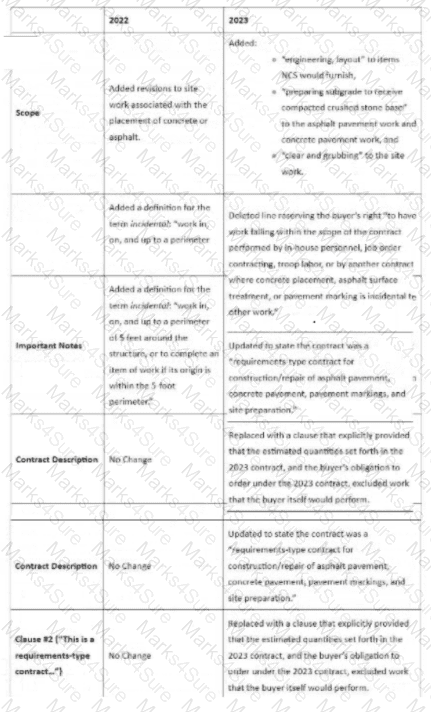
Following expiration of the 2020 contract, the buyer entered into additional one-year contracts in 2022 and 2023. Based on the comparison table provided, the key changes were:
2022: Added revisions to site work associated with the placement of concrete or asphalt; added a definition of “incident” as work in, on, and up to a perimeter of 5 feet around the structure or item to complete work if its origin is within that 5-foot perimeter; no change to contract description; no change to the clause stating the contract was a requirements-type contract.
2023: Added items NCS would furnish, including engineering/layout, preparing subgrade to receive compacted crushed stone base, and clear and grubbing; deleted the line reserving the buyer’s right to have certain work performed by in-house personnel, job order contracting, or another contract where concrete placement, asphalt surface treatment, or pavement marking was incidental to other work; updated the contract description to state the contract was a “requirements type contract for construction/repair of asphalt pavement, concrete pavement, pavement markings, and site preparation”; and replaced the clause with one stating that the estimated quantities set forth in the 2023 contract, and the buyer’s obligation to order under the 2023 contract, excluded work that the buyer itself would perform.
NCS claimed that during performance of the 2020, 2022, and 2023 contracts, the buyer diverted substantial portions of work within the scope sections to other contractors and claimed lost profits under each contract.
Question:
The buyer agreed that the 2020 contract was a requirements-type contract. However, the buyer and seller disagreed about whether the 2022 and 2023 contracts were requirements-type contracts. Were these contracts requirements-type contracts?
Interest-based negotiation, mediation, mini-trial, nonbinding arbitration, and binding arbitration are all examples of what procedure to resolve issues in controversy?
A __________ incentive is included when receiving the goods or services faster is important to the buyer.
Certain items need control of work operations, in-process controls, and inspection to meet technical requirements. In such a situation, buyers and sellers may use higher-level quality standards. Which of the following is a higher-level quality standard?
__________ involves collecting and organizing historical information through mathematical techniques and relating this information to the work output being estimated.
Scenario 5.0: 1
Offeror C contested the exclusion of its proposal from the competitive range under a request for proposals (RFP) issued by the buyer for “aircraft logistics, integration, configuration management, and engineering” (ALICE) services. The seller would provide personnel to work at a buyer’s location, and the buyer would direct all work and “establish work hours consistent with meeting the mission at each contract location.” The RFP provided an estimated level of effort, and offerors completed a pricing model spreadsheet.
Proposals were to be evaluated on mission suitability, past performance, and cost/price. The mission suitability and past performance factors were approximately equal in importance, and each was more important than cost/price. The purpose of the mission suitability factor was to determine the offeror’s ability to provide the required personnel at the required work hours to fulfill the contract need. It included several subfactors: management approach, overall management approach, staffing approach, and contract phase-in approach.
Offeror C argued that the buyer unfairly assessed a management approach weakness for failing to show a plan for complying with required work schedules and break times, failing to consider that the buyer establishes work hours consistent with mission needs, and failing to consider the buyer’s intention to have night shift work on Sundays. Offeror C’s proposal had discussed its approach to managing scheduling and breaks and stated that it would comply with collective bargaining agreement requirements. The buyer nevertheless judged the approach inadequate because it did not explain how Offeror C would enforce worker compliance, comparing the plan to a highway speed-limit sign that does not ensure motorists will not speed. GAO found that the RFP required offerors to explain their approaches to ensuring flexible scheduling and required breaks, but did not reasonably disclose that offerors also had to propose an enforcement mechanism.
Question:
In this scenario, how could the buyer have made its evaluation process more defensible to avoid a protest?
A contractor can submit a __________ to request a fair and reasonable settlement without submitting a claim.
Fundamentally, the contract management profession is about the knowledge and application of __________.
__________ means the ability to accurately perceive emotions in the moment and understand tendencies across situations.
Knowing how to capture, document, and share knowledge is an example of _________.
The rate of output of a worker or group of workers per unit of time, usually compared to an established standard or expected rate of output, is __________.
Scenario 5.0: 2
The buyer issued a request for proposals (RFP) for various support services. As part of these services, the seller would need to review the work of other contractors on existing and future programs. The RFP noted the potential for impaired objectivity or unfair competitive advantage organizational conflicts of interest (OCIs), and specified that the seller would be ineligible for involvement at any level on specifically identified contracts. The RFP also specified a second set of contracts—one of which was identified as “LKS”—that presented potential OCIs, and directed any seller performing work under these latter contracts to provide notice and an OCI mitigation plan that would be analyzed by the buyer.
The buyer intended to award a single cost-plus-fixed-fee, level-of-effort contract for a two-year base period with three option years to the offeror whose proposal provided the best value. This determination was to be based on an evaluation of proposals under the following three factors, in descending order of importance:
o Cost
o Mission suitability
o Past performance
For this contract, mission suitability and past performance, when combined, were to be approximately equal in importance to cost.
The RFP provided that the evaluation of cost proposals would assess both reasonableness and realism. To determine cost, the RFP provided estimates for both estimated level-of-effort hours and optional flex hours for nine labor categories, specifying the experience, skills, and description for each category. Under the mission suitability factor, the RFP included various management approach subfactors. These included a phase-in approach subfactor, which required offerors to specify an incumbent capture rate as a percentage of the total workforce and to justify the rate and methods used to achieve it. Both offerors in the competitive range indicated high incumbent capture rates. The proposed staffing approach was to be assessed under the technical approach subfactor.
The source selection plan provided a table that described how point scores would be assigned and which corresponding adjectival ratings would result from the scores. During the first evaluation, the buyer assigned a weakness to one of the two offerors in the competitive range, Offeror A, based on the fact that Offeror A offered at or below the average compensation for the low end of the required experience level, as well as the risk associated with Offeror A’s ability to capture a qualified workforce. In response, Offeror A showed the buyer that it had used commercial compensation rates to determine its compensation rates. As such, the compensation rates Offeror A had submitted in its proposal were less than the company’s engineers were currently being compensated.
After establishing the competitive range, the buyer held discussions with Offeror A and Offeror B. The buyer then requested final proposal revisions (FPRs).
In its FPR, Offeror A noted that its major subcontractor, Sub A, was the prime contractor on the “LKS project” mentioned in the RFP, and submitted an OCI mitigation plan that included a labor distribution and mapping template showing that the program supported by Sub A’s LKS project would not be overseen by Sub A’s staff performing work on the new contract. Contemporaneous records indicated a brief discussion by the evaluators of this approach, but did not discuss OCI mitigation directly and provided no indication that the potential OCI was analyzed.
After reevaluation, Offeror A had slightly higher scores in the technical approach and mission suitability subfactors, a lower past performance rating, and a lower probable cost. After receiving and evaluating the FPRs, the buyer awarded the contract to Offeror A.
Question:
Why did the buyer need to analyze cost reasonableness and realism for this solicitation?
The __________ states that only what is written in the contract is applicable and that all previous verbal or written statements are not.
Scenario 4.0: 2 — “The Requirements of a Requirements Contract”
In 2019, the buyer awarded National Concrete Supply (NCS) the first of three consecutive contracts for concrete placement, asphalt surface treatments, and pavement markings at one of its facilities. The first one-year contract had an option to extend performance through April 30, 2022. The 2020 contract was a “requirements type contract to be ordered on individual delivery orders.” The scope of the contract required NCS to furnish all labor, materials, equipment, transportation, traffic control, and supervision for construction and repair services. The contract provided that services for concrete work would “include, but not be limited to” base course restoration, crack repair, joint repair, concrete headwalls, complete restoration, concrete curb and gutter, concrete porches, steps, and patios, slab jacking, concrete sidewalks, rapid-set concrete repair, culverts and drainage structures, repair or construction of roads, airfield surfaces, walkways, retaining walls, parking lots, and concrete footings.
The buyer reserved the right “to have work falling within the scope of the contract performed by in-house personnel, job order contracting, or by another contract where concrete placement, asphalt surface treatment, or pavement marking is incidental to other work.”
The 2020 contract also included clauses stating, among other things, that this was a requirements contract and that the estimated quantities were not the buyer’s total requirements, but only estimates of requirements exceeding quantities the buyer might furnish within its own capabilities.
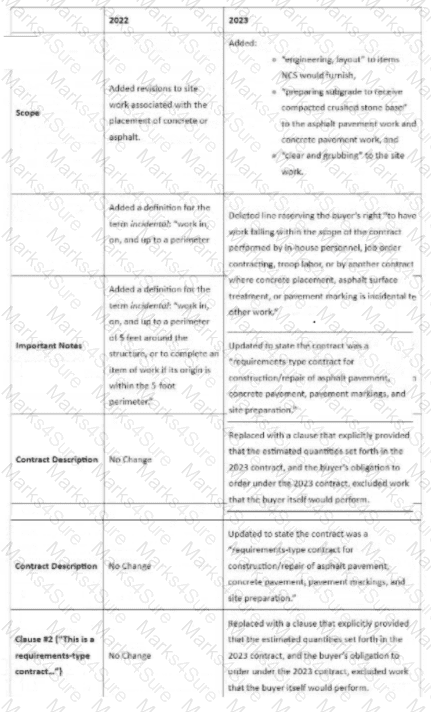
Following expiration of the 2020 contract, the buyer entered into additional one-year contracts in 2022 and 2023. Based on the comparison table provided, the key changes were:
2022: Added revisions to site work associated with the placement of concrete or asphalt; added a definition of “incident” as work in, on, and up to a perimeter of 5 feet around the structure or item to complete work if its origin is within that 5-foot perimeter; no change to contract description; no change to the clause stating the contract was a requirements-type contract.
2023: Added items NCS would furnish, including engineering/layout, preparing subgrade to receive compacted crushed stone base, and clear and grubbing; deleted the line reserving the buyer’s right to have certain work performed by in-house personnel, job order contracting, or another contract where concrete placement, asphalt surface treatment, or pavement marking was incidental to other work; updated the contract description to state the contract was a “requirements type contract for construction/repair of asphalt pavement, concrete pavement, pavement markings, and site preparation”; and replaced the clause with one stating that the estimated quantities set forth in the 2023 contract, and the buyer’s obligation to order under the 2023 contract, excluded work that the buyer itself would perform.
NCS claimed that during performance of the 2020, 2022, and 2023 contracts, the buyer diverted substantial portions of work within the scope sections to other contractors and claimed lost profits under each contract.
Question:
If the court found that the 2020 contract was a requirements-type contract, would the buyer have been in breach of contract if it had awarded another company a $500,000 contract for the construction of multiple roads during the performance period?
A written demand by one of the contracting parties seeking the payment of money in a sum certain is a/an __________.
PDF + Testing Engine

Testing Engine
PDF (Q&A)