
Free Practice Questions for the iSQI Technical Test Analyst CTAL-TA_V4.0 Exam (2026 Updated)
At Marks4sure, we are dedicated to providing IT professionals with the most accurate and reliable preparation materials for the iSQI CTAL-TA_V4.0 exam. To support your certification journey, we have made a selection of our premium 2026 Technical Test Analyst practice questions and answers available completely free. You can take this practice test as many times as you need. Every question includes a detailed, expertly verified explanation to ensure you fully grasp the core security concepts before test day.
In which of the following circumstances is the transition from a high-level test case to a low-level test case MOST LIKELY to be deferred from test design to test implementation?
You are working on a project to build a purchasing system. The main requirements for the system are that it shall:
Allow users to enter details of items that they wish to have purchased and, from these details, create a purchase request.
Take each purchase request through a workflow that will allow the requestor’s line manager to approve the request, reject it or return it for clarification / modification.
Forward approved requests to the Purchasing Department.
Allow purchasers to find the best available supplier for each approved request and place the request on that supplier as a purchase order.
The solution is being developed according to the company’s traditional V-model methodology. The requirements are clearly documented and include a business process model.
System testing has finished and the test manager has asked you, the senior TA, to identify any parts of the product that should be focused on during acceptance testing. The results of this may be used to adjust the acceptance test plan.
You are using defect cluster analysis, only counting defects with severity levels 1 to 3, ignoring low severity levels 4 and 5. Function point analysis was used for estimating, so you have used function points as the unit of size for the various functional areas of the product. No numeric estimates of expected defect quantities were made for them individually but, as a result of product risk analysis, these functional areas have been ranked according to the amount of product risk that was predicted in them, with risk ranking 1 being the highest and 5 the lowest; the thoroughness of the testing performed so far has been proportional to that. The results are presented in the table below.
Functional area
Total function points
Product risk ranking
Defects found
Purchase Request entry
2000
2
30
Purchase Request workflow
1500
4
15
Purchase Request authorisation
1000
5
25
Supplier identification
2000
1
30
Purchase Order creation
1000
3
30
Which functional areas would you recommend for more test focus in acceptance testing?
a) Purchase Request entry
b) Purchase Request workflow
c) Purchase Request authorization
d) Supplier Identification
e) Purchase Order creation
The following decision table shows the rules for sending a package. Same day delivery will not be provided for big packages. All combinations of same day delivery and international destination have been removed as they are infeasible.
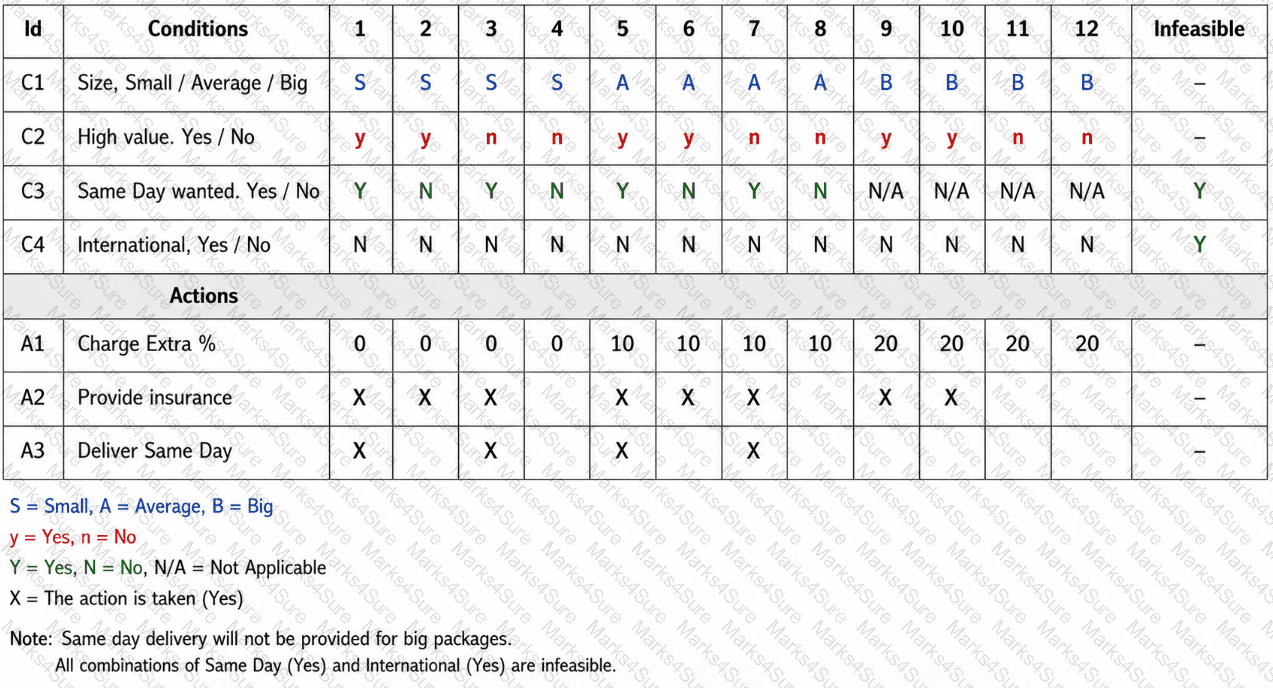
How many columns will the table have after all possible minimization has been performed?
You have been assigned as Test Analyst on a project that will deliver quotes for motor insurance. The amount quoted depends upon the combined values of twelve variables, that are resolved by a set of business rules.
What should be your MAIN task during the test analysis activity?
A system will be developed to support the administration of table-tennis tournaments. The following requirements for the enrolment of entrants have been provided:
R1. High. The administrator shall be able to enter the entrant's name, address, phone number/s (mobile and/or home), email and social media handles. Validation rules for these data items are provided separately.
R2. High. The administrator shall be able to enter the entrant’s current world ranking (up to 250) and their relationship with the tournament sponsors (i.e. clothing / equipment / endorsement).
R3. High. The administrator shall be able to enter the entrant’s attendance history at previous events (i.e. finalist / played / withdrew during event / withdrew before event).
R4. Medium. From the entrant’s address the system shall derive whether or not the entrant lives locally and, on the basis of that combined with other rules that are provided separately, shall suggest how much of the tournament’s overall prize fund should be offered to the entrant as their individual attendance fee.
R5. Low. The administrator should be able to change the suggested attendance fee and the system should then deduct this from the remaining prize fund balance accordingly.
You have been asked to review the requirements using perspective-based reading, from your viewpoint as the TA who will be writing functional correctness system test cases. Assume that the other rules referred to by requirements R1 and R4 have been reviewed and are satisfactorily testable. Which conclusion would you reach?
You are testing a program which should calculate the area of a trapezium and have decided to use metamorphic testing. The formula
Area = (((a + b) / 2) * h)
where a and b are the lengths of the two parallel sides, and h is the height when the parallel sides are horizontal.
Which ONE of the following would be an appropriate metamorphic relation?
The test basis for your latest project contains the activity diagram that is shown below. The business architect has confirmed that this model has been reviewed and approved by the stakeholders.
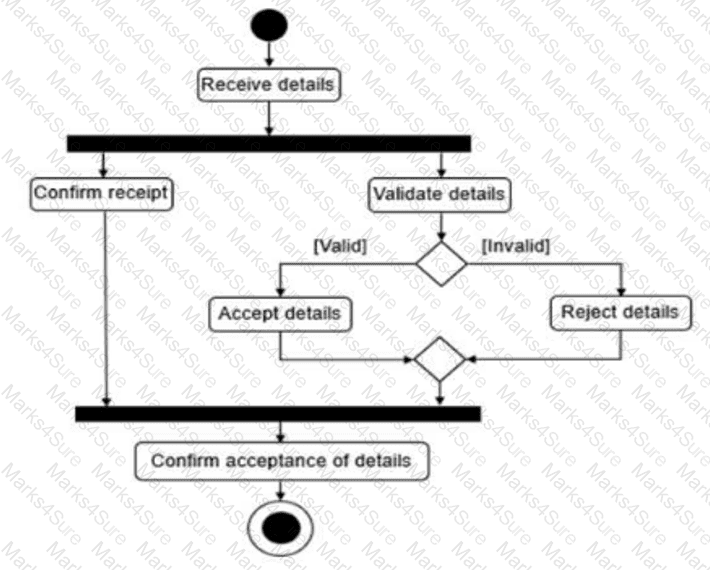
Which of the following conclusions is correct?
A savings bank rewards its customers with a £100 bonus when they reach the age of 21, if they have held a savings account for more than 3 years and have at least £2,000 in the account at that time.
Assume that Age is measured in whole years, Account term in whole years, and Account balance to two decimal places, i.e., pounds and pence.
The intended rule is:
IF Age = 21 AND Account term > 3 years AND Account balance > = £2000.00 THEN Pay £100 bonus
You have a suite of test cases with the following values:
• TC1 Age = 21, Account term = 3 years, Account balance = £2000.00
• TC2 Age = 20, Account term = 6 years, Account balance = £500.00
• TC3 Age = 20, Account term = 2 years, Account balance = £3000.00
Which of the following test cases should you add to the suite to achieve 100% Reliable domain coverage?
You are working on a project to build a purchasing system. The main requirements for the system are that it shall:
Allow users to enter details of items that they would like to purchase and, from these details, create a purchase request.
Take each purchase request through a workflow that will allow the requestor’s line manager to approve the request, reject it, or return it for clarification / modification.
Forward approved requests to the Purchasing Department.
Allow purchasers to find the best available supplier for each approved request and place the request on that supplier as a purchase order.
The system is being developed following an Agile SDLC. Risk-based testing is practiced informally, discussion about what testing each user story will need being done in a risk-driven way during story refinement, but there is no central product risk register. Testing is exploratory, except for the acceptance tests for each story’s acceptance tests. Operational profiles have been created to guide performance testing.
Regression test automation started late. The team want to automate all acceptance tests for every user story, but the test automation engineers are still playing catch up. They started with the tests that were easiest to automate, so the functional and non-functional coverage of the regression test pack is incomplete and random.
The current iteration is delivering a major change to the approval workflow and you, as a Test Analyst, have been tasked with defining the regression testing.
Which techniques would be MOST effective for selecting regression tests?
a) History-based, driven by the results of the regression tests run so far
b) Risk-based, driven by the product risks and their traceability to the tests
c) Operational profile-based, driven by the likely patterns of use of the relevant transactions
d) Coverage-based, driven by the coverage obtained from use of relevant test techniques
e) Impact analysis, driven by consultation with technical stakeholders to identify what might be affected.
The following use case diagram shows the process of raising a Purchase Request (PR) and getting it authorized. Details are entered in batches; any that fail validation will be rejected and must be re-entered. The details will indicate whether the request is a normal one or an emergency one. Normal requests must be authorized by the department manager, who may refuse to do so. Emergency requests will be automatically authorized and reported to the manager.
The test strategy states that:
• all combinations of extensions and exceptions, as well as the main scenario, shall be tested
• loops shall get simple loop coverage where the maximum number of iterations for validation exceptions is 3 and the typical number is 2.
What is the minimum quantity of test cases that will be needed to obtain this coverage?
PDF + Testing Engine

Testing Engine
PDF (Q&A)