Free Practice Questions for the iSQI Software testing CTAL-TM_Syll2012 Exam (2026 Updated)
At Marks4sure, we are dedicated to providing IT professionals with the most accurate and reliable preparation materials for the iSQI CTAL-TM_Syll2012 exam. To support your certification journey, we have made a selection of our premium 2026 iSQI Software testing practice questions and answers available completely free. You can take this practice test as many times as you need. Every question includes a detailed, expertly verified explanation to ensure you fully grasp the core security concepts before test day.
Which of the following organizational structures would be considered unorthodox? [1]
Your company is installing a third-party enterprise-wide business software package. This is the first time the company has done anything like this.
Which technique would be the best one to use to estimate the testing effort? [3]
You are a Test Manager on a new project. The software that is being created will be used to control the projectors in movie theaters. This is a time critical project because the software must be
released before the Christmas holiday season which has the highest movie attendance of the year.
You have decided to implement a review process for the work products that are a part of this release to save both time and money. In order to expedite the training, you brought in a consultant to
train the participants and moderators in proper review processes. Your team is enthusiastic about participating in the reviews.
The project is in the early planning stages. As the review leader, what is an appropriate activity for you to be doing at this point in the project? [3]
Test Tools and Automation
Assume you are a Test Manager involved in system testing of a CRM application for a Pay-TV company. Currently the application is able to support a proper number of users assuring the required responsiveness. Since the business is expected to grow, you have been asked to evaluate the ability of the application to grow to support more users while maintaining the same responsiveness.
Which of the following tools would you expect to be the most useful at performing this evaluation?
Number of correct responses: 1
K2 1 credit
Test Tools and Automation
Assume you are the Test Manager in charge of independent testing for avionics applications.
You are in charge of testing for a project to implement three different CSCI (Computer Software Configuration Item):
- a BOOT-X CSCI that must be certified at level B of the DO-178B standard
- a DIAG-X CSCI that must be certified at level C of the DO-178B standard
- a DRIV-X CSCI that must be certified at level A of the DO-178B standard
These are three different software modules written in C language to run on a specific hardware platform.
You have been asked to select a single code coverage tool to perform the mandatory code coverage measurements, in order to meet the structural coverage criteria prescribed by the DO-178B standard. This tool must be qualified as a verification tool under DO-178B.
Since there are significant budget constraints to purchase this tool, you are evaluating an open-source tool that is able to provide different types of code coverage. This tool meets perfectly your technical needs in terms of the programming language and the specific hardware platform (it supports also the specific C-compiler).
The source code of the tool is available.
Your team could easily customize the tool to meet the project needs. This tool is not qualified as a verification tool under the DO-178B.
Which of the following are the three main concerns related to that open-source tool selection?
Number of correct responses: 3
K4 3 credits (2 credits out of 3 credits correct, 1 credit point)
Test Tools and Automation
Assume you are managing a test automation project for a mission-critical system.
Because vendor provided tools and open source solutions don't meet the needs of this project, you ask your test team to develop a custom automation framework.
Which of the following management issues associated to the development of this custom automation framework is least likely to manage?
Number of correct responses: 1
K2 1 credit
Test Tools and Automation
In your organization the following tools of the same vendor are currently in use: a requirements management tool, a test management tool and a bug tracking tool.
You are the Test Manager.
You are currently evaluating a test automation tool of the same vendor (to complete the vendor's tool suite) against an interesting open-source test automation tool under the GNU GPL (General Public License).
There are no initial costs associated to that open-source tool.
Which of the following statements associated to the selection of the open-source tool is correct in this scenario?
Number of correct responses: 1
K2 1 credit
Test Tools and Automation
After a selection process you have selected a test management tool that is going be introduced in your organization and used by your test team in a pilot project.
You have already identified the member of your test team who will be the administrator of the tool, since he/she has a significant experience with the administration of test management tools and so he/she is able to make effective and efficient up-front decisions about "how" the tool will be used. You have also developed a training plan for the other members of your test team.
In collaboration with the administrator of the tool you have also devised standard ways of managing, storing and maintaining the tool and its assets including backup/restore procedures.
You have also analyzed standard formats supported by the tool (CSV, XLS, XML, etc.) to export, import and archive all the information managed by the tool itself (requirements, test case specifications, test plans etc.) for compliance with the most important test management tools, in order to minimize the impacts of migrating this information to a new tool that could replace the existing one in the future.
Which of the following phases in the lifecycle of the new tool has NOT been adequately considered in this description?
Number of correct responses: 1
K2 1 credit
Test Management
Consider an agile team adopting Extreme Programming (XP) with five developers and one tester without any coding experience.
To which of the following activities would you expect the tester will contribute most?
Number of correct responses: 1
K2 1 credit
Test Management
You are the Test Manager of a new project that will have three formal levels of testing: unit, integration and system testing. The testing strategy you decide to adopt a blend of risk-based testing and reactive testing strategies.
Which of the following answers describes the most consistent example of implementation of this test strategy during the execution of the system tests?
Number of correct responses: 1
K2 1 credit
Improving the Testing Process
Which of the following statements about the STEP test process improvement model is true?
Number of correct responses: 1
K2 1 credit
Improving the Testing Process
Which of the following statements about the TMMi test process improvement model is true?
Number of correct responses: 1
K2 1 credit
Improving the Testing Process
Consider the following statements describing the importance of improving the test process:
I. Test process improvement is important because being focused only on the test process it can provide recommendations to improve the test process itself, but it can’t indicate or suggest improvement to areas of the development process
II. Test process improvement is important because it is much more effective than software process improvement to improve the quality of a software system
III. Test process improvement is important because several process improvement models (STEP, TPI Next, TMMi) have been developed over the years
IV. Test process improvement is important because every organization, regardless of the context, should always achieve the maximum level of maturity of testing described in the test improvement models such as TMMi
Which of the following answers is correct?
Number of correct responses: 1
K2 1 credit
People Skills – Team Composition
An agile development team decides to hire a tester who has always worked:
- in independent test teams, reporting the problems found in a defect tracking system
- in safety-critical projects, with a stronger focus on the quality of the product than on time and budget.
This agile team is focused on short-term goals to get the product released on time and within budget.
Which of the following answers would you expect to be most likely true in this scenario?
Number of correct responses: 1
K2 1 credit
People Skills – Team Composition
Your test team consists of four members (Mary, Bob, Mark, Dave) with different interpersonal skills.
The following skills assessment spreadsheet shows the characteristics of the team members with respect to a list of interpersonal-skills (for each characteristic only the member with the highest level of that characteristic is indicated and marked with ‘X’):
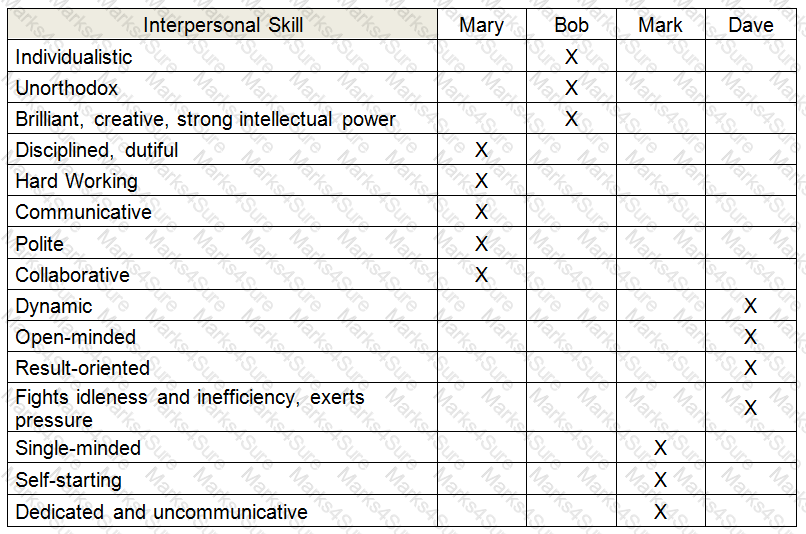
On the next project a member of your test team will have to perform some routine tasks requiring collaboration with other teams.
Who in your test team would you expect to be most suitable at doing these tasks?
Number of correct responses: 1
K4 3 credits
People Skills – Team Composition
Consider the following analysis of testing skills performed on four people: Alex, Robert, John and Mark (all the skills have been rated on an ascending scale: The higher the score, the better the skill):
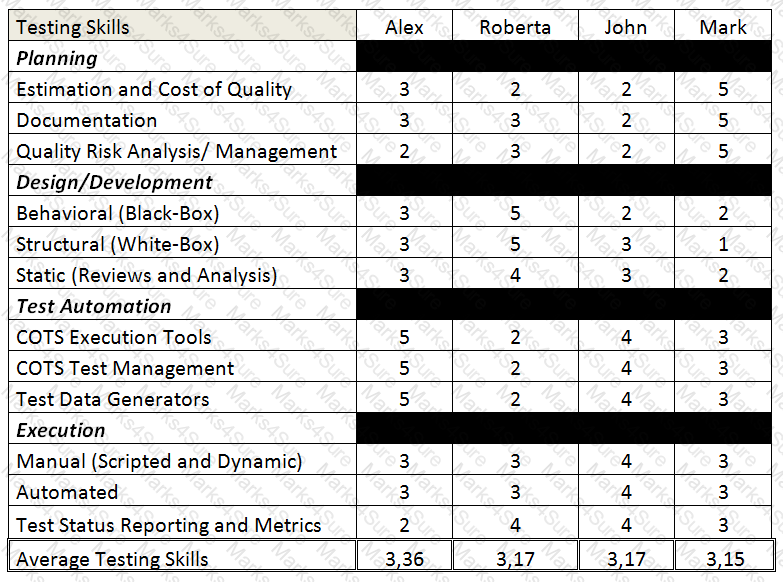
Which of these people, based on this analysis, would you expect to be most suitable to work specifically as test designer?
Number of correct responses: 1
K4 3 credits
People Skills – Team Composition
Which of the following would you expect to be most likely an example of a motivating factor for testers?
Number of correct responses: 1
K2 1 credit
People Skills – Team Composition
Which of the following would you expect to be most likely an example of a demotivating factor for testers?
Number of correct responses: 2
K2 1 credit
The following is the unique “critical” quality risk item that has been identified:
CR-RSK-1. The GUI of the application might accept non-integer values for the input field designed to get the number of bottles from the user
Test analysis for system testing has just begun and the following test conditions have been identified:
TC-SEL-2. Test the selection of the package sizes
TC-SEL-4. Test wrong numbers of bottles for an order
TC-CR-RSK-1. Test the accepted values from the input field designed to get the number of bottles from the user
Assume that you have used traceability to determine the logical test cases that cover all the requirements and the single risk item identified in that scenario.
Which of the following is a positive logical test that is complete and correct, and covers the REQ-SEL-4 requirement?
Number of correct responses: 1
K3 2 credits
Testing Process
Assume you are the Test Manager for a new software release of an e-commerce application.
The server farm consists of six servers providing different capabilities. Each capability is provided through a set of web services.
The requirements specification document contains several SLAs (Service Level Agreements) like the following:
SLA-001: 99.5 percent of all transactions shall have a response time less than five seconds under a load of up-to 5000 concurrent users
The main objective is to assure that all the SLAs specified in the requirements specification document will be met before system release. You decide to apply a risk-based testing strategy and an early risk analysis confirms that performance is high risk. You can count on a well-written requirements specification and on a model of the system behavior under various load levels produced by the system architect.
Which of the following test activities would you expect to be the less important ones to achieve the test objectives in this scenario?
Number of correct responses: 1
K4 3 credits
Testing Process
Consider an information system of a Pay-Tv company based on a SOA architecture.
The integrated system currently consists of three core systems:
- a CRM (Customer Relationship Management) system
- a BRM (Billing and Revenue Management) system
- a CAS (Conditional Access System) system
all of them communicating with SOA Middleware.
You have been asked to manage the testing activities for the integration of two additional off-the-shelf systems from two different vendors: a SMS (Short Message Service) server and an IVR (Interactive Voice Response) system.
Assume that there is a high likelihood that the two off-the-shelf systems will be low-quality and that you have a clear proof that the testing performed by the two vendors on their systems has been unsystematic and unprofessional. This obviously leads to higher quality risk for the overall integrated system.
You are the Test Manager of this project. Your main goal is to plan for testing activities to mitigate this risk.
Which of the following answers best describes the test activities (assuming it is possible to perform all of them) you should plan for?
Number of correct responses: 1
K4 3 credits
A chart showing the trend in the lag time from defect reporting to resolution during system testing is also available. The chart shows that the daily closure period is consistently and significantly above the rolling closure period for a long period of the system testing phase.
Almost all defects found during system testing have been related to the system as a whole, not related to single units or integrations issues. Almost all quality risks have been addressed during the unit and integration testing phase and no residual quality risks were present in the integrated system. This has been confirmed by exploratory testing sessions performed during system testing, targeted at finding defects in these quality risk areas.
Based on the given information only, which one of the following areas would you expect to be considered more in the retrospective meeting in order to be improved?
Number of correct responses: 1
K3 3 credits
Reviews
You are a Test Manager working for a software organization where reviews have never been applied. After a meeting with your managers examining a business case for reviews, (including their costs, benefits, and potential issues), the management finally decides to adopt formal reviews for future projects.
You have been given a budget that you have spent to provide training in the review process and to introduce the review process on a pilot project.
On that pilot project the introduction of reviews has been very positive in terms of positive involvement from all the participants. All the reviews applied to different documents have been very effective for their purposes (especially at revealing defects).
Which of the following answers describes an important success factor for the introduction of formal reviews which is missing in this scenario?
Number of correct responses: 1
K4 3 credits
The main objectives the senior management team wants to achieve are:
- to reduce the costs associated with dynamic testing
- to use reviews to ensure that the project is on course for success and following the plan
- to use reviews as a well-documented and effective bug-removal activity following a formal process with well-defined roles
- to determine the effectiveness of reviews in terms of phase containment
- to improve phase containment effectiveness
Which of the following answers would you expect to describe the best way to achieve these objectives?
Number of correct responses: 1
K4 3 credits
Reviews
Which of the following factors could negatively influence a review?
Number of correct responses: 1
K2 1 credit
During the follow-up phase the following conditions are checked:
X1. The code has been completely reviewed
X2. All the identified defects have been correctly fixed and the modified code has been compiled successfully and run through all the static analyzers used by the project without warnings and errors
X3. The modified code is available under the configuration management system with a new version number for the specified CI
If these conditions are fulfilled then the review process terminates.
Which of the following characteristics of a formal review is missing in this description?
Number of correct responses: 1
K2 1 credit
Reviews
You are the Test Manager of a project that adopts a V-model with four formal levels of testing: unit, integration, system and acceptance testing.
On this project reviews have been conducted for each development phase prior to testing, which is to say that reviews of requirements, functional specification, high-level design, low-level design and code have been performed prior to testing.
Assume that no requirements defects have been reported after the release of the product.
Which TWO of the following metrics do you need in order to evaluate the requirements reviews in terms of phase containment effectiveness?
Number of correct responses: 2
K3 2 credits
Defect Management
During the system testing phase a tester from your test team observes a failure in the system under test and he/she decides to create an incident report. The incident report is currently in a “new” state, indicating it needs to be investigated.
Which THREE of the following information items can’t yet be present in the incident report?
Number of correct responses: 3
K3 2 credits (2 credits out of 3 credits correct, 1 credit point)
Defect Management
Which of the following information would you expect to be the most useful to perform a defect clustering analysis?
Number of correct responses: 1
K2 1 credit
Defect Management
Assume you are working on a defect management process to be used by a software organization to track the current status of the defects reports for several projects.
When a defect is found for investigation a defect report is created in “Opened” state that is the unique initial state. The defect report status has also a unique finale state that is the “Closed” state.
The following state transition diagram describes the states of this defect management process:
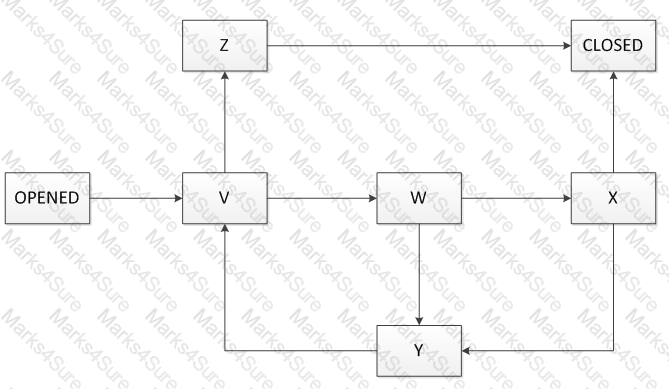
where only the initial (“Opened”) and final (“Closed”) states are indicated while the remaining states (V, W, X, Y, Z) have yet to be named.
Which of the following assignments would you expect to best complete the defect management process?
Number of correct responses: 1
K3 2 credits
Defect Management
Consider a defect report and assume that a part of its lifecycle includes the following states:
New: Is the initial state
Working: Means that the developers are addressing the defect in order to produce a fix for the defect
Clarification: Means that the developers need more information from the tester to address the defect and produce a fix for the defect and the tester is working to provide this information to the developers
Verification: Means that a fix for the defect has been produced and the tester is running the adequate tests to verify whether the fix solves the defect
Closed: is the final state
Which of the following answers represents an invalid sequence of states that can’t lead the bug report to the “Closed” state?
Number of correct responses: 1
K2 1 credit
PDF + Testing Engine

Testing Engine
PDF (Q&A)