
Free Practice Questions for the dbt Labs Analytics Engineers dbt-Analytics-Engineering Exam (2026 Updated)
At Marks4sure, we are dedicated to providing IT professionals with the most accurate and reliable preparation materials for the dbt Labs dbt-Analytics-Engineering exam. To support your certification journey, we have made a selection of our premium 2026 Analytics Engineers practice questions and answers available completely free. You can take this practice test as many times as you need. Every question includes a detailed, expertly verified explanation to ensure you fully grasp the core security concepts before test day.
You wrote this test against your fct_orders model to confirm status filters were properly applied by a parent model:
{{
config(
enabled=true,
severity= ' error '
)
}}
select *
from {{ ref( ' fct_orders ' ) }}
where status_code = 13
Which statement about this test is true?
You work at an e-commerce company and a vendor provides their inventory data via CSV file uploads to an S3 bucket.
How do you prep the data for dbt transformations?
Choose 1 option.
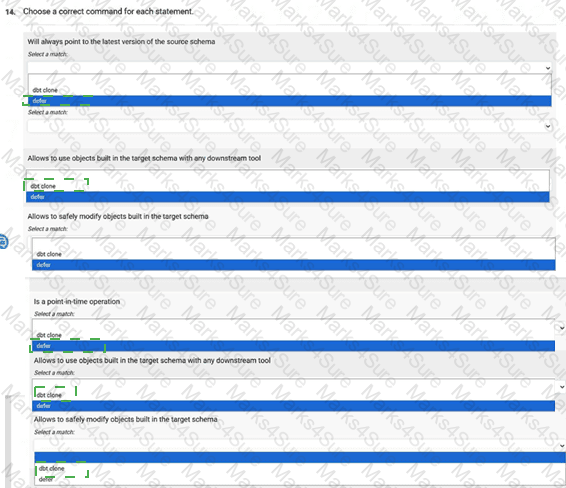
In development, you want to avoid having to re-run all upstream models when refactoring part of your project.
What could you do to save time rebuilding models without spending warehouse credits in your next command?
Examine this query:
select *
from {{ ref( ' stg_orders ' ) }}
where amount_usd < 0
You want to make this a generic test across multiple models.
Which set of two standard arguments should be used to replace {{ ref( ' stg_orders ' ) }} and amount_usd? Choose 1 option.
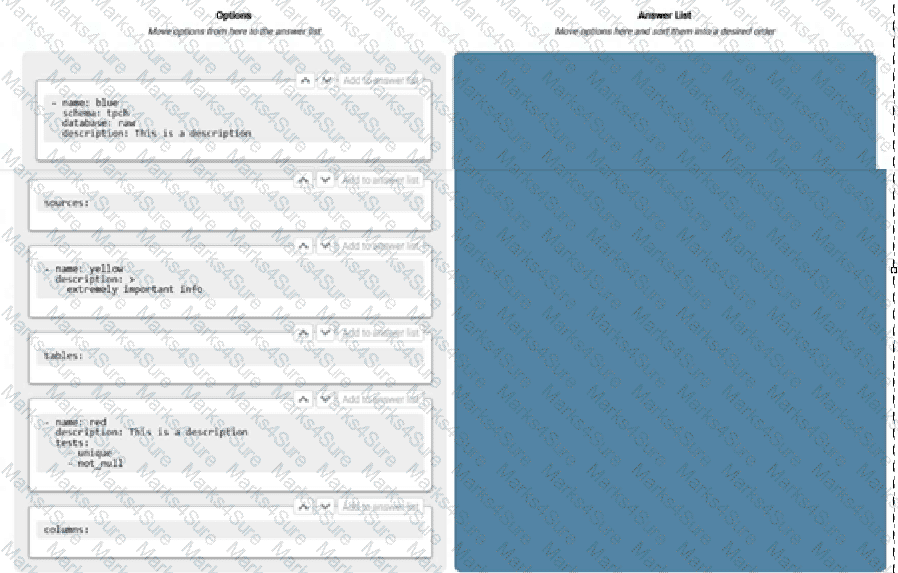
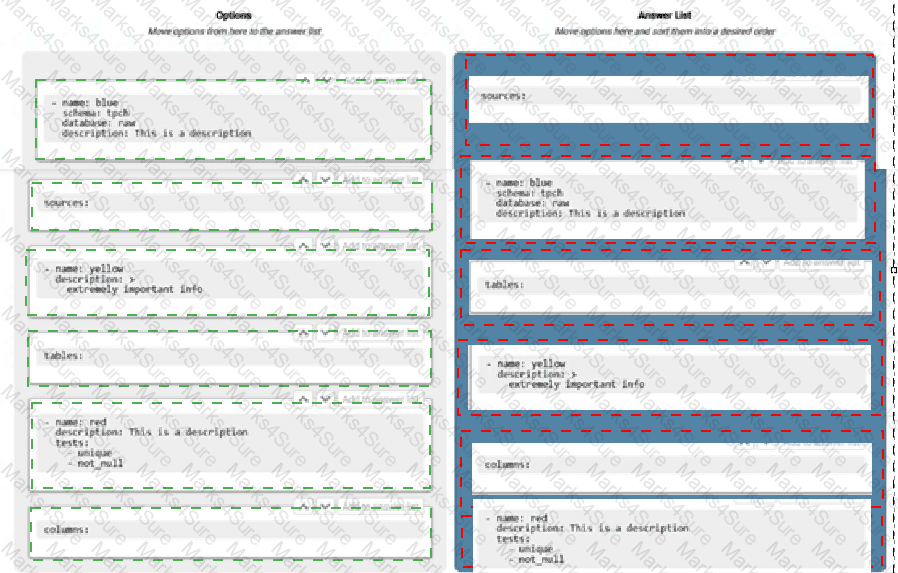
Ignoring indentation, arrange these YAML code snippets in the correct order to generate descriptions on the source, table, and column:
You have created a model called stg_tasks and now you need to implement tests.
You provide this in schema.yml:
version: 2
models:
- name: stg_tasks
columns:
- name: completed_at
tests:
- not_null:
- config:
where: " state = ' completed ' "
You receive this compilation error:
[WARNING]: Did not find matching node for patch with name ' stg_tasks ' in the ' models ' section of file ' models/example/schema.yml '
How can you change the configuration on the not_null test to fix this compiler error?
You have just executed dbt run on this model:
select * from {{ source( " {{ env_var( ' input ' ) }} " , ' table_name ' ) }}
and received this error:
Compilation Error in model my_model
expected token ' : ' , got ' } '
line 14
{{ source({{ env_var( ' input ' ) }}, ' table_name ' ) }}
How can you debug this?
13. An analyst on your team has informed you that the business logic creating the is_active column of your stg_users model is incorrect.
You update the column logic to:
case
when state = ' Active '
then true
else false
end as is_active
Which test can you add on the state column to support your expectations of the source data? Choose 1 option.
Which of the following is true about restricting the usage of models in dbt?
Choose 1 option.
Given this dbt_project.yml:
name: " jaffle_shop "
version: " 1.0.0 "
config-version: 2
profile: " snowflake "
model-paths: [ " models " ]
macro-paths: [ " macros " ]
snapshot-paths: [ " snapshots " ]
target-path: " target "
clean-targets:
- " logs "
- " target "
- " dbt_modules "
- " dbt_packages "
models:
jaffle_shop:
orders:
materialized: table
When executing a dbt run your models build as views instead of tables:
19:36:14 Found 1 model, 0 tests, 0 snapshots, 0 analyses, 179 macros, 0 operations, 0 seed files, 0 sources, 0 exposures, 0 metrics
19:36:16 Concurrency: 1 threads (target= ' default ' )
19:36:17 Finished running 1 view model in 3.35s.
19:36:17 Completed successfully
19:36:17 Done. PASS=1 WARN=0 ERROR=0 SKIP=0 TOTAL=1
Which could be a root cause of why the model was not materialized as a table?
The target-path is incorrectly configured.
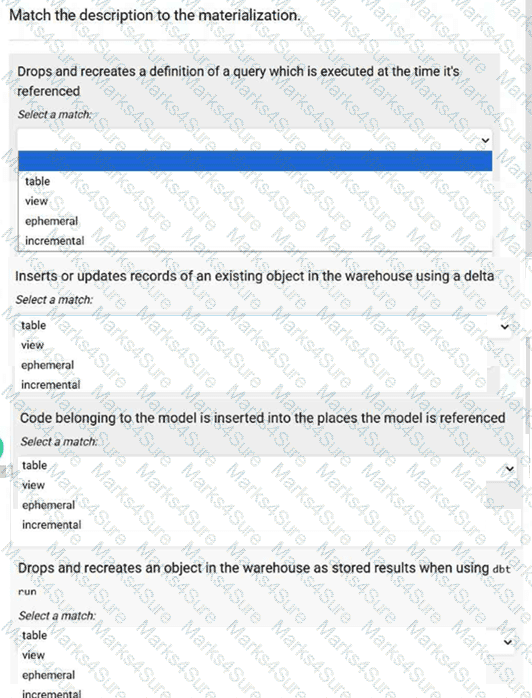
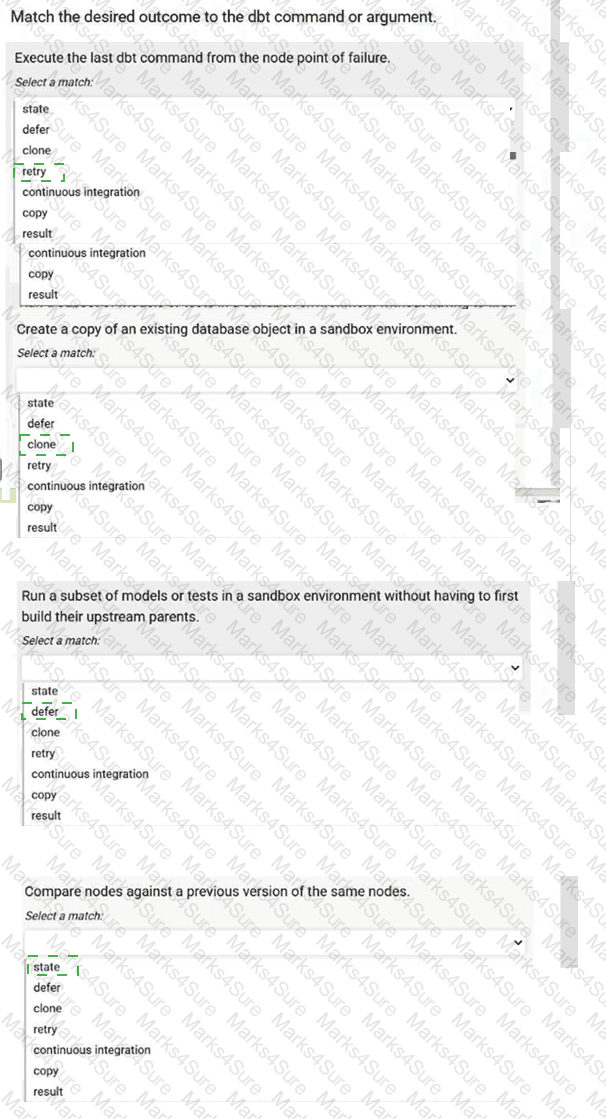
You run the command:
dbt test --select ' test_type:singular '
What will the command run?
Options shown:
PDF + Testing Engine

Testing Engine
PDF (Q&A)