Free Practice Questions for the Microsoft Certified: Azure Databricks Data Engineer DP-750 Exam (2026 Updated)
At Marks4sure, we are dedicated to providing IT professionals with the most accurate and reliable preparation materials for the Microsoft DP-750 exam. To support your certification journey, we have made a selection of our premium 2026 Microsoft Certified: Azure Databricks Data Engineer practice questions and answers available completely free. You can take this practice test as many times as you need. Every question includes a detailed, expertly verified explanation to ensure you fully grasp the core security concepts before test day.
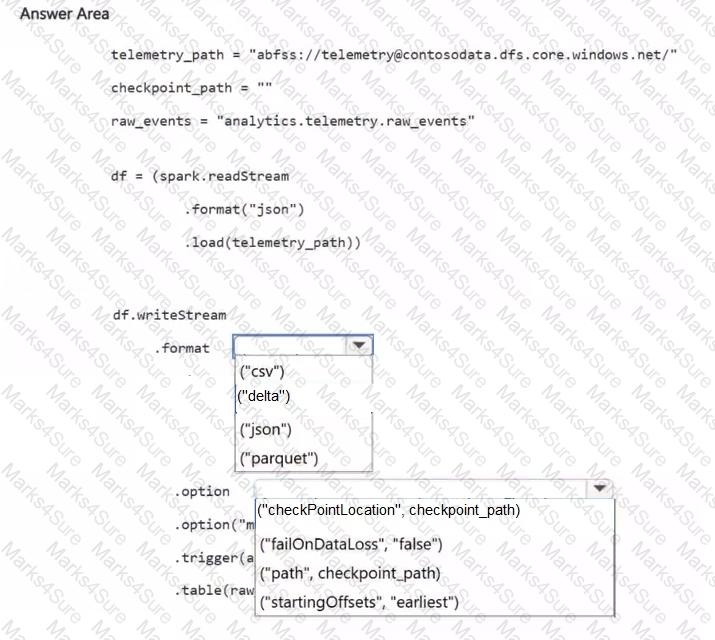
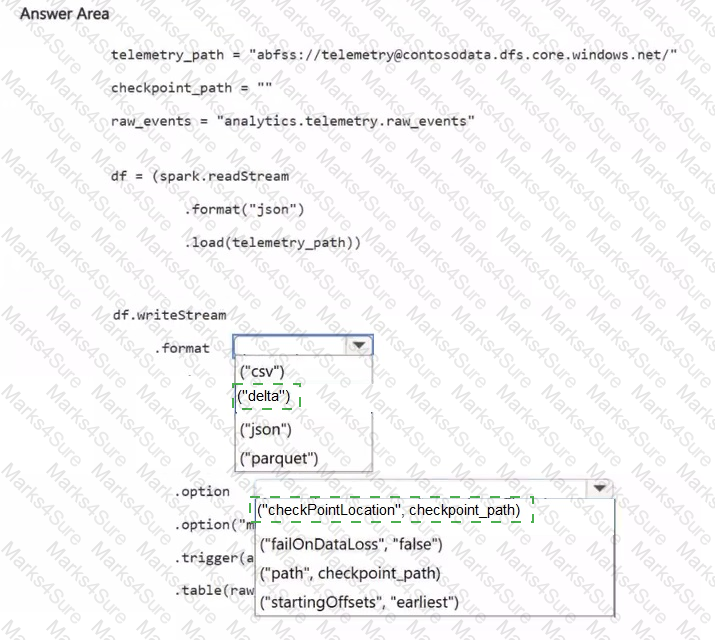
You need to complete the PySpark code for the Spark Structured Streaming pipelines. The solution must meet the data ingestion and processing requirements.
How should you complete the code segment? To answer, select the appropriate options in the answer area.
NOTE: Each correct selection is worth one point.
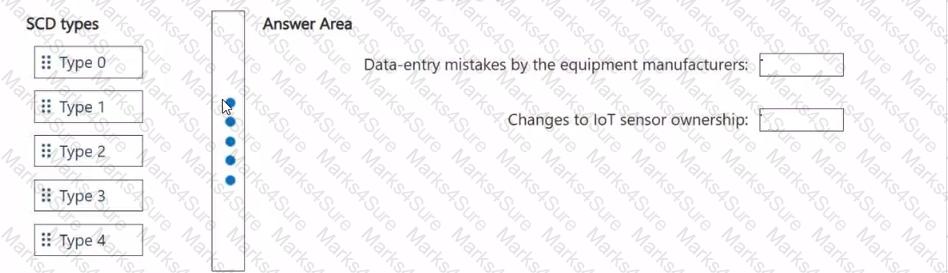
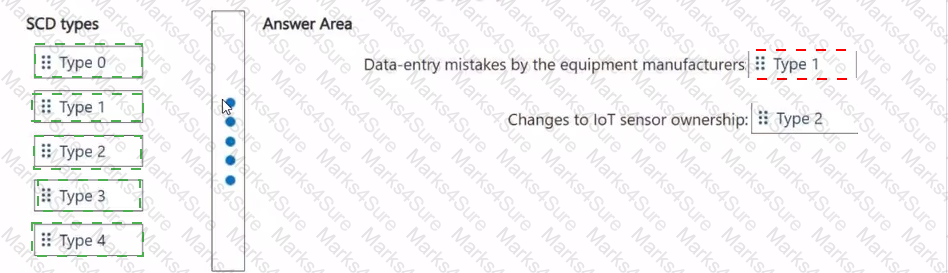
Which SCD type should you use to support the planned data modeling changes? To answer, drag the appropriate types to the correct issues. Each type may be used once, more than once, or not at all. You may need to drag the split bar between panes or scroll to view content.
NOTE: Each correct selection is worth one point.
DP-750 Report Card

You need to develop the task logic for a new job in Lakeflow Jobs that processes telemetry data.
Each task must contain only the appropriate logic for its step in the pipeline. The solution must support the planned changes and meet the data ingestion and processing requirements.
What should you do?
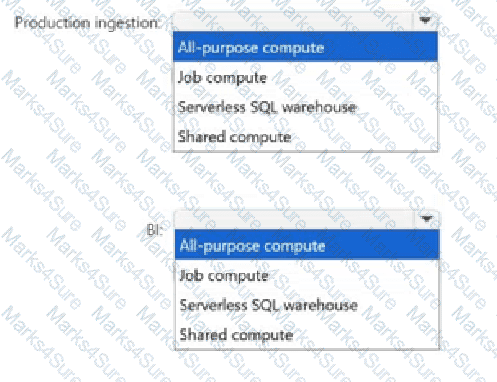
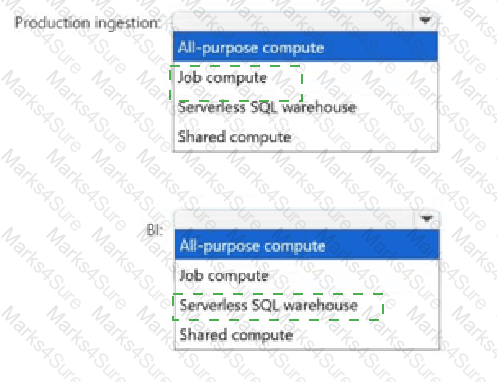
You need to recommend a compute type for the production ingestion workloads and BI workloads. The solution must meet the environment and compute requirements.
What should you recommend for each type of workload? To answer, select the appropriate options in the answer area.
NOTE: Each correct selection is worth one point.
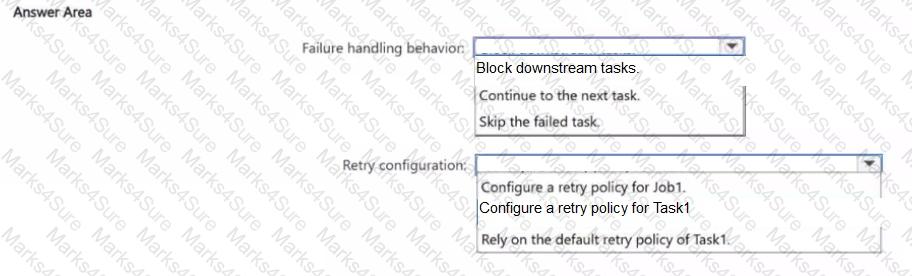
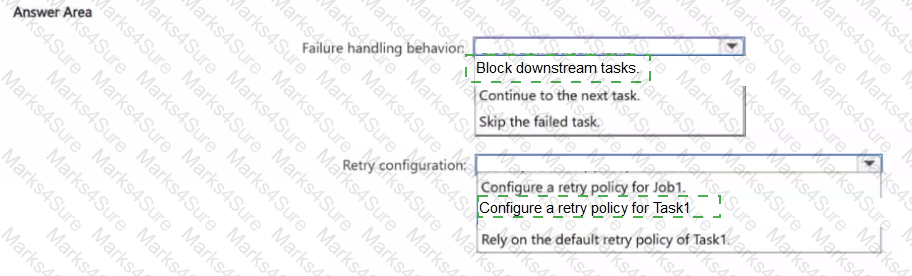
You have an Azure Databricks job named Job1 that contains an ingestion task named Task1 and transformation task named Task2. You need to ensure that if Task1 fails, the task retries automatically, and Task2 is prevented from running How should you configure Job1? To answer, select the appropriate options in the answer area.
NOTE: Each correct selection is worth one point.
You have an Azure Databricks workspace that is enabled for Unity Catalog and contains a Delta table named Orders.
You load the Orders table into an Apache Spark DataFrame named df.
You need to create a DataFrame that excludes rows where the order amount is null.
Solution: You run the following expression.
df.filter(df.order_amount != None)
Does this meet the goal?
You have an Azure Databricks workspace that is enabled for Unity Catalog.
You plan to create a job in Lakeflow Jobs named Job1 that:
• Ingests data from cloud storage
• Runs two independent transformation tasks
The transformation tasks must run only after the ingestion completes and must run in parallel.
You need to design the task logic for Job1.
What should you configure?
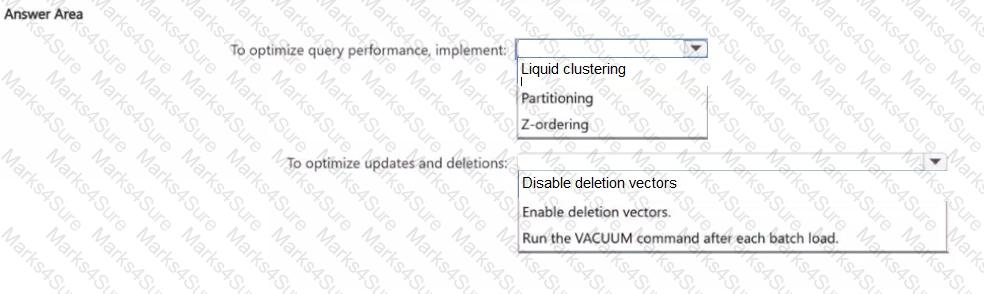
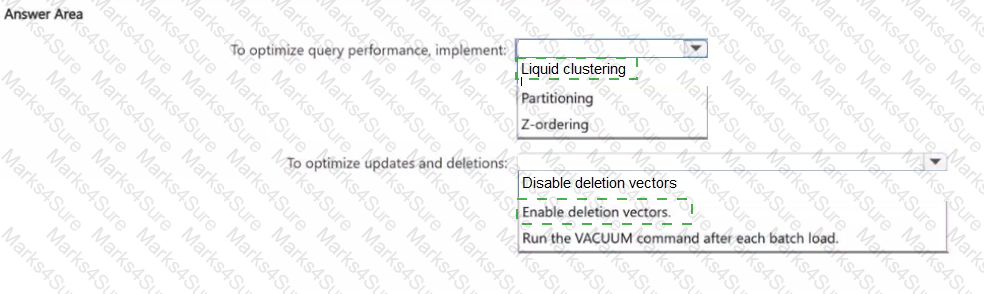
You have an Azure Databricks workspace that is enabled for Unity Catalog and contains a managed Delta table named Tabid.
Table! is written by batch jobs every hour and is queried frequently by filtering two columns named Customerld and EventDate.
You expect Table1 to grow significantly over time.
The rows in Table1 are frequently updated and deleted to support compliance requests.
You need to keep query performance consistent as Table1 grows. The solution must minimize update and deletion effort.
What should you include in the solution? To answer, select the appropriate options in the answer area
NOTE: Each correct selection is worth one point.
You have an Azure Databricks workspace that is attached to a Unity Catalog metastore named metastore1. Metastore1 contains a catalog named catalog 1.
You need to create a new schema named schema2 that meets the following requirements:
• Is contained in catalog1
• Uses abfss://containergstorageaccount.dfs.core.windows.net/data as the Managed location
Which SQL statement should you execute?
You have an Azure Databricks workspace that contains an all-purpose cluster named Cluster! You need to configure Cluster1 to meet the following requirements;
• The cluster must scale up automatically when workloads increase.
• The cluster must scale down automatically when workloads decrease.
The solution must minimize costs.
Which two actions should you perform? Each correct answer presents part of the solution.
NOTE: Each correct selection is worth one point.
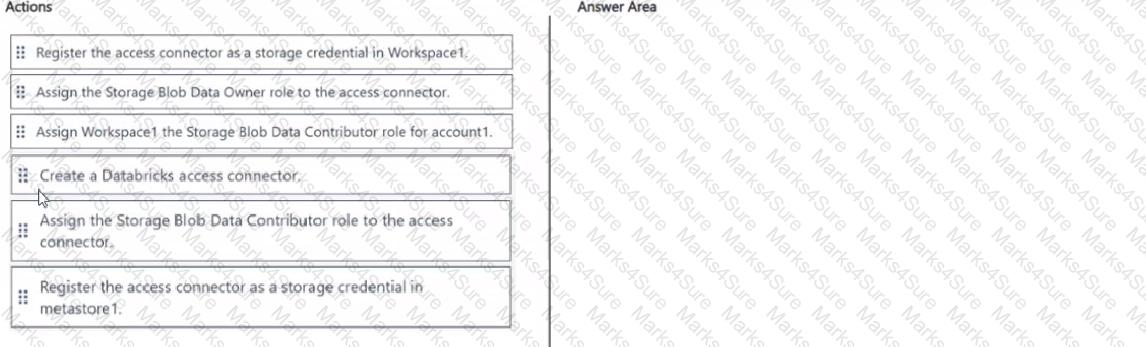
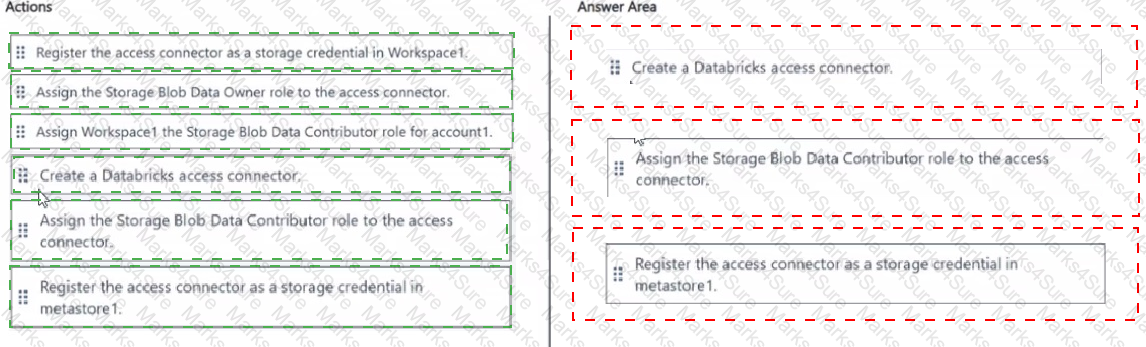
You have an Azure Databricks workspace named Workspace1 that is attached to a Unity Catalog metastore named metastore1
You need to register an Azure Storage account named account1 that has a hierarchical namespace enabled as an external location The external location must use a managed identity to authenticate to account1 and the solution must follow the principle of least privilege.
Which three actions should you perform in sequence ' To answer, move the appropriate actions from the list of actions to the answer area and arrange them in the correct order.
You have an Azure Databricks workspace that contains a job in Lakeflow Jobs named Job1.
Job1 processes raw data files stored in Azure Storage.
New files arrive at unpredictable intervals.
You need to ensure that Job1 starts automatically when new files arrive and does NOT consume compute resources when no data is available.
Which type of job trigger should you use?
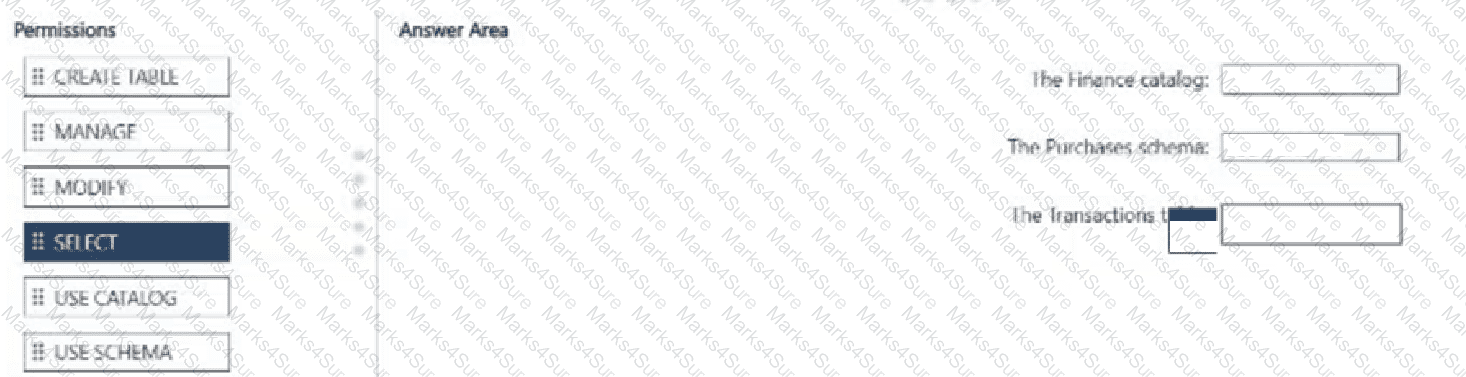
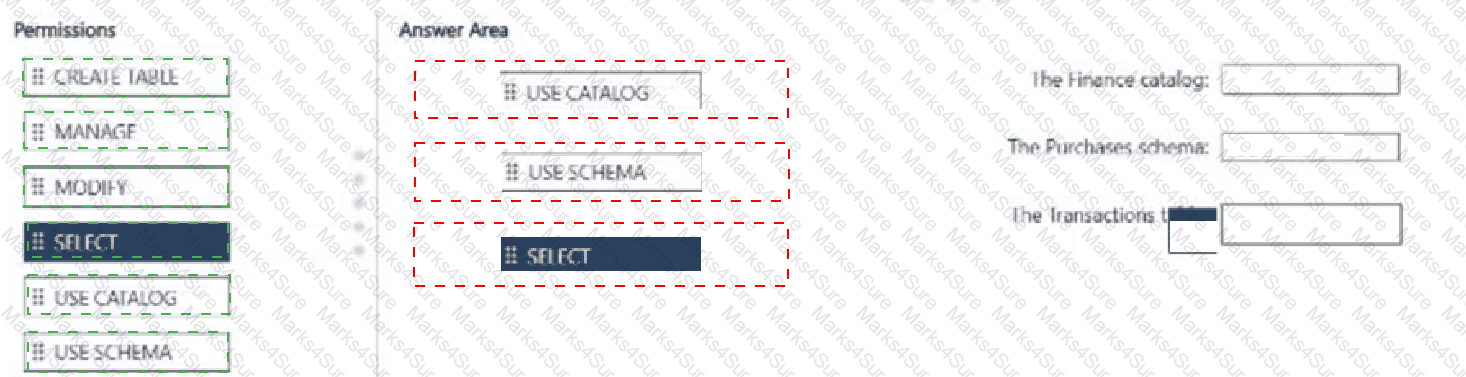
You have an Azure Databricks workspace that is enabled for Unity Catalog and contains:
A catalog named Finance
A schema named Purchases in the Finance catalog
A table named Transactions in the Purchases schema
You need to ensure that a user named finance_user can query the Transactions table. The solution must follow the principle of least privilege.
Which permission should you grant to finance_user for each object? To answer, drag the appropriate permissions to the correct objects. Each permission may be used once, more than once, or not at all. You may need to drag the split bar between panes or scroll to view content.
NOTE: Each correct selection is worth one point.
You have an Azure Databricks workspace.
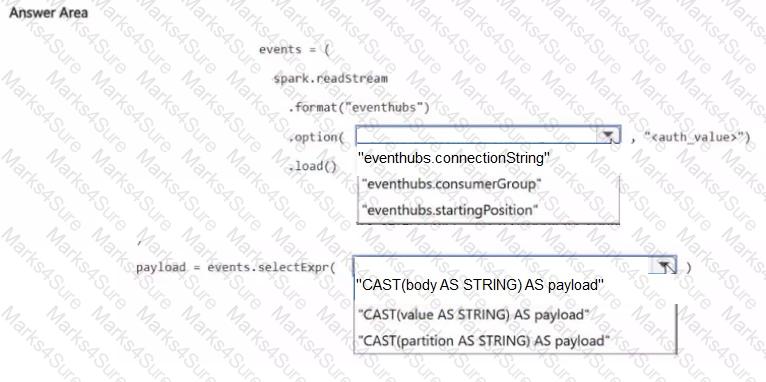
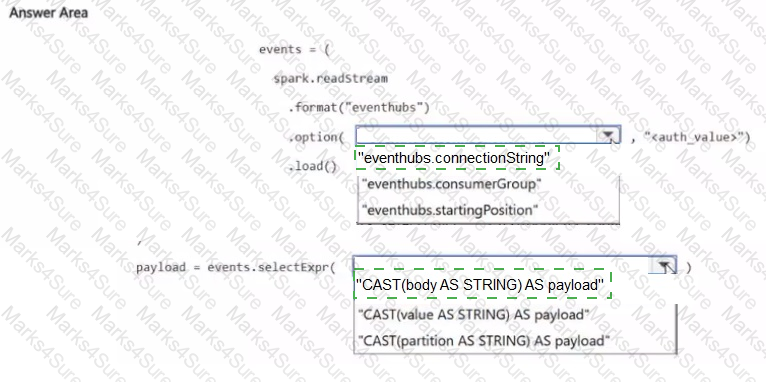
You need to ingest streaming data from Azure Event Hubs by using Apache Spark Structured Streaming The solution must authenticate to Event Hubs and read the event payload.
How should you complete the PySpark code segment? To answer, select the appropriate options in the answer area.
NOTE: Each correct selection is worth one point.
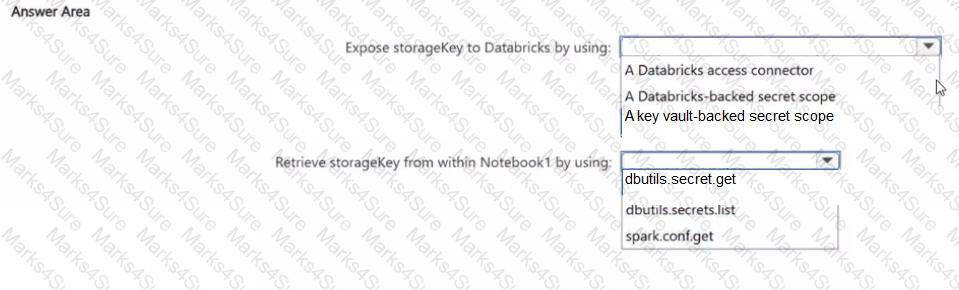
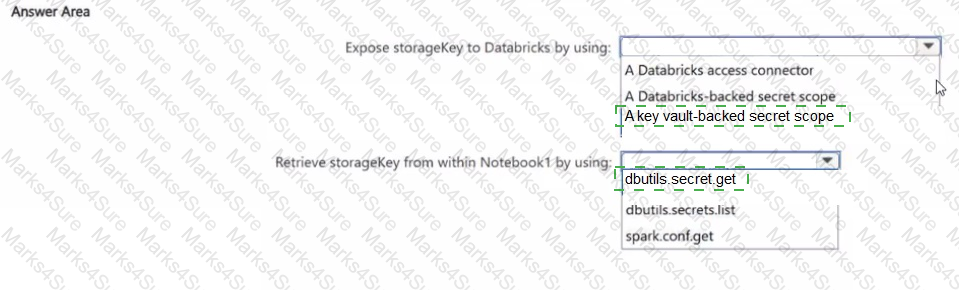
You have an Azure Databricks workspace.
You have an Azure key vault named kv-secure that stores a secret named storageKey. The value of storageKey is managed and updated by the cloud security team at your company.
You need to enable a Databricks notebook named Notebook 1 to retrieve the value of storageKey securely at runtime. The solution must follow the principle of least privilege and always retrieve the latest value.
What should you do? To answer, select the appropriate options in the answer area.
NOTE: Each correct selection is worth one point.
You have an Azure Databricks workspace that is enabled for Unity Catalog.
You plan to ingest data from CSV files stored in Azure Data Lake Storage Gen2. New rows are appended frequently.
You need to implement a data ingestion solution that meets the following requirements:
• New data must be available in near-real-time (NRT).
• The data must be stored in managed Delta tables.
• The solution must minimize custom code and maintenance effort.
What should you include in the solution?
You have an Azure Databticks workspace that is enabled for Unity Catalog and contains a catalog named catalog1.
You have a group named group!
You plan to create a schema named schema1 in catalog1.
You need to ensure that group1 meets the following requirements:
• Can create tables in schema1
• Can modify and query tables
• Cannot grant permissions for the schema and its objects
How should you complete the SQL statements? To answer, select the appropriate options in the answer area. NOTE: Each correct selection is worth one point.


PDF + Testing Engine

Testing Engine
PDF (Q&A)