
Free Practice Questions for the RedHat Red Hat Certified Engineer (RHCE) EX294 Exam (2026 Updated)
At Marks4sure, we are dedicated to providing IT professionals with the most accurate and reliable preparation materials for the RedHat EX294 exam. To support your certification journey, we have made a selection of our premium 2026 Red Hat Certified Engineer (RHCE) practice questions and answers available completely free. You can take this practice test as many times as you need. Every question includes a detailed, expertly verified explanation to ensure you fully grasp the core security concepts before test day.
Create a playbook /home/bob /ansible/motd.yml that runs on all inventory hosts and docs the following: The playbook should replaee any existing content of/etc/motd in the following text. Use ansible facts to display the FQDN of each host
On hosts in the dev host group the line should be " Welcome to Dev Server FQDN " .
On hosts in the webserver host group the line should be " Welcome to Apache Server FQDN " .
On hosts in the database host group the line should be " Welcome to MySQL Server FQDN " .
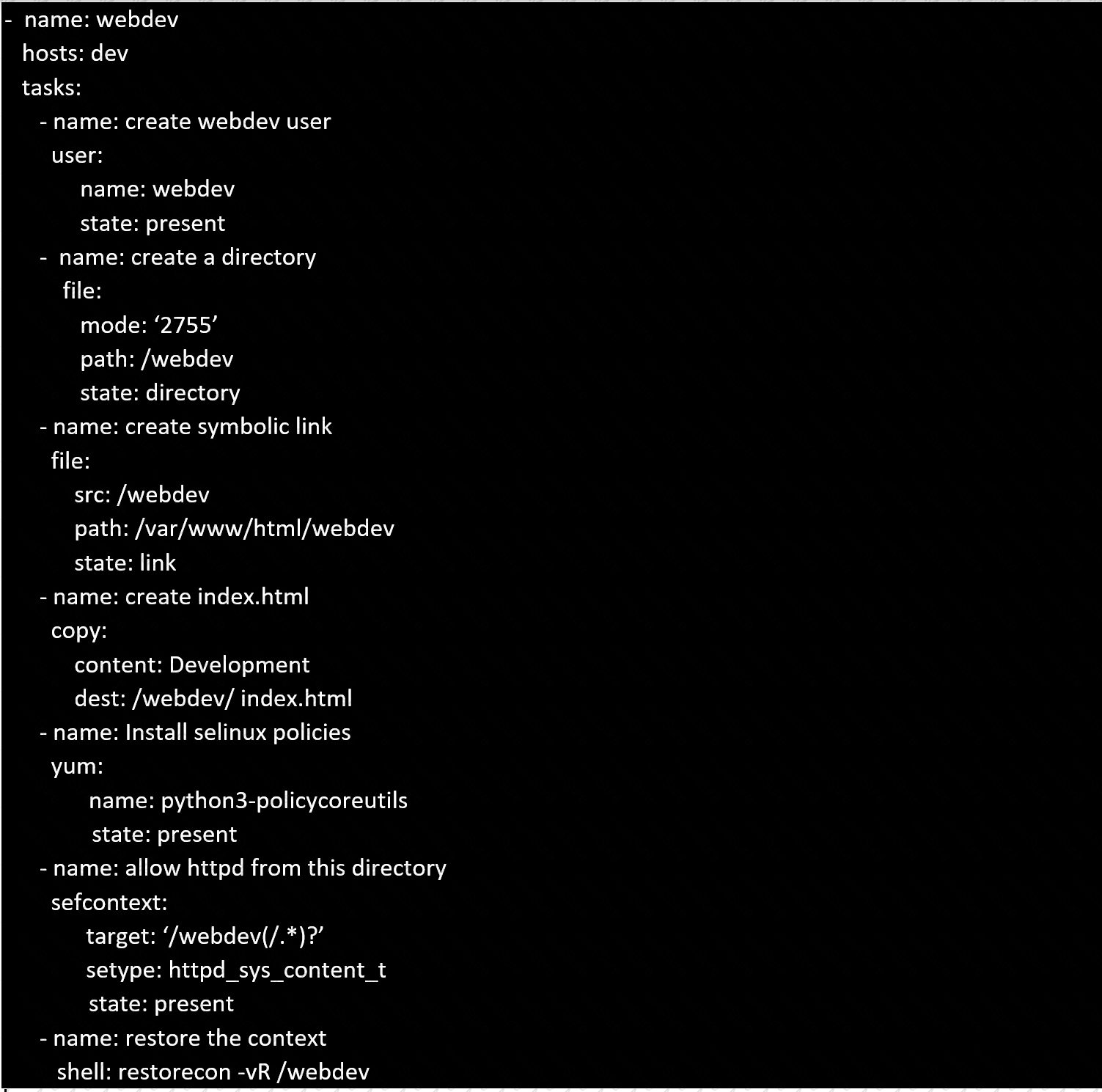
Create a playbook called webdev.yml in ' home/sandy/ansible . The playbook will create a directory Avcbdev on dev host. The permission of the directory are 2755 and owner is webdev. Create a symbolic link from /Webdev to /var/www/html/webdev. Serve a file from Avebdev7index.html which display s the text " Development " Curl http://nod e1 . e xample.com/w e bd e v/index.html to test
Install the RHEL system roles package and create a playbook called timesync.yml that:
-- > Runs over all managed hosts.
-- > Uses the timesync role.
-- > Configures the role to use the time server 192.168.10.254 ( Hear in redhat lab
use " classroom.example.com " )
-- > Configures the role to set the iburst parameter as enabled.
Generate a hosts file:
* Download an initial template file hosts.j2 from http://classroom.example.com/
hosts.j2 to
/home/admin/ansible/ Complete the template so that it can be used to generate a file
with a
line for each inventory host in the same format as /etc/hosts:
172.25.250.9 workstation.lab.example.com workstation
* Create a playbook called gen_hosts.yml that uses this template to generate the file
/etc/myhosts on hosts in the dev host group.
* When completed, the file /etc/myhosts on hosts in the dev host group should have a
line for
each managed host:
127.0.0.1 localhost localhost.localdomain localhost4 localhost4.localdomain4
::1 localhost localhost.localdomain localhost6 localhost6.localdomain6
172.25.250.10 serevra.lab.example.com servera
172.25.250.11 serevrb.lab.example.com serverb
172.25.250.12 serevrc.lab.example.com serverc
172.25.250.13 serevrd.lab.example.com serverd
-----------------------------------------------------------------
while practising you to create these file hear. But in exam have to download as per
questation.
hosts.j2 file consists.
localhost localhost.localdomain localhost4 localhost4.localdomain4
::1
localhost localhost.localdomain localhost6 localhost6.localdomain6
-------------------------------------------------------------------
Modify file content.
------------------------
Create a playbook called /home/admin/ansible/modify.yml as follows:
* The playbook runs on all inventory hosts
* The playbook replaces the contents of /etc/issue with a single line of text as
follows:
-- > On hosts in the dev host group, the line reads: “Development”
-- > On hosts in the test host group, the line reads: “Test”
-- > On hosts in the prod host group, the line reads: “Production”
Create a role called apache in " /home/admin/ansible/roles " with the following
requirements:
-- > The httpd package is installed, enabled on boot, and started.
-- > The firewall is enabled and running with a rule to allow access to the web server.
-- > template file index.html.j2 is used to create the file /var/www/html/index.html
with the output:
Welcome to HOSTNAME on IPADDRESS
-- > Where HOSTNAME is the fqdn of the managed node and IPADDRESS is the IP-Address of
the managed node.
note: you have to create index.html.j2 file.
-- > Create a playbook called httpd.yml that uses this role and the playbook runs on
hosts in the webservers host group.
Create an Ansible vault to store user passwords as follows:
* The name of the vault is valut.yml
* The vault contains two variables as follows:
- dev_pass with value wakennym
- mgr_pass with value rocky
* The password to encrypt and decrypt the vault is atenorth
* The password is stored in the file /home/admin/ansible/password.txt
PDF + Testing Engine

Testing Engine
PDF (Q&A)