
Free Practice Questions for the F5-CA F5CAB2 Exam (2026 Updated)
At Marks4sure, we are dedicated to providing IT professionals with the most accurate and reliable preparation materials for the F5 F5CAB2 exam. To support your certification journey, we have made a selection of our premium 2026 F5-CA practice questions and answers available completely free. You can take this practice test as many times as you need. Every question includes a detailed, expertly verified explanation to ensure you fully grasp the core security concepts before test day.
What type of virtual server will have a destination IP address of 0.0.0.0 and listen on a specific VLAN for requests?
A BIG-IP Administrator is informed that traffic on interface 1.1 is expected to increase beyond the maximum bandwidth capacity of the link. There is a single VLAN on the interface.
What should the BIG-IP Administrator do to increase the total available bandwidth? (Choose one answer)
Refer to the exhibit.
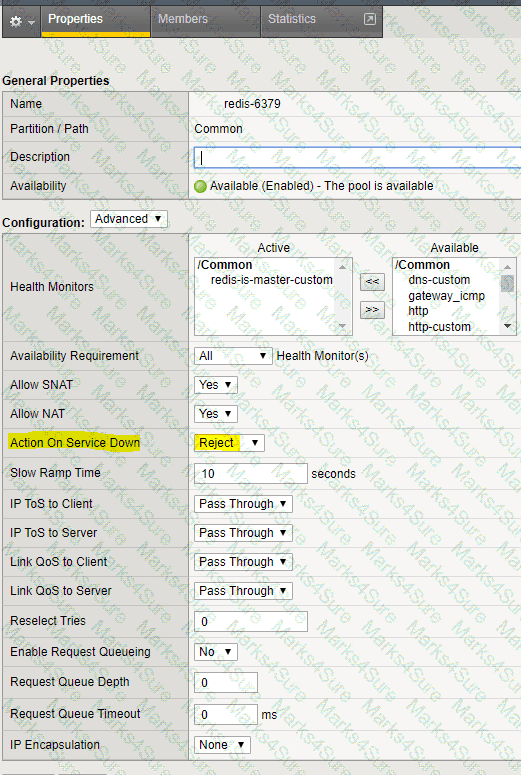
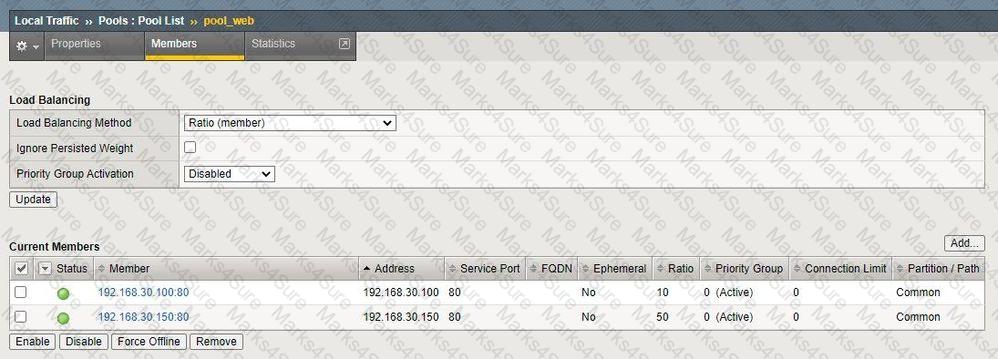
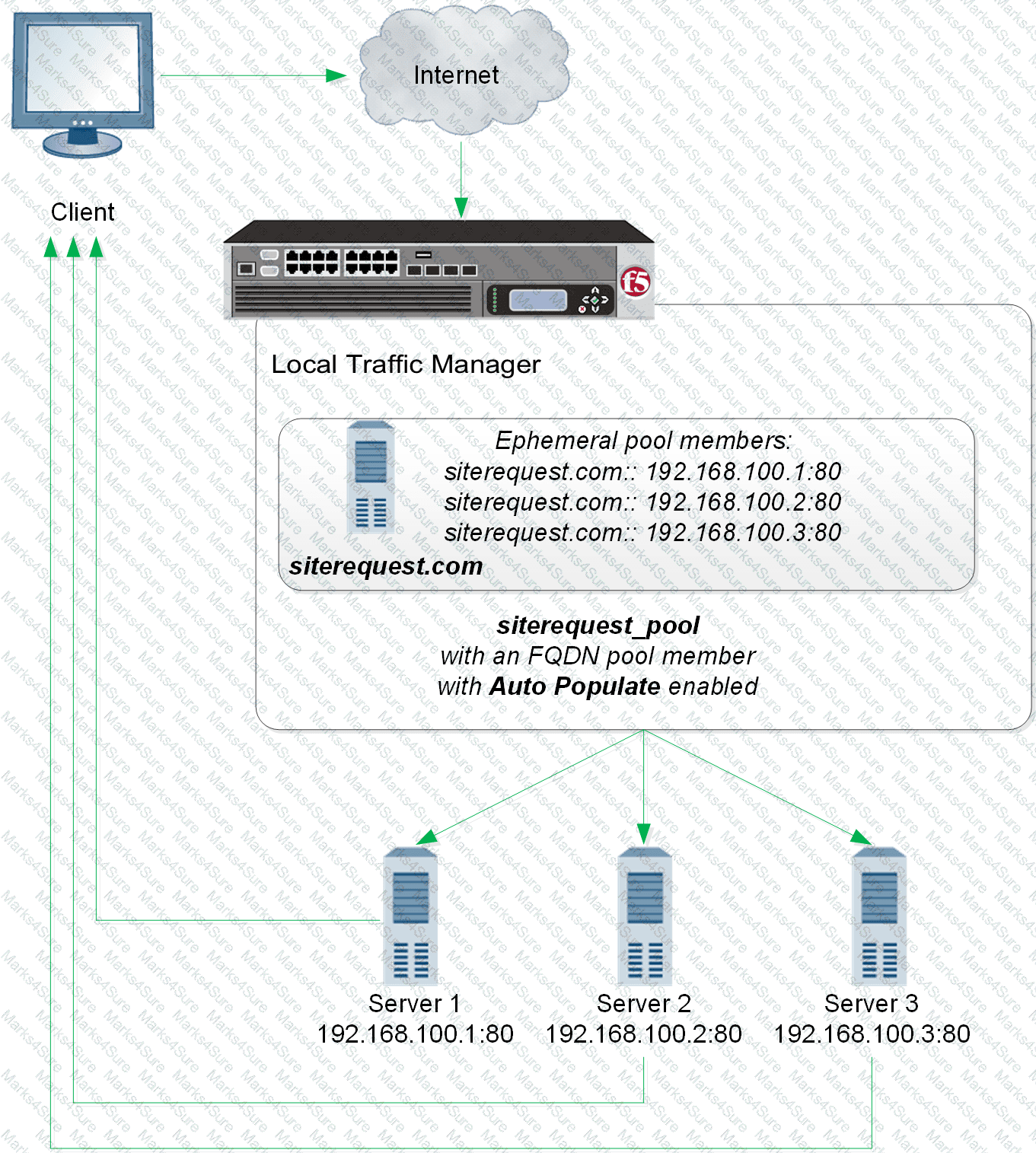
The BIG-IP Administrator needs to avoid overloading any of the pool members with connections when they become active . What should the BIG-IP Administrator configure to meet this requirement? (Choose one answer)
What should a BIG-IP Administrator configure to minimize impact during a failover?
What is the result when a BIG-IP Administrator manually disables a pool member ? (Choose one answer)
An application is configured so that the same pool member must be used for an entire session , and this behavior must persist across HTTP and FTP traffic . A user reports that a session terminates and must be restarted after the active BIG-IP device fails over to the standby device.
Which configuration settings should the BIG-IP Administrator verify to ensure proper behavior when BIG-IP failover occurs? (Choose one answer)
A virtual server is listening at 10.10.1.100:80 and has the following iRule associated with it:
when HTTP_REQUEST { if { [HTTP::header UserAgent] contains "MSIE" }
{ pool MSIE_pool }
else { pool Mozilla_pool }
If a user connects to http://10.10.1.100/foo.html and their browser does not specify a UserAgent, which pool will receive the request?
An application is configured so that the same pool member must be used for an entire session, as well as for HTTP and FTP traffic. A user reports that a session has terminated, and the user must restart the session. The BIG-IP Administrator determines that the active BIG-IP device failed over to the standby BIG-IP device. Which configuration settings should the BIG-IP Administrator verify to ensure proper behavior when BIG-IP failover occurs?
Active connections to pool members are unevenly distributed. The load balancing method is Least Connections (member) . Priority Group Activation is disabled .
What is a potential cause of the uneven distribution? (Choose one answer)
In the GUI, where should the BIG-IP Administrator configure an existing VLAN named external to a specific interface as untagged?
The diagram below shows the TCP connection setup for an application.
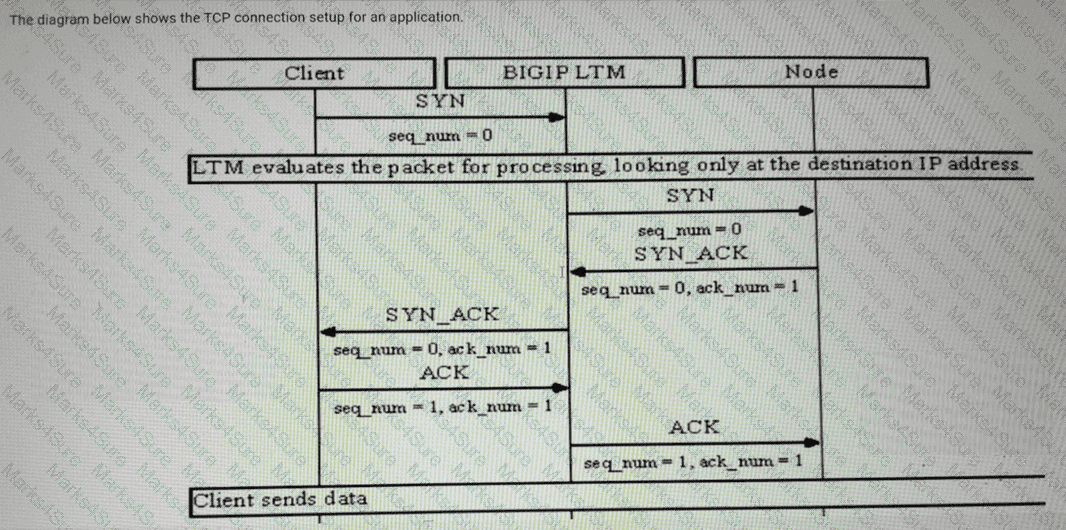
Which of the following virtual server types applies? (Choose one answer)
A virtual server is listening at 10.10.1.100:any and has the following iRule associated with it:
when CLIENT_ACCEPTED { if {[TCP::local_port] equals 21 } { pool
ftppool } elseif {[TCP::local_port] equals 23 } { pool telnetpool }
If a user connects to 10.10.1.100 and port 22, which pool will receive the request?
The BIG-IP Administrator wants to provide quick failover between the F5 LTM devices that are configured in an HA Pair with a single traffic-group. The BIG-IP Administrator wants to implement the Mac Masquerade feature for this quick failover and run this command: tmsh modify /cm traffic-group traffic-group-1 mac 02:12:34:56:00:00. However, the Network Operations team has identified an issue with the use of the same MAC address being used within different VLANs. As a result of this, the BIG-IP Administrator must implement the Per-VLAN Mac Masquerade in order to have a unique MAC address on each VLAN: tmsh modify /sys db tm.macmasqaddr_per_vlan value true. What would be the resulting MAC address on a tagged VLAN of 1501?
A BIG-IP Administrator has a cluster of devices. What should the administrator do after creating a new Virtual Server on device 1?
What type of virtual server has a destination of 0.0.0.0 and listens on a specific VLAN? (Choose one answer)
What should a BIG-IP Administrator configure to minimize impact during a failover ? (Choose one answer)
PDF + Testing Engine

Testing Engine
PDF (Q&A)