
Free Practice Questions for the Fortinet Certified Solution Specialist FCSS_CDS_AR-7.6 Exam (2026 Updated)
At Marks4sure, we are dedicated to providing IT professionals with the most accurate and reliable preparation materials for the Fortinet FCSS_CDS_AR-7.6 exam. To support your certification journey, we have made a selection of our premium 2026 Fortinet Certified Solution Specialist practice questions and answers available completely free. You can take this practice test as many times as you need. Every question includes a detailed, expertly verified explanation to ensure you fully grasp the core security concepts before test day.
Refer to the exhibit.
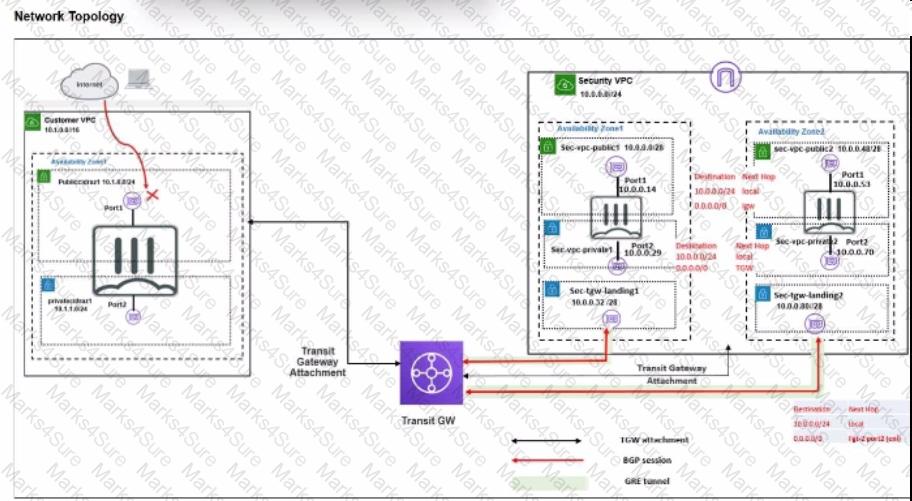
In your Amazon Web Services (AWS), you must allow inbound HTTPS access to the Customer VPC FortiGate VM from the internet. However, your HTTPS connection to the FortiGate VM in the Customer VPC is not successful.
Also, you must ensure that the Customer VPC FortiGate VM sends all the outbound Internet traffic through the Security VPC.
How do you correct this issue with minimal configuration changes? (Choose three.)
Refer to the exhibit.
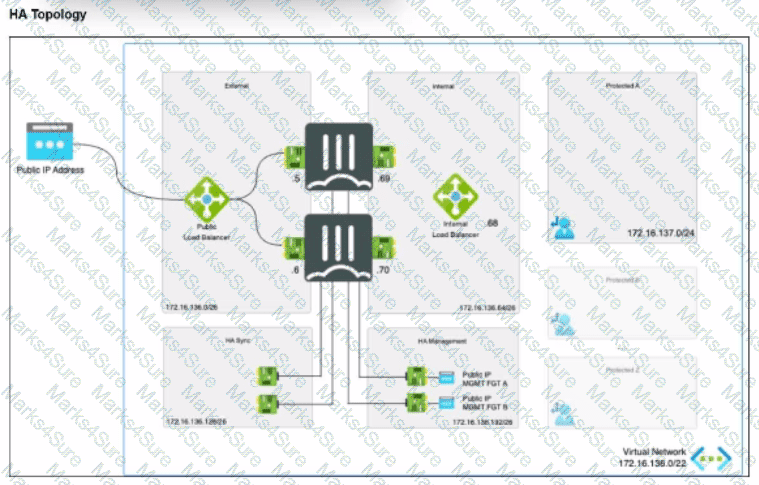
The exhibit shows an active-passive high availability FortiGate pair with external and internal Azure load balancers There is no SDN connector used in this solution.
Which configuration must the administrator implement on each FortiGate?
An administrator decides to use the Use managed identity option on the FortiGate SDN connector with Microsoft Azure. However, the SDN connector is failing on the connection.
What must the administrator do to correct this issue?
Refer to the exhibit.
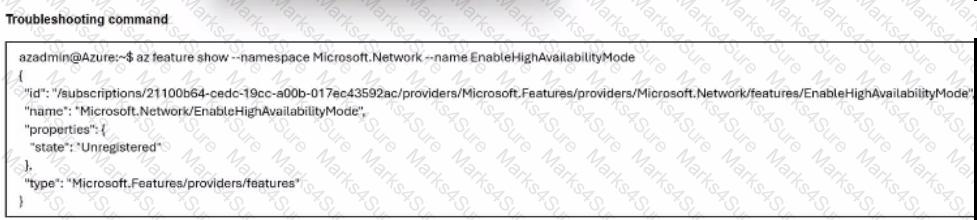
A managed security service provider (MSSP) administration team is trying to deploy a new HA cluster in Azure to filter traffic to and from a client that is also using Azure. However, every deployment attempt fails, and only some of the resources are deployed successfully. While troubleshooting this issue, the team runs the command shown in the exhibit.
What are the implications of the output of the command?
Refer to the exhibit.
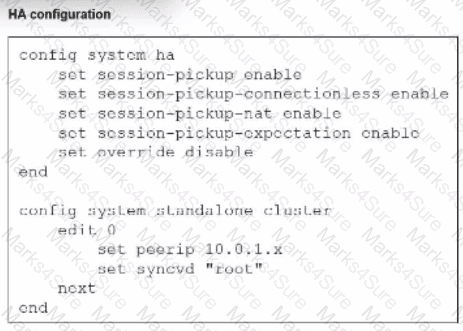
You deployed an HA active-active load balance sandwich with two FortiGate VMs in Microsoft Azure.
After the deployment, you prefer to use FGSP to synchronize sessions, and allow asymmetric return traffic. In the environment, FortiGate port 1 and port 2 are facing external and internal load balancers respectively.
What IP address must you use in the peerip configuration?
Your monitoring team reports performance issues with a web application hosted in Azure. You suspect that the bottleneck might be due to unexpected inbound traffic spikes.
Which method should you use to identify and analyze the traffic pattern?
You are using Ansible to modify the configuration of several FortiGate VMs.
What is the minimum number of files you need to creat, and in which file should you configure the target FortiGate IP addresses?
An administrator is trying to implement FortiCNP with Microsoft Azure Security integration. However, FortiCNP is not able to extract any cloud integration data from Azure; therefore, real-time cloud security monitoring is not possible.
What is causing this issue?
PDF + Testing Engine

Testing Engine
PDF (Q&A)