
Free Practice Questions for the CIMA Operational G1 Exam (2026 Updated)
At Marks4sure, we are dedicated to providing IT professionals with the most accurate and reliable preparation materials for the CIMA G1 exam. To support your certification journey, we have made a selection of our premium 2026 CIMA Operational practice questions and answers available completely free. You can take this practice test as many times as you need. Every question includes a detailed, expertly verified explanation to ensure you fully grasp the core security concepts before test day.
Comparative results for Pizzatime and Pizza2Go
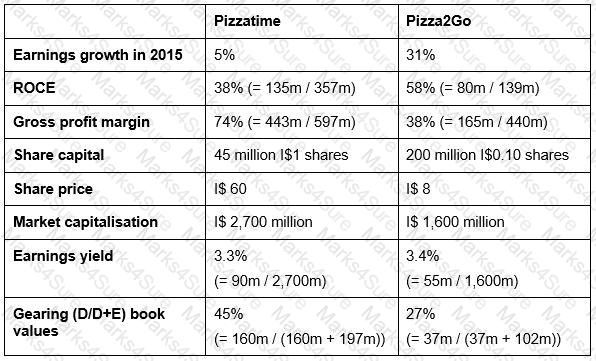
You have received the following email:
From: Monica Lall, Chief Executive
To: Financial Manager
Subject: benchmarking and growth ideas
Hi,
As you will already be aware, in 2015 our annual growth in both earnings and revenue was well below the target of 10%. This has clearly been a disappointment to our shareholders and we need to take rapid action to rebuild market confidence and avoid a fall in our share price. I would value your input on this one.
You will also see, from the financial data in the attachment, that our competitor, Pizza2Go, has reported higher growth and also a higher ROCE and I need to be able to explain these figures to our analysts. It would be really helpful to understand what they mean in terms of shareholder returns. The earnings growth figures are particularly disappointing, especially as Pizza2Go has shown such strong growth.
I need a response to this email as soon as possible that:
• Analyses the financial data in the attachment and explains what the ROCE and earnings growth figures mean in terms of the relative success of the two companies and returns to shareholders. I notice that we have a much higher gross profit margin and approximately the same earnings yield. Is it possible that the ROCE and earnings growth figures are misleading and that we are actually performing better than Pizza2Go?
• Suggests ways in which we could improve profitability. Use Porter ' s value chain model as your base.
Regards
Monica Lall
Chief Executive
Pizzatime
Partial transcript of television documentary entitled ' Did you enjoy that? '
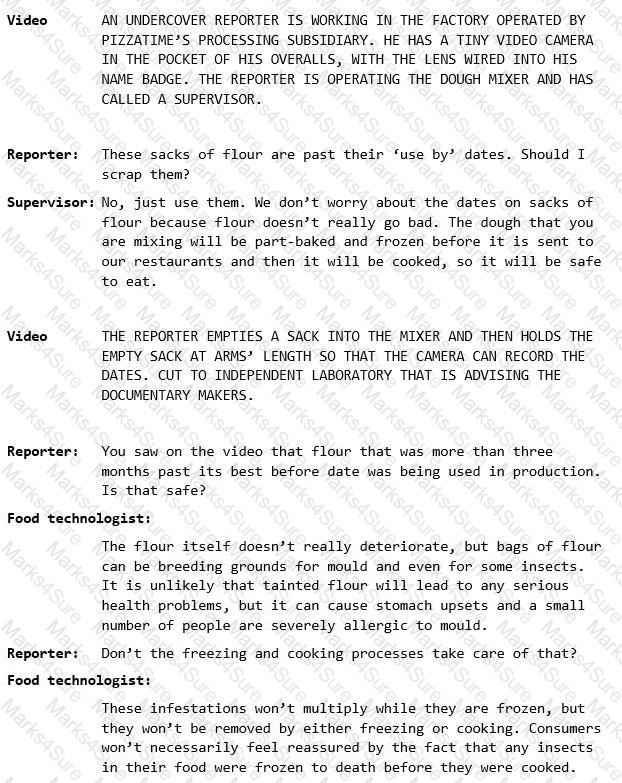
You have received the following email:
From: Monica Lall, Chief Executive
To: Financial Manager
Subject: television documentary
Hi,
I have attached a transcript of a documentary on food hygiene that was broadcast last night. The broadcaster did not seek our response and so we were unaware of it until it was broadcast.
We have only had a few hours to investigate but the basic story appears to be true. The manager in charge of the factory has interviewed the supervisor who was filmed and it appears that the main flour supplier is guilty of shipping goods that are almost at, or even slightly beyond, their ' use by ' dates. We operate on a just-in-time basis and so our factory would have to suspend production for anything up to 24 hours if a shipment was rejected.
We will, of course, check all inventories immediately. We will also find a new flour supplier for our factory in I-land. That will mean closing every restaurant for at least 72 hours until the factory can recommence production.
We have consulted our lawyers, who believe that we can expect large numbers of claims from customers. We can expect to be blamed for almost any form of ill-health suffered after eating one of our pizzas, regardless of whether we were to blame, as well as for psychological distress. Even though the year end is several months away, we will have to be ready to make a provision in the financial statements for the year ended 31 December 2016. This presents the company with a significant risk from our supply chain, which we need to consider.
I need you to email me your thoughts on the following:
How can we organise our supply chain better to prevent a recurrence? Clearly, flour is only one of many ingredients that we purchase.
How can we address the inevitable claims that we have acted unethically and against the public interest?
What are the accounting issues associated with determining the need for a provision in the financial statements?
Regards
Monica Lall
Chief Executive
Pizzatime
You have received the following email:
From: Matt Spot, Finance Director
To: Financial Manager
Subject: new menu
Hello
As a first stage in its development plans the Board have decided that Pizzatime must develop a new menu that uses top quality ingredients. The menu will include many more healthy and lower calorie options. This project has been given a high priority and we need to start researching and planning the new menu straight away.
I am considering organising some big data research to give us greater insight into our customers ' requirements. For example, it would help us find out how important fresh ingredients, the use of local produce and fewer processed meat products are to our customers. I realise that many customers are trying to lose weight and it would also be interesting to know what type of weight loss programmes they are using and what foods are permitted under each one.
I need your help on this one. Please email me your thoughts on the following:
Firstly, what sources of competitor and customer analysis should we use when drawing up a new menu? Please include the possibility of using big data and look at other useful sources of information.
Secondly, what are the downside risks to Pizzatime of introducing a new menu and are they worth taking?
Matt
PDF + Testing Engine

Testing Engine
PDF (Q&A)