
Free Practice Questions for the HashiCorp Security Automation Certification HCVA0-003 Exam (2026 Updated)
At Marks4sure, we are dedicated to providing IT professionals with the most accurate and reliable preparation materials for the HashiCorp HCVA0-003 exam. To support your certification journey, we have made a selection of our premium 2026 HashiCorp Security Automation Certification practice questions and answers available completely free. You can take this practice test as many times as you need. Every question includes a detailed, expertly verified explanation to ensure you fully grasp the core security concepts before test day.
Which of the following statements are true about Vault policies? Choose two correct answers.
A policy is shown in the exhibit.
What does this policy do?
Exhibit:
path " secret/data/{{identity.entity.id}}/* " { capabilities = [ " create " , " update " , " read " , " delete " ] }
path " secret/metadata/{{identity.entity.id}}/* " { capabilities = [ " list " ] }
A user logs into Vault through a configured LDAP auth method and notices that re-authentication is needed after every 8 hours.
Why would the user be required to log in again every 8 hours?
You need to manage access to Vault secrets engines for users that will have multiple accounts with various identity providers with which they will authenticate to Vault, such as GitHub, LDAP, Active Directory, etc.
What would allow them to have a single set of policies across all of these identity providers for each user?
When looking at Vault token details, which key helps you find the paths the token is able to access?
You are using an orchestrator to deploy a new application. Even though the orchestrator creates a new AppRole secret ID, security requires that only the new application has the combination of the role ID and secret ID. What feature can you use to meet these requirements?
Your company ' s security policies require that all encryption keys must be rotated at least once per year. After using the Transit secrets engine for a year, the Vault admin issues the proper command to rotate the key named ecommerce that was used to encrypt your data. What command can be used to easily re-encrypt the original data with the new version of the key?
What are the primary benefits of running Vault in a production deployment over dev server mode (select two)?
Which of the following policies would permit a user to generate dynamic credentials on a database?
Which of the following statements best describes the difference in cluster strategies between self-managed Vault and HashiCorp-managed Vault?
Which of the following Vault policies will allow a Vault client to read a secret stored at secrets/applications/app01/api_key?
What command would have created the token displayed below?
$ vault token lookup hvs.nNeZ2I64ALCxuO7dqQEJGPrO
Key: policies Value: [default dev], num_uses: 5, ttl: 767h59m49s
Key Value
--- -----
accessor mfvaVMFgOcXHIeqlRasroSOn
creation_time 1604610457
creation_ttl 768h
display_name token
entity_id n/a
expire_time 2024-12-07T16:07:37.7540672-05:00
explicit_max_ttl 0s
id hvs.nNeZ2I64ALCxuO7dqQEJGPrO
issue_time 2024-11-05T16:07:37.7540672-05:00
meta < nil >
num_uses 5
orphan false
path auth/token/create
policies [default dev]
renewable true
ttl 767h59m49s
type service
True or False? Once you create a KV v1 secrets engine and place data in it, there is no way to modify the mount to include the features of a KV v2 secrets engine.
How can Vault be used to programmatically obtain a generated code for MFA, somewhat similar to Google Authenticator?
You are deploying Vault in a local data center, but want to be sure you have a secondary Vault cluster in the event the primary cluster goes offline. In the secondary data center, you have applications that are running, as they are architected to run active/active. Which type of replication would be best in this scenario?
After issuing the command to delete a secret, you run a vault kv list command, but the path to the secret still seems to exist. What command would permanently delete the path from Vault?

How long does the Transit secrets engine store the resulting ciphertext by default?
You logged into the Vault CLI and attempted to enable an auth method, but you received this error message. What can you do to resolve the error and configure Vault?
(Error: dial tcp 127.0.0.1:8200: connect: connection refused)

Which of the following statements are true regarding Vault seal and unseal (select three)?
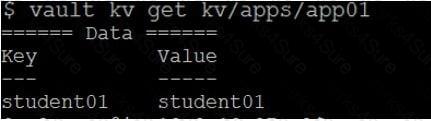
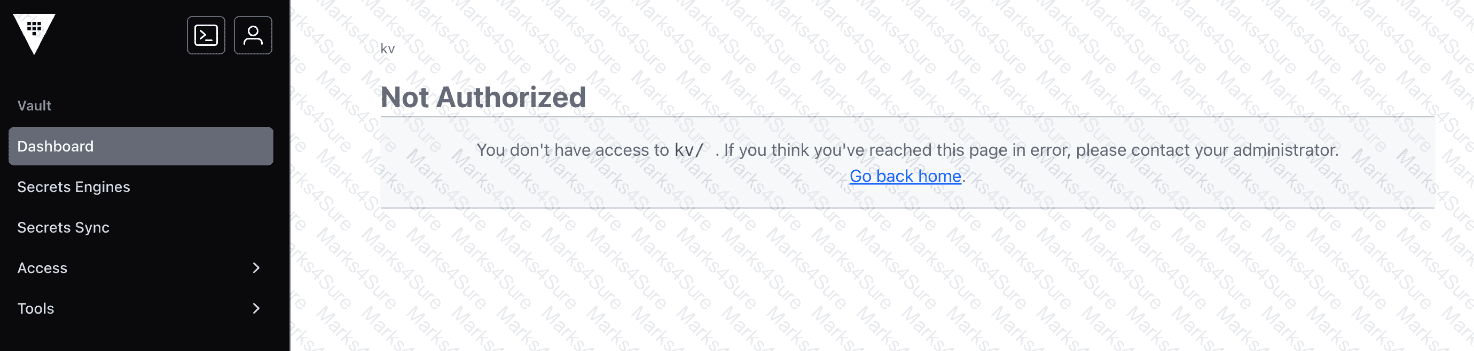
A user is assigned the following policy, and they can successfully retrieve secrets using the CLI. However, the user reports receiving an error message in the UI. Why can’t the user access the secret in the Vault UI?
path " kv/apps/app01 " { capabilities = [ " read " ] }
Successful retrieval using the CLI
(Error: Permission denied in UI)
True or False? When using the Transit secrets engine, setting the min_decryption_version will determine the minimum key length of the data key (i.e., 2048, 4096, etc.).
Below is a list of parent and child tokens and their associated TTL. Which token(s) will be revoked first?
Which of the following auth methods are intended for machine-to-machine authentication, and not necessarily human (operator) authentication? (Select four)
Which of the following features in Vault will replicate service tokens between clusters?
When a lease is created, what actions can be performed by using only the lease ID? (Choose two)
True or False? A token can be renewed up until the max TTL, even if the TTL has been reached.
Which of the following secrets engines can store static secrets in Vault for future retrieval?
True or False? Although AppRole is designed for machines, humans can use it to authenticate to Vault if you wish.
Kyle enabled the database secrets engine for dynamic credentials. Amy, the senior DBA, accidentally deleted the database users created by Vault, disrupting client applications. How can Kyle manually remove the leases in Vault?
You are considering using HCP Vault Dedicated but are concerned about differences between a hosted version and a self-hosted deployment. Which of the following statements is true about HCP Vault Dedicated?
An organization wants to authenticate an AWS EC2 virtual machine with Vault to access a dynamic database secret. The only authentication method which they can use in this case is AWS.
True or False? The following policy permits a user to read secrets contained in the path secrets/cloud/apps/jenkins?
text
CollapseWrapCopy
path " secrets/cloud/apps/jenkins/* " {
capabilities = [ " create " , " read " , " update " , " delete " , " list " ]
}
True or False? Once the lease for a dynamic secret has expired, Vault revokes the credentials on the backend platform for which they were created (i.e., database, AWS, Kubernetes).
Based on the output below, how many policies have been added to Vault?
$ vault policy list
base
default
root
web-app-1
automation-team
Tom needs to set the proper environment variable so he doesn’t need to first authenticate to Vault to retrieve dynamically generated credentials for a database server. What environment variable does Tom need to set first before running commands?
You need to decrypt customer data to provide it to an application. When you run the decryption command, you get the output below. Why does the response not directly reveal the cleartext data?
$ vault write transit/decrypt/phone_number ciphertext= " vault:v1:tgx2vsxtlQRfyLSKvem... "
Key Value
--- -----
plaintext aGFzaGljb3JwIGNlcnRpZmllZDogdmF1bHQgYXNzb2NpYXRl
Your organization has many applications needing heavy read access to Vault. As these applications integrate with Vault, the primary Vault cluster’s performance is negatively impacted. What feature can you use to scale the cluster and improve performance?
Elijah manages a legacy application that requires strict control over when its service account credentials change. Which type of credential should be used for this legacy application?
Short-lived, dynamically generated secrets provide organizations with many benefits. Select the benefits from the options below. (Select four)
Tom is authenticating to Vault using the CLI. Which of the following commands allows Tom to authenticate using the userpass method WITHOUT logging his password to the shell history?
After setting up a new HashiCorp Vault server with the default configurations, which method can be used to unseal Vault?
You are trying to create a new orphan token but receiving a Permission Denied error. What capabilities are required to create this token without using a root token?
True or False? The userpass auth method has the ability to access external services in order to provide authentication to Vault.
Which of the following unseal options can automatically unseal Vault upon the start of the Vault service? (Select four)
A new Vault administrator is writing a CURL command (shown below) to retrieve a secret stored in a KV v2 secrets engine at secret/audio/soundbooth but is receiving an error. What could be the cause of the error?
$ curl \
--header " X-Vault-Token: hvs.rffHw0iXqkRo19b2cjf93DM39WjpbN3J " \
https://vault.unlimited.com:8200/v1/secret/audio/soundbooth
After creating a dynamic credential on a database, the DBA accidentally deletes the credentials on the database itself. When attempting to remove the lease, Vault returns an error stating that the credential cannot be found. What command can be run to make Vault remove the secret?
Your organization wants to set up human-based authentication for AzureAD. What authentication method should you enable and configure for Vault?
When Vault is sealed, which are the only two operations available to a Vault administrator? (Select two)
Which of the following statements best describes the difference between static and dynamic credentials in a secrets management system?
True or False? To prepare for day-to-day operations, the root token should be safely saved outside of Vault in order to administer Vault.
Which of the following is not an action associated with the Transit secrets engine when interacting with data?
Which of the following statements are true about HCP Vault Dedicated? (Select three)
Which of the following auth methods is the best choice for human interaction with Vault (as opposed to machine/system authentication)?
Holly has discovered that a highly privileged dynamic credential with a very long lease time was created, which could negatively impact the organization’s security. What command can Holly use to invalidate the credential so it can’t be used without affecting other credentials?
Which two interfaces automatically assume the token for subsequent requests after successfully authenticating? (Select two)
You need to connect to and manage a new HCP Vault cluster using the Vault CLI on your laptop. What environment variables should you set to establish connectivity?
You are using Vault to generate dynamic credentials for a Microsoft SQL server to perform queries for a month-end report. The report seems to be taking much longer than expected due to degradation on the underlying server, and you are afraid that Vault might automatically revoke the credentials. How can you extend the time the credentials are valid to ensure your month-end query is successful?
You are using the Vault API to test authentication before modifying your CI/CD pipeline to properly authenticate to Vault. You manually authenticate to Vault and receive the response below. Based on the provided options, which of the following are true? (Select four)
$ curl \
--request POST \
--data @payload.json \
https://vault.krausen.com:8200/v1/auth/userpass/login/bryan.krausen | jq
*******************************************************************************
******* RESPONSE BELOW ********************************************************
*******************************************************************************
{
" request_id " : " f758e8da-11b6-8341-d404-56f0c370a7fa " ,
" lease_id " : " " ,
" renewable " : false,
" lease_duration " : 0,
" data " : null,
" wrap_info " : null,
" warnings " : null,
" auth " : {
" client_token " : " hvs.CbzCNJCVWt63jyzyaJakgDwz " ,
" accessor " : " rffwXzKFcxvaQi6Vgo8tY4Lt " ,
" policies " : [
" training " ,
" default "
],
" token_policies " : [
" training " ,
" default "
],
" metadata " : {
" username " : " bryan.krausen "
},
" lease_duration " : 84600,
" renewable " : true,
" entity_id " : " f1795f6a-c576-d619-b2d5-74c0aee08edb " ,
" token_type " : " service " ,
" orphan " : true
}
}
You have enabled the Transit secrets engine on your Vault cluster to provide an " encryption as a service " service as your team develops new applications. What is a prime use case for the Transit secrets engine?
Over a few years, you have a lot of data that has been encrypted by older versions of a Transit encryption key. Due to compliance regulations, you have to re-encrypt the data using the newest version of the encryption key. What is the easiest way to complete this task without putting the data at risk?
You are the primary Vault operator. During a routine audit, an auditor requested the ability to display all secrets under a specific path in Vault without seeing the actual stored data. Which policy permits the auditor to display the stored secrets without revealing their contents?
Vault enables the generation of dynamic credentials against many different platforms. When generating these credentials, what Vault feature is used to track the credentials?
True or False? Performing a rekey operation using the vault operator rekey command creates new unseal/recovery keys as well as a new root key?
Before data is written to the storage backend, the data is encrypted by which Vault feature?
You need to write a new policy for Vault for a group of users on the automation team. The requirements stipulate that each user (and all future users) get access to their own private section of a KV secrets engine at the path kv/team/ and be able to manage their own secrets. Which policy below meets these requirements while minimizing the administrative effort and following the principle of least privilege?
Your organization audited an essential application and found it isn’t securely storing data. For added security, auditors recommended encrypting all data before storing it in a backend database, and the application server should not store encryption keys locally. Which secrets engine meets these requirements?
Your organization has applications in a primary data center and a secondary warm-standby site. You want to configure Vault replication between the primary and secondary clusters. If the primary fails over to the secondary, the applications must interact with Vault without re-authenticating. What type of Vault replication would you use?
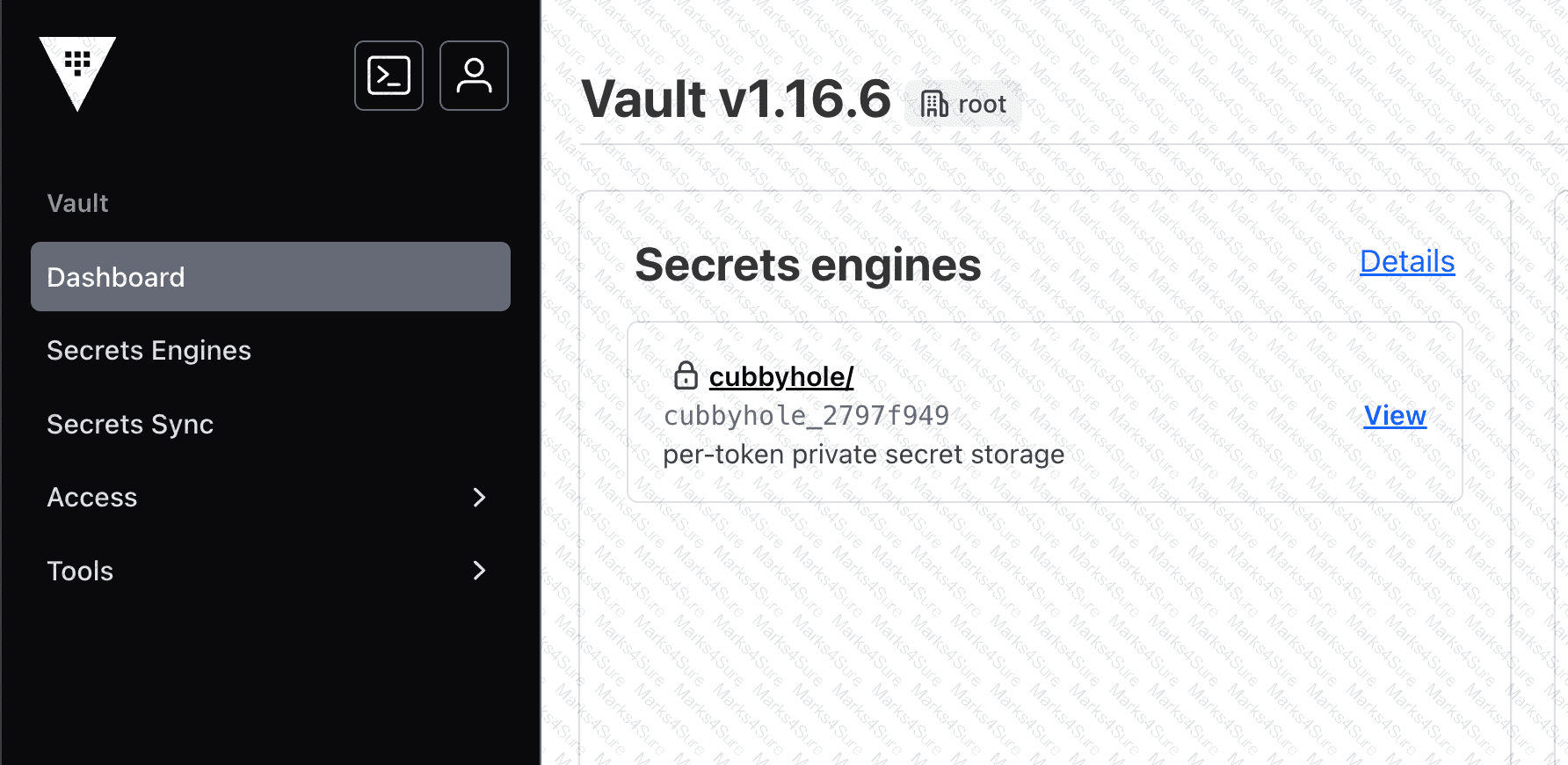
A developer has requested access to manage secrets at the path kv/apps/webapp01. You create the policy below which gives them the proper access:
path " kv/apps/webapp01 " {
capabilities = [ " read " , " create " , " update " , " list " ]
}
However, when the developer logs in to the Vault UI, they see the following screenshot and cannot access the desired secret. Why can’t the developer see the secrets they need?
Your team uses the Transit secrets engine to encrypt all data before writing it to a MySQL database server. During testing, you manually retrieve ciphertext from the database and decrypt it to ensure the data can be read. After decrypting the data, you are worried something is wrong because the plaintext data isn’t legible. Why can you not read the original plaintext data after decrypting the ciphertext?
$ vault write transit/decrypt/krausen-key ciphertext=vault:v1:8SDd3WHDOjf7mq69C.....
Key Value
--- -----
plaintext Zml2ZSBzdGFyIHByYWN0aWNlIGV4YW1zIGJ5IGJyeWFuIGtyYXVzZW4=
You are planning the deployment of your first Vault cluster and have decided to use Integrated Storage as the storage backend. Where do you configure the storage backend to be used by Vault?
To secure your applications, your organization uses certificates generated by a public CA. However, this strategy has proven expensive and you have to revoke certificates even though they have additional time left. What Vault plugin can be used to quickly generate X.509 certificates to secure your internal applications?
Your Azure Subscription ID is stored in Vault and you need to retrieve it via Vault API for an automated job. The Subscription ID is stored at secret/cloud/azure/subscription. The secret is stored on a KV Version 2 secrets engine. What curl command below would successfully retrieve the latest version of the secret?
A new application is being provisioned in your environment. The application requires the generation of dynamic credentials against the Oracle database in order to read reporting data. Which is the best auth method to use to permit the application to authenticate to Vault?
You are working on a new project and need to retrieve a secret from Vault. You log into the Vault UI and browse to the path where the secret is stored. Based on the screenshot below, what is true about the secrets stored in this path? (Select four)
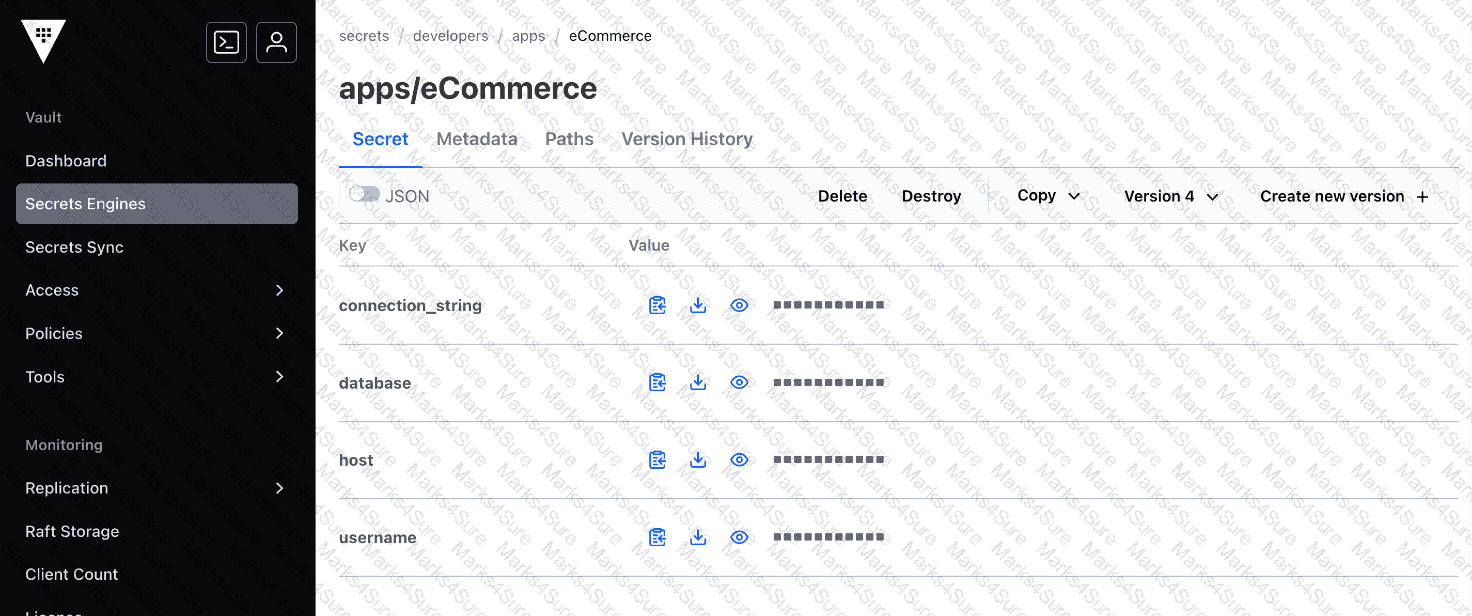
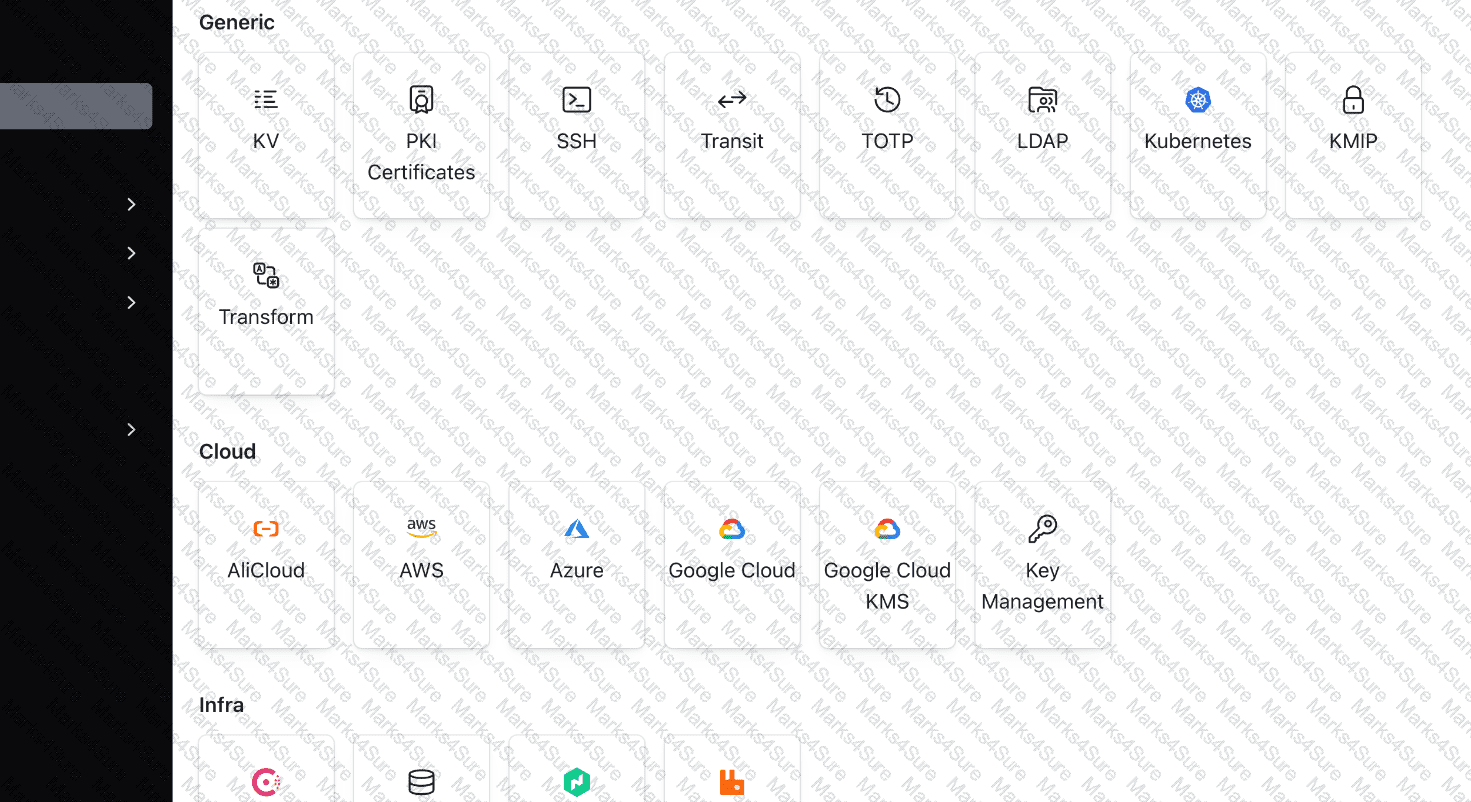
You have logged into the Vault UI and see this screen. What Vault component is being enabled in the screenshot below?
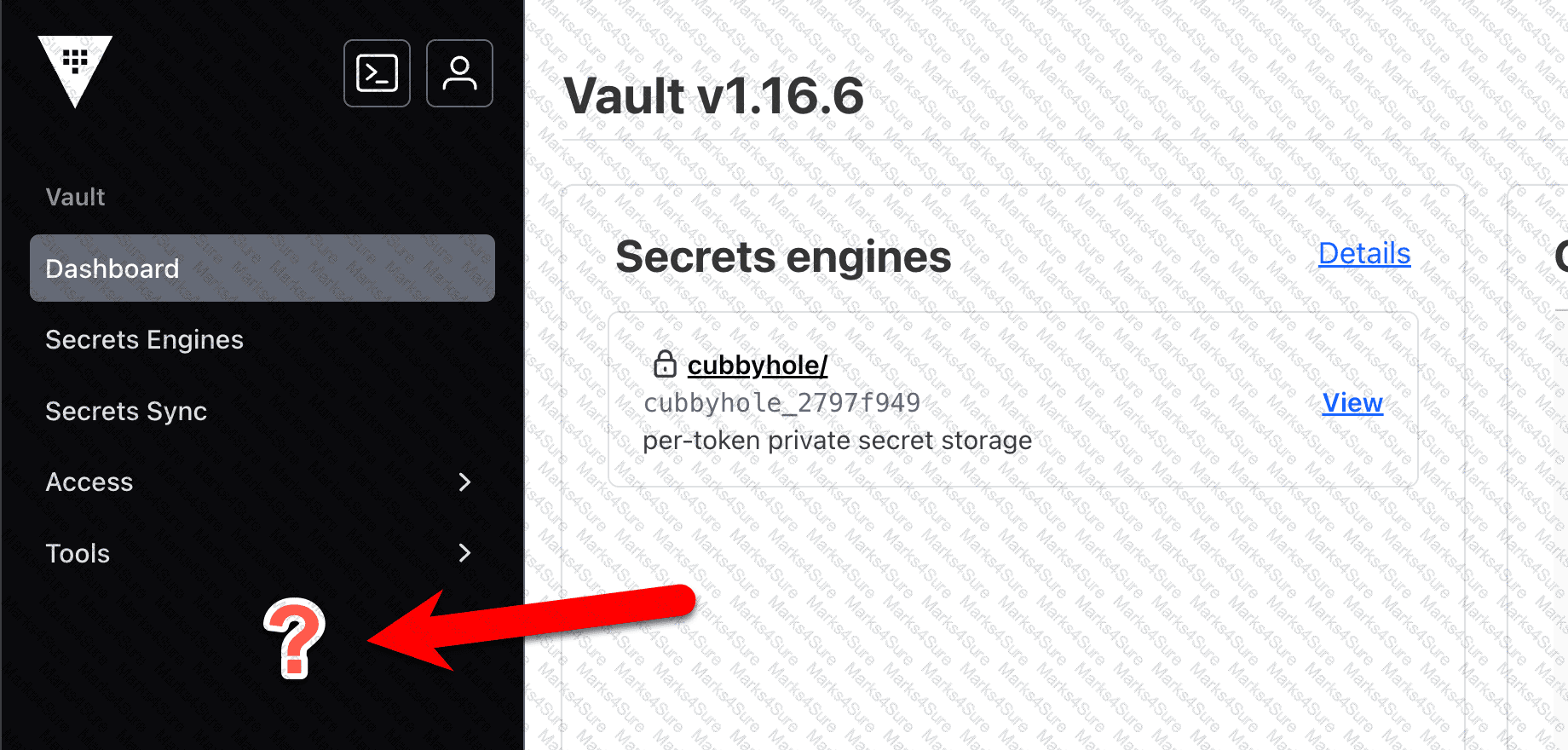
Your supervisor has requested that you log into Vault and update a policy for one of the development teams. You successfully authenticated to Vault via OIDC but do not see a way to manage the Vault policies. Why are you unable to manage policies in the Vault UI?
A web application uses Vault ' s transit secrets engine to encrypt data in-transit. If an attacker intercepts the data in transit which of the following statements are true? Choose two correct answers.
Your DevOps team would like to provision VMs in GCP via a CICD pipeline. They would like to integrate Vault to protect the credentials used by the tool. Which secrets engine would you recommend?
Which CLI command would enable a versioned Key/Value secrets engine in Vault at path my-secrets?
As a best practice, the root token should be stored in which of the following ways?
PDF + Testing Engine

Testing Engine
PDF (Q&A)