- Home
- HP
- ACA Campus Access Associate
- HPE6-A85
- Aruba Certified Campus Access Associate Exam Questions and Answers
Free Practice Questions for the HP ACA Campus Access Associate HPE6-A85 Exam (2026 Updated)
At Marks4sure, we are dedicated to providing IT professionals with the most accurate and reliable preparation materials for the HP HPE6-A85 exam. To support your certification journey, we have made a selection of our premium 2026 ACA Campus Access Associate practice questions and answers available completely free. You can take this practice test as many times as you need. Every question includes a detailed, expertly verified explanation to ensure you fully grasp the core security concepts before test day.
An AP signal strength of 0.0000001 milliwatts is equal to how many dBm?
Options:
–70 dBm
–60 dBm
–90 dBm
–80 dBm
Answer:
AExplanation:
Comprehensive and Detailed Explanation
HPE Press guide context | PDF page 712 | HPE Press, Aruba Certified Associate – Campus Access Official Certification Study Guide
Technical Deep Dive — Reconstructed (Original Chat Text Not Recoverable)
Convert milliwatts to dBm using 10 log10(P_mW). The power 0.0000001 mW is 10^-7 mW, so its dBm equivalent is -70. Every tenfold reduction in milliwatts decreases power by 10 dB. The other offered values correspond to different powers and therefore misapply the logarithmic scale.
The selected answer corresponds to A: –70 dBm. This matches the mechanism or management behavior described in the scenario rather than merely a related network feature.
Optimization should consider both immediate performance and its tradeoffs in RF capacity, airtime, reliability, security, and operational overhead.
A proper optimization decision balances a local performance improvement against the resulting effect on neighboring clients and the wider campus.
The answer should be validated against both the control-plane state and the forwarding or management outcome. A successful individual command alone is not proof that the end-to-end requirement is satisfied.
When troubleshooting or designing a change, verify compatibility between all participating devices, the management scope, and the applicable software release. The most useful evidence is the state observed on both sides of the affected connection.
What occurs when you remove a device subscription in HPE GreenLake?
Options:
The device is removed from all associated floor plans in Central.
The device status is shown as Offline in Central. The device is automatically unassigned from its site and group.
The device status is shown as Offline in Central and stays associated to the group and site.
The device is moved to the Unassigned Devices pool in Central.
Answer:
CExplanation:
Comprehensive and Detailed Explanation
HPE Press guide context | PDF page 579 | HPE Press, Aruba Certified Associate – Campus Access Official Certification Study Guide
Technical Deep Dive — Original Chat Wording
HPE GreenLake manages the subscriptions that authorize supported infrastructure devices to use Aruba Central management services.
When an administrator removes a device's subscription, Central no longer has the required entitlement to manage that device normally.
Consequently, the management interface can display its status as Offline.
This status does not necessarily mean the physical switch or AP has powered down or lost ordinary network connectivity.
Rather, it reflects the loss of the management relationship associated with the removed subscription.
Importantly, the device is not automatically removed from its existing site or group.
These assignments remain associated with its inventory record.
For example, a CX switch assigned to the London branch and the Branch-Switches group retains those associations after its Central subscription is removed.
If a valid subscription is later restored, retaining the existing organizational assignments can simplify recovery of centralized management.
This differs from explicitly unassigning a device from a site or management group, which may affect its configuration scope and inheritance.
Removing a subscription also does not automatically delete the device from floor plans or place it into a general unassigned-device pool.
Therefore, Option C is correct.
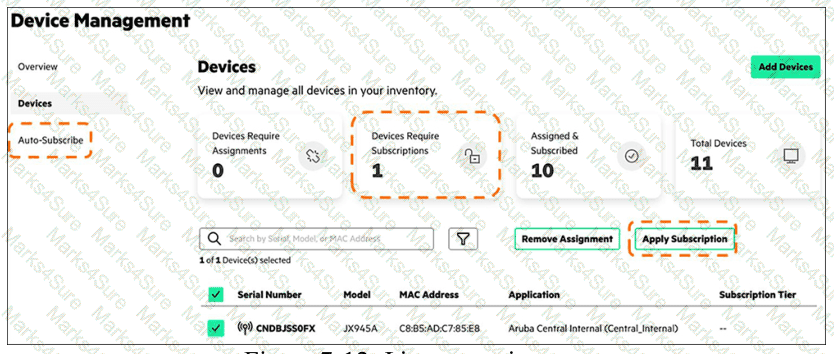
HPE Press study-guide figure / related learning illustration · Q156 Fig 7-12 License
How does a UXI sensor establish connectivity while being onboarded?
Options:
Through Ethernet or Wi-Fi
Through Bluetooth Low Energy
By using LAN over Powerline
By using direct cloud connection
Answer:
AExplanation:
Comprehensive and Detailed Explanation
HPE Press guide context | PDF page 1035 | HPE Press, Aruba Certified Associate – Campus Access Official Certification Study Guide
Technical Deep Dive — Original Chat Wording
HPE Aruba Networking User Experience Insight (UXI) uses dedicated sensors and supported software agents to evaluate network connectivity from an endpoint's perspective.
A physical UXI sensor can test wired Ethernet connections and wireless networks.
When monitoring a wired network, the sensor communicates through its Ethernet interface.
When monitoring a wireless network, it associates with the configured WLAN and performs supported authentication procedures.
The sensor then measures the steps required to obtain functional network connectivity.
These can include DHCP address assignment, DNS resolution, gateway reachability, and application access.
For example, a sensor monitoring an employee WLAN can attempt to associate with the SSID, complete authentication, acquire an IP address, and access a specified application.
If one stage fails, UXI records diagnostic information that helps the administrator identify the likely point of failure.
This provides more useful visibility into user experience than infrastructure availability checks alone.
Bluetooth Low Energy and powerline networking are not the ordinary wired or wireless testing methods described in the question.
Technical distinction: The HPE Press guide also explains that physical UXI sensors may initially use cellular connectivity or standard PoE during provisioning. Cellular connectivity can provide a management bootstrap path, but the monitored network experience is tested through wired Ethernet or Wi-Fi.
Therefore, Option A (Through Ethernet or Wi-Fi) is correct.
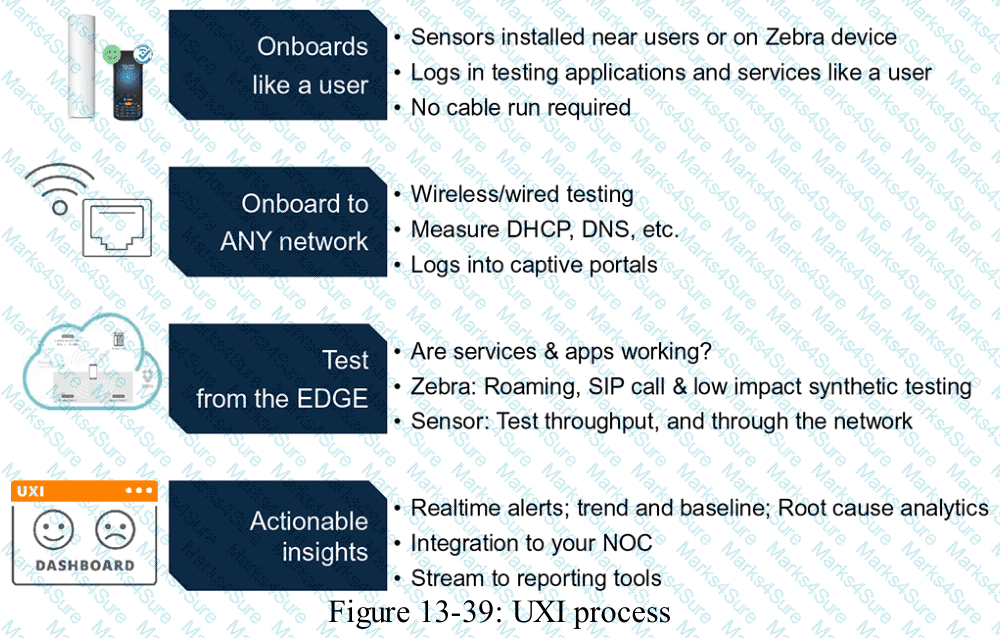
HPE Press study-guide figure / related learning illustration · Q195 Fig 13-39 UXI
Match each AAA Service to its correct definition. Matches may be used more than once or not at all.
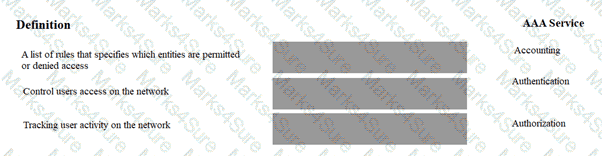
Options:
Answer:
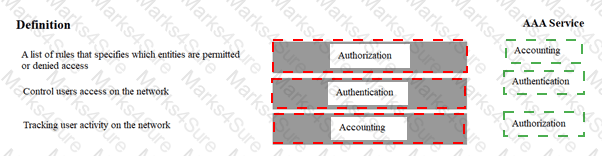
Explanation:
Exhibit item
Correct match
Rules specifying permitted or denied access
Authorization
Controls user access to the network
Authentication
Tracks user activity on the network
Accounting
Comprehensive and Detailed Explanation
HPE Press guide context | PDF page 814 | HPE Press, Aruba Certified Associate – Campus Access Official Certification Study Guide
Technical Deep Dive — Reconstructed (Original Chat Text Not Recoverable)
Authentication establishes identity, authorization decides the resources/actions that identity may access, and accounting records activity for monitoring or audit. The match is: permit/deny rules = Authorization, control user access by identity = Authentication, track user activity = Accounting. ClearPass can provide all three AAA functions.
The exhibit is a matching question: each original item must be paired with the applicable protocol, medium, security function, or address classification. The answer table below records the intended correspondence without changing the source exhibit.
Operational workflows should preserve consistent inventory, authorization, configuration history, and monitoring so that administrators can locate and manage devices predictably.
For example, a cloud-managed infrastructure device may be registered successfully but still require the correct subscription, site, group, and configuration scope.
In production, the decision should be documented and checked against the supported software release and platform model, because interface names, licensing tiers, and management workflows can change across Central and AOS-CX generations.
For practical use, confirm the prerequisite conditions first, then verify the resulting operational state. This separates an intended configuration from a working network service and avoids accepting a misleading result.
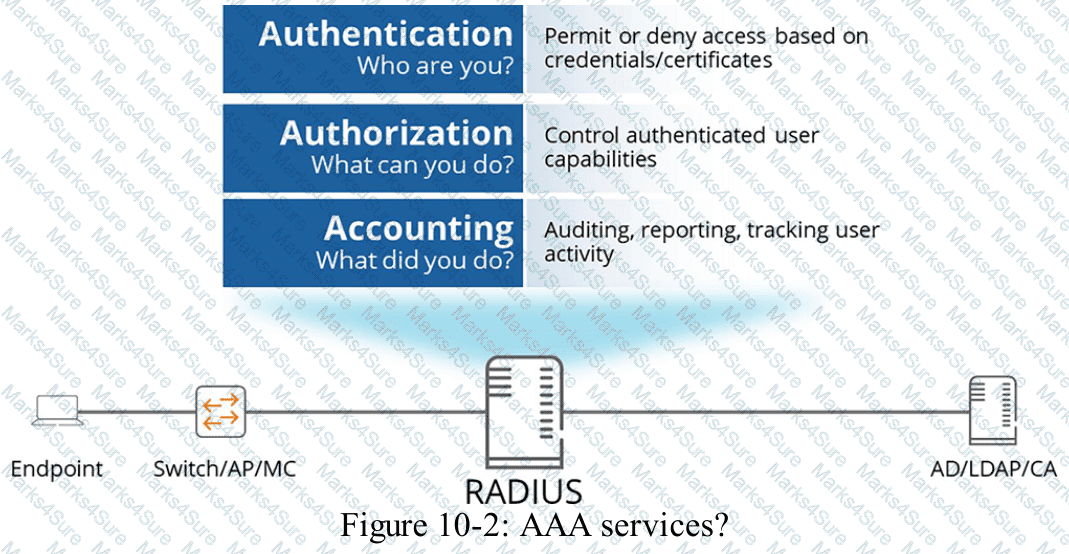
HPE Press study-guide figure / related learning illustration · Q69 AAA
Based on the show ip route output on a CX 8400, what kind of route is 10.1.20.0/24, vrf default via 10.1.12.2, [1/0] ?
Options:
local
OSPF
static
connected
Answer:
CExplanation:
Comprehensive and Detailed Explanation
HPE Press guide context | PDF page 231 | HPE Press, Aruba Certified Associate – Campus Access Official Certification Study Guide
Technical Deep Dive — Original Chat Wording
The AOS-CX routing table identifies how the switch reaches remote IP networks.
Each routing entry can contain the destination prefix, route source, next-hop address, administrative distance, and routing metric.
Consider the specified entry:
10.1.20.0/24 via 10.1.12.2 [1/0]
The destination network is 10.1.20.0/24 .
The next-hop address is 10.1.12.2 .
The square-bracket notation represents the administrative distance followed by the route metric.
In this example:
1: Administrative distance
0: Route metric
Under the standard AOS-CX defaults, static routes have an administrative distance of 1.
By comparison, directly connected routes have a default administrative distance of 0, and OSPF routes have a default administrative distance of 110.
A static route is configured manually rather than learned through a dynamic routing protocol.
A representative configuration is:
configure terminal
ip route 10.1.20.0/24 10.1.12.2
Administrators can examine static routing information using:
show ip route
show ip route static
Administrative distance can be customized, so it should not be considered an infallible route-origin identifier in every configuration.
However, the displayed [1/0] values match the ordinary AOS-CX static-route behavior described by the guide.
Therefore, Option C (static) is correct.
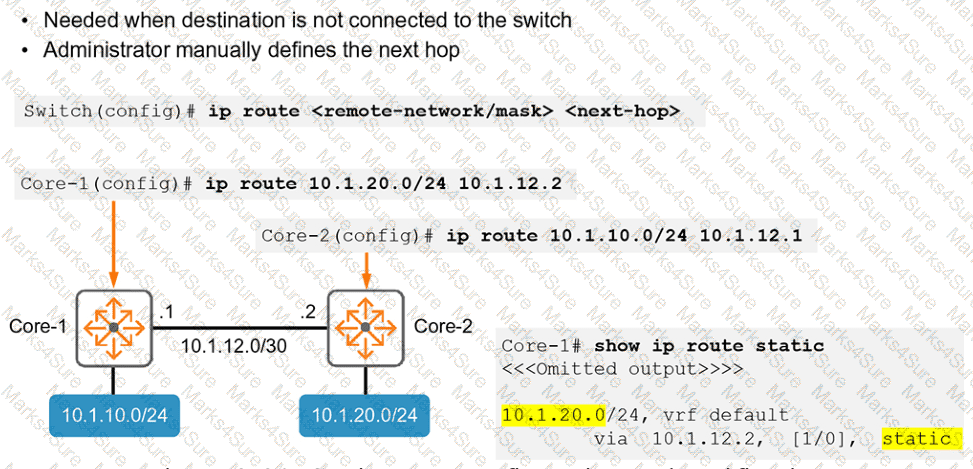
HPE Press study-guide figure / related learning illustration · Q149 Fig 3-20 Static
What information does a network speed test provide while troubleshooting?
Options:
It measures current network performance
It checks the physical status of cables and ports
It shows all connected devices on the local network
It diagnoses wireless signal strength and coverage
Answer:
AExplanation:
Comprehensive and Detailed Explanation
HPE Press guide context | PDF page 1033 | HPE Press, Aruba Certified Associate – Campus Access Official Certification Study Guide
Technical Deep Dive — Original Chat Wording
A network speed test evaluates the transfer performance observed between a testing endpoint and a selected destination.
Common measurements include download throughput, upload throughput, and sometimes connection latency.
Throughput represents the quantity of data successfully transferred during a specified period.
For example, a wireless laptop associated at a high physical-layer data rate may achieve substantially lower application throughput because of protocol overhead, channel contention, interference, or congestion.
Running a speed test helps determine the actual transfer performance experienced by the client.
Repeated tests can reveal performance variations during different periods of network utilization.
The location of the test server also affects the result.
A local test server can help isolate performance within the LAN, while an Internet-hosted test measures additional dependencies, including WAN connectivity and remote server capacity.
Speed tests do not directly identify damaged cables or faulty switch ports.
Physical-layer diagnosis requires appropriate interface counters, link information, and cable-testing tools.
Likewise, speed tests do not inventory all connected devices or map wireless coverage.
Those functions require different monitoring or discovery mechanisms.
Therefore, Option A (It measures current network performance) is correct.
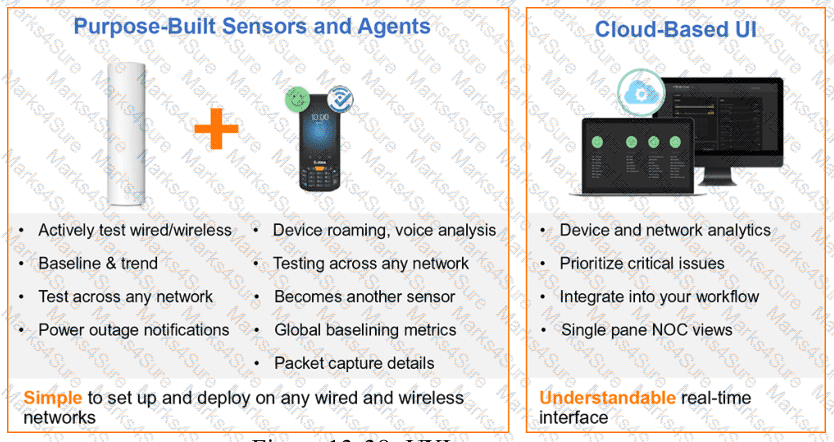
HPE Press study-guide figure / related learning illustration · Q155 Fig 13-38 UXI
How do real-time alerts in HPE Aruba Networking Central assist you in troubleshooting critical network events?
Options:
They monitor general network health metrics for long-term performance optimization
They send notifications about important issues so you can quickly respond
They show summarized reports after network problems have already been resolved
They collect and archive logs for future audit and regulatory compliance review
Answer:
BExplanation:
Comprehensive and Detailed Explanation
HPE Press guide context | PDF page 1028 | HPE Press, Aruba Certified Associate – Campus Access Official Certification Study Guide
Technical Deep Dive — Original Chat Wording
Real-time alerting enables network administrators to identify and respond to operational problems before they cause prolonged service disruption.
HPE Aruba Networking Central continuously monitors supported network infrastructure and can generate alerts when significant conditions occur.
Examples include access point disconnections, switch availability problems, authentication failures, connectivity degradation, and other network events.
When an alert condition is detected, Central records the corresponding event and can notify administrators through configured notification mechanisms.
The administrator can then examine relevant information, including affected devices, severity, event time, and associated operational details.
This provides an efficient starting point for troubleshooting.
For example, if several APs unexpectedly disconnect, Central can generate device-disconnection alerts.
A network technician can use these alerts to identify affected devices and investigate common infrastructure dependencies, such as PoE switches, uplinks, or management connectivity.
The alert acknowledgment feature allows administrators to record that an issue has been reviewed.
However, acknowledgment does not automatically resolve the underlying technical problem.
Long-term monitoring, historical reporting, and audit logging serve related but different purposes.
Real-time alerting is specifically intended to provide timely awareness of significant network conditions requiring attention.
Therefore, Option B is correct.
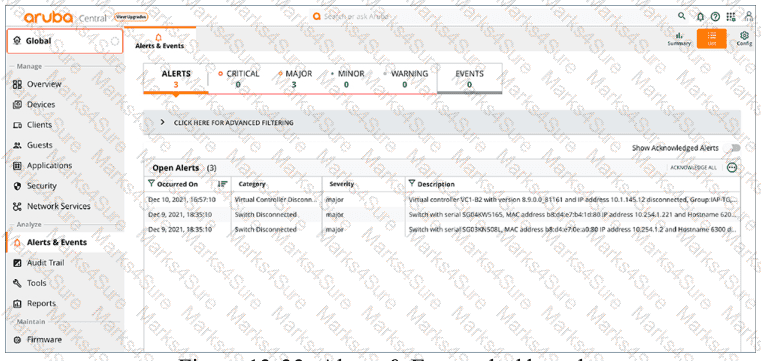
HPE Press study-guide figure / related learning illustration · Fig 13-33 Alerts
When would you bond multiple 20 MHz-wide 802.11 channels?
Options:
To decrease the Signal to Noise Ratio (SNR)
To provision highly available AP groups
To increase throughput between the client and AP
To utilize high gain omni-directional antennas
Answer:
CExplanation:
Comprehensive and Detailed Explanation
HPE Press guide context | PDF page 708 | HPE Press, Aruba Certified Associate – Campus Access Official Certification Study Guide
Technical Deep Dive — Reconstructed (Original Chat Text Not Recoverable)
Bonding adjacent 20-MHz channels creates wider 40-, 80-, or 160-MHz channels, increasing the PHY capacity available to supported clients under favorable RF conditions. Wider channels also consume more spectrum and can increase contention; they do not automatically improve coverage or SNR. Avoid wide channels in dense deployments without planning.
The selected answer corresponds to C: To increase throughput between the client and AP. This matches the mechanism or management behavior described in the scenario rather than merely a related network feature.
Optimization should consider both immediate performance and its tradeoffs in RF capacity, airtime, reliability, security, and operational overhead.
For example, higher PHY data rates do not guarantee higher useful throughput if airtime is lost to management traffic, contention, or retransmissions.
A strong verification step is to compare the expected outcome with operational status before and after the change. This confirms not only that a configuration was accepted, but also that the required service actually functions.
Which two statements accurately distinguish multimode fiber links from single-mode fiber links?
Choose two
Options:
Multimode fiber costs more and serves longer distances.
Single-mode fiber costs more and reaches longer distances.
Multi-mode fiber costs less and is used over shorter distances.
Single-mode fiber costs less but supports shorter distances.
Multi-mode fiber has a thicker core and is used for outdoor installations.
Answer:
B, CExplanation:
Comprehensive and Detailed Explanation
HPE Press guide context | PDF page 43 | HPE Press, Aruba Certified Associate – Campus Access Official Certification Study Guide
Technical Deep Dive — Original Chat Wording
Fiber-optic networking transmits information as optical signals through glass or plastic fiber.
Two widely used fiber types are multimode fiber (MMF) and single-mode fiber (SMF).
Multimode fiber has a relatively large core, commonly 50 or 62.5 micrometers. This permits multiple propagation modes within the fiber.
Different optical paths can introduce modal dispersion, limiting achievable transmission distances at particular data rates.
Multimode fiber is commonly used for shorter building and data-center connections.
Single-mode fiber has a much smaller core, typically around 9 micrometers, and supports a single principal propagation mode.
This significantly reduces modal dispersion and enables long-distance transmission using suitable optical transceivers.
Single-mode connections are common between buildings, across campuses, and in metropolitan or carrier networks.
The study guide describes multimode as less expensive and single-mode as more expensive. In practice, total link cost depends on both cabling and transceiver selection; single-mode optics can carry a price premium even when single-mode cable itself is competitively priced.
Option E is incorrect because a thicker core does not determine whether fiber is suitable for outdoor installation. Environmental suitability depends on cable construction and installation requirements.
Therefore, Options B and C accurately reflect the study-guide comparison.
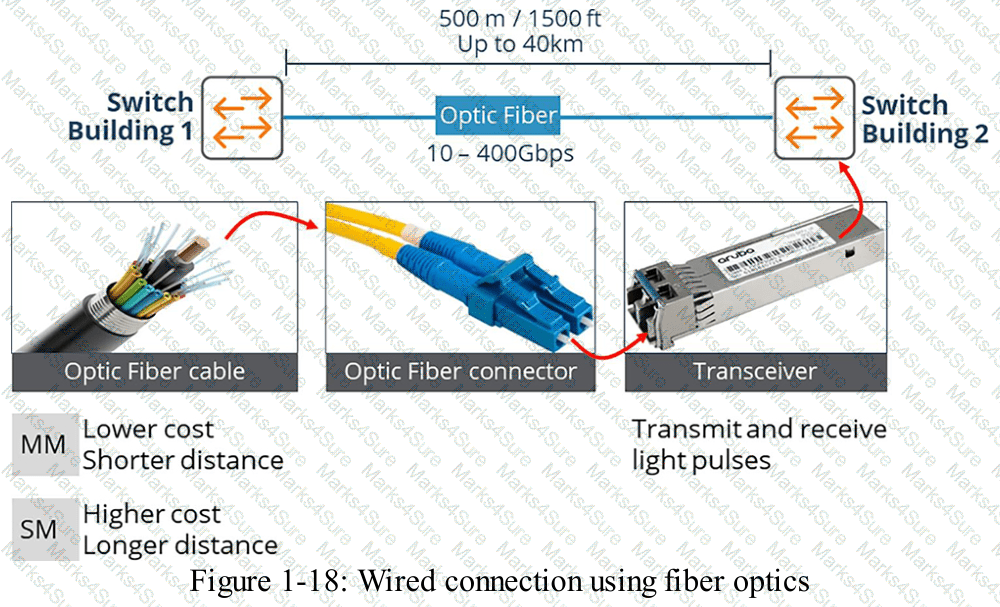
HPE Press study-guide figure / related learning illustration · Q182 Fig 1-18 fiber
How can you indicate the importance or urgency of a network alert?
Options:
Set the priority level of the alert.
Record the alert details in a service log.
Escalate the alert to a different technician.
Assign the alert to a specific user group.
Answer:
AExplanation:
Comprehensive and Detailed Explanation
HPE Press guide context | PDF page 1042 | HPE Press, Aruba Certified Associate – Campus Access Official Certification Study Guide
Technical Deep Dive — Original Chat Wording
Network alerts help administrators identify operational conditions that may require investigation or corrective action.
In HPE Aruba Networking Central, alerts can represent infrastructure failures, connectivity problems, authentication errors, and other monitored events.
Alert priority identifies the operational urgency associated with a particular issue.
A critical service-impacting alert should generally receive more immediate attention than a low-impact informational event.
Central distinguishes between an alert's severity and its assigned priority .
Severity reflects the alert classification, such as Critical, Major, Minor, or Info.
Priority is used to organize the response workflow and can be adjusted according to operational requirements.
For example, an alert affecting a business-critical gateway may receive a Very High priority because the failure affects essential services.
A minor issue involving a noncritical device may receive a lower priority.
Administrators can use these classifications to organize troubleshooting activities and determine which issues require immediate escalation.
Recording an alert in a service log provides documentation but does not directly set its urgency.
Escalating an alert changes responsibility or workflow, while assigning an alert to a group identifies who may handle it.
Neither action replaces the explicit priority setting.
Therefore, Option A (Set the priority level of the alert) is correct.

HPE Press study-guide figure / related learning illustration · Q122 Fig 13-46 Alerts
The customer needs to create authorization policies for users with Windows 10 clients and must authorize both device and user credentials within a single RADIUS session.
Which solution correctly meets this requirement?
Options:
HPE Aruba Networking ClearPass 6.9 with EAP-TLS
HPE Aruba Networking ClearPass 6.9 with EAP-TTLS
HPE Aruba Networking ClearPass 6.9 with PEAP
HPE Aruba Networking ClearPass 6.9 with EAP-TEAP
Answer:
DExplanation:
Comprehensive and Detailed Explanation
HPE Press guide context | PDF page 826 | HPE Press, Aruba Certified Associate – Campus Access Official Certification Study Guide
Technical Deep Dive — Reconstructed (Original Chat Text Not Recoverable)
EAP-TEAP can chain machine and user authentication within one protected TLS tunnel/RADIUS exchange, enabling authorization policies that evaluate both computer and logged-in identity. Standalone EAP-TLS authenticates its selected certificate identity; conventional PEAP/TTLS do not provide identical standardized chaining capability.
The selected answer corresponds to D: HPE Aruba Networking ClearPass 6.9 with EAP-TEAP. This matches the mechanism or management behavior described in the scenario rather than merely a related network feature.
Operational workflows should preserve consistent inventory, authorization, configuration history, and monitoring so that administrators can locate and manage devices predictably.
For example, a cloud-managed infrastructure device may be registered successfully but still require the correct subscription, site, group, and configuration scope.
A strong verification step is to compare the expected outcome with operational status before and after the change. This confirms not only that a configuration was accepted, but also that the required service actually functions.
For practical use, confirm the prerequisite conditions first, then verify the resulting operational state. This separates an intended configuration from a working network service and avoids accepting a misleading result.
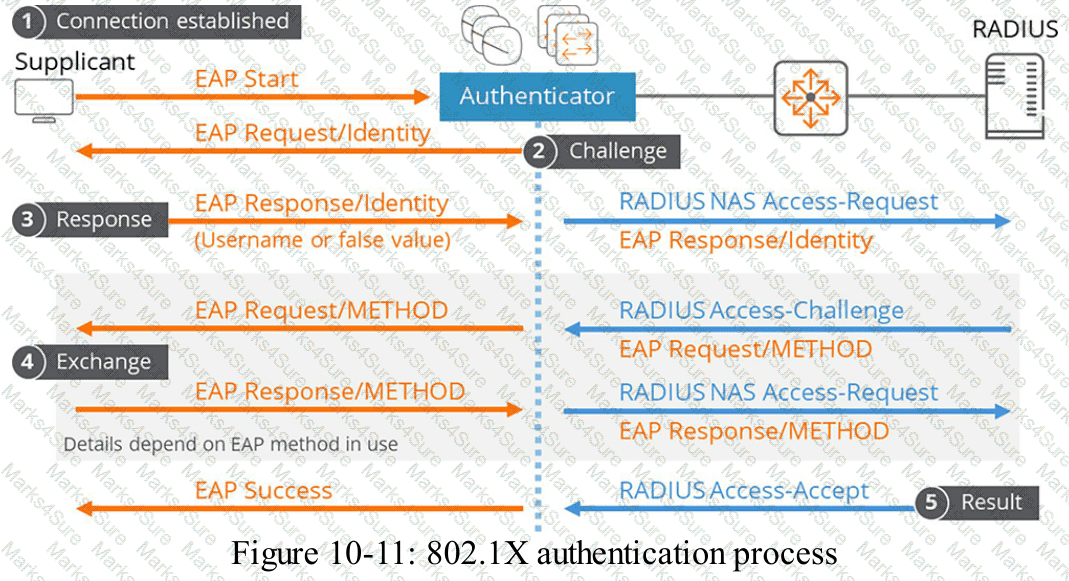
HPE Press study-guide figure / related learning illustration · Q72 8021X
What are the primary characteristics of the 6 GHz band?
Options:
Less RF signal is absorb by objects in a 6 GHz WLAN.
In North America, the 6 GHz band offers more 80 MHz channels than there are 40 MHz channels in the 5 GHz band.
Low Power Devices are allowed for indoor and outdoor usage.
The 6 GHz band is fully backward compatible with the existing bands.
Answer:
BExplanation:
Comprehensive and Detailed Explanation
HPE Press guide context | PDF page 711 | HPE Press, Aruba Certified Associate – Campus Access Official Certification Study Guide
Technical Deep Dive — Reconstructed (Original Chat Text Not Recoverable)
The 6-GHz Wi-Fi band dramatically increases available channel capacity relative to older bands, enabling numerous 80-MHz channels where regulators authorize the spectrum. It is not backward compatible with 2.4/5-GHz-only client radios, and low-power indoor categories have location restrictions. Higher frequencies generally suffer greater material attenuation, not less.
The selected answer corresponds to B: In North America, the 6 GHz band offers more 80 MHz channels than there are 40 MHz channels in the 5 GHz band.. This matches the mechanism or management behavior described in the scenario rather than merely a related network feature.
Operational workflows should preserve consistent inventory, authorization, configuration history, and monitoring so that administrators can locate and manage devices predictably.
Consistent RBAC, accurate inventories, and retained audit records simplify support handovers and reduce uncertainty during incident investigations.
For an administrator preparing for the associate certification, the key distinction is the precise protocol or Central workflow involved. Similar-sounding features often operate at different OSI layers or management stages.
Which action do you take to access profile management in HPE Aruba Networking Central?
Options:
Click the user icon from the Network Overview page.
Click Manage under the Devices menu in the Configuration Overview.
Select device type in the Network Overview page.
Click the configuration (gear) icon from the Network Overview page.
Answer:
DExplanation:
Comprehensive and Detailed Explanation
HPE Press guide context | PDF page 588 | HPE Press, Aruba Certified Associate – Campus Access Official Certification Study Guide
Technical Deep Dive — Original Chat Wording
HPE Aruba Networking Central provides centralized configuration management for switches, access points, gateways, and related networking services.
Configuration profiles allow administrators to define reusable parameters that can be applied to supported devices and operational scopes.
This approach reduces configuration duplication and helps maintain consistent network behavior.
From the Network Overview page in the Central interface described by the question, administrators access configuration management through the configuration icon, represented by a gear.
The configuration workspace provides access to settings associated with network devices and supported configuration scopes.
In the newer Central configuration architecture, administrators can work with profiles under different hierarchy levels, including Global, Sites, Device Groups, and Devices.
The Profiles tab enables administrators to create, inspect, modify, and delete supported configuration profiles.
Profile-based management is useful for standardizing wireless settings, interface behavior, security policies, and other network parameters.
For example, an organization operating several branch offices can define common configuration parameters and apply them consistently across applicable locations.
The user icon is associated with account or user functions rather than network profile management.
Selecting a device type changes the context of the network view but does not directly open profile management.
The configuration gear is the appropriate entry point.
Therefore, Option D (Click the configuration gear icon) is correct.
Refer to the exhibit.
Based on the topology shown, which configuration would be valid on Switch 1 port 1/1/2 to allow traffic to PC3 if an unmanaged switch is connected between PC3 and Switch 1?
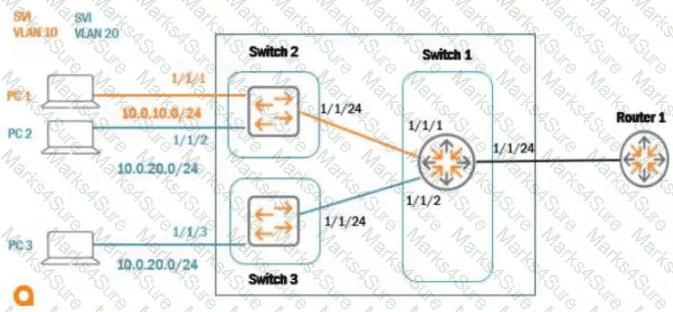
Options:
int 1/1/2, trunk allowed vlan 20
int 1/1/2, vlan native 20
int 1/1/2, vlan access 20
int 1/1/2, untagged vlan 20
Answer:
CExplanation:
Comprehensive and Detailed Explanation
HPE Press guide context | PDF page 127 | HPE Press, Aruba Certified Associate – Campus Access Official Certification Study Guide
Technical Deep Dive — Reconstructed (Original Chat Text Not Recoverable)
An unmanaged switch does not understand or preserve multiple VLAN tags as a managed trunk endpoint would. The AOS-CX port feeding it should be a Layer 2 access port in VLAN 20, allowing untagged PC3 traffic to enter the correct broadcast domain. `vlan access 20` is the expected AOS-CX syntax.
The selected answer corresponds to C: int 1/1/2, vlan access 20. This matches the mechanism or management behavior described in the scenario rather than merely a related network feature.
In an AOS-CX or Aruba Central deployment, the relevant settings must be applied in the correct interface, profile, policy, or management scope and then validated operationally.
For example, an apparently healthy physical port may still fail to serve a client when VLAN assignment, AAA policy, or Layer 3 gateway context is wrong.
In production, the decision should be documented and checked against the supported software release and platform model, because interface names, licensing tiers, and management workflows can change across Central and AOS-CX generations.
What is the common LAN use case for fiber-optic cabling?
Options:
Link telephones to a switch
Aggregate traffic for a printer
For connecting network devices over long distances
For connecting indoor AP to switches
Answer:
CExplanation:
Comprehensive and Detailed Explanation
HPE Press guide context | PDF page 43 | HPE Press, Aruba Certified Associate – Campus Access Official Certification Study Guide
Technical Deep Dive — Original Chat Wording
Fiber-optic cabling is commonly used for high-speed network connections over distances that exceed the limits of conventional twisted-pair copper Ethernet.
It transmits data using optical signals instead of electrical signals.
This allows fiber to provide high bandwidth while avoiding electrical interference affecting copper transmission media.
Fiber is frequently deployed between network wiring closets, distribution switches, campus buildings, and data-center equipment.
For example, two buildings separated by 500 meters may be connected using compatible fiber-optic cable and optical transceivers.
Standard twisted-pair Ethernet links generally have a maximum channel length of 100 meters, making fiber a better choice for many longer connections.
Single-mode fiber can support particularly long distances when paired with appropriate optical modules.
Multimode fiber is commonly used for shorter optical connections within buildings and data centers.
Network telephones and indoor access points commonly use twisted-pair copper because it can simultaneously support Ethernet communication and Power over Ethernet (PoE).
Fiber does not provide ordinary PoE delivery to these endpoints.
Connecting a printer normally does not require a long-distance optical link.
Fiber is therefore especially appropriate for infrastructure interconnections where distance, bandwidth, or electrical isolation makes copper impractical.
Therefore, Option C (For connecting network devices over long distances) is correct.
What is the purpose of onboarding devices into HPE GreenLake?
Options:
Monitor network client health.
Enable automatic firmware updates.
Track client onboarding status.
Ensure devices are registered and available for configuration.
Answer:
DExplanation:
Comprehensive and Detailed Explanation
HPE Press guide context | PDF page 572 | HPE Press, Aruba Certified Associate – Campus Access Official Certification Study Guide
Short exact extract: “HPE GreenLake is a cloud management and monitoring platform from HPE.”
Technical Deep Dive — Original Chat Wording
HPE GreenLake provides an account-level environment for registering and managing supported HPE infrastructure and services.
In the Aruba Central architecture covered by the guide, onboarding into GreenLake establishes the device's association with the customer's account.
This is an essential step before the device can be fully managed through the appropriate cloud application.
The onboarding process uses device-identification information, particularly serial numbers and MAC addresses.
Devices can be added individually or through supported bulk-import mechanisms.
After registration, the administrator can assign the devices to the appropriate service and complete any necessary subscription or entitlement steps.
For example, an organization purchasing multiple CX access switches can register them in GreenLake and associate them with Aruba Central.
Once the management prerequisites are satisfied, Central can provide configuration, monitoring, and lifecycle-management capabilities.
Registration is therefore different from configuring the actual network interfaces or WLAN policies.
GreenLake onboarding establishes the device's identity and management association; subsequent Central workflows control the deployed network configuration.
Client-health monitoring and firmware management are possible downstream capabilities, not the primary purpose of registering the infrastructure devices.
Similarly, client onboarding refers to user or endpoint network access, rather than infrastructure inventory registration.
Therefore, Option D (Ensure devices are registered and available for configuration) is correct.
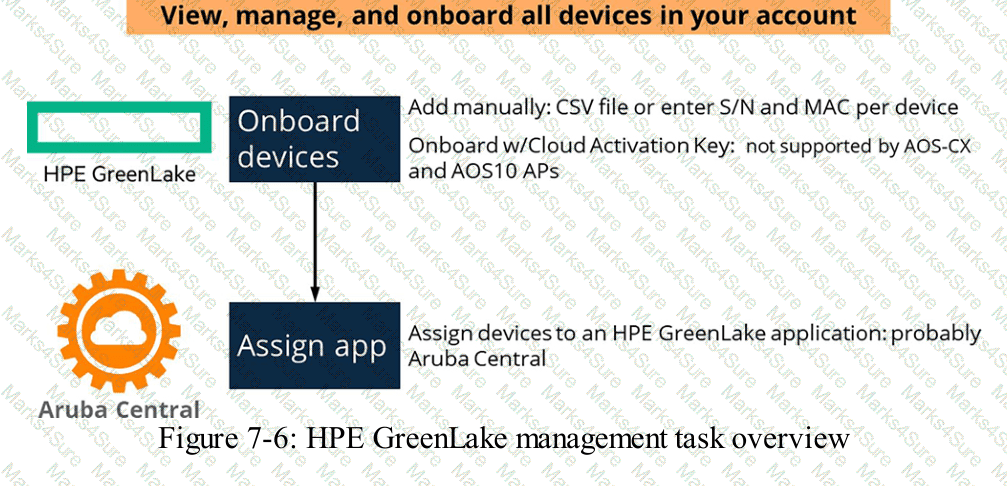
HPE Press study-guide figure / related learning illustration · Q111 Fig 7-6 GreenLake
Why must devices be managed during onboarding in HPE Aruba Networking Central?
Options:
To install firmware updates remotely.
To assign software licenses automatically.
To back up device logs daily.
To start the initial configuration of the devices.
Answer:
DExplanation:
Comprehensive and Detailed Explanation
HPE Press guide context | PDF page 567 | HPE Press, Aruba Certified Associate – Campus Access Official Certification Study Guide
Short exact extract: “The onboard device process starts at the device inventory.”
Technical Deep Dive — Original Chat Wording
HPE Aruba Networking Central provides centralized provisioning, configuration, and management for supported access points, switches, and gateways.
The onboarding workflow establishes a device's association with the management account and prepares it to receive its intended configuration.
The process involves registering the device in the inventory, assigning an appropriate management subscription, and enabling connectivity to Central.
Once these prerequisites are satisfied, the administrator can assign the device to the appropriate group or management scope.
The corresponding configuration can then be delivered through the management platform.
For example, an organization deploying new campus access switches can register their serial numbers and MAC addresses, assign the necessary subscriptions, and provision common VLAN, security, and interface configurations.
This eliminates much of the repetitive configuration normally required on individual switches.
Automatic firmware upgrades may be configured as an additional lifecycle-management function, but they are not the primary purpose of completing the initial management workflow.
Subscription assignment is a prerequisite for management, rather than the reason the device must be managed.
Daily log backup is a separate operational process.
The principal objective is to make the device available for initial centralized configuration and subsequent management.
Therefore, Option D (To start the initial configuration of the devices) is correct.

HPE Press study-guide figure / related learning illustration · Q106 Fig 7-1 Onboarding
What weakness is introduced into a WLAN environment when WPA2-Personal is used for security?
Options:
The Pairwise Mater Key (PMK) is shared by all users.
It does not use the WPA 4-Way Handshake.
The Pairwise Temporal Key (PTK) is specific to each session.
It uses X.509 certificates generated by a Certification Authority.
Answer:
AExplanation:
Comprehensive and Detailed Explanation
HPE Press guide context | PDF page 956 | HPE Press, Aruba Certified Associate – Campus Access Official Certification Study Guide
Technical Deep Dive — Original Chat Wording
WPA2-Personal uses a pre-shared passphrase to establish wireless encryption keys without an external authentication server.
In a conventional WPA2-PSK WLAN, every device using the same SSID and passphrase derives the same Pairwise Master Key (PMK).
The PMK serves as the foundation for generating additional cryptographic material during the four-way handshake.
Although every client establishes its own Pairwise Temporal Key (PTK), the shared PMK introduces security risks.
An attacker who captures a valid WPA2 four-way handshake can attempt offline dictionary attacks against the passphrase.
If the password is weak, an attacker may recover it without continuously interacting with the access point.
Furthermore, a person who knows the shared passphrase and captures another client's handshake can derive that client's session keying material in a conventional WPA2-PSK deployment.
This compromises the isolation expected between different wireless clients.
WPA3-Personal improves this architecture using Simultaneous Authentication of Equals (SAE), which establishes fresh session keying material and provides stronger resistance to offline password-guessing attacks.
Option B is incorrect because WPA2 uses the four-way handshake.
Option C describes a beneficial property of PTK derivation rather than the underlying weakness.
Option D describes certificate-based authentication, not standard WPA2-Personal.
Therefore, Option A is correct.
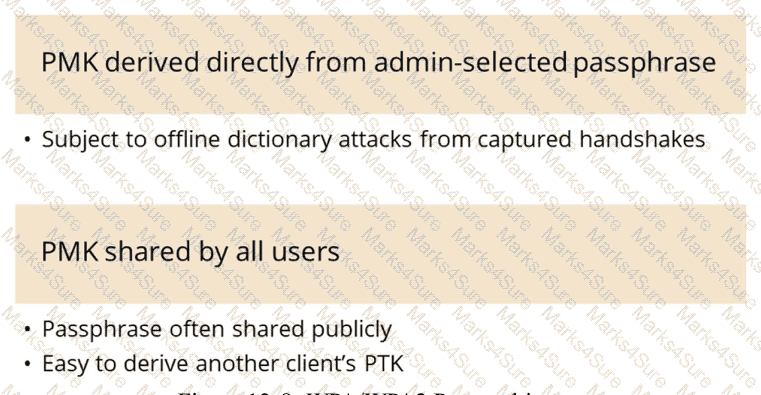
HPE Press study-guide figure / related learning illustration · Fig 12-8 WPA2 issues
Which role lets users manage physical floor plans in HPE Aruba Networking Central?
Options:
Floor Assign
Floor Remove
Floor Edit
Floor Create
Answer:
CExplanation:
Comprehensive and Detailed Explanation
HPE Press guide context | PDF page 667 | HPE Press, Aruba Certified Associate – Campus Access Official Certification Study Guide
Technical Deep Dive — Original Chat Wording
HPE Aruba Networking Central uses Role-Based Access Control (RBAC) to determine which users can view and modify network-management resources.
Floor Plan Manager contains physical building layouts, floor properties, device placements, and supported RF visualization elements.
Because these resources affect how the network's physical infrastructure is documented and analyzed, administrative access should be controlled.
Users with read-only permissions can inspect the information made available through the Floor Plan Manager.
Users granted the appropriate management permission can perform configuration activities such as creating, editing, and importing floor plans.
For example, an authorized network engineer may need to modify an office floor plan after a building renovation.
They might update the floor dimensions, adjust the AP placements, or change the representation of walls and rooms.
These actions require management or editing privileges rather than view-only access.
Among the question's options, Floor Edit most closely represents the capability to manage an existing physical floor plan.
Floor Assign, Floor Remove, and Floor Create describe narrower actions rather than the broader management capability.
Terminology qualification: The four labels in the question are not the current official built-in RBAC permission names. HPE documents Manage floorplans (Read-write) , and it also permits suitably configured custom roles.
Therefore, C is the intended choice by meaning, although the exact official permission name is different.
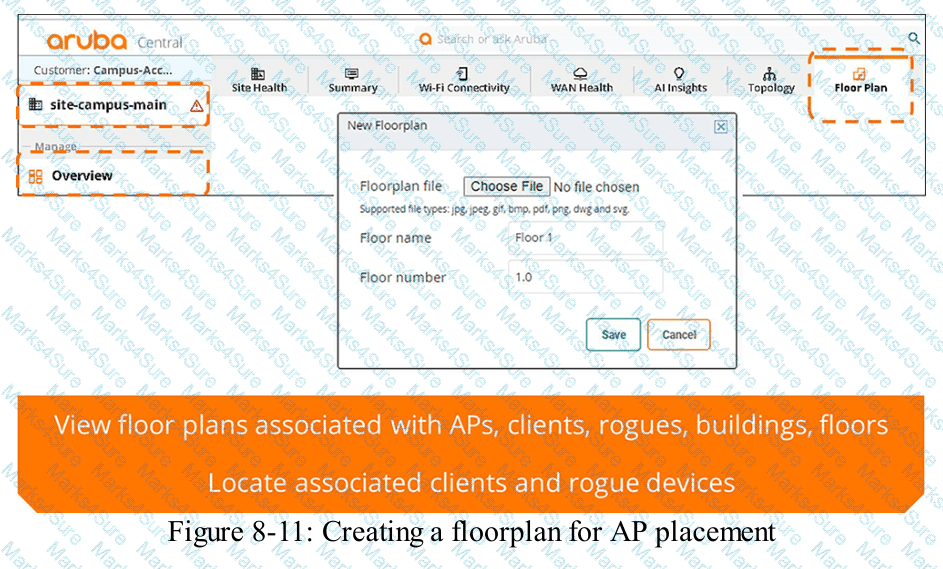
HPE Press study-guide figure / related learning illustration · Q128 Fig 8-11 Floor Management
Why is it important to monitor audit logs on a regular basis?
Options:
Tracking malicious user traffic.
Detecting unusual device activity.
Setting device retention periods.
Reviewing device storage capacity.
Answer:
BExplanation:
Comprehensive and Detailed Explanation
HPE Press guide context | PDF page 680 | HPE Press, Aruba Certified Associate – Campus Access Official Certification Study Guide
Technical Deep Dive — Original Chat Wording
Regular audit-log monitoring is an important operational and security practice.
Audit records provide visibility into administrative operations, configuration changes, and management events.
Reviewing these records can reveal activities that differ from expected operating patterns.
For example, an administrator may discover that an access-control policy was unexpectedly modified or that device settings were changed outside an approved maintenance window.
Such events can indicate configuration mistakes, unauthorized administrative activity, or a security incident requiring investigation.
Audit-log review also helps correlate unexpected network behavior with preceding configuration changes.
If a WLAN becomes unavailable immediately after a policy update, the Audit Trail can help identify the relevant administrative operation.
However, Aruba Central's Audit Trail should not be confused with a complete network-traffic analysis system.
It primarily records management activities rather than every packet transmitted by users or devices.
Consequently, Option A is too specific: identifying malicious user traffic generally requires traffic monitoring, security analytics, and appropriate network telemetry.
Retention periods are established through logging policy rather than by reviewing individual events.
Device storage-capacity monitoring is a separate operational function.
Of the available options, detecting unusual device-related or administrative activity is the strongest purpose for regular audit-log inspection.
Therefore, Option B is correct.
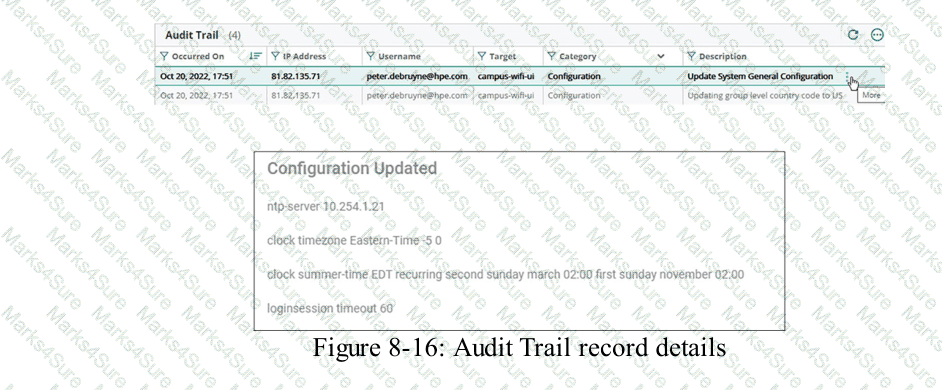
HPE Press study-guide figure / related learning illustration · Q169 Fig 8-16 Audit Details
When deploying access points in an enterprise campus, what PoE factors should be considered to optimize the WLAN design?
Options:
Determine the PoE class and total power budget needed on switches.
Schedule PoE port shutdowns to save energy during off-peak hours.
Locate switches near access points to reduce cabling distances across floors.
Determine uplink bandwidth and select switch models that match wireless speeds.
Answer:
AExplanation:
Comprehensive and Detailed Explanation
HPE Press guide context | PDF page 671 | HPE Press, Aruba Certified Associate – Campus Access Official Certification Study Guide
Technical Deep Dive — Original Chat Wording
Power over Ethernet (PoE) enables compatible Ethernet switches to provide electrical power and data connectivity to access points through structured network cabling.
When designing an enterprise WLAN, administrators must determine the power requirements of every AP and verify that the access switches provide sufficient capacity.
IEEE PoE technologies include 802.3af, 802.3at, and 802.3bt, with different power-delivery capabilities.
The required power depends on the AP model, enabled radios, USB peripherals, Ethernet interfaces, and other supported functions.
Some APs operate in a restricted mode when the available PoE power is insufficient, potentially disabling or limiting certain capabilities.
For example, if 20 APs each require 30 watts of allocated power, the nominal requirement is:
20 × 30 = 600 W
The switch or stack must provide an appropriate usable PoE budget for these devices, allowing for platform-specific reservations and other connected endpoints.
Administrators can inspect available power through:
show power-over-ethernet
show power-over-ethernet brief
Selecting a switch solely according to Ethernet port count can result in insufficient power capacity.
Uplink bandwidth and cabling distance remain important WLAN design considerations, but they do not replace the requirement to calculate PoE power demand.
Therefore, Option A is correct.
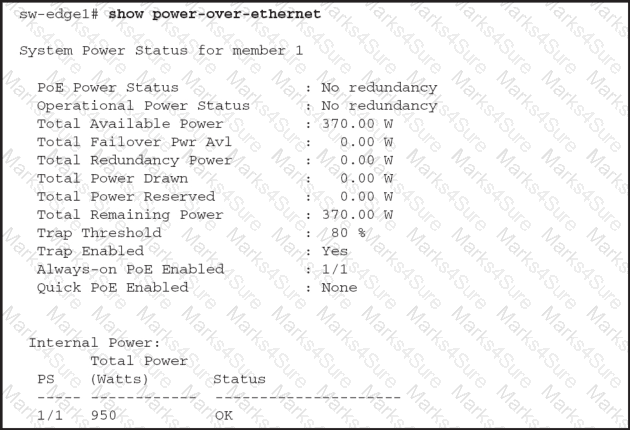
HPE Press study-guide figure / related learning illustration · Fig PoE 0
Which device type and group persona are needed to manage a Microbranch environment?
Options:
AOS-8 Branch Gateway Group Persona
AOS-10 AP Group Persona
AOS-10 Branch Gateway Group Persona
AOS-8 AP Group Persona
Answer:
BExplanation:
Comprehensive and Detailed Explanation
HPE Press guide context | PDF page 654 | HPE Press, Aruba Certified Associate – Campus Access Official Certification Study Guide
Technical Deep Dive — Reconstructed (Original Chat Text Not Recoverable)
Microbranch operation in AOS 10 uses APs assigned to an AOS 10 AP group/persona for distributed branch connectivity. It does not require treating the microbranch as an AOS 8 controller-based branch gateway group. Group architecture and software generation determine the supported configuration workflow.
The selected answer corresponds to B: AOS-10 AP Group Persona. This matches the mechanism or management behavior described in the scenario rather than merely a related network feature.
Operational workflows should preserve consistent inventory, authorization, configuration history, and monitoring so that administrators can locate and manage devices predictably.
Consistent RBAC, accurate inventories, and retained audit records simplify support handovers and reduce uncertainty during incident investigations.
When reviewing alternatives, identify which one directly addresses the stated requirement, rather than selecting a related capability that is useful elsewhere but does not fulfill the requested task.
The wrong choices may describe real technologies, but they perform different functions, apply to another layer, or omit a required prerequisite. Select the answer that resolves the exact scenario, not a nearby administrative task.
Which action helps clarify expectations when defining a network project's scope?
Options:
Document the network layout.
List the required resources.
Interview the organization's stakeholders.
Assess the existing equipment.
Answer:
CExplanation:
Comprehensive and Detailed Explanation
HPE Press guide context | PDF page 567 | HPE Press, Aruba Certified Associate – Campus Access Official Certification Study Guide
Technical Deep Dive — Original Chat Wording
Defining project scope requires a clear understanding of the organization's expectations.
Stakeholder interviews provide a structured way to gather those expectations before technical design decisions are finalized.
Relevant stakeholders may include business owners, IT managers, network operations personnel, security administrators, and facilities teams.
Each group may have different priorities and constraints.
For example, a security team may require certificate-based authentication and network segmentation.
The network operations team may prioritize simplified monitoring, configuration consistency, and high availability.
Business leaders may be concerned with deployment deadlines, cost, user experience, and future expansion.
Interviewing these stakeholders allows the design team to identify conflicting requirements and establish measurable project objectives.
It also helps clarify what the project includes and excludes.
For example, an office WLAN upgrade might include access-point replacement and switch PoE upgrades but exclude replacement of the existing WAN infrastructure.
Network diagrams, resource lists, and equipment assessments are useful inputs to the technical design.
However, they do not independently establish what the organization expects the project to accomplish.
Stakeholder interviews should therefore precede detailed technical specifications and final scope approval.
Therefore, Option C (Interview the organization's stakeholders) is correct.
The noise floor is measured at .000000001 milliwatts, and the receiver’s signal strength is -65dBm.
What is the Signal to Noise Ratio?
Options:
45 dBm
25 dBm
15 dBm
35 dBm
Answer:
BExplanation:
Comprehensive and Detailed Explanation
HPE Press guide context | PDF page 717 | HPE Press, Aruba Certified Associate – Campus Access Official Certification Study Guide
Technical Deep Dive — Reconstructed (Original Chat Text Not Recoverable)
Noise power of 0.000000001 mW is -90 dBm. With received signal -65 dBm, SNR is -65 - (-90) = 25 dB, which is dimensionless in decibels, not dBm. The offered answer '25 dBm' uses the wrong unit; numeric 25 is correct.
The selected answer corresponds to B: 25 dBm. This matches the mechanism or management behavior described in the scenario rather than merely a related network feature.
Optimization should consider both immediate performance and its tradeoffs in RF capacity, airtime, reliability, security, and operational overhead.
Use measurements rather than assumptions: compare the RF or switch metrics before and after making a controlled change.
When reviewing alternatives, identify which one directly addresses the stated requirement, rather than selecting a related capability that is useful elsewhere but does not fulfill the requested task.
The wrong choices may describe real technologies, but they perform different functions, apply to another layer, or omit a required prerequisite. Select the answer that resolves the exact scenario, not a nearby administrative task.
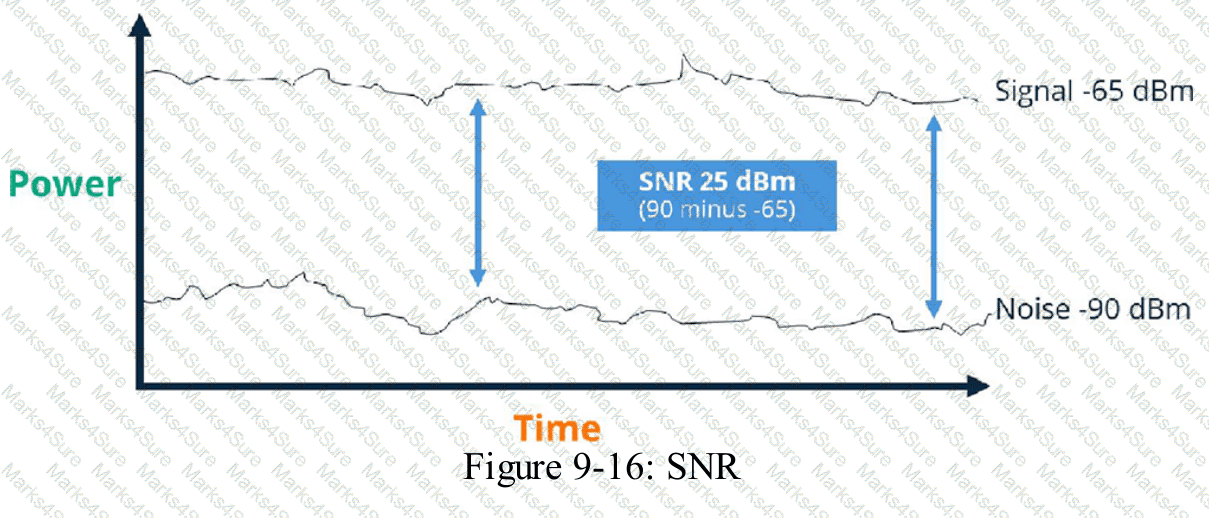
HPE Press study-guide figure / related learning illustration · Fig 9-16 SNR
Which HPE Aruba Networking technology delivers load balancing across radio bands and AP radios?
Options:
HPE Aruba Networking ESP
HPE Aruba Networking ClientMatch
HPE Aruba Networking AirWave
HPE Aruba Networking Central
Answer:
BExplanation:
Comprehensive and Detailed Explanation
HPE Press guide context | PDF page 782 | HPE Press, Aruba Certified Associate – Campus Access Official Certification Study Guide
Technical Deep Dive — Reconstructed (Original Chat Text Not Recoverable)
ClientMatch uses client and AP RF telemetry to improve associations, including steering capable clients from overloaded radios, reducing sticky-client problems, and selecting better AP/radio resources. AirWave and Central provide management and monitoring; ESP is a broader architecture rather than the dedicated steering technology.
The selected answer corresponds to B: HPE Aruba Networking ClientMatch. This matches the mechanism or management behavior described in the scenario rather than merely a related network feature.
Operational workflows should preserve consistent inventory, authorization, configuration history, and monitoring so that administrators can locate and manage devices predictably.
Consistent RBAC, accurate inventories, and retained audit records simplify support handovers and reduce uncertainty during incident investigations.
When reviewing alternatives, identify which one directly addresses the stated requirement, rather than selecting a related capability that is useful elsewhere but does not fulfill the requested task.
The wrong choices may describe real technologies, but they perform different functions, apply to another layer, or omit a required prerequisite. Select the answer that resolves the exact scenario, not a nearby administrative task.
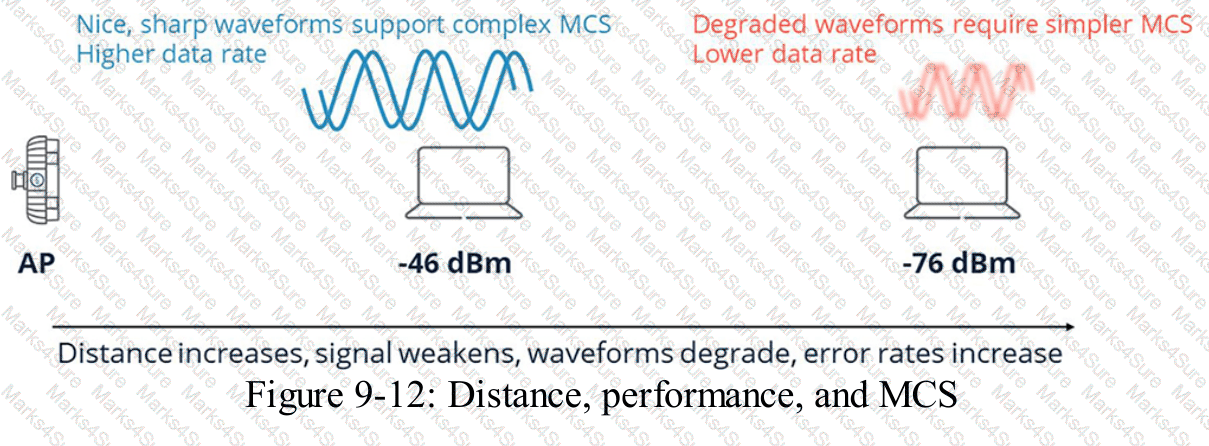
HPE Press study-guide figure / related learning illustration · Fig 9-12 Attenuation
Why would you create a device group in HPE Aruba Networking Central?
Options:
Make configuration easier by organizing devices by administrator preference.
Assign unique subscription keys automatically based on device group.
Monitor Internet traffic usage for each device group in real time.
Restrict device firmware updates to specific hardware models only.
Answer:
AExplanation:
Comprehensive and Detailed Explanation
HPE Press guide context | PDF page 589 | HPE Press, Aruba Certified Associate – Campus Access Official Certification Study Guide
Technical Deep Dive — Original Chat Wording
Device groups provide a logical way to organize network infrastructure in HPE Aruba Networking Central.
The primary benefit is simplifying configuration management across multiple devices with similar operational requirements.
For example, an organization may have 50 access switches deployed across several branch offices.
Instead of configuring every switch individually, administrators can place compatible switches into an appropriate device group and apply common settings.
These settings may include VLAN configuration, authentication policies, interface parameters, and supported management options.
Central supports group-level configuration methods, including graphical workflows and templates.
When a device joins a group, it can inherit the configuration associated with that group, reducing repetitive administrative work and configuration inconsistencies.
Administrators can create separate groups according to organizational requirements, device types, configuration methods, or operational responsibilities.
However, group membership should reflect actual configuration compatibility rather than arbitrary personal preferences.
Device groups do not automatically generate unique management subscriptions for each member.
Although groups can be used as scopes for monitoring and firmware management, their fundamental purpose is not specifically Internet traffic accounting or restricting upgrades to particular hardware models.
They provide a reusable administrative configuration boundary.
Therefore, Option A (Make configuration easier by organizing devices) is correct.
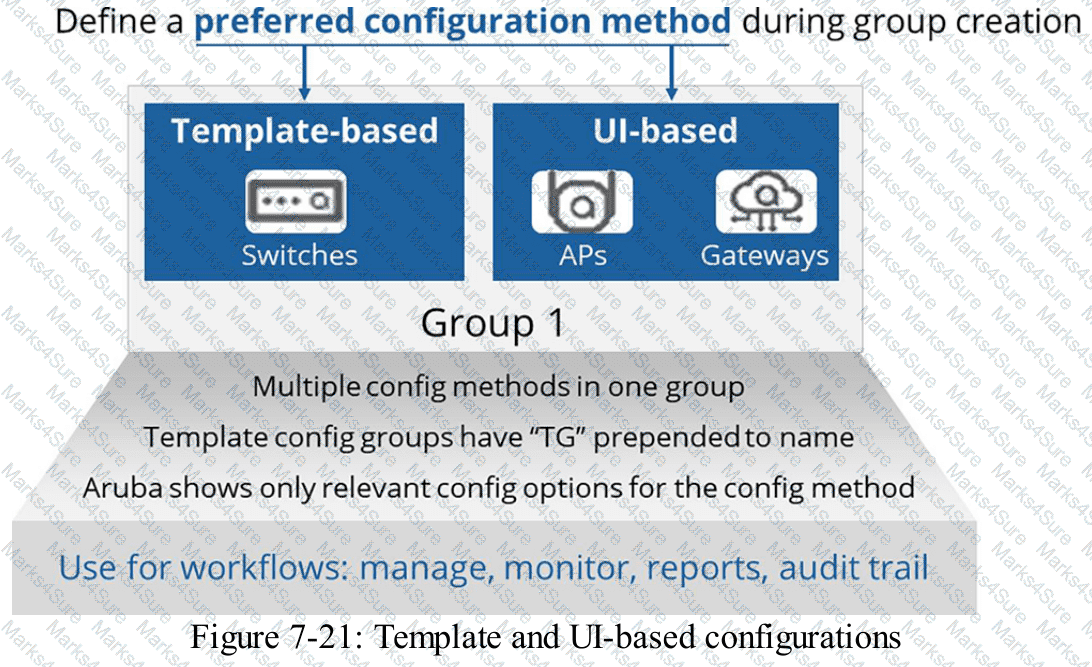
HPE Press study-guide figure / related learning illustration · Q197 Fig 7 21 Device Groups
Which method is valid for providing device credentials to end users during onboarding?
Options:
Push credentials through a software update process.
Share certificates by emailing them to users.
Download certificates using ClearPass Onboard Software.
Upload device credentials using a CSV import.
Answer:
CExplanation:
Comprehensive and Detailed Explanation
HPE Press guide context | PDF page 837 | HPE Press, Aruba Certified Associate – Campus Access Official Certification Study Guide
Technical Deep Dive — Original Chat Wording
HPE Aruba Networking ClearPass Onboard simplifies the provisioning of certificates and network access configurations for supported endpoint devices.
This capability is particularly useful in Bring Your Own Device (BYOD) environments, where administrators may not directly manage every client operating system.
ClearPass Onboard can present an enrollment workflow that allows users to authenticate and register their devices.
Following successful registration, the system can generate or obtain the appropriate device credentials and guide the client through installation.
These credentials can then be used for secure IEEE 802.1X authentication, typically with EAP-TLS.
Certificate-based authentication provides stronger identity assurance than relying solely on shared passwords.
ClearPass can operate with its own certificate authority or integrate with supported enterprise PKI services.
This allows the organization to manage certificate issuance, device identities, and credential revocation.
For example, an employee may use the onboarding portal to register a personal laptop and obtain a device-specific certificate.
The certificate then enables the laptop to authenticate to the corporate WLAN according to the organization's access policy.
Emailing private-key-bearing certificate packages is not the preferred secure enrollment method.
Software updates do not inherently provide an appropriate certificate-enrollment process, and CSV import is not the normal method for delivering individual device credentials to users.
Therefore, Option C (Download certificates using ClearPass Onboard Software) is correct.
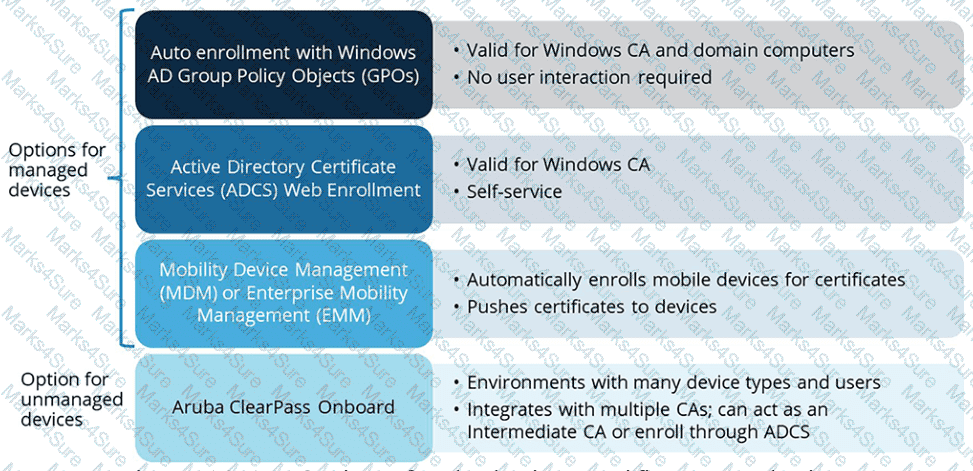
HPE Press study-guide figure / related learning illustration · Q145 Fig 10-17 Cert
Which statement regarding 20 MHz and 40 MHz Wi-Fi channels is accurate?
Options:
20 MHz channels have the same signal-to-noise ratio as 40 MHz channels but offer lower single-client connection speeds.
20 MHz channels have a higher signal-to-noise ratio than 40 MHz channels but allow lower single-client connection speeds.
20 MHz channels have the same signal-to-noise ratio as 40 MHz channels and allow the same single-client connection speeds.
20 MHz channels have a higher signal-to-noise ratio than 40 MHz channels and allow the same single-client connection speeds.
Answer:
BExplanation:
Comprehensive and Detailed Explanation
HPE Press guide context | PDF page 707 | HPE Press, Aruba Certified Associate – Campus Access Official Certification Study Guide
Technical Deep Dive — Reconstructed (Original Chat Text Not Recoverable)
A 20-MHz channel concentrates the permitted transmit power over narrower bandwidth and normally has a lower integrated noise floor than a 40-MHz channel. This supports a better SNR under comparable conditions but reduces peak available PHY data rate relative to a bonded 40-MHz channel. Channel-width choices must also account for contention and neighboring WLANs.
The selected answer corresponds to B: 20 MHz channels have a higher signal-to-noise ratio than 40 MHz channels but allow lower single-client connection speeds.. This matches the mechanism or management behavior described in the scenario rather than merely a related network feature.
Optimization should consider both immediate performance and its tradeoffs in RF capacity, airtime, reliability, security, and operational overhead.
For example, higher PHY data rates do not guarantee higher useful throughput if airtime is lost to management traffic, contention, or retransmissions.
Technical validation: this item contains a qualification or possible source-version ambiguity. Do not treat the choice as an unrestricted universal rule; retain the original exhibit and compare the exact deployment context with the relevant HPE documentation.
Which statement is true regarding local and shared profiles in HPE Aruba Networking Central?
Options:
A shared profile can be assigned to multiple device functions
A shared profile is limited to a single device function
A shared profile is inherited only by the regional hierarchy
A local profile can be assigned to multiple device functions
Answer:
AExplanation:
Comprehensive and Detailed Explanation
HPE Press guide context | PDF page 589 | HPE Press, Aruba Certified Associate – Campus Access Official Certification Study Guide
Technical Deep Dive — Original Chat Wording
HPE Aruba Networking Central uses configuration profiles to organize reusable device settings.
The newer Central configuration model distinguishes between shared profiles and local profiles.
Shared profiles are stored in the Configuration Library.
They are designed for reuse across supported management scopes and device functions.
For example, a common configuration profile may be assigned to multiple compatible device functions when those functions require identical settings.
A shared profile can be associated with Global, Site, Device Group, or other supported scopes.
Its configuration becomes effective when it is assigned to the appropriate scope and device function.
Local profiles are created within a specific scope and device-function context.
Their purpose is to provide configuration that applies locally rather than being reused across unrelated management scopes.
This distinction supports centralized configuration consistency while still allowing individual sites or device functions to have specialized settings.
For example, a shared configuration may define common operational settings across several locations, while a local profile may contain settings unique to one campus.
A shared profile is not limited to a single device function, nor is inheritance restricted exclusively to a regional hierarchy.
Local profiles are not designed for reuse across multiple device functions.
Therefore, Option A (A shared profile can be assigned to multiple device functions) is correct.
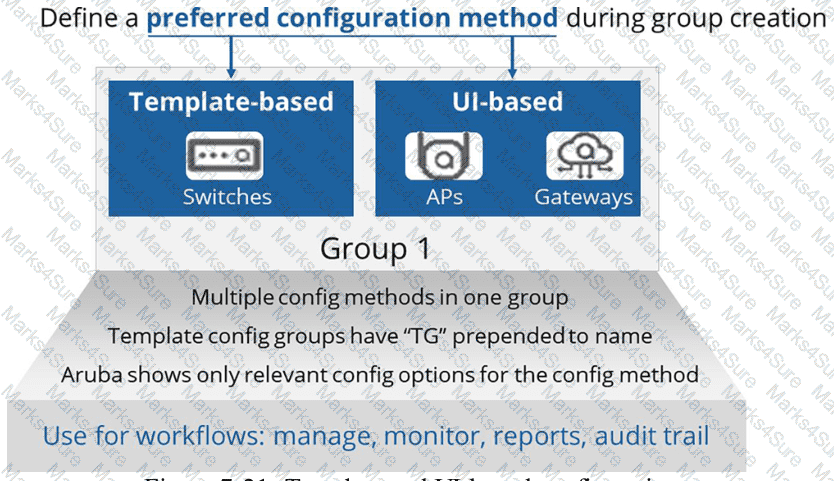
HPE Press study-guide figure / related learning illustration · Q164 Fig 7-21 Profiles
You must configure wireless access for several classes of IoT devices, some of which support only 802.11b. Each class needs a unique PSK and a different security policy applied as a role. There will be 15–20 distinct device classes, and performance must be optimized.
Which option meets these requirements?
Options:
Single SSID with MPSK for each IoT class, using 2.4GHz and 5 GHz bands
Individual SSIDs with unique PSK for each IoT class, using 2.4GHZ and 5 GHz band
Single SSID with MPSK for each IoT class, using 5 GHz and 6 GHz bands
Individual SSID with unique PSK for each IoT class, using 5 GHz and 6 GHz bands
Answer:
AExplanation:
Comprehensive and Detailed Explanation
HPE Press guide context | PDF page 878 | HPE Press, Aruba Certified Associate – Campus Access Official Certification Study Guide
Technical Deep Dive — Reconstructed (Original Chat Text Not Recoverable)
Some legacy 802.11b IoT devices require the 2.4-GHz band. A single SSID with MPSK per device class supports distinct secrets and role-based policies while minimizing SSID/beacon overhead. Splitting 15–20 classes across separate SSIDs wastes airtime, and a 5/6-GHz-only WLAN excludes the oldest clients.
The selected answer corresponds to A: Single SSID with MPSK for each IoT class, using 2.4GHz and 5 GHz bands. This matches the mechanism or management behavior described in the scenario rather than merely a related network feature.
In campus network design, a successful decision must satisfy the customer's capacity, topology, physical environment, and lifecycle constraints.
The correct design must also account for the distance and location of buildings, cabling standards, network closets, and the expected operational life of the installation.
For an administrator preparing for the associate certification, the key distinction is the precise protocol or Central workflow involved. Similar-sounding features often operate at different OSI layers or management stages.
Which information about users and devices is important when interpreting an architect’s high-level network design?
Options:
Estimate of total buildings by site.
Estimate of total remote workers present.
Estimate of total network switches installed.
Estimate of total users by site.
Answer:
DExplanation:
Comprehensive and Detailed Explanation
HPE Press guide context | PDF page 999 | HPE Press, Aruba Certified Associate – Campus Access Official Certification Study Guide
Technical Deep Dive — Original Chat Wording
A high-level network design describes the architecture required to meet an organization's business, connectivity, capacity, and security requirements.
Estimating the number of users at each site is particularly important because the user population directly influences network sizing.
For example, a corporate network may have three sites supporting 100, 500, and 1,500 users respectively.
Although the sites belong to the same organization, their infrastructure requirements will differ significantly.
The number of users affects the required access-switch port density, wireless access-point capacity, IP addressing, authentication infrastructure, and uplink bandwidth.
The estimate should also account for users connecting multiple devices, including laptops, smartphones, tablets, and other wireless endpoints.
HPE Aruba Networking's campus design guidance emphasizes evaluating device density, application requirements, and wireless capacity.
This is especially important for conference rooms, auditoriums, and other high-density environments.
Building counts and installed switch counts provide useful physical-infrastructure information, but they do not directly establish the demand generated by users.
Remote-worker estimates can help determine VPN or remote-access capacity, but they do not describe the complete user population at each campus site.
A reliable high-level design uses site-specific user estimates to support appropriate infrastructure sizing and future expansion.
Therefore, Option D (Estimate of total users by site) is correct.
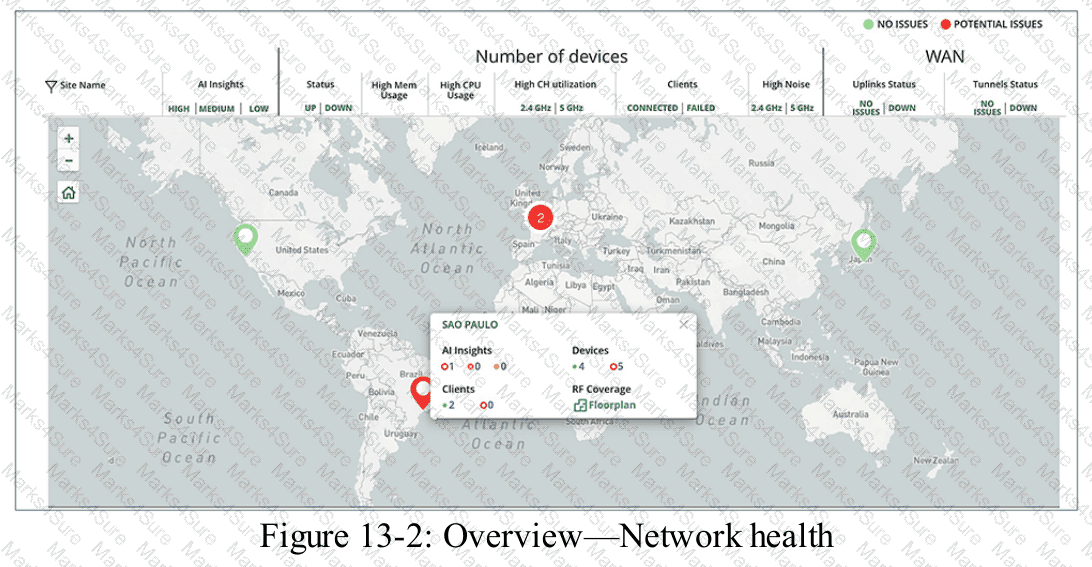
HPE Press study-guide figure / related learning illustration · Q201 Fig 13 2 Network Sites
A customer needs two CX 6200F 48G switches connected to one another across a distance of 80 m/252 ft between wiring closets. The switches must retain capacity for VSF expansion with ring topology in each cabinet.
What is a valid configuration for a redundant link-aggregation port?
Options:
Ports 1/1/1 and 1/1/2 for LAG
Ports 1/1/49 and 1/1/50 with SFP28 for LAG
Ports 1/1/51 and 1/1/52 with SFP+ for LAG
Ports 1/1/47 and 1/1/48 for LAG
Answer:
CExplanation:
Comprehensive and Detailed Explanation
HPE Press guide context | PDF page 526 | HPE Press, Aruba Certified Associate – Campus Access Official Certification Study Guide
Technical Deep Dive — Reconstructed (Original Chat Text Not Recoverable)
To preserve appropriate uplink/VSF stacking resources on a CX 6200F, use supported SFP+ uplink ports 1/1/51 and 1/1/52 for the redundant LAG between closets; select transceivers/cabling compatible with the 80-meter separation. A copper DAC is typically unsuitable at 80 meters, and certain higher-speed ports may be reserved for VSF expansion.
The selected answer corresponds to C: Ports 1/1/51 and 1/1/52 with SFP+ for LAG. This matches the mechanism or management behavior described in the scenario rather than merely a related network feature.
Optimization should consider both immediate performance and its tradeoffs in RF capacity, airtime, reliability, security, and operational overhead.
Use measurements rather than assumptions: compare the RF or switch metrics before and after making a controlled change.
Technical validation: this item contains a qualification or possible source-version ambiguity. Do not treat the choice as an unrestricted universal rule; retain the original exhibit and compare the exact deployment context with the relevant HPE documentation.
A customer with 1,860 employees has just deployed user and device certificates through a company-wide Group Policy Object (GPO).
When authenticating to the network, which EAP method chains user and machine authentication in a single RADIUS session?
Options:
EAP-TEAP
EAP-TTLS
EAP-TLS
PEAP
Answer:
AExplanation:
Comprehensive and Detailed Explanation
HPE Press guide context | PDF page 825 | HPE Press, Aruba Certified Associate – Campus Access Official Certification Study Guide
Technical Deep Dive — Reconstructed (Original Chat Text Not Recoverable)
EAP-TEAP performs tunneled user and machine authentication chaining within a single protected exchange, allowing ClearPass to evaluate both identities together. Certificate rollout via GPO supports machine/user certificate availability, but the question targets the specific chained EAP method, not ordinary single-identity EAP-TLS.
The selected answer corresponds to A: EAP-TEAP. This matches the mechanism or management behavior described in the scenario rather than merely a related network feature.
In an AOS-CX or Aruba Central deployment, the relevant settings must be applied in the correct interface, profile, policy, or management scope and then validated operationally.
For example, an apparently healthy physical port may still fail to serve a client when VLAN assignment, AAA policy, or Layer 3 gateway context is wrong.
A strong verification step is to compare the expected outcome with operational status before and after the change. This confirms not only that a configuration was accepted, but also that the required service actually functions.
For practical use, confirm the prerequisite conditions first, then verify the resulting operational state. This separates an intended configuration from a working network service and avoids accepting a misleading result.
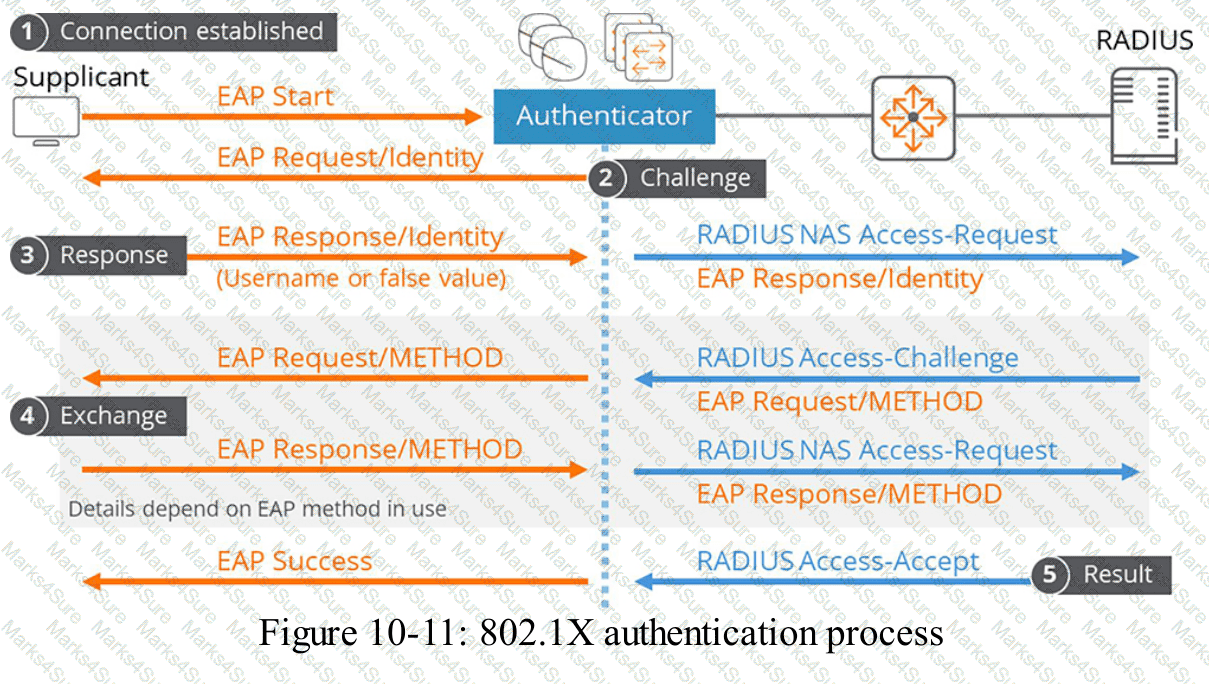
HPE Press study-guide figure / related learning illustration · Fig 10-11 EAP
Which role is a valid choice when assigning a role to a user in HPE GreenLake?
Options:
Aruba Central Technician
Workspace Manager
Workspace Administrator
Aruba Central Manager
Answer:
CExplanation:
Comprehensive and Detailed Explanation
HPE Press guide context | PDF page 573 | HPE Press, Aruba Certified Associate – Campus Access Official Certification Study Guide
Technical Deep Dive — Original Chat Wording
HPE GreenLake uses Role-Based Access Control to determine which administrative activities users can perform within a workspace.
A workspace is an administrative boundary through which users, services, and infrastructure resources can be managed.
The Workspace Administrator role provides elevated permissions for administering workspace resources and user access.
A user with this role can perform supported workspace-management activities, including assigning roles and managing access to services.
For example, an organization may appoint a network operations administrator to manage the GreenLake workspace containing its Aruba Central environment.
The Workspace Administrator can ensure that authorized users receive the appropriate access to the workspace.
However, workspace-level permissions and application-specific permissions must be distinguished.
A user may require both GreenLake workspace permissions and the appropriate Aruba Central application role to perform particular network-management functions.
This supports a layered access-control design in which account administration and network configuration responsibilities are separated.
The role should be assigned only to personnel who need its elevated privileges.
Organizations should apply least-privilege principles and periodically review administrative access.
Aruba Central Technician, Workspace Manager, and Aruba Central Manager are not the matching built-in GreenLake role names for the scenario.
Therefore, Option C (Workspace Administrator) is correct.
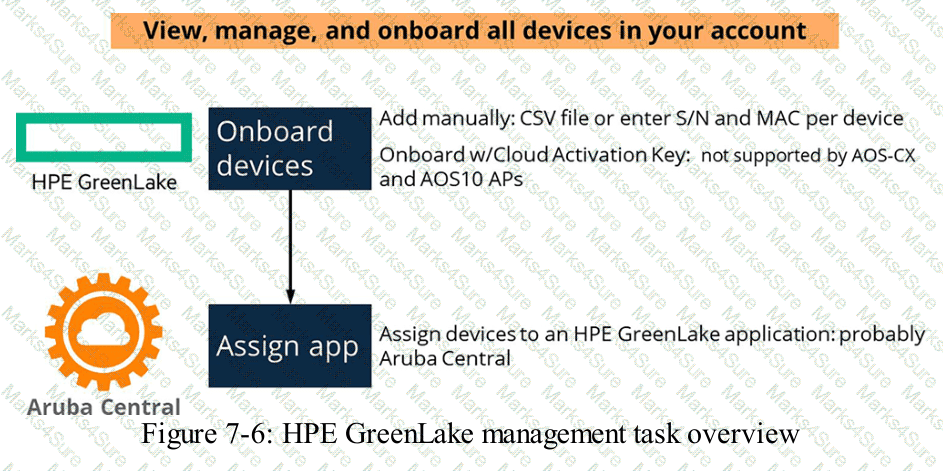
HPE Press study-guide figure / related learning illustration · Q135 Fig 7-6 GreenLake
Which action helps apply WLAN best practice to secure a wireless network for employees?
Options:
Enable MAC authentication for employee access.
Provided an assigned pre-shared key for each employee.
Use 802.1X authentication for employee access.
Use a shared passphrase for all users.
Answer:
CExplanation:
Comprehensive and Detailed Explanation
HPE Press guide context | PDF page 818 | HPE Press, Aruba Certified Associate – Campus Access Official Certification Study Guide
Technical Deep Dive — Original Chat Wording
IEEE 802.1X provides port-based network access control and is a standard approach for securing enterprise wireless networks.
It uses three main components: the supplicant, authenticator, and authentication server.
The supplicant is the employee's endpoint, such as a laptop or smartphone.
The authenticator is typically the wireless access point, while the authentication server commonly uses RADIUS.
In an HPE Aruba Networking deployment, ClearPass Policy Manager can provide centralized authentication and authorization services.
When an employee attempts to connect, the AP exchanges EAP authentication information between the client and authentication server.
The server evaluates the credentials and determines whether access should be granted.
The resulting authorization can include user roles, VLAN information, or other supported policy attributes.
Certificate-based EAP-TLS is particularly suitable for managed enterprise devices because it provides strong mutual authentication.
MAC authentication is weaker because MAC addresses can be observed and spoofed.
Individual PSKs can improve security in certain environments, but enterprise 802.1X provides more comprehensive identity-based control.
A shared passphrase for all employees introduces unnecessary credential-sharing and revocation risks.
Therefore, Option C (Use 802.1X authentication for employee access) is correct.
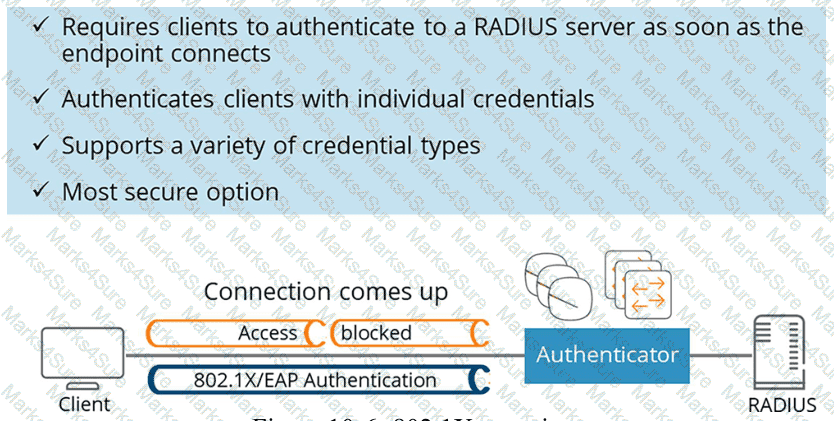
HPE Press study-guide figure / related learning illustration · Q162 Fig 10-6 8021x
What results from establishing goals at the beginning of a network design project?
Options:
It helps define the scope of work for the project.
It sets the technical specifications for all network components.
It identifies which vendor partners will be involved in deployment.
It helps determine the hardware requirements for the network project.
Answer:
AExplanation:
Comprehensive and Detailed Explanation
HPE Press guide context | PDF page 567 | HPE Press, Aruba Certified Associate – Campus Access Official Certification Study Guide
Technical Deep Dive — Original Chat Wording
Establishing project goals is one of the first activities in designing a campus network.
Project goals describe the outcomes that the organization expects from the proposed solution.
Examples include improving wireless coverage, increasing network availability, providing secure guest access, or expanding capacity for future devices.
These objectives determine the boundaries of the project and help establish what must be delivered.
For example, an organization may define a goal of providing reliable wireless connectivity across three office buildings.
This objective helps the project team determine whether the work includes wireless surveys, access-point installation, switch upgrades, authentication integration, and ongoing management configuration.
The resulting scope of work defines the activities and deliverables required to satisfy the agreed objectives.
Technical specifications are developed later after requirements have been analyzed.
Hardware selection depends on factors such as port density, PoE demand, bandwidth, availability, and expected growth.
Vendor selection is also a subsequent decision that may depend on procurement and technical requirements.
Defining goals does not independently determine every switch model or interface specification.
It provides the basis for making those decisions consistently.
Therefore, Option A (It helps define the scope of work for the project) is correct.
You are configuring a network device’s system settings. Which foundational network service should be included to ensure connectivity to HPE Aruba Networking Central?
Options:
SSH for secure access.
DNS for name resolution.
Syslog for log storage.
SNMP for device monitoring.
Answer:
BExplanation:
Comprehensive and Detailed Explanation
HPE Press guide context | PDF page 609 | HPE Press, Aruba Certified Associate – Campus Access Official Certification Study Guide
Technical Deep Dive — Original Chat Wording
Domain Name System (DNS) is a foundational network service that translates hostnames into IP addresses.
HPE Aruba Networking Central-managed devices commonly communicate with cloud services identified by fully qualified domain names.
DNS resolution enables a device to identify the IP addresses associated with those management-service endpoints.
For example, a switch may need to resolve the hostname of an Aruba Central service before establishing its management connection.
Without functioning name resolution, hostname-based service connections may fail even when ordinary IP routing is operational.
AOS-CX supports explicit DNS server configuration through commands such as:
configure terminal
ip dns server-address 10.254.1.21
Administrators should verify DNS reachability, default routing, and permitted outbound connectivity.
SSH provides secure command-line management but is not the hostname-resolution service used to locate Central endpoints.
Syslog delivers event records to logging destinations.
SNMP supports device monitoring and management information exchange.
Neither Syslog nor SNMP substitutes for DNS.
An important distinction is that the study-guide version of the AOS-CX Central client includes a default DNS resolver for its own cloud communication.
Therefore, a manually configured global DNS server is not universally required in every supported deployment.
Nevertheless, working DNS resolution remains important when Central services are identified through hostnames.
Therefore, Option B (DNS for name resolution) is correct.
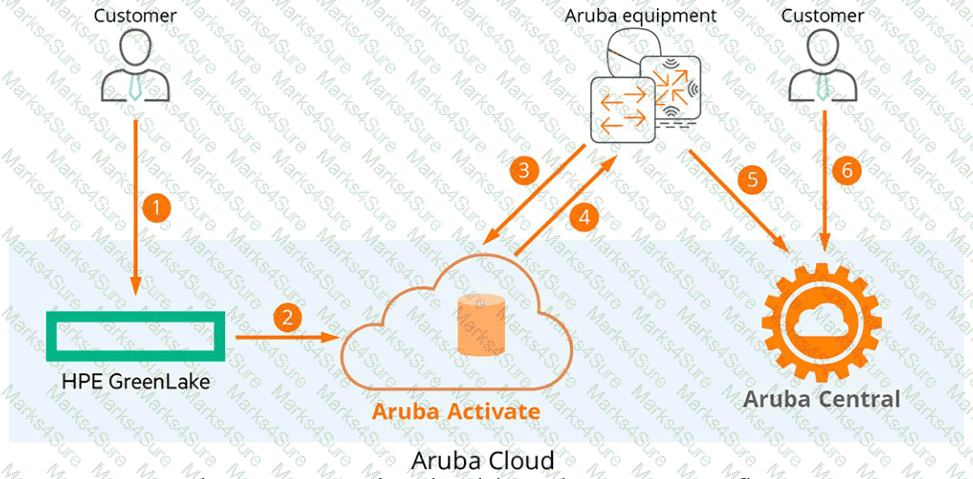
HPE Press study-guide figure / related learning illustration · Q148 Fig 7-7 Central
Why is WPA3-Personal authentication a more secure choice than WPA2-PSK authentication?
Options:
The client TPM module generates a unique encryption key for each attempted connection.
Simultaneous Authentication of ‘Equals’ is used to generate a fresh Pairwise Master Key for each attempted connection.
WPA3 requires longer, more secure passphrases.
WPA3 encrypts authentication traffic using TLS.
Answer:
BExplanation:
Comprehensive and Detailed Explanation
HPE Press guide context | PDF page 958 | HPE Press, Aruba Certified Associate – Campus Access Official Certification Study Guide
Technical Deep Dive — Reconstructed (Original Chat Text Not Recoverable)
WPA3-Personal replaces the conventional reusable WPA2-PSK PMK derivation with SAE, which negotiates fresh keying material for each authentication. SAE improves resistance to offline dictionary attacks and offers forward-secrecy properties. TPM hardware, TLS, or simply imposing a longer passphrase are not the fundamental reason given by the guide.
The selected answer corresponds to B: Simultaneous Authentication of ‘Equals’ is used to generate a fresh Pairwise Master Key for each attempted connection.. This matches the mechanism or management behavior described in the scenario rather than merely a related network feature.
In an AOS-CX or Aruba Central deployment, the relevant settings must be applied in the correct interface, profile, policy, or management scope and then validated operationally.
For example, an apparently healthy physical port may still fail to serve a client when VLAN assignment, AAA policy, or Layer 3 gateway context is wrong.
A strong verification step is to compare the expected outcome with operational status before and after the change. This confirms not only that a configuration was accepted, but also that the required service actually functions.
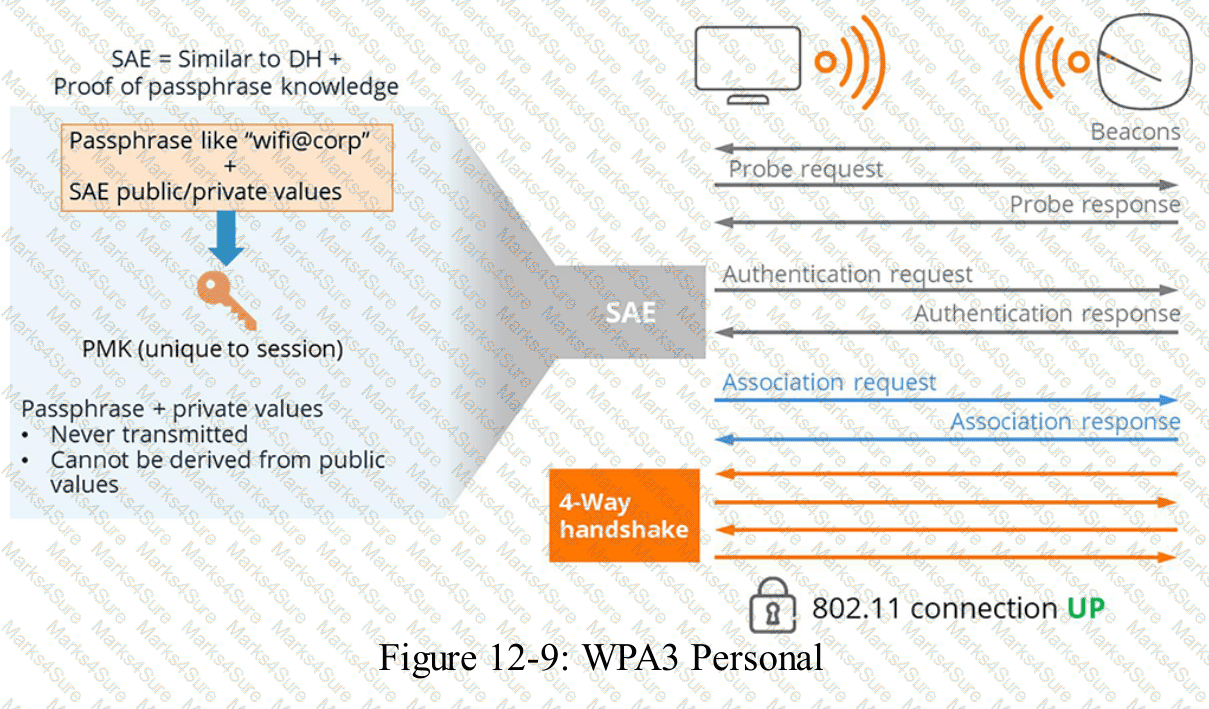
HPE Press study-guide figure / related learning illustration · Fig 12-9 SAE
Which action ensures that audit logs are retained in accordance with compliance requirements?
Options:
Set a proper retention period for logs.
Delete audit logs after each incident review.
Decrypt audit logs for data protection.
Increase storage space for more audit logs.
Answer:
AExplanation:
Comprehensive and Detailed Explanation
HPE Press guide context | PDF page 679 | HPE Press, Aruba Certified Associate – Campus Access Official Certification Study Guide
Short exact extract: “Use the audit trail feature to track AP configuration changes in Aruba Central.”
Technical Deep Dive — Original Chat Wording
Audit logs provide a historical record of administrative activities, configuration modifications, and other security-relevant operations.
In enterprise environments, audit records are important for accountability, investigations, and demonstrating compliance with applicable requirements.
A retention policy determines how long records must be preserved before they can be archived or deleted.
The appropriate period depends on the organization's legal, contractual, regulatory, and operational obligations.
For example, a regulated organization may need to preserve security-related events for a specified period and make them available during an external audit.
The network administrator must understand those requirements and configure the logging infrastructure accordingly.
Retention controls should include appropriate storage capacity, access restrictions, integrity protection, backup arrangements, and documented deletion procedures.
Deleting logs immediately after an incident review could destroy evidence required for subsequent investigations.
Decryption is not a general data-protection method. Audit records should instead be protected using appropriate encryption, authentication, and authorization controls.
Increasing storage capacity can help support a retention policy, but additional capacity alone does not establish how long records must be retained.
The controlling requirement is a documented and correctly implemented retention period.
Therefore, Option A (Set a proper retention period for logs) is correct.
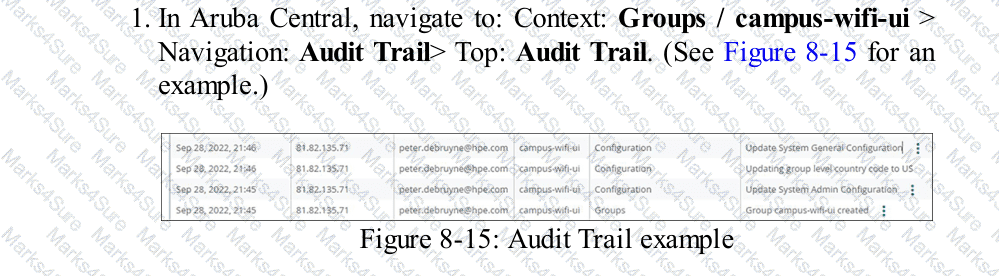
HPE Press study-guide figure / related learning illustration · Q167 Fig 8-15 Audit
How does one CX 6300M switch configuration use Layer 3 connectivity to route traffic between switch virtual interfaces 120 and 130?
Options:
Delete 'no routing' from the SVI interfaces.
Create static routes between SVI 120 and 130.
Route leaking must be configured in default VRF.
Routing is enabled by default with CX 6300M.
Answer:
DExplanation:
Comprehensive and Detailed Explanation
HPE Press guide context | PDF page 221 | HPE Press, Aruba Certified Associate – Campus Access Official Certification Study Guide
Short exact extract: “The SVIs are virtual layer 3 interfaces, for internal routing.”
Technical Deep Dive — Original Chat Wording
The HPE Aruba Networking CX 6300M is a multilayer switch capable of routing traffic between directly connected VLAN interfaces.
A Switched Virtual Interface (SVI) provides a logical Layer 3 interface associated with a particular VLAN.
For example, VLAN 120 may use subnet 10.1.120.0/24 , while VLAN 130 uses subnet 10.1.130.0/24 .
The switch can be configured as follows:
configure terminal
vlan 120
vlan 130
interface vlan 120
ip address 10.1.120.1/24
no shutdown
interface vlan 130
ip address 10.1.130.1/24
no shutdown
When both SVIs are operational in the same VRF, their connected networks are installed in the routing table.
The switch can then forward traffic between those subnets without requiring static routes between them.
Route leaking is unnecessary because both networks reside in the same routing domain.
The no routing command applies to configuring supported physical Ethernet interfaces for Layer 2 switching and is not the required method for enabling SVI routing.
There is an important distinction: AOS-CX software releases can differ in the default routing mode of physical interfaces. This does not change the fundamental behavior of SVIs as routed logical interfaces.
Administrators can verify the connected routes using:
show ip route
show ip interface brief
Therefore, Option D (Routing is enabled by default with CX 6300M) is the correct intended answer for inter-VLAN routing through configured SVIs.
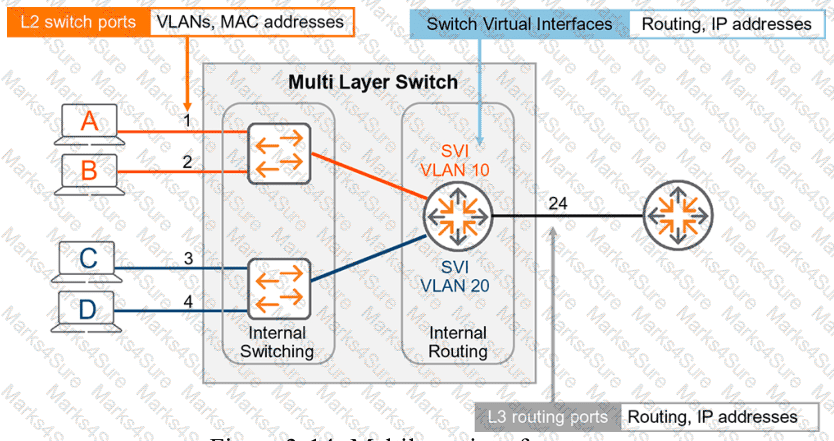
HPE Press study-guide figure / related learning illustration · Q165 Fig 3-14 SVI
Which test offers insight into available network bandwidth and performance?
Options:
speed test
latency check
ping test
load test
Answer:
AExplanation:
Comprehensive and Detailed Explanation
HPE Press guide context | PDF page 1033 | HPE Press, Aruba Certified Associate – Campus Access Official Certification Study Guide
Technical Deep Dive — Original Chat Wording
A network speed test measures the data-transfer performance observed between a test endpoint and a selected test server.
The primary measurements commonly include download throughput, upload throughput, and sometimes latency.
Throughput indicates how much application data can be transferred over a connection during a specified period.
For example, a Gigabit Ethernet connection may negotiate at 1 Gbps but deliver lower measured throughput because of protocol overhead, congestion, server limitations, or endpoint performance.
A speed test helps determine whether the connection is delivering an acceptable level of performance under the conditions present during the test.
Wireless performance can also be affected by signal strength, channel utilization, interference, channel width, and client capabilities.
A latency check focuses on transmission delay rather than data-transfer capacity.
A ping test primarily measures reachability and round-trip time using ICMP.
A load test evaluates system behavior under a specified workload and may expose scalability problems, but it is not the most direct test for the available throughput requested here.
Importantly, measured throughput is not identical to the theoretical maximum bandwidth of a physical connection.
Administrators should compare results with the expected performance baseline and repeat tests when investigating intermittent problems.
Therefore, Option A (Speed test) is correct.
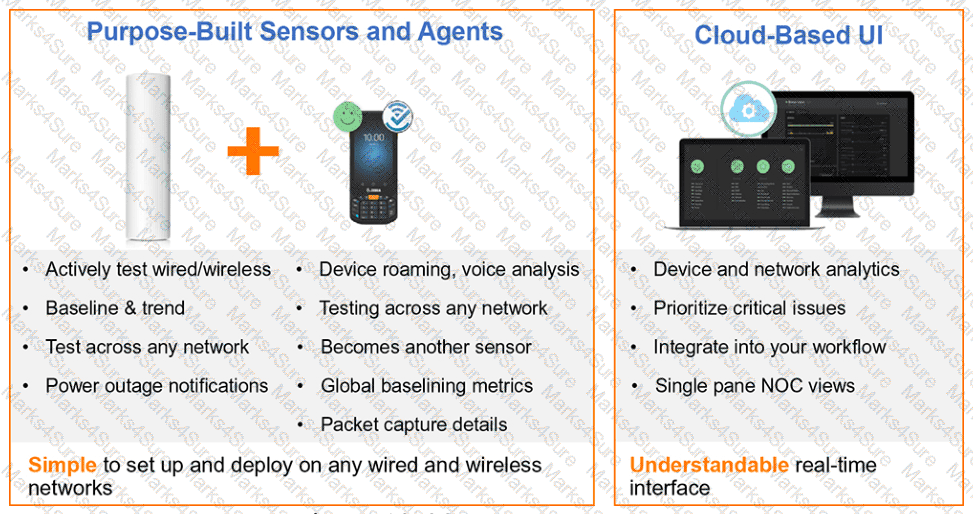
HPE Press study-guide figure / related learning illustration · Q143 Fig 13-38 UXI
Which feature can network administrators use to centralize RF planning and optimization services when using an HPE Aruba Networking Mobility Conductor architecture?
Options:
AirWave
Client Match
Client Wave
AirMatch
Answer:
DExplanation:
Comprehensive and Detailed Explanation
HPE Press guide context | PDF page 798 | HPE Press, Aruba Certified Associate – Campus Access Official Certification Study Guide
Technical Deep Dive — Reconstructed (Original Chat Text Not Recoverable)
AirMatch uses centralized RF planning and optimization under Mobility Conductor management. It evaluates radio/channel and power conditions across the WLAN and produces RF configuration choices. ClientMatch chiefly steers client associations; AirWave focuses on monitoring rather than central RF orchestration in this architecture.
The selected answer corresponds to D: AirMatch. This matches the mechanism or management behavior described in the scenario rather than merely a related network feature.
In campus network design, a successful decision must satisfy the customer's capacity, topology, physical environment, and lifecycle constraints.
An effective plan translates the requirement into measurable acceptance criteria, such as reachability, port capacity, redundancy, or RF service quality.
The answer should be validated against both the control-plane state and the forwarding or management outcome. A successful individual command alone is not proof that the end-to-end requirement is satisfied.
When troubleshooting or designing a change, verify compatibility between all participating devices, the management scope, and the applicable software release. The most useful evidence is the state observed on both sides of the affected connection.
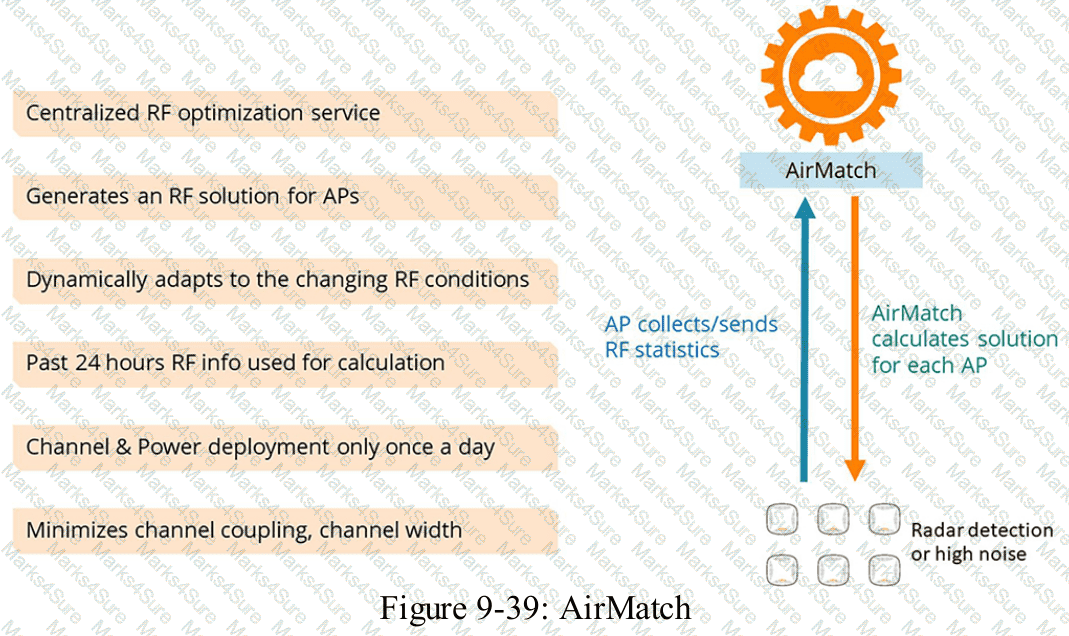
HPE Press study-guide figure / related learning illustration · Q64 AirMatch
A customer has recently implemented user and device certificates through a company-wide Group Policy Object (GPO).
Which EAP method requires client certificates to authenticate to the network?
Options:
EAP-TTLS
EAP-TEAP
EAP-TLS
PEAP
Answer:
CExplanation:
Comprehensive and Detailed Explanation
HPE Press guide context | PDF page 824 | HPE Press, Aruba Certified Associate – Campus Access Official Certification Study Guide
Short exact extract: “EAP-TLS is the preferred method and the one that you should implement for enterprise networks.”
Technical Deep Dive — Original Chat Wording
EAP-Transport Layer Security (EAP-TLS) is a certificate-based authentication method commonly used for secure enterprise wired and wireless networks.
It operates within the IEEE 802.1X authentication framework and provides mutual authentication between the supplicant and authentication server.
The authentication server presents its certificate so that the client can validate the server's identity.
The client also presents a valid certificate to authenticate its own identity.
This certificate-based approach avoids reliance on reusable passwords as the primary authentication secret.
In a Windows enterprise environment, Group Policy and certificate auto-enrollment can simplify certificate deployment to domain-managed computers and users.
HPE Aruba Networking ClearPass Policy Manager can validate presented certificates against trusted certificate authorities and apply authorization policies based on certificate attributes and other identity information.
EAP-TTLS and PEAP establish protected TLS tunnels, but they commonly support password-based inner authentication without requiring client certificates.
EAP-TEAP supports authentication chaining and may use certificates as part of its inner authentication methods. However, client certificates are not inherently required for every TEAP configuration.
EAP-TLS specifically requires the supplicant to possess a suitable certificate and private key for its normal certificate-based mutual authentication.
Certificate validation should also include appropriate trust-chain checks, validity periods, and identity verification.
Therefore, Option C (EAP-TLS) is correct.
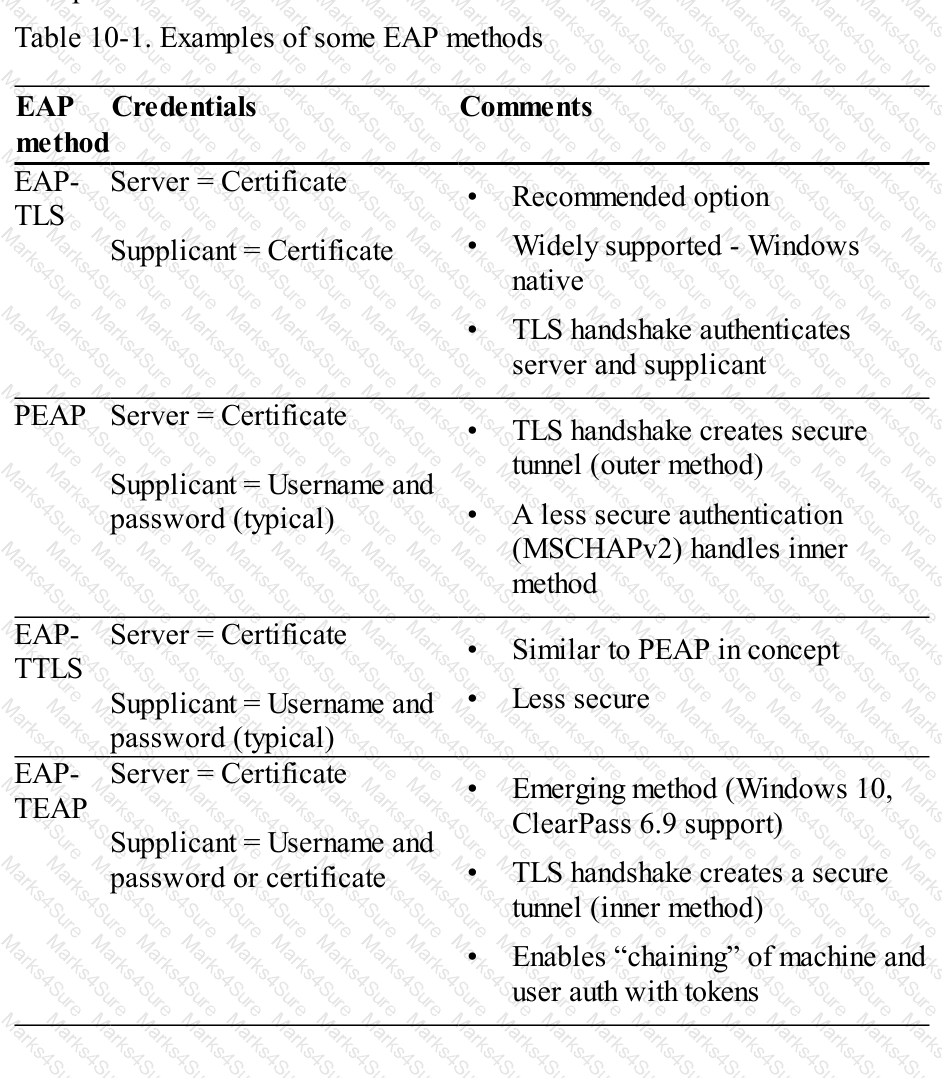
HPE Press study-guide figure / related learning illustration · Q123 Table 10-1 EAP TLS
Which statement concerning ZTP switch provisioning with HPE Aruba Networking Central is accurate?
Options:
ZTP requires DHCP but does not require DNS.
ZTP does not require DHCP but does require DNS.
ZTP does not require DHCP and DNS.
ZTP requires DHCP and DNS.
Answer:
DExplanation:
Comprehensive and Detailed Explanation
HPE Press guide context | PDF page 575 | HPE Press, Aruba Certified Associate – Campus Access Official Certification Study Guide
Technical Deep Dive — Reconstructed (Original Chat Text Not Recoverable)
AOS-CX zero-touch provisioning normally needs DHCP for addressing and discovery options and DNS to resolve cloud-service hostnames. The switch must reach required management endpoints through a permitted network path. Manual provisioning may avoid DHCP by using static addressing, but fully automatic deployment depends on both services in the expected workflow.
The selected answer corresponds to D: ZTP requires DHCP and DNS.. This matches the mechanism or management behavior described in the scenario rather than merely a related network feature.
In an AOS-CX or Aruba Central deployment, the relevant settings must be applied in the correct interface, profile, policy, or management scope and then validated operationally.
Useful validation normally includes examining the effective running configuration, the relevant show-command output, and the actual client or infrastructure behavior.
The answer should be validated against both the control-plane state and the forwarding or management outcome. A successful individual command alone is not proof that the end-to-end requirement is satisfied.
When troubleshooting or designing a change, verify compatibility between all participating devices, the management scope, and the applicable software release. The most useful evidence is the state observed on both sides of the affected connection.

HPE Press study-guide figure / related learning illustration · Q199 Fig 7 1 Device Onboarding
Which two features characterize HPE Aruba Networking ClientMatch?
Choose two
Options:
It helps to move sticky clients to another AP.
It is used to locate a client.
It is an HPE Aruba Networking patented technology.
An algorithm to adjust RF patterns
It optimizes channels of an AP.
Answer:
A, CExplanation:
Comprehensive and Detailed Explanation
HPE Press guide context | PDF page 783 | HPE Press, Aruba Certified Associate – Campus Access Official Certification Study Guide
Technical Deep Dive — Reconstructed (Original Chat Text Not Recoverable)
ClientMatch uses Aruba client-management algorithms to identify sticky clients and encourage their transition to better neighboring APs. The feature is Aruba-specific and uses measurements supplied by the WLAN infrastructure. It does not perform physical client location, which is a separate location-services function; AirMatch rather than ClientMatch optimizes RF channels.
The selected answer corresponds to A: It helps to move sticky clients to another AP.; C: It is an HPE Aruba Networking patented technology.. This matches the mechanism or management behavior described in the scenario rather than merely a related network feature.
Optimization should consider both immediate performance and its tradeoffs in RF capacity, airtime, reliability, security, and operational overhead.
A proper optimization decision balances a local performance improvement against the resulting effect on neighboring clients and the wider campus.
The practical deployment consequence is important: a plausible configuration can still fail when the peer interface, device role, licensing scope, or physical medium is mismatched. Checking that surrounding dependency avoids a misleading diagnosis.
What is a reason to use access controls for audit logs?
Options:
Audit logs contain only non-sensitive information
Logs can be changed anytime by any employee
Everyone should review logs to share the workload
It helps protect sensitive information in the logs
Answer:
DExplanation:
Comprehensive and Detailed Explanation
HPE Press guide context | PDF page 679 | HPE Press, Aruba Certified Associate – Campus Access Official Certification Study Guide
Technical Deep Dive — Original Chat Wording
Audit logs provide evidence of administrative activity, configuration changes, and security-related events.
In HPE Aruba Networking Central, audit trail information can include administrator identities, event timestamps, source IP addresses, affected devices, and descriptions of executed operations.
This information is valuable for troubleshooting and accountability but can also expose sensitive operational details.
For example, audit records might reveal network-management addresses, configuration structures, administrative activities, and security-relevant changes.
Consequently, unrestricted access to audit records would create unnecessary security and privacy risks.
Role-Based Access Control (RBAC) allows organizations to restrict audit-log visibility to authorized personnel.
Security administrators, auditors, and selected operations staff may require different levels of access according to their responsibilities.
Access control also helps prevent inappropriate disclosure and reduces the opportunity for unauthorized modification or deletion where such operations are permitted.
Audit-log security should form part of a broader logging strategy that includes appropriate retention, protected storage, reliable timestamps, and review procedures.
HPE's Central documentation confirms that audit records contain administrative identities, timestamps, source addresses, and configuration-related actions.
Audit logs are not inherently non-sensitive, nor should every employee be granted access simply to distribute the review workload.
Therefore, Option D is correct.
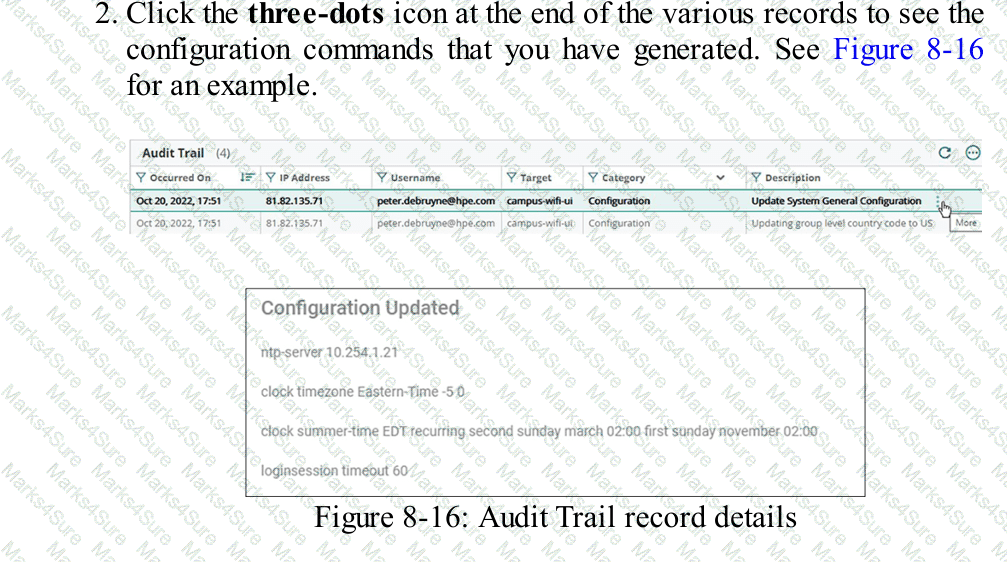
HPE Press study-guide figure / related learning illustration · Q109 Fig 8-16 Audit Records
You have been asked to troubleshoot failed connectivity between a local subnet at the HQ Office, with 490 employees, and a remote subnet at the Branch Office. PC1 cannot ping PC2.
Use the provided topology and show command output to determine the reason for the failure.
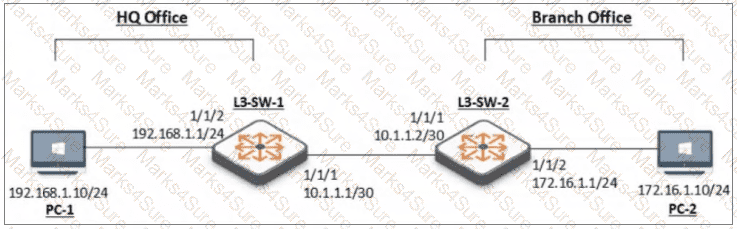
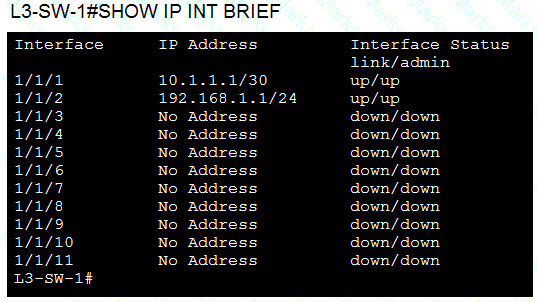
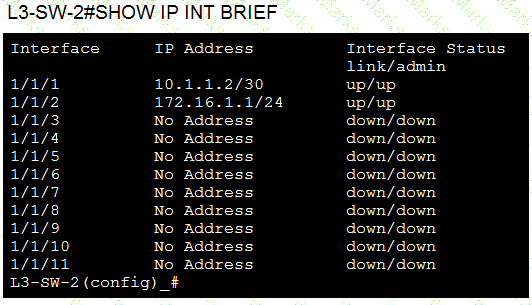
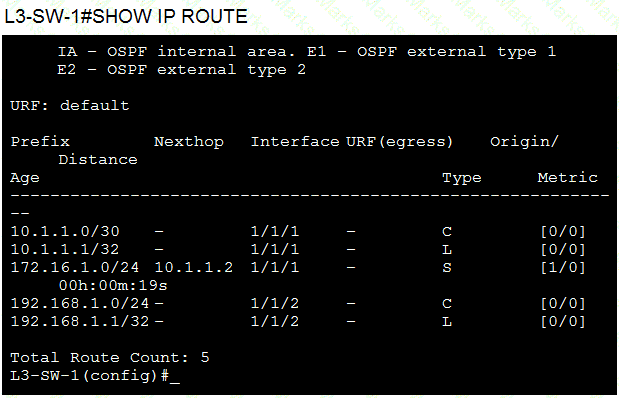
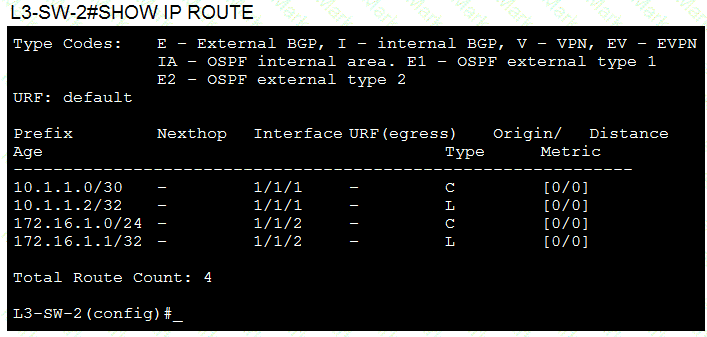
Options:
On Branch Office-L3-SW-2-There is no Layer 3 SVI configured in the correct subnet.
On Branch Office-L3-SW-2-The switch does not have a static route to the HQ Office Local Subnet.
On HQ Office L3-SW-1-The switch does not have a static default route to the internet.
On HQ OfficeL3-SW-1-There is no route to the Branch Office.
Answer:
BExplanation:
Comprehensive and Detailed Explanation
HPE Press guide context | PDF page 232 | HPE Press, Aruba Certified Associate – Campus Access Official Certification Study Guide
Technical Deep Dive — Reconstructed (Original Chat Text Not Recoverable)
The HQ switch has a static route for the branch's 172.16.1.0/24 subnet via the point-to-point next hop. However, the branch switch routing table contains only its directly connected links and the branch LAN; it lacks a route back to the HQ 192.168.1.0/24 LAN. Reply packets cannot return without a reverse route, so connectivity fails even when the forward path exists.
The selected answer corresponds to B: On Branch Office-L3-SW-2-The switch does not have a static route to the HQ Office Local Subnet.. This matches the mechanism or management behavior described in the scenario rather than merely a related network feature.
A disciplined investigation compares the observed symptom with expected behavior, tests the most likely failure stage, and verifies recovery rather than assuming that a single command has resolved the problem.
Collecting interface counters, event timestamps, configuration history, and service-test results helps determine whether a symptom originates locally or depends on another device.
Technical validation: this item contains a qualification or possible source-version ambiguity. Do not treat the choice as an unrestricted universal rule; retain the original exhibit and compare the exact deployment context with the relevant HPE documentation.
Which information must be specified when creating an HPE GreenLake user?
Options:
Enter the user's email address.
Enter the user's home telephone number.
Configure the user birth date
Choosing the user time zone
Answer:
AExplanation:
Comprehensive and Detailed Explanation
HPE Press guide context | PDF page 573 | HPE Press, Aruba Certified Associate – Campus Access Official Certification Study Guide
Technical Deep Dive — Original Chat Wording
HPE GreenLake provides identity and access management functions for administering users, workspaces, and supported cloud services.
When creating a new user, an administrator supplies the user's email address.
The email address serves as an important identity attribute and is used for account invitations and other supported account-management communications.
In the documented workflow, an authorized administrator opens the Users page and chooses to add a user.
When creating a new identity, the administrator enters the email address and configures the appropriate role assignments.
Roles determine the user's permissions within the workspace and associated services.
For example, an employee responsible for network monitoring may receive a role permitting operational visibility without broad administrative privileges.
Users requiring configuration permissions should receive only the access necessary for their duties.
Depending on the workspace and identity-management architecture, users may also be imported or selected from an existing identity directory.
In that case, the system can obtain the identity information from the directory.
A home telephone number, birth date, and preferred time zone are not the mandatory identifying field requested by the question.
The email address is the relevant requirement for creating a new GreenLake user.
Therefore, Option A (Enter the user's email address) is correct.
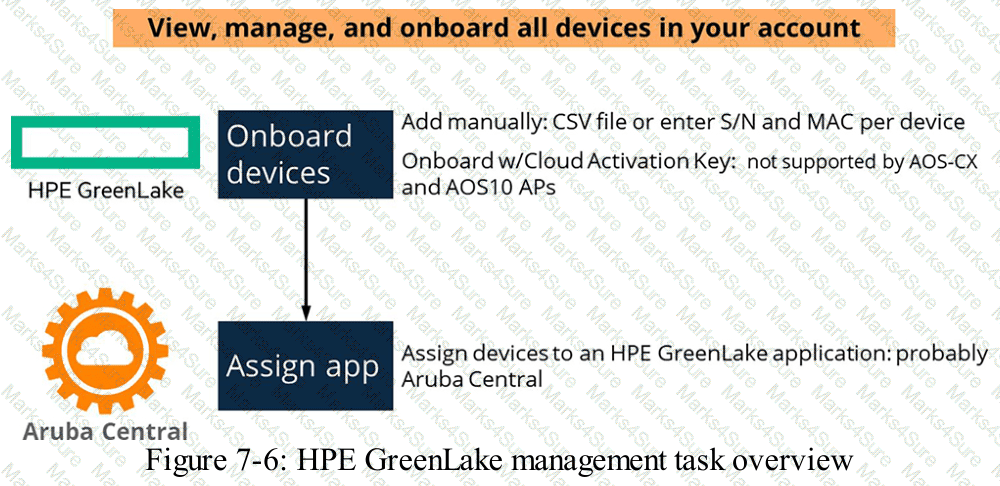
HPE Press study-guide figure / related learning illustration · Q187 Fig 7-6 GreenLake
Which HPE Aruba Networking technology enables device-specific passphrases to securely onboard legacy devices onto the WLAN?
Options:
Opportunistic Wireless Encryption (OWE)
Multiple Pre-Shared Key (MPSK)
Wired Equivalent Privacy (WEP)
Temporal Key Integrity Protocol (TKIP)
Answer:
BExplanation:
Comprehensive and Detailed Explanation
HPE Press guide context | PDF page 876 | HPE Press, Aruba Certified Associate – Campus Access Official Certification Study Guide
Technical Deep Dive — Reconstructed (Original Chat Text Not Recoverable)
Multiple Pre-Shared Key allows different clients or IoT device classes to use distinct passphrases on one SSID and supports differentiated role authorization. This reduces beacon overhead compared with many separate SSIDs and permits selective credential revocation. OWE encrypts open networks and WEP/TKIP are obsolete security mechanisms.
The selected answer corresponds to B: Multiple Pre-Shared Key (MPSK). This matches the mechanism or management behavior described in the scenario rather than merely a related network feature.
Operational workflows should preserve consistent inventory, authorization, configuration history, and monitoring so that administrators can locate and manage devices predictably.
For example, a cloud-managed infrastructure device may be registered successfully but still require the correct subscription, site, group, and configuration scope.
In production, the decision should be documented and checked against the supported software release and platform model, because interface names, licensing tiers, and management workflows can change across Central and AOS-CX generations.
For practical use, confirm the prerequisite conditions first, then verify the resulting operational state. This separates an intended configuration from a working network service and avoids accepting a misleading result.
Which statements describe HPE Aruba Networking ClearPass OnGuard Software?
Choose two
Options:
OnGuard is doing posture checks on client systems.
It is used for the self-registration of guest devices.
OnGuard is an agent, running on client systems.
OnGuard assigns a unique identity to each device.D. It is an intuitive portal for users to securely configure their devices.
Answer:
A, CExplanation:
Comprehensive and Detailed Explanation
HPE Press guide context | PDF page 565 | HPE Press, Aruba Certified Associate – Campus Access Official Certification Study Guide
Technical Deep Dive — Reconstructed (Original Chat Text Not Recoverable)
ClearPass OnGuard is an endpoint posture-assessment component and is delivered as an agent that runs on supported client operating systems. It checks security posture such as antivirus, patches, and other health conditions. Guest self-registration is handled by ClearPass Guest, and unique device certificate onboarding belongs to ClearPass Onboard.
The selected answer corresponds to A: OnGuard is doing posture checks on client systems.; C: OnGuard is an agent, running on client systems.. This matches the mechanism or management behavior described in the scenario rather than merely a related network feature.
Operational workflows should preserve consistent inventory, authorization, configuration history, and monitoring so that administrators can locate and manage devices predictably.
Consistent RBAC, accurate inventories, and retained audit records simplify support handovers and reduce uncertainty during incident investigations.
For an administrator preparing for the associate certification, the key distinction is the precise protocol or Central workflow involved. Similar-sounding features often operate at different OSI layers or management stages.
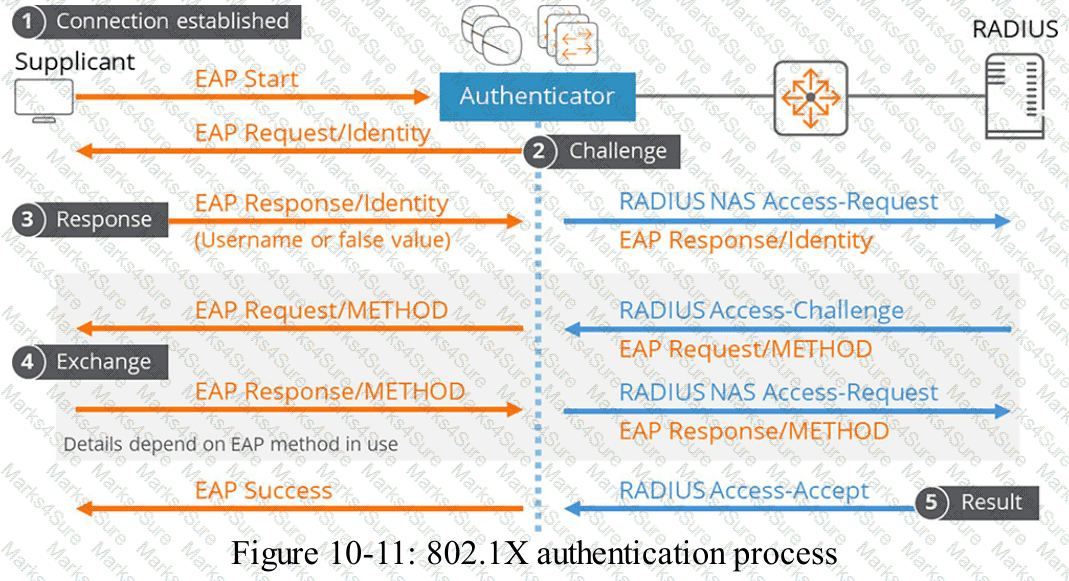
HPE Press study-guide figure / related learning illustration · Q72 8021X
Which certificate in the server’s chain of trust is self-signed?
Options:
Subordinate CA certificate
Root CA certificate
Issuing CA certificate
Intermediate CA certificate
Answer:
BExplanation:
Comprehensive and Detailed Explanation
HPE Press guide context | PDF page 822 | HPE Press, Aruba Certified Associate – Campus Access Official Certification Study Guide
Technical Deep Dive — Reconstructed (Original Chat Text Not Recoverable)
A root certification authority issues a trust anchor whose certificate is generally self-signed. Intermediate and issuing CAs receive signatures from their parent CA. During EAP-TLS validation a certificate chain terminates in a trusted root, and each subordinate signature is validated with the issuer's public key.
The selected answer corresponds to B: Root CA certificate. This matches the mechanism or management behavior described in the scenario rather than merely a related network feature.
Operational workflows should preserve consistent inventory, authorization, configuration history, and monitoring so that administrators can locate and manage devices predictably.
Consistent RBAC, accurate inventories, and retained audit records simplify support handovers and reduce uncertainty during incident investigations.
When reviewing alternatives, identify which one directly addresses the stated requirement, rather than selecting a related capability that is useful elsewhere but does not fulfill the requested task.
The wrong choices may describe real technologies, but they perform different functions, apply to another layer, or omit a required prerequisite. Select the answer that resolves the exact scenario, not a nearby administrative task.
Where are wireless-client roaming decisions made?
Options:
HPE Aruba Networking Central
Joint decision made by the origination and destination APs
Client device
Virtual Controller
Answer:
CExplanation:
Comprehensive and Detailed Explanation
HPE Press guide context | PDF page 769 | HPE Press, Aruba Certified Associate – Campus Access Official Certification Study Guide
Technical Deep Dive — Reconstructed (Original Chat Text Not Recoverable)
Roaming is ultimately initiated and chosen by the wireless client, even when infrastructure supplies 802.11k neighbor reports, 802.11v transition advice, or 802.11r fast roaming. Neither Central nor an AP can guarantee a station will choose a particular neighboring BSS.
The selected answer corresponds to C: Client device. This matches the mechanism or management behavior described in the scenario rather than merely a related network feature.
Optimization should consider both immediate performance and its tradeoffs in RF capacity, airtime, reliability, security, and operational overhead.
Use measurements rather than assumptions: compare the RF or switch metrics before and after making a controlled change.
For an administrator preparing for the associate certification, the key distinction is the precise protocol or Central workflow involved. Similar-sounding features often operate at different OSI layers or management stages.
The wrong choices may describe real technologies, but they perform different functions, apply to another layer, or omit a required prerequisite. Select the answer that resolves the exact scenario, not a nearby administrative task.
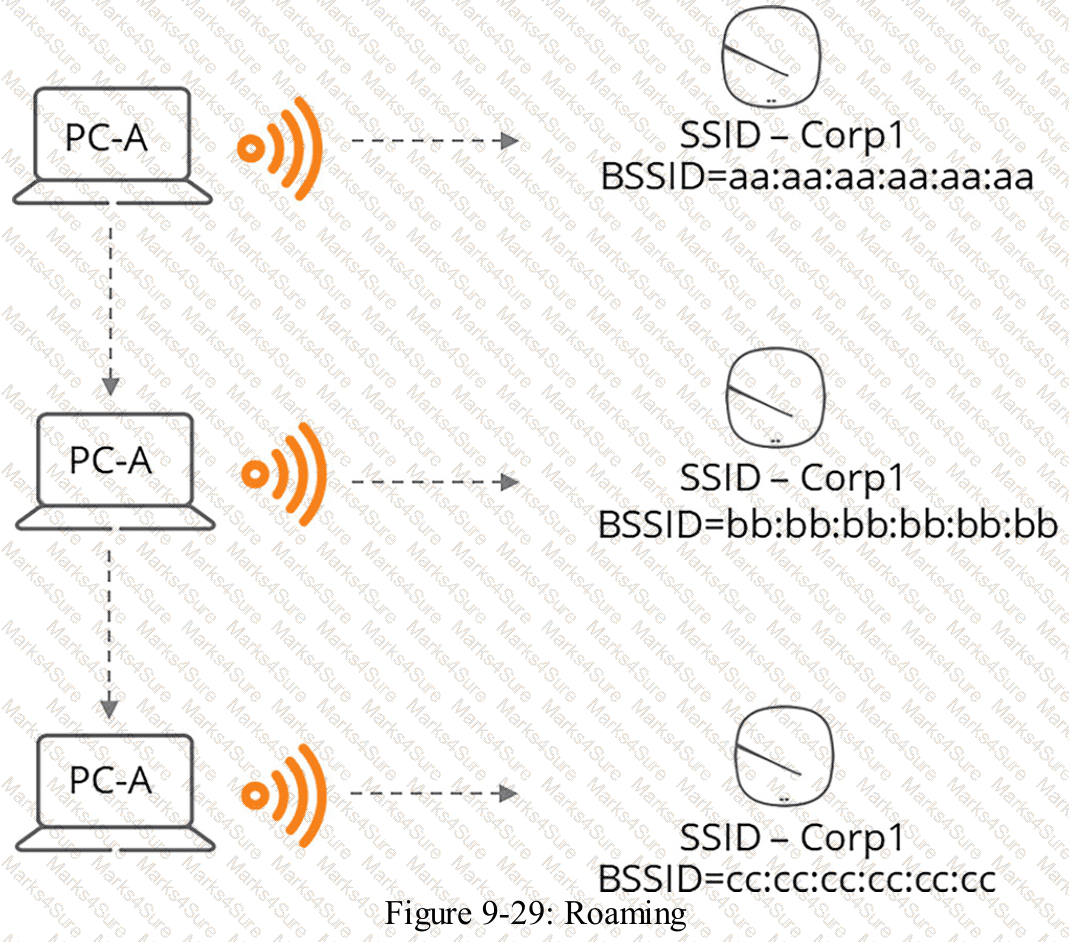
HPE Press study-guide figure / related learning illustration · Q68 Roaming
After selecting the Available Subscriptions number on the Inventory and Subscriptions card, what information is available to you?
Options:
Expiration information for subscription keys and subscriptions.
Firmware versions installed on devices in the subscription list.
Client onboarding success rates across different network segments.
Device assignment history for each onboarding attempt by user.
Answer:
AExplanation:
Comprehensive and Detailed Explanation
HPE Press guide context | PDF page 577 | HPE Press, Aruba Certified Associate – Campus Access Official Certification Study Guide
Technical Deep Dive — Original Chat Wording
HPE Aruba Networking Central uses subscription entitlements to authorize the management of supported switches, access points, and gateways.
The Inventory and Subscriptions card summarizes the number of registered devices and the available management subscriptions.
Selecting Available Subscriptions opens the detailed Subscription Keys page.
This page allows administrators to review subscription-related information, including available entitlements and their expiration status.
For example, a company may have multiple subscription keys purchased at different times.
Each key can have a different expiration date, making centralized subscription tracking important.
Administrators can identify subscriptions approaching expiration and plan renewals before management-service entitlements are interrupted.
The interface also helps organizations distinguish between available subscription capacity and subscriptions already assigned to managed devices.
Firmware versions are managed through device inventory and firmware-management functions.
Client onboarding success rates concern network-access performance and authentication processes.
Device assignment history may be recorded through applicable audit functions, but it is not the information specifically exposed by selecting Available Subscriptions.
Understanding subscription expiration is particularly important for networks that rely on continuous cloud-based infrastructure management.
Therefore, Option A (Expiration information for subscription keys and subscriptions) is correct.
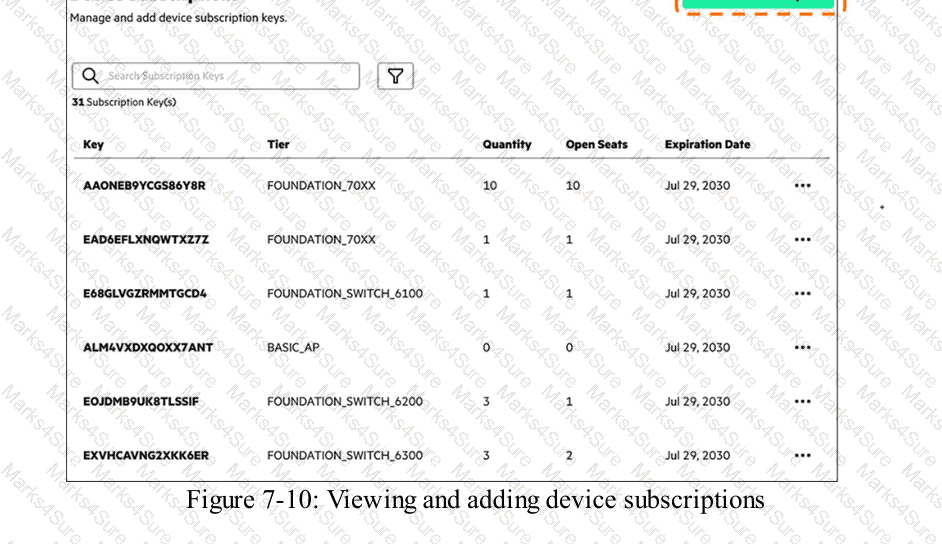
HPE Press study-guide figure / related learning illustration · Q168 Fig 7-10 Subscriptions
What is one benefit of using the Audit Trail in HPE Aruba Networking Central?
Options:
Supports regulatory compliance with detailed logs
Displays real-time network performance metrics
Provides immediate alerts for network issues
Enables configuration changes to be reversed automatically
Answer:
AExplanation:
Comprehensive and Detailed Explanation
HPE Press guide context | PDF page 679 | HPE Press, Aruba Certified Associate – Campus Access Official Certification Study Guide
Technical Deep Dive — Original Chat Wording
Audit trails provide a historical record of activities performed within a network-management environment.
HPE Aruba Networking Central records supported administrative and system-generated events, including configuration changes, device-management operations, and user-management activities.
These records help organizations determine what changed, when the action occurred, and which account or process was responsible.
For example, an administrator investigating an unexpected WLAN policy change can examine the Audit Trail to identify the corresponding configuration event.
Audit records may include timestamps, usernames, source addresses, operation categories, affected resources, and descriptions of executed actions.
Such information supports accountability and incident investigation.
It can also contribute to regulatory compliance by providing evidence of management activity and security-relevant changes.
However, the existence of an Audit Trail does not independently guarantee compliance with a particular standard.
Organizations must additionally establish appropriate access restrictions, retention policies, monitoring procedures, and evidence-preservation controls.
The Audit Trail is not intended primarily for real-time performance monitoring; dedicated network-health views provide that functionality.
Similarly, operational alerts are delivered through alerting and event-monitoring features.
An audit record identifies a configuration change but does not automatically reverse it.
Therefore, Option A (Supports regulatory compliance with detailed logs) is correct.

HPE Press study-guide figure / related learning illustration · Q115 Fig 8-15 Audit
What does WPA3-Personal use as the source for generating a different Pairwise Master Key (PMK) whenever a station connects to the wireless network?
Options:
Session-specific information (MACs and nonces)
Opportunistic Wireless Encryption (OWE)
Simultaneous Authentication of Equals (SAE)
Key Encryption Key (KEK)
Answer:
CExplanation:
Comprehensive and Detailed Explanation
HPE Press guide context | PDF page 958 | HPE Press, Aruba Certified Associate – Campus Access Official Certification Study Guide
Technical Deep Dive — Reconstructed (Original Chat Text Not Recoverable)
WPA3-Personal uses Simultaneous Authentication of Equals (SAE) to produce fresh PMK material for each authentication attempt. MAC/nonces participate in later key expansion but are not the password-authenticated key exchange mechanism itself. OWE applies to enhanced open networks rather than WPA3-Personal.
The selected answer corresponds to C: Simultaneous Authentication of Equals (SAE). This matches the mechanism or management behavior described in the scenario rather than merely a related network feature.
In an AOS-CX or Aruba Central deployment, the relevant settings must be applied in the correct interface, profile, policy, or management scope and then validated operationally.
For example, an apparently healthy physical port may still fail to serve a client when VLAN assignment, AAA policy, or Layer 3 gateway context is wrong.
In production, the decision should be documented and checked against the supported software release and platform model, because interface names, licensing tiers, and management workflows can change across Central and AOS-CX generations.
For practical use, confirm the prerequisite conditions first, then verify the resulting operational state. This separates an intended configuration from a working network service and avoids accepting a misleading result.
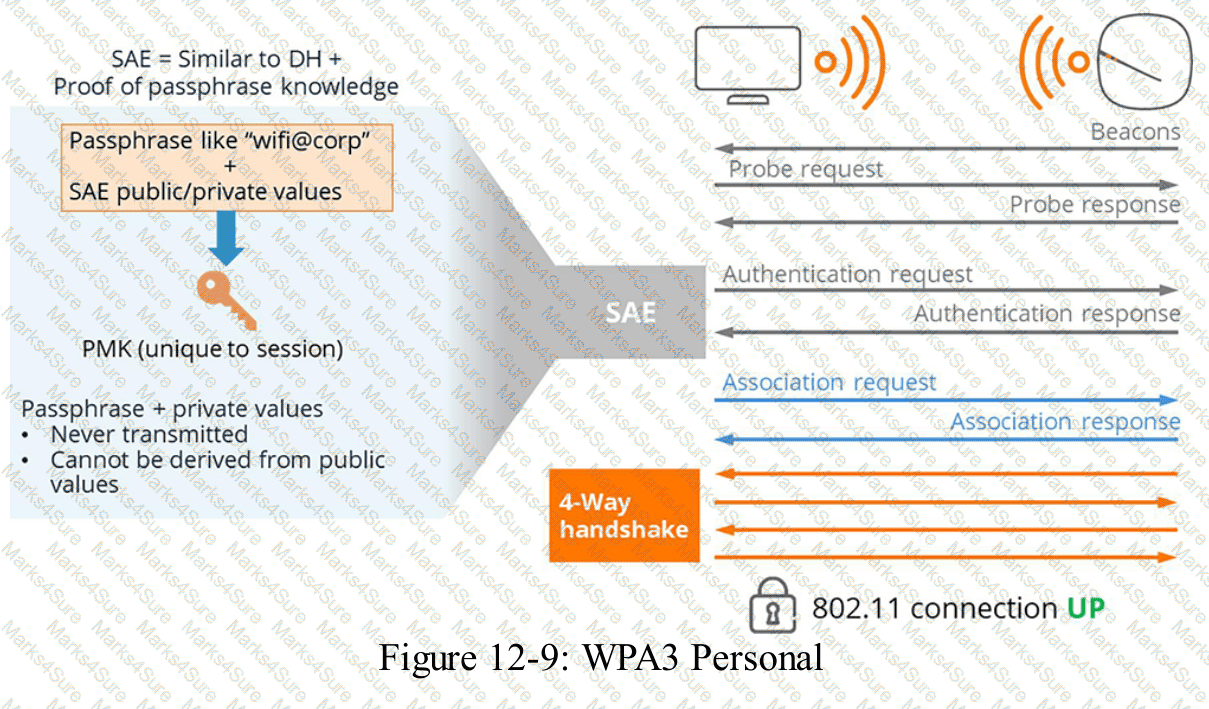
HPE Press study-guide figure / related learning illustration · Fig 12-9 SAE
Which layer preserves unique logical source and destination addresses over the entire path between endpoints?
Options:
Layer 5 – Session Layer
Layer 4 – Transport Layer
Layer 3 – Network
Layer 2 – Data Link Layer
Answer:
CExplanation:
Comprehensive and Detailed Explanation
HPE Press guide context | PDF page 34 | HPE Press, Aruba Certified Associate – Campus Access Official Certification Study Guide
Technical Deep Dive — Reconstructed (Original Chat Text Not Recoverable)
Layer 3 carries logical source and destination IP addresses across a sequence of routed networks. Each Ethernet hop uses its own Layer 2 source/destination MAC addresses, which change at routing boundaries. The network layer is responsible for logical addressing and forwarding through intermediate routers.
The selected answer corresponds to C: Layer 3 – Network. This matches the mechanism or management behavior described in the scenario rather than merely a related network feature.
Operational workflows should preserve consistent inventory, authorization, configuration history, and monitoring so that administrators can locate and manage devices predictably.
Consistent RBAC, accurate inventories, and retained audit records simplify support handovers and reduce uncertainty during incident investigations.
For an administrator preparing for the associate certification, the key distinction is the precise protocol or Central workflow involved. Similar-sounding features often operate at different OSI layers or management stages.
The wrong choices may describe real technologies, but they perform different functions, apply to another layer, or omit a required prerequisite. Select the answer that resolves the exact scenario, not a nearby administrative task.
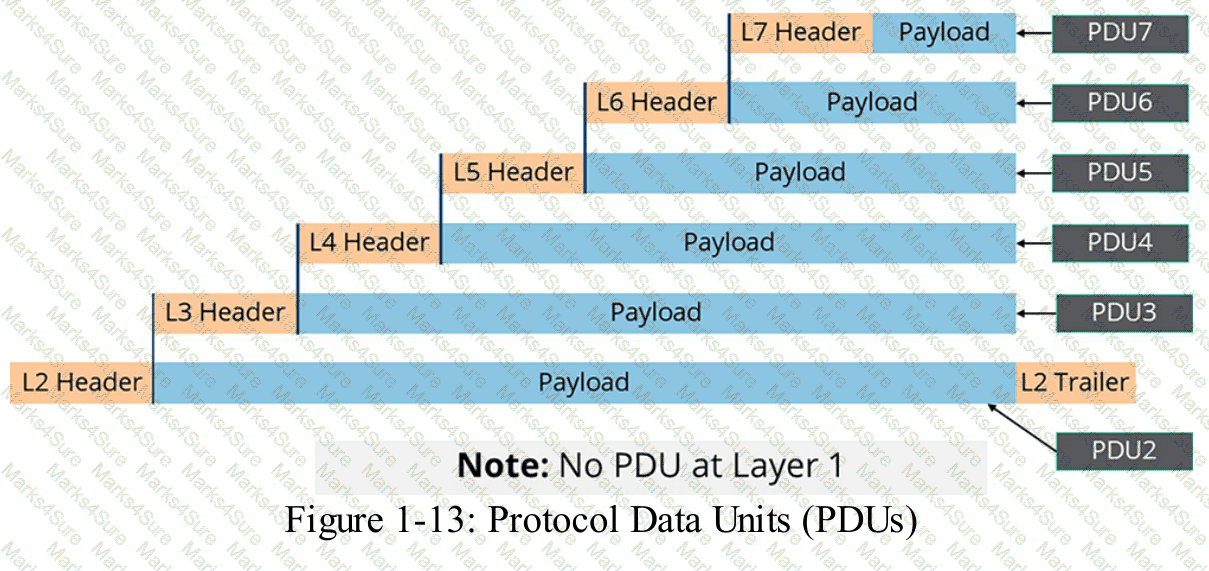
HPE Press study-guide figure / related learning illustration · Fig 1-13 PDU
Which type of insight or card appears on the default HPE Aruba Networking Central dashboard?
Options:
Licenses card
Sites card
API Gateway
Network Health card
Answer:
BExplanation:
Comprehensive and Detailed Explanation
HPE Press guide context | PDF page 999 | HPE Press, Aruba Certified Associate – Campus Access Official Certification Study Guide
Technical Deep Dive — Original Chat Wording
HPE Aruba Networking Central provides a consolidated Network Overview dashboard that enables administrators to monitor infrastructure across an organization.
The Sites card summarizes network locations and their operational health. Administrators can identify sites experiencing connectivity or device-health problems and open the relevant site dashboard for further analysis.
For example, an organization operating 30 branches can use the Sites card to identify locations with disconnected switches, degraded wireless service, or other reported conditions.
The Sites card provides a location-oriented operational view rather than requiring administrators to inspect every device individually.
Other dashboard cards present different categories of information.
The Device Health card summarizes infrastructure condition, while the Client Health card focuses on connected endpoints.
The Licenses card provides information about subscription consumption and management entitlements.
The API Gateway is an integration capability, not the dashboard card requested.
Verification qualification: The current HPE guide also explicitly identifies a Licenses card on the default dashboard. Therefore, the original question is ambiguous as a single-answer MCQ.
B is the likely intended selection , but A is also supported by official documentation. The question should specify the *site-health overview card* to make B uniquely correct.
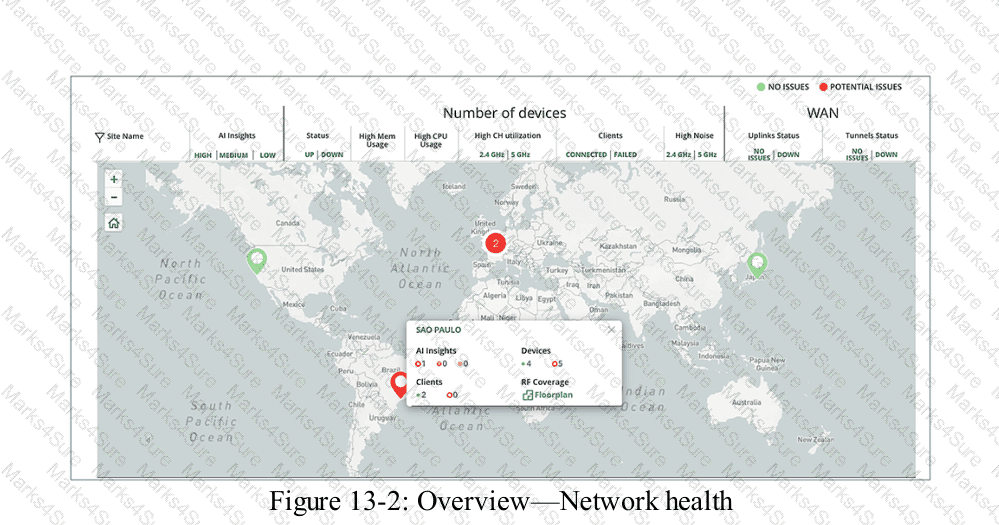
HPE Press study-guide figure / related learning illustration · Q166 Fig 13-2 Network Health
PDF + Testing Engine

Testing Engine
PDF (Q&A)