Free Practice Questions for the HPE Networking HPE7-A11 Exam (2026 Updated)
At Marks4sure, we are dedicated to providing IT professionals with the most accurate and reliable preparation materials for the HP HPE7-A11 exam. To support your certification journey, we have made a selection of our premium 2026 HPE Networking practice questions and answers available completely free. You can take this practice test as many times as you need. Every question includes a detailed, expertly verified explanation to ensure you fully grasp the core security concepts before test day.
Identify the stakeholders when collecting information for the network design and the new IDF/MDF design.
Choose two.
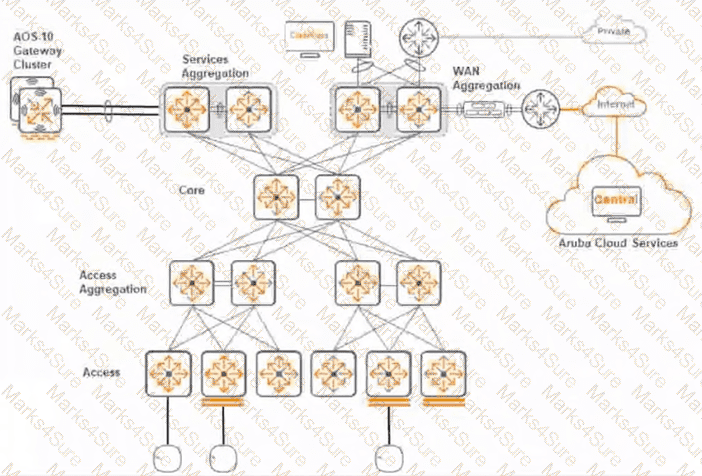
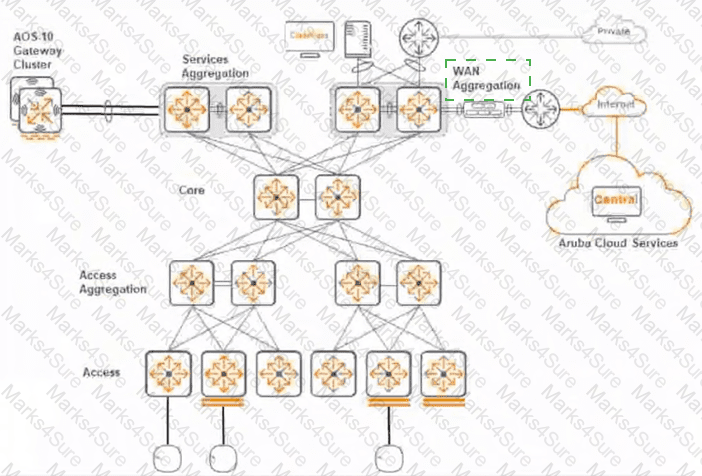
Based on this campus design, select the layer most suitable to be designed as a Border Persona when considering an EVPN VXLAN Fabric.
Original network architecture exhibit
A colleague has produced a proposed design for a large enterprise customer that uses HPE Aruba Networking AOS-CX 6300 switches at the wired access layer. The customer requires a secure, scalable solution founded on Zero Trust Security (ZTS) principles.
In the current environment, endpoint devices connected to access switches are configured to transmit 802.1Q-tagged frames, and the new design plans to tunnel traffic from the switches to an AOS-10 Gateway cluster by using User-Based Tunneling (UBT) in its default mode.
During a design review, you are asked to determine whether this solution supports the customer requirement to retain endpoint VLAN tags across the tunnel.
You recommend a modification, explaining that the proposed default configuration will not satisfy the customer’s technical requirement.
Which UBT configuration would support the customer requirement to preserve VLAN tagging from the endpoints across the UBT tunnel to the gateway?
During the stakeholder interview, an agenda is created to clarify customer expectations. The customer is concerned about future business requirements, with network scalability and flexibility being key.
Which expectations should be considered to solve upcoming business problems?
Choose two.
Which statement is true regarding HPE Aruba Networking Central licensing for gateways?
You are developing a technical proposal for a customer that plans to deploy HPE Aruba Networking Cloud Central-managed AOS-10 Access Points in a typical campus office environment. The customer has used ARM-based radio resource management successfully for many years. During their transition to AOS-10, they ask for guidance on suitable initial EIRP (Effective Isotropic Radiated Power) values for new radio profiles in HPE Aruba Networking Central.
Which EIRP configuration option should be recommended as an appropriate starting point for this office deployment?
A large multinational financial institution has engaged you to design a new full-stack wired and wireless network for its new 6-story regional office building. The facility’s bottom two floors will be retail space for a large banking branch. The upper floors will be carpeted corporate office space, with each floor approximately 100,000 sq ft (9290 sq m). All data centers are offsite and outside this project’s scope. The customer is underserved by its existing L2-based network infrastructure and wants to use modern best practices in the new design. The network must be fully resilient and fault-tolerant, with dynamic segmentation at the edge.
The retail space will provide public guest Wi-Fi access. Retail associates will use corporate tablets for customer service, and a mixture of wired and wireless devices will be deployed throughout the retail floors. Corporate users will mainly use wireless connectivity, although several wired clients, printers, and hard VoIP phones will be used.
The customer also plans to renovate the corporate office space to take advantage of 'smart office' technology. These enhancements will enable blue-dot wayfinding, presence analytics, and other location-based services.
The client chose to authenticate wired headless devices using Mac Authentication, with RADIUS attributes returned to the NAD to assign VLAN and port-access parameters to the authentication session on the switch port.
What would be critical to making this a successful deployment?
Choose two.
XYZ Regional Hospital is an integrated healthcare system consisting of hospitals, neighborhood health centers, and small doctor offices. XYZ Regional Hospital recently merged with 4x neighborhood health centers and 125 doctor branch offices. Its wireless, wired-access, and AAA solutions are outdated and must be replaced.
XYZ Regional Hospital wants to future-proof and improve efficiency at all sites by enhancing wired and wireless access and moving to centralized, unified wired/wireless and policy management that provides uninterrupted availability of all systems.
Locations:
XYZ Regional Hospital is located in New York City
Dila Health Center is located in City A
Mount Health Center is located in City B
Rock Health Center is located in City C
Branch clinics are located at different locations across the United States
Requirements:
Provide, through management software, a single pane of glass to manage wired and wireless LANs and VPNs across campus, branch, and remote environments through a web/cloud architecture that provides near real-time insight, troubleshooting tools, and Service Level performance reporting.
Seamless integration across wired, wireless, WAN, SD-Branch, and IoT
Provide secure wireless access for all Regional Hospital employees and partners, and provide wireless Internet access to medical citizens when they visit our facilities.
All access points must support these features and specifications: 802.11 ax (Wi-Fi 6E Certified)
Security options including WP2/WPA3 and 802.1X with Radius secure authentication
Identify and authenticate every wireless and wired device
End-to-end role-based security
Seamless mobility throughout the hospital for medical teams, patients, and visitors
Reduce Wi-Fi deployment times from days to hours and enable Zero-Touch deployments across the site
Establish a resilient, future-ready network infrastructure with the intelligence, scalability, and intuitive toolsets to meet emerging needs
Fully redundant branch solution with dynamic path selection to the hospital
XYZ Regional Hospital plans a wireless site survey at its main campus. It must address recurring Wi-Fi coverage issues.
Which pieces of information are required?
Choose two.
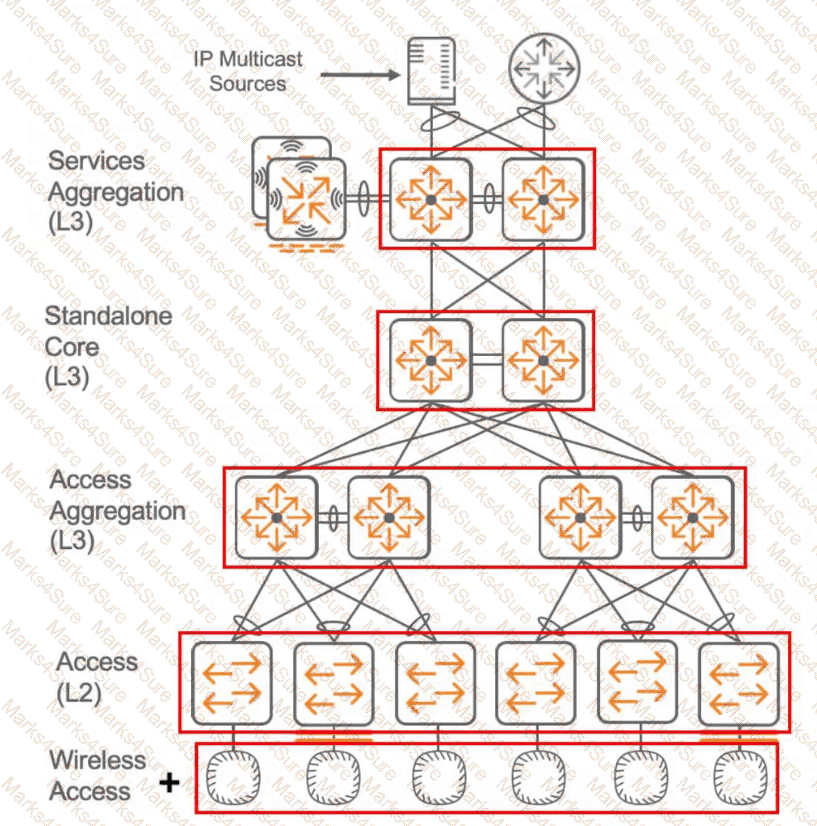
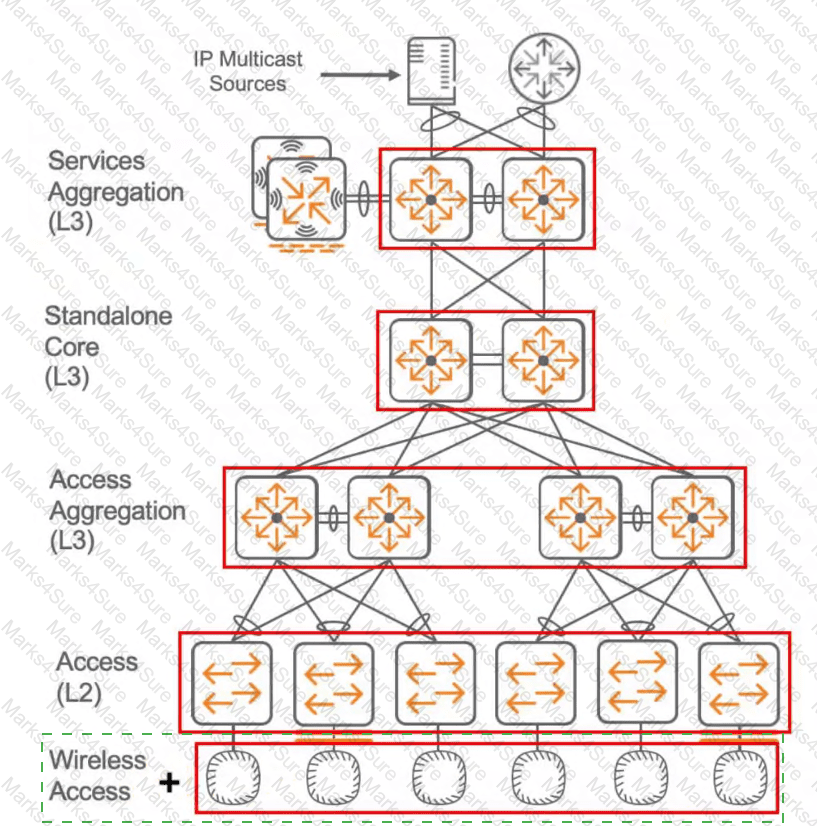
Mark the layer at which Dynamic Multicast Optimization should be activated.
HPE campus multicast network diagram showing services aggregation, standalone core, access aggregation, access layer and wireless access
You are working with a large enterprise customer preparing to deploy HPE Aruba Networking ClearPass Policy Manager (CPPM) across multiple campus locations. They have asked that ClearPass Insight be included in the technical proposal so they can use its historical reporting and analytics capabilities.
As part of the design consultation, the customer specifically wants to understand:
Whether Insight needs additional licensing or subscriptions.
How enabling Insight affects the size and structure of their CPPM cluster.
Which best practices they should follow to enable Insight resiliently and at scale.
Confirm which statements about HPE Aruba Networking ClearPass Insight are accurate so they can plan the correct number of nodes and licensing in the IRIS-generated Bill of Materials.
Choose two.
You are presenting your network-design solution to a customer. What is important to include in the presentation?
A global cruise-line company must refresh its current fleet. It will refresh the ship’s “insides” to remain cost-effective and improve sustainability, replacing all WLAN/LAN hardware. During this refresh, the company will retain its current security requirements. The CIO also wants to minimize the number of unused switch ports. Any future expansion will always involve a hardware refresh. The company begins with its smallest ship, supporting a maximum of 800 guests.
Each ship has a LAN infrastructure comprising two core switches, up to 10 redundant distribution switches, and up to 500 access switches (400 cabins and 100 technical rooms). The core switches are in the ship’s MDF, and the distribution switches are in the IDFs. Each cabin and technical room has one access switch.
The ship’s cabling structure will not be refreshed. Each IDF connects to the MDF through SMF, with two pairs available for the core-to-distribution interconnect. The MDF-to-IDF SMF run is under 300 meters (980 ft) and uses OS1 fiber. Each cabin connects to its IDF through a single OM2 pair, with a maximum length of 60 meters (200 ft). Each technical room connects to its IDF through a single OM2 pair, with lengths from 100 to 150 meters (320 to 500 ft).
For every cabin and technical room, the customer wants to replace its current fanless 2530/2540 without changing requirements, except that the uplink to the distribution switch must be upgraded to 10GbE to accommodate increased network traffic, and technical rooms require redundant power.
The WLAN infrastructure will be refreshed 1:1, with no new cabling or AP locations. It uses 200/300-series indoor and outdoor APs running InstantOS (fewer than 300 APs), and the customer has no changes to WLAN requirements.
The cruise-line company will replace its current Internet connection before the LAN/WLAN refresh. The new Internet connection will provide 99.8% uptime, required to keep paid guest Wi-Fi operational. With this new Internet connection, the CIO wants to base the design on Aruba’s ESP architecture because the Internet connection is guaranteed.
Based on HPE Aruba Networking best practices and the customer’s stated requirements, which segmentation design approach is suitable for this environment?
XYZ Regional Hospital is an integrated healthcare system comprising hospitals, neighborhood health centers, and small doctor offices. XYZ Regional Hospital recently merged with 4x neighborhood health centers and 125 doctor branch offices. Its wireless, wired-access, and AAA solutions are outdated and must be replaced.
XYZ Regional Hospital wants to future-proof and improve efficiency across all sites by enhancing wired and wireless access and moving to centralized, unified wired/wireless and policy management that provides uninterrupted availability of all systems.
Locations:
XYZ Regional Hospital is in New York City.
Dila Health Center is in City A.
Mount Health Center is in City B.
Rock Health Center is in City C.
Branch clinics are in different locations across the United States.
Requirements:
Provide, through management software, a single pane of glass to manage wired and wireless LANs and VPNs across campus, branch, and remote locations through web/cloud architecture that delivers near-real-time insight, troubleshooting tools, and Service Level performance reporting.
Seamless integration across wired, wireless, WAN, SD-Branch, and IoT.
Provide secure wireless access for all Regional Hospital employees and partners, and provide wireless Internet access to medical citizens when they visit the facilities.
All access points must support these features and specifications: 802.11 ax (Wi-Fi 6E Certified).
Security options including WP2/WPA3 and 802.1X with Radius secure authentication.
Identify and authenticate every wireless and wired device.
End-to-end role-based security.
Seamless mobility throughout the hospital for medical teams, patients, and visitors.
Reduce Wi-Fi deployment time from days to hours and enable Zero-Touch deployments across the site.
Establish a resilient, future-ready network infrastructure with the intelligence, scalability, and intuitive toolsets to meet emerging needs.
A fully redundant branch solution with dynamic path selection to the hospital.
XYZ Regional Hospital recently acquired a new outpatient building 900 feet (275 meters) from the main hospital, with a clear line of sight but no feasible fiber connection between the buildings.
The design requirements are:
Extend the existing wireless SSIDs to the outpatient building.
Cloud-manage all wired and wireless devices across both buildings.
Which combination of products should the Network Architect recommend?
As part of several technical proposals for a customer deploying both Wi-Fi 7 high-throughput HD and very high-throughput VHD networks based on HPE Aruba Networking AOS-10, you are identifying key considerations for radio frequency (RF) design and channel optimization.
Which statements are recommended AOS-10 best practices for RF planning and should be included in your proposals to deliver optimal wireless performance?
Choose two.
You and the customer agree that DUR will be used for centralized policy management. The plan also includes dynamic VNBT-based distributed Dynamic Segmentation. Which switch model should be selected?
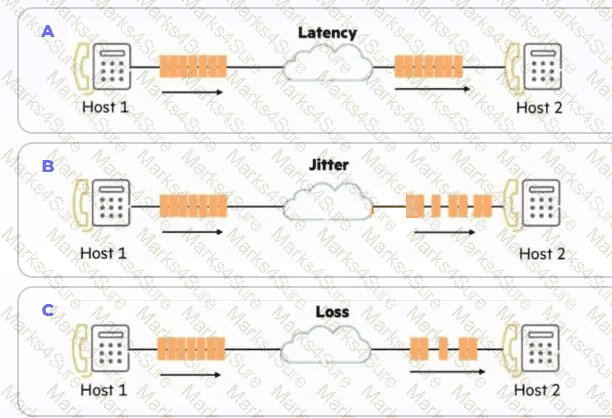
The client’s current network has occasional voice dropouts during phone calls between office locations. It has been determined that no packet loss is occurring, and QoS is the likely cause.
Which phenomenon is the client currently experiencing issues with?
Original exhibit — Question 36
What should be considered when using existing MMF and upgrading to equipment capable of 10 GbE speeds?
Choose two.
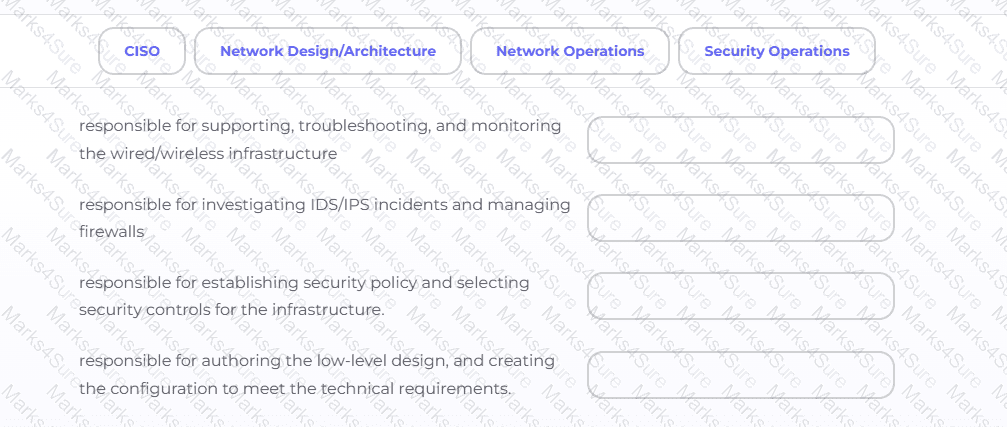
A junior engineer has been hired to help with a large-scale network infrastructure project. Because the engineer has not previously worked on a project this complex, they want to better understand the role each stakeholder will have.
Match each stakeholder title with the responsibility most likely associated with that role.
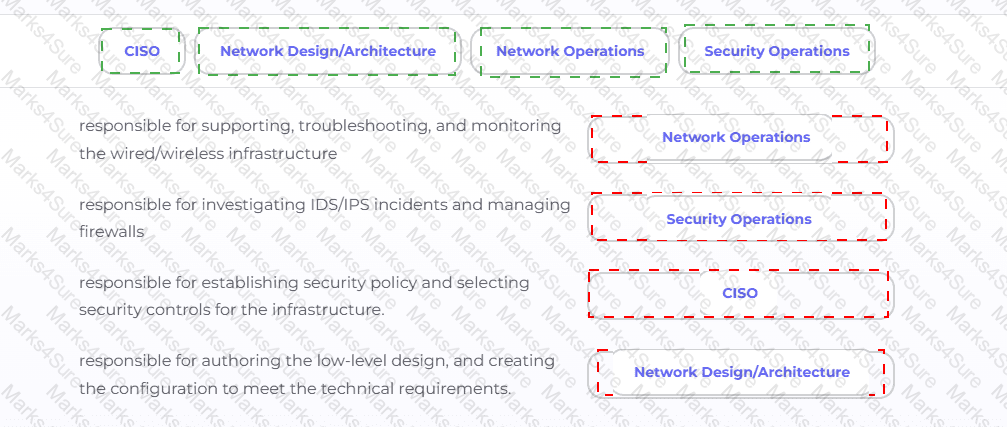
Following your initial meeting with the customer, which questions must you be able to answer?
Choose two.
You are meeting with different stakeholders in a customer’s IT organization as part of an HPE Aruba Networking campus access-layer design project. You need to collect technical input that supports design decisions, including switch-port capacity, uplink requirements, and user-connectivity needs.
Which two stakeholders participate in these design activities?
Choose two.
XYZ Regional Hospital is an integrated healthcare system comprising hospitals, neighborhood health centers, and small doctor offices. XYZ Regional Hospital recently merged with 4x neighborhood health centers and 125 doctor branch offices. Its wireless, wired-access, and AAA solutions are outdated and require replacement.
XYZ Regional Hospital wants to future-proof and improve efficiency across every site by enhancing wired and wireless access and moving to centralized, unified wired/wireless and policy management that provides uninterrupted availability of all systems.
Locations:
XYZ Regional Hospital is located in New York City.
Dila Health Center is located in City A.
Mount Health Center is located in City B.
Rock Health Center is located in City C.
Branch clinics are located at different locations across the United States.
Requirements:
Provide, through management software, a single pane of glass to manage wired and wireless LANs and VPNs across campus, branch, and remote sites through a web/cloud architecture that provides near real-time insight, troubleshooting tools, and Service Level performance reporting.
Seamless integration across wired, wireless, WAN, SD-Branch, and IoT.
Provide secure wireless access to all Regional Hospital employees and partners, and provide wireless Internet access to medical citizens when they visit the facilities.
All access points must support these features and specifications: 802.11 ax (Wi-Fi 6E Certified).
Security options including WP2/WPA3 and 802.1X with Radius secure authentication.
Identify and authenticate every wireless and wired device.
End-to-end role-based security.
Seamless mobility across the hospital for medical teams, patients, and visitors.
Cut Wi-Fi deployment times from days to hours and enable Zero-Touch deployments across the site.
Establish a resilient, future-ready network infrastructure with the intelligence, scalability, and intuitive toolsets needed to meet emerging needs.
A fully redundant branch solution with dynamic path selection to the hospital.
XYZ Regional Hospital is seeking an NAC solution to address its security challenges.
Requirements:
A fully redundant NAC solution for management and authentication.
Wireless and wired authentication for the main hospital will be handled locally.
Wireless and wired authentication for the health centers will be handled locally.
Wireless and wired authentication for the clinics will be authenticated against the main hospital NAC.
Staff users/devices must be able to visit any site and have the same experience.
Support 35k devices.
Locations:
XYZ Regional Hospital is located in City 1 - 15k devices.
Dila Health Center is located in City 2 - 8k devices.
Mount Health Center is located in City 3 - 5k devices.
Rock Health Center is located in City 4 - 4k devices.
125 branch clinics are located at different locations across the US - 2k devices.
Which solution fulfills the customer's requirements?
A global cruise-line company needs to modernize its existing fleet. To make the ships more cost-effective and sustainable, it will refresh the ship “insides” and replace all WLAN/LAN hardware. This refresh will not change the company’s current security requirements. The CIO also wants to minimize unused switch ports. Any future expansion will always require a hardware refresh. The effort begins with the smallest ship, which supports a maximum of 800 guests.
Each ship has a LAN infrastructure comprising two core switches, up to 10 redundant distribution switches, and up to 500 access switches (400 cabins and 100 technical rooms). The core switches are in the ship’s MDF, and the distribution switches are in the IDFs. Every cabin and technical room receives one access switch.
The ship’s cabling structure will remain unchanged. Each IDF connects to the MDF through SMF, with two pairs available for the core-to-distribution interconnect. The SM fiber between the MDF and IDF is under 300 meters (980 ft) and is OS1. Each cabin connects to the IDF through one OM2 pair, at a maximum length of 60 meters (200 ft). Each technical room connects to the IDF through one OM2 pair, with lengths from 100 to 150 meters (320 to 500 ft).
For every cabin and technical room, the customer wants to replace the existing fan-less 2530/2540 switches without altering requirements, except that the uplink to the distribution switch must be upgraded to 10GbE to accommodate increased network traffic, and technical rooms require redundant power.
The WLAN infrastructure will be refreshed 1:1, with no new cabling or AP locations. It is based on 200/300-series indoor and outdoor APs running InstantOS (fewer than 300 APs), and the customer has no WLAN requirement changes.
The cruise-line company will replace its current Internet connection before the LAN/WLAN refresh. The new connection will deliver 99.8% uptime, needed to keep paid guest Wi-Fi continuously operational. Because this Internet connection is guaranteed, the CIO wants the design based on Aruba’s ESP architecture.
Based on best practices, which switch model is the most cost-effective choice for the distribution layer?
You are a member of a cross-functional team developing a detailed design proposal for a customer deploying EVPN-VXLAN in a modern campus core and data center fabric. The customer is moving from a traditional VLAN-based Layer 2 design to a VXLAN-based overlay architecture to support segmentation scalability and automation.
As the solution undergoes review, you are asked to contribute by identifying and explaining core technical behaviors and configuration considerations critical to the success of EVPN-VXLAN in this environment.
Which statements accurately describe key characteristics of EVPN-VXLAN in modern campus or data center networks?
PDF + Testing Engine

Testing Engine
PDF (Q&A)