Free Practice Questions for the HPE Networking HPE7-A12 Exam (2026 Updated)
At Marks4sure, we are dedicated to providing IT professionals with the most accurate and reliable preparation materials for the HP HPE7-A12 exam. To support your certification journey, we have made a selection of our premium 2026 HPE Networking practice questions and answers available completely free. You can take this practice test as many times as you need. Every question includes a detailed, expertly verified explanation to ensure you fully grasp the core security concepts before test day.
Waratah Hospital, located in Australia, plans to relocate many data-center services to a new facility. (The remaining legacy data center is not included in this project.) Waratah Hospital has engaged an external consultant to help design the new data-center network.
Based on the data-center network-infrastructure requirements, the external consultant has produced a high-level design. The design document is summarized below.
Requirements and information:
Six racks in the data-center room (a single row).
Redundant top-of-rack leaf switches with back-to-front cooling in every rack, delivering 10/25-Gbps connectivity to servers, storage, and other devices.
Four 100-GbE uplinks per leaf switch.
The customer requested that all switch ports face the rear of the rack racks (hot aisle).
OOB management for servers, storage, and network devices must be provided through an external switch with back-to-front cooling. This switch must be included in the solution. One OOB switch provides connectivity for two racks.
Core equipment for the OOBM network is being reused.
Middle-of-row spine switches.
The data center must connect to the hospital building through links providing 400 Gbps.
Internet access is supplied through an existing firewall cluster containing two firewalls, with one firewall in each data room. The second firewall operates in standby mode, and VRRP is used for firewall failover. The data-center network must connect to these firewalls through links totaling 100 Gbps.
The external link is a dark-fiber direct link using single-mode fiber (OS2). The distance to the main hospital is 1.5 KM. The links will terminate on two core switches in the hospital.
The customer additionally requires:
99.999% uptime for this life-critical environment.
Planned and unplanned downtime must be minimized.
Software upgrades are permitted only once per year, with close to zero downtime.
All life-critical resources are accessed locally, and all resources reside within the hospital campus.
Waratah Hospital requires a highly secure data-center environment. Encrypted wire-speed connectivity between the data room and hospital is mandatory because the inter-building link crosses a public road.
Waratah Hospital has a mixture of virtualized (vSphere) servers, Nutanix storage, bare-metal servers, backup servers, and other devices.
Previously, the hospital experienced a security breach that caused data loss, network downtime, and identity theft.
Refer to the scenario. You have learned that the customer must extend two VRFs between the new data-center facility and the hospital. To meet the scenario requirements and general best practices, what should you recommend to connect border leaf switches to the hospital core?
A customer has deployed CX 10000 switches, Fabric Composer, and Pensando Policy and Services Manager (PSM). The switches are discovered in PSM, but no VRFs or networks have been added. The customer now wants to begin by applying micro-segmentation to one network. They state that they plan to add a policy containing rules that permit desired traffic from endpoints in this network. They will apply it to the network as an egress policy. At this time, they will not add any other networks to PSM or apply policies to them.
What warning should you raise to the customer about this plan?
You are deploying a data center network using CX 8360 switches. The network uses a spine-and-leaf topology and EVPN VXLAN. Shortly before deployment, the customer introduces a new requirement.
In one server rack, the customer hosts servers for different tenants. The leaf switches in that rack must be able to reuse the same VLAN IDs for separate logical L2/L3 domains.
What should you explain?
Waratah Hospital, located in Australia, plans to relocate many data-center services to a new facility. The remaining legacy data center is outside this project’s scope. Waratah Hospital engaged an external consultant to help design the new data center network.
Based on the data center network-infrastructure requirements, the external consultant created a high-level design. The design document is summarized below.
Requirements and information:
Six racks in the data center room, arranged in a single row.
Redundant top-of-rack leaf switches with back-to-front cooling in every rack, delivering 10/25 Gbps connectivity for servers, storage, and other devices.
Four 100 GbE uplinks per leaf switch.
The customer requested that all switch ports face the rear of the racks (the hot aisle).
OOB management for servers, storage, and network devices must be provided through an external switch with back-to-front cooling. This switch must be included in the solution. One OOB switch provides connectivity for two racks.
Core equipment for the OOBM network is being reused.
Middle-of-row spine switches.
The data center must connect to the hospital building using links that provide 400 Gbps.
Internet access is supplied through an existing firewall cluster with two firewalls, with one firewall in each data room. The second firewall operates in standby mode, and VRRP is used on the firewalls for failover. The data center network must connect to these firewalls with links totaling 100 Gbps.
The external link is a direct dark-fiber link based on single-mode fiber (OS2). The distance to the main hospital is 1.5 KM. The links will terminate on two core switches in the hospital.
The customer also requires:
99.999% uptime for this life-critical environment.
Planned and unplanned downtime must be minimized.
Software upgrades are permitted only once per year, with close to zero downtime.
All life-critical resources are accessed locally, and all resources are located within the hospital campus.
Waratah Hospital requires a highly secure data center environment. Encrypted wire-speed connectivity between the data room and the hospital is mandatory because the link between the buildings crosses a public road.
Waratah Hospital has a mixture of virtualized (vSphere) servers, Nutanix storage, bare-metal servers, backup servers, and other devices.
The hospital previously experienced a security breach that caused data loss, network downtime, and identity theft.
Which valid assumptions can be made for this scenario when preparing the network design documentation? Choose two.
A customer’s legacy three-tier architecture is being modernized with an L3 spine-and-leaf topology. The CX switches in the topology will supply the overlay. The customer data center has six VRFs. The customer has requested service leaf switches to connect to two clustered firewalls that route and filter traffic between the VRFs.
How can the efficiency of traffic flow between subnets in the same VRF be maximized?
You are designing a CX data center network for a customer who has stated that they must integrate the switches into their automation workflows.
Which capability allows the customer to meet this objective?
A customer wants to turn as many upfront costs as possible into smaller recurring bills. For which components can HPE GreenLake for Networking offer recurring billing?
Waratah Hospital, located in Australia, plans to move many data-center services to a new facility. (The remaining legacy data center is not included in this project.) Waratah Hospital has hired an external consultant to help design the new data-center network.
Based on the data-center network-infrastructure requirements, the external consultant has produced a high-level design. The following summarizes the design document.
Requirements and information:
Six racks in the data-center room (a single row).
Redundant top-of-rack leaf switches with back-to-front cooling in every rack, providing 10/25 Gbps connectivity to servers, storage, and other devices.
Four 100 GbE uplinks per leaf switch.
The customer requested that all switch ports face the back of the rack racks (hot aisle).
OOB management for servers, storage, and network must be provided through an external switch with back-to-front cooling. This switch must be included in the solution. One OOB switch provides connectivity for two racks.
Core equipment for the OOBM network is being reused.
Middle-of-row spine switches.
The data center must connect to the hospital building using links that provide 400 Gbps.
Internet access is supplied through an existing firewall cluster with two firewalls, with one firewall in each data room. The second firewall operates in standby mode, and VRRP is used on the firewalls for failover. The data-center network must connect to these firewalls using links totaling 100 Gbps.
The external link is a dark-fiber direct link based on single-mode fiber (OS2). The distance to the main hospital is 1.5 KM. The links will terminate on two core switches in the hospital.
The customer also requires:
99.999% uptime for this life-critical environment.
Planned and unplanned downtime must be minimized.
Software upgrades are permitted only once per year with close to zero downtime.
All life-critical resources are accessed locally, and all resources reside within the hospital campus.
Waratah Hospital requires a highly secure data-center environment. Encrypted wire-speed connectivity between the data room and the hospital is mandatory because the link between the buildings crosses a public road.
Waratah Hospital has a mix of virtualized (vSphere) servers, Nutanix storage, bare-metal servers, backup servers, and other devices.
In the past, the hospital experienced a security breach that resulted in data loss, network downtime, and identity theft.
Given the scenario, which environmental requirements are stated? Choose two.
You have designed a two-tier L2 data center network for a customer. While presenting the solution, the customer states that they have a mission-critical multicast application with sources and receivers in the data center.
Which CX feature, in addition to features supplied by the PIM-SM standard, should you explain to emphasize the value of your solution?
Waratah Hospital, located in Australia, plans to relocate many data-center services to a new facility. (The remaining legacy data center is outside the scope of this project.) Waratah Hospital has engaged an external consultant to help design the new data-center network.
Based on the data-center network-infrastructure requirements, the external consultant has produced a high-level design. The following summarizes the design document.
Requirements and information:
Six racks in the data-center room (a single row).
Redundant Top-of-Rack leaf switches with back-to-front cooling in every rack, delivering 10/25 Gbps connectivity for servers, storage, and other devices.
Four 100 GbE uplinks per leaf switch.
The customer requested that all switch ports face the back of the racks (hot aisle).
OOB management for servers, storage, and networking must be delivered through an external switch with back-to-front cooling. This switch must be included in the solution. One OOB switch provides connectivity for two racks.
Core equipment for the OOBM network is being reused.
Middle-of-row spine switches.
The data center must connect to the hospital building through links providing 400 Gbps.
Internet access is supplied through an existing firewall cluster with two firewalls, with one firewall in each data room. The second firewall runs in standby mode, and VRRP is used on the firewalls for failover. The data-center network must connect to these firewalls using links totaling 100 Gbps.
The external link is a dark-fiber direct link using single-mode fiber (OS2). The distance to the main hospital is 1.5 KM. The links will terminate on two core switches in the hospital.
The customer also requires:
99.999% uptime for this life-critical environment.
Planned and unplanned downtime must be minimized.
Software upgrades are permitted only once per year with close to zero downtime.
All life-critical resources are accessed locally, and all resources reside within the hospital campus.
Waratah Hospital requires a highly secure data-center environment. Encrypted wire-speed connectivity between the data room and the hospital is mandatory because the link between the buildings crosses a public road.
Waratah Hospital has a mix of virtualized (vSphere) servers, Nutanix storage, bare-metal servers, backup servers, and other devices.
Previously, the hospital experienced a security breach that caused data loss, network downtime, and identity theft.
In this scenario, the customer servers are HPE Servers. For the iLO ports, you propose one 6300M switch per rack. What is the best practice for connecting these switches to the data-center data plane?
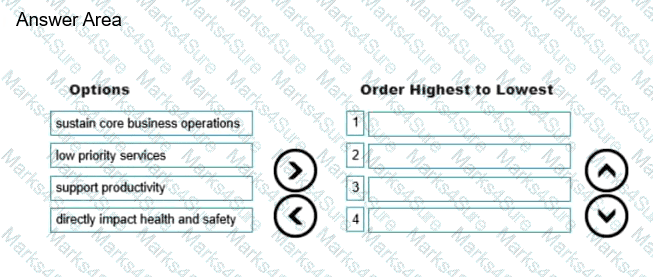
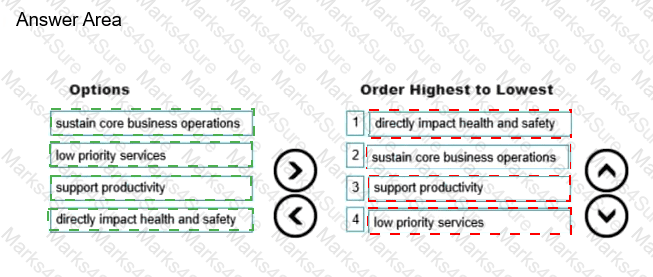
Order the severity levels (highest impact on top) into the righthand box.
Drag & Drop
A long-standing customer has acquired a company with 3,500 employees and plans to bring the new data center sites up to its standards. The customer has requested a bill of materials based only on the locations and port counts at the data center sites.
Which valid assumptions should be documented in the proposal? Choose two.
Several years ago, you delivered an L3 spine-and-leaf topology to a customer. The solution used two CX 8325-32C switches as spines and 20 CX 8325-48Y8C leaf switches. The leaf switches operate as 10 VSX pairs.
The customer now wants to double the topology’s forwarding capacity. What should you recommend?
You are presenting your solution to a customer. What is important to include in the presentation?
A customer currently has a data-center network using CX switches and Pensando for east-west firewalling. The data center is highly virtualized with VMware, but the customer is considering migrating some workloads to HPE VMs running on HPE Morpheus VM Essentials (VME).
What should you explain?
Refer to the exhibit.
You can change the services to save the customer money without affecting the level of support delivered. What change should you make?
PDF + Testing Engine

Testing Engine
PDF (Q&A)