
- Home
- Juniper
- JNCIA-Cloud
- JN0-214
- Cloud Associate (JNCIA-Cloud) Questions and Answers
Free Practice Questions for the Juniper JNCIA-Cloud JN0-214 Exam (2026 Updated)
At Marks4sure, we are dedicated to providing IT professionals with the most accurate and reliable preparation materials for the Juniper JN0-214 exam. To support your certification journey, we have made a selection of our premium 2026 JNCIA-Cloud practice questions and answers available completely free. You can take this practice test as many times as you need. Every question includes a detailed, expertly verified explanation to ensure you fully grasp the core security concepts before test day.
What is the role of overlay tunnels in an overlay software-defined networking (SDN) solution?
Options:
The overlay tunnels provide optimization of traffic for performance and resilience.
The overlay tunnels provide load balancing and scale out for applications.
The overlay tunnels provide microsegmentation for workloads.
The overlay tunnels abstract the underlay network topology.
Answer:
DExplanation:
In an overlay software-defined networking (SDN) solution, overlay tunnels play a critical role in abstracting the underlying physical network (underlay) from the virtualized network (overlay). Let’s analyze each option:
A. The overlay tunnels provide optimization of traffic for performance and resilience.
Incorrect: While overlay tunnels can contribute to traffic optimization indirectly, their primary role is not performance or resilience. These aspects are typically handled by SDN controllers or other network optimization tools.
B. The overlay tunnels provide load balancing and scale out for applications.
Incorrect: Load balancing and scaling are functions of application-level services or SDN controllers, not the overlay tunnels themselves. Overlay tunnels focus on encapsulating traffic rather than managing application workloads.
C. The overlay tunnels provide microsegmentation for workloads.
Incorrect: Microsegmentation is achieved through policies and security rules applied at the overlay network level, not directly by the tunnels themselves. Overlay tunnels enable the transport of segmented traffic but do not enforce segmentation.
D. The overlay tunnels abstract the underlay network topology.
Correct: Overlay tunnels encapsulate traffic between endpoints (e.g., VMs, containers) and hide the complexity of the underlay network. This abstraction allows the overlay network to operate independently of the physical network topology, enabling flexibility and scalability.
Why This Answer?
Abstraction of Underlay: Overlay tunnels use encapsulation protocols like VXLAN, GRE, or MPLS to create virtualized networks that are decoupled from the physical infrastructure. This abstraction simplifies network management and enables advanced features like multi-tenancy and mobility.
JNCIA Cloud References:
The JNCIA-Cloud certification covers overlay and underlay networks as part of its SDN curriculum. Understanding the role of overlay tunnels is essential for designing and managing virtualized networks in cloud environments.
For example, Juniper Contrail uses overlay tunnels to provide connectivity between virtual machines (VMs) and containers, abstracting the physical network and enabling seamless communication across distributed environments.
Which command would you use to see which VMs are running on your KVM device?
Options:
virt-install
virsh net-list
virsh list
VBoxManage list runningvms
Answer:
CExplanation:
KVM (Kernel-based Virtual Machine) is a popular open-source virtualization technology that allows you to run virtual machines (VMs) on Linux systems. The virsh command-line tool is used to manage KVM VMs. Let’s analyze each option:
A. virt-install
Incorrect: The virt-install command is used to create and provision new virtual machines. It is not used to list running VMs.
B. virsh net-list
Incorrect: The virsh net-list command lists virtual networks configured in the KVM environment. It does not display information about running VMs.
C. virsh list
Correct: The virsh list command displays the status of virtual machines managed by the KVM hypervisor. By default, it shows only running VMs. You can use the --all flag to include stopped VMs in the output.
D. VBoxManage list runningvms
Incorrect: The VBoxManage command is used with Oracle VirtualBox, not KVM. It is unrelated to KVM virtualization.
Why virsh list?
Purpose-Built for KVM: virsh is the standard tool for managing KVM virtual machines, and virsh list is specifically designed to show the status of running VMs.
Simplicity: The command is straightforward and provides the required information without additional complexity.
JNCIA Cloud References:
The JNCIA-Cloud certification emphasizes understanding virtualization technologies, including KVM. Managing virtual machines using tools like virsh is a fundamental skill for operating virtualized environments.
For example, Juniper Contrail supports integration with KVM hypervisors, enabling the deployment and management of virtualized network functions (VNFs). Proficiency with KVM tools ensures efficient management of virtualized infrastructure.
What are two available installation methods for an OpenShift cluster? (Choose two.)
Options:
installer-provisioned infrastructure
kubeadm
user-provisioned infrastructure
kubespray
Answer:
A, CExplanation:
OpenShift provides multiple methods for installing and deploying clusters, depending on the level of control and automation desired. Let’s analyze each option:
A. installer-provisioned infrastructure
Correct:
Installer-provisioned infrastructure (IPI) is an automated installation method where the OpenShift installer provisions and configures the underlying infrastructure (e.g., virtual machines, networking) using cloud provider APIs or bare-metal platforms. This method simplifies deployment by handling most of the setup automatically.
B. kubeadm
Incorrect:
kubeadm is a tool used to bootstrap Kubernetes clusters manually. While it is widely used for Kubernetes installations, it is not specific to OpenShift and is not an official installation method for OpenShift clusters.
C. user-provisioned infrastructure
Correct:
User-provisioned infrastructure (UPI) is a manual installation method where users prepare and configure the infrastructure (e.g., virtual machines, load balancers, DNS) before deploying OpenShift. This method provides greater flexibility and control over the environment but requires more effort from the user.
D. kubespray
Incorrect:
Kubespray is an open-source tool used to deploy Kubernetes clusters on various infrastructures. Like kubeadm , it is not specific to OpenShift and is not an official installation method for OpenShift clusters.
Why These Methods?
Installer-Provisioned Infrastructure (IPI): Automates the entire installation process, making it ideal for users who want a quick and hassle-free deployment.
User-Provisioned Infrastructure (UPI): Allows advanced users to customize the infrastructure and tailor the deployment to their specific needs.
JNCIA Cloud References:
The JNCIA-Cloud certification covers OpenShift installation methods as part of its curriculum on container orchestration platforms. Understanding the differences between IPI and UPI is essential for deploying OpenShift clusters effectively.
For example, Juniper Contrail integrates with OpenShift to provide advanced networking features, regardless of whether the cluster is deployed using IPI or UPI.
Which two statements are correct about Network Functions Virtualization (NFV)? (Choose two.)
Options:
the NFV framework explains how VNFs fits into the whole solution.
The NFV Infrastructure (NFVI) is a component of NFV.
The NFV Infrastructure (NFVI) is not a component of NFV.
The NFV framework is defined by the W3C.
Answer:
A, BExplanation:
Network Functions Virtualization (NFV) is a framework designed to virtualize network services traditionally run on proprietary hardware. It decouples network functions from dedicated hardware appliances and implements them as software running on standard servers or virtual machines. Let’s analyze each statement:
A. The NFV framework explains how VNFs fit into the whole solution.
Correct: The NFV framework provides a structured approach to deploying and managing Virtualized Network Functions (VNFs). It defines how VNFs interact with other components, such as the NFV Infrastructure (NFVI), Management and Orchestration (MANO), and the underlying hardware.
B. The NFV Infrastructure (NFVI) is a component of NFV.
Correct: The NFV Infrastructure (NFVI) is a critical part of the NFV architecture. It includes the physical and virtual resources (e.g., compute, storage, networking) that host and support VNFs. NFVI acts as the foundation for deploying and running virtualized network functions.
C. The NFV Infrastructure (NFVI) is not a component of NFV.
Incorrect: This statement contradicts the NFV architecture. NFVI is indeed a core component of NFV, providing the necessary infrastructure for VNFs.
D. The NFV framework is defined by the W3C.
Incorrect: The NFV framework is defined by the European Telecommunications Standards Institute (ETSI), not the W3C. ETSI’s NFV Industry Specification Group (ISG) established the standards and architecture for NFV.
Why These Answers?
Framework Explanation: The NFV framework provides a comprehensive view of how VNFs integrate into the overall solution, ensuring scalability and flexibility.
NFVI Role: NFVI is essential for hosting and supporting VNFs, making it a fundamental part of the NFV architecture.
JNCIA Cloud References:
The JNCIA-Cloud certification covers NFV as part of its cloud infrastructure curriculum. Understanding the NFV framework and its components is crucial for deploying and managing virtualized network functions in cloud environments.
For example, Juniper Contrail integrates with NFV frameworks to deploy and manage VNFs, enabling service providers to deliver network services efficiently and cost-effectively.
Which statement about software-defined networking is true?
Options:
It must manage networks through the use of containers and repositories.
It manages networks by separating the data forwarding plane from the control plane.
It applies security policies individually to each separate node.
It manages networks by merging the data forwarding plane with the control plane.
Answer:
BExplanation:
Software-Defined Networking (SDN) is a revolutionary approach to network management that separates the control plane from the data (forwarding) plane. Let’s analyze each option:
A. It must manage networks through the use of containers and repositories.
Incorrect: While containers and repositories are important in cloud-native environments, they are not a requirement for SDN. SDN focuses on programmability and centralized control, not containerization.
B. It manages networks by separating the data forwarding plane from the control plane.
Correct: SDN separates the control plane (decision-making) from the data forwarding plane (packet forwarding). This separation enables centralized control, programmability, and dynamic network management.
C. It applies security policies individually to each separate node.
Incorrect: SDN applies security policies centrally through the SDN controller, not individually to each node. Centralized policy enforcement is one of the key advantages of SDN.
D. It manages networks by merging the data forwarding plane with the control plane.
Incorrect: Merging the forwarding and control planes contradicts the fundamental principle of SDN. The separation of these planes is what enables SDN’s flexibility and programmability.
Why This Answer?
Separation of Planes: By decoupling the control plane from the forwarding plane, SDN enables centralized control over network devices. This architecture simplifies network management, improves scalability, and supports automation.
JNCIA Cloud References:
The JNCIA-Cloud certification covers SDN as a core concept in cloud networking. Understanding the separation of the control and forwarding planes is essential for designing and managing modern cloud environments.
For example, Juniper Contrail serves as an SDN controller, centralizing control over network devices and enabling advanced features like network automation and segmentation.
Which two statements are correct about an underlay network? (Choose two.)
Options:
An underlay network can be built using either Layer 2 or Layer 3 connectivity.
A Layer 3 underlay network uses routing protocols to provide IP connectivity.
The underlay network is the virtual network used to connect multiple virtual machines (VMs).
The underlay network is built using encapsulations tunnels.
Answer:
A, BExplanation:
An underlay network refers to the physical or logical network infrastructure that provides the foundation for overlay networks in cloud environments. It handles the actual transport of data between devices and serves as the backbone for cloud architectures. Let’s analyze each statement:
A. An underlay network can be built using either Layer 2 or Layer 3 connectivity.
Correct: Underlay networks can operate at both Layer 2 (switching) and Layer 3 (routing). For example:
Layer 2: Uses Ethernet switching to forward traffic within a single broadcast domain.
Layer 3: Uses IP routing to forward traffic across multiple subnets or networks.
B. A Layer 3 underlay network uses routing protocols to provide IP connectivity.
Correct: In a Layer 3 underlay network, routing protocols like OSPF, BGP, or EIGRP are used to exchange routing information and ensure IP connectivity between devices. This is common in large-scale cloud environments where scalability and segmentation are critical.
C. The underlay network is the virtual network used to connect multiple virtual machines (VMs).
Incorrect: The underlay network is the physical or logical infrastructure that supports the overlay network. The overlay network, on the other hand, is the virtual network used to connect VMs, containers, or other endpoints. The underlay provides the foundation, while the overlay adds abstraction and flexibility.
D. The underlay network is built using encapsulations tunnels.
Incorrect: Encapsulation tunnels (e.g., VXLAN, GRE) are used in overlay networks, not underlay networks. The underlay network provides the physical or logical transport layer, while the overlay network uses tunnels to create virtualized network segments.
Why These Answers?
Layer 2 and Layer 3 Flexibility: The underlay network must support both switching and routing to accommodate diverse workloads and topologies.
Routing Protocols in Layer 3: Routing protocols are essential for scalable and efficient IP connectivity in Layer 3 underlay networks.
JNCIA Cloud References:
The JNCIA-Cloud certification covers underlay and overlay networks as part of its discussion on cloud architectures. Understanding the distinction between underlay and overlay networks is crucial for designing and managing cloud environments.
For example, Juniper Contrail uses an underlay network to provide the physical connectivity required for overlay networks. The underlay ensures reliable and scalable transport, while the overlay enables flexible virtualized networking.
Which two statements are correct about cloud computing? (Choose two.)
Options:
Cloud computing eliminates operating expenses.
Cloud computing has the ability to scale elastically
Cloud computing increases the physical control of the data resources.
Cloud computing allows access to data any time from any location through the Internet.
Answer:
B, DExplanation:
Cloud computing is a model for delivering IT services where resources are provided over the internet on-demand. Let’s analyze each statement:
A. Cloud computing eliminates operating expenses.
Incorrect: While cloud computing can reduce certain operating expenses (e.g., hardware procurement, maintenance), it does not eliminate them entirely. Organizations still incur costs such as subscription fees, data transfer charges, and operational management of cloud resources. Additionally, there may be costs associated with training staff or migrating workloads to the cloud.
B. Cloud computing has the ability to scale elastically.
Correct: Elasticity is one of the key characteristics of cloud computing. It allows resources (e.g., compute, storage, networking) to scale up or down automatically based on demand. For example, during peak usage, additional virtual machines or storage can be provisioned dynamically, and when demand decreases, these resources can be scaled back. This ensures efficient resource utilization and cost optimization.
C. Cloud computing increases the physical control of the data resources.
Incorrect: Cloud computing typically reduces physical control over data resources because the infrastructure is managed by the cloud provider. For example, in public cloud models, the customer does not have direct access to the physical servers or data centers. Instead, they rely on the provider’s security and compliance measures.
D. Cloud computing allows access to data any time from any location through the Internet.
Correct: One of the core advantages of cloud computing is ubiquitous access. Users can access applications, services, and data from anywhere with an internet connection. This is particularly beneficial for remote work, collaboration, and global business operations.
JNCIA Cloud References:
The Juniper Networks Certified Associate - Cloud (JNCIA-Cloud) curriculum highlights the key characteristics of cloud computing, including elasticity, scalability, and ubiquitous access. These principles are foundational to understanding how cloud environments operate and how they differ from traditional on-premises solutions.
For example, Juniper Contrail, a software-defined networking (SDN) solution, leverages cloud elasticity to dynamically provision and manage network resources in response to changing demands. Similarly, the ability to access cloud resources remotely aligns with Juniper’s focus on enabling flexible and scalable cloud architectures.
You are asked to provision a bare-metal server using OpenStack.
Which service is required to satisfy this requirement?
Options:
Ironic
Zun
Trove
Magnum
Answer:
AExplanation:
OpenStack is an open-source cloud computing platform that provides various services for managing compute, storage, and networking resources. To provision a bare-metal server in OpenStack, the Ironic service is required. Let’s analyze each option:
A. Ironic
Correct: OpenStack Ironic is a bare-metal provisioning service that allows you to manage and provision physical servers as if they were virtual machines. It automates tasks such as hardware discovery, configuration, and deployment of operating systems on bare-metal servers.
B. Zun
Incorrect: OpenStack Zun is a container service that manages the lifecycle of containers. It is unrelated to bare-metal provisioning.
C. Trove
Incorrect: OpenStack Trove is a Database as a Service (DBaaS) solution that provides managed database instances. It does not handle bare-metal provisioning.
D. Magnum
Incorrect: OpenStack Magnum is a container orchestration service that supports Kubernetes, Docker Swarm, and other container orchestration engines. It is focused on containerized workloads, not bare-metal servers.
Why Ironic?
Purpose-Built for Bare-Metal: Ironic is specifically designed to provision and manage bare-metal servers, making it the correct choice for this requirement.
Automation: Ironic automates the entire bare-metal provisioning process, including hardware discovery, configuration, and OS deployment.
JNCIA Cloud References:
The JNCIA-Cloud certification covers OpenStack as part of its cloud infrastructure curriculum. Understanding OpenStack services like Ironic is essential for managing bare-metal and virtualized environments in cloud deployments.
For example, Juniper Contrail integrates with OpenStack to provide networking and security for both virtualized and bare-metal workloads. Proficiency with OpenStack services ensures efficient management of diverse cloud resources.
Your organization manages all of its sales through the Salesforce CRM solution.
In this scenario, which cloud service model are they using?
Options:
Storage as a Service (STaas)
Software as a Service (Saa
Platform as a Service (Paa)
Infrastructure as a Service (IaaS)
Answer:
BExplanation:
Cloud service models define how services are delivered and managed in a cloud environment. The three primary models are:
Infrastructure as a Service (IaaS): Provides virtualized computing resources such as servers, storage, and networking over the internet. Examples include Amazon EC2 and Microsoft Azure Virtual Machines.
Platform as a Service (PaaS): Provides a platform for developers to build, deploy, and manage applications without worrying about the underlying infrastructure. Examples include Google App Engine and Microsoft Azure App Services.
Software as a Service (SaaS): Delivers fully functional applications over the internet, eliminating the need for users to install or maintain software locally. Examples include Salesforce CRM, Google Workspace, and Microsoft Office 365.
In this scenario, the organization is using Salesforce CRM, which is a SaaS solution. Salesforce provides a complete customer relationship management (CRM) application that is accessible via a web browser, with no need for the organization to manage the underlying infrastructure or application code.
Why SaaS?
No Infrastructure Management: The customer does not need to worry about provisioning servers, databases, or networking components.
Fully Managed Application: Salesforce handles updates, patches, and maintenance, ensuring the application is always up-to-date.
Accessibility: Users can access Salesforce CRM from any device with an internet connection.
JNCIA Cloud References:
The JNCIA-Cloud certification emphasizes understanding the different cloud service models and their use cases. SaaS is particularly relevant in scenarios where organizations want to leverage pre-built applications without the complexity of managing infrastructure or development platforms.
For example, Juniper’s cloud solutions often integrate with SaaS platforms like Salesforce to provide secure connectivity and enhanced functionality. Understanding the role of SaaS in cloud architectures is essential for designing and implementing cloud-based solutions.
Click the Exhibit button.
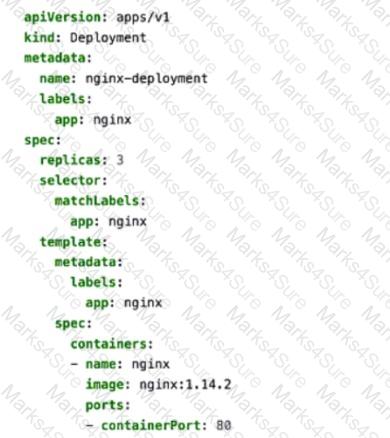
You apply the manifest file shown in the exhibit.
Which two statements are correct in this scenario? (Choose two.)
Options:
The created pods are receiving traffic on port 80.
This manifest is used to create a deployment.
This manifest is used to create a deploymentConfig.
Four pods are created as a result of applying this manifest.
Answer:
A, BExplanation:
The provided YAML manifest defines a Kubernetes Deployment object that creates and manages a set of pods running the NGINX web server. Let’s analyze each statement in detail:
A. The created pods are receiving traffic on port 80.
Correct:
The containerPort: 80 field in the manifest specifies that the NGINX container listens on port 80 for incoming traffic.
While this does not expose the pods externally, it ensures that the application inside the pod (NGINX) is configured to receive traffic on port 80.
B. This manifest is used to create a deployment.
Correct:
The kind: Deployment field explicitly indicates that this manifest is used to create a Kubernetes Deployment .
Deployments are used to manage the desired state of pods, including scaling, rolling updates, and self-healing.
C. This manifest is used to create a deploymentConfig.
Incorrect:
deploymentConfig is a concept specific to OpenShift, not standard Kubernetes. In OpenShift, deploymentConfig provides additional features like triggers and lifecycle hooks, but this manifest uses the standard Kubernetes Deployment object.
D. Four pods are created as a result of applying this manifest.
Incorrect:
The replicas: 3 field in the manifest specifies that the Deployment will create three replicas of the NGINX pod. Therefore, only three pods are created, not four.
Why These Statements?
Traffic on Port 80:
The containerPort: 80 field ensures that the NGINX application inside the pod listens on port 80. This is critical for the application to function as a web server.
Deployment Object:
The kind: Deployment field confirms that this manifest creates a Kubernetes Deployment, which manages the lifecycle of the pods.
Replica Count:
The replicas: 3 field explicitly states that three pods will be created. Any assumption of four pods is incorrect.
Additional Context:
Kubernetes Deployments: Deployments are one of the most common Kubernetes objects used to manage stateless applications. They ensure that the desired number of pod replicas is always running and can handle updates or rollbacks seamlessly.
Ports in Kubernetes: The containerPort field in the pod specification defines the port on which the containerized application listens. However, to expose the pods externally, a Kubernetes Service (e.g., NodePort, LoadBalancer) must be created.
JNCIA Cloud References:
The JNCIA-Cloud certification covers Kubernetes concepts, including Deployments, Pods, and networking. Understanding how Deployments work and how ports are configured is essential for managing containerized applications in cloud environments.
For example, Juniper Contrail integrates with Kubernetes to provide advanced networking and security features for Deployments like the one described in the exhibit.
Click the Exhibit button.
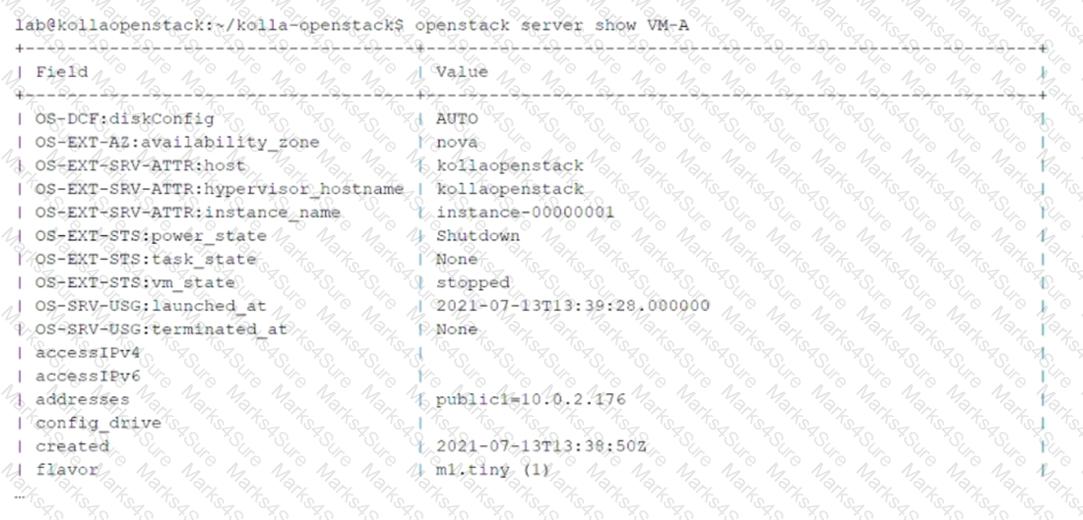
You have issued the openstack server show VM-A command and received the output shown in the exhibit.
To which virtual network is the VM-A instance attached?
Options:
m1.tiny
public1
Nova
kollaopenstack
Answer:
BExplanation:
The openstack server show command provides detailed information about a specific virtual machine (VM) instance in OpenStack. The output includes details such as the instance name, network attachments, power state, and more. Let’s analyze the question and options:
Key Information from the Exhibit:
The addresses field in the output shows
public1=10.0.2.176
This indicates that the VM-A instance is attached to the virtual network named public1 , with an assigned IP address of 10.0.2.176 .
Option Analysis:
A. m1.tiny
Incorrect: m1.tiny refers to the flavor of the VM, which specifies the resource allocation (e.g., CPU, memory, disk). It is unrelated to the virtual network.
B. public1
Correct: The addresses field explicitly states that the VM-A instance is attached to the public1 virtual network.
C. Nova
Incorrect: Nova is the OpenStack compute service that manages VM instances. It is not a virtual network.
D. kollaopenstack
Incorrect: kollaopenstack appears in the output as the hostname or project name but does not represent a virtual network.
Why public1?
Network Attachment: The addresses field in the output directly identifies the virtual network ( public1 ) to which the VM-A instance is attached.
IP Address Assignment: The IP address ( 10.0.2.176 ) confirms that the VM is connected to the public1 network.
JNCIA Cloud References:
The JNCIA-Cloud certification emphasizes understanding OpenStack commands and outputs, including the openstack server show command. Recognizing how virtual networks are represented in OpenStack is essential for managing VM connectivity.
For example, Juniper Contrail integrates with OpenStack Neutron to provide advanced networking features for virtual networks like public1 .
You want to view pods with their IP addresses in OpenShift.
Which command would you use to accomplish this task?
Options:
oc qet pods -o vaml
oc get pods -o wide
oc qet all
oc get pods
Answer:
BExplanation:
OpenShift provides various commands to view and manage pods. Let’s analyze each option:
A. oc qet pods -o vaml
Incorrect:
The command contains a typo ( qet instead of get ) and an invalid output format ( vaml ). The correct format would be yaml , but this command does not display pod IP addresses.
B. oc get pods -o wide
Correct:
The oc get pods -o wide command displays detailed information about pods, including their names, statuses, and IP addresses . The -o wide flag extends the output to include additional details like pod IPs and node assignments.
C. oc qet all
Incorrect:
The command contains a typo ( qet instead of get ). Even if corrected, oc get all lists all resources (e.g., pods, services, deployments) but does not display pod IP addresses.
D. oc get pods
Incorrect:
The oc get pods command lists pods with basic information such as name, status, and restart count. It does not include pod IP addresses unless the -o wide flag is used.
Why oc get pods -o wide?
Detailed Output: The -o wide flag provides extended information, including pod IP addresses, which is essential for troubleshooting and network configuration.
Ease of Use: This command is simple and effective for viewing pod details in OpenShift.
JNCIA Cloud References:
The JNCIA-Cloud certification emphasizes understanding OpenShift CLI commands and their outputs. Knowing how to retrieve detailed pod information is essential for managing and troubleshooting OpenShift environments.
For example, Juniper Contrail integrates with OpenShift to provide advanced networking features, relying on accurate pod IP information for traffic routing and segmentation.
Which two tools are used to deploy a Kubernetes environment for testing and development purposes? (Choose two.)
Options:
OpenStack
kind
oc
minikube
Answer:
B, DExplanation:
Kubernetes is a popular container orchestration platform used for deploying and managing containerized applications. Several tools are available for setting up Kubernetes environments for testing and development purposes. Let’s analyze each option:
A. OpenStack
Incorrect: OpenStack is an open-source cloud computing platform used for managing infrastructure resources (e.g., compute, storage, networking). It is not specifically designed for deploying Kubernetes environments.
B. kind
Correct: kind (Kubernetes IN Docker) is a tool for running local Kubernetes clusters using Docker containers as nodes. It is lightweight and ideal for testing and development purposes.
C. oc
Incorrect: oc is the command-line interface (CLI) for OpenShift, a Kubernetes-based container platform. While OpenShift can be used to deploy Kubernetes environments, oc itself is not a tool for setting up standalone Kubernetes clusters.
D. minikube
Correct: minikube is a tool for running a single-node Kubernetes cluster locally on your machine. It is widely used for testing and development due to its simplicity and ease of setup.
Why These Tools?
kind: Ideal for simulating multi-node Kubernetes clusters in a lightweight environment.
minikube: Perfect for beginners and developers who need a simple, single-node Kubernetes cluster for experimentation.
JNCIA Cloud References:
The JNCIA-Cloud certification covers Kubernetes as part of its container orchestration curriculum. Tools like kind and minikube are essential for learning and experimenting with Kubernetes in local environments.
For example, Juniper Contrail integrates with Kubernetes to provide advanced networking and security features for containerized workloads. Proficiency with Kubernetes tools ensures effective operation and troubleshooting.
Which term identifies to which network a virtual machine interface is connected?
Options:
virtual network ID
machine access control (MAC)
Virtual Extensible LAN
virtual tunnel endpoint (VTEP)
Answer:
AExplanation:
In cloud environments, virtual machines (VMs) connect to virtual networks to enable communication. Identifying the network to which a VM interface is connected is essential for proper configuration and isolation. Let’s analyze each option:
A. virtual network ID
Correct: The virtual network ID uniquely identifies the virtual network to which a VM interface is connected. This ID is used to logically group VMs and ensure they can communicate within the same network while maintaining isolation from other networks.
B. machine access control (MAC)
Incorrect: The MAC address is a hardware identifier for a network interface card (NIC). While it is unique to each interface, it does not identify the network to which the VM is connected.
C. Virtual Extensible LAN (VXLAN)
Incorrect: VXLAN is a tunneling protocol used to create overlay networks in cloud environments. While VXLAN encapsulates traffic, it does not directly identify the network to which a VM interface is connected.
D. virtual tunnel endpoint (VTEP)
Incorrect: A VTEP is a component of overlay networks (e.g., VXLAN) that encapsulates and decapsulates traffic. It is used to establish tunnels but does not identify the virtual network itself.
Why Virtual Network ID?
Logical Isolation: The virtual network ID ensures that VMs are logically grouped into isolated networks, enabling secure and efficient communication.
Scalability: Virtual networks allow cloud environments to scale by supporting multiple isolated networks within the same infrastructure.
JNCIA Cloud References:
The JNCIA-Cloud certification emphasizes understanding virtual networking concepts, including virtual networks and their identifiers. Virtual network IDs are fundamental to cloud architectures, enabling multi-tenancy and network segmentation.
For example, Juniper Contrail uses virtual network IDs to manage connectivity and isolation for VMs in cloud environments. Proper configuration of virtual networks ensures seamless communication and security.
What are two Kubernetes worker node components? (Choose two.)
Options:
kube-apiserver
kubelet
kube-scheduler
kube-proxy
Answer:
B, DExplanation:
Kubernetes worker nodes are responsible for running containerized applications and managing the workloads assigned to them. Each worker node contains several key components that enable it to function within a Kubernetes cluster. Let’s analyze each option:
A. kube-apiserver
Incorrect: The kube-apiserver is a control plane component, not a worker node component. It serves as the front-end for the Kubernetes API, handling communication between the control plane and worker nodes.
B. kubelet
Correct: The kubelet is a critical worker node component. It ensures that containers are running in the desired state by interacting with the container runtime (e.g., containerd). It communicates with the control plane to receive instructions and report the status of pods.
C. kube-scheduler
Incorrect: The kube-scheduler is a control plane component responsible for assigning pods to worker nodes based on resource availability and other constraints. It does not run on worker nodes.
D. kube-proxy
Correct: The kube-proxy is another essential worker node component. It manages network communication for services and pods by implementing load balancing and routing rules. It ensures that traffic is correctly forwarded to the appropriate pods.
Why These Components?
kubelet: Ensures that containers are running as expected and maintains the desired state of pods.
kube-proxy: Handles networking and enables communication between services and pods within the cluster.
JNCIA Cloud References:
The JNCIA-Cloud certification covers Kubernetes architecture, including the roles of worker node components. Understanding the functions of kubelet and kube-proxy is crucial for managing Kubernetes clusters and troubleshooting issues.
For example, Juniper Contrail integrates with Kubernetes to provide advanced networking and security features. Proficiency with worker node components ensures efficient operation of containerized workloads.
Which virtualization method requires less duplication of hardware resources?
Options:
OS-level virtualization
hardware-assisted virtualization
full virtualization
paravirtualization
Answer:
AExplanation:
Virtualization methods differ in how they utilize hardware resources. Let’s analyze each option:
A. OS-level virtualization
Correct: OS-level virtualization (e.g., containers) uses the host operating system’s kernel to run isolated user-space instances (containers). Since containers share the host OS kernel, there is less duplication of hardware resources compared to other virtualization methods.
B. hardware-assisted virtualization
Incorrect: Hardware-assisted virtualization (e.g., Intel VT-x, AMD-V) enables full virtual machines (VMs) to run on physical hardware. Each VM includes its own operating system, leading to duplication of resources like memory and CPU.
C. full virtualization
Incorrect: Full virtualization involves running a complete guest operating system on top of a hypervisor. Each VM requires its own OS, resulting in significant resource duplication.
D. paravirtualization
Incorrect: Paravirtualization modifies the guest operating system to communicate directly with the hypervisor. While it reduces some overhead compared to full virtualization, it still requires separate operating systems for each VM, leading to resource duplication.
Why OS-Level Virtualization?
Resource Efficiency: Containers share the host OS kernel, eliminating the need for multiple operating systems and reducing resource duplication.
Lightweight: Containers are faster to start and consume fewer resources compared to VMs.
JNCIA Cloud References:
The JNCIA-Cloud certification emphasizes understanding virtualization technologies, including OS-level virtualization. Containers are a key component of modern cloud-native architectures due to their efficiency and scalability.
For example, Juniper Contrail integrates with container orchestration platforms like Kubernetes to manage OS-level virtualization workloads efficiently.
PDF + Testing Engine

Testing Engine
PDF (Q&A)