
- Home
- CIPS
- CIPS Level 6 Professional Diploma in Procurement and Supply
- L6M1
- Strategic Ethical Leadership Questions and Answers
Free Practice Questions for the CIPS Level 6 Professional Diploma in Procurement and Supply L6M1 Exam (2026 Updated)
At Marks4sure, we are dedicated to providing IT professionals with the most accurate and reliable preparation materials for the CIPS L6M1 exam. To support your certification journey, we have made a selection of our premium 2026 CIPS Level 6 Professional Diploma in Procurement and Supply practice questions and answers available completely free. You can take this practice test as many times as you need. Every question includes a detailed, expertly verified explanation to ensure you fully grasp the core security concepts before test day.
What is meant by the ‘Contingency Model’ of Organisation? What factors should be considered?
Options:
Answer:
See the Answer is the explanation.
Explanation:
Overall explanation
Below you will find how you can plan and draft the essay. Remember this is an example of one way you could approach the question. At Level 6 the questions are much more open so your response may be completely different and that's okay.
Essay Plan
Intro – what is contingency theory?
Each factor in a paragraph: external environment, technology, size, culture, goals, leader style, the people
Conclusion – there is no universally ‘right’ way to structure an organisation, and it can change over time.
Example Essay
The Contingency Model of organization is a management and organizational theory that suggests there is no one-size-fits-all approach to organizing and managing a company. Instead, it proposes that the most effective organizational structure and management style depend on various external and internal factors, often referred to as contingencies. The core idea behind this model is that the optimal way to organize and manage an organization is contingent upon the unique circumstances or contingencies it faces.
Key factors that should be considered in the Contingency Model of Organization include:
Environmental Factors: The external environment, including factors like the industry in which the organization operates, economic conditions, competition, and legal and regulatory requirements, can greatly influence the organization's structure and strategy. An organisation should consider STEEPLED factors and Porter’s 5 Forces when deciding which company structure would be most appropriate.
Technology: The nature of the organization's technology and the rate of technological change can impact its structure and processes. Some organizations may need to be more flexible and adaptive due to rapidly changing technologies, while others may rely on stable and proven technologies. For example, does the organisational structure allow people to work remotely from home?
Organizational Size: The size of the organization can affect its structure and management practices. Smaller organizations might have a more informal structure, while larger ones may require more formal hierarchies. For example a small organisation would not benefit from a bureaucratic structure, but a large organisation may need several levels of management and a degree of bureaucracy.
Organizational Culture: The culture of the organization, including its values, norms, and beliefs, can influence how it is structured and managed. For instance, an innovative and entrepreneurial culture may lead to a flatter, more decentralized structure.
Goals and Strategy: The goals and strategy of the organization play a crucial role in determining its structure and management style. Different strategies, such as cost leadership, differentiation, or innovation, may require different organizational structures and approaches.
Leadership Style: The leadership style of top management can impact the organization's structure and culture. Leaders with a preference for centralization may create a more hierarchical structure, while those who favour decentralization may opt for a flatter structure.
Human Resources: The skills, abilities, and motivation of the workforce can influence how an organization is structured and managed. A highly skilled and motivated workforce may require less supervision and a more decentralized structure.
The important thing to note with the Contingency Theory is that t he organization's needs and circumstances can change over time, so what works best today may not be suitable in the future. Organizations must continuously assess and adapt their structures and management practices as contingencies evolve.
In essence, the Contingency Model recognizes that there is no universally optimal way to organize and manage an organization. Instead, managers must carefully assess and consider the various contingencies that affect their organization and make decisions accordingly. This approach promotes flexibility and adaptability in organizational design and management, allowing companies to better respond to changing circumstances and maximize their effectiveness.
Tutor Notes
- Another way this could come up as a question is related to a case study. You may be asked to pick out factors which would effect the way an organisation is structured.
- You could also be asked pros and cons of the contingency theory (pro: very flexible, highly responsive to changes con: people don’t know where they stand, harder to find accountability)
- It’s covered in detail in the studyguide but it’s quite a simple concept – the best structure for an organisation depends on lots of different factors.
Pat is the newly appointed CPO (Chief Procurement Officer) of Circle Ltd, a fictional manufacturing company. He is in charge of a team of 12 procurement assistants. He is looking to introduce a new E-Procurement system and is unsure what leadership style would be most appropriate to use: assertive, consulting, collaborating or inspiring. Discuss how Pat could use each of these influencing styles with his team, evaluating their effectiveness for this situation.
Options:
Answer:
See the Answer is the explanation.
Explanation:
Strategic Ethical Leadership in E-Procurement Implementation: Evaluating Influencing Styles
In modern procurement management, leadership style significantly impacts the success of strategic initiatives such as the introduction of an E-Procurement system . Pat, as the newly appointed Chief Procurement Officer (CPO) of Circle Ltd, must carefully select an influencing style to ensure smooth adoption of the system by his 12 procurement assistants . Different influencing styles— assertive, consulting, collaborating, and inspiring —offer distinct advantages and challenges in this scenario. This essay discusses how each of these leadership styles can be applied in Pat’s situation and evaluates their effectiveness.
1. Assertive Leadership Style
Assertive leadership involves directing employees with confidence and clarity, ensuring compliance through authority. If Pat adopts an assertive approach , he would:
Clearly communicate the decision to implement the E-Procurement system.
Set firm expectations for team members regarding system adoption.
Enforce a strict timeline for training and compliance.
Effectiveness in This Situation
Advantages: Provides clarity, speeds up decision-making, and ensures quick implementation.
Challenges: Could lead to resistance from employees who feel excluded from the decision-making process.
Best Used When: There is an urgent deadline or when employees lack knowledge of alternatives.
Given that procurement assistants may have concerns or fears about technological change , a purely assertive approach may create resistance rather than engagement.
2. Consulting Leadership Style
A consulting leadership style involves seeking input from team members before making a final decision. If Pat takes a consultative approach , he would:
Engage procurement assistants in discussions on how the new system will impact their work.
Conduct surveys or meetings to gather feedback.
Allow employees to voice concerns and propose suggestions.
Effectiveness in This Situation
Advantages: Encourages buy-in from employees, reduces resistance, and improves decision-making.
Challenges: Can be time-consuming if employees have diverging opinions or lack expertise in E-Procurement.
Best Used When: Employees have valuable experience or insights , and the leader seeks team engagement .
Since the system is new to the organization, consultation can help address fears and improve morale , but it should be structured efficiently to avoid unnecessary delays.
3. Collaborating Leadership Style
A collaborative leadership style fosters teamwork and shared decision-making, ensuring that all stakeholders work together toward a common goal. If Pat adopts a collaborative approach , he would:
Form a cross-functional project team to oversee the E-Procurement implementation.
Encourage knowledge sharing and problem-solving among team members.
Ensure that procurement assistants have a role in decision-making , such as selecting the software features they find most useful.
Effectiveness in This Situation
Advantages: Enhances teamwork , improves acceptance of change , and utilizes the collective expertise of the team.
Challenges: Can lead to slow decision-making and conflicts if there are disagreements on implementation details.
Best Used When: The project requires innovation and teamwork, and when employees have technical expertise or experience with procurement systems.
Since successful adoption of an E-Procurement system depends on user engagement, collaboration would be highly effective , but it needs structured guidance from leadership.
4. Inspiring Leadership Style
An inspiring leadership style focuses on motivating employees by sharing a vision and fostering enthusiasm. If Pat uses an inspirational approach , he would:
Explain the strategic benefits of E-Procurement for Circle Ltd, such as cost savings, efficiency, and competitive advantage.
Use storytelling and case studies to illustrate successful transformations in similar companies.
Recognize and reward employees who embrace the new system.
Effectiveness in This Situation
Advantages: Boosts morale and motivation , increases commitment , and reduces change resistance .
Challenges: Employees may still need practical guidance and structured training alongside motivation.
Best Used When: Change is significant and requires a mindset shift , especially in environments where innovation is encouraged .
Since the introduction of E-Procurement is a transformative change , an inspiring leadership approach would be effective in motivating employees, but it should be paired with practical implementation strategies .
Conclusion: Choosing the Best Approach
Pat must consider both the technical challenges of E-Procurement implementation and the human factors involved in change management. A blended approach combining multiple leadership styles would be the most effective strategy:
Start with an inspiring approach to generate enthusiasm and ensure employees understand the long-term benefits of E-Procurement.
Use consultation and collaboration to gather feedback and ensure employees feel involved in the change process.
Apply an assertive approach strategically , ensuring that deadlines and key expectations are met.
By combining these leadership styles, Pat can successfully implement the E-Procurement system while ensuring his team is engaged, motivated, and aligned with the company’s strategic goals.
Explain the following types of dismissal: fair dismissal, unfair dismissal, summary dismissal, constructive dismissal and redundancy (15 points) How should an employee respond if they believe they believe that they have been let go by their employer unfairly? (10 points).
Options:
Answer:
See the Answer is the explanation.
Explanation:
Overall explanation
Below you will find how you can plan and draft the essay. Remember this is an example of one way you could approach the question. At Level 6 the questions are much more open so your response may be completely different and that's okay.
Essay Plan
Introduction – complex area of law
Section 1 – each type of dismissal, explain and example
Section 2- what they should do; use internal channels first, seek advice (union / Citizens Advice), mediation, litigation via Employment Tribunal.
Example Essay
Employment termination is a complex area of employment law, and different types of dismissal carry distinct legal implications. In the United Kingdom, where employment law is well-established, employees are entitled to certain rights and protections when facing dismissal. This essay explores various types of dismissal, including fair dismissal, unfair dismissal, summary dismissal, constructive dismissal, and redundancy. It also discusses how employees should respond if they believe they have been unfairly dismissed.
Types of Dismissal:
Fair Dismissal: Fair dismissal occurs when an employer terminates an employee's contract with valid reasons that are recognized by law. Common grounds for fair dismissal include misconduct, lack of capability and statutory reasons. For example, an employee consistently failing to perform their job despite adequate training and support may be fairly dismissed for capability.
Unfair Dismissal: Unfair dismissal, on the other hand, happens when an employee is terminated without valid reasons or if the employer fails to follow the correct dismissal procedures. Employees with at least two years of continuous service have protection against unfair dismissal. For example if XYZ Ltd fire Employee X who has worked at the company for 5 years because there is a personality clash between them and the management, Employee X could claim unfair dismissal (personality clash is not a valid reason for dismissal).
Summary Dismissal: Summary dismissal, often referred to as instant or gross misconduct dismissal, occurs when an employer terminates an employee's contract without notice due to severe misconduct. It typically involves serious breaches of workplace rules or the law. For example if an employee is caught stealing, they may be fired on the spot without notice.
Constructive Dismissal: Constructive dismissal occurs when an employee resigns from their position due to an employer's fundamental breach of the employment contract, creating an unbearable working environment. An example of this is if the employer fails to provide the worker with the correct PPE to complete the work (for example in the Construction industry). Because the employee is unable to complete the work safely, they resign. In this instance, the ‘blame’ is put firmly on the fault of the employer for ‘making’ the employee resign.
Redundancy: Redundancy takes place when an employer dismisses an employee because the job role they held no longer exists, or the employer's business needs to reduce its workforce. Redundancy dismissals must adhere to specific procedures and fair selection criteria. In the UK this is referred to as TUPE.
If an employee believes that they are being fired unfairly they can claim unfair dismissal. Firstly, they should initially consider raising their concerns internally through the company's grievance procedure. This allows for a formal process where grievances can be investigated and addressed. This is particularly useful in large organisations where workers may be fired by middle-managers who are not properly trained or aware of the legislation regarding this area. By raising a concern through a grievance policy, it allows the right people in the company such as HR or the senior leadership team, to fully assess the situation.
Secondly, the employee should seek advice from an organisation such as Citizen’s Advice or their workers' union. They will be able to advise if the situation does amount to unfair dismissal. Getting a third party involved can help to bring in a new perspective and keep discussions positive and moving forward.
If it is believed that the unfair dismissal has merit, employees can contact ACAS (Advisory, Conciliation, and Arbitration Service) for early conciliation. ACAS may facilitate settlement discussions between the employee and employer to avoid legal proceedings. If internal processes and ACAS conciliation do not resolve the matter, employees can file a claim with the Employment Tribunal within specified time limits, asserting unfair dismissal. The time limit to claim is currently 3 months minus a day from the date you were dismissed. Employees may seek legal advice and representation during Employment Tribunal proceedings to ensure their rights are protected and they receive appropriate compensation if the claim is successful.
In conclusion, various types of dismissal exist, each with distinct legal implications. Employees should be aware of their rights and protections under UK employment law, particularly concerning unfair dismissal. It is important to remember that ‘employment rights’ in the UK are only granted after 2 years of service, and this is often a big factor when looking at this area of law. It is important for all employees in the UK to understand these types of dismissal as having appropriate responses empowers employees to seek redress when faced with unjust termination.
Evaluate the following approaches to leadership: autocratic and affiliative (25 points)
Options:
Answer:
See the Answer is the explanation.
Explanation:
Evaluation of Autocratic and Affiliative Leadership Approaches (25 Points)
Leadership approaches vary based on organizational needs, culture, and objectives. Below is an in-depth evaluation of Autocratic Leadership and Affiliative Leadership , focusing on their characteristics, advantages, disadvantages, and suitability in procurement and supply chain management.
1. Autocratic Leadership (12.5 Points)
Definition and Characteristics
Autocratic leadership is a command-and-control approach where decision-making is centralized, and the leader exerts full authority over subordinates. Employees have little to no input in decisions.
Key Features:
The leader makes all critical decisions without consulting the team.
Strict top-down communication is followed.
Highly structured and rule-based management.
Focus on efficiency, discipline, and control .
Suitable for crisis management, military organizations, and high-risk industries .
Advantages of Autocratic Leadership
✅ Quick Decision-Making:
Since decisions are made by one leader, the process is fast and efficient, especially in time-sensitive situations such as supply chain disruptions.
✅ Clear Chain of Command:
Employees have a clear understanding of who is in charge , reducing confusion and ensuring a structured workflow.
✅ Improved Accountability:
With strict supervision , employees remain focused on their tasks, leading to higher productivity.
✅ Effective in Crisis Situations:
In procurement, during a supply chain disruption (e.g., a supplier bankruptcy), a leader must make immediate decisions to secure alternative suppliers.
Disadvantages of Autocratic Leadership
❌ Lack of Employee Engagement & Motivation:
Since employees have no voice in decision-making , they may feel undervalued, leading to low morale and high turnover .
❌ Reduced Innovation & Creativity:
Employees are not encouraged to share new ideas or problem-solving approaches , which can limit procurement process improvements.
❌ Potential for Micromanagement:
Autocratic leaders tend to oversee every detail , leading to inefficiency and lack of trust in the team.
Suitability in Procurement & Supply Chain
✅ Best suited for highly regulated industries (e.g., government procurement, defense supply chains). ✅ Effective in emergency situations (e.g., supplier failure, legal compliance issues). ❌ Not ideal for collaborative procurement environments where supplier relationships and teamwork are crucial.
2. Affiliative Leadership (12.5 Points)
Definition and Characteristics
Affiliative leadership is a people-first leadership style that prioritizes employee well-being, relationships, and harmony within teams.
Key Features:
Focus on empathy and emotional intelligence .
The leader builds strong team bonds and fosters a positive workplace culture .
Employees are encouraged to collaborate and voice their opinions.
Suitable for organizations undergoing change, stress, or morale issues .
Advantages of Affiliative Leadership
✅ Boosts Employee Morale and Motivation:
Employees feel valued and supported , leading to higher job satisfaction and retention .
✅ Encourages Collaboration and Innovation:
Unlike autocratic leadership, an affiliative leader welcomes team input , encouraging creative solutions in procurement strategies.
✅ Strengthens Supplier Relationships:
In procurement, affiliative leadership improves negotiations and long-term supplier partnerships through trust and open communication .
✅ Effective During Organizational Change:
This approach helps teams adapt to new procurement strategies, digital transformations, or policy changes smoothly.
Disadvantages of Affiliative Leadership
❌ Lack of Firm Decision-Making:
Leaders may avoid conflict or tough decisions to maintain team harmony, leading to slow decision-making .
❌ Risk of Lower Performance Expectations:
Overemphasizing relationships may reduce accountability , leading to underperformance in procurement teams.
❌ Not Suitable for Crisis Management:
In urgent procurement situations (e.g., contract disputes, legal violations), an affiliative leader may struggle to enforce discipline .
Suitability in Procurement & Supply Chain
✅ Best for relationship-driven roles (e.g., supplier relationship management, collaborative procurement). ✅ Effective in team-building and change management (e.g., transitioning to digital procurement systems). ❌ Not ideal for high-risk decision-making environments (e.g., crisis procurement, compliance enforcement).
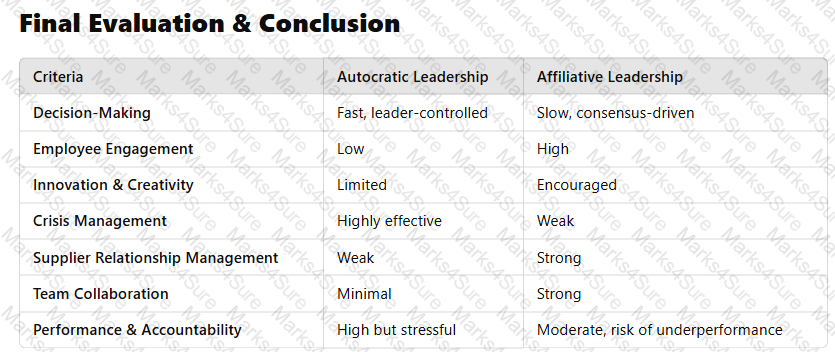 A screenshot of a computer
AI-generated content may be incorrect.
A screenshot of a computer
AI-generated content may be incorrect.
Which Leadership Style is Best for Procurement?
For short-term crises, regulatory compliance, or high-risk procurement → Autocratic Leadership is better.
For long-term supplier management, teamwork, and innovation → Affiliative Leadership is more effective.
A balanced approach (situational leadership) that combines elements of both styles is often the most effective strategy in procurement.
This evaluation provides a structured, detailed comparison that aligns with CIPS L6M1 exam expectations.
ABC Ltd is a consultancy organisation which employs 30 members of staff, all of whom work from a single office. Traditionally all record keeping has been paper-based. Mohammed, the CEO, has decided to implement electronic systems. Discuss the following methods of change Mohammed could use, explaining advantages and disadvantages of each: planned, incremental and revolutionary. Which style should Mohammed use? (25 points).
Options:
Answer:
See the Answer is the explanation.
Explanation:
Overall explanation
Below you will find how you can plan and draft the essay. Remember this is an example of one way you could approach the question. At Level 6 the questions are much more open so your response may be completely different and that's okay.
Essay Plan
Intro – what is change management?
P1 – planned
P2 – incremental
P3 – revolutionary
Conclusion – planned is best
Example Essay
Change management is a set of processes and strategies aimed at helping an organization smoothly transition from its current state to a desired future state. Mohammed, the CEO of ABC Ltd, aims to transition his consultancy organization from traditional paper-based record-keeping to electronic systems. To navigate this change effectively, Mohammed can consider various change management approaches, each with their own advantages and disadvantages:
Planned Change : Planned change is a methodical and structured approach to implementing change. It involves careful planning, preparation, and a well-defined roadmap for transitioning from the old paper-based system to the new electronic one. It typically minimizes disruption and resistance by providing employees with a clear understanding of the process. Mohammed could use a Ghantt chart and other tools so that everyone knows what is happening when: for example he could introduce the electronic systems department by department, for example having the HR department use it first, then after a month roll it out to other departments.
Advantages : Planned change offers predictability and allows for detailed planning and risk management. It also offers the lowest disruption; it gives employees an option to adapt gradually, reducing disruptions to daily operations and since the change is well-communicated and organized, it can effectively address employee resistance.
Disadvantages : Slower Implementation: It may take time to implement planned changes fully, potentially delaying the realization of benefits.
Incremental Change : Incremental change involves making small, manageable changes over time. This approach prioritizes gradual progress and can be less disruptive, as employees adapt step by step. For ABC Ltd this may be that each employee gets access to the system to do some aspects of their job first, then after a while they gain access to another part of the system and so fourth, until all actions are completed electronically rather than on paper.
Advantages : As this change method involves several steps, it reduces potential resistance to the change. It also provides Mohammed with a lower risk: Smaller changes are easier to monitor and adjust, lowering the risk of implementation issues. If the electronic system has a bug, this can be fixed quickly before doing away with the old paper system.
Disadvantages : The main disadvantage to this approach is similar to that of the planned approach- there is a prolonged transition: implementing changes incrementally may extend the transition period, delaying the full benefits.
Revolutionary Change : Revolutionary change entails a swift and complete shift from the old system to the new one. It aims for rapid transformation but can be highly disruptive and stressful for employees. This means Mohammed would introduce the system without warning, overnight.
Advantages : Revolutionary change can lead to quick results and immediate benefits. It is possible that employees may be more committed to using the new system due to the sense of urgency associated with this approach. They don’t get a choice or time to moan about the change- they have to simply get on and use the new system.
Disadvantages : High Disruption: The speed of change may lead to stress, resistance, and potential issues. It also comes with a higher risk of Failure: inadequate planning and adjustment time can increase the risk of implementation failure. If the new system has bugs, but Mohammed has done away with the old paper-based system, this may result in staff not being able to do any work.
Conclusion:
In the context of ABC Ltd's transition to electronic record-keeping, a planned change approach appears to be the most suitable. This approach offers a methodical, structured, and predictable transition process. It allows Mohammed to carefully plan and manage risks while minimizing disruptions to daily operations. Additionally, it is well-equipped to address any resistance that may arise during the change process. Considering these advantages, a planned change approach aligns well with the organization's need for a smooth and effective transition to electronic systems while ensuring the best chance for success.
Tutor Notes
- This question asks you to pick one of the options, so don’t sit on the fence here. Of those listed, planned or incremental would probably be the obvious choice, as revolutionary change is really risky for this scenario. Revolutionary change is associated more with responding to emergencies or creative tasks, rather than introducing a new IT system. Introducing an IT system really should be done slowly, as it allows time to sort any issues and get people on board and trained using it.
- A question on different types of change could also ask about emergent change- so make sure you’re familiar with this as well.
It has recently come to light that Fakeborough City Council has been engaging in discriminatory labour practices. These allogations include paying male employees more than female employees for completing the same type of work and excluding some employees from promotional opportunities for no good reason. Discuss how employees at Fakeborough City Council can deal with discrimination at work, and the risks that Fakeborough City Council are currently facing. (25 points).
Options:
Answer:
See the Answer is the explanation.
Explanation:
Overall explanation
Below you will find how you can plan and draft the essay. Remember this is an example of one way you could approach the question. At Level 6 the questions are much more open so your response may be completely different and that's okay.
Essay Plan
Introduction – discrimination undermines principles of fairness, equality and justice
Section 1: Employees should: use internal reportinc mechanisms, seek legal advice, talk to union, use ADR, keep records
Section 2: Council’s risks: legal, reputational, productivity, loss of talented staff, regulatory scrutiny
Conclusion: Council needs to promptly address these issues
Example Essay
Discrimination in the workplace is a grave issue that undermines the principles of fairness, equality, and justice. In this essay, we will discuss how employees at Fakeborough City Council can deal with discrimination at work and the risks currently faced by the council as a result of these discriminatory practices.
Dealing with Discrimination at Work:
Internal Reporting Mechanisms: Employees should utilize internal reporting mechanisms established by Fakeborough City Council to address discrimination issues. These mechanisms typically include channels for lodging complaints, such as HR departments or designated ombudsman officers. There may also be a whistleblowing channel which would inform senior leaders of issues such as the pay gap between male and female workers. By reporting incidents, employees can initiate formal investigations into these types of discriminatory practices.
Seek Legal Advice: If internal mechanisms do not yield satisfactory results or if employees fear retaliation, seeking legal advice from employment law specialists is a viable option. Legal professionals can provide guidance on pursuing legal remedies, such as filing discrimination claims with employment tribunals or courts. One way to do this may be for the employees at Fakeborough Council to speak to their trade unions or workers' councils, which could help individuals collectively address discrimination concerns. These representatives can negotiate with the council on behalf of affected employees and advocate for fair and equal treatment.
Document Incidents: Employees should keep detailed records of discriminatory incidents, including dates, times, locations, witnesses, and any relevant communication or documentation. These records can serve as valuable evidence in any legal proceedings or internal investigations.
Seek Mediation or Conciliation: Mediation or conciliation services can be explored as alternative dispute resolution methods. These processes aim to facilitate constructive dialogue between employees and the council to resolve discrimination issues amicably.
Risks Faced by Fakeborough City Council:
Legal Consequences: Fakeborough City Council is at risk of facing legal consequences if discrimination allegations are substantiated. If they are found to have paid male workers more than female workers, this would be in violation of the Equalities Act 2010. Consequences of a breach of this legislation may involve fines and compensation payments to affected employees.
Reputational Damage: Discrimination revelations can lead to significant reputational damage for the council. Negative media coverage and public backlash can erode public trust and support, making it challenging to attract and retain talent or secure funding for essential projects. As this is a public sector organisation, Fakeborough do not need to worry about loss to profits, as a private company would in a similar situation, however, damage to reputation could have other financial impacts such as losing out on opportunities. For example losing the opportunity to host events such as sporting events in the city because the event organisers don't want to be associated with the Council, or losing funding from central government.
Employee Morale and Productivity: Discrimination negatively impacts employee morale and productivity. Employees may disengage from their work, leading to decreased productivity, absenteeism, and high turnover rates, which can further strain the council's resources. This is particularly true when opportunities to advance are not equal. For example if Fakeborough council are only promoting white employees, then employees of other ethnicities will be disincentivised from working hard as they know that their work will not be compensated or rewarded.
Regulatory Scrutiny: Regulatory bodies, including the Equality and Human Rights Commission (EHRC) in the UK, may investigate Fakeborough City Council's employment practices if discrimination allegations arise. This can result in further legal obligations and potential penalties.
Loss of Talent: Discriminatory practices can drive away talented employees who seek workplaces with fair and inclusive cultures. This can result in a loss of valuable human capital, hindering the council's ability to deliver services effectively.
In conclusion, addressing discriminatory labour practices at Fakeborough City Council requires employees to use internal reporting mechanisms, seek legal advice, engage with employee representatives, document incidents, and explore mediation or conciliation. The council faces significant risks, including legal consequences, reputational damage, diminished employee morale and productivity, regulatory scrutiny, and the loss of talent. It is in the council's best interest to promptly address and rectify discriminatory practices to foster a fair, inclusive, and productive work environment while mitigating these risks.
Discuss 5 different sources of power an individual can have in the working environment. Explain who in an organisation may have this type of power and the pros and cons to each (25 points)
Options:
Answer:
See the Answer is the explanation.
Explanation:
Sources of Power in the Workplace: Types, Organizational Roles, and Their Pros & Cons
Power in the workplace influences decision-making, leadership effectiveness, and team dynamics. French and Raven’s five sources of power — legitimate, reward, coercive, expert, and referent power —are commonly found in organizational settings. Each type of power has advantages and disadvantages , depending on how it is used. This essay explores these five sources of power, their typical holders within an organization, and their pros and cons.
1. Legitimate Power
Definition:
Legitimate power is derived from a formal position or authority within an organization. It comes from the structure of the company rather than an individual’s personal qualities.
Who Holds This Power?
CEOs, Directors, Managers, Supervisors, Team Leaders
Example: A Procurement Director has legitimate power to approve supplier contracts.
Pros:
✔ Provides clear authority and structure in decision-making. ✔ Helps maintain order and accountability in an organization. ✔ Employees respect and follow official leaders.
Cons:
✘ Can lead to resistance if employees feel decisions are made without consultation . ✘ Overuse of authority can create a rigid, bureaucratic environment . ✘ Power is temporary —losing the title means losing authority.
2. Reward Power
Definition:
Reward power is the ability to influence behavior by offering incentives such as bonuses, promotions, pay raises, or recognition .
Who Holds This Power?
HR Managers, CEOs, Procurement Heads, Line Managers
Example: A Procurement Manager offers performance bonuses to encourage supplier cost reductions.
Pros:
✔ Motivates employees to achieve goals. ✔ Encourages high performance and engagement . ✔ Helps reinforce positive behaviors in the workplace.
Cons:
✘ Can create entitlement issues —employees may expect rewards for all tasks. ✘ If rewards are inconsistent , it can lead to demotivation . ✘ Over-reliance on rewards may reduce intrinsic motivation (employees only work for rewards, not passion).
3. Coercive Power
Definition:
Coercive power comes from the ability to punish or enforce negative consequences for poor performance, non-compliance, or misconduct.
Who Holds This Power?
Supervisors, Compliance Officers, HR Managers, Security Heads
Example: A Chief Compliance Officer enforces penalties for unethical procurement practices .
Pros:
✔ Ensures discipline and adherence to company policies. ✔ Helps prevent unethical behavior (e.g., fraud in procurement). ✔ Encourages employees to meet deadlines and expectations .
Cons:
✘ Creates fear and resentment among employees. ✘ Can lead to low morale and high turnover . ✘ Not effective long-term —employees may comply out of fear, not respect .
4. Expert Power
Definition:
Expert power comes from specialized knowledge, skills, or expertise that make an individual valuable in the workplace.
Who Holds This Power?
Subject Matter Experts (SMEs), Senior Engineers, IT Specialists, Procurement Analysts
Example: A Procurement Data Analyst has expert power by using big data analytics to improve supply chain efficiency .
Pros:
✔ Encourages trust and credibility among employees. ✔ Expertise is highly valuable —companies rely on knowledgeable individuals. ✔ Individuals with expert power often gain influence without formal authority .
Cons:
✘ Power is limited to specific expertise —not useful outside their domain. ✘ If not shared, expertise can lead to knowledge hoarding (lack of collaboration). ✘ Overconfidence in expertise can make individuals resistant to learning new approaches .
5. Referent Power
Definition:
Referent power is based on charisma, respect, and personal influence rather than authority or knowledge.
Who Holds This Power?
Charismatic Leaders, Mentors, Senior Employees with Strong Relationships
Example: A Senior Procurement Executive with strong leadership qualities inspires the team to embrace change.
Pros:
✔ Creates loyalty and trust among employees. ✔ Can be used to influence without authority . ✔ Helps in mentoring and developing future leaders .
Cons:
✘ Can be subjective —depends on personality and relationships. ✘ Overuse can lead to favoritism and bias in decision-making . ✘ Can be ineffective if employees do not personally respect the leader .
Conclusion
In any workplace, different individuals hold different types of power based on their role, expertise, and relationships . While legitimate, reward, coercive, expert, and referent power all contribute to leadership and decision-making, each has its own advantages and drawbacks . Effective leaders and procurement professionals must balance these power sources strategically , ensuring that authority is respected , motivation is sustained , discipline is enforced fairly , expertise is valued , and personal influence is used ethically .
Fred has recently been promoted from a Procurement Executive to Head of Procurement at Silly Name Company. Having worked in the procurement department of Silly Name Company for over 15 years, he has many ideas of how to improve the department, some of them radical. How can Fred assess the readiness of the department to change? How would this impact his decisions to introduce his desired changes? (25 points)
Options:
Answer:
See the Answer is the explanation.
Explanation:
Assessing Readiness for Change and Decision-Making: Fred’s Approach as Head of Procurement
Fred’s recent promotion from Procurement Executive to Head of Procurement at Silly Name Company presents him with an opportunity to implement his ideas for departmental improvement . However, as someone who has worked in the same organization for 15 years , Fred must first assess the department’s readiness for change before implementing radical reforms . Failure to do so could lead to resistance, disruption, and inefficiency . This essay explores how Fred can evaluate change readiness , and how this assessment will influence his decision-making .
Assessing the Readiness for Change
To successfully introduce changes in procurement , Fred must evaluate key factors that determine whether the department is ready to accept and implement new ideas .
1. Understanding the Organizational Culture
Fred should assess whether the company culture supports innovation and change or prefers stability and routine .
Indicators of Readiness: ✔ A culture that embraces innovation and continuous improvement . ✔ Employees who actively propose new ideas and improvements.
Potential Barriers: ✘ A culture resistant to change, where employees prefer "the way things have always been done." ✘ A history of failed change initiatives , causing skepticism.
Assessment Method: ✔ Surveys or feedback sessions to gauge employee attitudes toward change. ✔ Observing past change efforts —were they successful or met with resistance?
2. Evaluating Employee Buy-in and Mindset
Fred needs to assess whether employees are open to new ways of working or if they fear change due to job security concerns, workload increases, or lack of skills.
Indicators of Readiness: ✔ Employees express willingness to adopt new tools and processes. ✔ Staff members demonstrate adaptability to past procedural updates.
Potential Barriers: ✘ Employees fear that changes might make their jobs redundant . ✘ Resistance due to lack of understanding or training .
Assessment Method: ✔ Conduct one-on-one discussions or anonymous surveys on employee perceptions of change. ✔ Identify change champions who are enthusiastic about improvements.
3. Analyzing Current Processes and Pain Points
Before implementing radical changes , Fred must determine if current procurement processes are inefficient or if employees feel the need for change.
Indicators of Readiness: ✔ Procurement staff express frustration with outdated systems. ✔ Frequent delays, bottlenecks, or inefficiencies in procurement processes.
Potential Barriers: ✘ Employees feel the current processes work well enough and resist changing them. ✘ Lack of data to justify why new processes would be better than existing ones .
Assessment Method: ✔ Conduct a process audit to evaluate inefficiencies. ✔ Use KPIs (Key Performance Indicators) to measure procurement effectiveness.
4. Assessing Resource Availability
Even if the department is open to change , Fred must ensure there are sufficient resources (budget, technology, and expertise) to implement his ideas.
Indicators of Readiness: ✔ A budget exists to invest in new tools, training, or staff . ✔ The organization is willing to commit resources for change implementation.
Potential Barriers: ✘ Limited financial resources may delay or scale down initiatives. ✘ Employees lack the technical skills to adapt to new procurement methods.
Assessment Method: ✔ Check the procurement budget and forecast costs for proposed changes. ✔ Evaluate if the current team has the skills needed or requires training.
5. Leadership and Senior Management Support
Without support from senior management , Fred’s efforts may not succeed . He must assess how committed leadership is to change.
Indicators of Readiness: ✔ Senior leaders prioritize procurement transformation . ✔ Executives provide clear sponsorship and communication about improvements.
Potential Barriers: ✘ Leaders have competing priorities and are not fully committed. ✘ Conflicting objectives between departments slow down decision-making.
Assessment Method: ✔ Schedule meetings with senior management to discuss alignment. ✔ Seek an executive sponsor to advocate for procurement reforms.
How Readiness Assessment Impacts Fred’s Decision-Making
After evaluating the department’s change readiness , Fred’s approach to implementing changes will depend on the findings.
1. If Readiness is High:
Fred can proceed with bigger, transformative changes .
He can introduce automation tools, new supplier strategies, or restructuring initiatives .
A detailed change management plan should be developed, outlining: ✔ Timelines for implementation. ✔ Training programs to upskill employees. ✔ Performance metrics to track improvements.
2. If Readiness is Moderate:
Fred should implement gradual, phased changes rather than radical reforms.
He may need to educate employees on the benefits of change before pushing large initiatives.
Focus on quick wins that build momentum, such as: ✔ Small process optimizations . ✔ Minor policy adjustments . ✔ Pilot projects to test new ideas before full-scale rollout.
3. If Readiness is Low:
Fred must address employee concerns first before implementing major changes.
He should focus on communication and engagement to create a culture more open to change.
Strategies to increase readiness include: ✔ Organizing workshops and discussions to explain the need for change. ✔ Showcasing case studies of successful procurement transformations . ✔ Gaining senior leadership support to drive top-down change.
Conclusion
For Fred to successfully implement his procurement transformation ideas , he must first assess whether the department is ready for change . By evaluating organizational culture, employee mindset, process efficiency, resource availability, and senior management support , he can determine the right strategy —whether to proceed with radical changes , implement gradual improvements , or first increase change readiness . His decisions should be guided by employee engagement, clear communication, and alignment with business goals , ensuring that changes enhance procurement efficiency without causing unnecessary disruption .
Discuss three of the following areas of employment law: minimum wage, overtime and holiday pay, working hours, Health and Safety at Work, equality (25 points).
Options:
Answer:
See the Answer is the explanation.
Explanation:
Overall explanation
Below you will find how you can plan and draft the essay. Remember this is an example of one way you could approach the question. At Level 6 the questions are much more open so your response may be completely different and that's okay.
Essay Plan
Intro – explain which three; minimum wage, working hours, H & S
P1 – minimum wage
P2 – working hours
P3 – H & S
Conclusion – law is always evolving
Example Essay
Employment law in the United Kingdom has evolved over the years to safeguard the rights and interests of employees while providing a framework for fair and equitable employment practices. This essay delves into three crucial areas of employment law: minimum wage, working hours, and health and safety.
Minimum Wage. The National Minimum Wage Act 1998 and subsequent amendments established the legal framework for minimum wage rates in the UK. The current legislation sets different minimum wage rates for various age groups. Currently (2023) for those aged 23 and over the minimum wage is £10.42 per hour. This is rising to £11 in 2024. Younger workers will earn less, with those on an apprenticeship, considerably less. Minimum wage legislation has significantly improved the earnings of low-paid workers and reduced income inequality. It ensures that employees receive a fair wage for their labour, promoting economic stability and social well-being.
Interestingly, not all countries have a minimum wage or set it hourly. For example in Spain, minimum wage is set out monthly (around 1000 euros/ month). Sweden doesn’t have a minimum wage at all. Sweden relies on collective bargaining agreements negotiated between employers and labour unions to determine wage rates and employment conditions. These agreements are sector-specific and cover a wide range of industries, effectively setting minimum wage standards at the industry level rather than through legislation. This approach allows for flexibility and tailoring of wage rates to different sectors of the economy but also means that minimum wage levels can vary depending on the specific collective agreement in place within a given industry.
Working Hours: The Working Time Regulations 1998 (WTR) and the EU Working Time Directive establish legal limits on working hours, rest breaks, and paid leave for workers in the UK. The WTR also introduced the concept of the "opt-out," allowing workers to voluntarily exceed the 48-hour weekly working time limit. Working time regulations promote work-life balance, protect employees from excessive working hours, and enhance health and well-being. The "opt-out" provision provides flexibility but must be implemented with respect to workers' rights. It is common in the UK for Junior Doctors to opt out to ensure they have enough time to complete their training within a specific timeframe. Some training programs require a certain number of hours or procedures to be completed during a specific period. Another reason for opting out is the opportunity to earn more money, particularly if overtime is paid at a high rate.
Health and Safety: The Health and Safety at Work Act 1974 is the cornerstone of health and safety legislation in the UK. It places duties on employers to ensure the health, safety, and welfare of their employees, as well as others affected by their work activities. Specific regulations, such as the Management of Health and Safety at Work Regulations 1999, provide additional guidance. One of the main areas this legislation covers is the importance of completing risk assessments. The case of R v. Tangerine Confectionery Ltd (2018) emphasized the importance of risk assessments in preventing workplace accidents. The company was fined for failing to adequately assess the risk of an employee's arm getting trapped in a machine, resulting in serious injury. Health and Safety legislation has led to safer workplaces, reduced accident rates, and improved employee well-being. Employers are legally obligated to identify and mitigate workplace risks, ensuring the protection of their workforce.
In conclusion, UK employment law, encompassing minimum wage, working hours, and health and safety, plays a pivotal role in safeguarding employees' rights, promoting fair labour practices, and ensuring safe working environments. As employment dynamics continue to evolve, it is imperative that employment law remains adaptable, responsive, and protective of employees in an ever-changing work landscape.
PDF + Testing Engine

Testing Engine
PDF (Q&A)