
- Home
- CIPS
- CIPS Level 6 Professional Diploma in Procurement and Supply
- L6M2
- Global Commercial Strategy Questions and Answers
Free Practice Questions for the CIPS Level 6 Professional Diploma in Procurement and Supply L6M2 Exam (2026 Updated)
At Marks4sure, we are dedicated to providing IT professionals with the most accurate and reliable preparation materials for the CIPS L6M2 exam. To support your certification journey, we have made a selection of our premium 2026 CIPS Level 6 Professional Diploma in Procurement and Supply practice questions and answers available completely free. You can take this practice test as many times as you need. Every question includes a detailed, expertly verified explanation to ensure you fully grasp the core security concepts before test day.
Explain the characteristics of strategic decisions. At what level of a business are strategic decisions made and why?
Options:
Answer:
See the complete answer below in Explanation.
Explanation:
Characteristics of Strategic Decisions
Strategic decisions are long-term, high-impact choices that shape a company’s future direction. These decisions differ from operational and tactical decisions in several key ways:
Long-Term Focus – Strategic decisions determine the future direction of a business, often spanning several years. ???? Example: A company deciding to expand into international markets.
Significant Impact – They affect the entire organization , influencing growth, profitability, and market positioning. ???? Example: A shift from a brick-and-mortar retail model to an e-commerce-based approach .
Resource Intensive – They require large financial, human, and technological resources to implement. ???? Example: Investing in AI-driven supply chain automation .
High Risk and Uncertainty – These decisions involve considerable risks due to market changes, competition, and external factors . ???? Example: Entering an emerging market with regulatory and political risks .
Difficult to Reverse – Strategic decisions are not easily changed without significant costs or consequences. ???? Example: Mergers and acquisitions require extensive planning and are challenging to undo.
Cross-Functional Involvement – They require input from multiple departments (finance, marketing, operations, IT). ???? Example: A new product launch involves R & D, marketing, supply chain, and finance teams .
Aimed at Gaining Competitive Advantage – The goal is to improve the company’s market position and long-term success . ???? Example: Tesla’s focus on electric vehicle technology and charging infrastructure .
At What Level Are Strategic Decisions Made?
Strategic decisions are made at the corporate and business levels , typically by senior management and executives. The three levels of decision-making in a company are:
1. Corporate-Level Decisions (Top Management)
Made by the CEO, Board of Directors, and Senior Executives .
Concerned with the overall direction of the company.
Focuses on long-term objectives, market expansion, mergers & acquisitions .
Example: Amazon’s decision to acquire Whole Foods to expand into the grocery industry.
2. Business-Level Decisions (Middle Management)
Made by Divisional Heads, Business Unit Managers, and Senior Functional Leaders .
Focuses on how to compete effectively within a specific industry or market .
Covers areas such as pricing, product differentiation, and operational efficiency .
Example: Netflix shifting from a DVD rental business to a streaming service.
3. Functional-Level Decisions (Operational Managers)
Made by Department Heads, Operational Managers, and Team Leaders .
Concerned with day-to-day implementation of strategic and business-level plans.
Focuses on efficiency, productivity, and execution of company strategy .
Example: A supply chain manager optimizing inventory levels to reduce costs.
Why Are Strategic Decisions Made at the Corporate and Business Levels?
Require Vision and Expertise – Senior executives have the big-picture perspective needed for long-term planning.
Affect the Entire Organization – These decisions impact multiple departments, requiring cross-functional coordination.
High-Risk and Costly – Strategic choices involve financial investments, brand reputation, and market positioning .
Long-Term Focus – Corporate-level leaders ensure that decisions align with the company’s mission, vision, and goals .
Conclusion
Strategic decisions shape the company’s future, requiring careful planning, significant investment, and risk assessment. They are made at the corporate and business levels because they impact the entire organization , require expert leadership , and have long-term consequences .
XYZ is a successful cake manufacturer and wishes to expand the business to create additional confectionary items. The expansion will require the purchase of a further manufacturing facility, investment in machinery and the hiring of more staff. The CEO and CFO are confident that the diversification will be a success and are discussing ways to raise funding for the expansion and are debating between dept funding and funding. What are the advantages and disadvantages of each approach?
Options:
Answer:
See the complete answer below in Explanation.
Explanation:
Evaluation of Debt Funding vs. Equity Funding for XYZ’s Expansion
Introduction
As XYZ, a successful cake manufacturer , plans to expand into additional confectionery items , it requires significant investment in a new manufacturing facility, machinery, and staff . To finance this expansion, the company must choose between:
Debt Funding – Borrowing from banks or financial institutions.
Equity Funding – Raising capital by selling shares to investors.
Each funding option has advantages and disadvantages that impact financial stability, ownership control, and long-term business strategy .
1. Debt Funding ???? (Loans, Bonds, or Credit Facilities)
Definition
Debt funding involves borrowing money from banks, lenders, or issuing corporate bonds, which must be repaid with interest.
✅ Key Characteristics:
The company retains full ownership and decision-making control .
Loan repayments are fixed and predictable.
Interest payments are tax-deductible .
???? Example: XYZ takes a bank loan of £2 million to purchase new machinery and repay it over five years with interest.
Advantages of Debt Funding
✔ Ownership Retention – XYZ keeps full control over business decisions. ✔ Predictable Repayment Plan – Fixed monthly payments make financial planning easier. ✔ Tax Benefits – Interest payments reduce taxable income . ✔ Shorter-Term Obligation – Once the loan is repaid, there are no further obligations.
Disadvantages of Debt Funding
❌ Repayment Pressure – Regular repayments increase financial risk during slow sales periods. ❌ Interest Costs – High-interest rates can reduce profitability . ❌ Collateral Requirement – Lenders may require company assets as security . ❌ Credit Risk – If XYZ fails to repay, it risks losing assets or damaging credit ratings .
???? Best for: Companies that want to maintain ownership and have stable revenue streams to cover repayments.
2. Equity Funding ???? (Selling Shares to Investors or Venture Capitalists)
Definition
Equity funding involves raising capital by selling shares in the company to investors, such as private investors, venture capitalists, or the stock market .
✅ Key Characteristics:
No repayment obligations, but shareholders expect a return on investment (ROI) .
Investors gain partial ownership and may influence business decisions.
Funding amount depends on the company’s valuation and investor interest .
???? Example: XYZ sells 20% of its shares to a private investor for £3 million , which funds new production lines.
Advantages of Equity Funding
✔ No Repayment Obligation – Reduces financial burden on cash flow. ✔ Access to Large Capital – Easier to raise significant funds for expansion. ✔ Attracts Strategic Investors – Investors may provide expertise and industry connections. ✔ Spreads Business Risk – Losses are shared with investors, reducing pressure on XYZ.
Disadvantages of Equity Funding
❌ Loss of Ownership & Control – Investors gain a say in company decisions. ❌ Profit Sharing – Dividends or profit-sharing reduce earnings for existing owners. ❌ Longer Decision-Making Process – Raising equity capital takes time due to negotiations and regulatory compliance. ❌ Dilution of Shares – Selling shares reduces the founder’s ownership percentage.
???? Best for: Companies needing large funding amounts with less repayment pressure , but willing to share ownership and decision-making .
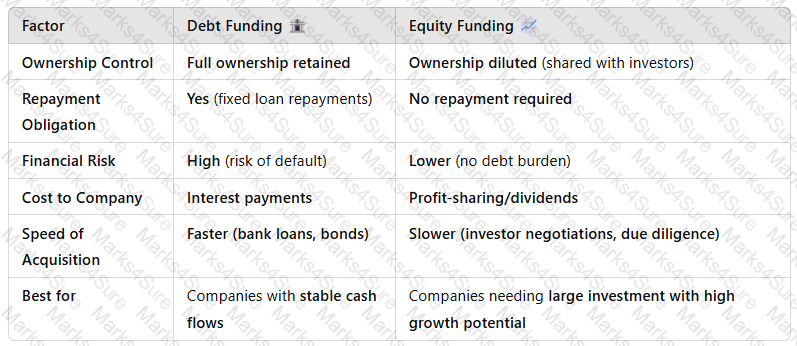
3. Comparison: Debt vs. Equity Funding
 A screenshot of a computer screen
Description automatically generated
A screenshot of a computer screen
Description automatically generated
Key Takeaway: The choice between debt and equity funding depends on XYZ’s risk tolerance, cash flow stability, and long-term growth strategy .
4. Conclusion & Recommendation
Both debt funding and equity funding offer advantages and risks for XYZ’s expansion.
✅ Debt funding is ideal if XYZ wants to retain ownership and has stable revenue to cover loan repayments. ✅ Equity funding is better if XYZ seeks larger investments, strategic expertise, and reduced financial risk .
???? Recommended Approach: A hybrid strategy , combining debt for short-term capital needs and equity for long-term growth , can provide financial flexibility while minimizing risks .
XYZ is a construction firm which builds houses in Birmingham. Discuss a tool that it can use to assess the remote environment and discuss a tool it can use to evaluate the operating environment.
Options:
Answer:
See the complete answer below in Explanation.
Explanation:
Environmental Analysis Tools for XYZ Construction Firm
To make strategic decisions, XYZ Construction needs to assess both the remote environment (external macro factors) and the operating environment (industry-specific and competitive factors). Two widely used tools for these assessments are:
PESTLE Analysis – for analyzing the remote environment
Porter’s Five Forces – for evaluating the operating environment
1. Assessing the Remote Environment: PESTLE Analysis
Tool: PESTLE Analysis helps organizations evaluate macro-environmental factors that impact long-term business strategy.
???? Why use PESTLE? It identifies external influences (political, economic, social, technological, legal, and environmental) that XYZ cannot control but must respond to.
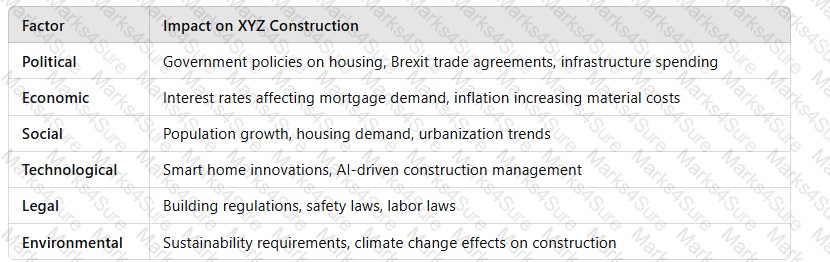
PESTLE Analysis for XYZ Construction:
 A screenshot of a web page
Description automatically generated
A screenshot of a web page
Description automatically generated
Example: If the UK government introduces new housing grants , XYZ may expand operations to capitalize on increased demand.
2. Evaluating the Operating Environment: Porter’s Five Forces
Tool: Porter’s Five Forces helps XYZ analyze industry-specific competition and market dynamics.
???? Why use Porter’s Five Forces? It helps assess competitive pressures that impact XYZ’s profitability and positioning.
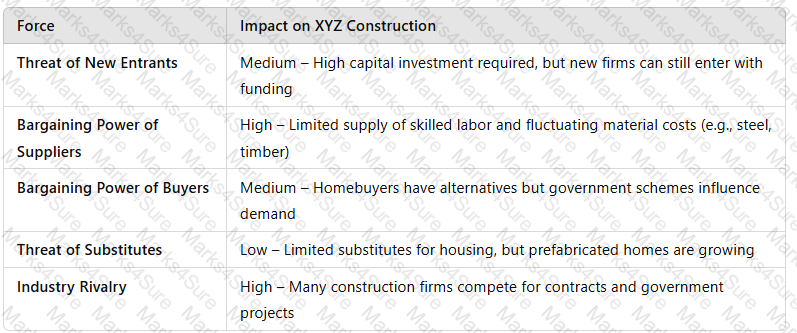
Porter’s Five Forces Analysis for XYZ Construction:
 A screenshot of a web page
Description automatically generated
A screenshot of a web page
Description automatically generated
Example: If supplier power is high due to rising material costs, XYZ must negotiate better contracts or explore alternative suppliers.
Conclusion
✅ PESTLE Analysis helps XYZ understand the external environment affecting the construction industry. ✅ Porter’s Five Forces enables XYZ to evaluate industry competition and make informed strategic choices.
Discuss the following strategic decisions, explaining the advantages and constraints of each: Market Penetration, Product Development and Market Development.
Options:
Answer:
See the complete answer below in Explanation.
Explanation:
Evaluation of Strategic Decisions: Market Penetration, Product Development, and Market Development
Introduction
Strategic decisions in business involve selecting the best approach to grow market share, increase revenue, and sustain competitive advantage . According to Ansoff’s Growth Matrix , businesses can pursue four strategic directions :
Market Penetration (expanding sales in existing markets with existing products)
Product Development (introducing new products to existing markets)
Market Development (expanding into new markets with existing products)
Diversification (introducing new products to new markets)
This answer focuses on Market Penetration, Product Development, and Market Development , discussing their advantages and constraints .
1. Market Penetration ???? (Increasing sales of existing products in existing markets)
Explanation
Market penetration involves increasing market share by: ✅ Encouraging existing customers to buy more. ✅ Attracting competitors ’ customers. ✅ Increasing promotional efforts. ✅ Improving pricing strategies.
???? Example: Coca-Cola uses aggressive marketing, promotions, and pricing strategies to increase sales in existing markets.
Advantages of Market Penetration
✔ Low Risk – No need for new product development. ✔ Cost-Effective – Uses existing infrastructure and supply chain. ✔ Builds Market Leadership – Strengthens brand loyalty and customer retention. ✔ Quick Revenue Growth – Increased sales generate higher profits.
Constraints of Market Penetration
❌ Market Saturation – Limited growth potential if the market is already saturated. ❌ Intense Competition – Competitors may retaliate with price cuts and promotions. ❌ Diminishing Returns – Lowering prices to attract customers can reduce profitability.
???? Strategic Consideration: Businesses should assess customer demand and competitive intensity before implementing a market penetration strategy.
2. Product Development ???? (Introducing new products to existing markets)
Explanation
Product development involves launching new or improved products to meet evolving customer needs. This can include: ✅ Innovation – Developing new features or technology. ✅ Product Line Extensions – Introducing variations (e.g., new flavors, models, packaging). ✅ Customization – Tailoring products to specific customer preferences.
???? Example: Apple frequently launches new iPhone models to attract existing customers.
Advantages of Product Development
✔ Higher Customer Retention – Keeps existing customers engaged with new offerings. ✔ Brand Differentiation – Strengthens competitive advantage through innovation. ✔ Increases Revenue Streams – Expands product portfolio and market opportunities.
Constraints of Product Development
❌ High R & D Costs – Requires investment in innovation and testing. ❌ Market Uncertainty – New products may fail if not aligned with customer needs. ❌ Risk of Cannibalization – New products may reduce sales of existing products.
???? Strategic Consideration: Businesses should conduct market research, prototyping, and feasibility analysis before launching new products.
3. Market Development ???? (Expanding into new markets with existing products)
Explanation
Market development involves selling existing products in new geographical areas or customer segments . Strategies include: ✅ Expanding into international markets. ✅ Targeting new demographics (e.g., different age groups or industries). ✅ Entering new distribution channels (e.g., e-commerce, retail stores).
???? Example: McDonald’s expands into new countries , adapting its menu to local preferences.
Advantages of Market Development
✔ Access to New Revenue Streams – Increases customer base and sales. ✔ Diversifies Market Risk – Reduces dependency on a single region. ✔ Leverages Existing Products – No need for costly product innovation.
Constraints of Market Development
❌ Cultural and Regulatory Barriers – Differences in consumer behavior, legal requirements, and competition. ❌ High Entry Costs – Requires investment in marketing, distribution, and local partnerships . ❌ Operational Challenges – Managing supply chains and logistics in new markets.
???? Strategic Consideration: Businesses should conduct market analysis and risk assessments before expanding internationally.
Conclusion
Each strategic decision has unique benefits and challenges :
✅ Market Penetration is low-risk but limited by market saturation . ✅ Product Development drives innovation but requires high investment . ✅ Market Development expands revenue streams but involves cultural and regulatory challenges .
The best approach depends on a company’s competitive position, financial resources, and long-term growth objectives .
Explain how culture and historic influences can impact upon a business’s strategic decisions and positioning within the marketplace
Options:
Answer:
See the complete answer below in Explanation.
Explanation:
How Culture and Historic Influences Impact Strategic Decisions and Market Positioning
A business’s strategic decisions and positioning within the marketplace are shaped by both organizational culture and historical influences . These factors affect how a company develops strategy, interacts with customers, manages employees, and competes globally .
1. The Role of Organizational Culture in Strategic Decisions
Organizational culture is the shared values, beliefs, and behaviors within a company. It influences decision-making, innovation, and competitive advantage .
???? How Culture Affects Strategy
✅ Risk Appetite – A culture that embraces innovation (e.g., Google) will invest in R & D, while risk-averse cultures (e.g., traditional banks) focus on stability. ✅ Decision-Making Speed – Hierarchical cultures (e.g., Japanese firms) rely on consensus, while Western firms (e.g., Apple) may have centralized decision-making. ✅ Customer Engagement – A customer-centric culture (e.g., Amazon) leads to investment in personalization and AI-driven recommendations.
???? Example:
Toyota’s Kaizen Culture (Continuous Improvement) has shaped its lean manufacturing strategy , giving it a competitive advantage in cost efficiency.
2. How Historic Influences Shape Business Strategy
Historical events, past business performance, economic trends, and industry evolution shape how businesses position themselves in the marketplace .
???? How History Affects Strategy
✅ Legacy of Innovation or Conservatism – Companies with a history of innovation (e.g., IBM, Tesla) continuously push boundaries, while firms with traditional roots (e.g., British banks) focus on risk management. ✅ Economic Crises and Financial Stability – Businesses that survived financial crises (e.g., 2008 recession) tend to develop risk-averse financial strategies . ✅ Market Reputation and Consumer Perception – A strong historical reputation can be leveraged for branding (e.g., Rolls-Royce’s luxury image).
???? Example:
Lego nearly went bankrupt in the early 2000s, leading it to redefine its strategy , focus on digital gaming partnerships , and revive its brand.
3. The Influence of National and Corporate Culture on Global Positioning
When expanding globally, businesses must align their strategies with different cultural expectations .
???? How Culture Affects Global Market Entry
✅ Consumer Preferences – Fast food chains adapt menus for local cultures (e.g., McDonald's in India offers vegetarian options). ✅ Negotiation & Communication Styles – Business negotiations in China emphasize relationships ("Guanxi"), while Western firms prioritize efficiency. ✅ Leadership and Management Approaches – German firms emphasize engineering precision, while Silicon Valley firms prioritize agility and experimentation.
???? Example:
IKEA modifies store layouts in different countries—small apartments in Japan vs. large home spaces in the U.S.
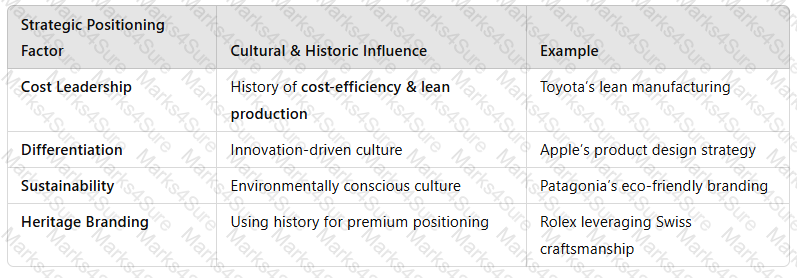
4. Strategic Positioning Based on Cultural & Historic Factors
A company’s historical and cultural influences define its positioning strategy :
 A screenshot of a white box
Description automatically generated
A screenshot of a white box
Description automatically generated
Conclusion
A business’s strategic decisions and market positioning are deeply influenced by organizational culture, national culture, and historical performance . Companies that leverage their cultural strengths and adapt to market history can achieve long-term competitive advantage .
Evaluate diversification as a growth strategy. What are the main drivers and risks?
Options:
Answer:
See the complete answer below in Explanation.
Explanation:
Evaluation of Diversification as a Growth Strategy
Introduction
Diversification is a growth strategy where a company expands into new markets or develops new products that are different from its existing offerings. It is the riskiest strategy in Ansoff’s Growth Matrix , but it can provide significant opportunities for business expansion, revenue diversification, and risk mitigation .
Diversification is driven by factors such as market saturation, competitive pressure, and technological advancements but also carries risks related to high investment costs and operational complexity .
1. Types of Diversification
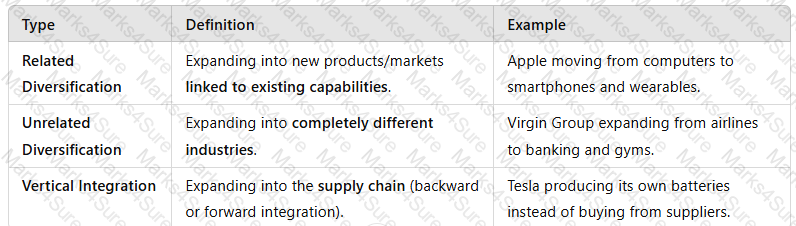 A screenshot of a computer
Description automatically generated
A screenshot of a computer
Description automatically generated
2. Main Drivers of Diversification ????
1. Market Saturation and Competitive Pressure
When a business reaches peak growth in its existing market, diversification helps find new revenue streams .
Competition forces businesses to explore new industries for continued growth.
???? Example: Amazon expanded from an online bookstore to cloud computing (AWS) due to competition and limited retail growth.
2. Risk Reduction and Business Sustainability
Diversifying reduces dependence on a single market or product .
Protects the business against economic downturns and industry-specific risks .
???? Example: Samsung operates in electronics, shipbuilding, and insurance , reducing reliance on one sector.
3. Leveraging Core Competencies and Brand Strength
Companies use existing expertise, technology, or brand reputation to enter new markets.
???? Example: Nike expanded from sportswear to fitness apps and wearable technology .
4. Technological Advancements & Market Opportunities
Digital transformation and innovation create opportunities for diversification.
Companies invest in new technologies, AI, and automation to expand their offerings.
???? Example: Google diversified into AI, smart home devices, and autonomous vehicles (Waymo) .
3. Risks of Diversification ⚠️
1. High Investment Costs & Uncertain Returns
Diversification requires significant R & D, marketing, and infrastructure investment .
ROI is uncertain, and failure can result in financial losses .
???? Example: Coca-Cola's failed diversification into the wine industry resulted in losses due to brand mismatch.
2. Lack of Expertise & Operational Challenges
Expanding into unfamiliar industries increases operational complexity and risks .
Companies may lack the expertise required for success.
???? Example: Tesco’s expansion into the US market (Fresh & Easy) failed due to a lack of understanding of American consumer behavior.
3. Dilution of Brand Identity
Expanding into unrelated sectors can confuse customers and weaken brand strength .
???? Example: Harley-Davidson’s attempt to enter the perfume market damaged its brand credibility.
4. Regulatory and Legal Barriers
Compliance with different industry regulations can be complex and costly.
???? Example: Facebook faced regulatory scrutiny when diversifying into financial services with Libra cryptocurrency .
4. Conclusion
Diversification can be a high-reward growth strategy , but it requires careful planning, market research, and strategic alignment .
✅ Main drivers include market saturation, risk reduction, leveraging expertise, and technology opportunities . ❌ Key risks include high costs, operational challenges, brand dilution, and regulatory barriers .
Companies must evaluate diversification carefully and ensure strategic fit, financial feasibility, and market demand before expanding into new industries.
XYZ is a large technology organisation which has used an aggressive growth strategy to become the market leader. It frequently buys out smaller firms to add to its increasing portfolio of businesses. How could XYZ use the Kachru Parenting Matrix to assist in decision making regarding future investments?
Options:
Answer:
See the complete answer below in Explanation.
Explanation:
Using the Kachru Parenting Matrix for XYZ’s Investment Decisions
Introduction
The Kachru Parenting Matrix is a strategic decision-making tool that helps businesses evaluate how well a parent company can add value to its subsidiaries . For XYZ, a large technology firm that follows an aggressive acquisition strategy , the Kachru Parenting Matrix can guide investment decisions by assessing the synergy between the parent company (XYZ) and its acquired businesses .
By using this matrix, XYZ can determine which acquisitions will benefit from its expertise, resources, and management style , ensuring maximum strategic alignment and value creation.
1. Explanation of the Kachru Parenting Matrix
The Kachru Parenting Matrix evaluates business units based on:
Business Unit Fit – How well the subsidiary aligns with the parent company’s core capabilities and expertise .
Parenting Advantage – The ability of the parent company to add value to the subsidiary through strategic oversight, resources, and expertise.
It categorizes business units into four quadrants , influencing investment decisions:
| Parenting Advantage →
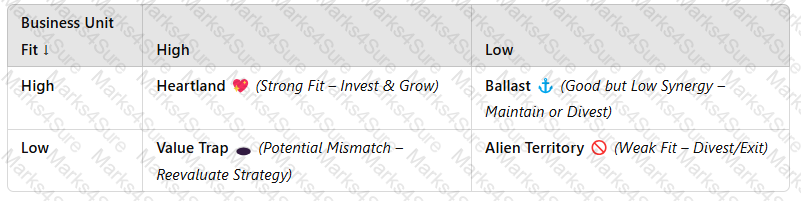 A screenshot of a computer
Description automatically generated
A screenshot of a computer
Description automatically generated
2. How XYZ Can Use the Kachru Parenting Matrix for Investment Decisions
1. Identifying Core Growth Areas – Heartland Businesses ???? (Invest & Grow)
These businesses strongly align with XYZ’s expertise and benefit from its technology, resources, and leadership .
XYZ should prioritize investment, innovation, and expansion in these areas.
???? Example: If XYZ specializes in AI and cloud computing , acquiring smaller AI startups would fall into the Heartland category, ensuring seamless integration and value creation.
✅ Strategic Action: Invest in R & D, talent acquisition, and global expansion for these subsidiaries.
2. Maintaining Complementary Businesses – Ballast Businesses ⚓ (Maintain or Divest if Needed)
These businesses are profitable but do not directly fit XYZ’s core strategy .
XYZ can keep them for financial stability or sell them if they drain management resources .
???? Example: If XYZ acquires a hardware company but primarily operates in software , the hardware unit may not fully align with its expertise .
✅ Strategic Action: Maintain for profitability or sell if it becomes a burden .
3. Avoiding Value Draining Investments – Value Trap Businesses ???? ️ (Reevaluate or Divest)
These businesses seem promising but struggle under XYZ’s management approach .
They may require too much intervention , reducing overall profitability.
???? Example: If XYZ buys a social media company but lacks the right expertise to monetize it effectively, it becomes a value trap .
✅ Strategic Action: Reevaluate if restructuring is possible; otherwise, sell to avoid financial losses.
4. Exiting Poorly Aligned Businesses – Alien Territory ???? (Divest Immediately)
These businesses do not align at all with XYZ’s strategy or expertise.
Keeping them leads to resource misallocation and inefficiencies .
???? Example: If XYZ acquires a retail clothing company , it would be in Alien Territory , as it does not fit within the technology industry .
✅ Strategic Action: Divest or spin off these businesses to focus on core competencies.
3. Strategic Benefits of Using the Kachru Parenting Matrix
✅ Improves Investment Focus – Helps XYZ identify the most valuable acquisitions . ✅ Enhances Synergy & Value Creation – Ensures subsidiaries benefit from XYZ’s resources and leadership . ✅ Prevents Poor Acquisitions – Avoids wasting capital on unrelated businesses . ✅ Optimizes Portfolio Management – Balances high-growth and stable revenue businesses .
4. Conclusion
The Kachru Parenting Matrix is a critical tool for XYZ to assess future acquisitions , ensuring that each business unit contributes to long-term profitability and strategic alignment .
✅ Heartland businesses should receive maximum investment . ✅ Ballast businesses can be maintained for financial stability . ✅ Value Trap businesses should be reevaluated or restructured . ✅ Alien Territory businesses must be divested to avoid inefficiencies .
By using this framework, XYZ can ensure smarter, more strategic acquisitions , maintaining its market leadership while avoiding financial risks .
XYX is an airline whose profits have been severely affected due to not being able to operate during a two-year pandemic. Cash reserves at the organisation are at an all time low and XYZ are looking into sources of short-term funding for working capital. Discuss four sources and suggest which one XYZ should use.
Options:
Answer:
See the complete answer below in Explanation.
Explanation:
Sources of Short-Term Funding for XYZ Airline
Introduction
XYZ, an airline with severe financial losses due to a two-year pandemic, requires short-term funding to maintain operations. With cash reserves at an all-time low , the airline needs immediate working capital to cover employee salaries, aircraft maintenance, airport fees, and fuel costs .
Short-term funding options provide temporary liquidity but come with different risks and costs. This answer evaluates four sources of short-term funding and recommends the best option for XYZ.
1. Bank Overdraft ???? (Flexible Borrowing Facility)
Explanation
A bank overdraft allows XYZ to withdraw funds beyond its available balance, up to a set limit.
✅ Advantages ✔ Flexible borrowing – Funds can be accessed as needed. ✔ Quick to arrange – Available through existing bank relationships. ✔ Interest only on borrowed amount – No need to take a large loan upfront.
❌ Disadvantages ✖ High-interest rates – Overdrafts often have higher interest than standard loans. ✖ Limited borrowing capacity – May not be enough to cover all costs. ✖ Bank may demand repayment at short notice .
???? Best for: Covering minor cash flow shortages but not large-scale operational funding .
2. Short-Term Business Loan ???? (Fixed-Term Borrowing from a Bank or Lender)
Explanation
A short-term loan provides a lump sum of cash that XYZ must repay over a set period (typically 3-12 months ).
✅ Advantages ✔ Larger funding amounts available – More substantial than overdrafts. ✔ Predictable repayment terms – Fixed monthly payments help with planning. ✔ Can be secured or unsecured – Secured loans offer lower interest rates.
❌ Disadvantages ✖ Requires repayment even if revenue is still low . ✖ Potentially high interest rates , especially for unsecured loans. ✖ Approval process may take time .
???? Best for: Covering larger operational costs like aircraft maintenance and staff salaries.
3. Sale and Leaseback of Assets ✈️ (Liquidity from Selling Existing Assets)
Explanation
XYZ can sell its aircraft or other assets to an investor or leasing company and then lease them back for continued use.
✅ Advantages ✔ Immediate cash injection without losing operational assets. ✔ No repayment burden – Unlike loans, it does not increase debt levels. ✔ Improves cash flow for essential expenses.
❌ Disadvantages ✖ Long-term cost increase – Leasing is more expensive than owning in the long run. ✖ Loss of asset ownership – Limits financial flexibility in the future. ✖ Dependent on market conditions – Aircraft resale values fluctuate.
???? Best for: Raising large capital quickly while continuing operations .
4. Government Grants or Emergency Aid ???? ️ (Public Sector Financial Assistance)
Explanation
Governments often provide financial aid or grants to struggling industries , especially airlines affected by global crises.
✅ Advantages ✔ No repayment required – Unlike loans, grants do not need to be repaid. ✔ Low risk – Does not increase financial liabilities. ✔ Supports industry stability – Governments want airlines to survive for economic reasons.
❌ Disadvantages ✖ Lengthy approval process – Bureaucratic delays may not provide immediate relief. ✖ Strict eligibility requirements – XYZ must meet conditions set by the government. ✖ Potential public criticism – Bailouts may attract negative media attention.
???? Best for: Long-term financial recovery rather than immediate short-term cash flow issues .
5. Recommendation: Best Source for XYZ
Recommended Option: ???? Sale and Leaseback of Assets ✈️
Why?
✅ Provides immediate liquidity – Essential for covering urgent operational costs. ✅ No additional debt burden – Unlike loans, it does not create financial liabilities. ✅ Ensures business continuity – XYZ can still operate leased aircraft.
Secondary Option: ???? Short-Term Loan
If sale and leaseback is not viable , a short-term business loan can be used for emergency liquidity , but it increases financial risk.
???? Final Takeaway:
Sale and Leaseback → Best for quick large-scale funding without debt.
Short-Term Loan → A backup option if leasing is unavailable.
Describe four drivers of internationalisation
Options:
Answer:
See the complete answer below in Explanation.
Explanation:
Four Key Drivers of Internationalisation
Introduction
Internationalisation refers to the process of expanding business operations into international markets . Companies expand globally to increase market share, access resources, reduce costs, and enhance competitiveness .
Several factors drive internationalisation, but the four key drivers are:
Market Drivers – Demand from global consumers.
Cost Drivers – Reducing production costs.
Competitive Drivers – Gaining an edge over rivals.
Government & Regulatory Drivers – Trade policies and incentives.
These factors influence business strategy, supply chain management, and operational efficiency in international markets.
1. Market Drivers ???? (Demand and Market Expansion)
Definition
Market drivers relate to consumer demand, global branding opportunities, and standardization of products across different markets .
✅ Why It Drives Internationalisation?
Companies seek new customers and revenue streams beyond domestic markets.
Global branding creates strong market presence and customer loyalty .
Similar customer preferences allow for product standardization and scalability .
???? Example: McDonald's expands globally by offering consistent branding and adapted menus to match local tastes.
???? Key Takeaway: Businesses expand internationally to tap into new markets, increase sales, and leverage brand recognition .
2. Cost Drivers ???? (Reducing Production and Operational Costs)
Definition
Cost drivers involve reducing manufacturing, labor, and supply chain costs by operating in lower-cost regions .
✅ Why It Drives Internationalisation?
Labor cost savings – Companies move production to low-cost countries (e.g., China, Vietnam, Mexico) .
Economies of scale – Expanding operations globally lowers per-unit costs .
Access to cheaper raw materials – Firms relocate to resource-rich countries for lower procurement costs.
???? Example: Apple manufactures iPhones in China due to lower labor costs and supplier proximity .
???? Key Takeaway: Companies internationalise to optimize costs, increase profit margins, and improve supply chain efficiency .
3. Competitive Drivers ???? (Gaining Market Advantage)
Definition
Competitive drivers push firms to expand internationally to stay ahead of rivals, access new technologies, and strengthen market positioning .
✅ Why It Drives Internationalisation?
Competing with global players forces firms to expand or risk losing market share.
First-mover advantage – Entering new markets early builds brand dominance .
Access to innovation – Expanding to regions with advanced R & D and skilled talent enhances competitiveness.
???? Example: Tesla expanded into China to compete with local EV manufacturers and dominate the world’s largest electric vehicle market.
???? Key Takeaway: Businesses internationalise to outperform competitors, access innovation, and capture strategic markets .
4. Government & Regulatory Drivers ???? ️ (Trade Policies & Incentives)
Definition
Government policies, trade agreements, and financial incentives influence how and where businesses expand internationally .
✅ Why It Drives Internationalisation?
Free Trade Agreements (FTAs) reduce tariffs, making exports/imports more attractive.
Government incentives (e.g., tax breaks, subsidies) encourage foreign investments.
Favorable regulations allow easier market entry and operations.
???? Example: Car manufacturers set up plants in Mexico due to NAFTA trade benefits and lower import tariffs into North America.
???? Key Takeaway: Businesses internationalise when government policies support market entry, trade facilitation, and investment incentives .
Conclusion
Internationalisation is driven by market demand, cost efficiencies, competitive pressures, and regulatory factors . Companies expand globally to:
✅ Access new customers and increase revenue. ✅ Reduce costs through cheaper production and labor. ✅ Stay competitive and gain market leadership. ✅ Leverage government trade policies for easier market entry.
Understanding these drivers helps businesses make informed global expansion decisions while managing risks effectively.
PDF + Testing Engine

Testing Engine
PDF (Q&A)