
Free Practice Questions for the MuleSoft Certified Architect MCIA-Level-1-Maintenance Exam (2026 Updated)
At Marks4sure, we are dedicated to providing IT professionals with the most accurate and reliable preparation materials for the MuleSoft MCIA-Level-1-Maintenance exam. To support your certification journey, we have made a selection of our premium 2026 MuleSoft Certified Architect practice questions and answers available completely free. You can take this practice test as many times as you need. Every question includes a detailed, expertly verified explanation to ensure you fully grasp the core security concepts before test day.
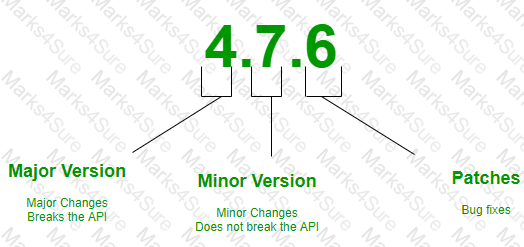
An API has been updated in Anypoint Exchange by its API producer from version 3.1.1 to 3.2.0 following accepted semantic versioning practices and the changes have been communicated via the API's public portal. The API endpoint does NOT change in the new version. How should the developer of an API client respond to this change?
 Diagram
Description automatically generated
Diagram
Description automatically generatedInsurance organization is planning to deploy Mule application in MuleSoft Hosted runtime plane. As a part of requirement , application should be scalable . highly available. It also has regulatory requirement which demands logs to be retained for at least 2 years. As an Integration Architect what step you will recommend in order to achieve this?
The AnyAirline organization's passenger reservations center is designing an integration solution that combines invocations of three different System APIs (bookFlight, bookHotel, and bookCar) in a business transaction. Each System API makes calls to a single database.
The entire business transaction must be rolled back when at least one of the APIs fails.
What is the most idiomatic (used for its intended purpose) way to integrate these APIs in near real-time that provides the best balance of consistency, performance, and reliability?
A Mule application is built to support a local transaction for a series of operations on a single database. The Mule application has a Scatter-Gather that participates in the local transaction.
What is the behavior of the Scatter-Gather when running within this local transaction?
A project team uses RAML specifications to document API functional requirements and deliver API definitions. As per the current legal requirement, all designed API definitions to be augmented with an additional non-functional requirement to protect the services from a high rate of requests according to define service level agreements.
Assuming that the project is following Mulesoft API governance and policies, how should the project team convey the necessary non-functional requirement to stakeholders?
A mule application must periodically process a large dataset which varies from 6 GB lo 8 GB from a back-end database and write transform data lo an FTPS server using a properly configured bad job scope.
The performance requirements of an application are approved to run in the cloud hub 0.2 vCore with 8 GB storage capacity and currency requirements are met.
How can the high rate of records be effectively managed in this application?
An organization is implementing a Quote of the Day API that caches today's quote. What scenario can use the CloudHub Object Store connector to persist the cache's state?
An insurance company is implementing a MuleSoft API to get inventory details from the two vendors. Due to network issues, the invocations to vendor applications are getting timed-out intermittently. But the transactions are successful upon reprocessing
What is the most performant way of implementing this requirement?
A Mule application is being designed for deployment to a single CloudHub worker. The Mule application will have a flow that connects to a SaaS system to perform some operations each time the flow is invoked.
The SaaS system connector has operations that can be configured to request a short-lived token (fifteen minutes) that can be reused for subsequent connections within the fifteen minute time window. After the token expires, a new token must be requested and stored.
What is the most performant and idiomatic (used for its intended purpose) Anypoint Platform component or service to use to support persisting and reusing tokens in the Mule application to help speed up reconnecting the Mule application to the SaaS application?
An organization is designing multiple new applications to run on CloudHub in a single Anypoint VPC and that must share data using a common persistent Anypoint object store V2 (OSv2).
Which design gives these mule applications access to the same object store instance?
An organization is creating a Mule application that will be deployed to CloudHub. The Mule application has a property named dbPassword that stores a database user’s password.
The organization's security standards indicate that the dbPassword property must be hidden from every Anypoint Platform user after the value is set in the Runtime Manager Properties tab.
What configuration in the Mule application helps hide the dbPassword property value in Runtime Manager?
How does timeout attribute help inform design decisions while using JMS connector listening for incoming messages in an extended architecture (XA) transaction?
A system API EmployeeSAPI is used to fetch employee's data from an underlying SQL database.
The architect must design a caching strategy to query the database only when there is an update to the employees stable or else return a cached response in order to minimize the number of redundant transactions being handled by the database.
What must the architect do to achieve the caching objective?
A trading company handles millions of requests a day. Due to nature of its business, it requires excellent
performance and reliability within its application.
For this purpose, company uses a number of event-based API's hosted on various mule clusters that communicate across a shared message queue sitting within its network.
Which method should be used to meet the company's requirement for its system?
A company is building an application network and has deployed four Mule APIs: one experience API, one process API, and two system APIs. The logs from all the APIs are aggregated in an external log aggregation tool. The company wants to trace messages that are exchanged between multiple API implementations. What is the most idiomatic (based on its intended use) identifier that should be used to implement Mule event tracing across the multiple API implementations?
A Mule application is built to support a local transaction for a series of operations on a single database. The mule application has a Scatter-Gather scope that participates in the local transaction.
What is the behavior of the Scatter-Gather when running within this local transaction?
An organization has deployed runtime fabric on an eight note cluster with performance profile. An API uses and non persistent object store for maintaining some of its state data. What will be the impact to the stale data if server crashes?
A company is modernizing its legal systems lo accelerate access lo applications and data while supporting the adoption of new technologies. The key to achieving this business goal is unlocking the companies' key systems and dala including microservices miming under Docker and kubernetes containers using apis.
Considering the current aggressive backlog and project delivery requirements the company wants to take a strategic approach in the first phase of its transformation projects by quickly deploying API's in mule runtime that are able lo scale, connect to on premises systems and migrate as needed.
Which runtime deployment option supports company's goals?
When the mule application using VM is deployed to a customer-hosted cluster or multiple cloudhub workers, how are messages consumed by the Mule engine?
A company is planning to migrate its deployment environment from on-premises cluster to a Runtime Fabric (RTF) cluster. It also has a requirement to enable Mule applications deployed to a Mule runtime instance to store and share data across application replicas and restarts.
How can these requirements be met?
As a part of business requirement , old CRM system needs to be integrated using Mule application. CRM system is capable of exchanging data only via SOAP/HTTP protocol. As an integration architect who follows API led approach , what is the the below step you will perform so that you can share document with CRM team?
To implement predictive maintenance on its machinery equipment, ACME Tractors has installed thousands of IoT sensors that will send data for each machinery asset as sequences of JMS messages, in near real-time, to a JMS queue named SENSOR_DATA on a JMS server. The Mule application contains a JMS Listener operation configured to receive incoming messages from the JMS servers SENSOR_DATA JMS queue. The Mule application persists each received JMS message, then sends a transformed version of the corresponding Mule event to the machinery equipment back-end systems.
The Mule application will be deployed to a multi-node, customer-hosted Mule runtime cluster. Under normal conditions, each JMS message should be processed exactly once.
How should the JMS Listener be configured to maximize performance and concurrent message processing of the JMS queue?
A corporation has deployed multiple mule applications implementing various public and private API's to different cloudhub workers. These API's arc Critical applications that must be highly available and in line with the reliability SLA as defined by stakeholders.
How can API availability (liveliness or readiness) be monitored so that Ops team receives outage notifications?
An organization has chosen Mulesoft for their integration and API platform.
According to the Mulesoft catalyst framework, what would an integration architect do to create achievement goals as part of their business outcomes?
What aspects of a CI/CD pipeline for Mule applications can be automated using MuleSoft-provided Maven plugins?
 Diagram
Description automatically generated
Diagram
Description automatically generatedAn insurance company has an existing API which is currently used by customers. API is deployed to customer hosted Mule runtime cluster. The load balancer that is used to access any APIs on the mule cluster is only configured to point to applications hosted on the server at port 443.
Mule application team of a company attempted to deploy a second API using port 443 but the application will not start and checking logs shows an error indicating the address is already in use.
Which steps must the organization take to resolve this error and allow customers to access both the API's?
An organization has decided on a cloud migration strategy to minimize the organization's own IT resources. Currently the organization has all of its new applications running on its own premises and uses an on-premises load balancer that exposes all APIs under the base URL ( https://api.rutujar.com ).
As part of migration strategy, the organization is planning to migrate all of its new applications and load balancer CloudHub.
What is the most straightforward and cost-effective approach to Mule application deployment and load balancing that preserves the public URL's?
An organization is using Mulesoft cloudhub and develops API's in the latest version. As a part of requirements for one of the API's, third party API needs to be called. The security team has made it clear that calling any external API needs to have include listing
As an integration architect please suggest the best way to accomplish the design plan to support these requirements?
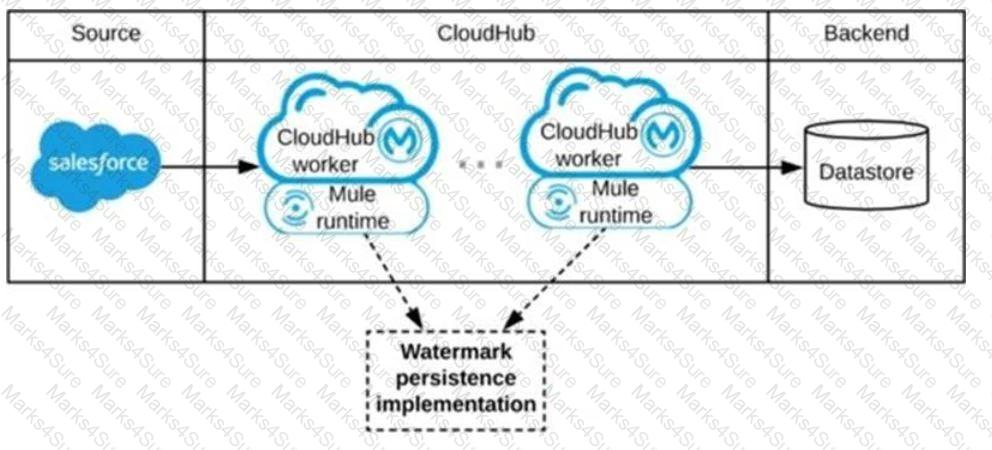
An application deployed to a runtime fabric environment with two cluster replicas is designed to periodically trigger of flow for processing a high-volume set of records from the source system and synchronize with the SaaS system using the Batch job scope
After processing 1000 records in a periodic synchronization of 1 lakh records, the replicas in which batch job instance was started went down due to unexpected failure in the runtime fabric environment
What is the consequence of losing the replicas that run the Batch job instance?
A mule application is required to periodically process large data set from a back-end database to Salesforce CRM using batch job scope configured properly process the higher rate of records.
The application is deployed to two cloudhub workers with no persistence queues enabled.
What is the consequence if the worker crashes during records processing?
As a part of project requirement, client will send a stream of data to mule application. Payload size can vary between 10mb to 5GB. Mule application is required to transform the data and send across multiple sftp servers. Due to the cost cuttings in the organization, mule application can only be allocated one worker with size of 0.2 vCore.
As an integration architect , which streaming strategy you would suggest to handle this scenario?
PDF + Testing Engine

Testing Engine
PDF (Q&A)