
Free Practice Questions for the MuleSoft Certified Architect MCIA-Level-1 Exam (2026 Updated)
At Marks4sure, we are dedicated to providing IT professionals with the most accurate and reliable preparation materials for the MuleSoft MCIA-Level-1 exam. To support your certification journey, we have made a selection of our premium 2026 MuleSoft Certified Architect practice questions and answers available completely free. You can take this practice test as many times as you need. Every question includes a detailed, expertly verified explanation to ensure you fully grasp the core security concepts before test day.
An automation engineer needs to write scripts to automate the steps of the API lifecycle, including steps to create, publish, deploy and manage APIs and their implementations in Anypoint Platform.
What Anypoint Platform feature can be used to automate the execution of all these actions in scripts in the easiest way without needing to directly invoke the Anypoint Platform REST APIs?
Refer to the exhibit.
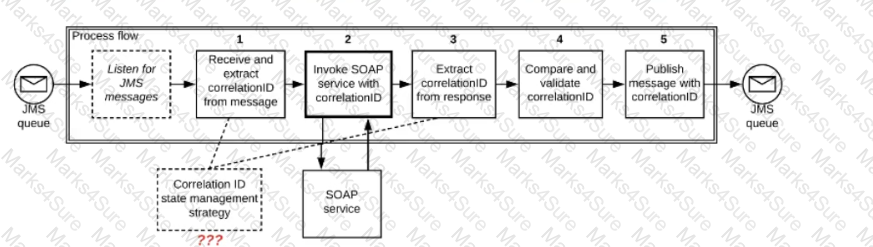
A Mule application is deployed to a multi-node Mule runtime cluster. The Mule application uses the competing consumer pattern among its cluster replicas to receive JMS messages from a JMS queue. To process each received JMS message, the following steps are performed in a flow:
Step l: The JMS Correlation ID header is read from the received JMS message.
Step 2: The Mule application invokes an idempotent SOAP webservice over HTTPS, passing the JMS Correlation ID as one parameter in the SOAP request.
Step 3: The response from the SOAP webservice also returns the same JMS Correlation ID.
Step 4: The JMS Correlation ID received from the SOAP webservice is validated to be identical to the JMS Correlation ID received in Step 1.
Step 5: The Mule application creates a response JMS message, setting the JMS Correlation ID message header to the validated JMS Correlation ID and publishes that message to a response JMS queue.
Where should the Mule application store the JMS Correlation ID values received in Step 1 and Step 3 so that the validation in Step 4 can be performed, while also making the overall Mule application highly available, fault-tolerant, performant, and maintainable?
 Diagram
Description automatically generated
Diagram
Description automatically generated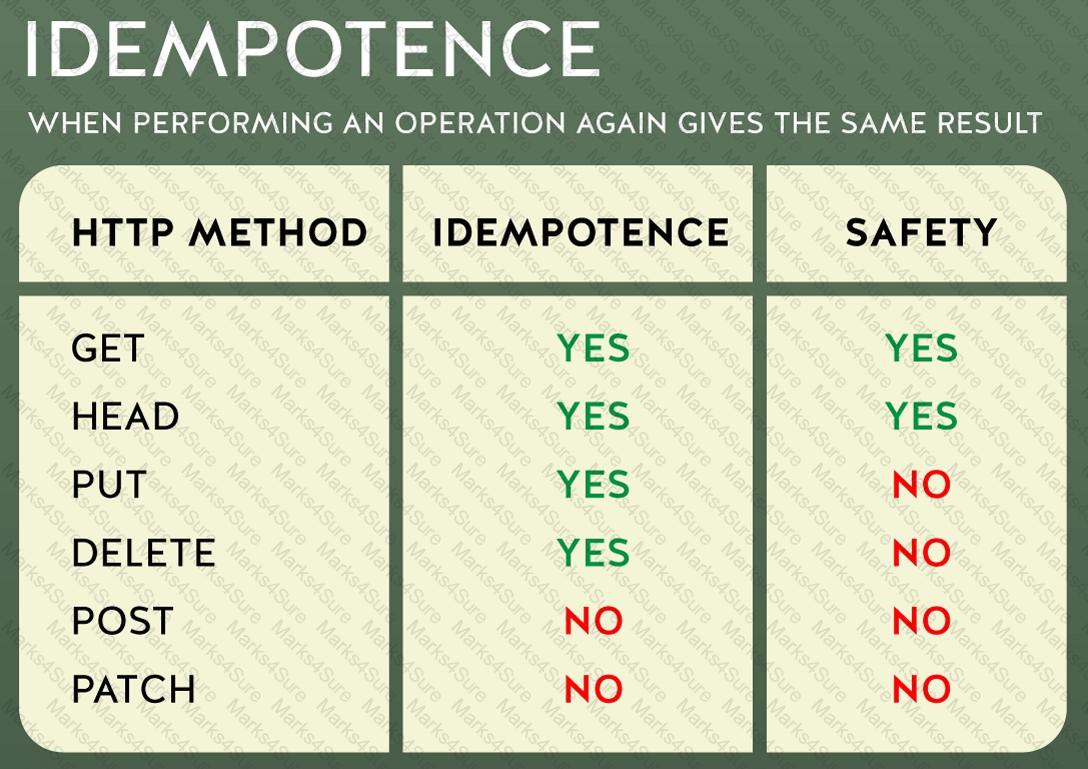 Table
Description automatically generated
Table
Description automatically generatedAn IT integration tram followed an API-led connectivity approach to implement an order-fulfillment business process. It created an order processing AP that coordinates stateful interactions with a variety of microservices that validate, create, and fulfill new product orders
Which interaction composition pattern did the integration architect who designed this order processing AP| use?
Refer to the exhibit.
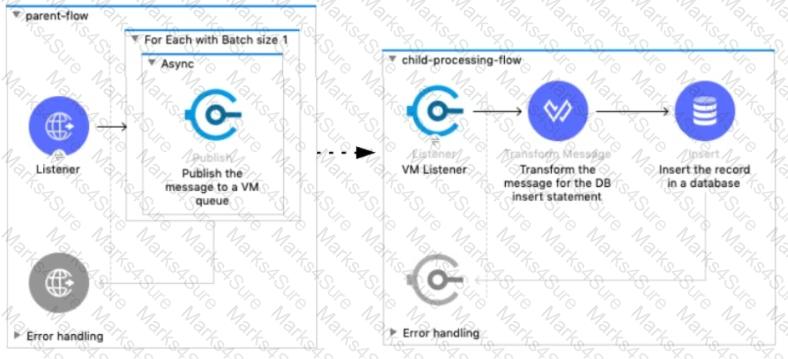
A Mule 4 application has a parent flow that breaks up a JSON array payload into 200 separate items, then sends each item one at a time inside an Async scope to a VM queue.
A second flow to process orders has a VM Listener on the same VM queue. The rest of this flow processes each received item by writing the item to a database.
This Mule application is deployed to four CloudHub workers with persistent queues enabled.
What message processing guarantees are provided by the VM queue and the CloudHub workers, and how are VM messages routed among the CloudHub workers for each invocation of the parent flow under normal operating conditions where all the CloudHub workers remain online?
An organization heeds to procure an enterprise software system to increase cross-selling opportunities and better rack prospect data.
Which category of enterprise software has these core capabilities, when used for its typical and intended purpose?
Refer to the exhibit.
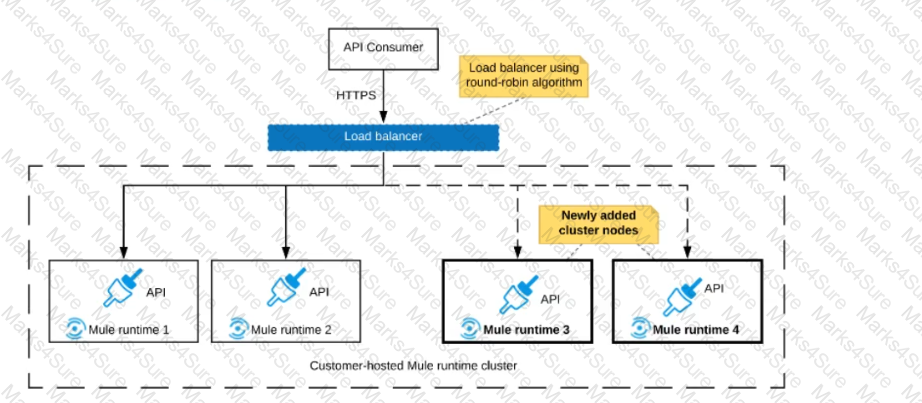
An organization uses a 2-node Mute runtime cluster to host one stateless API implementation. The API is accessed over HTTPS through a load balancer that uses round-robin for load distribution.
Two additional nodes have been added to the cluster and the load balancer has been configured to recognize the new nodes with no other change to the load balancer.
What average performance change is guaranteed to happen, assuming all cluster nodes are fully operational?
Which Exchange asset type represents a complete API specification in RAML or OAS format?
According to MuleSoft ' s IT delivery and operating model, which approach can an organization adopt in order to reduce the frequency of IT project delivery failures?
The ABC company has an Anypoint Runtime Fabric on VMs/Bare Metal (RTF-VM) appliance installed on its own customer-hosted AWS infrastructure.
Mule applications are deployed to this RTF-VM appliance. As part of the company standards, the Mule application logs must be forwarded to an external log management tool (LMT).
Given the company ' s current setup and requirements, what is the most idiomatic (used for its intended purpose) way to send Mule application logs to the external LMT?
An organization plans to use the Anypoint Platform audit logging service to log Anypoint MQ actions.
What consideration must be kept in mind when leveraging Anypoint MQ Audit Logs?
An organization has decided on a cloudhub migration strategy that aims to minimize the organizations own IT resources. Currently, the organizational has all of its Mule applications running on its own premises and uses an premises load balancer that exposes all APIs under the base URL https://api.acme.com
As part of the migration strategy, the organization plans to migrate all of its Mule applications and load balancer to cloudhub
What is the most straight-forward and cost effective approach to the Mule applications deployment and load balancing that preserves the public URLs?
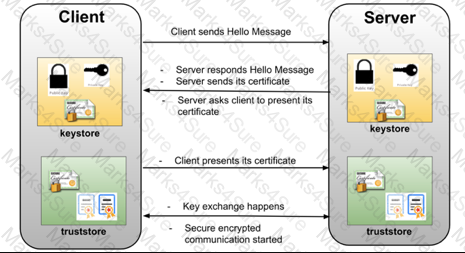
What requires configuration of both a key store and a trust store for an HTTP Listener?
Which Mulesoft feature helps users to delegate their access without sharing sensitive credentials or giving full control of accounts to 3rd parties?
According to the Internet Engineering Task Force (IETF), which supporting protocol does File Transfer Protocol (FTP) use for reliable communication?
Which of the below requirements prevent the usage of Anypoint MQ in a company ' s network? (Choose two answers)
Insurance organization is planning to deploy Mule application in MuleSoft Hosted runtime plane. As a part of requirement , application should be scalable . highly available. It also has regulatory requirement which demands logs to be retained for at least 2 years. As an Integration Architect what step you will recommend in order to achieve this?
A Mule application is synchronizing customer data between two different database systems.
What is the main benefit of using eXtended Architecture (XA) transactions over local transactions to synchronize these two different database systems?
An external REST client periodically sends an array of records in a single POST request to a Mule application API endpoint.
The Mule application must validate each record of the request against a JSON schema before sending it to a downstream system in the same order that it was received in the array
Record processing will take place inside a router or scope that calls a child flow. The child flow has its own error handling defined. Any validation or communication failures should not prevent further processing of the remaining records.
To best address these requirements what is the most idiomatic(used for it intended purpose) router or scope to used in the parent flow, and what type of error handler should be used in the child flow?
An Integration Mule application is being designed to synchronize customer data between two systems. One system is an IBM Mainframe and the other system is a Salesforce Marketing Cloud (CRM) instance. Both systems have been deployed in their typical configurations, and are to be invoked using the native protocols provided by Salesforce and IBM.
What interface technologies are the most straightforward and appropriate to use in this Mute application to interact with these systems, assuming that Anypoint Connectors exist that implement these interface technologies?
As a part of project , existing java implementation is being migrated to Mulesoft. Business is very tight on the budget and wish to complete the project in most economical way possible.
Canonical object model using java is already a part of existing implementation. Same object model is required by mule application for a business use case. What is the best way to achieve this?
A marketing organization is designing a Mule application to process campaign data. The Mule application will periodically check for a file in a SFTP location and process the records in the file. The size of the file can vary from 10MB to 5GB. Due to the limited availabiltty of vCores, the Mule application is deployed to a single CloudHub worker configured with vCore size 0.2.
The application must transform and send different formats of this file to three different downstream SFTP locations.
What is the most idiomatic (used for its intended purpose) and performant way to configure the SFTP operations or event sources to process the large files to support these deployment requirements?
According to MuleSoft, what is a major distinguishing characteristic of an application network in relation to the integration of systems, data, and devices?
A leading eCommerce giant will use MuleSoft APIs on Runtime Fabric (RTF) to process customer orders. Some customer-sensitive information, such as credit card information, is required in request payloads or is included in response payloads in some of the APIs. Other API requests and responses are not authorized to access some of this customer-sensitive information but have been implemented to validate and transform based on the structure and format of this customer-sensitive information (such as account IDs, phone numbers, and postal codes).
What approach configures an API gateway to hide sensitive data exchanged between API consumers and API implementations, but can convert tokenized fields back to their original value for other API requests or responses, without having to recode the API implementations?
Later, the project team requires all API specifications to be augmented with an additional non-functional requirement (NFR) to protect the backend services from a high rate of requests, according to defined service-level
agreements (SLAs). The NFR ' s SLAs are based on a new tiered subscription level " Gold " , " Silver " , or " Platinum " that must be tied to a new parameter that is being added to the Accounts object in their enterprise data model.
Following MuleSoft ' s recommended best practices, how should the project team now convey the necessary non-functional requirement to stakeholders?
A finance giant is planning to migrate all its Mule applications to Runtime fabric (RTF). Currently all Mule applications are deployed cloud hub using automated CI/CD scripts.
As an integration architect, which of the below step would you suggest to ensure that the applications from cloudhub are migrated properly to Runtime Fabric (RTF) with an assumption that organization is keen on keeping the same deployment strategy.
An organization is designing Mule application which connects to a legacy backend. It has been reported that backend services are not highly available and experience downtime quite often. As an integration architect which of the below approach you would propose to achieve high reliability goals?
A mule application uses an HTTP request operation to involve an external API.
The external API follows the HTTP specification for proper status code usage.
What is possible cause when a 3xx status code is returned to the HTTP Request operation from the external API?
Refer to the exhibit.
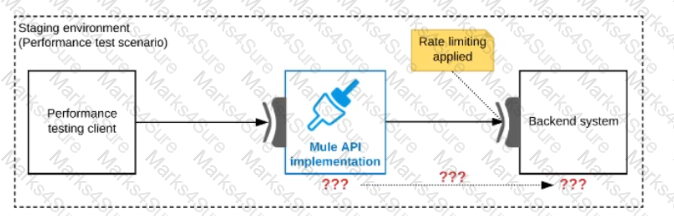
One of the backend systems invoked by an API implementation enforces rate limits on the number of requests a particular client can make. Both the backend system and the API implementation are deployed to several non-production environments in addition to production.
Rate limiting of the backend system applies to all non-production environments. The production environment, however, does NOT have any rate limiting.
What is the most effective approach to conduct performance tests of the API implementation in a staging (non-production) environment?
In Anypoint Platform, a company wants to configure multiple identity providers(Idps) for various lines of business (LOBs) Multiple business groups and environments have been defined for the these LOBs. What Anypoint Platform feature can use multiple Idps access the company’s business groups and environment?
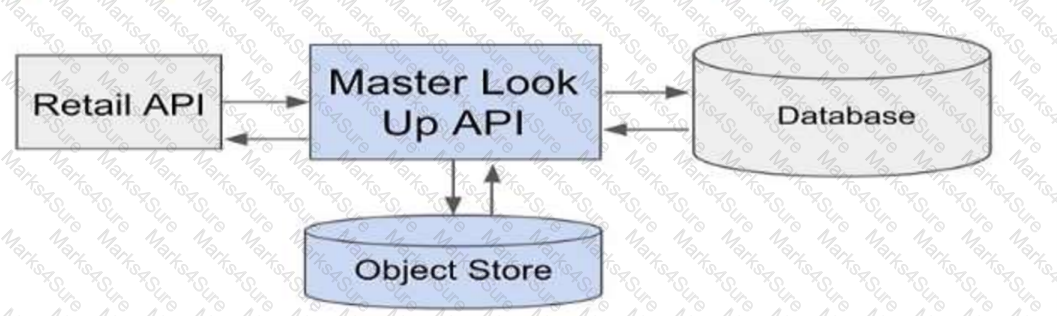
A manufacturing company is developing a new set of APIs for its retail business. One of the APIs is a Master Look Up API, which is a System API,
The API uses a persistent object-store. This API will be used by almost all other APIs to provide master lookup data.
The Master Look Up API is deployed on two CloudHub workers of 0.1 vCore each because there is a lot of master data to be cached. Most of the master
lookup data is stored as a key-value pair. The cache gets refreshed if the key is not found in the cache.
During performance testing, it was determined that the Master Look Up API has a high response time due to the latency of database queries executed to fetch the master lookup data.
What two methods can be used to resolve these performance issues?
Choose 2 answers
A new upstream API Is being designed to offer an SLA of 500 ms median and 800 ms maximum (99th percentile) response time. The corresponding API implementation needs to sequentially invoke 3 downstream APIs of very similar complexity. The first of these downstream APIs offers the following SLA for its response time: median: 100 ms, 80th percentile: 500 ms, 95th percentile: 1000 ms. If possible, how can a timeout be set in the upstream API for the invocation of the first downstream API to meet the new upstream API ' s desired SLA?
Refer to the exhibit.
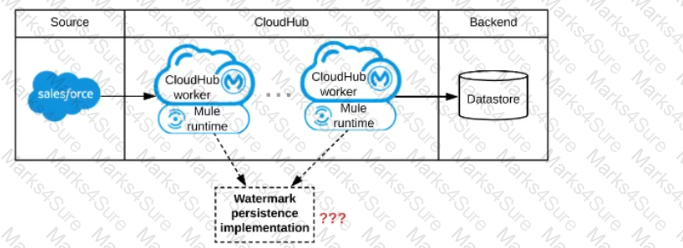
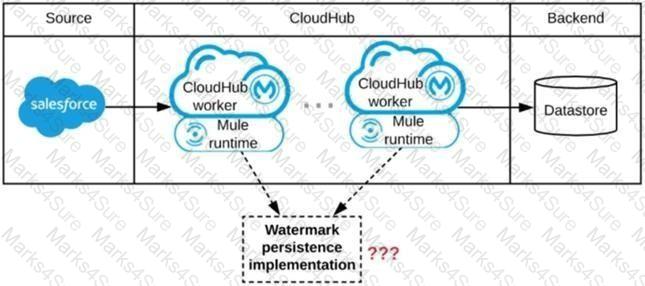
A Mule application is being designed to be deployed to several CIoudHub workers. The Mule application ' s integration logic is to replicate changed Accounts from Satesforce to a backend system every 5 minutes.
A watermark will be used to only retrieve those Satesforce Accounts that have been modified since the last time the integration logic ran.
What is the most appropriate way to implement persistence for the watermark in order to support the required data replication integration logic?
An integration architect is designing an API that must accept requests from API clients for both XML and JSON content over HTTP/1.1 by default.
Which API architectural style, when used for its intended and typical purposes, should the architect choose to meet these requirements?
Which Salesforce API is invoked to deploy, retrieve, create or delete customization information such as custom object definitions using a Mule Salesforce connector in a Mule application?
A company is planning to migrate its deployment environment from on-premises cluster to a Runtime Fabric (RTF) cluster. It also has a requirement to enable Mule applications deployed to a Mule runtime instance to store and share data across application replicas and restarts.
How can these requirements be met?
A Mule application uses the Database connector.
What condition can the Mule application automatically adjust to or recover from without needing to restart or redeploy the Mule application?
An Organization has previously provisioned its own AWS VPC hosting various servers. The organization now needs to use Cloudhub to host a Mule application that will implement a REST API once deployed to Cloudhub, this Mule application must be able to communicate securely with the customer-provisioned AWS VPC resources within the same region, without being interceptable on the public internet.
What Anypoint Platform features should be used to meet these network communication requirements between Cloudhub and the existing customer-provisioned AWS VPC?
An insurance provider is implementing Anypoint platform to manage its application infrastructure and is using the customer hosted runtime for its business due to certain financial requirements it must meet. It has built a number of synchronous API ' s and is currently hosting these on a mule runtime on one server
These applications make use of a number of components including heavy use of object stores and VM queues.
Business has grown rapidly in the last year and the insurance provider is starting to receive reports of reliability issues from its applications.
The DevOps team indicates that the API ' s are currently handling too many requests and this is over loading the server. The team has also mentioned that there is a significant downtime when the server is down for maintenance.
As an integration architect, which option would you suggest to mitigate these issues?
A Mule application is built to support a local transaction for a series of operations on a single database. The mule application has a Scatter-Gather scope that participates in the local transaction.
What is the behavior of the Scatter-Gather when running within this local transaction?
An organization currently uses a multi-node Mule runtime deployment model within their datacenter, so each Mule runtime hosts several Mule applications. The organization is planning to transition to a deployment model based on Docker containers in a Kubernetes cluster. The organization has already created a standard Docker image containing a Mule runtime and all required dependencies (including a JVM), but excluding the Mule application itself.
What is an expected outcome of this transition to container-based Mule application deployments?
A mule application is required to periodically process large data set from a back-end database to Salesforce CRM using batch job scope configured properly process the higher rate of records.
The application is deployed to two cloudhub workers with no persistence queues enabled.
What is the consequence if the worker crashes during records processing?
An airline is architecting an API connectivity project to integrate its flight data into an online aggregation website. The interface must allow for secure communication high-performance and asynchronous message exchange.
What are suitable interface technologies for this integration assuming that Mulesoft fully supports these technologies and that Anypoint connectors exist for these interfaces?
What is the MuleSoft-recommended best practice to share the connector and configuration information among the APIs?
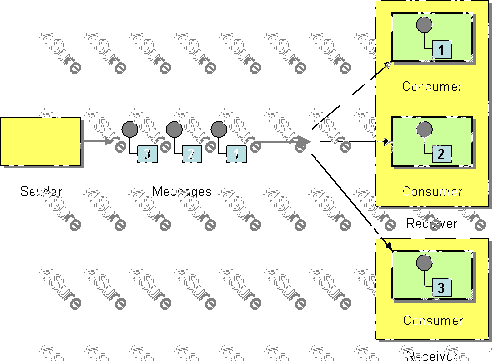
When a Mule application using VM queues is deployed to a customer-hosted cluster or multiple CloudHub v1.0 workers/replicas, how are messages consumed across the nodes?
An integration team follows MuleSoft’s recommended approach to full lifecycle API development.
Which activity should this team perform during the API implementation phase?
An organization ' s security policies mandate complete control of the login credentials used to log in to Anypoint Platform. What feature of Anypoint Platform should be used to meet this requirement?
An organization is sizing an Anypoint VPC to extend their internal network to Cloudhub.
For this sizing calculation, the organization assumes 150 Mule applications will be deployed among three(3) production environments and will use Cloudhub’s default zero-downtime feature. Each Mule application is expected to be configured with two(2) Cloudhub workers.This is expected to result in several Mule application deployments per hour.
An organization is designing a mule application to support an all or nothing transaction between serval database operations and some other connectors so that they all roll back if there is a problem with any of the connectors
Besides the database connector , what other connector can be used in the transaction.
 Table
Description automatically generated
Table
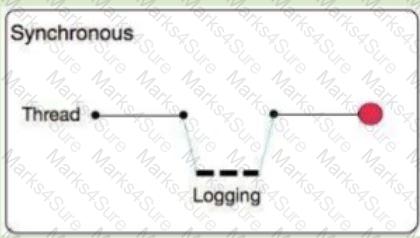
Description automatically generatedWhat is a key difference between synchronous and asynchronous logging from Mule applications?
 Chart, diagram
Description automatically generated
Chart, diagram
Description automatically generated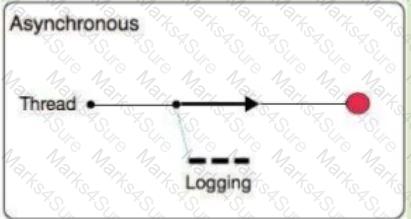 Chart, diagram, box and whisker chart
Description automatically generated
Chart, diagram, box and whisker chart
Description automatically generatedAn organization has deployed runtime fabric on an eight note cluster with performance profile. An API uses and non persistent object store for maintaining some of its state data. What will be the impact to the stale data if server crashes?
An organization has implemented a continuous integration (CI) lifecycle that promotes Mule applications through code, build, and test stages. To standardize the organization ' s CI journey, a new dependency control approach is being designed to store artifacts that include information such as dependencies, versioning, and build promotions.
To implement these process improvements, the organization will now require developers to maintain all dependencies related to Mule application code in a shared location.
What is the most idiomatic (used for its intended purpose) type of system the organization should use in a shared location to standardize all dependencies related to Mule application code?
An organization if struggling frequent plugin version upgrades and external plugin project dependencies. The team wants to minimize the impact on applications by creating best practices that will define a set of default dependencies across all new and in progress projects.
How can these best practices be achieved with the applications having the least amount of responsibility?
A Mule application uses APIkit for SOAP to implement a SOAP web service. The Mule application has been deployed to a CloudHub worker in a testing environment.
The integration testing team wants to use a SOAP client to perform Integration testing. To carry out the integration tests, the integration team must obtain the interface definition for the SOAP web service.
What is the most idiomatic (used for its intended purpose) way for the integration testing team to obtain the interface definition for the deployed SOAP web service in order to perform integration testing with the SOAP client?
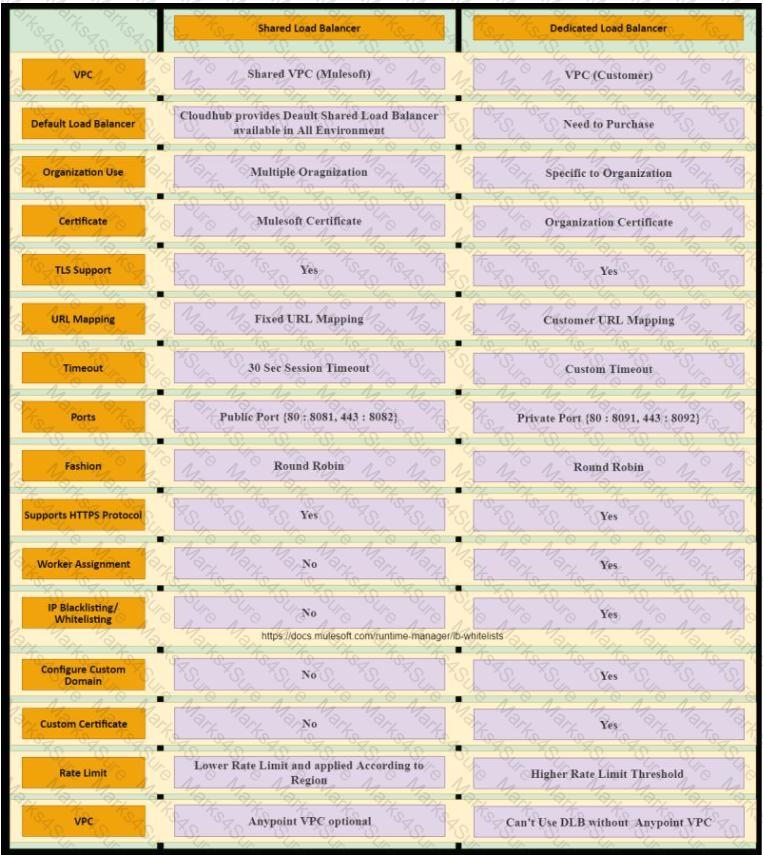
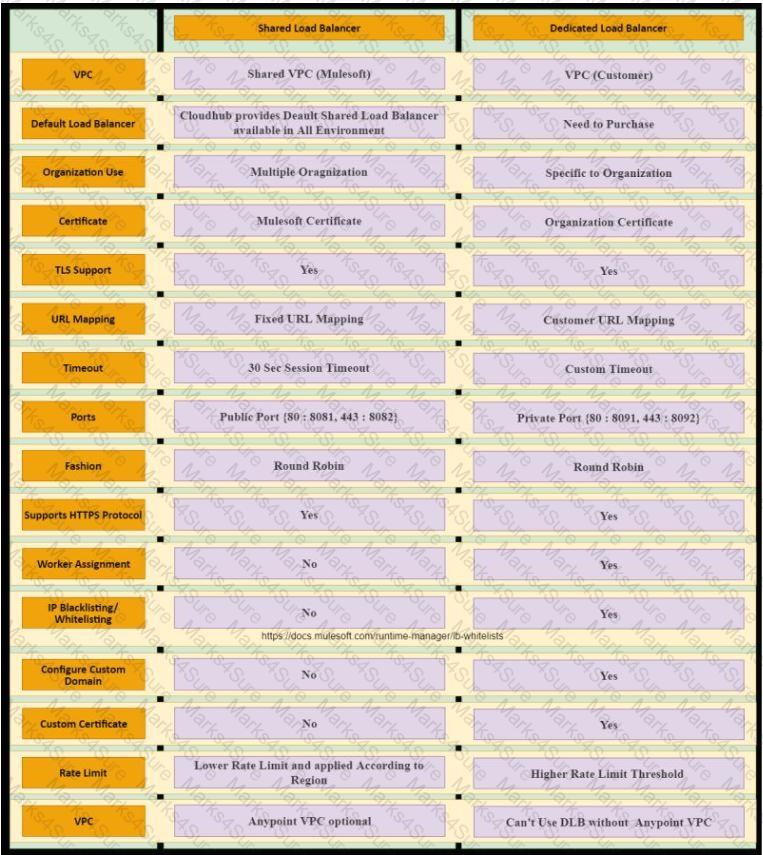
What comparison is true about a CloudHub Dedicated Load Balancer (DLB) vs. the CloudHub Shared Load Balancer (SLB)?
 Table
Description automatically generated
Table
Description automatically generatedA REST API is being designed to implement a Mule application.
What standard interface definition language can be used to define REST APIs?
Refer to the exhibit.
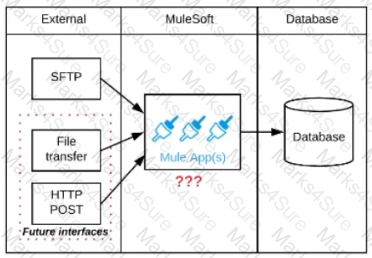
A business process involves the receipt of a file from an external vendor over SFTP. The file needs to be parsed and its content processed, validated, and ultimately persisted to a database. The delivery mechanism is expected to change in the future as more vendors send similar files using other mechanisms such as file transfer or HTTP POST.
What is the most effective way to design for these requirements in order to minimize the impact of future change?
 Diagram
Description automatically generated
Diagram
Description automatically generatedA Mule application is being designed To receive nightly a CSV file containing millions of records from an external vendor over SFTP, The records from the file need to be validated, transformed. And then written to a database. Records can be inserted into the database in any order.
In this use case, what combination of Mule components provides the most effective and performant way to write these records to the database?
A payment processing company has implemented a Payment Processing API Mule application to process credit card and debit card transactions, Because the Payment Processing API handles highly sensitive information, the payment processing company requires that data must be encrypted both In-transit and at-rest.
To meet these security requirements, consumers of the Payment Processing API must create request message payloads in a JSON format specified by the API, and the message payload values must be encrypted.
How can the Payment Processing API validate requests received from API consumers?
A MuteSoft developer must implement an API as a Mule application, run the application locally, and execute unit tests against the Running application.
Which Anypoint Platform component can the developer use to full all of these requirements?
A system API EmployeeSAPI is used to fetch employee ' s data from an underlying SQL database.
The architect must design a caching strategy to query the database only when there is an update to the employees stable or else return a cached response in order to minimize the number of redundant transactions being handled by the database.
What must the architect do to achieve the caching objective?
According to MuleSoft, which deployment characteristic applies to a microservices application architecture?
As an enterprise architect, what are the two reasons for which you would use a canonical data model in the new integration project using Mulesoft Anypoint platform ( choose two answers )
An organization is building out a test suite for their application using MUnit.
The Integration Architect has recommended using Test Recorder in Anypoint Studio to record the processing flows and then configure unit tests based on the captured events.
What Is a core consideration that must be kept In mind while using Test Recorder?
An organization has implemented the cluster with two customer hosted Mule runtimes is hosting an application.
This application has a flow with a JMS listener configured to consume messages from a queue destination. As an integration architect can you advise which JMS listener configuration must be used to receive messages in all the nodes of the cluster?
An integration Mute application is being designed to process orders by submitting them to a backend system for offline processing. Each order will be received by the Mute application through an HTTPS POST and must be acknowledged immediately. Once acknowledged, the order will be submitted to a backend system. Orders that cannot be successfully submitted due to rejections from the backend system will need to be processed manually (outside the backend system).
The Mule application will be deployed to a customer-hosted runtime and is able to use an existing ActiveMQ broker if needed.
The backend system has a track record of unreliability both due to minor network connectivity issues and longer outages.
What idiomatic (used for their intended purposes) combination of Mule application components and ActiveMQ queues are required to ensure automatic submission of orders to the backend system, while minimizing manual order processing?
What are two reasons why a typical MuleSoft customer favors a MuleSoft-hosted Anypoint Platform runtime plane over a customer-hosted runtime for its Mule application deployments? (Choose two.)
What is an advantage of using OAuth 2.0 client credentials and access tokens over only API keys for API authentication?
An API has been updated in Anypoint Exchange by its API producer from version 3.1.1 to 3.2.0 following accepted semantic versioning practices and the changes have been communicated via the API ' s public portal. The API endpoint does NOT change in the new version. How should the developer of an API client respond to this change?
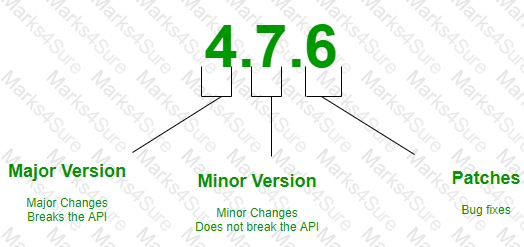 Diagram
Description automatically generated
Diagram
Description automatically generatedAn organization is designing the following two Mule applications that must share data via a common persistent object store instance:
- Mule application P will be deployed within their on-premises datacenter.
- Mule application C will run on CloudHub in an Anypoint VPC.
The object store implementation used by CloudHub is the Anypoint Object Store v2 (OSv2).
what type of object store(s) should be used, and what design gives both Mule applications access to the same object store instance?
A stock broking company makes use of CloudHub VPC to deploy Mule applications. Mule application needs to connect to a database application in the customers on-premises corporate data center and also to a Kafka cluster running in AWS VPC.
How is access enabled for the API to connect to the database application and Kafka cluster securely?
A mule application is being designed to perform product orchestration. The Mule application needs to join together the responses from an inventory API and a Product Sales History API with the least latency.
To minimize the overall latency. What is the most idiomatic (used for its intended purpose) design to call each API request in the Mule application?
A Mule application is built to support a local transaction for a series of operations on a single database. The Mule application has a Scatter-Gather that participates in the local transaction.
What is the behavior of the Scatter-Gather when running within this local transaction?
An organization has defined a common object model in Java to mediate the communication between different Mule applications in a consistent way. A Mule application is being built to use this common object model to process responses from a SOAP API and a REST API and then write the processed results to an order management system.
The developers want Anypoint Studio to utilize these common objects to assist in creating mappings for various transformation steps in the Mule application.
What is the most idiomatic (used for its intended purpose) and performant way to utilize these common objects to map between the inbound and outbound systems in the Mule application?
A manufacturing company plans to deploy Mule applications to its own
Azure Kubernetes service infrastructure.The organization wants to make
the Mule applications more available and robust by deploying each Mule
application to an isolated Mule runtime in a Docker container while
managing all the Mule applications from the MuleSoft-hosted control plane.
What choice of runtime plane meets these organizational requirements?
An organization has just developed a Mule application that implements a REST API. The mule application will be deployed to a cluster of customer hosted Mule runtimes.
What additional infrastructure component must the customer provide in order to distribute inbound API requests across the Mule runtimes of the cluster?
Refer to the exhibit.
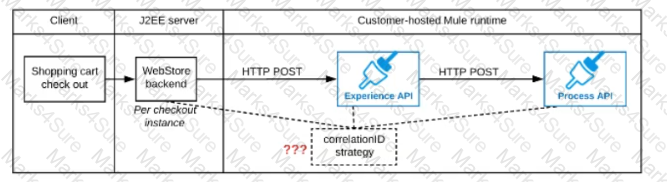
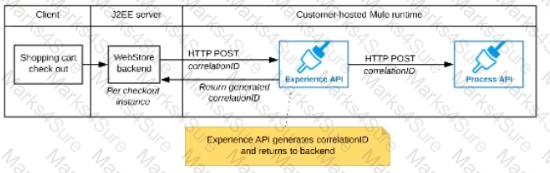
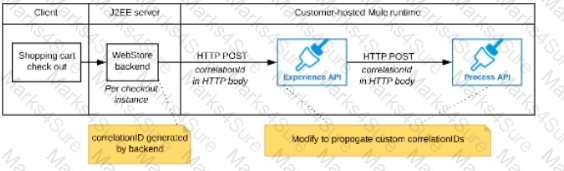
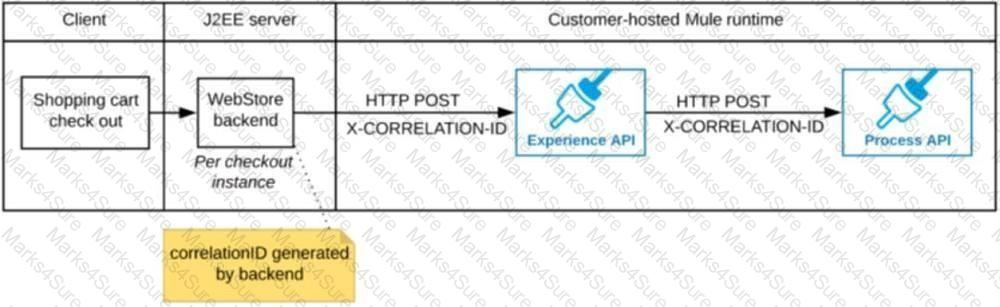
A shopping cart checkout process consists of a web store backend sending a sequence of API invocations to an Experience API, which in turn invokes a Process API. All API invocations are over HTTPS POST. The Java web store backend executes in a Java EE application server, while all API implementations are Mule applications executing in a customer -hosted Mule runtime.
End-to-end correlation of all HTTP requests and responses belonging to each individual checkout Instance is required. This is to be done through a common correlation ID, so that all log entries written by the web store backend, Experience API implementation, and Process API implementation include the same correlation ID for all requests and responses belonging to the same checkout instance.
What is the most efficient way (using the least amount of custom coding or configuration) for the web store backend and the implementations of the Experience API and Process API to participate in end-to-end correlation of the API invocations for each checkout instance?
A)
The web store backend, being a Java EE application, automatically makes use of the thread-local correlation ID generated by the Java EE application server and automatically transmits that to the Experience API using HTTP-standard headers
No special code or configuration is included in the web store backend, Experience API, and Process API implementations to generate and manage the correlation ID
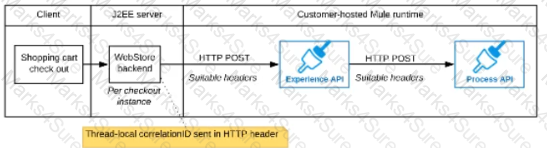
B)
The web store backend generates a new correlation ID value at the start of checkout and sets it on the X-CORRELATlON-lt HTTP request header In each API invocation belonging to that checkout
No special code or configuration is included in the Experience API and Process API implementations to generate and manage the correlation ID
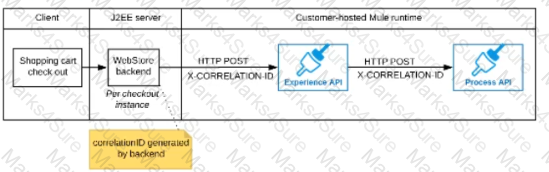
C)
The Experience API implementation generates a correlation ID for each incoming HTTP request and passes it to the web store backend in the HTTP response, which includes it in all subsequent API invocations to the Experience API.
The Experience API implementation must be coded to also propagate the correlation ID to the Process API in a suitable HTTP request header
D)
The web store backend sends a correlation ID value in the HTTP request body In the way required by the Experience API
The Experience API and Process API implementations must be coded to receive the custom correlation ID In the HTTP requests and propagate It in suitable HTTP request headers
 Graphical user interface, application, Word
Description automatically generated
Graphical user interface, application, Word
Description automatically generatedPDF + Testing Engine

Testing Engine
PDF (Q&A)