
Spring Sale Limited Time 65% Discount Offer - Ends in 0d 00h 00m 00s - Coupon code: pass65

MLS-C01 AWS Certified Machine Learning - Specialty Questions and Answers

Questions 4

A data engineer is preparing a dataset that a retail company will use to predict the number of visitors to stores. The data engineer created an Amazon S3 bucket. The engineer subscribed the S3 bucket to an AWS Data Exchange data product for general economic indicators. The data engineer wants to join the economic indicator data to an existing table in Amazon Athena to merge with the business data. All these transformations must finish running in 30-60 minutes.

Which solution will meet these requirements MOST cost-effectively?

Options:

A.

Configure the AWS Data Exchange product as a producer for an Amazon Kinesis data stream. Use an Amazon Kinesis Data Firehose delivery stream to transfer the data to Amazon S3 Run an AWS Glue job that will merge the existing business data with the Athena table. Write the result set back to Amazon S3.

B.

Use an S3 event on the AWS Data Exchange S3 bucket to invoke an AWS Lambda function. Program the Lambda function to use Amazon SageMaker Data Wrangler to merge the existing business data with the Athena table. Write the result set back to Amazon S3.

C.

Use an S3 event on the AWS Data Exchange S3 bucket to invoke an AWS Lambda Function Program the Lambda function to run an AWS Glue job that will merge the existing business data with the Athena table Write the results back to Amazon S3.

D.

Provision an Amazon Redshift cluster. Subscribe to the AWS Data Exchange product and use the product to create an Amazon Redshift Table Merge the data in Amazon Redshift. Write the results back to Amazon S3.

Buy Now
Questions 5

A manufacturing company wants to monitor its devices for anomalous behavior. A data scientist has trained an Amazon SageMaker scikit-learn model that classifies a device as normal or anomalous based on its 4-day telemetry. The 4-day telemetry of each device is collected in a separate file and is placed in an Amazon S3 bucket once every hour. The total time to run the model across the telemetry for all devices is 5 minutes.

What is the MOST cost-effective solution for the company to use to run the model across the telemetry for all the devices?

Options:

A.

SageMaker Batch Transform

B.

SageMaker Asynchronous Inference

C.

SageMaker Processing

D.

A SageMaker multi-container endpoint

Buy Now
Questions 6

A data scientist obtains a tabular dataset that contains 150 correlated features with different ranges to build a regression model. The data scientist needs to achieve more efficient model training by implementing a solution that minimizes impact on the model ' s performance. The data scientist decides to perform a principal component analysis (PCA) preprocessing step to reduce the number of features to a smaller set of independent features before the data scientist uses the new features in the regression model.

Which preprocessing step will meet these requirements?

Options:

A.

Use the Amazon SageMaker built-in algorithm for PCA on the dataset to transform the data

B.

Load the data into Amazon SageMaker Data Wrangler. Scale the data with a Min Max Scaler transformation step Use the SageMaker built-in algorithm for PCA on the scaled dataset to transform the data.

C.

Reduce the dimensionality of the dataset by removing the features that have the highest correlation Load the data into Amazon SageMaker Data Wrangler Perform a Standard Scaler transformation step to scale the data Use the SageMaker built-in algorithm for PCA on the scaled dataset to transform the data

D.

Reduce the dimensionality of the dataset by removing the features that have the lowest correlation. Load the data into Amazon SageMaker Data Wrangler. Perform a Min Max Scaler transformation step to scale the data. Use the SageMaker built-in algorithm for PCA on the scaled dataset to transform the data.

Buy Now
Questions 7

A machine learning specialist is developing a regression model to predict rental rates from rental listings. A variable named Wall_Color represents the most prominent exterior wall color of the property. The following is the sample data, excluding all other variables:

* Building ID 1000 has a Wall_Color value of Red.

* Building ID 1001 has a Wall_Color value of White.

* Building ID 1002 has a Wall_Color value of Green.

The specialist chose a model that needs numerical input data.

Which feature engineering approaches should the specialist use to allow the regression model to learn from the Wall_Color data? (Choose two.)

Options:

A.

Apply integer transformation and set Red = 1, White = 5, and Green = 10.

B.

Add new columns that store one-hot representation of colors.

C.

Replace the color name string by its length.

D.

Create three columns to encode the color in RGB format.

E.

Replace each color name by its training set frequency.

Buy Now
Questions 8

A data scientist is working on a public sector project for an urban traffic system. While studying the traffic patterns, it is clear to the data scientist that the traffic behavior at each light is correlated, subject to a small stochastic error term. The data scientist must model the traffic behavior to analyze the traffic patterns and reduce congestion.

How will the data scientist MOST effectively model the problem?

Options:

A.

The data scientist should obtain a correlated equilibrium policy by formulating this problem as a multi-agent reinforcement learning problem.

B.

The data scientist should obtain the optimal equilibrium policy by formulating this problem as a single-agent reinforcement learning problem.

C.

Rather than finding an equilibrium policy, the data scientist should obtain accurate predictors of traffic flow by using historical data through a supervised learning approach.

D.

Rather than finding an equilibrium policy, the data scientist should obtain accurate predictors of traffic flow by using unlabeled simulated data representing the new traffic patterns in the city and applying an unsupervised learning approach.

Buy Now
Questions 9

A car company is developing a machine learning solution to detect whether a car is present in an image. The image dataset consists of one million images. Each image in the dataset is 200 pixels in height by 200 pixels in width. Each image is labeled as either having a car or not having a car.

Which architecture is MOST likely to produce a model that detects whether a car is present in an image with the highest accuracy?

Options:

A.

Use a deep convolutional neural network (CNN) classifier with the images as input. Include a linear output layer that outputs the probability that an image contains a car.

B.

Use a deep convolutional neural network (CNN) classifier with the images as input. Include a softmax output layer that outputs the probability that an image contains a car.

C.

Use a deep multilayer perceptron (MLP) classifier with the images as input. Include a linear output layer that outputs the probability that an image contains a car.

D.

Use a deep multilayer perceptron (MLP) classifier with the images as input. Include a softmax output layer that outputs the probability that an image contains a car.

Buy Now
Questions 10

An insurance company is creating an application to automate car insurance claims. A machine learning (ML) specialist used an Amazon SageMaker Object Detection - TensorFlow built-in algorithm to train a model to detect scratches and dents in images of cars. After the model was trained, the ML specialist noticed that the model performed better on the training dataset than on the testing dataset.

Which approach should the ML specialist use to improve the performance of the model on the testing data?

Options:

A.

Increase the value of the momentum hyperparameter.

B.

Reduce the value of the dropout_rate hyperparameter.

C.

Reduce the value of the learning_rate hyperparameter.

D.

Increase the value of the L2 hyperparameter.

Buy Now
Questions 11

A Data Scientist is building a linear regression model and will use resulting p-values to evaluate the statistical significance of each coefficient. Upon inspection of the dataset, the Data Scientist discovers that most of the features are normally distributed. The plot of one feature in the dataset is shown in the graphic.

What transformation should the Data Scientist apply to satisfy the statistical assumptions of the linear

regression model?

Options:

A.

Exponential transformation

B.

Logarithmic transformation

C.

Polynomial transformation

D.

Sinusoidal transformation

Buy Now
Questions 12

A company is using a machine learning (ML) model to recommend products to customers. An ML specialist wants to analyze the data for the most popular recommendations in four dimensions.

The ML specialist will visualize the first two dimensions as coordinates. The third dimension will be visualized as color. The ML specialist will use size to represent the fourth dimension in the visualization.

Which solution will meet these requirements?

Options:

A.

Use the Amazon SageMaker Data Wrangler bar chart feature. Use Group By to represent the third and fourth dimensions.

B.

Use the Amazon SageMaker Canvas box plot visualization. Use color and fill pattern to represent the third and fourth dimensions.

C.

Use the Amazon SageMaker Data Wrangler histogram feature. Use color and fill pattern to represent the third and fourth dimensions.

D.

Use the Amazon SageMaker Canvas scatter plot visualization. Use scatter point size and color to represent the third and fourth dimensions.

Buy Now
Questions 13

A Machine Learning Specialist works for a credit card processing company and needs to predict which

transactions may be fraudulent in near-real time. Specifically, the Specialist must train a model that returns the

probability that a given transaction may fraudulent.

How should the Specialist frame this business problem?

Options:

A.

Streaming classification

B.

Binary classification

C.

Multi-category classification

D.

Regression classification

Buy Now
Questions 14

A Machine Learning Specialist wants to bring a custom algorithm to Amazon SageMaker. The Specialist

implements the algorithm in a Docker container supported by Amazon SageMaker.

How should the Specialist package the Docker container so that Amazon SageMaker can launch the training

correctly?

Options:

A.

Modify the bash_profile file in the container and add a bash command to start the training program

B.

Use CMD config in the Dockerfile to add the training program as a CMD of the image

C.

Configure the training program as an ENTRYPOINT named train

D.

Copy the training program to directory /opt/ml/train

Buy Now
Questions 15

A Machine Learning Specialist is deciding between building a naive Bayesian model or a full Bayesian network for a classification problem. The Specialist computes the Pearson correlation coefficients between each feature and finds that their absolute values range between 0.1 to 0.95.

Which model describes the underlying data in this situation?

Options:

A.

A naive Bayesian model, since the features are all conditionally independent.

B.

A full Bayesian network, since the features are all conditionally independent.

C.

A naive Bayesian model, since some of the features are statistically dependent.

D.

A full Bayesian network, since some of the features are statistically dependent.

Buy Now
Questions 16

A Data Scientist is building a model to predict customer churn using a dataset of 100 continuous numerical

features. The Marketing team has not provided any insight about which features are relevant for churn

prediction. The Marketing team wants to interpret the model and see the direct impact of relevant features on

the model outcome. While training a logistic regression model, the Data Scientist observes that there is a wide

gap between the training and validation set accuracy.

Which methods can the Data Scientist use to improve the model performance and satisfy the Marketing team’s

needs? (Choose two.)

Options:

A.

Add L1 regularization to the classifier

B.

Add features to the dataset

C.

Perform recursive feature elimination

D.

Perform t-distributed stochastic neighbor embedding (t-SNE)

E.

Perform linear discriminant analysis

Buy Now
Questions 17

A data scientist uses an Amazon SageMaker notebook instance to conduct data exploration and analysis. This requires certain Python packages that are not natively available on Amazon SageMaker to be installed on the notebook instance.

How can a machine learning specialist ensure that required packages are automatically available on the notebook instance for the data scientist to use?

Options:

A.

Install AWS Systems Manager Agent on the underlying Amazon EC2 instance and use Systems Manager Automation to execute the package installation commands.

B.

Create a Jupyter notebook file (.ipynb) with cells containing the package installation commands to execute and place the file under the /etc/init directory of each Amazon SageMaker notebook instance.

C.

Use the conda package manager from within the Jupyter notebook console to apply the necessary conda packages to the default kernel of the notebook.

D.

Create an Amazon SageMaker lifecycle configuration with package installation commands and assign the lifecycle configuration to the notebook instance.

Buy Now
Questions 18

A logistics company needs a forecast model to predict next month ' s inventory requirements for a single item in 10 warehouses. A machine learning specialist uses Amazon Forecast to develop a forecast model from 3 years of monthly data. There is no missing data. The specialist selects the DeepAR+ algorithm to train a predictor. The predictor means absolute percentage error (MAPE) is much larger than the MAPE produced by the current human forecasters.

Which changes to the CreatePredictor API call could improve the MAPE? (Choose two.)

Options:

A.

Set PerformAutoML to true.

B.

Set ForecastHorizon to 4.

C.

Set ForecastFrequency to W for weekly.

D.

Set PerformHPO to true.

E.

Set FeaturizationMethodName to filling.

Buy Now
Questions 19

A company builds computer-vision models that use deep learning for the autonomous vehicle industry. A machine learning (ML) specialist uses an Amazon EC2 instance that has a CPU: GPU ratio of 12:1 to train the models.

The ML specialist examines the instance metric logs and notices that the GPU is idle half of the time The ML specialist must reduce training costs without increasing the duration of the training jobs.

Which solution will meet these requirements?

Options:

A.

Switch to an instance type that has only CPUs.

B.

Use a heterogeneous cluster that has two different instances groups.

C.

Use memory-optimized EC2 Spot Instances for the training jobs.

D.

Switch to an instance type that has a CPU GPU ratio of 6:1.

Buy Now
Questions 20

A Machine Learning team uses Amazon SageMaker to train an Apache MXNet handwritten digit classifier model using a research dataset. The team wants to receive a notification when the model is overfitting. Auditors want to view the Amazon SageMaker log activity report to ensure there are no unauthorized API calls.

What should the Machine Learning team do to address the requirements with the least amount of code and fewest steps?

Options:

A.

Implement an AWS Lambda function to long Amazon SageMaker API calls to Amazon S3. Add code to push a custom metric to Amazon CloudWatch. Create an alarm in CloudWatch with Amazon SNS to receive a notification when the model is overfitting.

B.

Use AWS CloudTrail to log Amazon SageMaker API calls to Amazon S3. Add code to push a custom metric to Amazon CloudWatch. Create an alarm in CloudWatch with Amazon SNS to receive a notification when the model is overfitting.

C.

Implement an AWS Lambda function to log Amazon SageMaker API calls to AWS CloudTrail. Add code to push a custom metric to Amazon CloudWatch. Create an alarm in CloudWatch with Amazon SNS to receive a notification when the model is overfitting.

D.

Use AWS CloudTrail to log Amazon SageMaker API calls to Amazon S3. Set up Amazon SNS to receive a notification when the model is overfitting.

Buy Now
Questions 21

A media company with a very large archive of unlabeled images, text, audio, and video footage wishes to index its assets to allow rapid identification of relevant content by the Research team. The company wants to use machine learning to accelerate the efforts of its in-house researchers who have limited machine learning expertise.

Which is the FASTEST route to index the assets?

Options:

A.

Use Amazon Rekognition, Amazon Comprehend, and Amazon Transcribe to tag data into distinct categories/classes.

B.

Create a set of Amazon Mechanical Turk Human Intelligence Tasks to label all footage.

C.

Use Amazon Transcribe to convert speech to text. Use the Amazon SageMaker Neural Topic Model (NTM) and Object Detection algorithms to tag data into distinct categories/classes.

D.

Use the AWS Deep Learning AMI and Amazon EC2 GPU instances to create custom models for audio transcription and topic modeling, and use object detection to tag data into distinct categories/classes.

Buy Now
Questions 22

Each morning, a data scientist at a rental car company creates insights about the previous day’s rental car reservation demands. The company needs to automate this process by streaming the data to Amazon S3 in near real time. The solution must detect high-demand rental cars at each of the company’s locations. The solution also must create a visualization dashboard that automatically refreshes with the most recent data.

Which solution will meet these requirements with the LEAST development time?

Options:

A.

Use Amazon Kinesis Data Firehose to stream the reservation data directly to Amazon S3. Detect high-demand outliers by using Amazon QuickSight ML Insights. Visualize the data in QuickSight.

B.

Use Amazon Kinesis Data Streams to stream the reservation data directly to Amazon S3. Detect high-demand outliers by using the Random Cut Forest (RCF) trained model in Amazon SageMaker. Visualize the data in Amazon QuickSight.

C.

Use Amazon Kinesis Data Firehose to stream the reservation data directly to Amazon S3. Detect high-demand outliers by using the Random Cut Forest (RCF) trained model in Amazon SageMaker. Visualize the data in Amazon QuickSight.

D.

Use Amazon Kinesis Data Streams to stream the reservation data directly to Amazon S3. Detect high-demand outliers by using Amazon QuickSight ML Insights. Visualize the data in QuickSight.

Buy Now
Questions 23

A company is observing low accuracy while training on the default built-in image classification algorithm in Amazon SageMaker. The Data Science team wants to use an Inception neural network architecture instead of a ResNet architecture.

Which of the following will accomplish this? (Select TWO.)

Options:

A.

Customize the built-in image classification algorithm to use Inception and use this for model training.

B.

Create a support case with the SageMaker team to change the default image classification algorithm to Inception.

C.

Bundle a Docker container with TensorFlow Estimator loaded with an Inception network and use this for model training.

D.

Use custom code in Amazon SageMaker with TensorFlow Estimator to load the model with an Inception network and use this for model training.

E.

Download and apt-get install the inception network code into an Amazon EC2 instance and use this instance as a Jupyter notebook in Amazon SageMaker.

Buy Now
Questions 24

A machine learning (ML) developer for an online retailer recently uploaded a sales dataset into Amazon SageMaker Studio. The ML developer wants to obtain importance scores for each feature of the dataset. The ML developer will use the importance scores to feature engineer the dataset.

Which solution will meet this requirement with the LEAST development effort?

Options:

A.

Use SageMaker Data Wrangler to perform a Gini importance score analysis.

B.

Use a SageMaker notebook instance to perform principal component analysis (PCA).

C.

Use a SageMaker notebook instance to perform a singular value decomposition analysis.

D.

Use the multicollinearity feature to perform a lasso feature selection to perform an importance scores analysis.

Buy Now
Questions 25

A machine learning (ML) specialist is using Amazon SageMaker hyperparameter optimization (HPO) to improve a model’s accuracy. The learning rate parameter is specified in the following HPO configuration:

During the results analysis, the ML specialist determines that most of the training jobs had a learning rate between 0.01 and 0.1. The best result had a learning rate of less than 0.01. Training jobs need to run regularly over a changing dataset. The ML specialist needs to find a tuning mechanism that uses different learning rates more evenly from the provided range between MinValue and MaxValue.

Which solution provides the MOST accurate result?

Options:

A.

Modify the HPO configuration as follows:Select the most accurate hyperparameter configuration form this HPO job.

B.

Run three different HPO jobs that use different learning rates form the following intervals for MinValue and MaxValue while using the same number of training jobs for each HPO job:[0.01, 0.1][0.001, 0.01] [0.0001, 0.001]Select the most accurate hyperparameter configuration form these three HPO jobs.

C.

Modify the HPO configuration as follows:Select the most accurate hyperparameter configuration form this training job.

D.

Run three different HPO jobs that use different learning rates form the following intervals for MinValue and MaxValue. Divide the number of training jobs for each HPO job by three:[0.01, 0.1][0.001, 0.01] [0.0001, 0.001]Select the most accurate hyperparameter configuration form these three HPO jobs.

Buy Now
Questions 26

A music streaming company is building a pipeline to extract features. The company wants to store the features for offline model training and online inference. The company wants to track feature history and to give the company ' s data science teams access to the features.

Which solution will meet these requirements with the MOST operational efficiency?

Options:

A.

Use Amazon SageMaker Feature Store to store features for model training and inference. Create an online store for online inference. Create an offline store for model training. Create an 1AM role for data scientists to access and search through feature groups.

B.

Use Amazon SageMaker Feature Store to store features for model training and inference. Create an online store for both online inference and model training. Create an 1AM role for data scientists to access and search through feature groups.

C.

Create one Amazon S3 bucket to store online inference features. Create a second S3 bucket to store offline model training features. Turn onversioning for the S3 buckets and use tags to specify which tags are for online inference features and which are for offline model training features. Use Amazon Athena to query the S3 bucket for online inference. Connect the S3 bucket for offline model training to a SageMaker training job. Create an 1AM

D.

Create two separate Amazon DynamoDB tables to store online inference features and offline model training features. Use time-based versioning on both tables. Query the DynamoDB table for online inference. Move the data from DynamoDB to Amazon S3 when a new SageMaker training job is launched. Create an 1AM policy that allows data scientists to access both tables.

Buy Now
Questions 27

Acybersecurity company is collecting on-premises server logs, mobile app logs, and loT sensor data. The company backs up the ingested data in an Amazon S3 bucket and sends the ingested data to Amazon OpenSearch Service for further analysis. Currently, the company has a custom ingestion pipeline that is running on Amazon EC2 instances. The company needs to implement a new serverless ingestion pipeline that can automatically scale to handle sudden changes in the data flow.

Which solution will meet these requirements MOST cost-effectively?

Options:

A.

Create two Amazon Data Firehose delivery streams to send data to the S3 bucket and OpenSearch Service. Configure the data sources to send data to the delivery streams.

B.

Create one Amazon Kinesis data stream. Create two Amazon Data Firehose delivery streams to send data to the S3 bucket and OpenSearch Service. Connect the delivery streams to the data stream. Configure the data sources to send data to the data stream.

C.

Create one Amazon Data Firehose delivery stream to send data to OpenSearch Service. Configure the delivery stream to back up the raw data to the S3 bucket. Configure the data sources to send data to the delivery stream.

D.

Create one Amazon Kinesis data stream. Create one Amazon Data Firehose delivery stream to send data to OpenSearch Service. Configure the delivery stream to back up the data to the S3 bucket. Connect the delivery stream to the data stream. Configure the data sources to send data to the data stream.

Buy Now
Questions 28

A company sells thousands of products on a public website and wants to automatically identify products with potential durability problems. The company has 1.000 reviews with date, star rating, review text, review summary, and customer email fields, but many reviews are incomplete and have empty fields. Each review has already been labeled with the correct durability result.

A machine learning specialist must train a model to identify reviews expressing concerns over product durability. The first model needs to be trained and ready to review in 2 days.

What is the MOST direct approach to solve this problem within 2 days?

Options:

A.

Train a custom classifier by using Amazon Comprehend.

B.

Build a recurrent neural network (RNN) in Amazon SageMaker by using Gluon and Apache MXNet.

C.

Train a built-in BlazingText model using Word2Vec mode in Amazon SageMaker.

D.

Use a built-in seq2seq model in Amazon SageMaker.

Buy Now
Questions 29

A company ' s Machine Learning Specialist needs to improve the training speed of a time-series forecasting model using TensorFlow. The training is currently implemented on a single-GPU machine and takes approximately 23 hours to complete. The training needs to be run daily.

The model accuracy js acceptable, but the company anticipates a continuous increase in the size of the training data and a need to update the model on an hourly, rather than a daily, basis. The company also wants to minimize coding effort and infrastructure changes

What should the Machine Learning Specialist do to the training solution to allow it to scale for future demand?

Options:

A.

Do not change the TensorFlow code. Change the machine to one with a more powerful GPU to speed up the training.

B.

Change the TensorFlow code to implement a Horovod distributed framework supported by Amazon SageMaker. Parallelize the training to as many machines as needed to achieve the business goals.

C.

Switch to using a built-in AWS SageMaker DeepAR model. Parallelize the training to as many machines as needed to achieve the business goals.

D.

Move the training to Amazon EMR and distribute the workload to as many machines as needed to achieve the business goals.

Buy Now
Questions 30

A machine learning (ML) specialist is training a linear regression model. The specialist notices that the model is overfitting. The specialist applies an L1 regularization parameter and runs the model again. This change results in all features having zero weights.

What should the ML specialist do to improve the model results?

Options:

A.

Increase the L1 regularization parameter. Do not change any other training parameters.

B.

Decrease the L1 regularization parameter. Do not change any other training parameters.

C.

Introduce a large L2 regularization parameter. Do not change the current L1 regularization value.

D.

Introduce a small L2 regularization parameter. Do not change the current L1 regularization value.

Buy Now
Questions 31

While reviewing the histogram for residuals on regression evaluation data a Machine Learning Specialist notices that the residuals do not form a zero-centered bell shape as shown What does this mean?
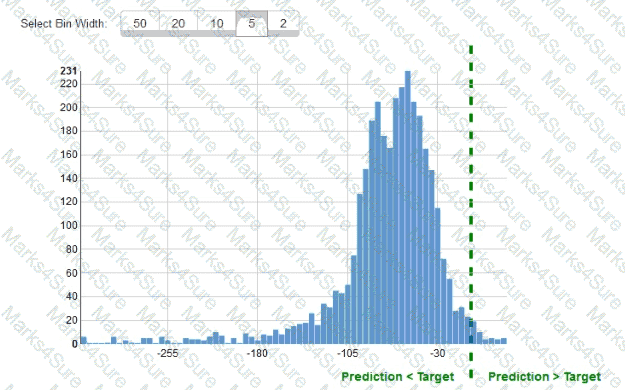
MLS-C01 Question 31

Options:

A.

The model might have prediction errors over a range of target values.

B.

The dataset cannot be accurately represented using the regression model

C.

There are too many variables in the model

D.

The model is predicting its target values perfectly.

Buy Now
Questions 32

A machine learning engineer is building a bird classification model. The engineer randomly separates a dataset into a training dataset and a validation dataset. During the training phase, the model achieves very high accuracy. However, the model did not generalize well during validation of the validation dataset. The engineer realizes that the original dataset was imbalanced.

What should the engineer do to improve the validation accuracy of the model?

Options:

A.

Perform stratified sampling on the original dataset.

B.

Acquire additional data about the majority classes in the original dataset.

C.

Use a smaller, randomly sampled version of the training dataset.

D.

Perform systematic sampling on the original dataset.

Buy Now
Questions 33

A Machine Learning Specialist is packaging a custom ResNet model into a Docker container so the company can leverage Amazon SageMaker for training The Specialist is using Amazon EC2 P3 instances to train the model and needs to properly configure the Docker container to leverage the NVIDIA GPUs

What does the Specialist need to do1?

Options:

A.

Bundle the NVIDIA drivers with the Docker image

B.

Build the Docker container to be NVIDIA-Docker compatible

C.

Organize the Docker container ' s file structure to execute on GPU instances.

D.

Set the GPU flag in the Amazon SageMaker Create TrainingJob request body

Buy Now
Questions 34

A company is building a new version of a recommendation engine. Machine learning (ML) specialists need to keep adding new data from users to improve personalized recommendations. The ML specialists gather data from the users’ interactions on the platform and from sources such as external websites and social media.

The pipeline cleans, transforms, enriches, and compresses terabytes of data daily, and this data is stored in Amazon S3. A set of Python scripts was coded to do the job and is stored in a large Amazon EC2 instance. The whole process takes more than 20 hours to finish, with each script taking at least an hour. The company wants to move the scripts out of Amazon EC2 into a more managed solution that will eliminate the need to maintain servers.

Which approach will address all of these requirements with the LEAST development effort?

Options:

A.

Load the data into an Amazon Redshift cluster. Execute the pipeline by using SQL. Store the results in Amazon S3.

B.

Load the data into Amazon DynamoDB. Convert the scripts to an AWS Lambda function. Execute the pipeline by triggering Lambda executions. Store the results in Amazon S3.

C.

Create an AWS Glue job. Convert the scripts to PySpark. Execute the pipeline. Store the results in Amazon S3.

D.

Create a set of individual AWS Lambda functions to execute each of the scripts. Build a step function by using the AWS Step Functions Data Science SDK. Store the results in Amazon S3.

Buy Now
Questions 35

A sports analytics company is providing services at a marathon. Each runner in the marathon will have their race ID printed as text on the front of their shirt. The company needs to extract race IDs from images of the runners.

Which solution will meet these requirements with the LEAST operational overhead?

Options:

A.

Use Amazon Rekognition.

B.

Use a custom convolutional neural network (CNN).

C.

Use the Amazon SageMaker Object Detection algorithm.

D.

Use Amazon Lookout for Vision.

Buy Now
Questions 36

A media company is building a computer vision model to analyze images that are on social media. The model consists of CNNs that the company trained by using images that the company stores in Amazon S3. The company used an Amazon SageMaker training job in File mode with a single Amazon EC2 On-Demand Instance.

Every day, the company updates the model by using about 10,000 images that the company has collected in the last 24 hours. The company configures training with only one epoch. The company wants to speed up training and lower costs without the need to make any code changes.

Which solution will meet these requirements?

Options:

A.

Instead of File mode, configure the SageMaker training job to use Pipe mode. Ingest the data from a pipe.

B.

Instead Of File mode, configure the SageMaker training job to use FastFile mode with no Other changes.

C.

Instead Of On-Demand Instances, configure the SageMaker training job to use Spot Instances. Make no Other changes.

D.

Instead Of On-Demand Instances, configure the SageMaker training job to use Spot Instances. Implement model checkpoints.

Buy Now
Questions 37

A Machine Learning Specialist is developing recommendation engine for a photography blog Given a picture, the recommendation engine should show a picture that captures similar objects The Specialist would like to create a numerical representation feature to perform nearest-neighbor searches

What actions would allow the Specialist to get relevant numerical representations?

Options:

A.

Reduce image resolution and use reduced resolution pixel values as features

B.

Use Amazon Mechanical Turk to label image content and create a one-hot representation indicating the presence of specific labels

C.

Run images through a neural network pie-trained on ImageNet, and collect the feature vectors from the penultimate layer

D.

Average colors by channel to obtain three-dimensional representations of images.

Buy Now
Questions 38

A manufacturer of car engines collects data from cars as they are being driven The data collected includes timestamp, engine temperature, rotations per minute (RPM), and other sensor readings The company wants to predict when an engine is going to have a problem so it can notify drivers in advance to get engine maintenance The engine data is loaded into a data lake for training

Which is the MOST suitable predictive model that can be deployed into production ' ?

Options:

A.

Add labels over time to indicate which engine faults occur at what time in the future to turn this into a supervised learning problem Use a recurrent neural network (RNN) to train the model to recognize when an engine might need maintenance for a certain fault.

B.

This data requires an unsupervised learning algorithm Use Amazon SageMaker k-means to cluster the data

C.

Add labels over time to indicate which engine faults occur at what time in the future to turn this into a supervised learning problem Use a convolutional neural network (CNN) to train the model to recognize when an engine might need maintenance for a certain fault.

D.

This data is already formulated as a time series Use Amazon SageMaker seq2seq to model the time series.

Buy Now
Questions 39

A company wants to classify user behavior as either fraudulent or normal. Based on internal research, a Machine Learning Specialist would like to build a binary classifier based on two features: age of account and transaction month. The class distribution for these features is illustrated in the figure provided.
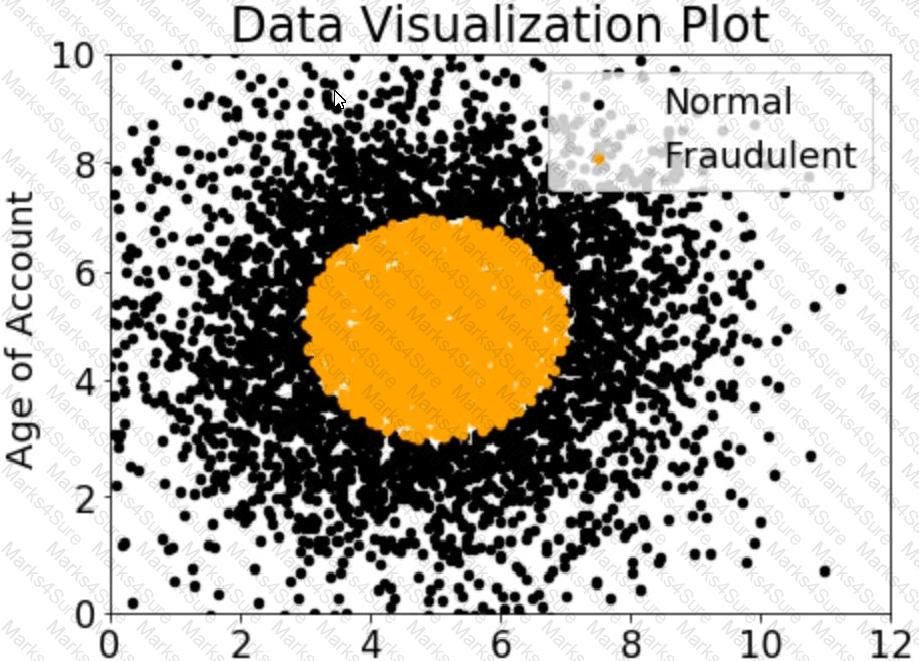
Based on this information, which model would have the HIGHEST recall with respect to the fraudulent class?

Options:

A.

Decision tree

B.

Linear support vector machine (SVM)

C.

Naive Bayesian classifier

D.

Single Perceptron with sigmoidal activation function

Buy Now
Questions 40

An ecommerce company wants to use machine learning (ML) to monitor fraudulent transactions on its website. The company is using Amazon SageMaker to research, train, deploy, and monitor the ML models.

The historical transactions data is in a .csv file that is stored in Amazon S3 The data contains features such as the user ' s IP address, navigation time, average time on each page, and the number of clicks for ....session. There is no label in the data to indicate if a transaction is anomalous.

Which models should the company use in combination to detect anomalous transactions? (Select TWO.)

Options:

A.

IP Insights

B.

K-nearest neighbors (k-NN)

C.

Linear learner with a logistic function

D.

Random Cut Forest (RCF)

E.

XGBoost

Buy Now
Questions 41

A social media company wants to develop a machine learning (ML) model to detect Inappropriate or offensive content in images. The company has collected a large dataset of labeled images and plans to use the built-in Amazon SageMaker image classification algorithm to train the model. The company also intends to use SageMaker pipe mode to speed up the training.

...company splits the dataset into training, validation, and testing datasets. The company stores the training and validation images in folders that are named Training and Validation, respectively. The folder ...ain subfolders that correspond to the names of the dataset classes. The company resizes the images to the same sue and generates two input manifest files named training.1st and validation.1st, for the ..ing dataset and the validation dataset. respectively. Finally, the company creates two separate Amazon S3 buckets for uploads of the training dataset and the validation dataset.

...h additional data preparation steps should the company take before uploading the files to Amazon S3?

Options:

A.

Generate two Apache Parquet files, training.parquet and validation.parquet. by reading the images into a Pandas data frame and storing the data frame as a Parquet file. Upload the Parquet files to the training S3 bucket

B.

Compress the training and validation directories by using the Snappy compression library Upload the manifest and compressed files to the training S3 bucket

C.

Compress the training and validation directories by using the gzip compression library. Upload the manifest and compressed files to the training S3 bucket.

D.

Generate two RecordIO files, training rec and validation.rec. from the manifest files by using the im2rec Apache MXNet utility tool. Upload the RecordlO files to the training S3 bucket.

Buy Now
Questions 42

A Data Scientist needs to analyze employment data. The dataset contains approximately 10 million

observations on people across 10 different features. During the preliminary analysis, the Data Scientist notices

that income and age distributions are not normal. While income levels shows a right skew as expected, with fewer individuals having a higher income, the age distribution also show a right skew, with fewer older

individuals participating in the workforce.

Which feature transformations can the Data Scientist apply to fix the incorrectly skewed data? (Choose two.)

Options:

A.

Cross-validation

B.

Numerical value binning

C.

High-degree polynomial transformation

D.

Logarithmic transformation

E.

One hot encoding

Buy Now
Questions 43

A data scientist is working on a forecast problem by using a dataset that consists of .csv files that are stored in Amazon S3. The files contain a timestamp variable in the following format:

March 1st, 2020, 08:14pm -

There is a hypothesis about seasonal differences in the dependent variable. This number could be higher or lower for weekdays because some days and hours present varying values, so the day of the week, month, or hour could be an important factor. As a result, the data scientist needs to transform the timestamp into weekdays, month, and day as three separate variables to conduct an analysis.

Which solution requires the LEAST operational overhead to create a new dataset with the added features?

Options:

A.

Create an Amazon EMR cluster. Develop PySpark code that can read the timestamp variable as a string, transform and create the new variables, and save the dataset as a new file in Amazon S3.

B.

Create a processing job in Amazon SageMaker. Develop Python code that can read the timestamp variable as a string, transform and create the new variables, and save the dataset as a new file in Amazon S3.

C.

Create a new flow in Amazon SageMaker Data Wrangler. Import the S3 file, use the Featurize date/time transform to generate the new variables, and save the dataset as a new file in Amazon S3.

D.

Create an AWS Glue job. Develop code that can read the timestamp variable as a string, transform and create the new variables, and save the dataset as a new file in Amazon S3.

Buy Now
Questions 44

An agriculture company wants to improve crop yield forecasting for the upcoming season by using crop yields from the last three seasons. The company wants to compare the performance of its new scikit-learn model to the benchmark.

A data scientist needs to package the code into a container that computes both the new model forecast and the benchmark.

The data scientist wants AWS to be responsible for the operational maintenance of the container.

Which solution will meet these requirements?

Options:

A.

Package the code as the training script for an Amazon SageMaker scikit-learn container.

B.

Package the code into a custom-built container. Push the container to Amazon Elastic Container Registry (Amazon ECR).

C.

Package the code into a custom-built container. Push the container to AWS Fargate.

D.

Package the code by extending an Amazon SageMaker scikit-learn container.

Buy Now
Questions 45

A retail company wants to update its customer support system. The company wants to implement automatic routing of customer claims to different queues to prioritize the claims by category.

Currently, an operator manually performs the category assignment and routing. After the operator classifies and routes the claim, the company stores the claim’s record in a central database. The claim’s record includes the claim’s category.

The company has no data science team or experience in the field of machine learning (ML). The company’s small development team needs a solution that requires no ML expertise.

Which solution meets these requirements?

Options:

A.

Export the database to a .csv file with two columns: claim_label and claim_text. Use the Amazon SageMaker Object2Vec algorithm and the .csv file to train a model. Use SageMaker to deploy the model to an inference endpoint. Develop a service in the application to use the inference endpoint to process incoming claims, predict the labels, and route the claims to the appropriate queue.

B.

Export the database to a .csv file with one column: claim_text. Use the Amazon SageMaker Latent Dirichlet Allocation (LDA) algorithm and the .csv file to train a model. Use the LDA algorithm to detect labels automatically. Use SageMaker to deploy the model to an inference endpoint. Develop a service in the application to use the inference endpoint to process incoming claims, predict the labels, and route the claims to the appropriate queue.

C.

Use Amazon Textract to process the database and automatically detect two columns: claim_label and claim_text. Use Amazon Comprehend custom classification and the extracted information to train the custom classifier. Develop a service in the application to use the Amazon Comprehend API to process incoming claims, predict the labels, and route the claims to the appropriate queue.

D.

Export the database to a .csv file with two columns: claim_label and claim_text. Use Amazon Comprehend custom classification and the .csv file to train the custom classifier. Develop a service in the application to use the Amazon Comprehend API to process incoming claims, predict the labels, and route the claims to the appropriate queue.

Buy Now
Questions 46

A company wants to use automatic speech recognition (ASR) to transcribe messages that are less than 60 seconds long from a voicemail-style application. The company requires the correct identification of 200 unique product names, some of which have unique spellings or pronunciations.

The company has 4,000 words of Amazon SageMaker Ground Truth voicemail transcripts it can use to customize the chosen ASR model. The company needs to ensure that everyone can update their customizations multiple times each hour.

Which approach will maximize transcription accuracy during the development phase?

Options:

A.

Use a voice-driven Amazon Lex bot to perform the ASR customization. Create customer slots within the bot that specifically identify each of the required product names. Use the Amazon Lex synonym mechanism to provide additional variations of each product name as mis-transcriptions are identified in development.

B.

Use Amazon Transcribe to perform the ASR customization. Analyze the word confidence scores in the transcript, and automatically create or update a custom vocabulary file with any word that has a confidence score below an acceptable threshold value. Use this updated custom vocabulary file in all future transcription tasks.

C.

Create a custom vocabulary file containing each product name with phonetic pronunciations, and use it with Amazon Transcribe to perform the ASR customization. Analyze the transcripts and manually update the custom vocabulary file to include updated or additional entries for those names that are not being correctly identified.

D.

Use the audio transcripts to create a training dataset and build an Amazon Transcribe custom language model. Analyze the transcripts and update the training dataset with a manually corrected version of transcripts where product names are not being transcribed correctly. Create an updated custom language model.

Buy Now
Questions 47

A Machine Learning Specialist working for an online fashion company wants to build a data ingestion solution for the company ' s Amazon S3-based data lake.

The Specialist wants to create a set of ingestion mechanisms that will enable future capabilities comprised of:

• Real-time analytics

• Interactive analytics of historical data

• Clickstream analytics

• Product recommendations

Which services should the Specialist use?

Options:

A.

AWS Glue as the data dialog; Amazon Kinesis Data Streams and Amazon Kinesis Data Analytics for real-time data insights; Amazon Kinesis Data Firehose for delivery to Amazon ES for clickstream analytics; Amazon EMR to generate personalized product recommendations

B.

Amazon Athena as the data catalog; Amazon Kinesis Data Streams and Amazon Kinesis Data Analytics for near-realtime data insights; Amazon Kinesis Data Firehose for clickstream analytics; AWS Glue to generate personalized product recommendations

C.

AWS Glue as the data catalog; Amazon Kinesis Data Streams and Amazon Kinesis Data Analytics for historical data insights; Amazon Kinesis Data Firehose for delivery to Amazon ES for clickstream analytics; Amazon EMR to generate personalized product recommendations

D.

Amazon Athena as the data catalog; Amazon Kinesis Data Streams and Amazon Kinesis Data Analytics for historical data insights; Amazon DynamoDB streams for clickstream analytics; AWS Glue to generate personalized product recommendations

Buy Now
Questions 48

A Machine Learning Specialist is working for an online retailer that wants to run analytics on every customer visit, processed through a machine learning pipeline. The data needs to be ingested by Amazon Kinesis Data Streams at up to 100 transactions per second, and the JSON data blob is 100 KB in size.

What is the MINIMUM number of shards in Kinesis Data Streams the Specialist should use to successfully ingest this data?

Options:

A.

1 shards

B.

10 shards

C.

100 shards

D.

1,000 shards

Buy Now
Questions 49

A company wants to classify user behavior as either fraudulent or normal. Based on internal research, a Machine Learning Specialist would like to build a binary classifier based on two features: age of account and transaction month. The class distribution for these features is illustrated in the figure provided.

MLS-C01 Question 49

Based on this information which model would have the HIGHEST accuracy?

Options:

A.

Long short-term memory (LSTM) model with scaled exponential linear unit (SELL))

B.

Logistic regression

C.

Support vector machine (SVM) with non-linear kernel

D.

Single perceptron with tanh activation function

Buy Now
Questions 50

A data scientist wants to improve the fit of a machine learning (ML) model that predicts house prices. The data scientist makes a first attempt to fit the model, but the fitted model has poor accuracy on both the training dataset and the test dataset.

Which steps must the data scientist take to improve model accuracy? (Select THREE.)

Options:

A.

Increase the amount of regularization that the model uses.

B.

Decrease the amount of regularization that the model uses.

C.

Increase the number of training examples that that model uses.

D.

Increase the number of test examples that the model uses.

E.

Increase the number of model features that the model uses.

F.

Decrease the number of model features that the model uses.

Buy Now
Questions 51

A company is building a demand forecasting model based on machine learning (ML). In the development stage, an ML specialist uses an Amazon SageMaker notebook to perform feature engineering during work hours that consumes low amounts of CPU and memory resources. A data engineer uses the same notebook to perform data preprocessing once a day on average that requires very high memory and completes in only 2 hours. The data preprocessing is not configured to use GPU. All the processes are running well on an ml.m5.4xlarge notebook instance.

The company receives an AWS Budgets alert that the billing for this month exceeds the allocated budget.

Which solution will result in the MOST cost savings?

Options:

A.

Change the notebook instance type to a memory optimized instance with the same vCPU number as the ml.m5.4xlarge instance has. Stop the notebook when it is not in use. Run both data preprocessing and feature engineering development on that instance.

B.

Keep the notebook instance type and size the same. Stop the notebook when it is not in use. Run data preprocessing on a P3 instance type with the same memory as the ml.m5.4xlarge instance by using Amazon SageMaker Processing.

C.

Change the notebook instance type to a smaller general-purpose instance. Stop the notebook when it is not in use. Run data preprocessing on an ml. r5 instance with the same memory size as the ml.m5.4xlarge instance by using Amazon SageMaker Processing.

D.

Change the notebook instance type to a smaller general-purpose instance. Stop the notebook when it is not in use. Run data preprocessing on an R5 instance with the same memory size as the ml.m5.4xlarge instance by using the Reserved Instance option.

Buy Now
Questions 52

A wildlife research company has a set of images of lions and cheetahs. The company created a dataset of the images. The company labeled each image with a binary label that indicates whether an image contains a lion or cheetah. The company wants to train a model to identify whether new images contain a lion or cheetah.

.... Dh Amazon SageMaker algorithm will meet this requirement?

Options:

A.

XGBoost

B.

Image Classification - TensorFlow

C.

Object Detection - TensorFlow

D.

Semantic segmentation - MXNet

Buy Now
Questions 53

A machine learning specialist works for a fruit processing company and needs to build a system that

categorizes apples into three types. The specialist has collected a dataset that contains 150 images for each type of apple and applied transfer learning on a neural network that was pretrained on ImageNet with this dataset.

The company requires at least 85% accuracy to make use of the model.

After an exhaustive grid search, the optimal hyperparameters produced the following:

68% accuracy on the training set

67% accuracy on the validation set

What can the machine learning specialist do to improve the system’s accuracy?

Options:

A.

Upload the model to an Amazon SageMaker notebook instance and use the Amazon SageMaker HPO feature to optimize the model’s hyperparameters.

B.

Add more data to the training set and retrain the model using transfer learning to reduce the bias.

C.

Use a neural network model with more layers that are pretrained on ImageNet and apply transfer learning to increase the variance.

D.

Train a new model using the current neural network architecture.

Buy Now
Questions 54

A company is using Amazon SageMaker to build a machine learning (ML) model to predict customer churn based on customer call transcripts. Audio files from customer calls are located in an on-premises VoIP system that has petabytes of recorded calls. The on-premises infrastructure has high-velocity networking and connects to the company ' s AWS infrastructure through a VPN connection over a 100 Mbps connection.

The company has an algorithm for transcribing customer calls that requires GPUs for inference. The company wants to store these transcriptions in an Amazon S3 bucket in the AWS Cloud for model development.

Which solution should an ML specialist use to deliver the transcriptions to the S3 bucket as quickly as possible?

Options:

A.

Order and use an AWS Snowball Edge Compute Optimized device with an NVIDIA Tesla module to run the transcription algorithm. Use AWS DataSync to send the resulting transcriptions to the transcription S3 bucket.

B.

Order and use an AWS Snowcone device with Amazon EC2 Inf1 instances to run the transcription algorithm Use AWS DataSync to send the resulting transcriptions to the transcription S3 bucket

C.

Order and use AWS Outposts to run the transcription algorithm on GPU-based Amazon EC2 instances. Store the resulting transcriptions in the transcription S3 bucket.

D.

Use AWS DataSync to ingest the audio files to Amazon S3. Create an AWS Lambda function to run the transcription algorithm on the audio files when they are uploaded to Amazon S3. Configure the function to write the resulting transcriptions to the transcription S3 bucket.

Buy Now
Questions 55

A manufacturing company stores production volume data in a PostgreSQL database.

The company needs an end-to-end solution that will give business analysts the ability to prepare data for processing and to predict future production volume based the previous year ' s production volume. The solution must not require the company to have coding knowledge.

Which solution will meet these requirements with the LEAST effort?

Options:

A.

Use AWS Database Migration Service (AWS DMS) to transfer the data from the PostgreSQL database to an Amazon S3 bucket. Create an Amazon EMR cluster to read the S3 bucket and perform the data preparation. Use Amazon SageMaker Studio for the prediction modeling.

B.

Use AWS Glue DataBrew to read the data that is in the PostgreSQL database and to perform the data preparation. Use Amazon SageMaker Canvas for the prediction modeling.

C.

Use AWS Database Migration Service (AWS DMS) to transfer the data from the PostgreSQL database to an Amazon S3 bucket. Use AWS Glue to read the data in the S3 bucket and to perform the data preparation. Use Amazon SageMaker Canvas for the prediction modeling.

D.

Use AWS Glue DataBrew to read the data that is in the PostgreSQL database and to perform the data preparation. Use Amazon SageMaker Studio for the prediction modeling.

Buy Now
Questions 56

A company needs to develop a model that uses a machine learning (ML) model for risk analysis. An ML engineer needs to evaluate the contribution each feature of a training dataset makes to the prediction of the target variable before the ML engineer selects features.

How should the ML engineer predict the contribution of each feature?

Options:

A.

Use the Amazon SageMaker Data Wrangler multicollinearity measurement features and the principal component analysis (PCA) algorithm to calculate the variance of the dataset along multiple directions in the feature space.

B.

Use an Amazon SageMaker Data Wrangler quick model visualization to find feature importance scores that are between 0.5 and 1.

C.

Use the Amazon SageMaker Data Wrangler bias report to identify potential biases in the data related to feature engineering.

D.

Use an Amazon SageMaker Data Wrangler data flow to create and modify a data preparation pipeline. Manually add the feature scores.

Buy Now
Questions 57

A Machine Learning Specialist is developing a daily ETL workflow containing multiple ETL jobs The workflow consists of the following processes

* Start the workflow as soon as data is uploaded to Amazon S3

* When all the datasets are available in Amazon S3, start an ETL job to join the uploaded datasets with multiple terabyte-sized datasets already stored in Amazon S3

* Store the results of joining datasets in Amazon S3

* If one of the jobs fails, send a notification to the Administrator

Which configuration will meet these requirements?

Options:

A.

Use AWS Lambda to trigger an AWS Step Functions workflow to wait for dataset uploads to complete in Amazon S3. Use AWS Glue to join the datasets Use an Amazon CloudWatch alarm to send an SNS notification to the Administrator in the case of a failure

B.

Develop the ETL workflow using AWS Lambda to start an Amazon SageMaker notebook instance Use a lifecycle configuration script to join the datasets and persist the results in Amazon S3 Use an Amazon CloudWatch alarm to send an SNS notification to the Administrator in the case of a failure

C.

Develop the ETL workflow using AWS Batch to trigger the start of ETL jobs when data is uploaded to Amazon S3 Use AWS Glue to join the datasets in Amazon S3 Use an Amazon CloudWatch alarm to send an SNS notification to the Administrator in the case of a failure

D.

Use AWS Lambda to chain other Lambda functions to read and join the datasets in Amazon S3 as soon as the data is uploaded to Amazon S3 Use an Amazon CloudWatch alarm to send an SNS notification to the Administrator in the case of a failure

Buy Now
Questions 58

A company is setting up an Amazon SageMaker environment. The corporate data security policy does not allow communication over the internet.

How can the company enable the Amazon SageMaker service without enabling direct internet access to Amazon SageMaker notebook instances?

Options:

A.

Create a NAT gateway within the corporate VPC.

B.

Route Amazon SageMaker traffic through an on-premises network.

C.

Create Amazon SageMaker VPC interface endpoints within the corporate VPC.

D.

Create VPC peering with Amazon VPC hosting Amazon SageMaker.

Buy Now
Questions 59

A financial company is trying to detect credit card fraud. The company observed that, on average, 2% of credit card transactions were fraudulent. A data scientist trained a classifier on a year ' s worth of credit card transactions data. The model needs to identify the fraudulent transactions (positives) from the regular ones (negatives). The company ' s goal is to accurately capture as many positives as possible.

Which metrics should the data scientist use to optimize the model? (Choose two.)

Options:

A.

Specificity

B.

False positive rate

C.

Accuracy

D.

Area under the precision-recall curve

E.

True positive rate

Buy Now
Questions 60

A beauty supply store wants to understand some characteristics of visitors to the store. The store has security video recordings from the past several years. The store wants to generate a report of hourly visitors from the recordings. The report should group visitors by hair style and hair color.

Which solution will meet these requirements with the LEAST amount of effort?

Options:

A.

Use an object detection algorithm to identify a visitor’s hair in video frames. Pass the identified hair to an ResNet-50 algorithm to determine hair style and hair color.

B.

Use an object detection algorithm to identify a visitor’s hair in video frames. Pass the identified hair to an XGBoost algorithm to determine hair style and hair color.

C.

Use a semantic segmentation algorithm to identify a visitor’s hair in video frames. Pass the identified hair to an ResNet-50 algorithm to determine hair style and hair color.

D.

Use a semantic segmentation algorithm to identify a visitor’s hair in video frames. Pass the identified hair to an XGBoost algorithm to determine hair style and hair.

Buy Now
Questions 61

A Data Scientist is training a multilayer perception (MLP) on a dataset with multiple classes. The target class of interest is unique compared to the other classes within the dataset, but it does not achieve and acceptable ecall metric. The Data Scientist has already tried varying the number and size of the MLP’s hidden layers,

which has not significantly improved the results. A solution to improve recall must be implemented as quickly as possible.

Which techniques should be used to meet these requirements?

Options:

A.

Gather more data using Amazon Mechanical Turk and then retrain

B.

Train an anomaly detection model instead of an MLP

C.

Train an XGBoost model instead of an MLP

D.

Add class weights to the MLP’s loss function and then retrain

Buy Now
Questions 62

A library is developing an automatic book-borrowing system that uses Amazon Rekognition. Images of library members’ faces are stored in an Amazon S3 bucket. When members borrow books, the Amazon Rekognition CompareFaces API operation compares real faces against the stored faces in Amazon S3.

The library needs to improve security by making sure that images are encrypted at rest. Also, when the images are used with Amazon Rekognition. they need to be encrypted in transit. The library also must ensure that the images are not used to improve Amazon Rekognition as a service.

How should a machine learning specialist architect the solution to satisfy these requirements?

Options:

A.

Enable server-side encryption on the S3 bucket. Submit an AWS Support ticket to opt out of allowing images to be used for improving the service, and follow the process provided by AWS Support.

B.

Switch to using an Amazon Rekognition collection to store the images. Use the IndexFaces and SearchFacesByImage API operations instead of the CompareFaces API operation.

C.

Switch to using the AWS GovCloud (US) Region for Amazon S3 to store images and for Amazon Rekognition to compare faces. Set up a VPN connection and only call the Amazon Rekognition API operations through the VPN.

D.

Enable client-side encryption on the S3 bucket. Set up a VPN connection and only call the Amazon Rekognition API operations through the VPN.

Buy Now
Questions 63

A company is building a line-counting application for use in a quick-service restaurant. The company wants to use video cameras pointed at the line of customers at a given register to measure how many people are in line and deliver notifications to managers if the line grows too long. The restaurant locations have limited bandwidth for connections to external services and cannot accommodate multiple video streams without impacting other operations.

Which solution should a machine learning specialist implement to meet these requirements?

Options:

A.

Install cameras compatible with Amazon Kinesis Video Streams to stream the data to AWS over the restaurant ' s existing internet connection. Write an AWS Lambda function to take an image and send it to Amazon Rekognition to count the number of faces in the image. Send an Amazon Simple Notification Service (Amazon SNS) notification if the line is too long.

B.

Deploy AWS DeepLens cameras in the restaurant to capture video. Enable Amazon Rekognition on the AWS DeepLens device, and use it to trigger a local AWS Lambda function when a person is recognized. Use the Lambda function to send an Amazon Simple Notification Service (Amazon SNS) notification if the line is too long.

C.

Build a custom model in Amazon SageMaker to recognize the number of people in an image. Install cameras compatible with Amazon Kinesis Video Streams in the restaurant. Write an AWS Lambda function to take an image. Use the SageMaker endpoint to call the model to count people. Send an Amazon Simple Notification Service (Amazon SNS) notification if the line is too long.

D.

Build a custom model in Amazon SageMaker to recognize the number of people in an image. Deploy AWS DeepLens cameras in the restaurant. Deploy the model to the cameras. Deploy an AWS Lambda function to the cameras to use the model to count people and send an Amazon Simple Notification Service (Amazon SNS) notification if the line is too long.

Buy Now
Questions 64

A Machine Learning Specialist is applying a linear least squares regression model to a dataset with 1 000 records and 50 features Prior to training, the ML Specialist notices that two features are perfectly linearly dependent

Why could this be an issue for the linear least squares regression model?

Options:

A.

It could cause the backpropagation algorithm to fail during training

B.

It could create a singular matrix during optimization which fails to define a unique solution

C.

It could modify the loss function during optimization causing it to fail during training

D.

It could introduce non-linear dependencies within the data which could invalidate the linear assumptions of the model

Buy Now
Questions 65

An ecommerce company is automating the categorization of its products based on images. A data scientist has trained a computer vision model using the Amazon SageMaker image classification algorithm. The images for each product are classified according to specific product lines. The accuracy of the model is too low when categorizing new products. All of the product images have the same dimensions and are stored within an Amazon S3 bucket. The company wants to improve the model so it can be used for new products as soon as possible.

Which steps would improve the accuracy of the solution? (Choose three.)

Options:

A.

Use the SageMaker semantic segmentation algorithm to train a new model to achieve improved accuracy.

B.

Use the Amazon Rekognition DetectLabels API to classify the products in the dataset.

C.

Augment the images in the dataset. Use open-source libraries to crop, resize, flip, rotate, and adjust the brightness and contrast of the images.

D.

Use a SageMaker notebook to implement the normalization of pixels and scaling of the images. Store the new dataset in Amazon S3.

E.

Use Amazon Rekognition Custom Labels to train a new model.

F.

Check whether there are class imbalances in the product categories, and apply oversampling or undersampling as required. Store the new dataset in Amazon S3.

Buy Now
Questions 66

A data scientist wants to use Amazon Forecast to build a forecasting model for inventory demand for a retail company. The company has provided a dataset of historic inventory demand for its products as a .csv file stored in an Amazon S3 bucket. The table below shows a sample of the dataset.

How should the data scientist transform the data?

Options:

A.

Use ETL jobs in AWS Glue to separate the dataset into a target time series dataset and an item metadata dataset. Upload both datasets as .csv files to Amazon S3.

B.

Use a Jupyter notebook in Amazon SageMaker to separate the dataset into a related time series dataset and an item metadata dataset. Upload both datasets as tables in Amazon Aurora.

C.

Use AWS Batch jobs to separate the dataset into a target time series dataset, a related time series dataset, and an item metadata dataset. Upload them directly to Forecast from a local machine.

D.

Use a Jupyter notebook in Amazon SageMaker to transform the data into the optimized protobuf recordIO format. Upload the dataset in this format to Amazon S3.

Buy Now
Questions 67

A company has a podcast platform that has thousands of users. The company implemented an algorithm to detect low podcast engagement based on a 10-minute running window of user events such as listening to. pausing, and closing the podcast. A machine learning (ML) specialist is designing the ingestion process for these events. The ML specialist needs to transform the data to prepare the data for inference.

How should the ML specialist design the transformation step to meet these requirements with the LEAST operational effort?

Options:

A.

Use an Amazon Managed Streaming for Apache Kafka (Amazon MSK) cluster to ingest event data. Use Amazon Managed Service for Apache Flink (previously known as Amazon Kinesis Data Analytics) to transform the most recent 10 minutes of data before inference.

B.

Use Amazon Kinesis Data Streams to ingest event data. Store the data in Amazon S3 by using Amazon Data Firehose. Use AWS Lambda to transform the most recent 10 minutes of data before inference.

C.

Use Amazon Kinesis Data Streams to ingest event data. Use Amazon Managed Service for Apache Flink (previously known as Amazon Kinesis Data Analytics) to transform the most recent 10 minutes of data before inference.

D.

Use an Amazon Managed Streaming for Apache Kafka (Amazon MSK) cluster to ingest event data. Use AWS Lambda to transform the most recent 10 minutes of data before inference.

Buy Now
Questions 68

When submitting Amazon SageMaker training jobs using one of the built-in algorithms, which common parameters MUST be specified? (Select THREE.)

Options:

A.

The training channel identifying the location of training data on an Amazon S3 bucket.

B.

The validation channel identifying the location of validation data on an Amazon S3 bucket.

C.

The 1AM role that Amazon SageMaker can assume to perform tasks on behalf of the users.

D.

Hyperparameters in a JSON array as documented for the algorithm used.

E.

The Amazon EC2 instance class specifying whether training will be run using CPU or GPU.

F.

The output path specifying where on an Amazon S3 bucket the trained model will persist.

Buy Now
Questions 69

A manufacturing company needs to identify returned smartphones that have been damaged by moisture. The company has an automated process that produces 2.000 diagnostic values for each phone. The database contains more than five million phone evaluations. The evaluation process is consistent, and there are no missing values in the data. A machine learning (ML) specialist has trained an Amazon SageMaker linear learner ML model to classify phones as moisture damaged or not moisture damaged by using all available features. The model ' s F1 score is 0.6.

What changes in model training would MOST likely improve the model ' s F1 score? (Select TWO.)

Options:

A.

Continue to use the SageMaker linear learner algorithm. Reduce the number of features with the SageMaker principal component analysis (PCA) algorithm.

B.

Continue to use the SageMaker linear learner algorithm. Reduce the number of features with the scikit-iearn multi-dimensional scaling (MDS) algorithm.

C.

Continue to use the SageMaker linear learner algorithm. Set the predictor type to regressor.

D.

Use the SageMaker k-means algorithm with k of less than 1.000 to train the model

E.

Use the SageMaker k-nearest neighbors (k-NN) algorithm. Set a dimension reduction target of less than 1,000 to train the model.

Buy Now
Questions 70

A retail company collects customer comments about its products from social media, the company website, and customer call logs. A team of data scientists and engineers wants to find common topics and determine which products the customers are referring to in their comments. The team is using natural language processing (NLP) to build a model to help with this classification.

Each product can be classified into multiple categories that the company defines. These categories are related but are not mutually exclusive. For example, if there is mention of " Sample Yogurt " in the document of customer comments, then " Sample Yogurt " should be classified as " yogurt, " " snack, " and " dairy product. "

The team is using Amazon Comprehend to train the model and must complete the project as soon as possible.

Which functionality of Amazon Comprehend should the team use to meet these requirements?

Options:

A.

Custom classification with multi-class mode

B.

Custom classification with multi-label mode

C.

Custom entity recognition

D.

Built-in models

Buy Now
Questions 71

A Machine Learning Specialist kicks off a hyperparameter tuning job for a tree-based ensemble model using Amazon SageMaker with Area Under the ROC Curve (AUC) as the objective metric This workflow will eventually be deployed in a pipeline that retrains and tunes hyperparameters each night to model click-through on data that goes stale every 24 hours

With the goal of decreasing the amount of time it takes to train these models, and ultimately to decrease costs, the Specialist wants to reconfigure the input hyperparameter range(s)

Which visualization will accomplish this?

Options:

A.

A histogram showing whether the most important input feature is Gaussian.

B.

A scatter plot with points colored by target variable that uses (-Distributed Stochastic Neighbor Embedding (I-SNE) to visualize the large number of input variables in an easier-to-read dimension.

C.

A scatter plot showing (he performance of the objective metric over each training iteration

D.

A scatter plot showing the correlation between maximum tree depth and the objective metric.

Buy Now
Questions 72

A data scientist must build a custom recommendation model in Amazon SageMaker for an online retail company. Due to the nature of the company ' s products, customers buy only 4-5 products every 5-10 years. So, the company relies on a steady stream of new customers. When a new customer signs up, the company collects data on the customer ' s preferences. Below is a sample of the data available to the data scientist.

MLS-C01 Question 72

How should the data scientist split the dataset into a training and test set for this use case?

Options:

A.

Shuffle all interaction data. Split off the last 10% of the interaction data for the test set.

B.

Identify the most recent 10% of interactions for each user. Split off these interactions for the test set.

C.

Identify the 10% of users with the least interaction data. Split off all interaction data from these users for the test set.

D.

Randomly select 10% of the users. Split off all interaction data from these users for the test set.

Buy Now
Questions 73

A large mobile network operating company is building a machine learning model to predict customers who are likely to unsubscribe from the service. The company plans to offer an incentive for these customers as the cost of churn is far greater than the cost of the incentive.

The model produces the following confusion matrix after evaluating on a test dataset of 100 customers:

Based on the model evaluation results, why is this a viable model for production?

Options:

A.

The model is 86% accurate and the cost incurred by the company as a result of false negatives is less than the false positives.

B.

The precision of the model is 86%, which is less than the accuracy of the model.

C.

The model is 86% accurate and the cost incurred by the company as a result of false positives is less than the false negatives.

D.

The precision of the model is 86%, which is greater than the accuracy of the model.

Buy Now
Questions 74

A machine learning specialist is developing a proof of concept for government users whose primary concern is security. The specialist is using Amazon SageMaker to train a convolutional neural network (CNN) model for a photo classifier application. The specialist wants to protect the data so that it cannot be accessed and transferred to a remote host by malicious code accidentally installed on the training container.

Which action will provide the MOST secure protection?

Options:

A.

Remove Amazon S3 access permissions from the SageMaker execution role.

B.

Encrypt the weights of the CNN model.

C.

Encrypt the training and validation dataset.

D.

Enable network isolation for training jobs.

Buy Now
Questions 75

A Data Scientist is developing a machine learning model to predict future patient outcomes based on information collected about each patient and their treatment plans. The model should output a continuous value as its prediction. The data available includes labeled outcomes for a set of 4,000 patients. The study was conducted on a group of individuals over the age of 65 who have a particular disease that is known to worsen with age.

Initial models have performed poorly. While reviewing the underlying data, the Data Scientist notices that, out of 4,000 patient observations, there are 450 where the patient age has been input as 0. The other features for these observations appear normal compared to the rest of the sample population.

How should the Data Scientist correct this issue?

Options:

A.

Drop all records from the dataset where age has been set to 0.

B.

Replace the age field value for records with a value of 0 with the mean or median value from the dataset.

C.

Drop the age feature from the dataset and train the model using the rest of the features.

D.

Use k-means clustering to handle missing features.

Buy Now
Questions 76

A company ' s machine learning (ML) specialist is designing a scalable data storage solution for Amazon SageMaker. The company has an existing TensorFlow-based model that uses a train.py script. The model relies on static training data that is currently stored in TFRecord format.

What should the ML specialist do to provide the training data to SageMaker with the LEAST development overhead?

Options:

A.

Put the TFRecord data into an Amazon S3 bucket. Use AWS Glue or AWS Lambda to reformat the data to protobuf format and store the data in a second S3 bucket. Point the SageMaker training invocation to the second S3 bucket.

B.

Rewrite the train.py script to add a section that converts TFRecord data to protobuf format. Point the SageMaker training invocation to the local path of the data. Ingest the protobuf data instead of the TFRecord data.

C.

Use SageMaker script mode, and use train.py unchanged. Point the SageMaker training invocation to the local path of the data without reformatting the training data.

D.

Use SageMaker script mode, and use train.py unchanged. Put the TFRecord data into an Amazon S3 bucket. Point the SageMaker training invocation to the S3 bucket without reformatting the training data.

Buy Now
Questions 77

A machine learning (ML) engineer is preparing a dataset for a classification model. The ML engineer notices that some continuous numeric features have a significantly greater value than most other features. A business expert explains that the features are independently informative and that the dataset is representative of the target distribution.

After training, the model ' s inferences accuracy is lower than expected.

Which preprocessing technique will result in the GREATEST increase of the model ' s inference accuracy?

Options:

A.

Normalize the problematic features.

B.

Bootstrap the problematic features.

C.

Remove the problematic features.

D.

Extrapolate synthetic features.

Buy Now
Questions 78

A Machine Learning Specialist needs to be able to ingest streaming data and store it in Apache Parquet files for exploration and analysis. Which of the following services would both ingest and store this data in the correct format?

Options:

A.

AWSDMS

B.

Amazon Kinesis Data Streams

C.

Amazon Kinesis Data Firehose

D.

Amazon Kinesis Data Analytics

Buy Now
Questions 79

A finance company has collected stock return data for 5.000 publicly traded companies. A financial analyst has a dataset that contains 2.000 attributes for each company. The financial analyst wants to use Amazon SageMaker to identify the top 15 attributes that are most valuable to predict future stock returns.

Which solution will meet these requirements with the LEAST operational overhead?

Options:

A.

Use the linear learner algorithm in SageMaker to train a linear regression model to predict the stock returns. Identify the most predictive features by ranking absolute coefficient values.

B.

Use random forest regression in SageMaker to train a model to predict the stock returns. Identify the most predictive features based on Gini importance scores.

C.

Use an Amazon SageMaker Data Wrangler quick model visualization to predict the stock returns. Identify the most predictive features based on the quick model ' s feature importance scores.

D.

Use Amazon SageMaker Autopilot to build a regression model to predict the stock returns. Identify the most predictive features based on an Amazon SageMaker Clarify report.

Buy Now
Questions 80

A company is using Amazon Polly to translate plaintext documents to speech for automated company announcements However company acronyms are being mispronounced in the current documents How should a Machine Learning Specialist address this issue for future documents?

Options:

A.

Convert current documents to SSML with pronunciation tags

B.

Create an appropriate pronunciation lexicon.

C.

Output speech marks to guide in pronunciation

D.

Use Amazon Lex to preprocess the text files for pronunciation

Buy Now
Questions 81

An ecommerce company wants to train a large image classification model with 10.000 classes. The company runs multiple model training iterations and needs to minimize operational overhead and cost. The company also needs to avoid loss of work and model retraining.

Which solution will meet these requirements?

Options:

A.

Create the training jobs as AWS Batch jobs that use Amazon EC2 Spot Instances in a managed compute environment.

B.

Use Amazon EC2 Spot Instances to run the training jobs. Use a Spot Instance interruption notice to save a snapshot of the model to Amazon S3 before an instance is terminated.

C.

Use AWS Lambda to run the training jobs. Save model weights to Amazon S3.

D.

Use managed spot training in Amazon SageMaker. Launch the training jobs with checkpointing enabled.

Buy Now
Questions 82

During mini-batch training of a neural network for a classification problem, a Data Scientist notices that training accuracy oscillates What is the MOST likely cause of this issue?

Options:

A.

The class distribution in the dataset is imbalanced

B.

Dataset shuffling is disabled

C.

The batch size is too big

D.

The learning rate is very high

Buy Now
Questions 83

A company operates large cranes at a busy port. The company plans to use machine learning (ML) for predictive maintenance of the cranes to avoid unexpected breakdowns and to improve productivity.

The company already uses sensor data from each crane to monitor the health of the cranes in real time. The sensor data includes rotation speed, tension, energy consumption, vibration, pressure, and …perature for each crane. The company contracts AWS ML experts to implement an ML solution.

Which potential findings would indicate that an ML-based solution is suitable for this scenario? (Select TWO.)

Options:

A.

The historical sensor data does not include a significant number of data points and attributes for certain time periods.

B.

The historical sensor data shows that simple rule-based thresholds can predict crane failures.

C.

The historical sensor data contains failure data for only one type of crane model that is in operation and lacks failure data of most other types of crane that are in operation.

D.

The historical sensor data from the cranes are available with high granularity for the last 3 years.

E.

The historical sensor data contains most common types of crane failures that the company wants to predict.

Buy Now
Questions 84

A retail company is ingesting purchasing records from its network of 20,000 stores to Amazon S3 by using Amazon Kinesis Data Firehose. The company uses a small, server-based application in each store to send the data to AWS over the internet. The company uses this data to train a machine learning model that is retrained each day. The company ' s data science team has identified existing attributes on these records that could be combined to create an improved model.

Which change will create the required transformed records with the LEAST operational overhead?

Options:

A.

Create an AWS Lambda function that can transform the incoming records. Enable data transformation on the ingestion Kinesis Data Firehose delivery stream. Use the Lambda function as the invocation target.

B.

Deploy an Amazon EMR cluster that runs Apache Spark and includes the transformation logic. Use Amazon EventBridge (Amazon CloudWatch Events) to schedule an AWS Lambda function to launch the cluster each day and transform the records that accumulate in Amazon S3. Deliver the transformed records to Amazon S3.

C.

Deploy an Amazon S3 File Gateway in the stores. Update the in-store software to deliver data to the S3 File Gateway. Use a scheduled daily AWS Glue job to transform the data that the S3 File Gateway delivers to Amazon S3.

D.

Launch a fleet of Amazon EC2 instances that include the transformation logic. Configure the EC2 instances with a daily cron job to transform the records that accumulate in Amazon S3. Deliver the transformed records to Amazon S3.

Buy Now
Questions 85

A data scientist uses Amazon SageMaker Data Wrangler to define and perform transformations and feature engineering on historical data. The data scientist saves the transformations to SageMaker Feature Store.

The historical data is periodically uploaded to an Amazon S3 bucket. The data scientist needs to transform the new historic data and add it to the online feature store The data scientist needs to prepare the .....historic data for training and inference by using native integrations.

Which solution will meet these requirements with the LEAST development effort?

Options:

A.

Use AWS Lambda to run a predefined SageMaker pipeline to perform the transformations on each new dataset that arrives in the S3 bucket.

B.

Run an AWS Step Functions step and a predefined SageMaker pipeline to perform the transformations on each new dalaset that arrives in the S3 bucket

C.

Use Apache Airflow to orchestrate a set of predefined transformations on each new dataset that arrives in the S3 bucket.

D.

Configure Amazon EventBridge to run a predefined SageMaker pipeline to perform the transformations when a new data is detected in the S3 bucket.

Buy Now
Questions 86

A Machine Learning Specialist trained a regression model, but the first iteration needs optimizing. The Specialist needs to understand whether the model is more frequently overestimating or underestimating the target.

What option can the Specialist use to determine whether it is overestimating or underestimating the target value?

Options:

A.

Root Mean Square Error (RMSE)

B.

Residual plots

C.

Area under the curve

D.

Confusion matrix

Buy Now
Questions 87

A company processes millions of orders every day. The company uses Amazon DynamoDB tables to store order information. When customers submit new orders, the new orders are immediately added to the DynamoDB tables. New orders arrive in the DynamoDB tables continuously.

A data scientist must build a peak-time prediction solution. The data scientist must also create an Amazon OuickSight dashboard to display near real-lime order insights. The data scientist needs to build a solution that will give QuickSight access to the data as soon as new order information arrives.

Which solution will meet these requirements with the LEAST delay between when a new order is processed and when QuickSight can access the new order information?

Options:

A.

Use AWS Glue to export the data from Amazon DynamoDB to Amazon S3. Configure OuickSight to access the data in Amazon S3.

B.

Use Amazon Kinesis Data Streams to export the data from Amazon DynamoDB to Amazon S3. Configure OuickSight to access the data in Amazon S3.

C.

Use an API call from OuickSight to access the data that is in Amazon DynamoDB directly

D.

Use Amazon Kinesis Data Firehose to export the data from Amazon DynamoDB to Amazon S3. Configure OuickSight to access the data in Amazon S3.

Buy Now
Questions 88

A machine learning specialist needs to analyze comments on a news website with users across the globe. The specialist must find the most discussed topics in the comments that are in either English or Spanish.

What steps could be used to accomplish this task? (Choose two.)

Options:

A.

Use an Amazon SageMaker BlazingText algorithm to find the topics independently from language. Proceed with the analysis.

B.

Use an Amazon SageMaker seq2seq algorithm to translate from Spanish to English, if necessary. Use a SageMaker Latent Dirichlet Allocation (LDA) algorithm to find the topics.

C.

Use Amazon Translate to translate from Spanish to English, if necessary. Use Amazon Comprehend topic modeling to find the topics.

D.

Use Amazon Translate to translate from Spanish to English, if necessary. Use Amazon Lex to extract topics form the content.

E.

Use Amazon Translate to translate from Spanish to English, if necessary. Use Amazon SageMaker Neural Topic Model (NTM) to find the topics.

Buy Now
Questions 89

A Machine Learning team runs its own training algorithm on Amazon SageMaker. The training algorithm

requires external assets. The team needs to submit both its own algorithm code and algorithm-specific

parameters to Amazon SageMaker.

What combination of services should the team use to build a custom algorithm in Amazon SageMaker?

(Choose two.)

Options:

A.

AWS Secrets Manager

B.

AWS CodeStar

C.

Amazon ECR

D.

Amazon ECS

E.

Amazon S3

Buy Now
Questions 90

A company wants to segment a large group of customers into subgroups based on shared characteristics. The company’s data scientist is planning to use the Amazon SageMaker built-in k-means clustering algorithm for this task. The data scientist needs to determine the optimal number of subgroups (k) to use.

Which data visualization approach will MOST accurately determine the optimal value of k?

Options:

A.

Calculate the principal component analysis (PCA) components. Run the k-means clustering algorithm for a range of k by using only the first two PCA components. For each value of k, create a scatter plot with a different color for each cluster. The optimal value of k is the value where the clusters start to look reasonably separated.

B.

Calculate the principal component analysis (PCA) components. Create a line plot of the number of components against the explained variance. The optimal value of k is the number of PCA components after which the curve starts decreasing in a linear fashion.

C.

Create a t-distributed stochastic neighbor embedding (t-SNE) plot for a range of perplexity values. The optimal value of k is the value of perplexity, where the clusters start to look reasonably separated.

D.

Run the k-means clustering algorithm for a range of k. For each value of k, calculate the sum of squared errors (SSE). Plot a line chart of the SSE for each value of k. The optimal value of k is the point after which the curve starts decreasing in a linear fashion.

Buy Now
Questions 91

A Machine Learning Specialist is packaging a custom ResNet model into a Docker container so the company can leverage Amazon SageMaker for training. The Specialist is using Amazon EC2 P3 instances to train the model and needs to properly configure the Docker container to leverage the NVIDIA GPUs.

What does the Specialist need to do?

Options:

A.

Bundle the NVIDIA drivers with the Docker image.

B.

Build the Docker container to be NVIDIA-Docker compatible.

C.

Organize the Docker container ' s file structure to execute on GPU instances.

D.

Set the GPU flag in the Amazon SageMaker CreateTrainingJob request body

Buy Now
Questions 92

A Machine Learning Specialist is required to build a supervised image-recognition model to identify a cat. The ML Specialist performs some tests and records the following results for a neural network-based image classifier:

Total number of images available = 1,000 Test set images = 100 (constant test set)

The ML Specialist notices that, in over 75% of the misclassified images, the cats were held upside down by their owners.

Which techniques can be used by the ML Specialist to improve this specific test error?

Options:

A.

Increase the training data by adding variation in rotation for training images.

B.

Increase the number of epochs for model training.

C.

Increase the number of layers for the neural network.

D.

Increase the dropout rate for the second-to-last layer.

Buy Now
Questions 93

A company is running an Amazon SageMaker training job that will access data stored in its Amazon S3 bucket A compliance policy requires that the data never be transmitted across the internet How should the company set up the job?

Options:

A.

Launch the notebook instances in a public subnet and access the data through the public S3 endpoint

B.

Launch the notebook instances in a private subnet and access the data through a NAT gateway

C.

Launch the notebook instances in a public subnet and access the data through a NAT gateway

D.

Launch the notebook instances in a private subnet and access the data through an S3 VPC endpoint.

Buy Now
Questions 94

An office security agency conducted a successful pilot using 100 cameras installed at key locations within the main office. Images from the cameras were uploaded to Amazon S3 and tagged using Amazon Rekognition, and the results were stored in Amazon ES. The agency is now looking to expand the pilot into a full production system using thousands of video cameras in its office locations globally. The goal is to identify activities performed by non-employees in real time.

Which solution should the agency consider?

Options:

A.

Use a proxy server at each local office and for each camera, and stream the RTSP feed to a uniqueAmazon Kinesis Video Streams video stream. On each stream, use Amazon Rekognition Video and createa stream processor to detect faces from a collection of known employees, and alert when non-employeesare detected.

B.

Use a proxy server at each local office and for each camera, and stream the RTSP feed to a uniqueAmazon Kinesis Video Streams video stream. On each stream, use Amazon Rekognition Image to detectfaces from a collection of known employees and alert when non-employees are detected.

C.

Install AWS DeepLens cameras and use the DeepLens_Kinesis_Video module to stream video toAmazon Kinesis Video Streams for each camera. On each stream, use Amazon Rekognition Video andcreate a stream processor to detect faces from a collection on each stream, and alert when nonemployeesare detected.

D.

Install AWS DeepLens cameras and use the DeepLens_Kinesis_Video module to stream video toAmazon Kinesis Video Streams for each camera. On each stream, run an AWS Lambda function tocapture image fragments and then call Amazon Rekognition Image to detect faces from a collection ofknown employees, and alert when non-employees are detected.

Buy Now
Questions 95

A retail company wants to combine its customer orders with the product description data from its product catalog. The structure and format of the records in each dataset is different. A data analyst tried to use a spreadsheet to combine the datasets, but the effort resulted in duplicate records and records that were not properly combined. The company needs a solution that it can use to combine similar records from the two datasets and remove any duplicates.

Which solution will meet these requirements?

Options:

A.

Use an AWS Lambda function to process the data. Use two arrays to compare equal strings in the fields from the two datasets and remove any duplicates.

B.

Create AWS Glue crawlers for reading and populating the AWS Glue Data Catalog. Call the AWS Glue SearchTables API operation to perform a fuzzy-matching search on the two datasets, and cleanse the data accordingly.

C.

Create AWS Glue crawlers for reading and populating the AWS Glue Data Catalog. Use the FindMatches transform to cleanse the data.

D.

Create an AWS Lake Formation custom transform. Run a transformation for matching products from the Lake Formation console to cleanse the data automatically.

Buy Now
Questions 96

A data scientist at a financial services company used Amazon SageMaker to train and deploy a model that predicts loan defaults. The model analyzes new loan applications and predicts the risk of loan default. To train the model, the data scientist manually extracted loan data from a database. The data scientist performed the model training and deployment steps in a Jupyter notebook that is hosted on SageMaker Studio notebooks. The model ' s prediction accuracy is decreasing over time. Which combination of slept in the MOST operationally efficient way for the data scientist to maintain the model ' s accuracy? (Select TWO.)

Options:

A.

Use SageMaker Pipelines to create an automated workflow that extracts fresh data, trains the model, and deploys a new version of the model.

B.

Configure SageMaker Model Monitor with an accuracy threshold to check for model drift. Initiate an Amazon CloudWatch alarm when the threshold is exceeded. Connect the workflow in SageMaker Pipelines with the CloudWatch alarm to automatically initiate retraining.

C.

Store the model predictions in Amazon S3 Create a daily SageMaker Processing job that reads the predictions from Amazon S3, checks for changes in model prediction accuracy, and sends an email notification if a significant change is detected.

D.

Rerun the steps in the Jupyter notebook that is hosted on SageMaker Studio notebooks to retrain the model and redeploy a new version of the model.

E.

Export the training and deployment code from the SageMaker Studio notebooks into a Python script. Package the script into an Amazon Elastic Container Service (Amazon ECS) task that an AWS Lambda function can initiate.

Buy Now
Questions 97

A data engineer needs to provide a team of data scientists with the appropriate dataset to run machine learning training jobs. The data will be stored in Amazon S3. The data engineer is obtaining the data from an Amazon Redshift database and is using join queries to extract a single tabular dataset. A portion of the schema is as follows:

...traction Timestamp (Timeslamp)

...JName(Varchar)

...JNo (Varchar)

Th data engineer must provide the data so that any row with a CardNo value of NULL is removed. Also, the TransactionTimestamp column must be separated into a TransactionDate column and a isactionTime column Finally, the CardName column must be renamed to NameOnCard.

The data will be extracted on a monthly basis and will be loaded into an S3 bucket. The solution must minimize the effort that is needed to set up infrastructure for the ingestion and transformation. The solution must be automated and must minimize the load on the Amazon Redshift cluster

Which solution meets these requirements?

Options:

A.

Set up an Amazon EMR cluster Create an Apache Spark job to read the data from the Amazon Redshift cluster and transform the data. Load the data into the S3 bucket. Schedule the job to run monthly.

B.

Set up an Amazon EC2 instance with a SQL client tool, such as SQL Workbench/J. to query the data from the Amazon Redshift cluster directly. Export the resulting dataset into a We. Upload the file into the S3 bucket. Perform these tasks monthly.

C.

Set up an AWS Glue job that has the Amazon Redshift cluster as the source and the S3 bucket as the destination Use the built-in transforms Filter, Map. and RenameField to perform the required transformations. Schedule the job to run monthly.

D.

Use Amazon Redshift Spectrum to run a query that writes the data directly to the S3 bucket. Create an AWS Lambda function to run the query monthly

Buy Now
Questions 98

A machine learning (ML) specialist needs to solve a binary classification problem for a marketing dataset. The ML specialist must maximize the Area Under the ROC Curve (AUC) of the algorithm by training an XGBoost algorithm. The ML specialist must find values for the eta, alpha, min_child_weight, and max_depth hyperparameter that will generate the most accurate model.  

Which approach will meet these requirements with the LEAST operational overhead?  

Options:

A.

Use a bootstrap script to install scikit-learn on an Amazon EMR cluster. Deploy the EMR cluster. Apply k-fold cross-validation methods to the algorithm.

B.

Deploy Amazon SageMaker prebuilt Docker images that have scikit-learn installed. Apply k-fold cross-validation methods to the algorithm.

C.

Use Amazon SageMaker automatic model tuning (AMT). Specify a range of values for each hyperparameter.

D.

Subscribe to an AUC algorithm that is on AWS Marketplace. Specify a range of values for each hyperparameter.

Buy Now
Questions 99

A network security vendor needs to ingest telemetry data from thousands of endpoints that run all over the world. The data is transmitted every 30 seconds in the form of records that contain 50 fields. Each record is up to 1 KB in size. The security vendor uses Amazon Kinesis Data Streams to ingest the data. The vendor requires hourly summaries of the records that Kinesis Data Streams ingests. The vendor will use Amazon Athena to query the records and to generate the summaries. The Athena queries will target 7 to 12 of the available data fields.

Which solution will meet these requirements with the LEAST amount of customization to transform and store the ingested data?

Options:

A.

Use AWS Lambda to read and aggregate the data hourly. Transform the data and store it in Amazon S3 by using Amazon Kinesis Data Firehose.

B.

Use Amazon Kinesis Data Firehose to read and aggregate the data hourly. Transform the data and store it in Amazon S3 by using a short-lived Amazon EMR cluster.

C.

Use Amazon Kinesis Data Analytics to read and aggregate the data hourly. Transform the data and store it in Amazon S3 by using Amazon Kinesis Data Firehose.

D.

Use Amazon Kinesis Data Firehose to read and aggregate the data hourly. Transform the data and store it in Amazon S3 by using AWS Lambda.

Buy Now
Exam Code: MLS-C01
Exam Name: AWS Certified Machine Learning - Specialty
Last Update: May 5, 2026
Questions: 330

PDF + Testing Engine

$63.52  $181.49

Testing Engine

$50.57  $144.49
buy now MLS-C01 testing engine

PDF (Q&A)

$43.57  $124.49
buy now MLS-C01 pdf