
Free Practice Questions for the Fortinet Network Security Expert NSE5_FSW_AD-7.6 Exam (2026 Updated)
At Marks4sure, we are dedicated to providing IT professionals with the most accurate and reliable preparation materials for the Fortinet NSE5_FSW_AD-7.6 exam. To support your certification journey, we have made a selection of our premium 2026 Fortinet Network Security Expert practice questions and answers available completely free. You can take this practice test as many times as you need. Every question includes a detailed, expertly verified explanation to ensure you fully grasp the core security concepts before test day.
You are deploying a new FortiSwitch device in a branch office and you want it to be automatically detected and managed by FortiGate. Which FortiSwitch feature enables automatic detection during deployment? (Choose one answer)
Exhibit.
port24 is the only uplink port connected to the network where access to FortiSwitch management services is possible. However, FortiSwitch is still not accessible on the management interface. Which two actions should you take to fix the issue and access FortiSwitch? (Choose two.)
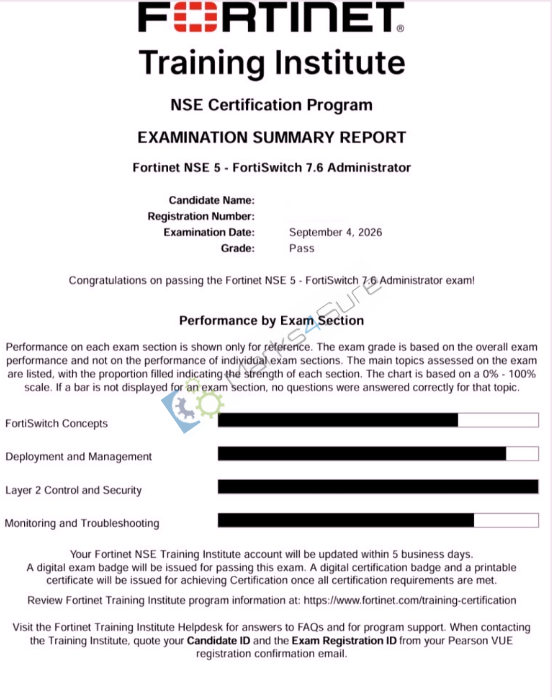
NSE5_FSW_AD-7.6 Report Card
(Full question statement start from here)
You enable Dynamic Host Configuration Protocol (DHCP) snooping on a VLAN and configure a FortiSwitch port astrustedfor DHCP snooping. What additional step is required to configure the port as trusted forDynamic ARP Inspection (DAI)? (Choose one answer)
Which two statements about 802.1X authentication on FortiSwitch ports are true? (Choose two.)
Which drop policy mode, if assigned to a congested port, will drop incoming packets until there is no congestion on the egress port?
Refer to the diagnostic output:
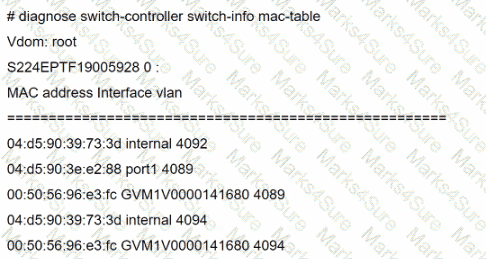
Two entries in the exhibit show that the same MAC address has been used in two different VLANs. Which MAC address is shown in the above output?
You are configuring FortiSwitch to perform layer 3 inter-VLAN routing while managed by FortiGate over FortiLink. On supported hardware models, FortiSwitch can offload routing decisions for better performance.1How does FortiSwitch perform routing between VLANs? (Choose one answer)
Refer to the exhibit.
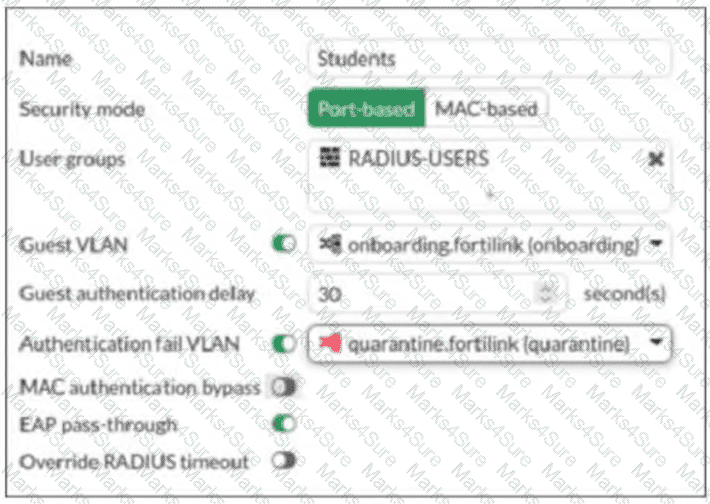
The security port policy is configured as shown in the exhibit. Which behavior occurs if a device connected to the port that does not support 802.1X? (Choose one answer)
(Full question statement start from here)
Refer to the exhibit.
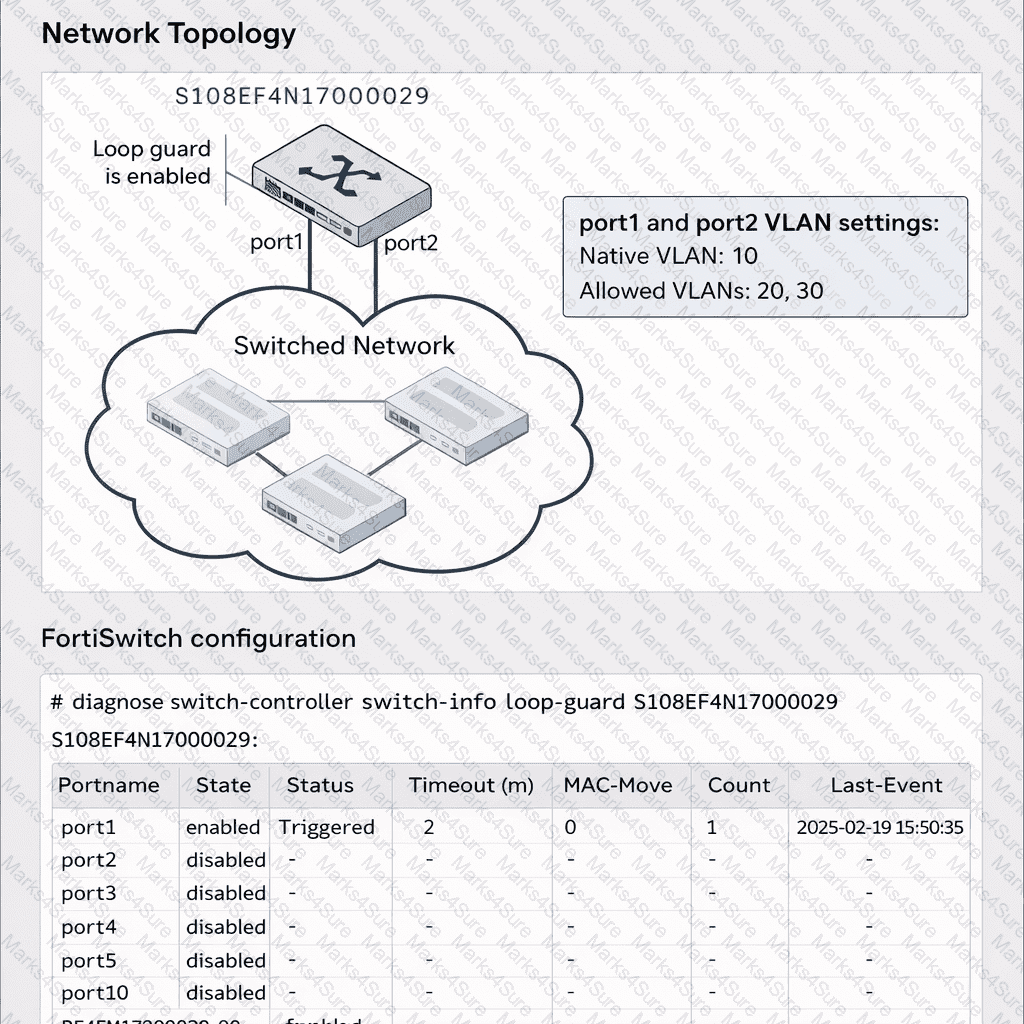
You run the command diagnose switch-controller switch-info loopguard access-1 and see that theMAC-Movecolumn displays a value of0forport1.
What does this indicate? (Choose one answer)
Which two statements about managing a FortiSwitch stack on FortiGate are true? (Choose two.)
How does FortiSwitch perform actions on ingress and egress traffic using the access control list (ACL)?
(Full question statement start from here)
When you change FortiSwitch management mode fromstandalonetomanaged, what happens to the existing standalone configuration? (Choose one answer)
You are designing a multi-tenant network using FortiSwitch devices in standalone mode. Security is a priority and each tenant’s servers must be completely isolated from one another, and from all other servers in the network, to prevent lateral communication. However, all servers must have access to the shared FortiGate firewall for internet access. Which type of private VLAN (PVLAN) configuration should you apply to meet these security requirements? (Choose one answer)
You need to mirror traffic from a source port on Switch A to a monitoring device on Switch C. For that purpose, you’re configuring Remote Switched Port Analyzer (RSPAN).1Due to the nature of RSPAN, what is the best practice when setting it up? (Choose one answer)
Refer to the exhibits.
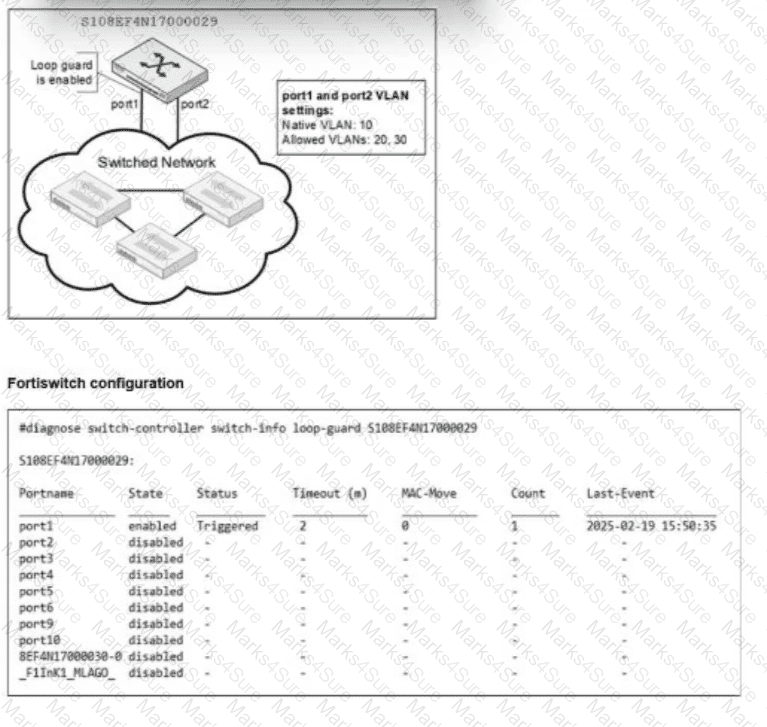
You are reviewing a FortiSwitch configuration where port1 and port2 are connected to a switched network. Loop guard is enabled on port1.
The CLI output shows that the port1 status is triggered due to loop guard. Which two conditions could have caused this shutdown? (Choose two.)
What feature can network administrators use to segment network operations and the administration of managed FortiSwitch devices on FortiGate?
Refer to the exhibits. An IP phone is connected to port1 of FortiSwitch Access-1. The IP phone tags its traffic with VLAN ID 20. On FortiGate, VLAN IP_Phone (VLAN ID 20) has been configured, and port1 of Access-1 is set with VLAN 20 as the native VLAN. However, the IP phone cannot reach the network. The exhibit shows the partial VLAN configuration and the port1 configuration on Access-1.
Which configuration change must you make on FortiSwitch to allow ingress and egress traffic for the IP phone? (Choose one answer)
(Full question statement start from here)
Refer to the exhibit.
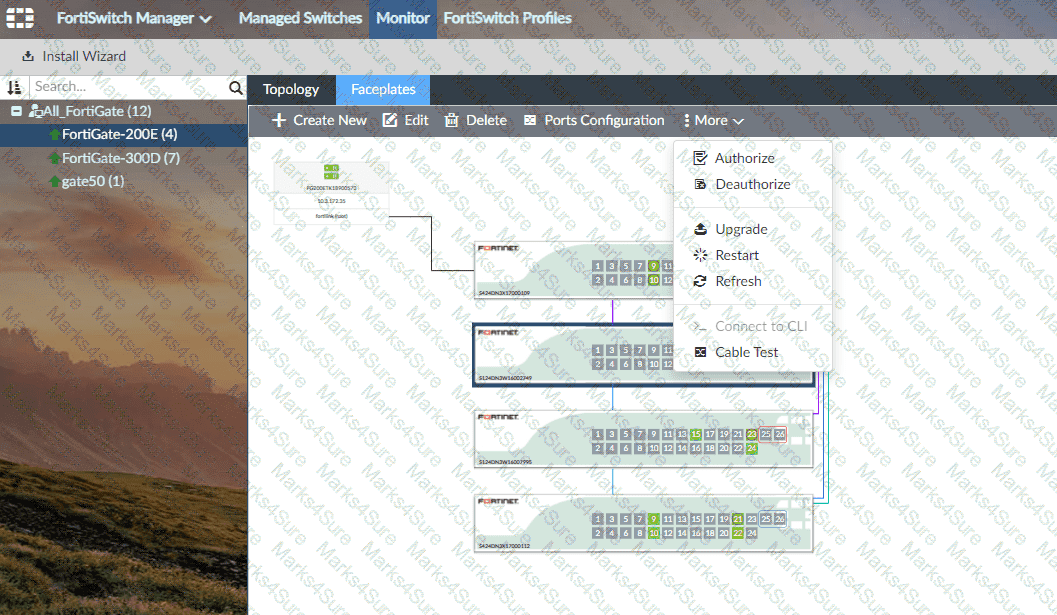

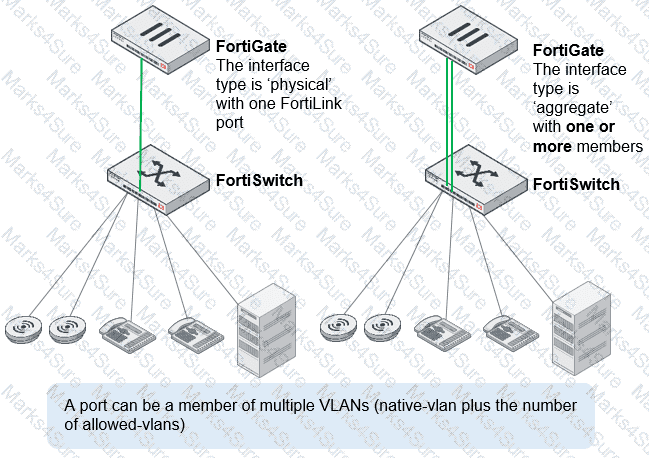
Which information does FortiGate use to generate the port details in the FortiSwitch Faceplates view? (Choose one answer)
Which feature should you enable to reduce the number or unwanted IGMP reports processed by the IGMP querier?
Refer to the exhibit.
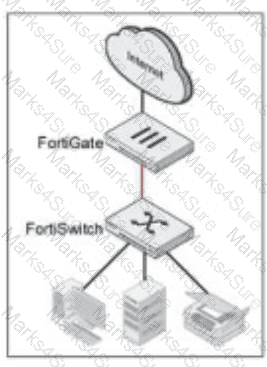
Which two configurations can you use for the FortiLink interface in a basic single FortiGate-single FortiSwitch topology? (Choose two.)
Refer to the exhibit.
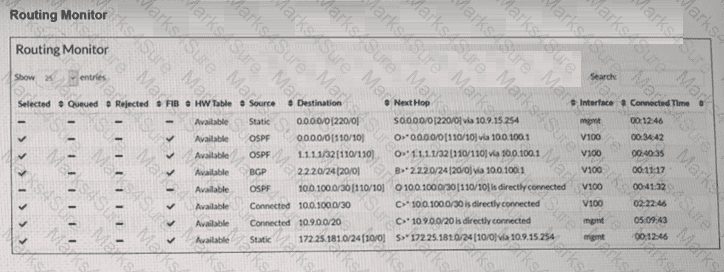
Two routes in the routing monitor are marked as available but are not installed in the forwarding information base (FIB). Which statement correctly explains why the routes have this status? (Choose one answer)
Refer to the exhibits.
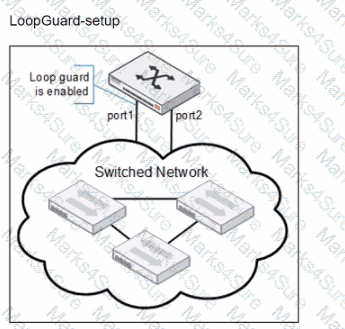
Port1 and port2 are the only ports configured with the same native VLAN 10.
What are two reasons that can trigger port1 to shut down? (Choose two.)
(Full question statement start from here)
A FortiGate is connected to a pair of FortiSwitch devices.
For redundancy, FortiGate must use uplinks on both switches simultaneouslywithout depending on Spanning Tree Protocol (STP).
Which configuration is required? (Choose one answer)
What happens when a routed VLAN interface (RVI) is configured on a FortiSwitch port or trunk? (Choose one answer)
Which statement about the IGMP snooping querier when enabled on a VLAN is true?
Which statement about using MAC, IP, and protocol-based VLANs on FortiSwitch is true?
Which statement about 802.1X security profiles using MAC-based authentication mode is true?
Which two rules used by MSTP are similar to rules used by other STP methods? (Choose two.)
What are two reasons why time synchronization between FortiGate and its managed FortiSwitch is critical in switch management? (Choose two.)
Refer to the exhibits.
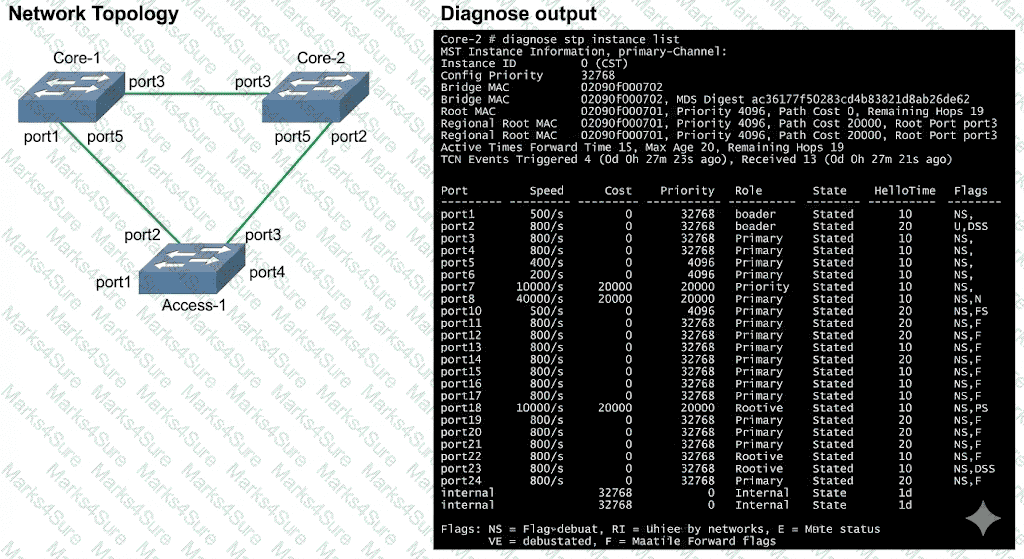
Three FortiSwitch devices in standalone mode are interconnected. The CLI command diagnose stp instance list is executed on Core-2. Based on the output shown in the exhibit, what can you conclude about Core-2? (Choose one answer)
PDF + Testing Engine

Testing Engine
PDF (Q&A)