Pre-Winter Sale Limited Time 65% Discount Offer - Ends in 0d 00h 00m 00s - Coupon code: pass65

Free Practice Questions for the Fortinet NSE 7 Network Security Architect NSE7_FSN_AR-7.6 Exam (2026 Updated)

At Marks4sure, we are dedicated to providing IT professionals with the most accurate and reliable preparation materials for the Fortinet NSE7_FSN_AR-7.6 exam. To support your certification journey, we have made a selection of our premium 2026 NSE 7 Network Security Architect practice questions and answers available completely free. You can take this practice test as many times as you need. Every question includes a detailed, expertly verified explanation to ensure you fully grasp the core security concepts before test day.

Questions 4

Which two statements about an auxiliary session ate true? (Choose two.)

Options:

A.

With the auxiliary session selling disabled, only auxiliary sessions are offloaded.

B.

With the auxiliary session setting enabled. ECMP traffic is accelerated to the NP6 processor.

C.

With the auxiliary session setting enabled. Iwo sessions are created in case of routing change.

D.

With the auxiliary session setting disabled, for each traffic path. FortiGate uses the same auxiliary session.

Buy Now
Questions 5

Refer to the exhibit.

Partial output of a real-time OSPF debug is shown.
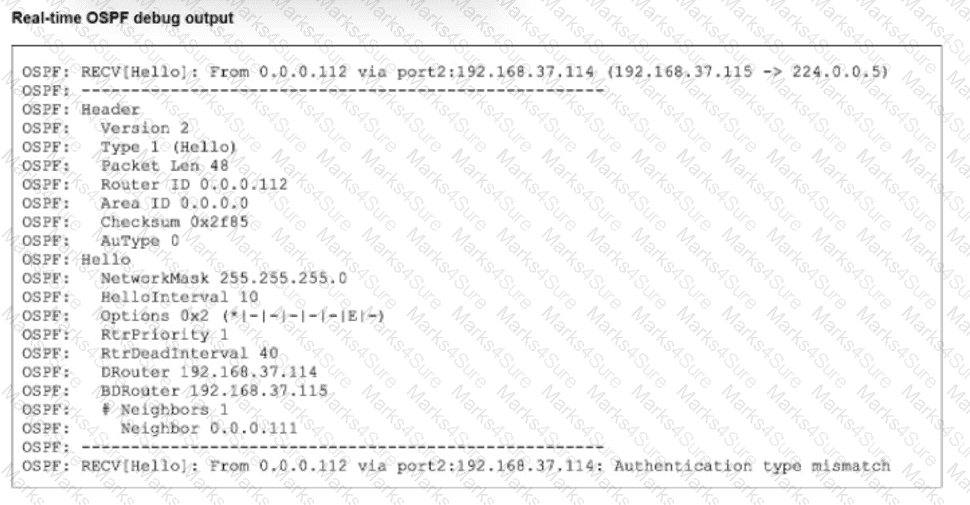
NSE7_FSN_AR-7.6 Question 5

Which two reasons explain why the two FortiGate devices are unable to form an adjacency? (Choose two.)

Options:

A.

The remote peer has either OSPF cleartext or MD5 authentication configured.

B.

There is an OSPF authentication configuration mismatch.

C.

The local FortiGate does not have OSPF authentication configured

D.

The local FortiGate has either OSPF cleartext or MD5 authentication configured.

Buy Now
Questions 6

Refer to the exhibit, which shows partial outputs from two routing debug commands.
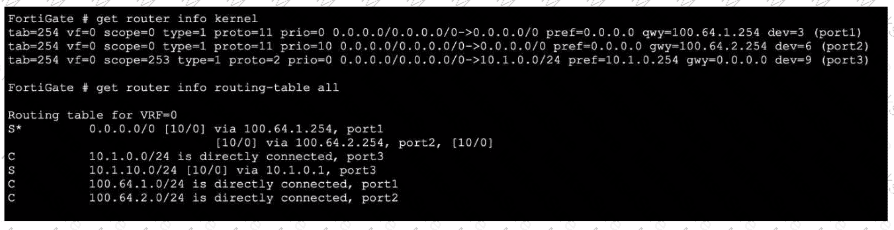
NSE7_FSN_AR-7.6 Question 6

Which change must an administrator make on FortiGate to route web traffic from internal users to the internet, using ECMP?

Options:

A.

Set snat-route-change to enable.

B.

Set the priority of the static default route using port2 to 1.

C.

Set preserve-session-route to enable.

D.

Set the priority of the static default route using port1 to 10.

Buy Now
Questions 7

Refer to the exhibit.

NSE7_FSN_AR-7.6 Question 7

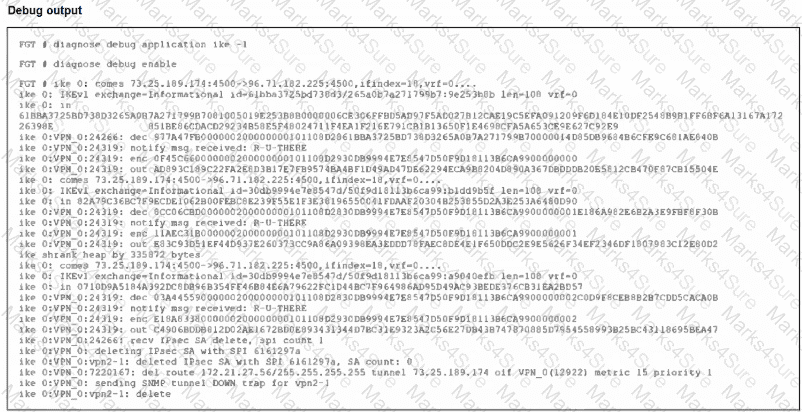
An IPsec VPN tunnel is dropping, as shown by the debug output.

Analyzing the debug output, what could be causing the tunnel to go down?

Options:

A.

Phase 2 drops but Phase 1 is up.

B.

Dead Peer Detection is not receiving its acknowledge packet.

C.

The tunnel drops during rekey negotiation.

D.

The tunnel drops after the timer expires.

Buy Now
Questions 8

Refer to the exhibit, which shows the output of diagnose sys session stat.
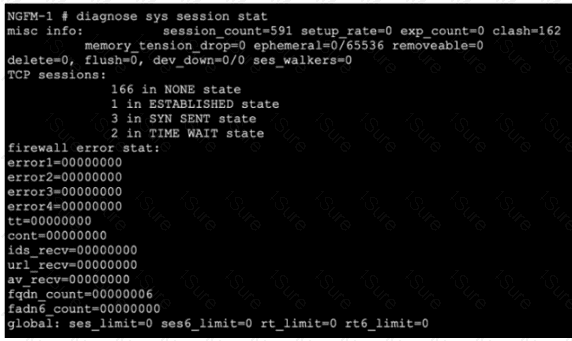
NSE7_FSN_AR-7.6 Question 8

Which statement about the output shown in the exhibit is correct?

Options:

A.

All the sessions in the session table are TCP sessions.

B.

162 sessions have been deleted because of memory page exhaustion.

C.

There are 166 TCP sessions waiting to complete the three-way handshake.

D.

There are two sessions that have not been removed in case any out-of-order packets arrive.

Buy Now
Questions 9

Refer to the exhibit, which shows the port1 interface configuration on FortiGate and partial session information for ICMP traffic.

NSE7_FSN_AR-7.6 Question 9

What happens to the session information if a routing change occurs that affects this session?

Options:

A.

Only the interface and gateway information for dev=7 will be removed.

B.

The session information will not change unless the current route has been removed from the routing table.

C.

The session will be flagged as dirty but no route lookups will be performed.

D.

Sessions involving port7 or port19 will not have their routing information flushed.

Buy Now
Questions 10

Exhibit.

NSE7_FSN_AR-7.6 Question 10

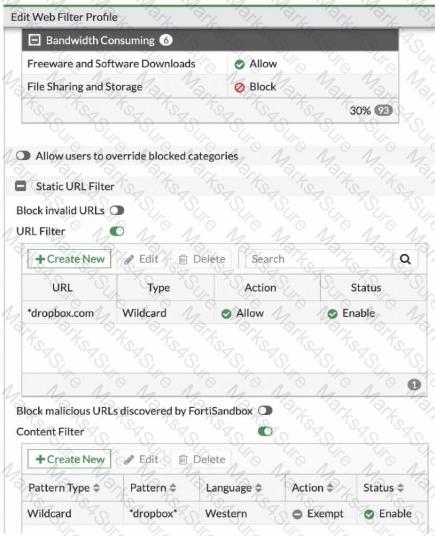
Refer to the exhibit, which shows a partial web fillet profile configuration.

Which action does FortiGate lake if a user attempts to access www. dropbox. com, which is categorized as File Sharing and Storage?

Options:

A.

FortiGate allows the connection, based on the URL Filter configuration.

B.

FortiGate blocks the connection as an invalid URL.

C.

FortiGate exempts the connection, based on the Web Content Filter configuration.

D.

FortiGate blocks the connection, based on the FortiGuard category based filter configuration.

Buy Now
Questions 11

Exhibit.

NSE7_FSN_AR-7.6 Question 11

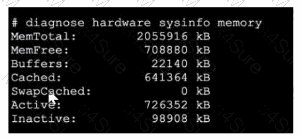
Refer to the exhibit, which shows a partial output of diagnose hardware aysinfo memory.

Which two statements about the output are true? (Choose two.)

Options:

A.

There are 98908 kB of memory that will never be used.

B.

The user space has 708880 kB of physical memory that is not used by the system.

C.

The I/O cache, which has 641364 kB of memory allocated to it.

D.

The value indicated next to the inactive heading represents the currently unused cache page.

Buy Now
Questions 12

Which three common FortiGate-to-collector-agent connectivity issues can you identify using the FSSO real-time debug? (Choose three.)

Options:

A.

The SSL certificate used for FSSO over SSL has expired.

B.

The connection was refused. There may be a mismatch of the TCP port.

C.

FortiGate cannot reach the IP address of the collector agent.

D.

The pro-shared key does not match

E.

The group filters do not match.

Buy Now
Questions 13

Refer to the exhibit.

NSE7_FSN_AR-7.6 Question 13

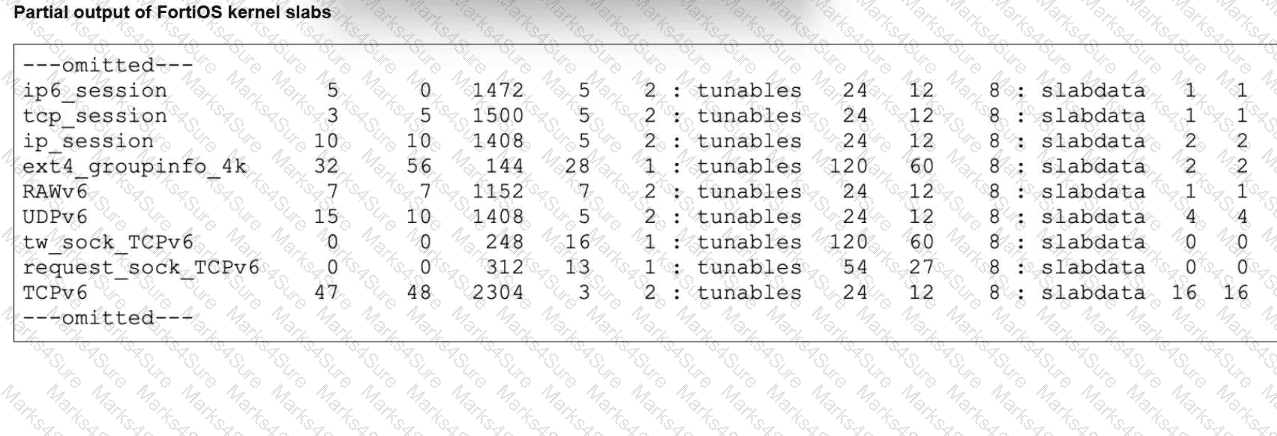
The partial output of FortiOS kernel slabs is shown. Which statement about total slab size is true?

Options:

A.

The total slab size of the ip_session Tlab is 14080 kB and is associated with the user space.

B.

The total slab size of the tcp_session slab is 7500 kB and is associated with the kernel.

C.

The total slab size of the ip6_session slab is 1472 kB and is associated with the kernel.

D.

The total slab size of the UDPv6 slab is 14080 kB and is associated with the user space.

Buy Now
Questions 14

Consider the scenario where the server name indication (SNI) does not match either the common name (CN) or any of the subject alternative names (SAN) in the server certificate.

Which action will FortiGate take when using the default settings for SSL certificate inspection?

Options:

A.

FortiGate uses the SNI from the user ' s web browser.

B.

FortiGate closes the connection because this represents an invalid SSL/TLS configuration.

C.

FortiGate uses the first entry listed in the SAN field in the server certificate.

D.

FortiGate uses the CN information from the Subject field in the server certificate.

Buy Now
Questions 15

Which Iwo troubleshooting steps should you perform lf you encounter issues with intermittent web filter behavior? (Choose two.)

Options:

A.

Check that the inspection mode configured for the web filter profile matches that of the firewall policy where it is applied.

B.

Check that FortiGate is not entering conserve mode.

C.

Check that the correct port is mapped to HTTP in the Protocol Options

D.

Check that the communication between FortiGate and FortiGuard is stable

Buy Now
Questions 16

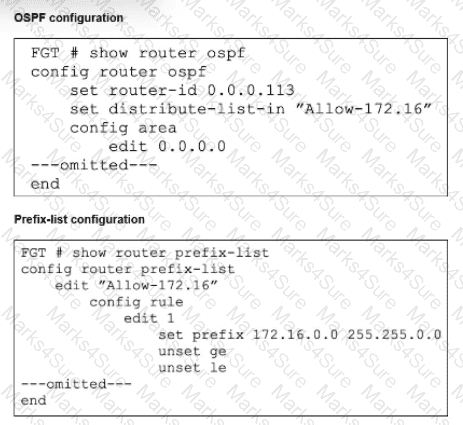
Refer to the exhibits.

NSE7_FSN_AR-7.6 Question 16

An OSPF peer is advertising route 172.16.52.0/24. The local FortiGate is configured with an inbound distribution list that allows the 172.16.0.0/16 network to be injected into its routing table. However, the 1 ' 2.16.52.0/24 subnet cannot be seen in the FIB.

Which two stops can the administrator of the local FortiGate take to ensure that the advertised 172.16. 52.0/24 subnet will be injected into the routing table? (Choose two.)

Options:

A.

Add another entry to the prefix list to specifically allow the 172.16.52.0/24 network.

B.

Change the ge value to 17.

C.

Change the R- value lo 16.

D.

Modify the default prefix-list behavior from implicit deny to implicit allow.

Buy Now
Questions 17

In which two slates is a given session categorized as ephemeral? (Choose two.)

Options:

A.

A UDP session with only one packet received

B.

A UOP session with packets sent and received

C.

A TCP session waiting for the SYN ACK

D.

A TCP session waiting for FIN ACK

Buy Now
Questions 18

Refer to the exhibit, which shows the output of a debug command.
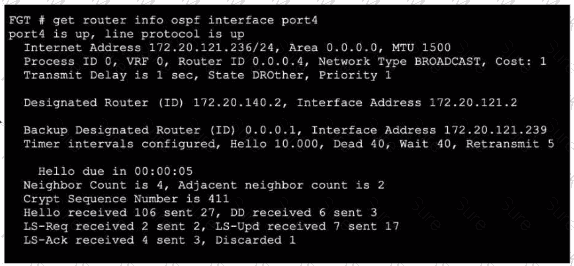
NSE7_FSN_AR-7.6 Question 18

Which two statements about the output are true? (Choose two.)

Options:

A.

The interlace is part of the OSPF backbone area.

B.

There are a total of five OSPF routers attached to the vorz4 network segment

C.

One of the neighbors has a router ID of 0.0.0.4.

D.

In the network connected to port4, two OSPF routers are down.

Buy Now
Questions 19

Exhibit.

NSE7_FSN_AR-7.6 Question 19

Refer to the exhibit, which shows the output of diagnose automation test.

What can you observe from the output? (Choose two.)

Options:

A.

The automation stitch test is not being logged.

B.

The automation stitch test failed but the HA failover was successful.

C.

An HA failover occurred.

D.

The test was unsuccessful.

Buy Now
Questions 20

Refer to the exhibit, which shows a partial output of the fssod daemon real-time debug command.

NSE7_FSN_AR-7.6 Question 20

What two conclusions can you draw from the output? (Choose two.)

Options:

A.

The workstation with IP 10.124.2.90 will be polled frequently using TCP port 445 to see if the user is still logged on.

B.

The logon event can be seen on the collector agent installed on Windows.

C.

FSSO is using DC agent mode to detect logon events.

D.

FSSO is using agentless polling mode to detect logon events.

Buy Now
Questions 21

Exhibit.

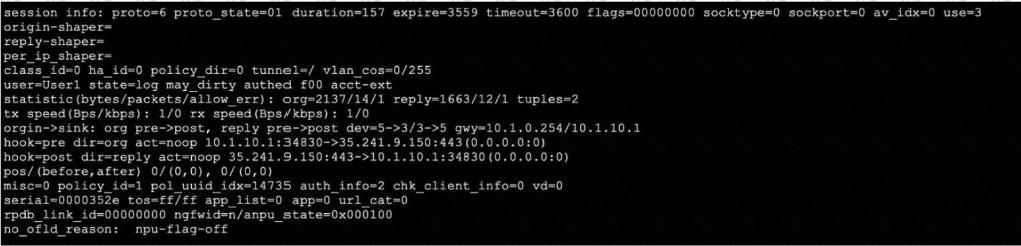
NSE7_FSN_AR-7.6 Question 21

Refer to the exhibit, which shows the output of a session. Which two statements are true? (Choose Iwo.)

Options:

A.

The TCP session has been successfully established.

B.

The session was initiated from an authenticated user.

C.

The session is being inspected using flow inspection.

D.

The session is being offloaded.

Buy Now
Questions 22

Refer to the exhibit, which shows the output of get router info ospf neighbor.
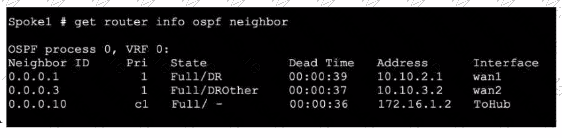
NSE7_FSN_AR-7.6 Question 22

What can you conclude from the command output?

Options:

A.

The network type connecting the local Fortigate and OSPF neighbor 0.0.0.10 is point-to-point.

B.

All neighbors are in area 0.0.0.0.

C.

The local FortiGate is the BDR.

D.

The local FortiGate is not a DROther.

Buy Now
Questions 23

During the SAML negotiation process, in which section does the Identity Provider (IdP) provide the SAML attributes used in the authentication process to the Service Provider (SP)?

Options:

A.

Bindings HTTP post

B.

Assertion dump

C.

Authentication request

D.

Authentication response

Buy Now
Questions 24

When FortiGate enters conserve mode because of memory pressure, which action can FortiGate perform to preserve memory?

Options:

A.

FortiGate automatically reboots to clear memory and restore full operation.

B.

FortiGate switches to a less memory-intensive inspection mode, such as flow-based inspection.

C.

FortiGate reduces or stops non-essential processes like logging and antivirus scanning.

D.

FortiGate begins dropping all new sessions to protect resources.

Buy Now
Questions 25

Which two protocol states indicate that traffic is bidirectional? (Choose two.)

Options:

A.

proto_state=01 for a TCP session.

B.

proto_state=01 for a UDP session.

C.

proto_state=05 for a TCP session.

D.

proto_state=00 for an ICMP session.

Buy Now
Questions 26

Refer to the exhibit, which shows the output of the command get router info bgp neighbors 100.64.2.254 advertised-routes.
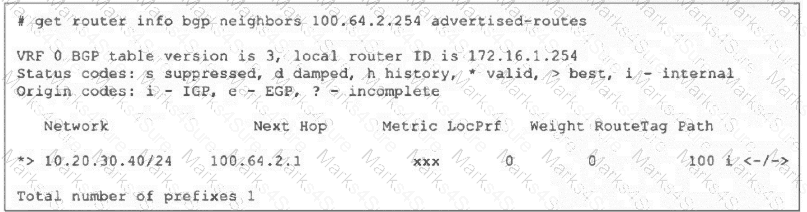
NSE7_FSN_AR-7.6 Question 26

What can you conclude from the output?

Options:

A.

The BGP state of the two BGP participants is OpenConfirm.

B.

The router ID of the neighbor is 100.64.2.254.

C.

The BGP neighbor is advertising the 10.20.30.40/24 network to the local router.

D.

The local router is advertising the 10.20.30.40/24 network to its BGP neighbor.

Buy Now
Questions 27

An administrator wants to capture encrypted phase 2 traffic between two FotiGate devices using the built-in sniffer.

If the administrator knows that there Is no NAT device located between both FortiGate devices, which command should the administrator run?

Options:

A.

diagnose sniffer packet any ' udp port 500 '

B.

diagnose sniffer packet any ' lp proto 50 '

C.

diagnose sniffer packet any ' udp port 4500 '

D.

diagnose sniffer packet any ' ah '

Buy Now
Questions 28

Exhibit.

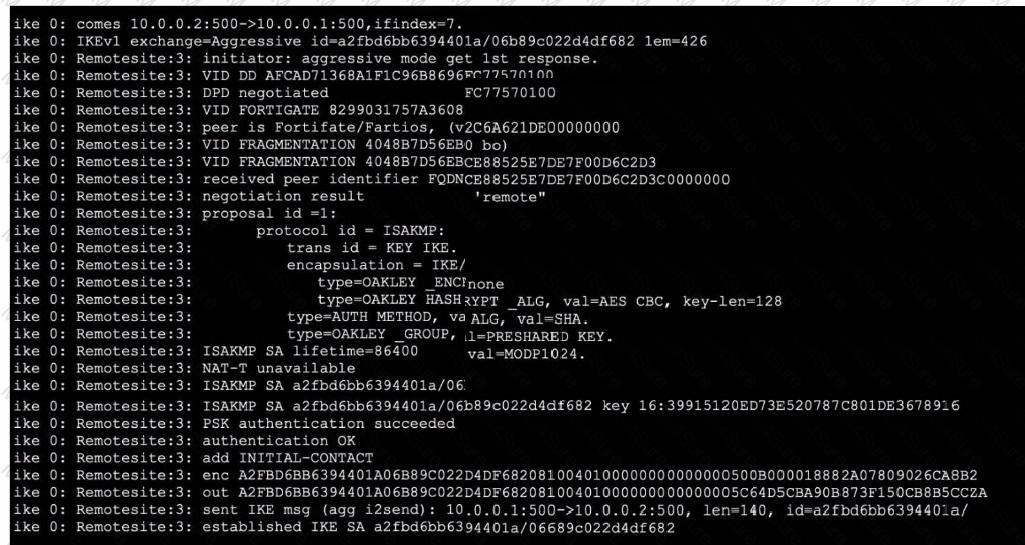
NSE7_FSN_AR-7.6 Question 28

Refer to the exhibit, which contains partial output from an IKE real-time debug.

Which two statements about this debug output are correct? (Choose two.)

Options:

A.

Perfect Forward Secrecy (PFS) is enabled in the configuration.

B.

The local gateway IP address is 10.0.0.1.

C.

It shows a phase 2 negotiation.

D.

The initiator provided remote as its IPsec peer ID.

Buy Now
Questions 29

Which two statements about conserve mode are true? (Choose two.)

Options:

A.

FortiGate enters conserve mode when the system memory reaches the configured extreme threshold.

B.

FortiGate starts taking the configured action for new sessions requiring content inspection when the system memory reaches the configured red threshold.

C.

FortiGate exits conserve mode when the system memory goes below the configured green threshold.

D.

FortiGate starts dropping all new sessions when the system memory reaches the configured red threshold.

Buy Now
Questions 30

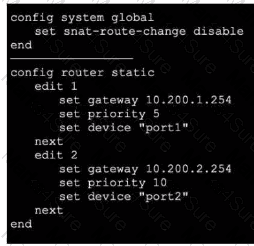
Exhibit 1.

NSE7_FSN_AR-7.6 Question 30

Exhibit 2.

NSE7_FSN_AR-7.6 Question 30

Refer to the exhibits, which show the configuration on FortiGate and partial internet session information from a user on the internal network.

An administrator would like to lest session failover between the two service provider connections.

Which two changes must the administrator make to force this existing session to immediately start using the other interface? (Choose two.)

Options:

A.

Change the priority of the port1 static route to 11.

B.

Change the priority of the port2 static route to 5.

C.

Configure unset snat-route-change to return it to the default setting.

D.

Configure set snat-route-change enable.

Buy Now
Questions 31

A VPN tunnel is up. To monitor traffic flow, the administrator enters the following CLI commands on an SSH session on FortiGate:

# diagnose debug enable

# diagnose sniffer packet any ' udp and port 500 ' 4

However, the sniffer does not show any output. Assuming default configuration values, what are two possible reasons there is no output? (Choose two answers)

Options:

A.

The filter should be modified to also capture packets for TCP port 443 or UDP port 4500 .

B.

NAT Traversal is enabled.

C.

The sniffer must be restricted to the remote peer IP address.

D.

The sniffer output will be ignored because running diagnose debug enable shows only application real-time debugs.

Buy Now
Questions 32

Refer to the exhibit, which shows the output of diagnose sys session list.
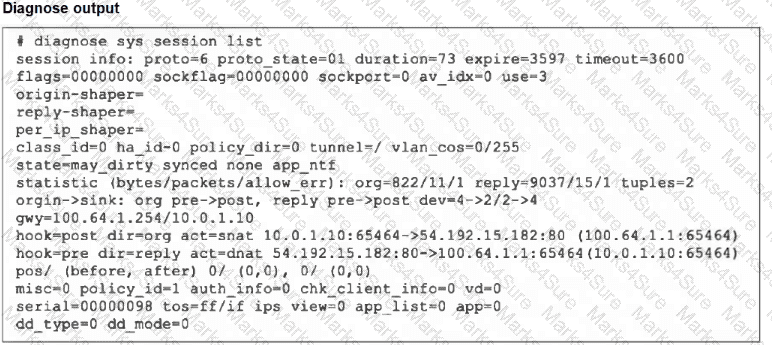
NSE7_FSN_AR-7.6 Question 32

If the HA ID for the primary device is 0, what happens if the primary fails and the secondary becomes the primary?

Options:

A.

The secondary device has this session synchronized; however, because application control is applied, the session is marked dirty and has to be re-evaluated after failover.

B.

Traffic for this session continues to be permitted on the new primary device after failover, without requiring the client to restart the session with the server.

C.

The session will be removed from the session table of the secondary device because of the presence of allowed error packets, which will force the client to restart the session with the server.

D.

The session state is preserved but the kernel will need to re-evaluate the session because NAT was applied.

Buy Now
Questions 33

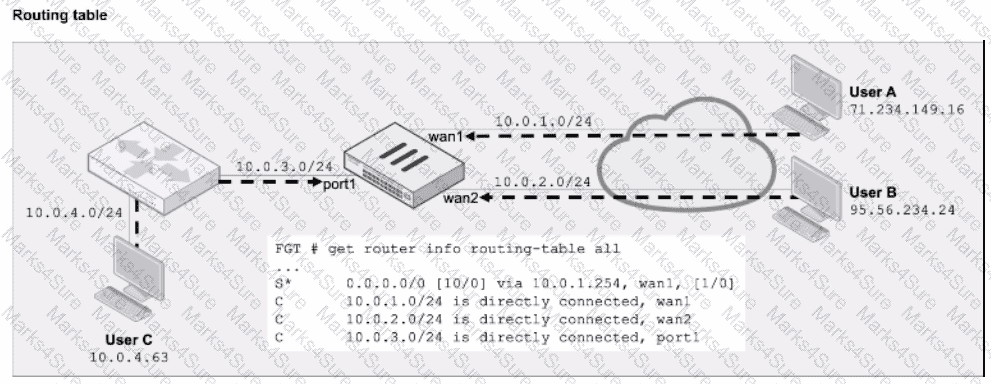
Refer to the exhibit.

NSE7_FSN_AR-7.6 Question 33

The routing table information is shown.

Assuming a default configuration, which three statements about the RPF check on FortiGate are

correct? (Choose three.)

Options:

A.

User C: Fail. There is no route to 10.0.4.63 using port1 in the routing table.

B.

User B: Pass. FortiGate will use asymmetric routing using want to reply to traffic for 95.56.234.24.

C.

User C: Pass. FortiGate will forward all incoming packets from User C using the default static route.

D.

User B: Fail. There is no route to 95.56.234.24 using wan2 in the routing table.

E.

User A: Pass. The default static route through want passes the RPF check regardless of the source IP address.

Buy Now
Questions 34

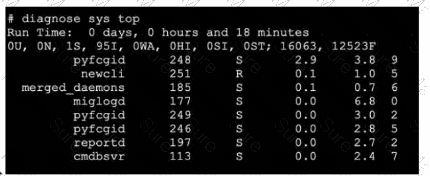
Refer to the exhibit.

NSE7_FSN_AR-7.6 Question 34

Which three pieces of information does the diagnose sys top command provide? (Choose three.)

Options:

A.

The miglogd daemon is running on CPU core ID 0.

B.

The diagnose sys top command has been running for 18 minutes.

C.

The miglogd daemon would be on top of the list, if the administrator pressed m on the keyboard.

D.

The cmdbsvr process is occupying 2.4% of the total user memory space.

E.

If the neweli daemon continues to be in the R state, it will need to be manually restarted.

Buy Now
Questions 35

Refer to the exhibit.

Partial output of diagnose sys session stat command is shown.
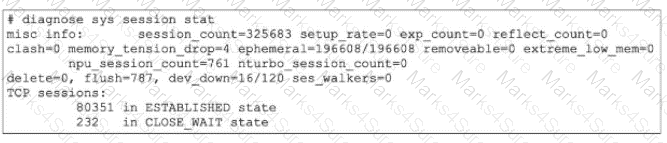
NSE7_FSN_AR-7.6 Question 35

An administrator has noticed unusual behavior from FortiGate. It appears that sessions are randomly removed. Which two reasons could explain this? (Choose two.)

Options:

A.

FortiGate is deleting sessions because the kernel cannot allocate more memory pages

B.

FortiGate is dropping all TCP sessions with incomplete three-way handshakes.

C.

FortiGate is not accepting sessions because the device has been down 10 out of 120 seconds.

D.

FortiGate is flushing sessions because of high memory usage.

Buy Now
Questions 36

Refer to the exhibits, which contain the partial configurations of two VPNs on FortiGate.
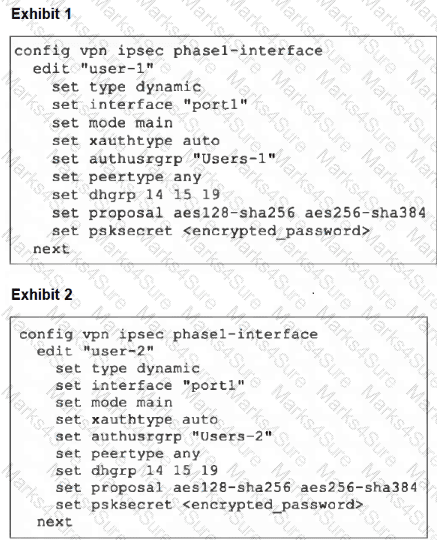
NSE7_FSN_AR-7.6 Question 36

An administrator has configured two VPNs for two different user groups. Users who are in the Users-2 group are not able to connect to the VPN. After running a diagnostics command, the administrator discovers that FortiGate is not matching the user-2 VPN for members of the Users-2 group.

Which two changes must the administrator make to fix the issue? (Choose two.)

Options:

A.

Change to aggressive mode on both VPNs.

B.

Enable XAuth on both VPNs.

C.

Use different pre-shared keys on both VPNs.

D.

Set up specific peer IDs on both VPNs.

Buy Now
Questions 37

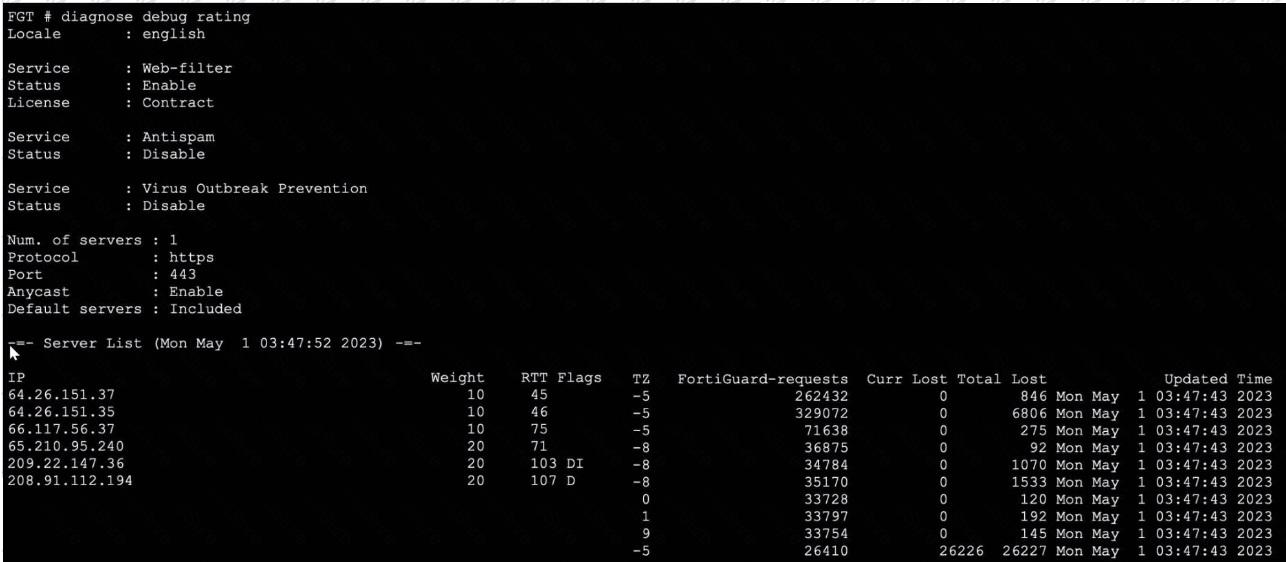
Refer to the exhibit, which shows the output of a diagnose command. What can you conclude from the RTT value?
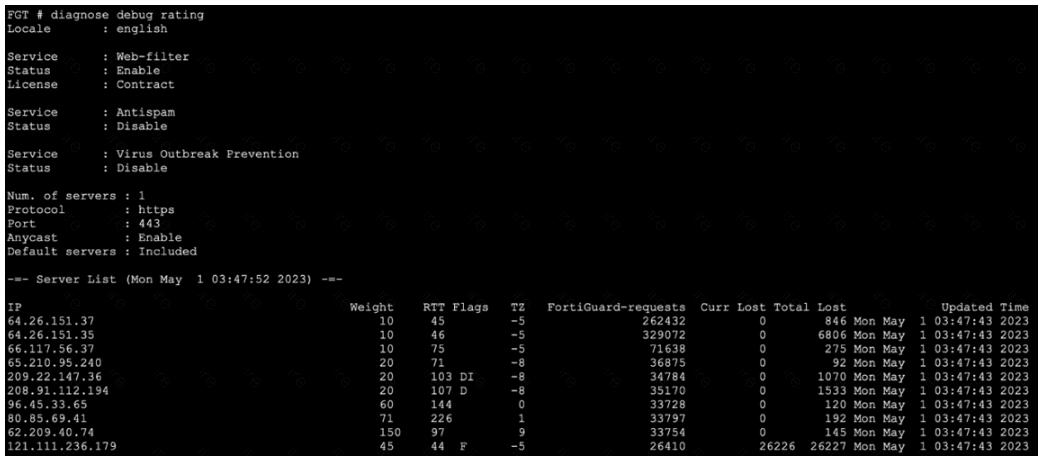
NSE7_FSN_AR-7.6 Question 37

Options:

A.

Its value represents the time it takes to receive a response after a rating request is sent to a particular server.

B.

Its value is incremented with each packet lost.

C.

It determines which FortiGuard server is used for license validation.

D.

Its initial value is statically set to 10.

Buy Now
Questions 38

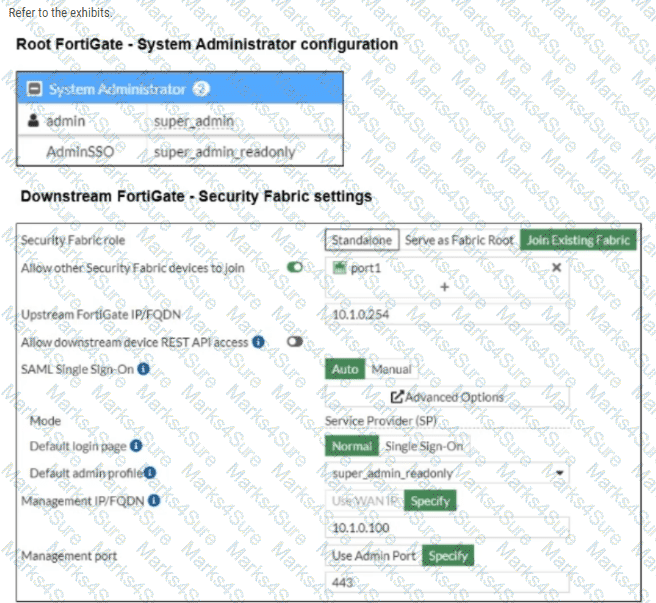
Refer to the exhibits.

NSE7_FSN_AR-7.6 Question 38

The system administrator settings configured on the root FortiGate and the Security Fabric settings configured on a downstream FortiGate are shown.

When prompted to sign in with Security Fabric to the downstream FortiGate, a user enters the single sign-on (SSO) provider credentials.

What happens next for the user?

Options:

A.

The user is redirected to the root FortiGate.

B.

The user accesses the downstream FortiGate with super_admin_readonly privileges.

C.

The user accesses the root FortiGate with AdminSSO privileges.

D.

The user receives an authentication failure message.

Buy Now
Questions 39

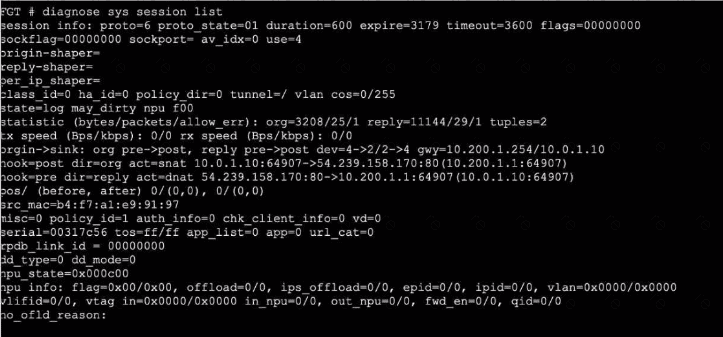
Refer to the exhibit, which shows the omitted output of a session table entry.

NSE7_FSN_AR-7.6 Question 39

Which two statements are true? (Choose two.)

Options:

A.

The traffic has been tagged for VLAN 0000.

B.

NP7 is handling offloading of this session.

C.

The traffic matches Policy ID 1.

D.

The session has been offloaded.

Buy Now
Questions 40

Refer to the exhibit.

NSE7_FSN_AR-7.6 Question 40

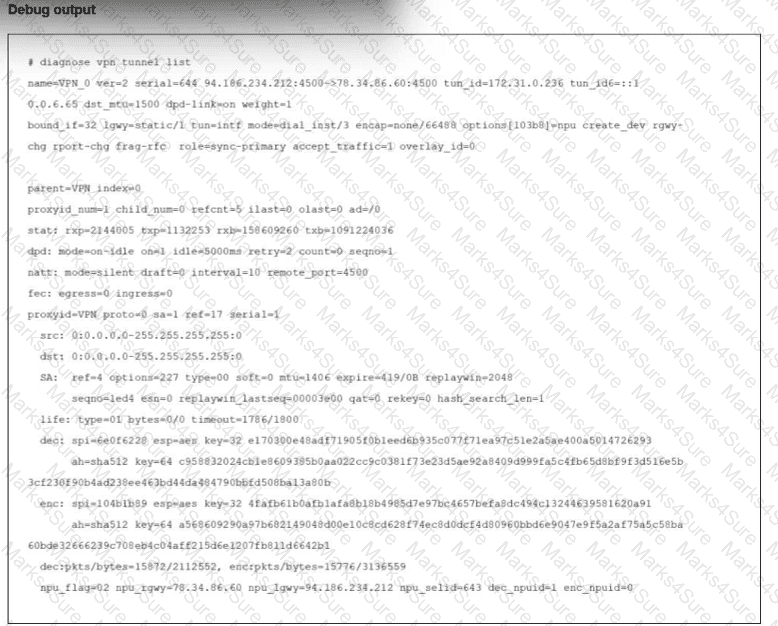
The output of the command diagnose vpn tunnel list is shown.

Reviewing the debug command, what is the current status of the traffic flowing through the tunnel?

Options:

A.

The outbound IPsec SA was copied to the NPU.

B.

NP6 is handling the offloading.

C.

The inbound and outbound IPsec SAs were copied to the NPU.

D.

The inbound IPsec SA was copied to the NPU.

Buy Now
Questions 41

Exhibit.

NSE7_FSN_AR-7.6 Question 41

Refer to the exhibit, which shows the output of a diagnose command.

What can you conclude about the debug output in this scenario?

Options:

A.

The first server provided to FortiGate when it performed a DNS query looking for a list of rating servers, was 121.111.236.179.

B.

There is a natural correlation between the value in the FortiGuard-requests field and the value in the Weight field.

C.

FortiGate used 64.26.151.37 as the initial server to validate its contract.

D.

Servers with a negative TZ value are less preferred for rating requests.

Buy Now
Questions 42

Exhibit.

NSE7_FSN_AR-7.6 Question 42

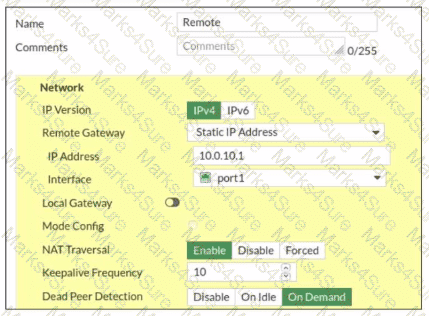
Refer to the exhibit, which contains a screenshot of some phase 1 settings.

The VPN is not up. To diagnose the issue, the administrator enters the following CLI commands on an SSH session on FortiGate:

NSE7_FSN_AR-7.6 Question 42

However, the IKE real-time debug does not show any output. Why?

Options:

A.

The administrator must also run the command diagnose debug enable.

B.

The debug shows only error messages. If there is no output, then the phase 1 and phase 2 configurations match.

C.

The log-filter setting is incorrect. The VPN traffic does not match this filter.

D.

Replace diagnose debug application ike -1 with diagnose debug application ipsec -1.

Buy Now
Exam Code: NSE7_FSN_AR-7.6
Exam Name: Fortinet NSE 7 - Secure Networking 7.6 Architect
Last Update: Sep 12, 2026
Questions: 172

PDF + Testing Engine

$64.99   $185.69

Testing Engine

$49.99   $142.83

PDF (Q&A)

$54.99   $157.11