
Free Practice Questions for the CIMA Management P2 Exam (2026 Updated)
At Marks4sure, we are dedicated to providing IT professionals with the most accurate and reliable preparation materials for the CIMA P2 exam. To support your certification journey, we have made a selection of our premium 2026 CIMA Management practice questions and answers available completely free. You can take this practice test as many times as you need. Every question includes a detailed, expertly verified explanation to ensure you fully grasp the core security concepts before test day.
Which of the following is the ideal basis to use for a transfer price when there is a perfect external market?
A positive net present value (NPV) has been calculated for a project to launch a new product. An additional calculation is required to identify the sensitivity of the NPV to changes in the forecast total sales volume.
The present value of which of the following would be used in the calculation?
A project requires an initial investment of $160,000 in an asset for which the annual depreciation charge will be $40,000. The forecast profits from the investment are as follows.
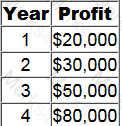
What is the payback period for the project in years? Give your answer to two decimal places.
Performance measures that monitor the extent to which a not-for-profit organization ' s objectives have been achieved are measures of:
TTR Ltd plans to purchase a new plant for $1,000m on the 1st of January 20X6. The annual sales expected from the production of this plant is S400m per year. The plant has an expected life of five years. The financial
accountant has computed the NPV of the project at $61.42m considering a discount rate of 10%.
The marketing director wants to know the percentage drop in revenue that the sales team can afford before the project becomes unviable. Which of the following indicates the percentage required by the marketing
director?
A company wishes to appraise a potential project. One of the project ' s relevant cash flows is the receipt, expressed in money terms, of $20,000 per year for the first 5 years.
The company ' s real cost of capital is 5% per year and the expected rate of inflation is 3% per year.
What is the real value of the expected receipt in year 2?
Give your answer to the nearest $10.
Which of the following statements is TRUE about the activity based costing system when compared to absorption costing method?
A division of a company transfers all its output to other divisions in the same company.
For this division, which of the following measures is NOT affected by the transfer price that the division uses?
Which TWO of the following actions taken during the budgetary planning process will result in the creation of budgetary slack?
One aspect of life cycle costing is the recognition of the fact that during the design or development stage a large proportion of many products ' life cycle costs are:
S is considering launching a new product.
The variable costs of manufacturing the product will be $6 per unit.
The product must be manufactured in batches of 2,000 units. The machine set up cost for each batch will be $4,000.
Maximum capacity will be 8,000 units each year.
Market research has shown that the unit selling price will affect the demand for the product as follows.
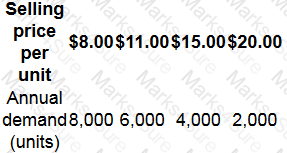
Which unit selling price will maximise annual profit?
Which of the following statements is NOT correct?
Transfer prices between responsibility centers should be set at a level that:
An 80% learning curve is expected for a repetitive and complex task.
Which of the following statements is correct?
A project requires an initial investment of $50,000. It will generate positive cash flows for two years as follows.
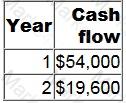
The cost of capital is 12% per year.
What is the equivalent annual net present value of the project?
Give your answer to the nearest $10.
A company manufactures and sells a range of products. Relevant data for one unit of a particular product are as follows.
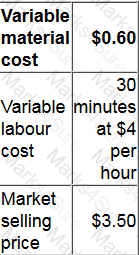
The company is using target costing to ensure that it achieves a contribution of 40% of the market selling price.
In order to achieve the target cost, by how much does the company need to reduce the variable cost per unit?
LL produces an item, the Z, for which the demand curve is estimated to be:
P = 10 - 0.0001Q
where, P is the unit price in $ and Q is the annual sales volume in units;
Marginal revenue (MR) = 10 - 0.0002Q
The variable cost of producing the Z is $2 per unit. The annual fixed costs of production are $110,000.
What is the profit maximizing output level?
A company has just launched a new product at a selling price that is designed to rapidly gain market share and to discourage other competitors from entering the market.
Which pricing strategy is the company using?
SQ has the opportunity to invest in project X. The net present value for project X is $12,600. Cash inflows occur in years 1, 2 and 3. The company ' s cost of capital is 14%.
Calculate the annualized equivalent annuity of project X.
Give your answer to the nearest whole $.
.
In an organization ' s transfer pricing system the selling division and the purchasing division each record a different price for the same transaction.
This is known as a:
PorkyCo is a leading bread manufacturer in Toyland operating two functional divisions: pulled and roasted. PorkyCo uses IT systems in all of its functions, for example, accounting has one system, manufacturing has its
system, warehousing has another and human resources is the latest to develop a dedicated system to manage training and development
The issue now is that when the CEO, Mr Button, needs information about two or more functions, he has to convene the department heads to get their reports and then study each in turn. As senior management
accountant at PorkyCo, help free up Mr Button ' s time by suggesting the most efficient way of getting all the information he needs.
The following summarised financial statements have been prepared by JNM ' s North subsidiary for the year just ended:
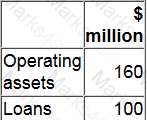
Calculate the North subsidiary ' s Residual Income, assuming that JNM ' s cost of capital is 10%.
Give your answer to the nearest $ million.
When considering a capital investment, relevant costs for decision making have which THREE of the following features?
Using Porter ' s value chain, place the tokens to correctly categories the following activities of a manufacturing company.
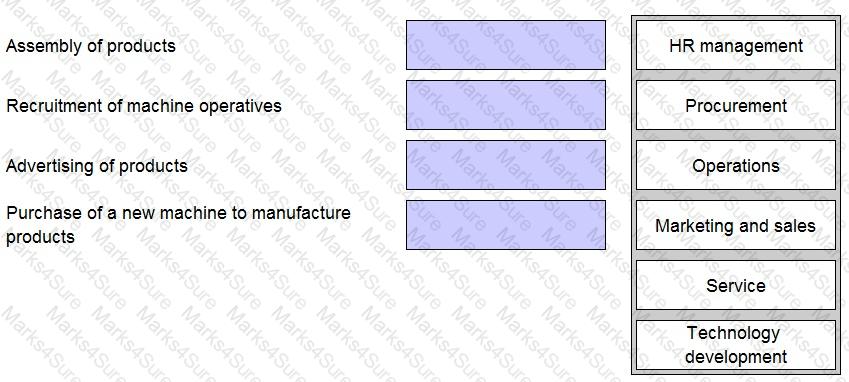
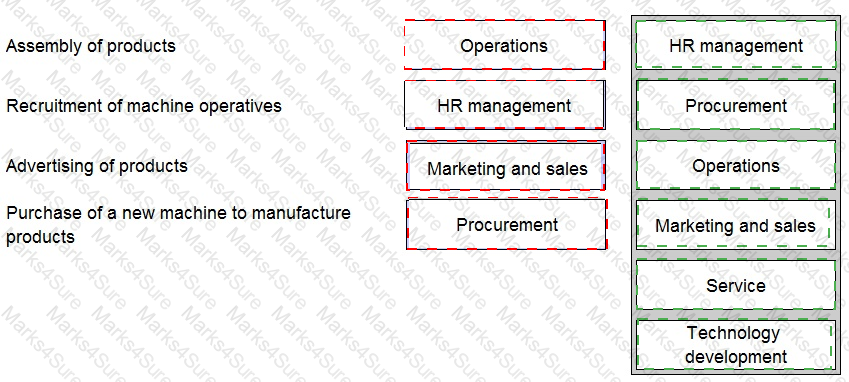
The following forecast data relate to the first three years of a five year project.
The project will require an initial investment of $30,000 in non-current assets.
All revenue will be received in the year it is earned and all operating costs will be paid in the year they are incurred. Tax will be paid in the following year.
Tax depreciation will be 25% per annum of the reducing balance.
The taxation rate will be 30% of taxable profits.

What is the forecast after tax cash flow for year 3 (to the nearest $10)?
A company is considering two mutually exclusive projects, an analysis of which is given below:
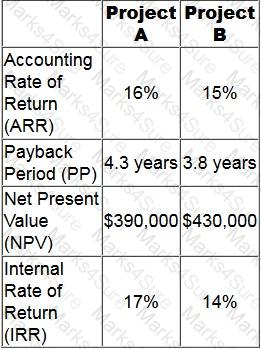
The company ' s cost of capital is 12%.
Assuming an objective of maximising shareholders ' wealth, which project would be recommmended?
Company X is considering the launch of a new product. In order to compete in the market the selling price must be $100 per unit. Company X aims to achieve a sales margin of 25 per cent.
Direct materials cost is $75 for each unit. It takes 15 minutes for workers to assemble each unit. Workers are paid $16 per hour. 5 per cent of paid time is idle. Overheads are absorbed at $6.50 per unit.
What is the value of any cost gap between the forecast total cost and the target cost?
A company is considering four mutually exclusive projects. There are three possible future demand conditions but the company has no idea of the probability of each of these demand conditions occurring. The forecast net present values (NPVs) of each of the four projects, under each of the three possible future demand conditions, are as follows.
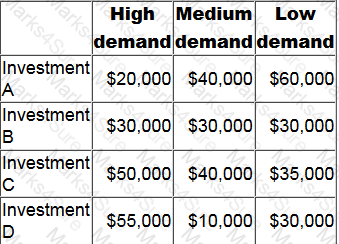
Using the maximax criterion, which investment should be selected?
A senior manager is concerned about the dysfunctional consequences of a company ' s current approach to budget preparation. The senior manager has discovered that budget holders are carrying budgetary slack forward from one period to the next without this being identified or challenged.
Which of the following approaches to budget preparation is the company using?
An 80% learning curve will apply to the production of a new product. The first unit will require 120 labor hours. The labor rate is $11 per hour.
To the nearest $1, the expected total labor cost for the first 4 units is:
The money cost of capital is 12%. The expected rate of inflation is 4%. What is the real cost of capital?
Give your answer to 2 decimal places.
The net present value of the cost of operating a machine for the next 4 years is £6,340. The discount rate used is 10%.
What is the equivalent annual cost and the present value of the cost in perpetuity of operating this machine?
Use discount factors to 3 decimal places.
An investment centre manager is considering the purchase of a new machine. If purchased, the new machine would replace an existing one that is used to manufacture one of the investment centre ' s existing products.
The new machine would incur $800 per month additional running costs; this includes $300 per month of additional depreciation.
The new machine would save on direct labor time. This means that the fixed production overhead absorbed by the product on the basis of direct labor hours would reduce by $100 per month.
What is the total cost of the above that is relevant to the decision to purchase the machine?
K Supermarket spends $80,000 per year on checking and processing receipts of inventory. Annual warehouse costs are a further $70,000 per year. These costs are currently treated as fixed overheads in the company ' s costing system.
As an experiment, the company is preparing a direct profitability analysis of a small range of products, including fresh grapes.
K Supermarket receives a total of 3,600 deliveries every year. 20% of these deliveries are of perishable goods such as grapes. It takes twice as long to process a delivery of perishable goods compared to a normal delivery because perishable goods have to be checked more carefully.
Half of the warehouse costs are for the chilled store that is used to store perishable goods. At any time, the chilled store has 800 kilos of perishable goods in stock.
K Supermarket receives 150 deliveries of grapes every year. Each delivery is for 100 kilos of grapes. The grapes spend an average of two days in the chilled store before they are sold.
Calculate the total cost per kilo of checking, processing and storing grapes that should be taken into account in determining the profitability of grapes.
Give your answer to the nearest whole cent.
Which of the following statements about the use of traditional budgeting compared with a beyond budgeting approach is correct?
The cash flows from a project are detailed in the table below.
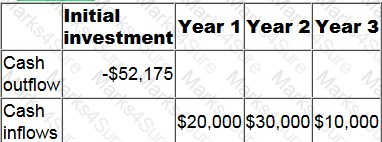
To the nearest 1%, what is the project ' s internal rate of return?
A not-for-profit organization measures performance using the three Es. If the organization has made optimum utilization of available resources then it should be described as:
A company makes three products, E, F and G. Total overheads for the year are expected to be $1.2 million, with the following split between cost pools:
Cost driver information has been estimated as follows:

The company plans to make 10,000 units of product E in the year, with an expected direct cost of $0.60 per unit. This annual production of product E is expected to require 20 quality inspections, 28 purchase requisitions, and 400 kilogrammes of materials.
What is the overhead cost per unit of product E?
A group consists of two divisions, Alpha and Beta, both of which are profit centers. Alpha sells a product to the external market and also sells it as an intermediate product to Beta.
Beta then processes further before selling the final product to the external market. The current group transfer pricing policy requires Alpha to charge Beta with the variable cost of production.
Which of the following statements is valid?
A company is considering investing $150,000 in a project which will generate the following contributions during the first three years.
Tax depreciation allowance is 25% each year of the reducing balance.
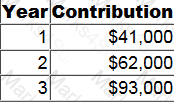
The taxation rate is 30% of taxable profits and tax is payable in the year after that in which it arises.
To the nearest $10, what is the forecast total project cash flow in year 3?
Which THREE of the following are advantages of changing from a ' top-down ' to a ' bottom-up ' (participative) style of budgeting?
A company must decide today whether to proceed with a proposed project. If the project proceeds, the initial investment of $150,000 would be made in one year ' s time. The benefit of the project would be a perpetuity of $22,000 per year commencing one year after the investment is made. The company ' s cost of capital is 14% per year.
To the nearest $100, what is the net present value of the project?
An organization wants to increase the use value that customers place on one of its products - a laptop computer.
Which of the following actions, taken to increase the value to the customer, would increase the product ' s use value?
Select ALL that apply.
Which basis of transfer pricing retains the full autonomy of divisional managers?
The performance report for the production manager of a company for the last month included the following.
1,000 direct labor hours were worked at a basic rate of pay of $10 per hour. 200 of these hours were worked during overtime for which a 30% overtime premium was paid. 80 of these overtime hours were to fulfill a customer order that had originally been planned for manufacture next month. The sales manager had agreed to bring forward the delivery of this order at the request of the customer. The remaining overtime hours were due to unexpected inefficiency of the workforce; this has been traced to poor supervision by a junior manager.
Material costs included the following:
$5,300 of material A. Material A is a commodity and, due to changes on the global market, the actual unit cost of this material for last month was 6% higher than had been expected
$5,250 of material B. The usage of material B last month was 5% higher than it should have been due to faulty workmanship on the production line.
What is the total value of the above costs that was controllable by the production manager?
Four mutually exclusive projects have been appraised as follows using net present value (NPV), internal rate of return (IRR), accounting rate of return (ARR) and payback period (PP).
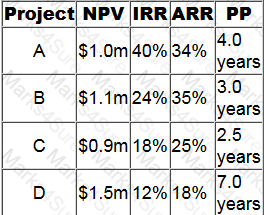
Recommend which of the projects should be chosen.
A project is viable because it has a positive net present value (NPV).
Details of four of the input variables, together with the sensitivity of the viability of the project to a change in each one in isolation, are given below.
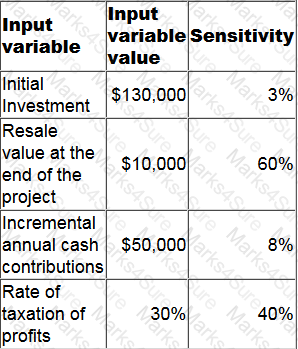
Which of the following statements is correct?
The following cost of quality report has been prepared for the latest period.

What is the difference between the cost of conformance and the cost of non-conformance?
A large company that sells a single product has many customers. The contribution per unit of the product is $40. Data for the company as a whole are given below.
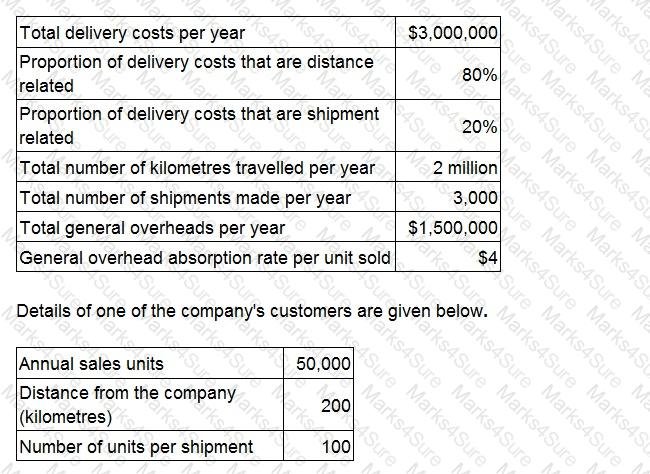
Using customer profitability analysis, what is the total annual profit for this customer?
IOP ' s product is manufactured using a production process that is known to have a defect rate of 10%.
IOP ' s quality control department has developed a test that has a 98% probability of classifying a non-defective item correctly and a 2% probability of classifying a non-defective item as defective.
The same test has a 95% probability of classifying a defective item correctly and a 5% probability of classifying a defective item as non-defective.
Calculate the proportion of IOP ' s output that will be classified as non-defective by the quality control department ' s test.
Give your answer to one decimal place.
Which of the following statements is correct in respect of the key feature of dual pricing?
For a pharmaceutical manufacturer, in which perspective of the Balanced Scorecard should the performance measure ' number of patents granted during the year ' be included?
An organization is competing in the high technology market. It sets a high sales price for its products initially to target the early adopters, and then the price is gradually reduced.
This pricing strategy is known as:
An organization is comprised of two divisions. One of the divisions manufactures a product that it sells both to an imperfect external market and to the other division.
The organization wishes to establish the most suitable basis for the transfer price for this product and is considering either a negotiated transfer price or a market-based transfer price.
Which of the following statements is correct?
PDF + Testing Engine

Testing Engine
PDF (Q&A)