
Free Practice Questions for the National Payroll Institute Payroll Fundamentals PF1 Exam (2026 Updated)
At Marks4sure, we are dedicated to providing IT professionals with the most accurate and reliable preparation materials for the National Payroll Institute PF1 exam. To support your certification journey, we have made a selection of our premium 2026 Payroll Fundamentals practice questions and answers available completely free. You can take this practice test as many times as you need. Every question includes a detailed, expertly verified explanation to ensure you fully grasp the core security concepts before test day.
In Block 6 of the Record of Employment, what pay period type is entered for employees who are paid salary plus regularly paid commission?
An employee who lives in Ontario and reports to work at a permanent establishment of the employer in Quebec will have income tax deducted based on which province?
Dollar amounts that are paid to an employee to cover expenses that they incurred while performing their job, but are not considered in the calculation of an employee’s earnings are:
In Block 12 of the Record of Employment, the final pay period ending date for employees who are paid solely by commission or are paid salary plus irregularly paid commission will be:
The authorization for hiring form should contain a checklist to ensure the organization obtains all required information. What is an example of an item that could be on that checklist?
Alyssa is a member of her employer’s Defined Contribution Pension Plan. The plan defines the contribution as 3% of the employee’s pensionable earnings, with the employer matching the employee’s contribution. Alyssa’s pensionable earnings are $3,400.00 per month. Calculate the total payment to be remitted to Alyssa’s Defined Contribution Pension Plan each month.
Vacation pay on termination would be recorded in which Block(s) on the Record of Employment?
Elodie is paid her commissions together with her bi-weekly salary of $1,000.00. This pay period her commissions are $4,300.00. Calculate her Québec Pension Plan (QPP) contribution for this pay period.
(PF1 Exam – Net Pay Calculation Template Worksheet: Quebec)
Question ID: pf1-exam-npc-q-f
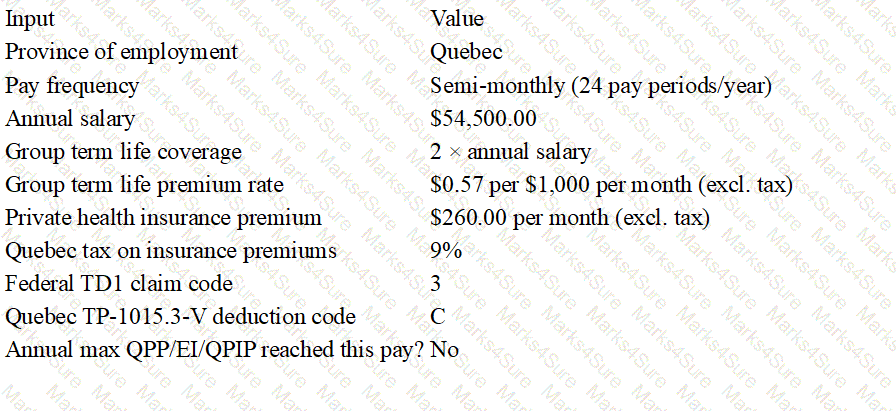
Mara Poirier works for Affordable Transport in Quebec and earns an annual salary of $54,500.00, paid on a semi-monthly basis.
In addition to her regular salary, Mara’s employer provides the following benefits:
Group term life insurance coverage through a third party of two times her annual salary.
Monthly group term life insurance premiums are $0.57 per $1,000.00 of coverage, excluding taxes.
Private health insurance benefits with a monthly premium of $260.00, excluding taxes.
The tax on insurance premiums in Quebec is 9%.
Mara’s federal TD1 claim code is 3 and her provincial TP-1015.3-V deduction code is C.
Mara will not reach the annual maximums for QPP, EI, or QPIP in this pay period.
Required: Calculate Mara’s net pay, following the order of the steps in the net pay template.
EXHIBIT A — Net Pay Template (Fill in all blanks)
Earnings / Income Bases
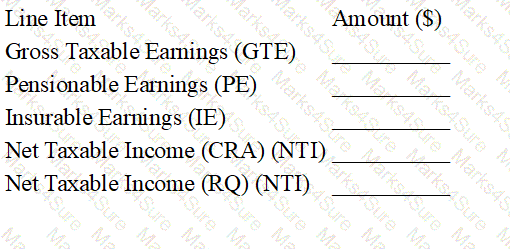
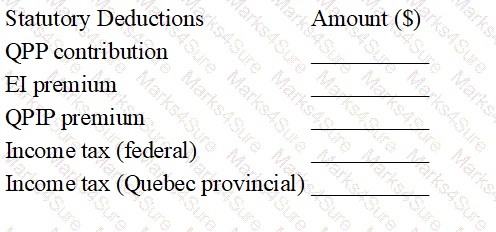
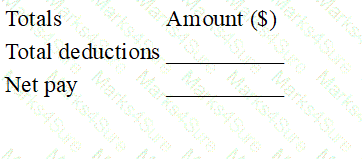
Step 1 — Calculate Mara’s gross earnings for this pay period (GTE).
[ ____________________________________________ ]
Step 2 — Calculate the pensionable earnings (PE).
[ ____________________________________________ ]
Step 3 — Calculate the insurable earnings (IE).
[ ____________________________________________ ]
Step 4 — Calculate the net taxable income (CRA) (NTI).
[ ____________________________________________ ]
Step 5 — Calculate the net taxable income (RQ) (NTI).
[ ____________________________________________ ]
Step 6 — Calculate Mara’s Quebec Pension Plan (QPP) contribution.
[ ____________________________________________ ]
Step 7 — Calculate Mara’s Employment Insurance (EI) premium.
[ ____________________________________________ ]
Step 8 — Calculate Mara’s Quebec Parental Insurance Plan (QPIP) premium.
[ ____________________________________________ ]
Step 9 — Determine Mara’s federal income tax.
[ ____________________________________________ ]
Step 10 — Determine Mara’s Quebec provincial income tax.
[ ____________________________________________ ]
Step 11 — Calculate Mara’s total deductions.
[ ____________________________________________ ]
Step 12 — Calculate Mara’s net pay.
[ ____________________________________________ ]
Ursula is 17 years old, works in Quebec and earns $750.00 weekly. Ursula pays weekly union dues of $18.00 along with a special weekly union assessment of $10.00 for construction of a new union hall for its members. Ursula also has registered pension plan (RPP) contributions of $20.00 deducted from each pay. Calculate Ursula’s net federal taxable income.
Tanya submitted a letter of resignation to her employer on April 2 of the current year advising that she would be resigning her position effective April 27 for the pay period ending April 28. What date will appear in Block 11 of Tanya’s Record of Employment?
Paul Westin works for an Alberta organization and receives a regular salary of $1,800.00 semi-monthly. He will be receiving a payout of accrued vacation with no time taken of $1,400.00 on a separate cheque. He has federal and provincial TD1s on file with claim code 1. Calculate the income taxes to be withheld on his vacation pay.
PF1 Exam – Net Pay Calculation (Template Worksheet)
Scenario
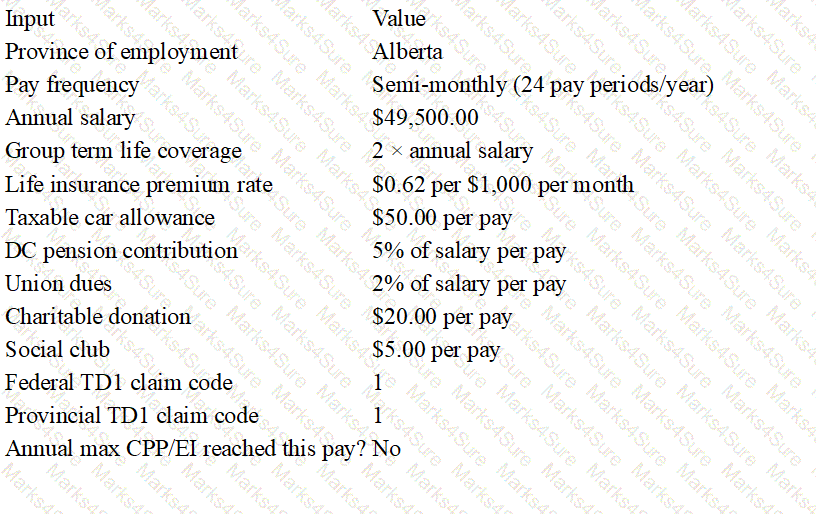
Diane Lemay works for Monarch Construction in Alberta and earns an annual salary of $49,500.00, paid on a semi-monthly basis.
The company provides its employees with group term life insurance coverage of two times annual salary and pays a monthly premium of $0.62 per $1,000.00 of coverage.
Diane uses her car to meet with clients on company business and receives a taxable car allowance of $50.00 per pay.
The company has a defined contribution pension plan to which Diane contributes 5% of her salary each pay.
Diane also contributes $20.00 to United Way and has $5.00 deducted for her social club membership each pay. She belongs to a union and pays 2% of her salary in union dues per pay period.
Diane’s federal and provincial TD1 claim codes are 1. She will not reach the first Canada Pension Plan or Employment Insurance annual maximums this pay period.
Required: Calculate the employee’s net pay, following the order of the steps in the net pay template.
EXHIBIT A — Net Pay Template (Fill in all blanks)
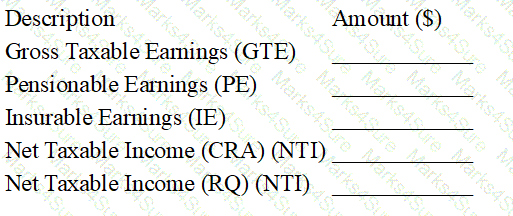
STATUTORY DEDUCTIONS
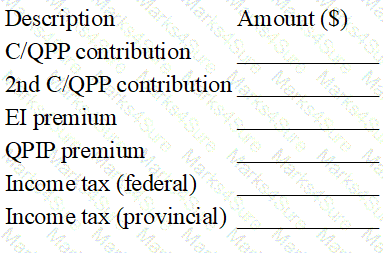
OTHER DEDUCTIONS
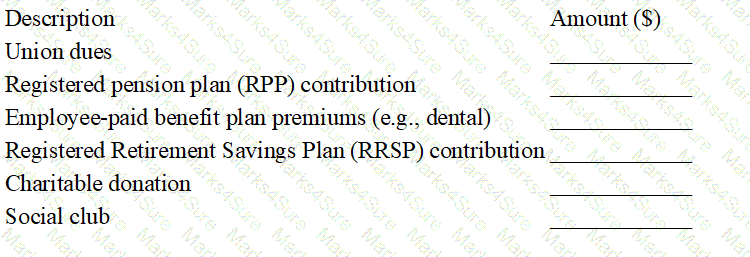
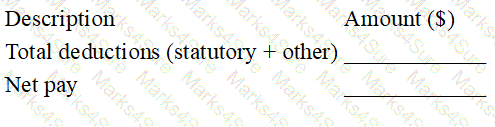
Given Data (Reference)
Step 1 — Calculate the employee’s gross taxable earnings (GTE) for this pay.
[ _________________________________ ]
Step 2 — Calculate the pensionable earnings (PE).
[ _________________________________ ]
Step 3 — Calculate the insurable earnings (IE).
[ _________________________________ ]
Step 4 — Calculate the net taxable income (CRA) (NTI).
[ _________________________________ ]
Step 5 — Calculate the net taxable income (RQ) (NTI).
[ _________________________________ ]
Step 6 — Calculate Diane’s Canada Pension Plan contribution.
[ _________________________________ ]
Step 7 — Calculate Diane’s Employment Insurance premium.
[ _________________________________ ]
Step 8 — Calculate Diane’s Quebec Parental Insurance Plan premium.
[ _________________________________ ]
Step 9 — Determine Diane’s federal income tax.
[ _________________________________ ]
Step 10 — Determine Diane’s provincial income tax.
[ _________________________________ ]
Step 11 — Calculate Diane’s total deductions (statutory + other).
[ _________________________________ ]
Step 12 — Calculate Diane’s net pay.
[ _________________________________ ]
Which pension plan requires the services of an actuary to study and forecast future needs of the plan to ensure the plan remains sufficiently funded to provide employees with their retirement benefits?
PDF + Testing Engine

Testing Engine
PDF (Q&A)