
Free Practice Questions for the PMI Project-Management-Professional PMP Exam (2026 Updated)
At Marks4sure, we are dedicated to providing IT professionals with the most accurate and reliable preparation materials for the PMI PMP exam. To support your certification journey, we have made a selection of our premium 2026 Project-Management-Professional practice questions and answers available completely free. You can take this practice test as many times as you need. Every question includes a detailed, expertly verified explanation to ensure you fully grasp the core security concepts before test day.
During the execution phase of a project, a new regulation is published. A subject matter expert (SME) on the project team contacts the project manager and tells them
that the new regulation might heavily impact the project ' s delivery.
What should the project manager do?
During a sprint review, the customer described a strong market trend that will highly impact the product vision and the project management plan. What should the
project manager do?
While facilitating the weekly team meeting, a developer raises the concern that a team lead from a different department is frequently asking for status updates on
ongoing tasks. The project manager was not aware of these interferences.
What should the project manager do next?
A project manager is leading a project for a large company. During project execution, an engineer discovers that a spare part should be immediately changed to avoid
a power outage. The replacement part will take time to obtain through the organization ' s procurement process.
What should the project manager do?
The project team is working on integrating a generative artificial intelligence (Al) solution, which will function as customer-facing agent. The project manager has
recently learned from the company ' s legal department that the European Union is updating its Al Act. This update needs to be considered as it will impact the project
scope and will drive deadlines.
What should the project manager do?
During a team ' s weekly status meeting, team members have minor disagreements about how to perform work and some defer to the team lead while others speak
confidently. The project manager realizes that team members have different expectations of the team ' s dynamics and operating model.
What should the project manager do?
The vendor just informed the project manager that an item will not be delivered as scheduled due to a manufacturing error. This will impact the delivery timeline of the
project as there are dependencies to the completion of this item delivery.
What action should the project manager take?
A project to replace a legacy process is in the initiation phase. The project manager needs to send requests for proposals to potential vendors. The business case contains the project’s high-level goals, and all potential vendors have previously delivered similar projects.
What should the project manager do to ensure that activities and tools from the legacy process are retained when necessary?
A project manager is leading an iterative project to develop a very innovative product. However, a group of stakeholders are hesitant because the high complexity of the product involves many business rules.
What should the project manager do?
A project manager works for a company that recently won a big government contract. The company has a flat hierarchy and self-organized teams. The client wants
the project manager to use a predictive management approach and an up-front project management plan. However, the project manager knows that a more agile
approach would be better due to the high uncertainty of the project scope.
What should the project manager do?
A project manager is working for a multinational financial services company that does business in more than 100 countries. The company is rolling out a time
management system in multiple countries.
What should the project manager do?
During the rollout of interactive digital whiteboards to several schools, a project manager is informed there are delays at the customs office that prevent the delivery of
the newest model of whiteboards from the overseas supplier as planned. The project timeline will be impacted.
What should the project manager do?
A scrum master is leading an agile project to develop a video game product. Midway through a sprint, the customer asks the team to immediately add a new feature
to the product. The team asks the scrum master for guidance.
What should the scrum master do first?
During the execution of an Al project, the different teams responsible for developing deliverables are consistently delayed. The teams do not have access to shared
resources or are dependent on other teams to complete tasks.
What should the project manager do first?
A project manager is leading an online learning system development project for a government body. The project team is working on a new feature that needs a very
stable video streaming platform. A stakeholder from marketing suggests using a platform that has been used in other marketing projects. Following the endorsement
of senior management, the team soon adopts this platform. Yet during development, the team finds that the platform cannot handle multilanguage subtitles, which are
critical to the online learning system.
What should the project manager have done to avoid this situation?
A project manager conducts weekly virtual project meetings with all stakeholders to keep them updated on project progress and discuss key issues. Some stakeholders appear disengaged or are occupied with other work during the meetings. Other stakeholders have stopped attending.
What should the project manager do?
Asubject matter expert (SME) working for the client ' s company is coming up with new project requirements periodically. This causes confusion, time is wasted
rearranging the requirements. The project manager has learned that this SME is a new to the project.
What should the project manager do?
A project team is planning a university graduation ceremony. During a team meeting, a team member disagrees with the project manager on the prioritization of
project activities. The team member thinks that it would be more efficient to prioritize the sponsorship instead of preparing a budget since a budget template already
exists.
What should the project manager do?
A project manager is engaged in a process improvement project. The business analyst working with the team has been instructed to interact with line production team
members in an efficient manner. Since process duplication would affect their reaction time, line production team members have a significant interest in process
improvement to improve quality.
How should the project manager advise the business analyst to improve interaction with the line production team?
A project manager is leading an ongoing project for a highly reputable international client. A few hours before the final review meeting, during which the client is expected to accept the project and authorize a substantial payment, the project manager’s company suffers a cyberattack. The client is very strict and maintains that any missed deadlines will result in a considerable penalty.
What should the project manager do?
A project manager is comparing actual revenue with projected revenue to determine necessary changes for increasing revenue. The revenue is influenced by the volume of transactions and data extractions.
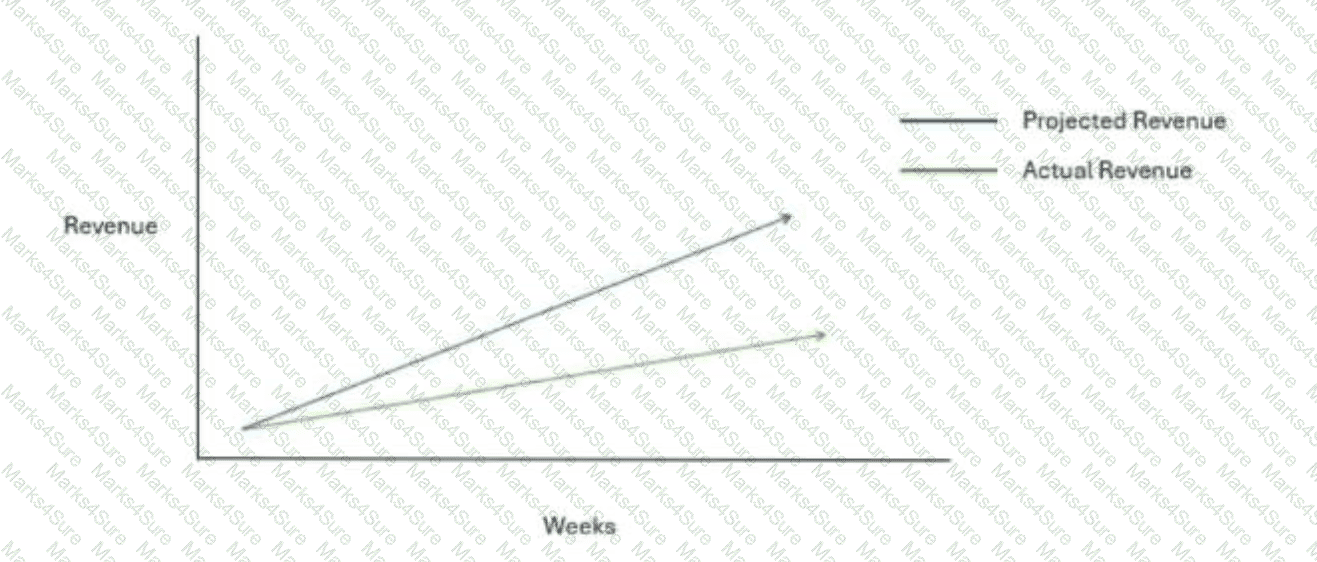
What actions should the project manager take to reduce the gap between projected and actual revenue? (Refer to the Line Chart)
During a project status meeting, two project stakeholders disagree about what should be included in the next deliverable. One of the stakeholders would like the team to include a finalized version of the new component in the release. Using the finalized version will impact the project timeline. The second stakeholder would like the team to include a beta version of the new component to allow the client to provide feedback before the component is finalized.
What should the project manager do next?
A project team is working for a client in the international banking sector, where frequent regulatory changes are common. On the current project, the team will verify compliance with a new
legal framework which aims to strengthen regulation, supervision, and risk management.
What should the project manager do first?
A project team had been developing their deliverables on a 2-week sprint. The deliverables were tested and proven to be functional. However, during the sprint
review, they were rejected because they failed to meet the end-user requirements.
What actions should the project manager have done?
A team member is experiencing personal issues and has not participated in key project meetings. Other members of the project team are complaining about this
behavior and urge the project manager to take action.
What should the project manager do?
A project is approaching the closure phase. The project manager realizes that the team has consumed more hours than what was budgeted because some nonfunctional security requirements were not considered during project initiation.
What should the project manager do to avoid this issue in the future?
The product owner spends 20% of their time on a project. The product owner complains to the project manager that team members are asking questions via emails
and refusing to provide effort estimates until all of their questions are clarified. This is delaying the final work estimate.
What should the project manager do?
A project manager is leading a global project involving third-party contractors, internal stakeholders, and regulators. During a project board meeting, stakeholders are
informed of a regional compliance issue that could delay a critical milestone. One stakeholder demands immediate resolution, while another stakeholder thinks it is
not a priority.
What should the project manager do?
There are considerable differences in experience levels among project team members working on a project. Multiple stakeholders are requesting that deliverables
relevant to them be assigned to the most experienced team members, which is not feasible.
What should the project manager do?
A team is working on a hospital construction project and is using a predictive approach. The team has encountered a challenge affecting their deadline because a
critical team member is on medical leave. The project is in jeopardy of falling behind schedule.
What should the project manager do first?
A product owner who possesses a strong technical background has been actively involved with the project team for several years. The product owner has been quite
vocal about the expected duration of the work. As a result, the project team has ceased providing development estimates to avoid causing any dissatisfaction with the
product owner.
What should the project manager do?
A project manager is overseeing a hybrid project with two distinct workstreams: hardware operating predictively and software operating adaptively. However, the procurement contract for the software vendor has been finalized with clauses based on a predictive way of working. Meanwhile, many software work items are undergoing different prioritizations on the Kanban board.
What should the project manager do?
During a daily coordination meeting, the team reports that due to considerable challenges with the infrastructure, the planned tasks are now blocked and cannot move
forward. What should the project manager do?
A project manager is developing a project schedule in which only the high-level scope is defined; the detailed work breakdown structure (WBS) is to be developed at
the beginning of each project phase. Project teams are focusing on short-term objectives and can only detail the scope for work they are currently performing. Despite
this, the project sponsor asks for a master project schedule.
What two actions should the project manager take in this situation? (Choose 2)
An agile project in progress has a large number of blocked items and the project manager does not have visibility on the underlying issues. What should the project manager do to allow transparency and remove the blockers?
A project team released the first phase of a newly developed IT system to their operations team a month ago. The project team is currently working on new tasks for
the next phase but is continually contacted by operations key users with their new findings.
What should the project manager do to avoid this situation in the future?
Abig corporation with a large quantity of well-documented procedures is planning to acquire a small company. The potential loss of key resources due to uncertainty
around the merger is a significant concern.
What should the project manager do?
A project manager is assigned to a project in which the business and the technology to be used are well-known. What should the project manager do to learn about
the customer ' s needs, the complexity, and the resulting impact of the project?
The release of a mobile application is near. However, the team is experiencing a major regulatory approval delay for the application ' s graphics. This delay will impact
the launch of the mobile app.
What should the project manager do?
Ahigh-performing team is working diligently to deliver a project ahead of schedule. While the deliverables meet the necessary quality standards, the team member
responsible for this aspect of the project exhibits inadequate skills in quality management and lacks enthusiasm for the task.
What should the project manager do?
A city infrastructure project aims to construct a bridge to enhance traffic flow and alleviate congestion. The project is under tight deadlines due to upcoming major events in the city. The team is employing a hybrid approach by incorporating agile practices into a traditionally structured project schedule.
A key stakeholder asks the project manager to expedite the delivery of specific work packages. The project manager determines that this request will affect the project cost.
What should the project manager do?
Agroup of specialists with years of experience is temporarily joining a project team. The project manager has been eager for their help in the production of a key
deliverable.
How should the project manager effectively lead these experienced team members?
After finishing a project, the project manager organized a lessons learned meeting. What should the project manager do next?
‘An organization undergoes a major budget revisal. The project manager gathers the stakeholders to discuss the situation as some projects are stil in-progress and may be impacted.
What two actions should the project manager take? (Choose 2)
A project manager is leading a team developing a new production line. The project manager feels overwhelmed after seeing a long list of assumptions and constraints
in the project charter. Therefore, the project manager wants to thoroughly analyze the project requirements, complexities, and uncertainties to understand the
potential challenges and risks.
Which action should the project manager take?
Acharity organization is considering adopting artificial intelligence (Al) technology to 100 secondary schools throughout the country. After completing a needs
assessment with the schools, the project manager realizes there is no internal expertise for such Al technology.
What should the project manager do next?
Solution Development Case Study
A project manager was assigned to a project to deliver a corporate IT security solution within a 12-month timeline and a budget of $2.5 million USD. To help ensure project success, the project manager established a governance framework featuring a steering committee of senior executives from relevant functional areas. The project manager conducted a detailed stakeholder analysis using a power/interest grid to prioritize engagement strategies and developed a quality management plan incorporating quality metrics, control charts, and acceptance criteria for each deliverable.
Project work required specialized security testing tools, so the project manager collaborated with the procurement team to develop vendor selection criteria and contract terms. The team used an agile approach to develop software coupled with a predictive approach to manage other aspects of the project. The project manager implemented a configuration management system to track changes and maintain version control of project information.
During execution, the project manager coordinated between various teams, including software development, cybersecurity, quality assurance, compliance, and customer experience, each with its own methodologies and tools. To address integration challenges, the project manager developed a comprehensive project management plan, with a detailed work breakdown structure (WBS), a master schedule using the critical path method, and earned value management (EVM). The team helped the project manager create and tailor a risk management plan focusing on integration points between teams, along with a communications matrix to ensure consistent cross-functional meetings with stakeholders.
During the project, challenges such as resource conflicts, scope creep, and technical integration issues arose. The project manager addressed these challenges using a resource optimization plan, a formal change control process, and technical working groups.
The project was delivered within budget and was concluded 2 months later than the original baseline due to an approved change. Stakeholders accepted the delay due to additional security features added during execution. The final product met all quality metrics and received positive feedback from beta customers. The project provided valuable lessons on early stakeholder alignment, integrated change control, cross-functional communication, and regular risk reassessment, which informed good practices for future projects within the organization.
What should the project manager do to facilitate and improve communications between the multiple teams within this project?
(Refer to the Solution Development Case Study exhibit.)
Due to competing priorities in a project, team members have been working overtime. However, the deadline is still being delayed because of the amount of work
required. The business owner begins questioning the project health and asks for reports on milestones on a weekly basis.
What should the project manager do?
Alocal city government is deploying a project management system in several departments. At the start of a new phase, the project manager asks a department
manager for input on the project schedule. In response, the department manager wants to know more about their role and responsibilities in the scheduling process.
What should the project manager do?
Aclient complains that an in-process multimillion-dollar project is not meeting their needs. The clients have consulted the project manager several times.
What should the project manager do?
In the last project status meeting, a team member reported some tasks with conflicting priorities. Now, other team members are delayed in their tasks due to the
dependencies.
What should the project manager do to address this situation?
A project sponsor provides a charter and appoints a project manager to implement a large project over 5 years. The sponsor then requests the project budget and
outcomes from the project manager.
What should the project manager do first?
A project to upgrade high-voltage transmission lines, towers, and substations in a remote mountainous area is 50% complete at the end of April.
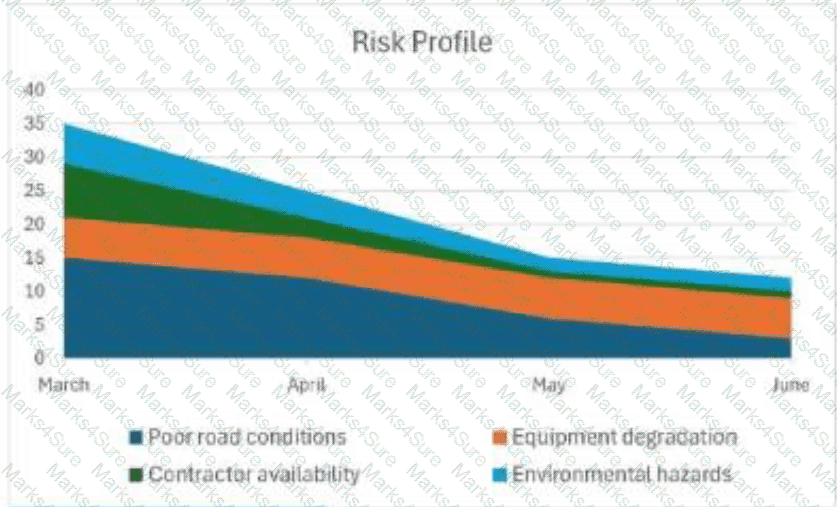
The risk manager has implemented risk responses and is projecting the probability and impact for the remainder of the project. At a monthly risk meeting, the risk manager presents the chart shown above.
What two conclusions can be determined from this chart? (Choose 2)
PDF + Testing Engine

Testing Engine
PDF (Q&A)