
Free Practice Questions for the NBRC Pulmonary Function Technology (PFT) RPFT Exam (2026 Updated)
At Marks4sure, we are dedicated to providing IT professionals with the most accurate and reliable preparation materials for the NBRC RPFT exam. To support your certification journey, we have made a selection of our premium 2026 Pulmonary Function Technology (PFT) practice questions and answers available completely free. You can take this practice test as many times as you need. Every question includes a detailed, expertly verified explanation to ensure you fully grasp the core security concepts before test day.
In setting up a CO analyzer, a pulmonary function technologist notices that the analyzer reads -0.03 while sampling air. The technologist should
A patient's bronchial provocation test was interpreted as positive for hyperreactive airways. Considering changes from a pre-challenge baseline, all of the following are consistent with this interpretation EXCEPT a
When using a variable pressure plethysmograph, a leak in the door seal that develops subsequent to calibration will cause underestimation of
A pulmonary function technologist is asked to select gas concentrations to simulate pediatric patients' exhaled concentrations during a D Lco simu - lation. Which of the following F E CO concentrations should the technologist select?
A comparison of two techniques for measuring Rawis shown below:
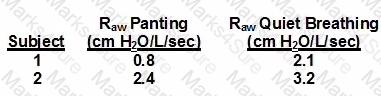
Which of the following should a pulmonary function technologist conclude?
Results of two blood gas samples drawn from the same patient, 30 minutes apart, are shown below:
Which of the following is the most likely explanation for these differences?
A 54-year-old male with a normal ECG at rest develops dyspnea during an exercise (stress) test, and the following ECG pattern is noted at 25 watts:
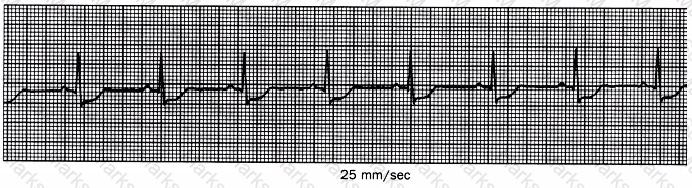
25 mm/sec A pulmonary function technologist should
A pulmonary function technologist is performing quality control on a nebulizer used in the 5-breath dosimeter bronchial challenge. The target output of the device is 0.09 mL, plus or minus 10%. After 10 actuations, the nebulizer output was 75 µL with a 2.0 mL initial saline dose in the nebulizer. The technologist should
The following values are reported at maximum effort for a 50-year-old, 70-kg (154-lb) male with significant coronary artery disease during ergometer stress testing. Which of the following is most likely an error?
A patient's vital capacity is slightly reduced, the FEWFVC is normal, and the uncorrected DLco is increased. Which of the following is the most likely diagnosis?
A patient with severe airflow limitation pants too rapidly ( > 3 breaths/second) against a closed shutter in a body plethysmograph. Which of the following will occur?
Which of the following is a common reason for an unstable zero reading from an infrared analyzer?
The following results are obtained from an adult male:
The corrected D Lco value
Which of the following is the most reliable indicator that a patient has achieved his maximum exercise capacity during a progressive exercise (stress) test?
While performing a quality control test on an open circuit nitrogen system, the volume of a 3-liter syringe is measured as 3.9 L. Which of the following is the most probable explanation?
While assessing a patient's expired gases at rest prior to exercise, a pulmonary function technologist calculates the RER as 0.6. Which of the following is the most likely explanation?
During a forced vital capacity (FVC) maneuver, a patient produces an exhalation with a slow start and delayed peak expiratory flow. Which of the following is the most probable cause of this pattern?
The following blood gas report is questioned by the attending physician:
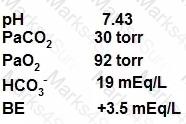
Which of the following values is INCONSISTENT?
In a patient with neuromuscular disease, which of the following is the best way to detect airway obstruction?
When performing quality control in a body plethysmograph using a 5-L isothermal bottle, the V TG at shutter closure are as follows:

A pulmonary function technologist should
A pulmonary function technologist is reviewing results of a recent mechanical diffusion simul-ation using a 3-liter syringe. The test was conducted at a room temperature of 22° C. The following BTPS results were reported:
Which of the following should the technologist do?
While performing duplicate blood gas analyses, a pulmonary function technologist notes that the second instrument gives consistently higher values forPaCO 2 and PaO 2 . Which of the following is the most probable cause of higher readings from the second instrument?
While reviewing exercise data, a pulmonary function technologist notes that the patient's anaerobic threshold occurred at 35% of the patient's VO 2MAX . This indicates the patient has
When performing exercise testing on a biologic control, the measurements obtained should be compared with
The following data were obtained from a bronchial challenge test:
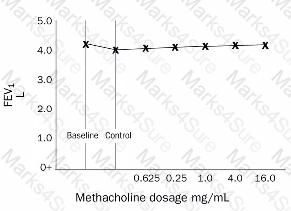
APC 20 of 2 mg/mL was obtained the next day in another laboratory. Which of the following is the most likely explanation for these data?
Which of the following sets of FIF data is most consistent with an extrathoracic airway obstruction?
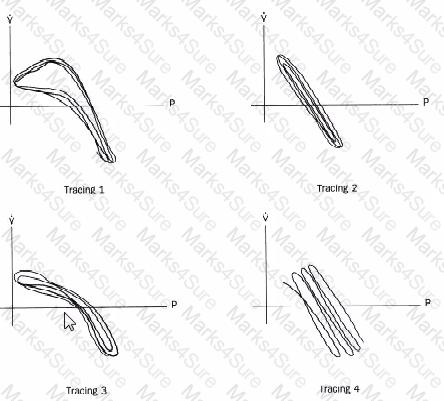
Which of the above patterns illustrates the effect of increasing temperature in the plethysmograph during airways resistance measurement?
Which of the following is the most reliable method to estimate the effectiveness of standard procedures to minimize the risk of cross-contamination during spirometry testing in a pulmonary function laboratory?
A government agency requires that a pulmonary function technologist establish procedures to minimize the loss of laboratory data. Which of the following should be included in these procedures?
1. Continuous mirroring of hard drives
2. Storage of duplicate test data offsite
3. No Internet connections to the computer storing the database
4. Contracting with a third-party security company
The following values are obtained using a 3-liter calibration syringe during volume calibration of a dry-rolling spirometer:
2.80 L
2.79 L
2.82 L
The performance of this spirometer is best described as
PDF + Testing Engine

Testing Engine
PDF (Q&A)