
Free Practice Questions for the SOA Certified SOA Architect S90.08B Exam (2026 Updated)
At Marks4sure, we are dedicated to providing IT professionals with the most accurate and reliable preparation materials for the SOA S90.08B exam. To support your certification journey, we have made a selection of our premium 2026 Certified SOA Architect practice questions and answers available completely free. You can take this practice test as many times as you need. Every question includes a detailed, expertly verified explanation to ensure you fully grasp the core security concepts before test day.
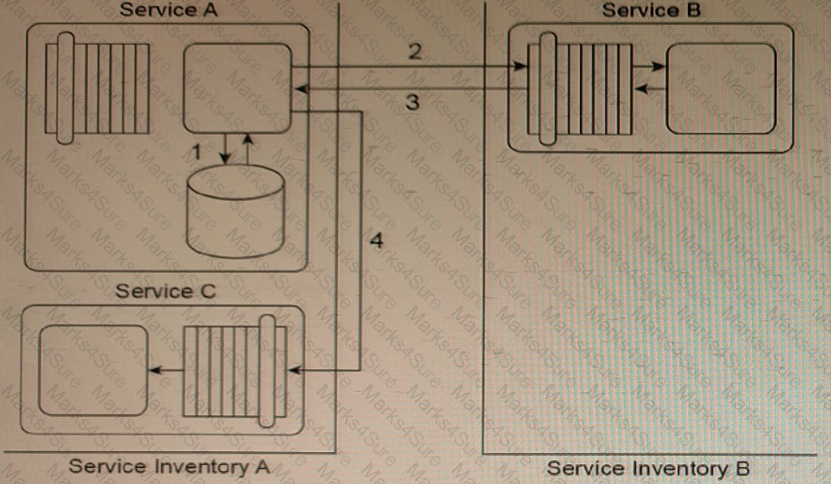
Service A is a task service that sends Service B a message (2) requesting that Service B return data back to Service A in a response message (3). Depending on the response received, Service A may be required to send a message to Service C (4) for which it requires no response.
Before it contacts Service B, Service A must first retrieve a list of code values from its own database (1) and then place this data into its own memory. If it turns out that it must send a message to Service C, then Service A must combine the data it receives from Service B with the data from the code value list in order to create the message it sends to Service C. If Service A is not required to invoke Service C, it can complete its task by discarding the code values.
Service A and Service C reside in Service Inventory A. Service B resides in Service Inventory B.
You are told that the services in Service Inventory A were designed with service contracts that are based on different design standards and technologies than the services In Service Inventory B. As a result, Service A is a SOAP-based Web service and Service B Is a REST service that exchanges JSON-formatted messages. Therefore, Service A and Service B cannot currently communicate. Furthermore, Service C is an agnostic service that is heavily accessed by many concurrent service consumers. Service C frequently reaches its usage thresholds, during which it is not available and messages sent to it are not received.
What steps can be taken to solve these problems?
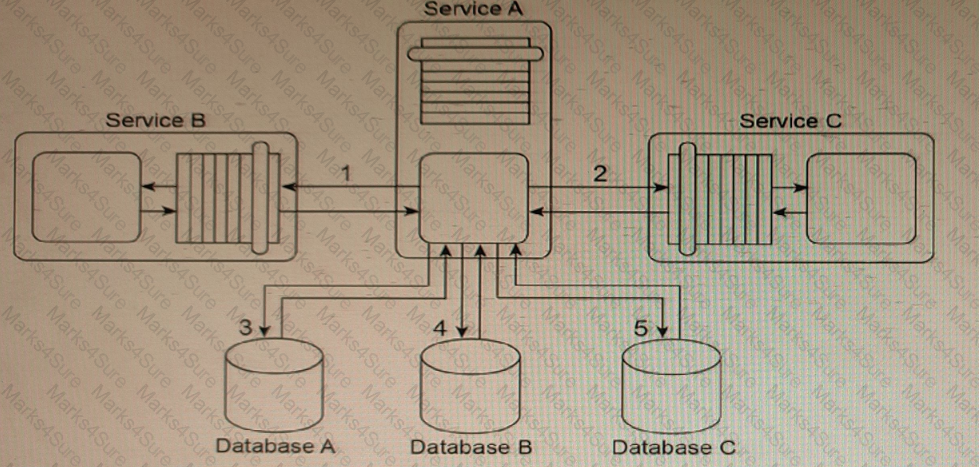
Service A is an entity service that provides a set of generic and reusable service capabilities. In order to carry out the functionality of any one of its service capabilities, Service A is required to compose Service B (1) and Service C (2), and Service A is required to access Database A (3), Database B (4), and Database C (5). These three databases are shared by other applications within the IT enterprise.
All of service capabilities provided by Service A are synchronous, which means that for each request a service consumer makes, Service A is required to issue a response message after all of the processing has completed.
Service A is one of many entity services that reside In a highly normalized service Inventory. Because Service A provides agnostic logic, it is heavily reused and is currently part of many service compositions.
You are told that Service A has recently become unstable and unreliable. The problem has been traced to two issues with the current service architecture. First, Service B, which Is also an entity service, is being increasingly reused and has itself become unstable and unreliable. When Service B fails, the failure is carried over to Service A. Secondly, shared Database B has a complex data model. Some of the queries issued by Service A to shared Database B can take a very long time to complete.
What steps can be taken to solve these problems without compromising the normalization of the service inventory?
PDF + Testing Engine

Testing Engine
PDF (Q&A)