
- Home
- ISC
- ISC 2 Credentials
- SSCP
- Systems Security Certified Practitioner Questions and Answers
Free Practice Questions for the ISC 2 Credentials SSCP Exam (2026 Updated)
At Marks4sure, we are dedicated to providing IT professionals with the most accurate and reliable preparation materials for the ISC SSCP exam. To support your certification journey, we have made a selection of our premium 2026 ISC 2 Credentials practice questions and answers available completely free. You can take this practice test as many times as you need. Every question includes a detailed, expertly verified explanation to ensure you fully grasp the core security concepts before test day.
IT security measures should:
Options:
Be complex
Be tailored to meet organizational security goals.
Make sure that every asset of the organization is well protected.
Not be developed in a layered fashion.
Answer:
BExplanation:
In general, IT security measures are tailored according to an organization ' s unique needs. While numerous factors, such as the overriding mission requirements, and guidance, are to be considered, the fundamental issue is the protection of the mission or business from IT security-related, negative impacts. Because IT security needs are not uniform, system designers and security practitioners should consider the level of trust when connecting to other external networks and internal sub-domains. Recognizing the uniqueness of each system allows a layered security strategy to be used - implementing lower assurance solutions with lower costs to protect less critical systems and higher assurance solutions only at the most critical areas.
The more complex the mechanism, the more likely it may possess exploitable flaws. Simple mechanisms tend to have fewer exploitable flaws and require less maintenance. Further, because configuration management issues are simplified, updating or replacing a simple mechanism becomes a less intensive process.
Security designs should consider a layered approach to address or protect against a specific threat or to reduce a vulnerability. For example, the use of a packet-filtering router in conjunction with an application gateway and an intrusion detection system combine to increase the work-factor an attacker must expend to successfully attack the system. Adding good password controls and adequate user training improves the system ' s security posture even more.
The need for layered protections is especially important when commercial-off-the-shelf (COTS) products are used. Practical experience has shown that the current state-of-the-art for security quality in COTS products does not provide a high degree of protection against sophisticated attacks. It is possible to help mitigate this situation by placing several controls in series, requiring additional work by attackers to accomplish their goals.
Source: STONEBURNER, Gary & al, National Institute of Standards and Technology (NIST), NIST Special Publication 800-27, Engineering Principles for Information Technology Security (A Baseline for Achieving Security), June 2001 (pages 9-10).
Which division of the Orange Book deals with discretionary protection (need-to-know)?
Options:
D
C
B
A
Answer:
BExplanation:
C deals with discretionary protection. See matric below:
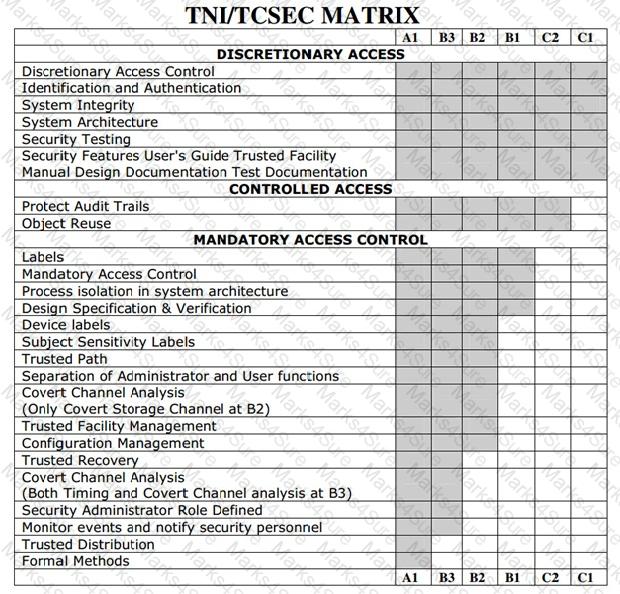
TCSEC Matric
The following are incorrect answers:
D is incorrect. D deals with minimal security.
B is incorrect. B deals with mandatory protection.
A is incorrect. A deals with verified protection.
Reference(s) used for this question:
CBK, p. 329 – 330
and
Shon Harris, CISSP All In One (AIO), 6th Edition , page 392-393
The type of discretionary access control (DAC) that is based on an individual ' s identity is also called:
Options:
Identity-based Access control
Rule-based Access control
Non-Discretionary Access Control
Lattice-based Access control
Answer:
AExplanation:
An identity-based access control is a type of Discretionary Access Control (DAC) that is based on an individual ' s identity.
DAC is good for low level security environment. The owner of the file decides who has access to the file.
If a user creates a file, he is the owner of that file. An identifier for this user is placed in the file header and/or in an access control matrix within the operating system.
Ownership might also be granted to a specific individual. For example, a manager for a certain department might be made the owner of the files and resources within her department. A system that uses discretionary access control (DAC) enables the owner of the resource to specify which subjects can access specific resources.
This model is called discretionary because the control of access is based on the discretion of the owner. Many times department managers, or business unit managers , are the owners of the data within their specific department. Being the owner, they can specify who should have access and who should not.
Reference(s) used for this question:
Harris, Shon (2012-10-18). CISSP All-in-One Exam Guide, 6th Edition (p. 220). McGraw-Hill . Kindle Edition.
Like the Kerberos protocol, SESAME is also subject to which of the following?
Options:
timeslot replay
password guessing
symmetric key guessing
asymmetric key guessing
Answer:
BExplanation:
Sesame is an authentication and access control protocol, that also supports communication confidentiality and integrity. It provides public key based authentication along with the Kerberos style authentication, that uses symmetric key cryptography. Sesame supports the Kerberos protocol and adds some security extensions like public key based authentication and an ECMA-style Privilege Attribute Service.
The users under SESAME can authenticate using either symmetric encryption as in Kerberos or Public Key authentication. When using Symmetric Key authentication as in Kerberos, SESAME is also vulnerable to password guessing just like Kerberos would be. The Symmetric key being used is based on the password used by the user when he logged on the system. If the user has a simple password it could be guessed or compromise. Even thou Kerberos or SESAME may be use, there is still a need to have strong password discipline.
The Basic Mechanism in Sesame for strong authentication is as follow:
The user sends a request for authentication to the Authentication Server as in Kerberos, except that SESAME is making use of public key cryptography for authentication where the client will present his digital certificate and the request will be signed using a digital signature. The signature is communicated to the authentication server through the preauthentication fields. Upon receipt of this request, the authentication server will verifies the certificate, then validate the signature, and if all is fine the AS will issue a ticket granting ticket (TGT) as in Kerberos. This TGT will be use to communicate with the privilage attribute server (PAS) when access to a resource is needed.
Users may authenticate using either a public key pair or a conventional (symmetric) key. If public key cryptography is used, public key data is transported in preauthentication data fields to help establish identity.
Kerberos uses tickets for authenticating subjects to objects and SESAME uses Privileged Attribute Certificates (PAC), which contain the subject’s identity, access capabilities for the object, access time period, and lifetime of the PAC. The PAC is digitally signed so that the object can validate that it came from the trusted authentication server, which is referred to as the privilege attribute server (PAS). The PAS holds a similar role as the KDC within Kerberos. After a user successfully authenticates to the authentication service (AS), he is presented with a token to give to the PAS. The PAS then creates a PAC for the user to present to the resource he is trying to access.
Reference(s) used for this question:
http://srg.cs.uiuc.edu/Security/nephilim/Internal/SESAME.txt
and
KRUTZ, Ronald L. & VINES, Russel D., The CISSP Prep Guide: Mastering the Ten Domains of Computer Security, 2001, John Wiley & Sons, Page 43.
Which of the following statements pertaining to biometrics is FALSE?
Options:
User can be authenticated based on behavior.
User can be authenticated based on unique physical attributes.
User can be authenticated by what he knows.
A biometric system ' s accuracy is determined by its crossover error rate (CER).
Answer:
CExplanation:
As this is not a characteristic of Biometrics this is the rigth choice for this question. This is one of the three basic way authentication can be performed and it is not related to Biometrics. Example of something you know would be a password or PIN for example.
Please make a note of the negative ' FALSE ' within the question. This question may seem tricky to some of you but you would be amazed at how many people cannot deal with negative questions. There will be a few negative questions within the real exam, just like this one the keyword NOT or FALSE will be in Uppercase to clearly indicate that it is negative.
Biometrics verifies an individual’s identity by analyzing a unique personal attribute or behavior, which is one of the most effective and accurate methods of performing authentication (one to one matching) or identification (a one to many matching).
A biometric system scans an attribute or behavior of a person and compares it to a template store within an authentication server datbase, such template would be created in an earlier enrollment process. Because this system inspects the grooves of a person’s fingerprint, the pattern of someone’s retina, or the pitches of someone’s voice, it has to be extremely sensitive.
The system must perform accurate and repeatable measurements of anatomical or physiological characteristics. This type of sensitivity can easily cause false positives or false negatives. The system must be calibrated so that these false positives and false negatives occur infrequently and the results are as accurate as possible.
There are two types of failures in biometric identification:
False Rejection also called False Rejection Rate (FRR) — The system fail to recognize a legitimate user. While it could be argued that this has the effect of keeping the protected area extra secure, it is an intolerable frustration to legitimate users who are refused access because the scanner does not recognize them.
False Acceptance or False Acceptance Rate (FAR) — This is an erroneous recognition, either by confusing one user with another or by accepting an imposter as a legitimate user.
Physiological Examples:
Unique Physical Attributes:
Fingerprint (Most commonly accepted)
Hand Geometry
Retina Scan (Most accurate but most intrusive)
Iris Scan
Vascular Scan
Behavioral Examples:
Repeated Actions
Keystroke Dynamics
(Dwell time (the time a key is pressed) and Flight time (the time between " key up " and the next " key down " ).
Signature Dynamics
(Stroke and pressure points)
EXAM TIP:
Retina scan devices are the most accurate but also the most invasive biometrics system available today. The continuity of the retinal pattern throughout life and the difficulty in fooling such a device also make it a great long-term, high-security option. Unfortunately, the cost of the proprietary hardware as well the stigma of users thinking it is potentially harmful to the eye makes retinal scanning a bad fit for most situations.
Remember for the exam that fingerprints are the most commonly accepted type of biometrics system.
The other answers are incorrect:
' Users can be authenticated based on behavior. ' is incorrect as this choice is TRUE as it pertains to BIOMETRICS.
Biometrics systems makes use of unique physical characteristics or behavior of users.
' User can be authenticated based on unique physical attributes. ' is also incorrect as this choice is also TRUE as it pertains to BIOMETRICS. Biometrics systems makes use of unique physical characteristics or behavior of users.
' A biometric system ' s accuracy is determined by its crossover error rate (CER) ' is also incorrect as this is TRUE as it also pertains to BIOMETRICS. The CER is the point at which the false rejection rates and the false acceptance rates are equal. The smaller the value of the CER, the more accurate the system.
Reference(s) used for this question:
Hernandez CISSP, Steven (2012-12-21). Official (ISC)2 Guide to the CISSP CBK, Third Edition ((ISC)2 Press) (Kindle Locations 25353-25356). Auerbach Publications. Kindle Edition.
and
Hernandez CISSP, Steven (2012-12-21). Official (ISC)2 Guide to the CISSP CBK, Third Edition ((ISC)2 Press) (Kindle Locations 25297-25303). Auerbach Publications. Kindle Edition.
Which of the following is NOT a technical control?
Options:
Password and resource management
Identification and authentication methods
Monitoring for physical intrusion
Intrusion Detection Systems
Answer:
CExplanation:
It is considered to be a ' Physical Control '
There are three broad categories of access control: administrative, technical, and physical. Each category has different access control mechanisms that can be carried out manually or automatically. All of these access control mechanisms should work in concert with each other to protect an infrastructure and its data.
Each category of access control has several components that fall within it, a partial list is shown here. Not all controls fall into a single category, many of the controls will be in two or more categories. Below you have an example with backups where it is in all three categories:
Administrative Controls
Policy and procedures
- A backup policy would be in place
Personnel controls
Supervisory structure
Security-awareness training
Testing
Physical Controls
Network segregation
Perimeter security
Computer controls
Work area separation
Data backups (actual storage of the media, i:e Offsite Storage Facility)
Cabling
Technical Controls
System access
Network architecture
Network access
Encryption and protocols
Control zone
Auditing
Backup (Actual software doing the backups)
The following answers are incorrect :
Password and resource management is considered to be a logical or technical control.
Identification and authentication methods is considered to be a logical or technical control.
Intrusion Detection Systems is considered to be a logical or technical control.
Reference : Shon Harris , AIO v3 , Chapter - 4 : Access Control , Page : 180 - 185
What can be described as an imaginary line that separates the trusted components of the TCB from those elements that are NOT trusted?
Options:
The security kernel
The reference monitor
The security perimeter
The reference perimeter
Answer:
CExplanation:
The security perimeter is the imaginary line that separates the trusted components of the kernel and the Trusted Computing Base (TCB) from those elements that are not trusted. The reference monitor is an abstract machine that mediates all accesses to objects by subjects. The security kernel can be software, firmware or hardware components in a trusted system and is the actual instantiation of the reference monitor. The reference perimeter is not defined and is a distracter.
Source: HARE, Chris, Security Architecture and Models, Area 6 CISSP Open Study Guide, January 2002.
Which of the following elements is NOT included in a Public Key Infrastructure (PKI)?
Options:
Timestamping
Repository
Certificate revocation
Internet Key Exchange (IKE)
Answer:
DExplanation:
Other elements are included in a PKI.
Source: KRUTZ, Ronald L. & VINES, Russel D., The CISSP Prep Guide: Mastering the Ten Domains of Computer Security, John Wiley & Sons, 2001, Chapter 4: Cryptography (page 165).
In the Bell-LaPadula model, the Star-property is also called:
Options:
The simple security property
The confidentiality property
The confinement property
The tranquility property
Answer:
BExplanation:
The Bell-LaPadula model focuses on data confidentiality and access to classified information, in contrast to the Biba Integrity Model which describes rules for the protection of data integrity.
In this formal model, the entities in an information system are divided into subjects and objects.
The notion of a " secure state " is defined, and it is proven that each state transition preserves security by moving from secure state to secure state, thereby proving that the system satisfies the security objectives of the model.
The Bell-LaPadula model is built on the concept of a state machine with a set of allowable states in a system. The transition from one state to another state is defined by transition functions.
A system state is defined to be " secure " if the only permitted access modes of subjects to objects are in accordance with a security policy.
To determine whether a specific access mode is allowed, the clearance of a subject is compared to the classification of the object (more precisely, to the combination of classification and set of compartments, making up the security level) to determine if the subject is authorized for the specific access mode.
The clearance/classification scheme is expressed in terms of a lattice. The model defines two mandatory access control (MAC) rules and one discretionary access control (DAC) rule with three security properties:
The Simple Security Property - a subject at a given security level may not read an object at a higher security level (no read-up).
The property (read " star " -property) - a subject at a given security level must not write to any object at a lower security level (no write-down). The property is also known as the Confinement property.
The Discretionary Security Property - use an access control matrix to specify the discretionary access control.
The transfer of information from a high-sensitivity document to a lower-sensitivity document may happen in the Bell-LaPadula model via the concept of trusted subjects. Trusted Subjects are not restricted by the property. Untrusted subjects are.
Trusted Subjects must be shown to be trustworthy with regard to the security policy. This security model is directed toward access control and is characterized by the phrase: " no read up, no write down. " Compare the Biba model, the Clark-Wilson model and the Chinese Wall.
With Bell-LaPadula, users can create content only at or above their own security level (i.e. secret researchers can create secret or top-secret files but may not create public files; no write-down). Conversely, users can view content only at or below their own security level (i.e. secret researchers can view public or secret files, but may not view top-secret files; no read-up).
Strong Property
The Strong Property is an alternative to the Property in which subjects may write to objects with only a matching security level. Thus, the write-up operation permitted in the usual Property is not present, only a write-to-same level operation. The Strong Property is usually discussed in the context of multilevel database management systems and is motivated by integrity concerns.
Tranquility principle
The tranquility principle of the Bell-LaPadula model states that the classification of a subject or object does not change while it is being referenced. There are two forms to the tranquility principle: the " principle of strong tranquility " states that security levels do not change during the normal operation of the system and the " principle of weak tranquility " states that security levels do not change in a way that violates the rules of a given security policy.
Another interpretation of the tranquility principles is that they both apply only to the period of time during which an operation involving an object or subject is occurring. That is, the strong tranquility principle means that an object ' s security level/label will not change during an operation (such as read or write); the weak tranquility principle means that an object ' s security level/label may change in a way that does not violate the security policy during an operation.
Reference(s) used for this question:
http://en.wikipedia.org/wiki/Biba_Model
http://en.wikipedia.org/wiki/Mandatory_access_control
http://en.wikipedia.org/wiki/Discretionary_access_control
http://en.wikipedia.org/wiki/Clark-Wilson_model
http://en.wikipedia.org/wiki/Brewer_and_Nash_model
What is called the percentage of valid subjects that are falsely rejected by a Biometric Authentication system?
Options:
False Rejection Rate (FRR) or Type I Error
False Acceptance Rate (FAR) or Type II Error
Crossover Error Rate (CER)
True Rejection Rate (TRR) or Type III Error
Answer:
AExplanation:
The percentage of valid subjects that are falsely rejected is called the False Rejection Rate (FRR) or Type I Error.
Source: KRUTZ, Ronald L. & VINES, Russel D., The CISSP Prep Guide: Mastering the Ten Domains of Computer Security, 2001, John Wiley & Sons, Page 38.
Which of the following are suitable protocols for securing VPN connections at the lower layers of the OSI model?
Options:
S/MIME and SSH
TLS and SSL
IPsec and L2TP
PKCS#10 and X.509
Answer:
CExplanation:
Which of the following is NOT an administrative control?
Options:
Logical access control mechanisms
Screening of personnel
Development of policies, standards, procedures and guidelines
Change control procedures
Answer:
AExplanation:
It is considered to be a technical control.
Logical is synonymous with Technical Control. That was the easy answer.
There are three broad categories of access control: Administrative, Technical, and Physical.
Each category has different access control mechanisms that can be carried out manually or automatically. All of these access control mechanisms should work in concert with each other to protect an infrastructure and its data.
Each category of access control has several components that fall within it, as shown here:
Administrative Controls
• Policy and procedures
• Personnel controls
• Supervisory structure
• Security-awareness training
• Testing
Physical Controls
Network segregation
Perimeter security
Computer controls
Work area separation
Data backups
Technical Controls
System access
Network architecture
Network access
Encryption and protocols
Control zone
Auditing
The following answers are incorrect :
Screening of personnel is considered to be an administrative control
Development of policies, standards, procedures and guidelines is considered to be an administrative control
Change control procedures is considered to be an administrative control.
Reference : Shon Harris AIO v3 , Chapter - 3 : Security Management Practices , Page : 52-54
The control of communications test equipment should be clearly addressed by security policy for which of the following reasons?
Options:
Test equipment is easily damaged.
Test equipment can be used to browse information passing on a network.
Test equipment is difficult to replace if lost or stolen.
Test equipment must always be available for the maintenance personnel.
Answer:
BExplanation:
Test equipment must be secured. There are equipment and other tools that if in the wrong hands could be used to " sniff " network traffic and also be used to commit fraud. The storage and use of this equipment should be detailed in the security policy for this reason.
The following answers are incorrect:
Test equipment is easily damaged. Is incorrect because it is not the best answer, and from a security point of view not relevent.
Test equipment is difficult to replace if lost or stolen. Is incorrect because it is not the best answer, and from a security point of view not relevent.
Test equipment must always be available for the maintenance personnel. Is incorrect because it is not the best answer, and from a security point of view not relevent.
References:
OIG CBK Operations Security (pages 642 - 643)
Risk analysis is MOST useful when applied during which phase of the system development process?
Options:
Project initiation and Planning
Functional Requirements definition
System Design Specification
Development and Implementation
Answer:
AExplanation:
In most projects the conditions for failure are established at the beginning of the project. Thus risk management should be established at the commencement of the project with a risk assessment during project initiation.
As it is clearly stated in the ISC2 book: Security should be included at the first phase of development and throughout all of the phases of the system development life cycle. This is a key concept to understand for the purpose for the exam.
The most useful time is to undertake it at project initiation, although it is often valuable to update the current risk analysis at later stages.
Attempting to retrofit security after the SDLC is completed would cost a lot more money and might be impossible in some cases. Look at the family of browsers we use today, for the past 8 years they always claim that it is the most secure version that has been released and within days vulnerabilities will be found.
Risks should be monitored throughout the SDLC of the project and reassessed when appropriate.
The phases of the SDLC can very from one source to another one. It could be as simple as Concept, Design, and Implementation. It could also be expanded to include more phases such as this list proposed within the ISC2 Official Study book:
Project Initiation and Planning
Functional Requirements Definition
System Design Specification
Development and Implementation
Documentations and Common Program Controls
Testing and Evaluation Control, certification and accreditation (C & A)
Transition to production (Implementation)
And there are two phases that will extend beyond the SDLC, they are:
Operation and Maintenance Support (O & M)
Revisions and System Replacement (Disposal)
Source: Information Systems Audit and Control Association, Certified Information Systems Auditor 2002 review manual, chapter 6: Business Application System Development, Acquisition, Implementation and Maintenance (page 291).
and
The Official ISC2 Guide to the CISSP CBK , Second Edition, Page 182-185
What is defined as the hardware, firmware and software elements of a trusted computing base that implement the reference monitor concept?
Options:
The reference monitor
Protection rings
A security kernel
A protection domain
Answer:
CExplanation:
A security kernel is defined as the hardware, firmware and software elements of a trusted computing base that implement the reference monitor concept. A reference monitor is a system component that enforces access controls on an object. A protection domain consists of the execution and memory space assigned to each process. The use of protection rings is a scheme that supports multiple protection domains.
Source: KRUTZ, Ronald L. & VINES, Russel D., The CISSP Prep Guide: Mastering the Ten Domains of Computer Security, John Wiley & Sons, 2001, Chapter 5: Security Architecture and Models (page 194).
Which of the following is NOT a common integrity goal?
Options:
Prevent unauthorized users from making modifications.
Maintain internal and external consistency.
Prevent authorized users from making improper modifications.
Prevent paths that could lead to inappropriate disclosure.
Answer:
DExplanation:
Inappropriate disclosure is a confidentiality, not an integrity goal.
All of the other choices above are integrity goals addressed by the Clark-Wilson integrity model.
The Clark-Wilson model is an integrity model that addresses all three integrity goals:
1. prevent unauthorized users from making modifications,
2. prevent authorized users from making improper modifications, and
3. maintain internal and external consistency through auditing.
NOTE: Biba address only the first goal of integrity above
Reference(s) used for this question:
Harris, Shon (2012-10-18). CISSP All-in-One Exam Guide, 6th Edition (p. 1384). McGraw-Hill. Kindle Edition.
Which of the following best corresponds to the type of memory addressing where the address location that is specified in the program instruction contains the address of the final desired location?
Options:
Direct addressing
Indirect addressing
Indexed addressing
Program addressing
Answer:
BExplanation:
Indirect addressing is when the address location that is specified in the program instruction contains the address of the final desired location. Direct addressing is when a portion of primary memory is accessed by specifying the actual address of the memory location. Indexed addressing is when the contents of the address defined in the program ' s instruction is added to that of an index register. Program addressing is not a defined memory addressing mode.
Source: WALLHOFF, John, CBK#6 Security Architecture and Models (CISSP Study Guide), April 2002 (page 2).
Which of the following can be defined as the process of rerunning a portion of the test scenario or test plan to ensure that changes or corrections have not introduced new errors?
Options:
Unit testing
Pilot testing
Regression testing
Parallel testing
Answer:
CExplanation:
Regression testing is the process of rerunning a portion of the test scenario or test plan to ensure that changes or corrections have not introduced new errors. The data used in regression testing should be the same as the data used in the original test. Unit testing refers to the testing of an individual program or module. Pilot testing is a preliminary test that focuses only on specific and predetermined aspects of a system. Parallel testing is the process of feeding test data into two systems and comparing the results.
Source: Information Systems Audit and Control Association, Certified Information Systems Auditor 2002 review manual, Chapter 6: Business Application System Development, Acquisition, Implementation and Maintenance (page 300).
What are the three FUNDAMENTAL principles of security?
Options:
Accountability, confidentiality and integrity
Confidentiality, integrity and availability
Integrity, availability and accountability
Availability, accountability and confidentiality
Answer:
BExplanation:
The following answers are incorrect because:
Accountability, confidentiality and integrity is not the correct answer as Accountability is not one of the fundamental principle of security.
Integrity, availability and accountability is not the correct answer as Accountability is not one of the fundamental principle of security.
Availability, accountability and confidentiality is not the correct answer as Accountability is not one of the fundamental objective of security.
References : Shon Harris AIO v3 , Chapter - 3: Security Management Practices , Pages : 49-52
What mechanism does a system use to compare the security labels of a subject and an object?
Options:
Validation Module.
Reference Monitor.
Clearance Check.
Security Module.
Answer:
BExplanation:
Because the Reference Monitor is responsible for access control to the objects by the subjects it compares the security labels of a subject and an object.
According to the OIG: The reference monitor is an access control concept referring to an abstract machine that mediates all accesses to objects by subjects based on information in an access control database. The reference monitor must mediate all access, be protected from modification, be verifiable as correct, and must always be invoked. The reference monitor, in accordance with the security policy, controls the checks that are made in the access control database.
The following are incorrect:
Validation Module. A Validation Module is typically found in application source code and is used to validate data being inputted.
Clearance Check. Is a distractor, there is no such thing other than what someone would do when checking if someone is authorized to access a secure facility.
Security Module. Is typically a general purpose module that prerforms a variety of security related functions.
References:
OIG CBK, Security Architecture and Design (page 324)
AIO, 4th Edition, Security Architecture and Design, pp 328-328.
Wikipedia - http://en.wikipedia.org/wiki/Reference_monitor
Ensuring least privilege does not require:
Options:
Identifying what the user ' s job is.
Ensuring that the user alone does not have sufficient rights to subvert an important process.
Determining the minimum set of privileges required for a user to perform their duties.
Restricting the user to required privileges and nothing more.
Answer:
BExplanation:
Ensuring that the user alone does not have sufficient rights to subvert an important process is a concern of the separation of duties principle and it does not concern the least privilege principle.
Source: DUPUIS, Clément, Access Control Systems and Methodology CISSP Open Study Guide, version 1.0, march 2002 (page 33).
Which of the following is NOT a proper component of Media Viability Controls?
Options:
Storage
Writing
Handling
Marking
Answer:
BExplanation:
Media Viability Controls include marking, handling and storage.
Source: KRUTZ, Ronald L. & VINES, Russel D., The CISSP Prep Guide: Mastering the Ten Domains of Computer Security, 2001, John Wiley & Sons, Page 231.
Public Key Infrastructure (PKI) uses asymmetric key encryption between parties. The originator encrypts information using the intended recipient ' s " public " key in order to get confidentiality of the data being sent. The recipients use their own " private " key to decrypt the information. The " Infrastructure " of this methodology ensures that:
Options:
The sender and recipient have reached a mutual agreement on the encryption key exchange that they will use.
The channels through which the information flows are secure.
The recipient ' s identity can be positively verified by the sender.
The sender of the message is the only other person with access to the recipient ' s private key.
Answer:
CExplanation:
Through the use of Public Key Infrastructure (PKI) the recipient ' s identity can be positively verified by the sender.
The sender of the message knows he is using a Public Key that belongs to a specific user. He can validate through the Certification Authority (CA) that a public key is in fact the valid public key of the receiver and the receiver is really who he claims to be. By using the public key of the recipient, only the recipient using the matching private key will be able to decrypt the message. When you wish to achieve confidentiality, you encrypt the message with the recipient public key.
If the sender would wish to prove to the recipient that he is really who he claims to be then the sender would apply a digital signature on the message before encrypting it with the public key of the receiver. This would provide Confidentiality and Authenticity of the message.
A PKI (Public Key Infrastructure) enables users of an insecure public network, such as the Internet, to securely and privately exchange data through the use of public key-pairs that are obtained and shared through a trusted authority, usually referred to as a Certificate Authority.
The PKI provides for digital certificates that can vouch for the identity of individuals or organizations, and for directory services that can store, and when necessary, revoke those digital certificates. A PKI is the underlying technology that addresses the issue of trust in a normally untrusted environment.
The following answers are incorrect:
The sender and recipient have reached a mutual agreement on the encryption key exchange that they will use. Is incorrect because through the use of Public Key Infrastructure (PKI), the parties do not have to have a mutual agreement. They have a trusted 3rd party Certificate Authority to perform the verification of the sender.
The channels through which the information flows are secure. Is incorrect because the use of Public Key Infrastructure (PKI) does nothing to secure the channels.
The sender of the message is the only other person with access to the recipient ' s private key. Is incorrect because the sender does not have access to the recipient ' s private key though Public Key Infrastructure (PKI).
Reference(s) used for this question:
OIG CBK Cryptography (pages 253 - 254)
Which of the following test makes sure the modified or new system includes appropriate access controls and does not introduce any security holes that might compromise other systems?
Options:
Recovery testing
Security testing
Stress/volume testing
Interface testing
Answer:
BExplanation:
Security testing makes sure the modified or new system includes appropriate access controls and does not introduce any security holes that might compromise other systems.
Recovery testing checks the system ' s ability to recover after a software or hardware failure.
Stress/volume testing involves testing an application with large quantities of data in order to evaluate performance during peak hours.
Interface testing evaluates the connection of two or more components that pass information from one area to another.
Source: Information Systems Audit and Control Association, Certified Information Systems Auditor 2002 review manual, Chapter 6: Business Application System Development, Acquisition, Implementation and Maintenance (page 300).
Which of the following is considered the weakest link in a security system?
Options:
People
Software
Communications
Hardware
Answer:
AExplanation:
The Answer: People. The other choices can be strengthened and counted on (For the most part) to remain consistent if properly protected. People are fallible and unpredictable. Most security intrusions are caused by employees. People get tired, careless, and greedy. They are not always reliable and may falter in following defined guidelines and best practices. Security professionals must install adequate prevention and detection controls and properly train all systems users Proper hiring and firing practices can eliminate certain risks. Security Awareness training is key to ensuring people are aware of risks and their responsibilities.
The following answers are incorrect:Software. Although software exploits are major threat and cause for concern, people are the weakest point in a security posture. Software can be removed, upgraded or patched to reduce risk.
Communications. Although many attacks from inside and outside an organization use communication methods such as the network infrastructure, this is not the weakest point in a security posture. Communications can be monitored, devices installed or upgraded to reduce risk and react to attack attempts.
Hardware. Hardware components can be a weakness in a security posture, but they are not the weakest link of the choices provided. Access to hardware can be minimized by such measures as installing locks and monitoring access in and out of certain areas.
The following reference(s) were/was used to create this question:
Shon Harris AIO v.3 P.19, 107-109
ISC2 OIG 2007, p.51-55
Which of the following binds a subject name to a public key value?
Options:
A public-key certificate
A public key infrastructure
A secret key infrastructure
A private key certificate
Answer:
AExplanation:
Remember the term Public-Key Certificate is synonymous with Digital Certificate or Identity certificate.
The certificate itself provides the binding but it is the certificate authority who will go through the Certificate Practice Statements (CPS) actually validating the bindings and vouch for the identity of the owner of the key within the certificate.
As explained in Wikipedia:
In cryptography, a public key certificate (also known as a digital certificate or identity certificate) is an electronic document which uses a digital signature to bind together a public key with an identity — information such as the name of a person or an organization, their address, and so forth. The certificate can be used to verify that a public key belongs to an individual.
In a typical public key infrastructure (PKI) scheme, the signature will be of a certificate authority (CA). In a web of trust scheme such as PGP or GPG, the signature is of either the user (a self- signed certificate) or other users ( " endorsements " ) by getting people to sign each other keys. In either case, the signatures on a certificate are attestations by the certificate signer that the identity information and the public key belong together.
RFC 2828 defines the certification authority (CA) as:
An entity that issues digital certificates (especially X.509 certificates) and vouches for the binding between the data items in a certificate.
An authority trusted by one or more users to create and assign certificates. Optionally, the certification authority may create the user ' s keys.
X509 Certificate users depend on the validity of information provided by a certificate. Thus, a CA should be someone that certificate users trust, and usually holds an official position created and granted power by a government, a corporation, or some other organization. A CA is responsible for managing the life cycle of certificates and, depending on the type of certificate and the CPS that applies, may be responsible for the life cycle of key pairs associated with the certificates
Source: SHIREY, Robert W., RFC2828: Internet Security Glossary, may 2000.
and
http://en.wikipedia.org/wiki/Public_key_certificate
Kerberos is vulnerable to replay in which of the following circumstances?
Options:
When a private key is compromised within an allotted time window.
When a public key is compromised within an allotted time window.
When a ticket is compromised within an allotted time window.
When the KSD is compromised within an allotted time window.
Answer:
CExplanation:
Replay can be accomplished on Kerberos if the compromised tickets are used within an allotted time window.
The security depends on careful implementation:enforcing limited lifetimes for authentication credentials minimizes the threat of of replayed credentials, the KDC must be physically secured, and it should be hardened, not permitting any non-kerberos activities.
Which of the following statements pertaining to Kerberos is false?
Options:
The Key Distribution Center represents a single point of failure.
Kerberos manages access permissions.
Kerberos uses a database to keep a copy of all users ' public keys.
Kerberos uses symmetric key cryptography.
Answer:
CExplanation:
Kerberos is a trusted, credential-based, third-party authentication protocol that uses symmetric (secret) key cryptography to provide robust authentication to clients accessing services on a network.
One weakness of Kerberos is its Key Distribution Center (KDC), which represents a single point of failure.
The KDC contains a database that holds a copy of all of the symmetric/secret keys for the principals.
Reference(s) used for this question:
KRUTZ, Ronald L. & VINES, Russel D., The CISSP Prep Guide: Mastering the Ten Domains of Computer Security, John Wiley & Sons, 2001, Chapter 2: Access control systems (page40).
Which type of password provides maximum security because a new password is required for each new log-on?
Options:
One-time or dynamic password
Congnitive password
Static password
Passphrase
Answer:
AExplanation:
" one-time password " provides maximum security because a new password is required for each new log-on.
Source: KRUTZ, Ronald L. & VINES, Russel D., The CISSP Prep Guide: Mastering the Ten Domains of Computer Security, 2001, John Wiley & Sons, Page 36.
Which type of control is concerned with restoring controls?
Options:
Compensating controls
Corrective controls
Detective controls
Preventive controls
Answer:
BExplanation:
Corrective controls are concerned with remedying circumstances and restoring controls.
Detective controls are concerned with investigating what happen after the fact such as logs and video surveillance tapes for example.
Compensating controls are alternative controls, used to compensate weaknesses in other controls.
Preventive controls are concerned with avoiding occurrences of risks.
Source: TIPTON, Hal, (ISC)2, Introduction to the CISSP Exam presentation.
Physical security is accomplished through proper facility construction, fire and water protection, anti-theft mechanisms, intrusion detection systems, and security procedures that are adhered to and enforced. Which of the following is not a component that achieves this type of security?
Options:
Administrative control mechanisms
Integrity control mechanisms
Technical control mechanisms
Physical control mechanisms
Answer:
BExplanation:
Integrity Controls Mechanisms are not part of physical security. All of the other detractors were correct this one was the wrong one that does not belong to Physical Security. Below you have more details extracted from the SearchSecurity web site:
Information security depends on the security and management of the physical space in which computer systems operate. Domain 9 of the CISSP exam ' s Common Body of Knowledge addresses the challenges of securing the physical space, its systems and the people who work within it by use of administrative, technical and physical controls. The following QUESTION NO: s are covered:
Facilities management: The administrative processes that govern the maintenance and protection of the physical operations space, from site selection through emergency response.
Risks, issues and protection strategies: Risk identification and the selection of security protection components.
Perimeter security: Typical physical protection controls.
Facilities management
Facilities management is a complex component of corporate security that ranges from the planning of a secure physical site to the management of the physical information system environment. Facilities management responsibilities include site selection and physical security planning (i.e. facility construction, design and layout, fire and water damage protection, antitheft mechanisms, intrusion detection and security procedures.) Protections must extend to both people and assets. The necessary level of protection depends on the value of the assets and data. CISSP® candidates must learn the concept of critical-path analysis as a means of determining a component ' s business function criticality relative to the cost of operation and replacement. Furthermore, students need to gain an understanding of the optimal location and physical attributes of a secure facility. Among the QUESTION NO: s covered in this domain are site inspection, location, accessibility and obscurity, considering the area crime rate, and the likelihood of natural hazards such as floods or earthquakes.
This domain also covers the quality of construction material, such as its protective qualities and load capabilities, as well as how to lay out the structure to minimize risk of forcible entry and accidental damage. Regulatory compliance is also touched on, as is preferred proximity to civil protection services, such as fire and police stations. Attention is given to computer and equipment rooms, including their location, configuration (entrance/egress requirements) and their proximity to wiring distribution centers at the site.
Physical risks, issues and protection strategies
An overview of physical security risks includes risk of theft, service interruption, physical damage, compromised system integrity and unauthorized disclosure of information. Interruptions to business can manifest due to loss of power, services, telecommunications connectivity and water supply. These can also seriously compromise electronic security monitoring alarm/response devices. Backup options are also covered in this domain, as is a strategy for quantifying the risk exposure by simple formula.
Investment in preventive security can be costly. Appropriate redundancy of people skills, systems and infrastructure must be based on the criticality of the data and assets to be preserved. Therefore a strategy is presented that helps determine the selection of cost appropriate controls. Among the QUESTION NO: s covered in this domain are regulatory and legal requirements, common standard security protections such as locks and fences, and the importance of establishing service level agreements for maintenance and disaster support. Rounding out the optimization approach are simple calculations for determining mean time between failure and mean time to repair (used to estimate average equipment life expectancy) — essential for estimating the cost/benefit of purchasing and maintaining redundant equipment.
As the lifeblood of computer systems, special attention is placed on adequacy, quality and protection of power supplies. CISSP candidates need to understand power supply concepts and terminology, including those for quality (i.e. transient noise vs. clean power); types of interference (EMI and RFI); and types of interruptions such as power excess by spikes and surges, power loss by fault or blackout, and power degradation from sags and brownouts. A simple formula is presented for determining the total cost per hour for backup power. Proving power reliability through testing is recommended and the advantages of three power protection approaches are discussed (standby UPS, power line conditioners and backup sources) including minimum requirements for primary and alternate power provided.
Environmental controls are explored in this domain, including the value of positive pressure water drains and climate monitoring devices used to control temperature, humidity and reduce static electricity. Optimal temperatures and humidity settings are provided. Recommendations include strict procedures during emergencies, preventing typical risks (such as blocked fans), and the use of antistatic armbands and hygrometers. Positive pressurization for proper ventilation and monitoring for air born contaminants is stressed.
The pros and cons of several detection response systems are deeply explored in this domain. The concept of combustion, the classes of fire and fire extinguisher ratings are detailed. Mechanisms behind smoke-activated, heat-activated and flame-activated devices and Automatic Dial-up alarms are covered, along with their advantages, costs and shortcomings. Types of fire sources are distinguished and the effectiveness of fire suppression methods for each is included. For instance, Halon and its approved replacements are covered, as are the advantages and the inherent risks to equipment of the use of water sprinklers.
Administrative controls
The physical security domain also deals with administrative controls applied to physical sites and assets. The need for skilled personnel, knowledge sharing between them, separation of duties, and appropriate oversight in the care and maintenance of equipment and environments is stressed. A list of management duties including hiring checks, employee maintenance activities and recommended termination procedures is offered. Emergency measures include accountability for evacuation and system shutdown procedures, integration with disaster and business continuity plans, assuring documented procedures are easily available during different types of emergencies, the scheduling of periodic equipment testing, administrative reviews of documentation, procedures and recovery plans, responsibilities delegation, and personnel training and drills.
Perimeter security
Domain nine also covers the devices and techniques used to control access to a space. These include access control devices, surveillance monitoring, intrusion detection and corrective actions. Specifications are provided for optimal external boundary protection, including fence heights and placement, and lighting placement and types. Selection of door types and lock characteristics are covered. Surveillance methods and intrusion-detection methods are explained, including the use of video monitoring, guards, dogs, proximity detection systems, photoelectric/photometric systems, wave pattern devices, passive infrared systems, and sound and motion detectors, and current flow sensitivity devices that specifically address computer theft. Room lock types — both preset and cipher locks (and their variations) -- device locks, such as portable laptop locks, lockable server bays, switch control locks and slot locks, port controls, peripheral switch controls and cable trap locks are also covered. Personal access control methods used to identify authorized users for site entry are covered at length, noting social engineering risks such as piggybacking. Wireless proximity devices, both user access and system sensing readers are covered (i.e. transponder based, passive devices and field powered devices) in this domain.
Now that you ' ve been introduced to the key concepts of Domain 9, watch the Domain 9, Physical Security video
Return to the CISSP Essentials Security School main page
See all SearchSecurity.com ' s resources on CISSP certification training
Source: HARRIS, Shon, All-In-One CISSP Certification Exam Guide, McGraw-Hill/Osborne, 2001, Page 280.
Which access control model achieves data integrity through well-formed transactions and separation of duties?
Options:
Clark-Wilson model
Biba model
Non-interference model
Sutherland model
Answer:
AExplanation:
The Clark-Wilson model differs from other models that are subject- and object- oriented by introducing a third access element programs resulting in what is called an access triple, which prevents unauthorized users from modifying data or programs. The Biba model uses objects and subjects and addresses integrity based on a hierarchical lattice of integrity levels. The non-interference model is related to the information flow model with restrictions on the information flow. The Sutherland model approaches integrity by focusing on the problem of inference.
Source: ANDRESS, Mandy, Exam Cram CISSP, Coriolis, 2001, Chapter 2: Access Control Systems and Methodology (page 12).
And: KRAUSE, Micki & TIPTON, Harold F., Handbook of Information Security Management, CRC Press, 1997, Domain 1: Access Control.
What is considered the most important type of error to avoid for a biometric access control system?
Options:
Type I Error
Type II Error
Combined Error Rate
Crossover Error Rate
Answer:
BExplanation:
When a biometric system is used for access control, the most important error is the false accept or false acceptance rate, or Type II error, where the system would accept an impostor.
A Type I error is known as the false reject or false rejection rate and is not as important in the security context as a type II error rate. A type one is when a valid company employee is rejected by the system and he cannot get access even thou it is a valid user.
The Crossover Error Rate (CER) is the point at which the false rejection rate equals the false acceptance rate if your would create a graph of Type I and Type II errors. The lower the CER the better the device would be.
The Combined Error Rate is a distracter and does not exist.
Source: TIPTON, Harold F. & KRAUSE, Micki, Information Security Management Handbook, 4th edition (volume 1), 2000, CRC Press, Chapter 1, Biometric Identification (page 10).
The Terminal Access Controller Access Control System (TACACS) employs which of the following?
Options:
a user ID and static password for network access
a user ID and dynamic password for network access
a user ID and symmetric password for network access
a user ID and asymmetric password for network access
Answer:
AExplanation:
For networked applications, the Terminal Access Controller Access Control System (TACACS) employs a user ID and a static password for network access.
Source: KRUTZ, Ronald L. & VINES, Russel D., The CISSP Prep Guide: Mastering the Ten Domains of Computer Security, 2001, John Wiley & Sons, Page 44.
The high availability of multiple all-inclusive, easy-to-use hacking tools that do NOT require much technical knowledge has brought a growth in the number of which type of attackers?
Options:
Black hats
White hats
Script kiddies
Phreakers
Answer:
CExplanation:
As script kiddies are low to moderately skilled hackers using available scripts and tools to easily launch attacks against victims.
The other answers are incorrect because :
Black hats is incorrect as they are malicious , skilled hackers.
White hats is incorrect as they are security professionals.
Phreakers is incorrect as they are telephone/PBX (private branch exchange) hackers.
Reference : Shon Harris AIO v3 , Chapter 12: Operations security , Page : 830
What is called the formal acceptance of the adequacy of a system ' s overall security by the management?
Options:
Certification
Acceptance
Accreditation
Evaluation
Answer:
CExplanation:
Accreditation is the authorization by management to implement software or systems in a production environment. This authorization may be either provisional or full.
The following are incorrect answers:
Certification is incorrect. Certification is the process of evaluating the security stance of the software or system against a selected set of standards or policies. Certification is the technical evaluation of a product. This may precede accreditation but is not a required precursor.
Acceptance is incorrect. This term is sometimes used as the recognition that a piece of software or system has met a set of functional or service level criteria (the new payroll system has passed its acceptance test). Certification is the better tem in this context.
Evaluation is incorrect. Evaluation is certainly a part of the certification process but it is not the best answer to the question.
Reference(s) used for this question:
The Official Study Guide to the CBK from ISC2, pages 559-560
AIO3, pp. 314 - 317
AIOv4 Security Architecture and Design (pages 369 - 372)
AIOv5 Security Architecture and Design (pages 370 - 372)
As per the Orange Book, what are two types of system assurance?
Options:
Operational Assurance and Architectural Assurance.
Design Assurance and Implementation Assurance.
Architectural Assurance and Implementation Assurance.
Operational Assurance and Life-Cycle Assurance.
Answer:
DExplanation:
Are the two types of assurance mentioned in the Orange book.
The following answers are incorrect:
Operational Assurance and Architectural Assurance. Is incorrect because Architectural Assurance is not a type of assurance mentioned in the Orange book.
Design Assurance and Implementation Assurance. Is incorrect because neither are types of assurance mentioned in the Orange book.
Architectural Assurance and Implementation Assurance. Is incorrect because neither are types of assurance mentioned in the Orange book.
A security evaluation report and an accreditation statement are produced in which of the following phases of the system development life cycle?
Options:
project initiation and planning phase
system design specification phase
development & documentation phase
acceptance phase
Answer:
DExplanation:
The Answer: " acceptance phase " . Note the question asks about an " evaluation report " - which details how the system evaluated, and an " accreditation statement " which describes the level the system is allowed to operate at. Because those two activities are a part of testing and testing is a part of the acceptance phase, the only answer above that can be correct is " acceptance phase " .
The other answers are not correct because:
The " project initiation and planning phase " is just the idea phase. Nothing has been developed yet to be evaluated, tested, accredited, etc.
The " system design specification phase " is essentially where the initiation and planning phase is fleshed out. For example, in the initiation and planning phase, we might decide we want the system to have authentication. In the design specification phase, we decide that that authentication will be accomplished via username/password. But there is still nothing actually developed at this point to evaluate or accredit.
The " development & documentation phase " is where the system is created and documented. Part of the documentation includes specific evaluation and accreditation criteria. That is the criteria that will be used to evaluate and accredit the system during the " acceptance phase " .
In other words - you cannot evaluate or accredit a system that has not been created yet. Of the four answers listed, only the acceptance phase is dealing with an existing system. The others deal with planning and creating the system, but the actual system isn ' t there yet.
In computing what is the name of a non-self-replicating type of malware program containing malicious code that appears to have some useful purpose but also contains code that has a malicious or harmful purpose imbedded in it, when executed, carries out actions that are unknown to the person installing it, typically causing loss or theft of data, and possible system harm.
Options:
virus
worm
Trojan horse.
trapdoor
Answer:
CExplanation:
A trojan horse is any code that appears to have some useful purpose but also contains code that has a malicious or harmful purpose imbedded in it. A Trojan often also includes a trapdoor as a means to gain access to a computer system bypassing security controls.
Wikipedia defines it as:
A Trojan horse, or Trojan, in computing is a non-self-replicating type of malware program containing malicious code that, when executed, carries out actions determined by the nature of the Trojan, typically causing loss or theft of data, and possible system harm. The term is derived from the story of the wooden horse used to trick defenders of Troy into taking concealed warriors into their city in ancient Greece, because computer Trojans often employ a form of social engineering, presenting themselves as routine, useful, or interesting in order to persuade victims to install them on their computers.
The following answers are incorrect:
virus. Is incorrect because a Virus is a malicious program and is does not appear to be harmless, it ' s sole purpose is malicious intent often doing damage to a system. A computer virus is a type of malware that, when executed, replicates by inserting copies of itself (possibly modified) into other computer programs, data files, or the boot sector of the hard drive; when this replication succeeds, the affected areas are then said to be " infected " .
worm. Is incorrect because a Worm is similiar to a Virus but does not require user intervention to execute. Rather than doing damage to the system, worms tend to self-propagate and devour the resources of a system. A computer worm is a standalone malware computer program that replicates itself in order to spread to other computers. Often, it uses a computer network to spread itself, relying on security failures on the target computer to access it. Unlike a computer virus, it does not need to attach itself to an existing program. Worms almost always cause at least some harm to the network, even if only by consuming bandwidth, whereas viruses almost always corrupt or modify files on a targeted computer.
trapdoor. Is incorrect because a trapdoor is a means to bypass security by hiding an entry point into a system. Trojan Horses often have a trapdoor imbedded in them.
References:
http://en.wikipedia.org/wiki/Trojan_horse_%28computing%29
and
http://en.wikipedia.org/wiki/Computer_virus
and
http://en.wikipedia.org/wiki/Computer_worm
and
http://en.wikipedia.org/wiki/Backdoor_%28computing%29
Which of the following virus types changes some of its characteristics as it spreads?
Options:
Boot Sector
Parasitic
Stealth
Polymorphic
Answer:
DExplanation:
A Polymorphic virus produces varied but operational copies of itself in hopes of evading anti-virus software.
The following answers are incorrect:
boot sector. Is incorrect because it is not the best answer. A boot sector virus attacks the boot sector of a drive. It describes the type of attack of the virus and not the characteristics of its composition.
parasitic. Is incorrect because it is not the best answer. A parasitic virus attaches itself to other files but does not change its characteristics.
stealth. Is incorrect because it is not the best answer. A stealth virus attempts to hide changes of the affected files but not itself.
Which of the following encryption algorithms does not deal with discrete logarithms?
Options:
El Gamal
Diffie-Hellman
RSA
Elliptic Curve
Answer:
CExplanation:
The security of the RSA system is based on the assumption that factoring the product into two original large prime numbers is difficult
Source:
KRUTZ, Ronald L. & VINES, Russel D., The CISSP Prep Guide: Mastering the Ten Domains of Computer Security, John Wiley & Sons, 2001, Chapter 4: Cryptography (page 159).
Shon Harris, CISSP All-in-One Examine Guide, Third Edition, McGraw-Hill Companies, August 2005, Chapter 8: Cryptography, Page 636 - 639
Which of the following is often the greatest challenge of distributed computing solutions?
Options:
scalability
security
heterogeneity
usability
Answer:
BExplanation:
The correct answer to this " security " . It is a major factor in deciding if a centralized or decentralized environment is more appropriate.
Example: In a centralized computing environment, you have a central server and workstations (often " dumb terminals " ) access applications, data, and everything else from that central servers. Therefore, the vast majority of your security resides on a centrally managed server. In a decentralized (or distributed) environment, you have a collection of PC ' s each with their own operating systems to maintain, their own software to maintain, local data storage requiring protection and backup. You may also have PDA ' s and " smart phones " , data watches, USB devices of all types able to store data... the list gets longer all the time.
It is entirely possible to reach a reasonable and acceptable level of security in a distributed environment. But doing so is significantly more difficult, requiring more effort, more money, and more time.
The other answers are not correct because:
scalability - A distributed computing environment is almost infinitely scalable. Much more so than a centralized environment. This is therefore a bad answer.
heterogeneity - Having products and systems from multiple vendors in a distributed environment is significantly easier than in a centralized environment. This would not be a " challenge of distributed computing solutions " and so is not a good answer.
usability - This is potentially a challenge in either environment, but whether or not this is a problem has very little to do with whether it is a centralized or distributed environment. Therefore, this would not be a good answer.
Which virus category has the capability of changing its own code, making it harder to detect by anti-virus software?
Options:
Stealth viruses
Polymorphic viruses
Trojan horses
Logic bombs
Answer:
BExplanation:
A polymorphic virus has the capability of changing its own code, enabling it to have many different variants, making it harder to detect by anti-virus software. The particularity of a stealth virus is that it tries to hide its presence after infecting a system. A Trojan horse is a set of unauthorized instructions that are added to or replacing a legitimate program. A logic bomb is a set of instructions that is initiated when a specific event occurs.
Source: HARRIS, Shon, All-In-One CISSP Certification Exam Guide, McGraw-Hill/Osborne, 2002, chapter 11: Application and System Development (page 786).
What is the main characteristic of a bastion host?
Options:
It is located on the internal network.
It is a hardened computer implementation
It is a firewall.
It does packet filtering.
Answer:
BExplanation:
A bastion host is a special purpose computer on a network specifically designed and configured to withstand attack. The computer hosts a single application, for example a proxy server, and all other services are removed or limited to reduce the threat to the computer. It is hardened in this manner primarily due to its location and purpose, which is either on the outside of the firewall or in the DMZ and usually involves access from untrusted networks or computers.
References:
http://en.wikipedia.org/wiki/Bastion_host
Crime Prevention Through Environmental Design (CPTED) is a discipline that:
Options:
Outlines how the proper design of a physical environment can reduce crime by directly affecting human behavior.
Outlines how the proper design of the logical environment can reduce crime by directly affecting human behavior.
Outlines how the proper design of the detective control environment can reduce crime by directly affecting human behavior.
Outlines how the proper design of the administrative control environment can reduce crime by directly affecting human behavior.
Answer:
AExplanation:
Crime Prevention Through Environmental Design (CPTED) is a discipline that outlines how the proper design of a physical environment can reduce crime by directly affecting human behavior. It provides guidance about lost and crime prevention through proper facility contruction and environmental components and procedures.
CPTED concepts were developed in the 1960s. They have been expanded upon and have matured as our environments and crime types have evolved. CPTED has been used not just to develop corporate physical security programs, but also for large-scale activities such as development of neighborhoods, towns, and cities. It addresses landscaping, entrances, facility and neighborhood layouts, lighting, road placement, and traffic circulation patterns. It looks at microenvironments, such as offices and rest-rooms, and macroenvironments, like campuses and cities.
Reference(s) used for this question:
Harris, Shon (2012-10-18). CISSP All-in-One Exam Guide, 6th Edition (p. 435). McGraw-Hill. Kindle Edition.
and
CPTED Guide Book
In the CIA triad, what does the letter A stand for?
Options:
Auditability
Accountability
Availability
Authentication
Answer:
CExplanation:
The CIA triad stands for Confidentiality, Integrity and Availability.
What does the (star) property mean in the Bell-LaPadula model?
Options:
No write up
No read up
No write down
No read down
Answer:
CExplanation:
The (star) property of the Bell-LaPadula access control model states that writing of information by a subject at a higher level of sensitivity to an object at a lower level of sensitivity is not permitted (no write down).
Source: KRUTZ, Ronald L. & VINES, Russel D., The CISSP Prep Guide: Mastering the Ten Domains of Computer Security, John Wiley & Sons, 2001, Chapter 5: Security Architectures and Models (page 202).
Also check out: HARRIS, Shon, All-In-One CISSP Certification Exam Guide, McGraw-Hill/Osborne, 2002, Chapter 5: Security Models and Architecture (page 242, 243).
Which of following is not a service provided by AAA servers (Radius, TACACS and DIAMETER)?
Options:
Authentication
Administration
Accounting
Authorization
Answer:
BExplanation:
Radius, TACACS and DIAMETER are classified as authentication, authorization, and accounting (AAA) servers.
Source: TIPTON, Harold F. & KRAUSE, MICKI, Information Security Management Handbook, 4th Edition, Volume 2, 2001, CRC Press, NY, Page 33.
also see:
The term " AAA " is often used, describing cornerstone concepts [of the AIC triad] Authentication, Authorization, and Accountability. Left out of the AAA acronym is Identification which is required before the three " A ' s " can follow. Identity is a claim, Authentication proves an identity, Authorization describes the action you can perform on a system once you have been identified and authenticated, and accountability holds users accountable for their actions.
Which of the following access control models requires defining classification for objects?
Options:
Role-based access control
Discretionary access control
Identity-based access control
Mandatory access control
Answer:
DExplanation:
With mandatory access control (MAC), the authorization of a subject ' s access to an object is dependant upon labels, which indicate the subject ' s clearance, and classification of objects.
The Following answers were incorrect:
Identity-based Access Control is a type of Discretionary Access Control (DAC), they are synonymous.
Role Based Access Control (RBAC) and Rule Based Access Control (RuBAC or RBAC) are types of Non Discretionary Access Control (NDAC).
Tip:
When you have two answers that are synonymous they are not the right choice for sure.
There is only one access control model that makes use of Label, Clearances, and Categories, it is Mandatory Access Control, none of the other one makes use of those items.
Reference(s) used for this question:
KRUTZ, Ronald L. & VINES, Russel D., The CISSP Prep Guide: Mastering the Ten Domains of Computer Security, John Wiley & Sons, 2001, Chapter 2: Access control systems (page 33).
Which of the following is not a preventive login control?
Options:
Last login message
Password aging
Minimum password length
Account expiration
Answer:
AExplanation:
The last login message displays the last login date and time, allowing a user to discover if their account was used by someone else. Hence, this is rather a detective control.
Source: RUSSEL, Deborah & GANGEMI, G.T. Sr., Computer Security Basics, O ' Reilly, July 1992 (page 63).
Access Control techniques do not include which of the following choices?
Options:
Relevant Access Controls
Discretionary Access Control
Mandatory Access Control
Lattice Based Access Control
Answer:
AExplanation:
Access Control Techniques
Discretionary Access Control
Mandatory Access Control
Lattice Based Access Control
Rule-Based Access Control
Role-Based Access Control
Source: DUPUIS, Clement, Access Control Systems and Methodology, Version 1, May 2002, CISSP Open Study Group Study Guide for Domain 1, Page 13.
A department manager has read access to the salaries of the employees in his/her department but not to the salaries of employees in other departments. A database security mechanism that enforces this policy would typically be said to provide which of the following?
Options:
Content-dependent access control
Context-dependent access control
Least privileges access control
Ownership-based access control
Answer:
AExplanation:
When access control is based on the content of an object, it is considered to be content dependent access control.
Content-dependent access control is based on the content itself.
The following answers are incorrect:
context-dependent access control. Is incorrect because this type of control is based on what the context is, facts about the data rather than what the object contains.
least privileges access control. Is incorrect because this is based on the least amount of rights needed to perform their jobs and not based on what is contained in the database.
ownership-based access control. Is incorrect because this is based on the owner of the data and and not based on what is contained in the database.
References:
OIG CBK Access Control (page 191)
Considerations of privacy, invasiveness, and psychological and physical comfort when using the system are important elements for which of the following?
Options:
Accountability of biometrics systems
Acceptability of biometrics systems
Availability of biometrics systems
Adaptability of biometrics systems
Answer:
BExplanation:
Acceptability refers to considerations of privacy, invasiveness, and psychological and physical comfort when using the system.
Source: KRUTZ, Ronald L. & VINES, Russel D., The CISSP Prep Guide: Mastering the Ten Domains of Computer Security, 2001, John Wiley & Sons, Page 39.
Which of the following is NOT a type of motion detector?
Options:
Photoelectric sensor
Passive infrared sensors
Microwave Sensor.
Ultrasonic Sensor.
Answer:
AExplanation:
A photoelectric sensor does not " directly " sense motion there is a narrow beam that won ' t set off the sensor unless the beam is broken. Photoelectric sensors, along with dry contact switches, are a type of perimeter intrusion detector.
All of the other answers are valid types of motion detectors types.
The content below on the different types of sensors is from Wikepedia:
Indoor Sensors
These types of sensors are designed for indoor use. Outdoor use would not be advised due to false alarm vulnerability and weather durability. Passive infrared detectors

Passive Infrared Sensor
The passive infrared detector (PIR) is one of the most common detectors found in household and small business environments because it offers affordable and reliable functionality. The term passive means the detector is able to function without the need to generate and radiate its own energy (unlike ultrasonic and microwave volumetric intrusion detectors that are “active” in operation). PIRs are able to distinguish if an infrared emitting object is present by first learning the ambient temperature of the monitored space and then detecting a change in the temperature caused by the presence of an object. Using the principle of differentiation, which is a check of presence or nonpresence, PIRs verify if an intruder or object is actually there. Creating individual zones of detection where each zone comprises one or more layers can achieve differentiation. Between the zones there are areas of no sensitivity (dead zones) that are used by the sensor for comparison.
Ultrasonic detectors
Using frequencies between 15 kHz and 75 kHz, these active detectors transmit ultrasonic sound waves that are inaudible to humans. The Doppler shift principle is the underlying method of operation, in which a change in frequency is detected due to object motion. This is caused when a moving object changes the frequency of sound waves around it. Two conditions must occur to successfully detect a Doppler shift event:
There must be motion of an object either towards or away from the receiver.
The motion of the object must cause a change in the ultrasonic frequency to the receiver relative to the transmitting frequency.
The ultrasonic detector operates by the transmitter emitting an ultrasonic signal into the area to be protected. The sound waves are reflected by solid objects (such as the surrounding floor, walls and ceiling) and then detected by the receiver. Because ultrasonic waves are transmitted through air, then hard-surfaced objects tend to reflect most of the ultrasonic energy, while soft surfaces tend to absorb most energy.
When the surfaces are stationary, the frequency of the waves detected by the receiver will be equal to the transmitted frequency. However, a change in frequency will occur as a result of the Doppler principle, when a person or object is moving towards or away from the detector. Such an event initiates an alarm signal. This technology is considered obsolete by many alarm professionals, and is not actively installed.
Microwave detectors
This device emits microwaves from a transmitter and detects any reflected microwaves or reduction in beam intensity using a receiver. The transmitter and receiver are usually combined inside a single housing (monostatic) for indoor applications, and separate housings (bistatic) for outdoor applications. To reduce false alarms this type of detector is usually combined with a passive infrared detector or " Dualtec " alarm.
Microwave detectors respond to a Doppler shift in the frequency of the reflected energy, by a phase shift, or by a sudden reduction of the level of received energy. Any of these effects may indicate motion of an intruder.
Photo-electric beams
Photoelectric beam systems detect the presence of an intruder by transmitting visible or infrared light beams across an area, where these beams may be obstructed. To improve the detection surface area, the beams are often employed in stacks of two or more. However, if an intruder is aware of the technology ' s presence, it can be avoided. The technology can be an effective long-range detection system, if installed in stacks of three or more where the transmitters and receivers are staggered to create a fence-like barrier. Systems are available for both internal and external applications. To prevent a clandestine attack using a secondary light source being used to hold the detector in a ' sealed ' condition whilst an intruder passes through, most systems use and detect a modulated light source.
Glass break detectors
The glass break detector may be used for internal perimeter building protection. When glass breaks it generates sound in a wide band of frequencies. These can range from infrasonic, which is below 20 hertz (Hz) and can not be heard by the human ear, through the audio band from 20 Hz to 20 kHz which humans can hear, right up to ultrasonic, which is above 20 kHz and again cannot be heard. Glass break acoustic detectors are mounted in close proximity to the glass panes and listen for sound frequencies associated with glass breaking. Seismic glass break detectors are different in that they are installed on the glass pane. When glass breaks it produces specific shock frequencies which travel through the glass and often through the window frame and the surrounding walls and ceiling. Typically, the most intense frequencies generated are between 3 and 5 kHz, depending on the type of glass and the presence of a plastic interlayer. Seismic glass break detectors “feel” these shock frequencies and in turn generate an alarm condition.
The more primitive detection method involves gluing a thin strip of conducting foil on the inside of the glass and putting low-power electrical current through it. Breaking the glass is practically guaranteed to tear the foil and break the circuit.
Smoke, heat, and carbon monoxide detectors

Heat Detection System
Most systems may also be equipped with smoke, heat, and/or carbon monoxide detectors. These are also known as 24 hour zones (which are on at all times). Smoke detectors and heat detectors protect from the risk of fire and carbon monoxide detectors protect from the risk of carbon monoxide. Although an intruder alarm panel may also have these detectors connected, it may not meet all the local fire code requirements of a fire alarm system.
Other types of volumetric sensors could be:
Active Infrared
Passive Infrared/Microware combined
Radar
Accoustical Sensor/Audio
Vibration Sensor (seismic)
Air Turbulence
Controls provide accountability for individuals who are accessing sensitive information. This accountability is accomplished:
Options:
through access control mechanisms that require identification and authentication and through the audit function.
through logical or technical controls involving the restriction of access to systems and the protection of information.
through logical or technical controls but not involving the restriction of access to systems and the protection of information.
through access control mechanisms that do not require identification and authentication and do not operate through the audit function.
Answer:
AExplanation:
Controls provide accountability for individuals who are accessing sensitive information. This accountability is accomplished through access control mechanisms that require identification and authentication and through the audit function. These controls must be in accordance with and accurately represent the organization ' s security policy. Assurance procedures ensure that the control mechanisms correctly implement the security policy for the entire life cycle of an information system.
Source: KRUTZ, Ronald L. & VINES, Russel D., The CISSP Prep Guide: Mastering the Ten Domains of Computer Security, 2001, John Wiley & Sons, Page 33.
What is Kerberos?
Options:
A three-headed dog from the egyptian mythology.
A trusted third-party authentication protocol.
A security model.
A remote authentication dial in user server.
Answer:
BExplanation:
Is correct because that is exactly what Kerberos is.
The following answers are incorrect:
A three-headed dog from Egyptian mythology. Is incorrect because we are dealing with Information Security and not the Egyptian mythology but the Greek Mythology.
A security model. Is incorrect because Kerberos is an authentication protocol and not just a security model.
A remote authentication dial in user server. Is incorrect because Kerberos is not a remote authentication dial in user server that would be called RADIUS.
Which security model is based on the military classification of data and people with clearances?
Options:
Brewer-Nash model
Clark-Wilson model
Bell-LaPadula model
Biba model
Answer:
CExplanation:
The Bell-LaPadula model is a confidentiality model for information security based on the military classification of data, on people with clearances and data with a classification or sensitivity model. The Biba, Clark-Wilson and Brewer-Nash models are concerned with integrity.
Source: HARE, Chris, Security Architecture and Models, Area 6 CISSP Open Study Guide, January 2002.
Which of the following remote access authentication systems is the most robust?
Options:
TACACS+
RADIUS
PAP
TACACS
Answer:
AExplanation:
TACACS+ is a proprietary Cisco enhancement to TACACS and is more robust than RADIUS. PAP is not a remote access authentication system but a remote node security protocol.
Source: KRUTZ, Ronald L. & VINES, Russel D., The CISSP Prep Guide: Mastering the Ten Domains of Computer Security, John Wiley & Sons, 2001, Chapter 3: Telecommunications and Network Security (page 122).
In non-discretionary access control using Role Based Access Control (RBAC), a central authority determines what subjects can have access to certain objects based on the organizational security policy. The access controls may be based on:
Options:
The societies role in the organization
The individual ' s role in the organization
The group-dynamics as they relate to the individual ' s role in the organization
The group-dynamics as they relate to the master-slave role in the organization
Answer:
BExplanation:
In Non-Discretionary Access Control, when Role Based Access Control is being used, a central authority determines what subjects can have access to certain objects based on the organizational security policy. The access controls may be based on the individual ' s role in the organization.
Reference(S) used for this question:
KRUTZ, Ronald L. & VINES, Russel D., The CISSP Prep Guide: Mastering the Ten Domains of Computer Security, 2001, John Wiley & Sons, Page 33.
Which of the following forms of authentication would most likely apply a digital signature algorithm to every bit of data that is sent from the claimant to the verifier?
Options:
Dynamic authentication
Continuous authentication
Encrypted authentication
Robust authentication
Answer:
BExplanation:
Continuous authentication is a type of authentication that provides protection against impostors who can see, alter, and insert information passed between the claimant and verifier even after the claimant/verifier authentication is complete. These are typically referred to as active attacks, since they assume that the imposter can actively influence the connection between claimant and verifier. One way to provide this form of authentication is to apply a digital signature algorithm to every bit of data that is sent from the claimant to the verifier. There are other combinations of cryptography that can provide this form of authentication but current strategies rely on applying some type of cryptography to every bit of data sent. Otherwise, any unprotected bit would be suspect. Robust authentication relies on dynamic authentication data that changes with each authenticated session between a claimant and a verifier, but does not provide protection against active attacks. Encrypted authentication is a distracter.
Source: GUTTMAN, Barbara & BAGWILL, Robert, NIST Special Publication 800-xx, Internet Security Policy: A Technical Guide, Draft Version, May 25, 2000 (page 34).
A confidential number used as an authentication factor to verify a user ' s identity is called a:
Options:
PIN
User ID
Password
Challenge
Answer:
AExplanation:
PIN Stands for Personal Identification Number, as the name states it is a combination of numbers.
The following answers are incorrect:
User ID This is incorrect because a Userid is not required to be a number and a Userid is only used to establish identity not verify it.
Password. This is incorrect because a password is not required to be a number, it could be any combination of characters.
Challenge. This is incorrect because a challenge is not defined as a number, it could be anything.
Which of the following is a trusted, third party authentication protocol that was developed under Project Athena at MIT?
Options:
Kerberos
SESAME
KryptoKnight
NetSP
Answer:
AExplanation:
Kerberos is a trusted, third party authentication protocol that was developed under Project Athena at MIT.
Kerberos is a network authentication protocol. It is designed to provide strong authentication for client/server applications by using secret-key cryptography. A free implementation of this protocol is available from the Massachusetts Institute of Technology. Kerberos is available in many commercial products as well.
The Internet is an insecure place. Many of the protocols used in the Internet do not provide any security. Tools to " sniff " passwords off of the network are in common use by systems crackers. Thus, applications which send an unencrypted password over the network are extremely vulnerable. Worse yet, other client/server applications rely on the client program to be " honest " about the identity of the user who is using it. Other applications rely on the client to restrict its activities to those which it is allowed to do, with no other enforcement by the server.
Some sites attempt to use firewalls to solve their network security problems. Unfortunately, firewalls assume that " the bad guys " are on the outside, which is often a very bad assumption. Most of the really damaging incidents of computer crime are carried out by insiders. Firewalls also have a significant disadvantage in that they restrict how your users can use the Internet. (After all, firewalls are simply a less extreme example of the dictum that there is nothing more secure then a computer which is not connected to the network --- and powered off!) In many places, these restrictions are simply unrealistic and unacceptable.
Kerberos was created by MIT as a solution to these network security problems. The Kerberos protocol uses strong cryptography so that a client can prove its identity to a server (and vice versa) across an insecure network connection. After a client and server have used Kerberos to prove their identity, they can also encrypt all of their communications to assure privacy and data integrity as they go about their business.
Kerberos is freely available from MIT, under a copyright permission notice very similar to the one used for the BSD operating and X11 Windowing system. MIT provides Kerberos in source form, so that anyone who wishes to use it may look over the code for themselves and assure themselves that the code is trustworthy. In addition, for those who prefer to rely on a professional supported product, Kerberos is available as a product from many different vendors.
In summary, Kerberos is a solution to your network security problems. It provides the tools of authentication and strong cryptography over the network to help you secure your information systems across your entire enterprise. We hope you find Kerberos as useful as it has been to us. At MIT, Kerberos has been invaluable to our Information/Technology architecture.
KryptoKnight is a Peer to Peer authentication protocol incorporated into the NetSP product from IBM.
SESAME is an authentication and access control protocol, that also supports communication confidentiality and integrity. It provides public key based authentication along with the Kerberos style authentication, that uses symmetric key cryptography. Sesame supports the Kerberos protocol and adds some security extensions like public key based authentication and an ECMA-style Privilege Attribute Service. The complete Sesame protocol is a two step process. In the first step, the client successfully authenticates itself to the Authentication Server and obtains a ticket that can be presented to the Privilege Attribute Server. In the second step, the initiator obtains proof of his access rights in the form of Privilege Attributes Certificate (PAC). The PAC is a specific form of Access Control Certificate as defined in the ECMA-219 document. This document describes the extensions to Kerberos for public key based authentication as adopted in Sesame.
SESAME, KryptoKnight, and NetSP never took off and the protocols are no longer commonly used.
References:
http://www.cmf.nrl.navy.mil/CCS/people/kenh/kerberos-faq.html#whatis
and
Source: KRUTZ, Ronald L. & VINES, Russel D., The CISSP Prep Guide: Mastering the Ten Domains of Computer Security, 2001, John Wiley & Sons, Page 40.
An attack initiated by an entity that is authorized to access system resources but uses them in a way not approved by those who granted the authorization is known as a(n):
Options:
active attack
outside attack
inside attack
passive attack
Answer:
CExplanation:
An inside attack is an attack initiated by an entity inside the security perimeter, an entity that is authorized to access system resources but uses them in a way not approved by those who granted the authorization whereas an outside attack is initiated from outside the perimeter, by an unauthorized or illegitimate user of the system. An active attack attempts to alter system resources to affect their operation and a passive attack attempts to learn or make use of the information from the system but does not affect system resources.
Source: SHIREY, Robert W., RFC2828: Internet Security Glossary, may 2000.
For maximum security design, what type of fence is most effective and cost-effective method (Foot are being used as measurement unit below)?
Options:
3 ' to 4 ' high
6 ' to 7 ' high
8 ' high and above with strands of barbed wire
Double fencing
Answer:
DExplanation:
The most commonly used fence is the chain linked fence and it is the most affordable. The standard is a six-foot high fence with two-inch mesh square openings. The material should consist of nine-gauge vinyl or galvanized metal. Nine-gauge is a typical fence material installed in residential areas.
Additionally, it is recommended to place barbed wire strands angled out from the top of the fence at a 45° angle and away from the protected area with three strands running across the top. This will provide for a seven-foot fence. There are several variations of the use of “top guards” using V-shaped barbed wire or the use of concertina wire as an enhancement, which has been a replacement for more traditional three strand barbed wire “top guards.”
The fence should be fastened to ridged metal posts set in concrete every six feet with additional bracing at the corners and gate openings. The bottom of the fence should be stabilized against intruders crawling under by attaching posts along the bottom to keep the fence from being pushed or pulled up from the bottom. If the soil is sandy, the bottom edge of the fence should be installed below ground level.
For maximum security design, the use of double fencing with rolls of concertina wire positioned between the two fences is the most effective deterrent and cost-efficient method. In this design, an intruder is required to use an extensive array of ladders and equipment to breach the fences.
Most fencing is largely a psychological deterrent and a boundary marker rather than a barrier, because in most cases such fences can be rather easily penetrated unless added security measures are taken to enhance the security of the fence. Sensors attached to the fence to provide electronic monitoring of cutting or scaling the fence can be used.
Reference(s) used for this question:
Hernandez CISSP, Steven (2012-12-21). Official (ISC)2 Guide to the CISSP CBK, Third Edition ((ISC)2 Press) (Kindle Locations 24416-24431). Auerbach Publications. Kindle Edition.
Which of the following is most affected by denial-of-service (DOS) attacks?
Options:
Confidentiality
Integrity
Accountability
Availability
Answer:
DExplanation:
Denial of service attacks obviously affect availability of targeted systems.
Source: KRUTZ, Ronald L. & VINES, Russel D., The CISSP Prep Guide: Mastering the Ten Domains of Computer Security, John Wiley & Sons, 2001, Chapter 3: Telecommunications and Network Security (page 61).
Which of the following is most appropriate to notify an internal user that session monitoring is being conducted?
Options:
Logon Banners
Wall poster
Employee Handbook
Written agreement
Answer:
DExplanation:
This is a tricky question, the keyword in the question is Internal users.
There are two possible answers based on how the question is presented, this question could either apply to internal users or ANY anonymous/external users.
Internal users should always have a written agreement first, then logon banners serve as a constant reminder.
Banners at the log-on time should be used to notify external users of any monitoring that is being conducted. A good banner will give you a better legal stand and also makes it obvious the user was warned about who should access the system, who is authorized and unauthorized, and if it is an unauthorized user then he is fully aware of trespassing. Anonymous/External users, such as those logging into a web site, ftp server or even a mail server; their only notification system is the use of a logon banner.
References used for this question:
KRUTZ, Ronald L. & VINES, Russel D., The CISSP Prep Guide: Mastering the Ten Domains of Computer Security, 2001, John Wiley & Sons, Page 50.
and
Shon Harris, CISSP All-in-one, 5th edition, pg 873
Which access control type has a central authority that determine to what objects the subjects have access to and it is based on role or on the organizational security policy?
Options:
Mandatory Access Control
Discretionary Access Control
Non-Discretionary Access Control
Rule-based Access control
Answer:
CExplanation:
Non Discretionary Access Control include Role Based Access Control (RBAC) and Rule Based Access Control (RBAC or RuBAC). RABC being a subset of NDAC, it was easy to eliminate RBAC as it was covered under NDAC already.
Some people think that RBAC is synonymous with NDAC but RuBAC would also fall into this category.
Discretionary Access control is for environment with very low level of security. There is no control on the dissemination of the information. A user who has access to a file can copy the file or further share it with other users.
Rule Based Access Control is when you have ONE set of rules applied uniformly to all users. A good example would be a firewall at the edge of your network. A single rule based is applied against any packets received from the internet.
Mandatory Access Control is a very rigid type of access control. The subject must dominate the object and the subject must have a Need To Know to access the information. Objects have labels that indicate the sensitivity (classification) and there is also categories to enforce the Need To Know (NTK).
Source: KRUTZ, Ronald L. & VINES, Russel D., The CISSP Prep Guide: Mastering the Ten Domains of Computer Security, 2001, John Wiley & Sons, Page 33.
Which of the following statements relating to the Bell-LaPadula security model is FALSE (assuming the Strong Star property is not being used) ?
Options:
A subject is not allowed to read up.
The property restriction can be escaped by temporarily downgrading a high level subject.
A subject is not allowed to read down.
It is restricted to confidentiality.
Answer:
CExplanation:
It is not a property of Bell LaPadula model.
The other answers are incorrect because:
A subject is not allowed to read up is a property of the ' simple security rule ' of Bell LaPadula model.
The property restriction can be escaped by temporarily downgrading a high level subject can be escaped by temporarily downgrading a high level subject or by identifying a set of trusted objects which are permitted to violate the property as long as it is not in the middle of an operation.
It is restricted to confidentiality as it is a state machine model that enforces the confidentiality aspects of access control.
Which of the following statements pertaining to quantitative risk analysis is false?
Options:
Portion of it can be automated
It involves complex calculations
It requires a high volume of information
It requires little experience to apply
Answer:
DExplanation:
Assigning the values for the inputs to a purely quantitative risk assessment requires both a lot of time and significant experience on the part of the assessors. The most experienced employees or representatives from each of the departments would be involved in the process. It is NOT an easy task if you wish to come up with accurate values.
" It can be automated " is incorrect. There are a number of tools on the market that automate the process of conducting a quantitative risk assessment.
" It involves complex calculations " is incorrect. The calculations are simple for basic scenarios but could become fairly complex for large cases. The formulas have to be applied correctly.
" It requires a high volume of information " is incorrect. Large amounts of information are required in order to develop reasonable and defensible values for the inputs to the quantitative risk assessment.
References:
CBK, pp. 60-61
AIO3, p. 73, 78
The Cissp Prep Guide - Mastering The Ten Domains Of Computer Security - 2001, page 24
Business Continuity Planning (BCP) is not defined as a preparation that facilitates:
Options:
the rapid recovery of mission-critical business operations
the continuation of critical business functions
the monitoring of threat activity for adjustment of technical controls
the reduction of the impact of a disaster
Answer:
CExplanation:
Although important, The monitoring of threat activity for adjustment of technical controls is not facilitated by a Business Continuity Planning
The following answers are incorrect:
All of the other choices are facilitated by a BCP:
the continuation of critical business functions
the rapid recovery of mission-critical business operations
the reduction of the impact of a disaster
Which of the following is an example of an active attack?
Options:
Traffic analysis
Scanning
Eavesdropping
Wiretapping
Answer:
BExplanation:
Scanning is definitively a very active attack. The attacker will make use of a scanner to perform the attack, the scanner will send a very large quantity of packets to the target in order to illicit responses that allows the attacker to find information about the operating system, vulnerabilities, misconfiguration and more. The packets being sent are sometimes attempting to identify if a known vulnerability exist on the remote hosts.
A passive attack is usually done in the footprinting phase of an attack. While doing your passive reconnaissance you never send a single packet to the destination target. You gather information from public databases such as the DNS servers, public information through search engines, financial information from finance web sites, and technical infomation from mailing list archive or job posting for example.
An attack can be active or passive.
An " active attack " attempts to alter system resources or affect their operation.
A " passive attack " attempts to learn or make use of information from the system but does not affect system resources. (E.g., see: wiretapping.)
The following are all incorrect answers because they are all passive attacks:
Traffic Analysis - Is the process of intercepting and examining messages in order to deduce information from patterns in communication. It can be performed even when the messages are encrypted and cannot be decrypted. In general, the greater the number of messages observed, or even intercepted and stored, the more can be inferred from the traffic. Traffic analysis can be performed in the context of military intelligence or counter-intelligence, and is a concern in computer security.
Eavesdropping - Eavesdropping is another security risk posed to networks. Because of the way some networks are built, anything that gets sent out is broadcast to everyone. Under normal circumstances, only the computer that the data was meant for will process that information. However, hackers can set up programs on their computers called " sniffers " that capture all data being broadcast over the network. By carefully examining the data, hackers can often reconstruct real data that was never meant for them. Some of the most damaging things that get sniffed include passwords and credit card information.
In the cryptographic context, Eavesdropping and sniffing data as it passes over a network are considered passive attacks because the attacker is not affecting the protocol, algorithm, key, message, or any parts of the encryption system. Passive attacks are hard to detect, so in most cases methods are put in place to try to prevent them rather than to detect and stop them. Altering messages, modifying system files, and masquerading as another individual are acts that are considered active attacks because the attacker is actually doing something instead of sitting back and gathering data. Passive attacks are usually used to gain information prior to carrying out an active attack. "
Wiretapping - Wiretapping refers to listening in on electronic communications on telephones, computers, and other devices. Many governments use it as a law enforcement tool, and it is also used in fields like corporate espionage to gain access to privileged information. Depending on where in the world one is, wiretapping may be tightly controlled with laws that are designed to protect privacy rights, or it may be a widely accepted practice with little or no protections for citizens. Several advocacy organizations have been established to help civilians understand these laws in their areas, and to fight illegal wiretapping.
Reference(s) used for this question:
HARRIS, Shon, All-In-One CISSP Certification Exam Guide, 6th Edition, Cryptography, Page 865
and
http://en.wikipedia.org/wiki/Attack_%28computing%29
and
http://www.wisegeek.com/what-is-wiretapping.htm
and
https://pangea.stanford.edu/computing/resources/network/security/risks.php
and
http://en.wikipedia.org/wiki/Traffic_analysis
When preparing a business continuity plan, who of the following is responsible for identifying and prioritizing time-critical systems?
Options:
Executive management staff
Senior business unit management
BCP committee
Functional business units
Answer:
BExplanation:
Many elements of a BCP will address senior management, such as the statement of importance and priorities, the statement of organizational responsibility, and the statement of urgency and timing. Executive management staff initiates the project, gives final approval and gives ongoing support. The BCP committee directs the planning, implementation, and tests processes whereas functional business units participate in implementation and testing.
Source: KRUTZ, Ronald L. & VINES, Russel D., The CISSP Prep Guide: Mastering the Ten Domains of Computer Security, John Wiley & Sons, 2001, Chapter 8: Business Continuity Planning and Disaster Recovery Planning (page 275).
Which of the following choice is NOT normally part of the questions that would be asked in regards to an organization ' s information security policy?
Options:
Who is involved in establishing the security policy?
Where is the organization ' s security policy defined?
What are the actions that need to be performed in case of a disaster?
Who is responsible for monitoring compliance to the organization ' s security policy?
Answer:
CExplanation:
Actions to be performed in case of a disaster are not normally part of an information security policy but part of a Disaster Recovery Plan (DRP).
Only personnel implicated in the plan should have a copy of the Disaster Recovery Plan whereas everyone should be aware of the contents of the organization ' s information security policy.
Source: ALLEN, Julia H., The CERT Guide to System and Network Security Practices, Addison-Wesley, 2001, Appendix B, Practice-Level Policy Considerations (page 398).
What best describes a scenario when an employee has been shaving off pennies from multiple accounts and depositing the funds into his own bank account?
Options:
Data fiddling
Data diddling
Salami techniques
Trojan horses
Answer:
CExplanation:
Source: HARRIS, Shon, All-In-One CISSP Certification Exam Guide, McGraw-Hill/Osborne, 2001, Page 644.
What security problem is most likely to exist if an operating system permits objects to be used sequentially by multiple users without forcing a refresh of the objects?
Options:
Disclosure of residual data.
Unauthorized obtaining of a privileged execution state.
Denial of service through a deadly embrace.
Data leakage through covert channels.
Answer:
AExplanation:
This question is asking you to consider the effects of object reuse. Object reuse is " reassigning to subject media that previously contained information. Object reuse is a security concern because if insufficient measures were taken to erase the information on the media, the information may be disclosed to unauthorized personnel. "
This concept relates to Security Architecture and Design, because it is in level C2: Controlled Access Protection, of the Orange Book, where " The object reuse concept must be invoked, meaning that any medium holding data must not contain any remnants of information after it is release for another subject to use. "
Which of the following security modes of operation involves the highest risk?
Options:
Compartmented Security Mode
Multilevel Security Mode
System-High Security Mode
Dedicated Security Mode
Answer:
BExplanation:
In multilevel mode, two or more classification levels of data exist, some people are not cleared for all the data on the system.
Risk is higher because sensitive data could be made available to someone not validated as being capable of maintaining secrecy of that data (i.e., not cleared for it).
In other security modes, all users have the necessary clearance for all data on the system.
Source: LaROSA, Jeanette (domain leader), Application and System Development Security CISSP Open Study Guide, version 3.0, January 2002.
Which of the following is an unintended communication path that is NOT protected by the system ' s normal security mechanisms?
Options:
A trusted path
A protection domain
A covert channel
A maintenance hook
Answer:
CExplanation:
A covert channel is an unintended communication path within a system, therefore it is not protected by the system ' s normal security mechanisms. Covert channels are a secret way to convey information.
Covert channels are addressed from TCSEC level B2.
The following are incorrect answers:
A trusted path is the protected channel that allows a user to access the Trusted Computing Base (TCB) without being compromised by other processes or users.
A protection domain consists of the execution and memory space assigned to each process.
A maintenance hook is a hardware or software mechanism that was installed to permit system maintenance and to bypass the system ' s security protections.
Reference used for this question:
KRUTZ, Ronald L. & VINES, Russel D., The CISSP Prep Guide: Mastering the Ten Domains of Computer Security, John Wiley & Sons, 2001, Chapter 6: Operations Security (page 219).
Which of the following is not appropriate in addressing object reuse?
Options:
Degaussing magnetic tapes when they ' re no longer needed.
Deleting files on disk before reusing the space.
Clearing memory blocks before they are allocated to a program or data.
Clearing buffered pages, documents, or screens from the local memory of a terminal or printer.
Answer:
BExplanation:
Object reuse requirements, applying to systems rated TCSEC C2 and above, are used to protect files, memory, and other objects in a trusted system from being accidentally accessed by users who are not authorized to access them. Deleting files on disk merely erases file headers in a directory structure. It does not clear data from the disk surface, thus making files still recoverable. All other options involve clearing used space, preventing any unauthorized access.
Source: RUSSEL, Deborah & GANGEMI, G.T. Sr., Computer Security Basics, O ' Reilly, July 1992 (page 119).
What do the ILOVEYOU and Melissa virus attacks have in common?
Options:
They are both denial-of-service (DOS) attacks.
They have nothing in common.
They are both masquerading attacks.
They are both social engineering attacks.
Answer:
CExplanation:
While a masquerading attack can be considered a type of social engineering, the Melissa and ILOVEYOU viruses are examples of masquerading attacks, even if it may cause some kind of denial of service due to the web server being flooded with messages. In this case, the receiver confidently opens a message coming from a trusted individual, only to find that the message was sent using the trusted party ' s identity.
Source: HARRIS, Shon, All-In-One CISSP Certification Exam Guide, McGraw-Hill/Osborne, 2002, Chapter 10: Law, Investigation, and Ethics (page 650).
What is malware that can spread itself over open network connections?
Options:
Worm
Rootkit
Adware
Logic Bomb
Answer:
AExplanation:
Computer worms are also known as Network Mobile Code, or a virus-like bit of code that can replicate itself over a network, infecting adjacent computers.
A computer worm is a standalone malware computer program that replicates itself in order to spread to other computers. Often, it uses a computer network to spread itself, relying on security failures on the target computer to access it. Unlike a computer virus, it does not need to attach itself to an existing program. Worms almost always cause at least some harm to the network, even if only by consuming bandwidth, whereas viruses almost always corrupt or modify files on a targeted computer.
A notable example is the SQL Slammer computer worm that spread globally in ten minutes on January 25, 2003. I myself came to work that day as a software tester and found all my SQL servers infected and actively trying to infect other computers on the test network.
A patch had been released a year prior by Microsoft and if systems were not patched and exposed to a 376 byte UDP packet from an infected host then system would become compromised.
Ordinarily, infected computers are not to be trusted and must be rebuilt from scratch but the vulnerability could be mitigated by replacing a single vulnerable dll called sqlsort.dll.
Replacing that with the patched version completely disabled the worm which really illustrates to us the importance of actively patching our systems against such network mobile code.
The following answers are incorrect:
- Rootkit: Sorry, this isn ' t correct because a rootkit isn ' t ordinarily classified as network mobile code like a worm is. This isn ' t to say that a rootkit couldn ' t be included in a worm, just that a rootkit isn ' t usually classified like a worm. A rootkit is a stealthy type of software, typically malicious, designed to hide the existence of certain processes or programs from normal methods of detection and enable continued privileged access to a computer. The term rootkit is a concatenation of " root " (the traditional name of the privileged account on Unix operating systems) and the word " kit " (which refers to the software components that implement the tool). The term " rootkit " has negative connotations through its association with malware.
- Adware: Incorrect answer. Sorry but adware isn ' t usually classified as a worm. Adware, or advertising-supported software, is any software package which automatically renders advertisements in order to generate revenue for its author. The advertisements may be in the user interface of the software or on a screen presented to the user during the installation process. The functions may be designed to analyze which Internet sites the user visits and to present advertising pertinent to the types of goods or services featured there. The term is sometimes used to refer to software that displays unwanted advertisements.
- Logic Bomb: Logic bombs like adware or rootkits could be spread by worms if they exploit the right service and gain root or admin access on a computer.
The following reference(s) was used to create this question:
The CCCure CompTIA Holistic Security+ Tutorial and CBT
and
http://en.wikipedia.org/wiki/Rootkit
and
http://en.wikipedia.org/wiki/Computer_worm
and
http://en.wikipedia.org/wiki/Adware
Which of the following is commonly used for retrofitting multilevel security to a database management system?
Options:
trusted front-end.
trusted back-end.
controller.
kernel.
Answer:
AExplanation:
If you are " retrofitting " that means you are adding to an existing database management system (DBMS). You could go back and redesign the entire DBMS but the cost of that could be expensive and there is no telling what the effect will be on existing applications, but that is redesigning and the question states retrofitting. The most cost effective way with the least effect on existing applications while adding a layer of security on top is through a trusted front-end.
Clark-Wilson is a synonym of that model as well. It was used to add more granular control or control to database that did not provide appropriate controls or no controls at all. It is one of the most popular model today. Any dynamic website with a back-end database is an example of this today.
Such a model would also introduce separation of duties by allowing the subject only specific rights on the objects they need to access.
The following answers are incorrect:
trusted back-end. Is incorrect because a trusted back-end would be the database management system (DBMS). Since the question stated " retrofitting " that eliminates this answer.
controller. Is incorrect because this is a distractor and has nothing to do with " retrofitting " .
kernel. Is incorrect because this is a distractor and has nothing to do with " retrofitting " . A security kernel would provide protection to devices and processes but would be inefficient in protecting rows or columns in a table.
Which of the following was designed to support multiple network types over the same serial link?
Options:
Ethernet
SLIP
PPP
PPTP
Answer:
CExplanation:
The Point-to-Point Protocol (PPP) was designed to support multiple network types over the same serial link, just as Ethernet supports multiple network types over the same LAN. PPP replaces the earlier Serial Line Internet Protocol (SLIP) that only supports IP over a serial link. PPTP is a tunneling protocol.
Source: STREBE, Matthew and PERKINS, Charles, Firewalls 24seven, Sybex 2000, Chapter 3: TCP/IP from a Security Viewpoint.
Crackers today are MOST often motivated by their desire to:
Options:
Help the community in securing their networks.
Seeing how far their skills will take them.
Getting recognition for their actions.
Gaining Money or Financial Gains.
Answer:
DExplanation:
A few years ago the best choice for this question would have been seeing how far their skills can take them. Today this has changed greatly, most crimes committed are financially motivated.
Profit is the most widespread motive behind all cybercrimes and, indeed, most crimes- everyone wants to make money. Hacking for money or for free services includes a smorgasbord of crimes such as embezzlement, corporate espionage and being a “hacker for hire”. Scams are easier to undertake but the likelihood of success is much lower. Money-seekers come from any lifestyle but those with persuasive skills make better con artists in the same way as those who are exceptionally tech-savvy make better “hacks for hire”.
" White hats " are the security specialists (as opposed to Black Hats) interested in helping the community in securing their networks. They will test systems and network with the owner authorization.
A Black Hat is someone who uses his skills for offensive purpose. They do not seek authorization before they attempt to comprise the security mechanisms in place.
" Grey Hats " are people who sometimes work as a White hat and other times they will work as a " Black Hat " , they have not made up their mind yet as to which side they prefer to be.
The following are incorrect answers:
All the other choices could be possible reasons but the best one today is really for financial gains.
References used for this question:
http://library.thinkquest.org/04oct/00460/crimeMotives.html
and
http://www.informit.com/articles/article.aspx?p=1160835
and
http://www.aic.gov.au/documents/1/B/A/%7B1BA0F612-613A-494D-B6C5-06938FE8BB53%7Dhtcb006.pdf
Which of the following computer design approaches is based on the fact that in earlier technologies, the instruction fetch was the longest part of the cycle?
Options:
Pipelining
Reduced Instruction Set Computers (RISC)
Complex Instruction Set Computers (CISC)
Scalar processors
Answer:
CExplanation:
Complex Instruction Set Computer (CISC) uses instructions that perform many operations per instruction. It was based on the fact that in earlier technologies, the instruction fetch was the longest part of the cycle. Therefore, by packing more operations into an instruction, the number of fetches could be reduced. Pipelining involves overlapping the steps of different instructions to increase the performance in a computer. Reduced Instruction Set Computers (RISC) involve simpler instructions that require fewer clock cycles to execute. Scalar processors are processors that execute one instruction at a time.
Source: KRUTZ, Ronald L. & VINES, Russel D., The CISSP Prep Guide: Mastering the Ten Domains of Computer Security, John Wiley & Sons, 2001, Chapter 5: Security Architectures and Models (page 188).
Preservation of confidentiality within information systems requires that the information is not disclosed to:
Options:
Authorized person
Unauthorized persons or processes.
Unauthorized persons.
Authorized persons and processes
Answer:
BExplanation:
Confidentiality assures that the information is not disclosed to unauthorized persons or processes.
Source: KRUTZ, Ronald L. & VINES, Russel D., The CISSP Prep Guide: Mastering the Ten Domains of Computer Security, 2001, John Wiley & Sons, Page 31.
Who should DECIDE how a company should approach security and what security measures should be implemented?
Options:
Senior management
Data owner
Auditor
The information security specialist
Answer:
AExplanation:
They are responsible for security of the organization and the protection of its assets.
The following answers are incorrect because :
Data owner is incorrect as data owners should not decide as to what security measures should be applied.
Auditor is also incorrect as auditor cannot decide as to what security measures should be applied.
The information security specialist is also incorrect as they may have the technical knowledge of how security measures should be implemented and configured , but they should not be in a position of deciding what measures should be applied.
Reference : Shon Harris AIO v3 , Chapter-3: Security Management Practices , Page : 51.
What can best be defined as high-level statements, beliefs, goals and objectives?
Options:
Standards
Policies
Guidelines
Procedures
Answer:
BExplanation:
Policies are high-level statements, beliefs, goals and objectives and the general means for their attainment for a specific subject area. Standards are mandatory activities, action, rules or regulations designed to provide policies with the support structure and specific direction they require to be effective. Guidelines are more general statements of how to achieve the policies objectives by providing a framework within which to implement procedures. Procedures spell out the specific steps of how the policy and supporting standards and how guidelines will be implemented.
Source: HARE, Chris, Security management Practices CISSP Open Study Guide, version 1.0, april 1999.
Several analysis methods can be employed by an IDS, each with its own strengths and weaknesses, and their applicability to any given situation should be carefully considered. There are two basic IDS analysis methods that exists. Which of the basic method is more prone to false positive?
Options:
Pattern Matching (also called signature analysis)
Anomaly Detection
Host-based intrusion detection
Network-based intrusion detection
Answer:
BExplanation:
Several analysis methods can be employed by an IDS, each with its own strengths and weaknesses, and their applicability to any given situation should be carefully considered.
There are two basic IDS analysis methods:
1. Pattern Matching (also called signature analysis), and
2. Anomaly detection
PATTERN MATCHING
Some of the first IDS products used signature analysis as their detection method and simply looked for known characteristics of an attack (such as specific packet sequences or text in the data stream) to produce an alert if that pattern was detected. If a new or different attack vector is used, it will not match a known signature and, thus, slip past the IDS.
ANOMALY DETECTION
Alternately, anomaly detection uses behavioral characteristics of a system’s operation or network traffic to draw conclusions on whether the traffic represents a risk to the network or host. Anomalies may include but are not limited to:
Multiple failed log-on attempts
Users logging in at strange hours
Unexplained changes to system clocks
Unusual error messages
Unexplained system shutdowns or restarts
Attempts to access restricted files
An anomaly-based IDS tends to produce more data because anything outside of the expected behavior is reported. Thus, they tend to report more false positives as expected behavior patterns change. An advantage to anomaly-based IDS is that, because they are based on behavior identification and not specific patterns of traffic, they are often able to detect new attacks that may be overlooked by a signature-based system. Often information from an anomaly-based IDS may be used to create a pattern for a signature-based IDS.
Host Based Intrusion Detection (HIDS)
HIDS is the implementation of IDS capabilities at the host level. Its most significant difference from NIDS is that related processes are limited to the boundaries of a single-host system. However, this presents advantages in effectively detecting objectionable activities because the IDS process is running directly on the host system, not just observing it from the network. This offers unfettered access to system logs, processes, system information, and device information, and virtually eliminates limits associated with encryption. The level of integration represented by HIDS increases the level of visibility and control at the disposal of the HIDS application.
Network Based Intrustion Detection (NIDS)
NIDS are usually incorporated into the network in a passive architecture, taking advantage of promiscuous mode access to the network. This means that it has visibility into every packet traversing the network segment. This allows the system to inspect packets and monitor sessions without impacting the network or the systems and applications utilizing the network.
Below you have other ways that instrusion detection can be performed:
Stateful Matching Intrusion Detection
Stateful matching takes pattern matching to the next level. It scans for attack signatures in the context of a stream of traffic or overall system behavior rather than the individual packets or discrete system activities. For example, an attacker may use a tool that sends a volley of valid packets to a targeted system. Because all the packets are valid, pattern matching is nearly useless. However, the fact that a large volume of the packets was seen may, itself, represent a known or potential attack pattern. To evade attack, then, the attacker may send the packets from multiple locations with long wait periods between each transmission to either confuse the signature detection system or exhaust its session timing window. If the IDS service is tuned to record and analyze traffic over a long period of time it may detect such an attack. Because stateful matching also uses signatures, it too must be updated regularly and, thus, has some of the same limitations as pattern matching.
Statistical Anomaly-Based Intrusion Detection
The statistical anomaly-based IDS analyzes event data by comparing it to typical, known, or predicted traffic profiles in an effort to find potential security breaches. It attempts to identify suspicious behavior by analyzing event data and identifying patterns of entries that deviate from a predicted norm. This type of detection method can be very effective and, at a very high level, begins to take on characteristics seen in IPS by establishing an expected baseline of behavior and acting on divergence from that baseline. However, there are some potential issues that may surface with a statistical IDS. Tuning the IDS can be challenging and, if not performed regularly, the system will be prone to false positives. Also, the definition of normal traffic can be open to interpretation and does not preclude an attacker from using normal activities to penetrate systems. Additionally, in a large, complex, dynamic corporate environment, it can be difficult, if not impossible, to clearly define “normal” traffic. The value of statistical analysis is that the system has the potential to detect previously unknown attacks. This is a huge departure from the limitation of matching previously known signatures. Therefore, when combined with signature matching technology, the statistical anomaly-based IDS can be very effective.
Protocol Anomaly-Based Intrusion Detection
A protocol anomaly-based IDS identifies any unacceptable deviation from expected behavior based on known network protocols. For example, if the IDS is monitoring an HTTP session and the traffic contains attributes that deviate from established HTTP session protocol standards, the IDS may view that as a malicious attempt to manipulate the protocol, penetrate a firewall, or exploit a vulnerability. The value of this method is directly related to the use of well-known or well-defined protocols within an environment. If an organization primarily uses well-known protocols (such as HTTP, FTP, or telnet) this can be an effective method of performing intrusion detection. In the face of custom or nonstandard protocols, however, the system will have more difficulty or be completely unable to determine the proper packet format. Interestingly, this type of method is prone to the same challenges faced by signature-based IDSs. For example, specific protocol analysis modules may have to be added or customized to deal with unique or new protocols or unusual use of standard protocols. Nevertheless, having an IDS that is intimately aware of valid protocol use can be very powerful when an organization employs standard implementations of common protocols.
Traffic Anomaly-Based Intrusion
Detection A traffic anomaly-based IDS identifies any unacceptable deviation from expected behavior based on actual traffic structure. When a session is established between systems, there is typically an expected pattern and behavior to the traffic transmitted in that session. That traffic can be compared to expected traffic conduct based on the understandings of traditional system interaction for that type of connection. Like the other types of anomaly-based IDS, traffic anomaly-based IDS relies on the ability to establish “normal” patterns of traffic and expected modes of behavior in systems, networks, and applications. In a highly dynamic environment it may be difficult, if not impossible, to clearly define these parameters.
Reference(s) used for this question:
Hernandez CISSP, Steven (2012-12-21). Official (ISC)2 Guide to the CISSP CBK, Third Edition ((ISC)2 Press) (Kindle Locations 3664-3686). Auerbach Publications. Kindle Edition.
and
Hernandez CISSP, Steven (2012-12-21). Official (ISC)2 Guide to the CISSP CBK, Third Edition ((ISC)2 Press) (Kindle Locations 3711-3734). Auerbach Publications. Kindle Edition.
and
Hernandez CISSP, Steven (2012-12-21). Official (ISC)2 Guide to the CISSP CBK, Third Edition ((ISC)2 Press) (Kindle Locations 3694-3711). Auerbach Publications. Kindle Edition.
Which of the following is an issue with signature-based intrusion detection systems?
Options:
Only previously identified attack signatures are detected.
Signature databases must be augmented with inferential elements.
It runs only on the windows operating system
Hackers can circumvent signature evaluations.
Answer:
AExplanation:
An issue with signature-based ID is that only attack signatures that are stored in their database are detected.
New attacks without a signature would not be reported. They do require constant updates in order to maintain their effectiveness.
Reference used for this question:
KRUTZ, Ronald L. & VINES, Russel D., The CISSP Prep Guide: Mastering the Ten Domains of Computer Security, 2001, John Wiley & Sons, Page 49.
Attributable data should be:
Options:
always traced to individuals responsible for observing and recording the data
sometimes traced to individuals responsible for observing and recording the data
never traced to individuals responsible for observing and recording the data
often traced to individuals responsible for observing and recording the data
Answer:
AExplanation:
As per FDA data should be attributable, original, accurate, contemporaneous and legible. In an automated system attributability could be achieved by a computer system designed to identify individuals responsible for any input.
Source: U.S. Department of Health and Human Services, Food and Drug Administration, Guidance for Industry - Computerized Systems Used in Clinical Trials, April 1999, page 1.
Which of the following is NOT a fundamental component of an alarm in an intrusion detection system?
Options:
Communications
Enunciator
Sensor
Response
Answer:
DExplanation:
Response is the correct choice. A response would essentially be the action that is taken once an alarm has been produced by an IDS, but is not a fundamental component of the alarm.
The following are incorrect answers:
Communications is the component of an alarm that delivers alerts through a variety of channels such as email, pagers, instant messages and so on.
An Enunciator is the component of an alarm that uses business logic to compose the content and format of an alert and determine the recipients of that alert.
A sensor is a fundamental component of IDS alarms. A sensor detects an event and produces an appropriate notification.
Domain: Access Control
A host-based IDS is resident on which of the following?
Options:
On each of the critical hosts
decentralized hosts
central hosts
bastion hosts
Answer:
AExplanation:
A host-based IDS is resident on a host and reviews the system and event logs in order to detect an attack on the host and to determine if the attack was successful. All critical serves should have a Host Based Intrusion Detection System (HIDS) installed. As you are well aware, network based IDS cannot make sense or detect pattern of attacks within encrypted traffic. A HIDS might be able to detect such attack after the traffic has been decrypted on the host. This is why critical servers should have both NIDS and HIDS.
FROM WIKIPEDIA:
A HIDS will monitor all or part of the dynamic behavior and of the state of a computer system. Much as a NIDS will dynamically inspect network packets, a HIDS might detect which program accesses what resources and assure that (say) a word-processor hasn\ ' t suddenly and inexplicably started modifying the system password-database. Similarly a HIDS might look at the state of a system, its stored information, whether in RAM, in the file-system, or elsewhere; and check that the contents of these appear as expected.
One can think of a HIDS as an agent that monitors whether anything/anyone - internal or external - has circumvented the security policy that the operating system tries to enforce.
http://en.wikipedia.org/wiki/Host-based_intrusion_detection_system
Which of the following best describes signature-based detection?
Options:
Compare source code, looking for events or sets of events that could cause damage to a system or network.
Compare system activity for the behaviour patterns of new attacks.
Compare system activity, looking for events or sets of events that match a predefined pattern of events that describe a known attack.
Compare network nodes looking for objects or sets of objects that match a predefined pattern of objects that may describe a known attack.
Answer:
CExplanation:
Misuse detectors compare system activity, looking for events or sets of events that match a predefined pattern of events that describe a known attack. As the patterns corresponding to known attacks are called signatures, misuse detection is sometimes called " signature-based detection. "
The most common form of misuse detection used in commercial products specifies each pattern of events corresponding to an attack as a separate signature. However, there are more sophisticated approaches to doing misuse detection (called " state-based " analysis techniques) that can leverage a single signature to detect groups of attacks.
Which of the following monitors network traffic in real time?
Options:
network-based IDS
host-based IDS
application-based IDS
firewall-based IDS
Answer:
AExplanation:
This type of IDS is called a network-based IDS because monitors network traffic in real time.
Source: KRUTZ, Ronald L. & VINES, Russel D., The CISSP Prep Guide: Mastering the Ten Domains of Computer Security, 2001, John Wiley & Sons, Page 48.
Which of the following tools is less likely to be used by a hacker?
Options:
l0phtcrack
Tripwire
OphCrack
John the Ripper
Answer:
BExplanation:
Tripwire is an integrity checking product, triggering alarms when important files (e.g. system or configuration files) are modified.
This is a tool that is not likely to be used by hackers, other than for studying its workings in order to circumvent it.
Other programs are password-cracking programs and are likely to be used by security administrators as well as by hackers. More info regarding Tripwire available on the Tripwire, Inc. Web Site.
NOTE:
The biggest competitor to the commercial version of Tripwire is the freeware version of Tripwire. You can get the Open Source version of Tripwire at the following URL: http://sourceforge.net/projects/tripwire/
Which of the following computer crime is MORE often associated with INSIDERS?
Options:
IP spoofing
Password sniffing
Data diddling
Denial of service (DOS)
Answer:
CExplanation:
It refers to the alteration of the existing data , most often seen before it is entered into an application.This type of crime is extremely common and can be prevented by using appropriate access controls and proper segregation of duties. It will more likely be perpetrated by insiders, who have access to data before it is processed.
The other answers are incorrect because :
IP Spoofing is not correct as the questions asks about the crime associated with the insiders. Spoofing is generally accomplished from the outside.
Password sniffing is also not the BEST answer as it requires a lot of technical knowledge in understanding the encryption and decryption process.
Denial of service (DOS) is also incorrect as most Denial of service attacks occur over the internet.
Reference : Shon Harris , AIO v3 , Chapter-10 : Law , Investigation & Ethics , Page : 758-760.
Java is not:
Options:
Object-oriented.
Distributed.
Architecture Specific.
Multithreaded.
Answer:
CExplanation:
JAVA was developed so that the same program could be executed on multiple hardware and operating system platforms, it is not Architecture Specific.
The following answers are incorrect:
Object-oriented. Is not correct because JAVA is object-oriented. It should use the object-oriented programming methodology.
Distributed. Is incorrect because JAVA was developed to be able to be distrubuted, run on multiple computer systems over a network.
Multithreaded. Is incorrect because JAVA is multi-threaded that is calls to subroutines as is the case with object-oriented programming.
A virus is a program that can replicate itself on a system but not necessarily spread itself by network connections.
Which of the following technologies is a target of XSS or CSS (Cross-Site Scripting) attacks?
Options:
Web Applications
Intrusion Detection Systems
Firewalls
DNS Servers
Answer:
AExplanation:
XSS or Cross-Site Scripting is a threat to web applications where malicious code is placed on a website that attacks the use using their existing authenticated session status.
Cross-Site Scripting attacks are a type of injection problem, in which malicious scripts are injected into the otherwise benign and trusted web sites. Cross-site scripting (XSS) attacks occur when an attacker uses a web application to send malicious code, generally in the form of a browser side script, to a different end user. Flaws that allow these attacks to succeed are quite widespread and occur anywhere a web application uses input from a user in the output it generates without validating or encoding it.
An attacker can use XSS to send a malicious script to an unsuspecting user. The end user’s browser has no way to know that the script should not be trusted, and will execute the script. Because it thinks the script came from a trusted source, the malicious script can access any cookies, session tokens, or other sensitive information retained by your browser and used with that site. These scripts can even rewrite the content of the HTML page.
Mitigation:
Configure your IPS - Intrusion Prevention System to detect and suppress this traffic.
Input Validation on the web application to normalize inputted data.
Set web apps to bind session cookies to the IP Address of the legitimate user and only permit that IP Address to use that cookie.
See the XSS (Cross Site Scripting) Prevention Cheat Sheet
See the Abridged XSS Prevention Cheat Sheet
See the DOM based XSS Prevention Cheat Sheet
See the OWASP Development Guide article on Phishing.
See the OWASP Development Guide article on Data Validation.
The following answers are incorrect:
Intrusion Detection Systems: Sorry. IDS Systems aren ' t usually the target of XSS attacks but a properly-configured IDS/IPS can " detect and report on malicious string and suppress the TCP connection in an attempt to mitigate the threat.
Firewalls: Sorry. Firewalls aren ' t usually the target of XSS attacks.
DNS Servers: Same as above, DNS Servers aren ' t usually targeted in XSS attacks but they play a key role in the domain name resolution in the XSS attack process.
The following reference(s) was used to create this question:
CCCure Holistic Security+ CBT and Curriculum
and
https://www.owasp.org/index.php/Cross-site_Scripting_%28XSS%29
Which of the following is not a component of a Operations Security " triples " ?
Options:
Asset
Threat
Vulnerability
Risk
Answer:
DExplanation:
The Operations Security domain is concerned with triples - threats, vulnerabilities and assets.
Source: KRUTZ, Ronald L. & VINES, Russel D., The CISSP Prep Guide: Mastering the Ten Domains of Computer Security, 2001, John Wiley & Sons, Page 216.
The Information Technology Security Evaluation Criteria (ITSEC) was written to address which of the following that the Orange Book did not address?
Options:
integrity and confidentiality.
confidentiality and availability.
integrity and availability.
none of the above.
Answer:
CExplanation:
TCSEC focused on confidentiality while ITSEC added integrity and availability as security goals.
The following answers are incorrect:
integrity and confidentiality. Is incorrect because TCSEC addressed confidentiality.
confidentiality and availability. Is incorrect because TCSEC addressed confidentiality.
none of the above. Is incorrect because ITSEC added integrity and availability as security goals.
Who of the following is responsible for ensuring that proper controls are in place to address integrity, confidentiality, and availability of IT systems and data?
Options:
Business and functional managers
IT Security practitioners
System and information owners
Chief information officer
Answer:
CExplanation:
The system and information owners are responsible for ensuring that proper controls are in place to address integrity, confidentiality, and availability of the IT systems and data they own. IT security practitioners are responsible for proper implementation of security requirements in their IT systems.
Source: STONEBURNER, Gary et al., NIST Special publication 800-30, Risk management Guide for Information Technology Systems, 2001 (page 6).
In what way could Java applets pose a security threat?
Options:
Their transport can interrupt the secure distribution of World Wide Web pages over the Internet by removing SSL and S-HTTP
Java interpreters do not provide the ability to limit system access that an applet could have on a client system.
Executables from the Internet may attempt an intentional attack when they are downloaded on a client system.
Java does not check the bytecode at runtime or provide other safety mechanisms for program isolation from the client system.
Answer:
CExplanation:
Source: TIPTON, Hal, (ISC)2, Introduction to the CISSP Exam presentation.
Virus scanning and content inspection of SMIME encrypted e-mail without doing any further processing is:
Options:
Not possible
Only possible with key recovery scheme of all user keys
It is possible only if X509 Version 3 certificates are used
It is possible only by " brute force " decryption
Answer:
AExplanation:
Content security measures presumes that the content is available in cleartext on the central mail server.
Encrypted emails have to be decrypted before it can be filtered (e.g. to detect viruses), so you need the decryption key on the central " crypto mail server " .
There are several ways for such key management, e.g. by message or key recovery methods. However, that would certainly require further processing in order to achieve such goal.
Which of the following steps should be one of the first step performed in a Business Impact Analysis (BIA)?
Options:
Identify all CRITICAL business units within the organization.
Evaluate the impact of disruptive events.
Estimate the Recovery Time Objectives (RTO).
Identify and Prioritize Critical Organization Functions
Answer:
DExplanation:
Project Initiation and Management
This is the first step in building the Business Continuity program is project initiation and management. During this phase, the following activities will occur:
Obtain senior management support to go forward with the project
Define a project scope, the objectives to be achieved, and the planning assumptions
Estimate the project resources needed to be successful, both human resources and financial resources
Define a timeline and major deliverables of the project In this phase, the program will be managed like a project, and a project manager should be assigned to the BC and DR domain.
The next step in the planning process is to have the planning team perform a BIA. The BIA will help the company decide what needs to be recovered, and how quickly. Mission functions are typically designated with terms such as critical, essential, supporting and nonessential to help determine the appropriate prioritization.
One of the first steps of a BIA is to Identify and Prioritize Critical Organization Functions. All organizational functions and the technology that supports them need to be classified based on their recovery priority. Recovery time frames for organization operations are driven by the consequences of not performing the function. The consequences may be the result of organization lost during the down period; contractual commitments not met resulting in fines or lawsuits, lost goodwill with customers.
All other answers are incorrect.
Reference(s) used for this question:
Hernandez CISSP, Steven (2012-12-21). Official (ISC)2 Guide to the CISSP CBK, Third Edition ((ISC)2 Press) (Kindle Locations 21073-21075). Auerbach Publications. Kindle Edition.
Hernandez CISSP, Steven (2012-12-21). Official (ISC)2 Guide to the CISSP CBK, Third Edition ((ISC)2 Press) (Kindle Locations 20697-20710). Auerbach Publications. Kindle Edition.
If your property Insurance has Replacement Cost Valuation (RCV) clause your damaged property will be compensated:
Options:
Based on the value of item on the date of loss
Based on new, comparable, or identical item for old regardless of condition of lost item
Based on value of item one month before the loss
Based on the value listed on the Ebay auction web site
Answer:
BExplanation:
RCV is the maximum amount your insurance company will pay you for damage to covered property before deducting for depreciation. The RCV payment is based on the current cost to replace your property with new, identical or comparable property.
The other choices were detractor:
Application and definition of the insurance terms Replacement Cost Value (RCV), Actual Cash Value (ACV) and depreciation can be confusing. It’s important that you understand the terms to help settle your claim fairly.
An easy way to understand RCV and ACV is to think in terms of “new” and “used.”
Replacement cost is the item ' s current price, new. “What will it cost when I replace it?”
Actual cash is the item ' s used price, old. “How much money is it worth since I used it for five years?”
Hold Back
Most policies only pay the Actual Cash Value upfront, and then they pay you the “held back” depreciation after you incur the expense to repair or replace your personal property items.
NOTE: You must remember to send documentation to the insurance company proving you’ve incurred the additional expense you will be reimbursed.
Actual Cash Value (ACV)
ACV is the amount your insurance company will pay you for damage to covered property after deducting for depreciation. ACV is the replacement cost of a new item, minus depreciation. If stated as a simple equation, ACV could be defined as follows: ACV=RCV-Depreciation
Unfortunately, ACV is not always as easy to agree upon as a simple math equation. The ACV can also be calculated as the price a willing buyer would pay for your used item.
Depreciation
Depreciation (sometimes called “hold back”) is defined as the “loss in value from all causes, including age, and wear and tear.” Although the definition seems to be clear, in our experience, value” as a real-world application is clearly subjective and varies widely. We have seen the same adjuster apply NO depreciation (100 percent value) on one claim and 40 percent depreciation almost half value) on an almost identical claim.
This shows that the process of applying depreciation is subjective and clearly negotiable.
Excessive Depreciation
When the insurance company depreciates more than they should, it is called “Excessive depreciation.” Although not ethical, it is very common. Note any items that have excessive depreciation and write a letter to your insurance company.
References:
http://carehelp.org/downloads/category/1-insurance-handouts.html?download=17%3Ahandout08-rcv-and-acv
and
http://www.schirickinsurance.com/resources/value2005.pdf
and
TIPTON, Harold F. & KRAUSE, MICKI, information Security Management Handbook, 4th Edition, Volume 1
Property Insurance overview, Page 587.
Which of the following best defines a Computer Security Incident Response Team (CSIRT)?
Options:
An organization that provides a secure channel for receiving reports about suspected security incidents.
An organization that ensures that security incidents are reported to the authorities.
An organization that coordinates and supports the response to security incidents.
An organization that disseminates incident-related information to its constituency and other involved parties.
Answer:
CExplanation:
RFC 2828 (Internet Security Glossary) defines a Computer Security Incident Response Team (CSIRT) as an organization that coordinates and supports the response to security incidents that involves sites within a defined constituency. This is the proper definition for the CSIRT. To be considered a CSIRT, an organization must provide a secure channel for receiving reports about suspected security incidents, provide assistance to members of its constituency in handling the incidents and disseminate incident-related information to its constituency and other involved parties. Security-related incidents do not necessarily have to be reported to the authorities.
Source: SHIREY, Robert W., RFC2828: Internet Security Glossary, may 2000.
Due care is not related to:
Options:
Good faith
Prudent man
Profit
Best interest
Answer:
CExplanation:
Officers and directors of a company are expected to act carefully in fulfilling their tasks. A director shall act in good faith, with the care an ordinarily prudent person in a like position would exercise under similar circumstances and in a manner he reasonably believes is in the best interest of the enterprise. The notion of profit would tend to go against the due care principle.
Source: ANDRESS, Mandy, Exam Cram CISSP, Coriolis, 2001, Chapter 10: Law, Investigation, and Ethics (page 186).
Why would anomaly detection IDSs often generate a large number of false positives?
Options:
Because they can only identify correctly attacks they already know about.
Because they are application-based are more subject to attacks.
Because they can ' t identify abnormal behavior.
Because normal patterns of user and system behavior can vary wildly.
Answer:
DExplanation:
Unfortunately, anomaly detectors and the Intrusion Detection Systems (IDS) based on them often produce a large number of false alarms, as normal patterns of user and system behavior can vary wildly. Being only able to identify correctly attacks they already know about is a characteristic of misuse detection (signature-based) IDSs. Application-based IDSs are a special subset of host-based IDSs that analyze the events transpiring within a software application. They are more vulnerable to attacks than host-based IDSs. Not being able to identify abnormal behavior would not cause false positives, since they are not identified.
Source: DUPUIS, Cl?ment, Access Control Systems and Methodology CISSP Open Study Guide, version 1.0, march 2002 (page 92).
Which of the following would assist the most in Host Based intrusion detection?
Options:
audit trails.
access control lists.
security clearances
host-based authentication
Answer:
AExplanation:
To assist in Intrusion Detection you would review audit logs for access violations.
The following answers are incorrect:
access control lists. This is incorrect because access control lists determine who has access to what but do not detect intrusions.
security clearances. This is incorrect because security clearances determine who has access to what but do not detect intrusions.
host-based authentication. This is incorrect because host-based authentication determine who have been authenticated to the system but do not dectect intrusions.
Which of the following is a disadvantage of a statistical anomaly-based intrusion detection system?
Options:
it may truly detect a non-attack event that had caused a momentary anomaly in the system.
it may falsely detect a non-attack event that had caused a momentary anomaly in the system.
it may correctly detect a non-attack event that had caused a momentary anomaly in the system.
it may loosely detect a non-attack event that had caused a momentary anomaly in the system.
Answer:
BExplanation:
Some disadvantages of a statistical anomaly-based ID are that it will not detect an attack that does not significantly change the system operating characteristics, or it may falsely detect a non-attack event that had caused a momentary anomaly in the system.
Source: KRUTZ, Ronald L. & VINES, Russel D., The CISSP Prep Guide: Mastering the Ten Domains of Computer Security, 2001, John Wiley & Sons, Page 49.
What is the appropriate role of the security analyst in the application system development or acquisition project?
Options:
policeman
control evaluator & consultant
data owner
application user
Answer:
BExplanation:
The correct answer is " control evaluator & consultant " . During any system development or acquisition, the security staff should evaluate security controls and advise (or consult) on the strengths and weaknesses with those responsible for making the final decisions on the project.
The other answers are not correct because:
policeman - It is never a good idea for the security staff to be placed into this type of role (though it is sometimes unavoidable). During system development or acquisition, there should be no need of anyone filling the role of policeman.
data owner - In this case, the data owner would be the person asking for the new system to manage, control, and secure information they are responsible for. While it is possible the security staff could also be the data owner for such a project if they happen to have responsibility for the information, it is also possible someone else would fill this role. Therefore, the best answer remains " control evaluator & consultant " .
application user - Again, it is possible this could be the security staff, but it could also be many other people or groups. So this is not the best answer.
Who is responsible for initiating corrective measures and capabilities used when there are security violations?
Options:
Information systems auditor
Security administrator
Management
Data owners
Answer:
CExplanation:
Management is responsible for protecting all assets that are directly or indirectly under their control.
They must ensure that employees understand their obligations to protect the company ' s assets, and implement security in accordance with the company policy. Finally, management is responsible for initiating corrective actions when there are security violations.
Source: HARE, Chris, Security management Practices CISSP Open Study Guide, version 1.0, april 1999.
At what stage of the applications development process should the security department become involved?
Options:
Prior to the implementation
Prior to systems testing
During unit testing
During requirements development
Answer:
DExplanation:
Source: TIPTON, Hal, (ISC)2, Introduction to the CISSP Exam presentation.
Which of the following choices describe a condition when RAM and Secondary storage are used together?
Options:
Primary storage
Secondary storage
Virtual storage
Real storage
Answer:
CExplanation:
Virtual storage a service provided by the operating system where it uses a combination of RAM and disk storage to simulate a much larger address space than is actually present. Infrequently used portions of memory are paged out by being written to secondary storage and paged back in when required by a running program.
Most OS’s have the ability to simulate having more main memory than is physically available in the system. This is done by storing part of the data on secondary storage, such as a disk. This can be considered a virtual page. If the data requested by the system is not currently in main memory, a page fault is taken. This condition triggers the OS handler. If the virtual address is a valid one, the OS will locate the physical page, put the right information in that page, update the translation table, and then try the request again. Some other page might be swapped out to make room. Each process may have its own separate virtual address space along with its own mappings and protections.
The following are incorrect answers:
Primary storage is incorrect. Primary storage refers to the combination of RAM, cache and the processor registers. Primary Storage The data waits for processing by the processors, it sits in a staging area called primary storage. Whether implemented as memory, cache, or registers (part of the CPU), and regardless of its location, primary storage stores data that has a high probability of being requested by the CPU, so it is usually faster than long-term, secondary storage. The location where data is stored is denoted by its physical memory address. This memory register identifier remains constant and is independent of the value stored there. Some examples of primary storage devices include random-access memory (RAM), synchronous dynamic random-access memory (SDRAM), and read-only memory (ROM). RAM is volatile, that is, when the system shuts down, it flushes the data in RAM although recent research has shown that data may still be retrievable. Contrast this
Secondary storage is incorrect. Secondary storage holds data not currently being used by the CPU and is used when data must be stored for an extended period of time using high-capacity, nonvolatile storage. Secondary storage includes disk, floppies, CD ' s, tape, etc. While secondary storage includes basically anything different from primary storage, virtual memory ' s use of secondary storage is usually confined to high-speed disk storage.
Real storage is incorrect. Real storage is another word for primary storage and distinguishes physical memory from virtual memory.
Reference(s) used for this question:
Hernandez CISSP, Steven (2012-12-21). Official (ISC)2 Guide to the CISSP CBK, Third Edition ((ISC)2 Press) (Kindle Locations 17164-17171). Auerbach Publications. Kindle Edition.
Hernandez CISSP, Steven (2012-12-21). Official (ISC)2 Guide to the CISSP CBK, Third Edition ((ISC)2 Press) (Kindle Locations 17196-17201). Auerbach Publications. Kindle Edition.
Hernandez CISSP, Steven (2012-12-21). Official (ISC)2 Guide to the CISSP CBK, Third Edition ((ISC)2 Press) (Kindle Locations 17186-17187). Auerbach Publications. Kindle Edition.
An Architecture where there are more than two execution domains or privilege levels is called:
Options:
Ring Architecture.
Ring Layering
Network Environment.
Security Models
Answer:
AExplanation:
In computer science, hierarchical protection domains, often called protection rings, are a mechanism to protect data and functionality from faults (fault tolerance) and malicious behavior (computer security). This approach is diametrically opposite to that of capability-based security.
Computer operating systems provide different levels of access to resources. A protection ring is one of two or more hierarchical levels or layers of privilege within the architecture of a computer system. This is generally hardware-enforced by some CPU architectures that provide different CPU modes at the hardware or microcode level. Rings are arranged in a hierarchy from most privileged (most trusted, usually numbered zero) to least privileged (least trusted, usually with the highest ring number). On most operating systems, Ring 0 is the level with the most privileges and interacts most directly with the physical hardware such as the CPU and memory.
Special gates between rings are provided to allow an outer ring to access an inner ring ' s resources in a predefined manner, as opposed to allowing arbitrary usage. Correctly gating access between rings can improve security by preventing programs from one ring or privilege level from misusing resources intended for programs in another. For example, spyware running as a user program in Ring 3 should be prevented from turning on a web camera without informing the user, since hardware access should be a Ring 1 function reserved for device drivers. Programs such as web browsers running in higher numbered rings must request access to the network, a resource restricted to a lower numbered ring.
Ring Architecture
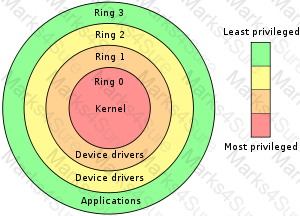
All of the other answers are incorrect because they are detractors.
References:
OIG CBK Security Architecture and Models (page 311)
and
https://en.wikipedia.org/wiki/Ring_%28computer_security%29
Which property ensures that only the intended recipient can access the data and nobody else?
Options:
Confidentiality
Capability
Integrity
Availability
Answer:
AExplanation:
Confidentiality is defined as the property that ensures that only the intended recipient can access the data and nobody else. It is usually achieve using cryptogrphic methods, tools, and protocols.
Confidentiality supports the principle of “least privilege” by providing that only authorized individuals, processes, or systems should have access to information on a need-to-know basis. The level of access that an authorized individual should have is at the level necessary for them to do their job. In recent years, much press has been dedicated to the privacy of information and the need to protect it from individuals, who may be able to commit crimes by viewing the information. Identity theft is the act of assuming one’s identity through knowledge of confidential information obtained from various sources.
The following are incorrect answers:
Capability is incorrect. Capability is relevant to access control. Capability-based security is a concept in the design of secure computing systems, one of the existing security models. A capability (known in some systems as a key) is a communicable, unforgeable token of authority. It refers to a value that references an object along with an associated set of access rights. A user program on a capability-based operating system must use a capability to access an object. Capability-based security refers to the principle of designing user programs such that they directly share capabilities with each other according to the principle of least privilege, and to the operating system infrastructure necessary to make such transactions efficient and secure.
Integrity is incorrect. Integrity protects information from unauthorized modification or loss.
Availability is incorrect. Availability assures that information and services are available for use by authorized entities according to the service level objective.
Reference(s) used for this question:
Hernandez CISSP, Steven (2012-12-21). Official (ISC)2 Guide to the CISSP CBK, Third Edition ((ISC)2 Press) (Kindle Locations 9345-9349). Auerbach Publications. Kindle Edition.
http://en.wikipedia.org/wiki/Capability-based_security
Which of the following refers to the data left on the media after the media has been erased?
Options:
remanence
recovery
sticky bits
semi-hidden
Answer:
AExplanation:
Actually the term " remanence " comes from electromagnetism, the study of the electromagnetics. Originally referred to (and still does in that field of study) the magnetic flux that remains in a magnetic circuit after an applied magnetomotive force has been removed. Absolutely no way a candidate will see anywhere near that much detail on any similar CISSP question, but having read this, a candidate won ' t be likely to forget it either.
It is becoming increasingly commonplace for people to buy used computer equipment, such as a hard drive, or router, and find information on the device left there by the previous owner; information they thought had been deleted. This is a classic example of data remanence: the remains of partial or even the entire data set of digital information. Normally, this refers to the data that remain on media after they are written over or degaussed. Data remanence is most common in storage systems but can also occur in memory.
Specialized hardware devices known as degaussers can be used to erase data saved to magnetic media. The measure of the amount of energy needed to reduce the magnetic field on the media to zero is known as coercivity.
It is important to make sure that the coercivity of the degausser is of sufficient strength to meet object reuse requirements when erasing data. If a degausser is used with insufficient coercivity, then a remanence of the data will exist. Remanence is the measure of the existing magnetic field on the media; it is the residue that remains after an object is degaussed or written over.
Data is still recoverable even when the remanence is small. While data remanence exists, there is no assurance of safe object reuse.
Reference(s) used for this question:
Hernandez CISSP, Steven (2012-12-21). Official (ISC)2 Guide to the CISSP CBK, Third Edition ((ISC)2 Press) (Kindle Locations 4207-4210). Auerbach Publications. Kindle Edition.
and
Hernandez CISSP, Steven (2012-12-21). Official (ISC)2 Guide to the CISSP CBK, Third Edition ((ISC)2 Press) (Kindle Locations 19694-19699). Auerbach Publications. Kindle Edition.
Which of the following statements pertaining to VPN protocol standards is false?
Options:
L2TP is a combination of PPTP and L2F.
L2TP and PPTP were designed for single point-to-point client to server communication.
L2TP operates at the network layer.
PPTP uses native PPP authentication and encryption services.
Answer:
CExplanation:
L2TP and PPTP were both designed for individual client to server connections; they enable only a single point-to-point connection per session. Dial-up VPNs use L2TP often. Both L2TP and PPTP operate at the data link layer (layer 2) of the OSI model. PPTP uses native PPP authentication and encryption services and L2TP is a combination of PPTP and Layer 2 Forwarding protocol (L2F).
Source: KRUTZ, Ronald L. & VINES, Russel D., The CISSP Prep Guide: Mastering the Ten Domains of Computer Security, John Wiley & Sons, 2001, Chapter 3: Telecommunications and Network Security (page 95).
What is an IP routing table?
Options:
A list of IP addresses and corresponding MAC addresses.
A list of station and network addresses with corresponding gateway IP address.
A list of host names and corresponding IP addresses.
A list of current network interfaces on which IP routing is enabled.
Answer:
BExplanation:
A routing table is used when a destination IP address is not located on the current LAN segment. It consists of a list of station and network addresses and a corresponding gateway IP address further along to which a routing equipment should send packets that match that station or network address. A list of IP addresses and corresponding MAC addresses is an ARP table. A DNS is used to match host names and corresponding IP addresses. The last choice is a distracter.
Source: STREBE, Matthew and PERKINS, Charles, Firewalls 24seven, Sybex 2000, Chapter 3: TCP/IP from a Security Viewpoint.
What is the proper term to refer to a single unit of Ethernet data at the link layer of the DoD TCP model ?
Options:
Ethernet Segment.
Ethernet Datagram.
Ethernet Frame.
Ethernet Packet.
Answer:
CExplanation:
Ethernet is frame based network technology.
See below a few definitions from RFC 1122:
SEGMENT
A segment is the unit of end-to-end transmission in the TCP protocol. A segment consists of a TCP header followed by application data. A segment is transmitted by encapsulation inside an IP datagram.
PACKET
A packet is the unit of data passed across the interface between the internet layer and the link layer. It includes an IP header and data. A packet may be a complete IP datagram or a fragment of an IP datagram.
FRAME
A frame is the unit of transmission in a link layer protocol, and consists of a link-layer header followed by a packet.
The following answers are incorrect:
Ethernet segment. Is incorrect because Ethernet segment is a distractor, TCP segment would be the correct terminology. Ethernet is a frame based network technology,
Ethernet datagram. Is incorrect because Ethernet datagram is a distractor, IP datagram would be the correct terminology. Ethernet is a frame based network technology
Ethernet packet. Is incorrect because Ethernet packet is a distractor, a Packet is a group of information so would not be a " single unit " . Ethernet is a frame based network technology.
Look at the diagrams below that were extracted from my Security+ Computer Based Tutorial.
TCP/IP Data Structures
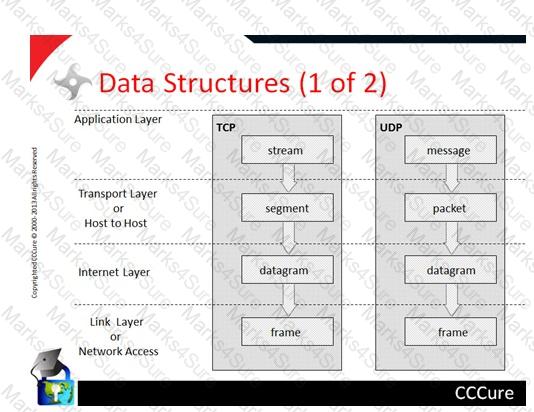
IMPORTANT NOTE:
The names used on the diagram above are from RFC 1122 which describe the DOD Model.
Vendors and Books may use slightly different names or even number of layers.
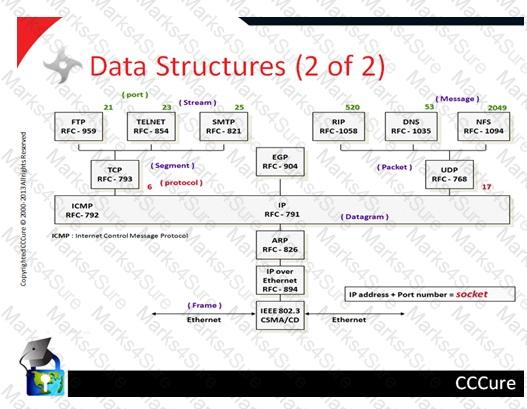
TCP/IP Data Structure
The following Reference(s) were used for this question:
Wikipedia http://en.wikipedia.org/wiki/Ethernet
What protocol is used on the Local Area Network (LAN) to obtain an IP address from it ' s known MAC address?
Options:
Reverse address resolution protocol (RARP)
Address resolution protocol (ARP)
Data link layer
Network address translation (NAT)
Answer:
AExplanation:
The reverse address resolution protocol (RARP) sends out a packet including a MAC address and a request to be informed of the IP address that should be assigned to that MAC.
Diskless workstations do not have a full operating system but have just enough code to know how to boot up and broadcast for an IP address, and they may have a pointer to the server that holds the operating system. The diskless workstation knows its hardware address, so it broadcasts this information so that a listening server can assign it the correct IP address.
As with ARP, Reverse Address Resolution Protocol (RARP) frames go to all systems on the subnet, but only the RARP server responds. Once the RARP server receives this request, it looks in its table to see which IP address matches the broadcast hardware address. The server then sends a message that contains its IP address back to the requesting computer. The system now has an IP address and can function on the network.
The Bootstrap Protocol (BOOTP) was created after RARP to enhance the functionality that RARP provides for diskless workstations. The diskless workstation can receive its IP address, the name server address for future name resolutions, and the default gateway address from the BOOTP server. BOOTP usually provides more functionality to diskless workstations than does RARP.
The evolution of this protocol has unfolded as follows: RARP evolved into BOOTP, which evolved into DHCP.
The following are incorrect answers:
NAT is a tool that is used for masking true IP addresses by employing internal addresses.
ARP does the opposite of RARP, it finds the MAC address that maps with an existing IP address.
Data Link layer The Data Link layer is not a protocol; it is represented at layer 2 of the OSI model. In the TCP/IP model, the Data Link and Physical layers are combined into the Network Access layer, which is sometimes called the Link layer or the Network Interface layer.
Reference(s) used for this question:
Harris, Shon (2012-10-25). CISSP All-in-One Exam Guide, 6th Edition, Telecommunications and Network Security, Page 584-585 and also 598. For Kindle users see Kindle Locations 12348-12357. McGraw-Hill.
and
KRUTZ, Ronald L. & VINES, Russel D., The CISSP Prep Guide: Mastering the Ten Domains of Computer Security, John Wiley & Sons, 2001, Chapter 3: Telecommunications and Network Security (page 87).
Secure Sockets Layer (SSL) is very heavily used for protecting which of the following?
Options:
Web transactions.
EDI transactions.
Telnet transactions.
Electronic Payment transactions.
Answer:
AExplanation:
SSL was developed Netscape Communications Corporation to improve security and privacy of HTTP transactions.
SSL is one of the most common protocols used to protect Internet traffic.
It encrypts the messages using symmetric algorithms, such as IDEA, DES, 3DES, and Fortezza, and also calculates the MAC for the message using MD5 or SHA-1. The MAC is appended to the message and encrypted along with the message data.
The exchange of the symmetric keys is accomplished through various versions of Diffie–Hellmann or RSA. TLS is the Internet standard based on SSLv3. TLSv1 is backward compatible with SSLv3. It uses the same algorithms as SSLv3; however, it computes an HMAC instead of a MAC along with other enhancements to improve security.
The following are incorrect answers:
" EDI transactions " is incorrect. Electronic Data Interchange (EDI) is not the best answer to this question though SSL could play a part in some EDI transactions.
" Telnet transactions " is incorrect. Telnet is a character mode protocol and is more likely to be secured by Secure Telnet or replaced by the Secure Shell (SSH) protocols.
" Eletronic payment transactions " is incorrect. Electronic payment is not the best answer to this question though SSL could play a part in some electronic payment transactions.
Reference(s) used for this question:
Hernandez CISSP, Steven (2012-12-21). Official (ISC)2 Guide to the CISSP CBK, Third Edition ((ISC)2 Press) (Kindle Locations 16615-16619). Auerbach Publications. Kindle Edition.
and
http://en.wikipedia.org/wiki/Transport_Layer_Security
Which of the following is an IP address that is private (i.e. reserved for internal networks, and not a valid address to use on the Internet)?
Options:
192.168.42.5
192.166.42.5
192.175.42.5
192.1.42.5
Answer:
AExplanation:
This is a valid Class C reserved address. For Class C, the reserved addresses are 192.168.0.0 - 192.168.255.255.
The private IP address ranges are defined within RFC 1918:
RFC 1918 private ip address range
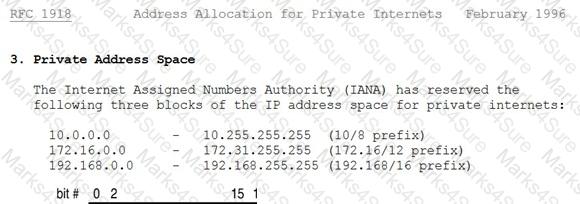
The following answers are incorrect:
192.166.42.5 Is incorrect because it is not a Class C reserved address.
192.175.42.5 Is incorrect because it is not a Class C reserved address.
192.1.42.5 Is incorrect because it is not a Class C reserved address.
Which layer of the OSI/ISO model handles physical addressing, network topology, line discipline, error notification, orderly delivery of frames, and optional flow control?
Options:
Physical
Data link
Network
Session
Answer:
BExplanation:
The Data Link layer provides data transport across a physical link. It handles physical addressing, network topology, line discipline, error notification, orderly delivery of frames, and optional flow control.
Source: ROTHKE, Ben, CISSP CBK Review presentation on domain 2, August 1999.
Which cable technology refers to the CAT3 and CAT5 categories?
Options:
Coaxial cables
Fiber Optic cables
Axial cables
Twisted Pair cables
Answer:
DExplanation:
Twisted Pair cables currently have two categories in common usage. CAT3 and CAT5.
Source: KRUTZ, Ronald L. & VINES, Russel D., The CISSP Prep Guide: Mastering the Ten Domains of Computer Security, 2001, John Wiley & Sons, Page 72.
Secure Shell (SSH-2) provides all the following services except:
Options:
secure remote login
command execution
port forwarding
user authentication
Answer:
DExplanation:
This is one of the tricky negative question. You have to pay close attention to the word EXCEPT within the question.
The SSH transport layer is a secure, low level transport protocol. It provides strong encryption, cryptographic host authentication, and integrity protection.
Authentication in this protocol level is host-based; this protocol does not perform user authentication. A higher level protocol for user authentication can be designed on top of this protocol.
The protocol has been designed to be simple and flexible to allow parameter negotiation, and to minimize the number of round-trips. The key exchange method, public key algorithm, symmetric encryption algorithm, message authentication algorithm, and hash algorithm are all negotiated. It is expected that in most environments, only 2 round-trips will be needed for full key exchange, server authentication, service request, and acceptance notification of service request. The worst case is 3 round-trips.
The following are incorrect answers:
" Remote log-on " is incorrect. SSH does provide remote log-on.
" Command execution " is incorrect. SSH does provide command execution.
" Port forwarding " is incorrect. SSH does provide port forwarding. SSH also has a wonderful feature called SSH Port Forwarding, sometimes called SSH Tunneling, which allows you to establish a secure SSH session and then tunnel arbitrary TCP connections through it. Tunnels can be created at any time, with almost no effort and no programming, which makes them very appealing. See the article below in the reference to take a look at SSH Port Forwarding in detail, as it is a very useful but often misunderstood technology. SSH Port Forwarding can be used for secure communications in a myriad of different ways.
You can see a nice tutorial on the PUTTY web site on how to use PUTTY to do port forwarding at:
http://www.cs.uu.nl/technical/services/ssh/putty/puttyfw.html
Reference(s) used for this question:
RFC 4253 at https://www.ietf.org/rfc/rfc4253.txt
and
SSH Port Forwarding by Symantec
Which of the following was developed as a simple mechanism for allowing simple network terminals to load their operating system from a server over the LAN?
Options:
DHCP
BootP
DNS
ARP
Answer:
BExplanation:
BootP was developed as a simple mechanism for allowing simple network terminals to load their operating system from a server over the LAN. Over time, it has expanded to allow centralized configuration of many aspects of a host ' s identity and behavior on the network. Note that DHCP, more complex, has replaced BootP over time.
Source: STREBE, Matthew and PERKINS, Charles, Firewalls 24seven, Sybex 2000, Chapter 4: Sockets and Services from a Security Viewpoint.
Which of the following protocols is not implemented at the Internet layer of the TCP/IP protocol model?
Options:
User datagram protocol (UDP)
Internet protocol (IP)
Internet Group Management Protocol (IGMP)
Internet control message protocol (ICMP)
Answer:
AExplanation:
The User Datagram Protocol (UDP) is implemented at the host-to-host transport layer, not at the internet layer.
Protocol at what layer?
Ensure you are familiar with both the OSI model and the DoD TCP/IP model as well. You need to know how to contrast the two side by side and what are the names being used on both side. Below you have a graphic showing the two and how things maps between the two as well as some of the most common protcolos found at each of the layers:
Protocols at what layers of the DoD TCP/IP model
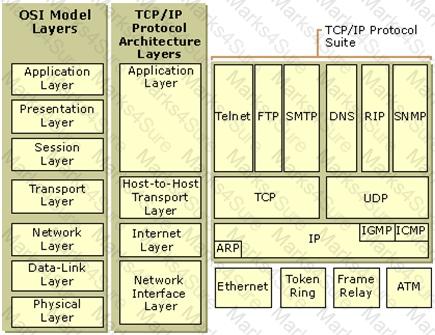
Graphic from http://technet.microsoft.com/en-us/library/cc958821.aspx
The following are incorrect answers:
All of the other protocols sit at the Internet Layer of the TCP/IP model.
NOTE:
Some reference are calling the Transport layer on the DoD model Host-to-Host.
Reference(s) used for this question:
Shon Harris, CISSP All In One (AIO), 6th edition , Telecommunication and Network Security, Page 518,534
and
KRUTZ, Ronald L. & VINES, Russel D., The CISSP Prep Guide: Mastering the Ten Domains of Computer Security, John Wiley & Sons, 2001, Chapter 3: Telecommunications and Network Security (page 85).
and
Microsoft Technet at http://technet.microsoft.com/en-us/library/cc958821.aspx
A circuit level proxy is ___________________ when compared to an application level proxy.
Options:
lower in processing overhead.
more difficult to maintain.
more secure.
slower.
Answer:
AExplanation:
Since the circuit level proxy does not anayze the application content of the packet in making its decisions, it has lower overhead than an application level proxy.
" More difficult to maintain " is incorrect. Circuit level proxies are typicall easier to configure and simpler to maintain that an application level proxy.
" More secure " is incorrect. A circuit level proxy is not necessarily more secure than an application layer proxy.
" Slower " is incorrect. Because it is lower in overhead, a circuit level proxy is typically faster than an application level proxy.
References:
CBK,pp. 466 - 467
AIO3, pp.488 - 490
When an outgoing request is made on a port number greater than 1023, this type of firewall creates an ACL to allow the incoming reply on that port to pass:
Options:
packet filtering
CIrcuit level proxy
Dynamic packet filtering
Application level proxy
Answer:
CExplanation:
The dynamic packet filtering firewall is able to create ACL ' s on the fly to allow replies on dynamic ports (higher than 1023).
Packet filtering is incorrect. The packet filtering firewall usually requires that the dynamic ports be left open as a group in order to handle this situiation.
Circuit level proxy is incorrect. The circuit level proxy builds a conduit between the trusted and untrusted hosts and does not work by dynamically creating ACL ' s.
Application level proxy is incorrect. The application level proxy " proxies " for the trusted host in its communications with the untrusted host. It does not dynamically create ACL ' s to control traffic.
How do you distinguish between a bridge and a router?
Options:
A bridge simply connects multiple networks, a router examines each packet to determine which network to forward it to.
" Bridge " and " router " are synonyms for equipment used to join two networks.
The bridge is a specific type of router used to connect a LAN to the global Internet.
The bridge connects multiple networks at the data link layer, while router connects multiple networks at the network layer.
Answer:
DExplanation:
A bridge operates at the Data Link Layer and a router operates at the Network Layer.
The following answers are incorrect:
A bridge simply connects multiple networks, a router examines each packet to determine which network to forward it to. Is incorrect because both forward packets this is not distinctive enough.
" Bridge " and " router " are synonyms for equipment used to join two networks. Is incorrect because the two are unique and operate at different layers of the OSI model.
The bridge is a specific type of router used to connect a LAN to the global Internet. Is incorrect because a bridge does not connect a LAN to the global internet, but connects networks together creating a LAN.
Which of the following devices enables more than one signal to be sent out simultaneously over one physical circuit?
Options:
Router
Multiplexer
Channel service unit/Data service unit (CSU/DSU)
Wan switch
Answer:
BExplanation:
Multiplexers are devices that enable enables more than one signal to be sent out simultaneously over one physical circuit.
Source: KRUTZ, Ronald L. & VINES, Russel D., The CISSP Prep Guide: Mastering the Ten Domains of Computer Security, John Wiley & Sons, 2001, Chapter 3: Telecommunications and Network Security (page 118).
While using IPsec, the ESP and AH protocols both provides integrity services. However when using AH, some special attention needs to be paid if one of the peers uses NAT for address translation service. Which of the items below would affects the use of AH and it´s Integrity Check Value (ICV) the most?
Options:
Key session exchange
Packet Header Source or Destination address
VPN cryptographic key size
Crypotographic algorithm used
Answer:
BExplanation:
It may seem odd to have two different protocols that provide overlapping functionality.
AH provides authentication and integrity, and ESP can provide those two functions and confidentiality.
Why even bother with AH then?
In most cases, the reason has to do with whether the environment is using network address translation (NAT). IPSec will generate an integrity check value (ICV), which is really the same thing as a MAC value, over a portion of the packet. Remember that the sender and receiver generate their own values. In IPSec, it is called an ICV value. The receiver compares her ICV value with the one sent by the sender. If the values match, the receiver can be assured the packet has not been modified during transmission. If the values are different, the packet has been altered and the receiver discards the packet.
The AH protocol calculates this ICV over the data payload, transport, and network headers. If the packet then goes through a NAT device, the NAT device changes the IP address of the packet. That is its job. This means a portion of the data (network header) that was included to calculate the ICV value has now changed, and the receiver will generate an ICV value that is different from the one sent with the packet, which means the packet will be discarded automatically.
The ESP protocol follows similar steps, except it does not include the network header portion when calculating its ICV value. When the NAT device changes the IP address, it will not affect the receiver’s ICV value because it does not include the network header when calculating the ICV.
Here is a tutorial on IPSEC from the Shon Harris Blog:
The Internet Protocol Security (IPSec) protocol suite provides a method of setting up a secure channel for protected data exchange between two devices. The devices that share this secure channel can be two servers, two routers, a workstation and a server, or two gateways between different networks. IPSec is a widely accepted standard for providing network layer protection. It can be more flexible and less expensive than end-to end and link encryption methods.
IPSec has strong encryption and authentication methods, and although it can be used to enable tunneled communication between two computers, it is usually employed to establish virtual private networks (VPNs) among networks across the Internet.
IPSec is not a strict protocol that dictates the type of algorithm, keys, and authentication method to use. Rather, it is an open, modular framework that provides a lot of flexibility for companies when they choose to use this type of technology. IPSec uses two basic security protocols: Authentication Header (AH) and Encapsulating Security Payload (ESP). AH is the authenticating protocol, and ESP is an authenticating and encrypting protocol that uses cryptographic mechanisms to provide source authentication, confidentiality, and message integrity.
IPSec can work in one of two modes: transport mode, in which the payload of the message is protected, and tunnel mode, in which the payload and the routing and header information are protected. ESP in transport mode encrypts the actual message information so it cannot be sniffed and uncovered by an unauthorized entity. Tunnel mode provides a higher level of protection by also protecting the header and trailer data an attacker may find useful. Figure 8-26 shows the high-level view of the steps of setting up an IPSec connection.
Each device will have at least one security association (SA) for each VPN it uses. The SA, which is critical to the IPSec architecture, is a record of the configurations the device needs to support an IPSec connection. When two devices complete their handshaking process, which means they have agreed upon a long list of parameters they will use to communicate, these data must be recorded and stored somewhere, which is in the SA.
The SA can contain the authentication and encryption keys, the agreed-upon algorithms, the key lifetime, and the source IP address. When a device receives a packet via the IPSec protocol, it is the SA that tells the device what to do with the packet. So if device B receives a packet from device C via IPSec, device B will look to the corresponding SA to tell it how to decrypt the packet, how to properly authenticate the source of the packet, which key to use, and how to reply to the message if necessary.
SAs are directional, so a device will have one SA for outbound traffic and a different SA for inbound traffic for each individual communication channel. If a device is connecting to three devices, it will have at least six SAs, one for each inbound and outbound connection per remote device. So how can a device keep all of these SAs organized and ensure that the right SA is invoked for the right connection? With the mighty secu rity parameter index (SPI), that’s how. Each device has an SPI that keeps track of the different SAs and tells the device which one is appropriate to invoke for the different packets it receives. The SPI value is in the header of an IPSec packet, and the device reads this value to tell it which SA to consult.
IPSec can authenticate the sending devices of the packet by using MAC (covered in the earlier section, “The One-Way Hash”). The ESP protocol can provide authentication, integrity, and confidentiality if the devices are configured for this type of functionality.
So if a company just needs to make sure it knows the source of the sender and must be assured of the integrity of the packets, it would choose to use AH. If the company would like to use these services and also have confidentiality, it would use the ESP protocol because it provides encryption functionality. In most cases, the reason ESP is employed is because the company must set up a secure VPN connection.
It may seem odd to have two different protocols that provide overlapping functionality. AH provides authentication and integrity, and ESP can provide those two functions and confidentiality. Why even bother with AH then? In most cases, the reason has to do with whether the environment is using network address translation (NAT). IPSec will generate an integrity check value (ICV), which is really the same thing as a MAC value, over a portion of the packet. Remember that the sender and receiver generate their own values. In IPSec, it is called an ICV value. The receiver compares her ICV value with the one sent by the sender. If the values match, the receiver can be assured the packet has not been modified during transmission. If the values are different, the packet has been altered and the receiver discards the packet.
The AH protocol calculates this ICV over the data payload, transport, and network headers. If the packet then goes through a NAT device, the NAT device changes the IP address of the packet. That is its job. This means a portion of the data (network header) that was included to calculate the ICV value has now changed, and the receiver will generate an ICV value that is different from the one sent with the packet, which means the packet will be discarded automatically.
The ESP protocol follows similar steps, except it does not include the network header portion when calculating its ICV value. When the NAT device changes the IP address, it will not affect the receiver’s ICV value because it does not include the network header when calculating the ICV.
Because IPSec is a framework, it does not dictate which hashing and encryption algorithms are to be used or how keys are to be exchanged between devices. Key management can be handled manually or automated by a key management protocol. The de facto standard for IPSec is to use Internet Key Exchange (IKE), which is a combination of the ISAKMP and OAKLEY protocols. The Internet Security Association and Key Management Protocol (ISAKMP) is a key exchange architecture that is independent of the type of keying mechanisms used. Basically, ISAKMP provides the framework of what can be negotiated to set up an IPSec connection (algorithms, protocols, modes, keys). The OAKLEY protocol is the one that carries out the negotiation process. You can think of ISAKMP as providing the playing field (the infrastructure) and OAKLEY as the guy running up and down the playing field (carrying out the steps of the negotiation).
IPSec is very complex with all of its components and possible configurations. This complexity is what provides for a great degree of flexibility, because a company has many different configuration choices to achieve just the right level of protection. If this is all new to you and still confusing, please review one or more of the following references to help fill in the gray areas.
The following answers are incorrect:
The other options are distractors.
The following reference(s) were/was used to create this question:
Shon Harris, CISSP All-in-One Exam Guide- fiveth edition, page 759
and
https://neodean.wordpress.com/tag/security-protocol/
Which of the following ports does NOT normally need to be open for a mail server to operate?
Options:
Port 110
Port 25
Port 119
Port 143
Answer:
CExplanation:
Port 119 is normally used for the Network News Transfer Protocol. It is thus not need for a mail server, which would normally listen to ports 25 (SMTP), 110 (POP3) and 143 (IMAP).
Source: STREBE, Matthew and PERKINS, Charles, Firewalls 24seven, Sybex 2000, Chapter 1: Understanding Firewalls.
The Diffie-Hellman algorithm is used for:
Options:
Encryption
Digital signature
Key agreement
Non-repudiation
Answer:
CExplanation:
The Diffie-Hellman algorithm is used for Key agreement (key distribution) and cannot be used to encrypt and decrypt messages.
Source: WALLHOFF, John, CBK#5 Cryptography (CISSP Study Guide), April 2002 (page 4).
Note: key agreement, is different from key exchange, the functionality used by the other asymmetric algorithms.
References:
AIO, third edition Cryptography (Page 632)
AIO, fourth edition Cryptography (Page 709)
Which of the following protects Kerberos against replay attacks?
Options:
Tokens
Passwords
Cryptography
Time stamps
Answer:
DExplanation:
A replay attack refers to the recording and retransmission of packets on the network. Kerberos uses time stamps, which protect against this type of attack.
Source: HARRIS, Shon, All-In-One CISSP Certification Exam Guide, McGraw-Hill/Osborne, 2002, chapter 8: Cryptography (page 581).
Which of the following keys has the SHORTEST lifespan?
Options:
Secret key
Public key
Session key
Private key
Answer:
CExplanation:
As session key is a symmetric key that is used to encrypt messages between two users. A session key is only good for one communication session between users.
For example , If Tanya has a symmetric key that she uses to encrypt messages between Lance and herself all the time , then this symmetric key would not be regenerated or changed. They would use the same key every time they communicated using encryption. However , using the same key repeatedly increases the chances of the key being captured and the secure communication being compromised. If , on the other hand , a new symmetric key were generated each time Lance and Tanya wanted to communicate , it would be used only during their dialog and then destroyed. if they wanted to communicate and hour later , a new session key would be created and shared.
The other answers are not correct because :
Public Key can be known to anyone.
Private Key must be known and used only by the owner.
Secret Keys are also called as Symmetric Keys, because this type of encryption relies on each user to keep the key a secret and properly protected.
REFERENCES:
SHON HARRIS , ALL IN ONE THIRD EDITION : Chapter 8 : Cryptography , Page : 619-620
What is used to bind a document to its creation at a particular time?
Options:
Network Time Protocol (NTP)
Digital Signature
Digital Timestamp
Certification Authority (CA)
Answer:
CExplanation:
While a digital signature binds a document to the possessor of a particular key, a digital timestamp binds a document to its creation at a particular time.
Trusted timestamping is the process of securely keeping track of the creation and modification time of a document. Security here means that no one — not even the owner of the document — should be able to change it once it has been recorded provided that the timestamper ' s integrity is never compromised.
The administrative aspect involves setting up a publicly available, trusted timestamp management infrastructure to collect, process and renew timestamps or to make use of a commercially available time stamping service.
A modern example of using a Digital Timestamp is the case of an industrial research organization that may later need to prove, for patent purposes, that they made a particular discovery on a particular date; since magnetic media can be altered easily, this may be a nontrivial issue. One possible solution is for a researcher to compute and record in a hardcopy laboratory notebook a cryptographic hash of the relevant data file. In the future, should there be a need to prove the version of this file retrieved from a backup tape has not been altered, the hash function could be recomputed and compared with the hash value recorded in that paper notebook.
According to the RFC 3161 standard, a trusted timestamp is a timestamp issued by a trusted third party (TTP) acting as a Time Stamping Authority (TSA). It is used to prove the existence of certain data before a certain point (e.g. contracts, research data, medical records,...) without the possibility that the owner can backdate the timestamps. Multiple TSAs can be used to increase reliability and reduce vulnerability.
The newer ANSI ASC X9.95 Standard for trusted timestamps augments the RFC 3161 standard with data-level security requirements to ensure data integrity against a reliable time source that is provable to any third party. This standard has been applied to authenticating digitally signed data for regulatory compliance, financial transactions, and legal evidence.
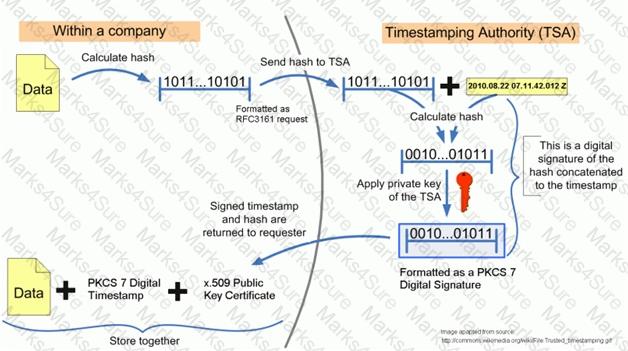
Digital TimeStamp
The following are incorrect answers:
Network Time Protocol (NTP) is used to achieve high accuracy time synchronization for computers across a network.
A Certification Authority (CA) is the entity responsible for the issuance of digital certificates.
A Digital Signature provides integrity and authentication but does not bind a document to a specific time it was created.
Reference used for this question:
http://en.m.wikipedia.org/wiki/File:Trusted_timestamping.gif
and
http://en.wikipedia.org/wiki/Trusted_timestamping
Which of the following is defined as an Internet, IPsec, key-establishment protocol, partly based on OAKLEY, that is intended for putting in place authenticated keying material for use with ISAKMP and for other security associations?
Options:
Internet Key exchange (IKE)
Security Association Authentication Protocol (SAAP)
Simple Key-management for Internet Protocols (SKIP)
Key Exchange Algorithm (KEA)
Answer:
AExplanation:
RFC 2828 (Internet Security Glossary) defines IKE as an Internet, IPsec, key-establishment protocol (partly based on OAKLEY) that is intended for putting in place authenticated keying material for use with ISAKMP and for other security associations, such as in AH and ESP.
The following are incorrect answers:
SKIP is a key distribution protocol that uses hybrid encryption to convey session keys that are used to encrypt data in IP packets.
The Key Exchange Algorithm (KEA) is defined as a key agreement algorithm that is similar to the Diffie-Hellman algorithm, uses 1024-bit asymmetric keys, and was developed and formerly classified at the secret level by the NSA.
Security Association Authentication Protocol (SAAP) is a distracter.
Reference(s) used for this question:
SHIREY, Robert W., RFC2828: Internet Security Glossary, may 2000.
PGP uses which of the following to encrypt data?
Options:
An asymmetric encryption algorithm
A symmetric encryption algorithm
A symmetric key distribution system
An X.509 digital certificate
Answer:
BExplanation:
Notice that the question specifically asks what PGP uses to encrypt For this, PGP uses an symmetric key algorithm. PGP then uses an asymmetric key algorithm to encrypt the session key and then send it securely to the receiver. It is an hybrid system where both types of ciphers are being used for different purposes.
Whenever a question talks about the bulk of the data to be sent, Symmetric is always best to choice to use because of the inherent speed within Symmetric Ciphers. Asymmetric ciphers are 100 to 1000 times slower than Symmetric Ciphers.
The other answers are not correct because:
" An asymmetric encryption algorithm " is incorrect because PGP uses a symmetric algorithm to encrypt data.
" A symmetric key distribution system " is incorrect because PGP uses an asymmetric algorithm for the distribution of the session keys used for the bulk of the data.
" An X.509 digital certificate " is incorrect because PGP does not use X.509 digital certificates to encrypt the data, it uses a session key to encrypt the data.
References:
Official ISC2 Guide page: 275
All in One Third Edition page: 664 - 665
Which of the following is not a DES mode of operation?
Options:
Cipher block chaining
Electronic code book
Input feedback
Cipher feedback
Answer:
CExplanation:
Output feedback (OFB) is a DES mode of operation, not input feedback.
Source: KRUTZ, Ronald L. & VINES, Russel D., The CISSP Prep Guide: Mastering the Ten Domains of Computer Security, John Wiley & Sons, 2001, Chapter 4: Cryptography (page 149).
Cryptography does not concern itself with which of the following choices?
Options:
Availability
Integrity
Confidentiality
Validation
Answer:
DExplanation:
The cryptography domain addresses the principles, means, and methods of disguising information to ensure its integrity, confidentiality, and authenticity. Unlike the other domains, cryptography does not completely support the standard of availability.
Availability
Cryptography supports all three of the core principles of information security. Many access control systems use cryptography to limit access to systems through the use of passwords. Many token-based authentication systems use cryptographic-based hash algorithms to compute one-time passwords. Denying unauthorized access prevents an attacker from entering and damaging the system or network, thereby denying access to authorized users if they damage or currupt the data.
Confidentiality
Cryptography provides confidentiality through altering or hiding a message so that ideally it cannot be understood by anyone except the intended recipient.
Integrity
Cryptographic tools provide integrity checks that allow a recipient to verify that a message has not been altered. Cryptographic tools cannot prevent a message from being altered, but they are effective to detect either intentional or accidental modification of the message.
Additional Features of Cryptographic Systems In addition to the three core principles of information security listed above, cryptographic tools provide several more benefits.
Nonrepudiation
In a trusted environment, the authentication of the origin can be provided through the simple control of the keys. The receiver has a level of assurance that the message was encrypted by the sender, and the sender has trust that the message was not altered once it was received. However, in a more stringent, less trustworthy environment, it may be necessary to provide assurance via a third party of who sent a message and that the message was indeed delivered to the right recipient. This is accomplished through the use of digital signatures and public key encryption. The use of these tools provides a level of nonrepudiation of origin that can be verified by a third party.
Once a message has been received, what is to prevent the recipient from changing the message and contesting that the altered message was the one sent by the sender? The nonrepudiation of delivery prevents a recipient from changing the message and falsely claiming that the message is in its original state. This is also accomplished through the use of public key cryptography and digital signatures and is verifiable by a trusted third party.
Authentication
Authentication is the ability to determine if someone or something is what it declares to be. This is primarily done through the control of the keys, because only those with access to the key are able to encrypt a message. This is not as strong as the nonrepudiation of origin, which will be reviewed shortly Cryptographic functions use several methods to ensure that a message has not been changed or altered. These include hash functions, digital signatures, and message authentication codes (MACs). The main concept is that the recipient is able to detect any change that has been made to a message, whether accidentally or intentionally.
Access Control
Through the use of cryptographic tools, many forms of access control are supported—from log-ins via passwords and passphrases to the prevention of access to confidential files or messages. In all cases, access would only be possible for those individuals that had access to the correct cryptographic keys.
NOTE FROM CLEMENT:
As you have seen this question was very recently updated with the latest content of the Official ISC2 Guide (OIG) to the CISSP CBK, Version 3.
Myself, I agree with most of you that cryptography does not help on the availability side and it is even the contrary sometimes if you loose the key for example. In such case you would loose access to the data and negatively impact availability. But the ISC2 is not about what I think or what you think, they have their own view of the world where they claim and state clearly that cryptography does address availability even thou it does not fully address it.
They look at crypto as the ever emcompassing tool it has become today. Where it can be use for authentication purpose for example where it would help to avoid corruption of the data through illegal access by an unauthorized user.
The question is worded this way in purpose, it is VERY specific to the CISSP exam context where ISC2 preaches that cryptography address availability even thou they state it does not fully address it. This is something new in the last edition of their book and something you must be aware of.
Best regards
Clement
The following terms are from the Software Development Security domain:
Validation: The assurance that a product, service, or system meets the needs of the customer and other identified stakeholders. It often involves acceptance and suitability with external customers. Contrast with verification below. "
Verification: The evaluation of whether or not a product, service, or system complies with a regulation, requirement, specification, or imposed condition. It is often an internal process. Contrast with validation. "
The terms above are from the Software Development Security Domain.
Reference(s) used for this question:
Schneiter, Andrew (2013-04-15). Official (ISC)2 Guide to the CISSP CBK, Third Edition : Cryptography (Kindle Locations 227-244). . Kindle Edition.
and
Schneiter, Andrew (2013-04-15). Official (ISC)2 Guide to the CISSP CBK, Third Edition : Cryptography (Kindle Locations 206-227). . Kindle Edition.
and
http://en.wikipedia.org/wiki/Verification_and_validation
Memory management in TCSEC levels B3 and A1 operating systems may utilize " data hiding " . What does this mean?
Options:
System functions are layered, and none of the functions in a given layer can access data outside that layer.
Auditing processes and their memory addresses cannot be accessed by user processes.
Only security processes are allowed to write to ring zero memory.
It is a form of strong encryption cipher.
Answer:
AExplanation:
Data Hiding is protecting data so that it is only available to higher levels this is done and is also performed by layering, when the software in each layer maintains its own global data and does not directly reference data outside its layers.
The following answers are incorrect:
Auditing processes and their memory addresses cannot be accessed by user processes. Is incorrect because this does not offer data hiding.
Only security processes are allowed to write to ring zero memory. This is incorrect, the security kernel would be responsible for this.
It is a form of strong encryption cipher. Is incorrect because this does not conform to the definition of data hiding.
Related to information security, confidentiality is the opposite of which of the following?
Options:
closure
disclosure
disposal
disaster
Answer:
BExplanation:
Confidentiality is the opposite of disclosure.
Source: KRUTZ, Ronald L. & VINES, Russel D., The CISSP Prep Guide: Mastering the Ten Domains of Computer Security, 2001, John Wiley & Sons, Page 59.
If an operating system permits shared resources such as memory to be used sequentially by multiple users/application or subjects without a refresh of the objects/memory area, what security problem is MOST likely to exist?
Options:
Disclosure of residual data.
Unauthorized obtaining of a privileged execution state.
Data leakage through covert channels.
Denial of service through a deadly embrace.
Answer:
AExplanation:
Allowing objects to be used sequentially by multiple users without a refresh of the objects can lead to disclosure of residual data. It is important that steps be taken to eliminate the chance for the disclosure of residual data.
Object reuse refers to the allocation or reallocation of system resources to a user or, more appropriately, to an application or process. Applications and services on a computer system may create or use objects in memory and in storage to perform programmatic functions. In some cases, it is necessary to share these resources between various system applications. However, some objects may be employed by an application to perform privileged tasks on behalf of an authorized user or upstream application. If object usage is not controlled or the data in those objects is not erased after use, they may become available to unauthorized users or processes.
Disclosure of residual data and Unauthorized obtaining of a privileged execution state are both a problem with shared memory and resources. Not clearing the heap/stack can result in residual data and may also allow the user to step on somebody ' s session if the security token/identify was maintained in that space. This is generally more malicious and intentional than accidental though. The MOST common issue would be Disclosure of residual data.
The following answers are incorrect:
Unauthorized obtaining of a privileged execution state. Is incorrect because this is not a problem with Object Reuse.
Data leakage through covert channels. Is incorrect because it is not the best answer. A covert channel is a communication path. Data leakage would not be a problem created by Object Reuse. In computer security, a covert channel is a type of computer security attack that creates a capability to transfer information objects between processes that are not supposed to be allowed to communicate by the computer security policy. The term, originated in 1973 by Lampson is defined as " (channels) not intended for information transfer at all, such as the service program ' s effect on system load. " to distinguish it from Legitimate channels that are subjected to access controls by COMPUSEC.
Denial of service through a deadly embrace. Is incorrect because it is only a detractor.
References:
Hernandez CISSP, Steven (2012-12-21). Official (ISC)2 Guide to the CISSP CBK, Third Edition ((ISC)2 Press) (Kindle Locations 4174-4179). Auerbach Publications. Kindle Edition.
and
https://www.fas.org/irp/nsa/rainbow/tg018.htm
and
http://en.wikipedia.org/wiki/Covert_channel
Which expert system operating mode allows determining if a given hypothesis is valid?
Options:
Blackboard
Lateral chaining
Forward chaining
Backward chaining
Answer:
DExplanation:
Backward-chaining mode - the expert system backtracks to determine if a given hypothesis is valid. Backward-chaining is generally used when there are a large number of possible solutions relative to the number of inputs.
Incorrect answers are:
In a forward-chaining mode, the expert system acquires information and comes to a conclusion based on that information. Forward-chaining is the reasoning approach that can be used when there is a small number of solutions relative to the number of inputs.
Blackboard is an expert system-reasoning methodology in which a solution is generated by the use of a virtual blackboard, wherein information or potential solutions are placed on the blackboard by a plurality of individuals or expert knowledge sources. As more information is placed on the blackboard in an iterative process, a solution is generated.
Lateral-chaining mode - No such expert system mode.
Sources:
KRUTZ, Ronald L. & VINES, Russel D., The CISSP Prep Guide: Mastering the Ten Domains of Computer Security, John Wiley & Sons, 2001, Chapter 7: Applications and Systems Development (page 259).
KRUTZ, Ronald & VINES, Russel, The CISSP Prep Guide: Gold Edition, Wiley Publishing Inc., 2003, Chapter 7: Expert Systems (page 354).
What is the name for a substitution cipher that shifts the alphabet by 13 places?
Options:
Caesar cipher
Polyalphabetic cipher
ROT13 cipher
Transposition cipher
Answer:
CExplanation:
An extremely simple example of conventional cryptography is a substitution cipher.
A substitution cipher substitutes one piece of information for another. This is most frequently done by offsetting letters of the alphabet. Two examples are Captain Midnight ' s Secret Decoder Ring, which you may have owned when you were a kid, and Julius Caesar ' s cipher. In both cases, the algorithm is to offset the alphabet and the key is the number of characters to offset it. So the offset could be one, two, or any number you wish. ROT-13 is an example where it is shifted 13 spaces. The Ceaser Cipher is another example where it is shifted 3 letters to the left.
ROT13 ( " rotate by 13 places " , sometimes hyphenated ROT-13) is a simple letter substitution cipher that replaces a letter with the letter 13 letters after it in the alphabet. ROT13 is an example of the Caesar cipher, developed in ancient Rome.
In the basic Latin alphabet, ROT13 is its own inverse; that is, to undo ROT13, the same algorithm is applied, so the same action can be used for encoding and decoding. The algorithm provides virtually no cryptographic security, and is often cited as a canonical example of weak encryption.
ROT13 is used in online forums as a means of hiding spoilers, puzzle solutions, and offensive materials from the casual glance. ROT13 has been described as the " Usenet equivalent of a magazine printing the answer to a quiz upside down " . ROT13 has inspired a variety of letter and word games on-line, and is frequently mentioned in newsgroup conversations. See diagram Below:
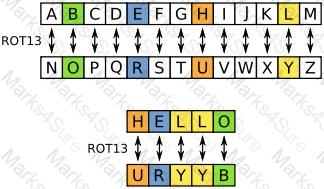
Rot 13 Cipher
The following are incorrect:
The Caesar cipher is a simple substitution cipher that involves shifting the alphabet three positions to the right. In cryptography, a Caesar cipher, also known as Caesar ' s cipher, the shift cipher, Caesar ' s code or Caesar shift, is one of the simplest and most widely known encryption techniques. It is a type of substitution cipher in which each letter in the plaintext is replaced by a letter some fixed number of positions down the alphabet. For example, with a left shift of 3, D would be replaced by A, E would become B, and so on. The method is named after Julius Caesar, who used it in his private correspondence.
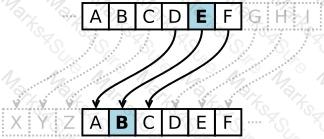
Caesar Cipher
Polyalphabetic cipher refers to using multiple alphabets at a time. A polyalphabetic cipher is any cipher based on substitution, using multiple substitution alphabets. The Vigenère cipher is probably the best-known example of a polyalphabetic cipher, though it is a simplified special case.

Viginere Cipher
Transposition cipher is a different type of cipher. In cryptography, a transposition cipher is a method of encryption by which the positions held by units of plaintext (which are commonly characters or groups of characters) are shifted according to a regular system, so that the ciphertext constitutes a permutation of the plaintext. That is, the order of the units is changed. See the reference below for multiple examples of Transpositio Ciphers.
An exemple of Transposition cipher could be columnar transposition, the message is written out in rows of a fixed length, and then read out again column by column, and the columns are chosen in some scrambled order. Both the width of the rows and the permutation of the columns are usually defined by a keyword. For example, the word ZEBRAS is of length 6 (so the rows are of length 6), and the permutation is defined by the alphabetical order of the letters in the keyword. In this case, the order would be " 6 3 2 4 1 5 " .
In a regular columnar transposition cipher, any spare spaces are filled with nulls; in an irregular columnar transposition cipher, the spaces are left blank. Finally, the message is read off in columns, in the order specified by the keyword. For example, suppose we use the keyword ZEBRAS and the message WE ARE DISCOVERED. FLEE AT ONCE. In a regular columnar transposition, we write this into the grid as Follows:

Transposition Cipher
Providing five nulls (QKJEU) at the end. The ciphertext is then read off as:
EVLNE ACDTK ESEAQ ROFOJ DEECU WIREE
Reference(s) used for this question:
http://en.wikipedia.org/wiki/ROT13
http://en.wikipedia.org/wiki/Caesar_cipher
http://en.wikipedia.org/wiki/Polyalphabetic_cipher
http://en.wikipedia.org/wiki/Transposition_cipher
How many bits is the effective length of the key of the Data Encryption Standard algorithm?
Options:
168
128
56
64
Answer:
CExplanation:
The correct answer is " 56 " . This is actually a bit of a trick question, since the actual key length is 64 bits. However, every eighth bit is ignored because it is used for parity. This makes the " effective length of the key " that the question actually asks for 56 bits.
The other answers are not correct because:
168 - This is the number of effective bits in Triple DES (56 times 3).
128 - Many encryption algorithms use 128 bit key, but not DES. Note that you may see 128 bit encryption referred to as " military strength encryption " because many military systems use key of this length.
64 - This is the actual length of a DES encryption key, but not the " effective length " of the DES key.
Which of the following is not a disadvantage of symmetric cryptography when compared with Asymmetric Ciphers?
Options:
Provides Limited security services
Has no built in Key distribution
Speed
Large number of keys are needed
Answer:
CExplanation:
Symmetric cryptography ciphers are generally fast and hard to break. So speed is one of the key advantage of Symmetric ciphers and NOT a disadvantage. Symmetric Ciphers uses simple encryption steps such as XOR, substitution, permutation, shifting columns, shifting rows, etc... Such steps does not required a large amount of processing power compare to the complex mathematical problem used within Asymmetric Ciphers.
Some of the weaknesses of Symmetric Ciphers are:
The lack of automated key distribution. Usually an Asymmetric cipher would be use to protect the symmetric key if it needs to be communicated to another entity securely over a public network. In the good old day this was done manually where it was distributed using the Floppy Net sometimes called the Sneaker Net (you run to someone ' s office to give them the key).
As far as the total number of keys are required to communicate securely between a large group of users, it does not scale very well. 10 users would require 45 keys for them to communicate securely with each other. If you have 1000 users then you would need almost half a million key to communicate secure. On Asymmetric ciphers there is only 2000 keys required for 1000 users. The formula to calculate the total number of keys required for a group of users who wishes to communicate securely with each others using Symmetric encryption is Total Number of Users (N) * Total Number of users minus one Divided by 2 or N (N-1)/2
Symmetric Ciphers are limited when it comes to security services, they cannot provide all of the security services provided by Asymmetric ciphers. Symmetric ciphers provides mostly confidentiality but can also provide integrity and authentication if a Message Authentication Code (MAC) is used and could also provide user authentication if Kerberos is used for example. Symmetric Ciphers cannot provide Digital Signature and Non-Repudiation.
Reference used for theis question:
WALLHOFF, John, CBK#5 Cryptography (CISSP Study Guide), April 2002 (page 2).
Which of the following is more suitable for a hardware implementation?
Options:
Stream ciphers
Block ciphers
Cipher block chaining
Electronic code book
Answer:
AExplanation:
A stream cipher treats the message as a stream of bits or bytes and performs mathematical functions on them individually. The key is a random value input into the stream cipher, which it uses to ensure the randomness of the keystream data. They are more suitable for hardware implementations, because they encrypt and decrypt one bit at a time. They are intensive because each bit must be manipulated, which works better at the silicon level. Block ciphers operate a the block level, dividing the message into blocks of bits. Cipher Block chaining (CBC) and Electronic Code Book (ECB) are operation modes of DES, a block encryption algorithm.
Source: WALLHOFF, John, CBK#5 Cryptography (CISSP Study Guide), April 2002 (page 2).
Which type of encryption is considered to be unbreakable if the stream is truly random and is as large as the plaintext and never reused in whole or part?
Options:
One Time Pad (OTP)
One time Cryptopad (OTC)
Cryptanalysis
Pretty Good Privacy (PGP)
Answer:
AExplanation:
OTP or One Time Pad is considered unbreakable if the key is truly random and is as large as the plaintext and never reused in whole or part AND kept secret.
In cryptography, a one-time pad is a system in which a key generated randomly is used only once to encrypt a message that is then decrypted by the receiver using the matching one-time pad and key. Messages encrypted with keys based on randomness have the advantage that there is theoretically no way to " break the code " by analyzing a succession of messages. Each encryption is unique and bears no relation to the next encryption so that some pattern can be detected.
With a one-time pad, however, the decrypting party must have access to the same key used to encrypt the message and this raises the problem of how to get the key to the decrypting party safely or how to keep both keys secure. One-time pads have sometimes been used when the both parties started out at the same physical location and then separated, each with knowledge of the keys in the one-time pad. The key used in a one-time pad is called a secret key because if it is revealed, the messages encrypted with it can easily be deciphered.
One-time pads figured prominently in secret message transmission and espionage before and during World War II and in the Cold War era. On the Internet, the difficulty of securely controlling secret keys led to the invention of public key cryptography.
The biggest challenge with OTP was to get the pad security to the person or entity you wanted to communicate with. It had to be done in person or using a trusted courrier or custodian. It certainly did not scale up very well and it would not be usable for large quantity of data that needs to be encrypted as we often time have today.
The following answers are incorrect:
- One time Cryptopad: Almost but this isn ' t correct. Cryptopad isn ' t a valid term in cryptography.
- Cryptanalysis: Sorry, incorrect. Cryptanalysis is the process of analyzing information in an effort to breach the cryptographic security systems.
- PGP - Pretty Good Privacy: PGP, written by Phil Zimmermann is a data encryption and decryption program that provides cryptographic privacy and authentication for data. Still isn ' t the right answer though. Read more here about PGP.
The following reference(s) was used to create this question:
To get more info on this QUESTION NO: s or any QUESTION NO: s of Security+, subscribe to the CCCure Holistic Security+ CBT available at: http://www.cccure.tv
and
http://users.telenet.be/d.rijmenants/en/otp.htm
and
http://en.wikipedia.org/wiki/One-time_pad
and
http://searchsecurity.techtarget.com/definition/one-time-pad
What is NOT true with pre shared key authentication within IKE / IPsec protocol?
Options:
Pre shared key authentication is normally based on simple passwords
Needs a Public Key Infrastructure (PKI) to work
IKE is used to setup Security Associations
IKE builds upon the Oakley protocol and the ISAKMP protocol.
Answer:
BExplanation:
Internet Key Exchange (IKE or IKEv2) is the protocol used to set up a security association (SA) in the IPsec protocol suite. IKE builds upon the Oakley protocol and ISAKMP. IKE uses X.509 certificates for authentication which are either pre-shared or distributed using DNS (preferably with DNSSEC) and a Diffie–Hellman key exchange to set up a shared session secret from which cryptographic keys are derived.
Internet Key Exchange (IKE) Internet key exchange allows communicating partners to prove their identity to each other and establish a secure communication channel, and is applied as an authentication component of IPSec.
IKE uses two phases:
Phase 1: In this phase, the partners authenticate with each other, using one of the following:
Shared Secret: A key that is exchanged by humans via telephone, fax, encrypted e-mail, etc.
Public Key Encryption: Digital certificates are exchanged.
Revised mode of Public Key Encryption: To reduce the overhead of public key encryption, a nonce (a Cryptographic function that refers to a number or bit string used only once, in security engineering) is encrypted with the communicating partner’s public key, and the peer’s identity is encrypted with symmetric encryption using the nonce as the key. Next, IKE establishes a temporary security association and secure tunnel to protect the rest of the key exchange. Phase 2: The peers’ security associations are established, using the secure tunnel and temporary SA created at the end of phase 1.
The following reference(s) were used for this question:
Hernandez CISSP, Steven (2012-12-21). Official (ISC)2 Guide to the CISSP CBK, Third Edition ((ISC)2 Press) (Kindle Locations 7032-7048). Auerbach Publications. Kindle Edition.
and
RFC 2409 at http://tools.ietf.org/html/rfc2409
and
http://en.wikipedia.org/wiki/Internet_Key_Exchange
The Data Encryption Algorithm performs how many rounds of substitution and permutation?
Options:
4
16
54
64
Answer:
BExplanation:
Source: TIPTON, Hal, (ISC)2, Introduction to the CISSP Exam presentation.
In which phase of Internet Key Exchange (IKE) protocol is peer authentication performed?
Options:
Pre Initialization Phase
Phase 1
Phase 2
No peer authentication is performed
Answer:
BExplanation:
The Internet Key Exchange (IKE) protocol is a key management protocol standard that is used in conjunction with the IPSec standard. IKE enhances IPSec by providing additional features, flexibility, and ease of configuration for the IPSec standard. IPSec can however, be configured without IKE by manually configuring the gateways communicating with each other for example.
A security association (SA) is a relationship between two or more entities that describes how the entities will use security services to communicate securely.
In phase 1 of this process, IKE creates an authenticated, secure channel between the two IKE peers, called the IKE security association. The Diffie-Hellman key agreement is always performed in this phase.
In phase 2 IKE negotiates the IPSec security associations and generates the required key material for IPSec. The sender offers one or more transform sets that are used to specify an allowed combination of transforms with their respective settings.
Benefits provided by IKE include:
Eliminates the need to manually specify all the IPSec security parameters in the crypto maps at both peers.
Allows you to specify a lifetime for the IPSec security association.
Allows encryption keys to change during IPSec sessions.
Allows IPSec to provide anti-replay services.
Permits Certification Authority (CA) support for a manageable, scalable IPSec implementation.
Allows dynamic authentication of peers.
References:
RFC 2409: The Internet Key Exchange (IKE);
DORASWAMY, Naganand & HARKINS, Dan, Ipsec: The New Security Standard for the Internet, Intranets, and Virtual Private Networks, 1999, Prentice Hall PTR;
SMITH, Richard E., Internet Cryptography, 1997, Addison-Wesley Pub Co.
Which of the following is not a property of the Rijndael block cipher algorithm?
Options:
It employs a round transformation that is comprised of three layers of distinct and invertible transformations.
It is suited for high speed chips with no area restrictions.
It operates on 64-bit plaintext blocks and uses a 128 bit key.
It could be used on a smart card.
Answer:
CExplanation:
All other properties above apply to the Rijndael algorithm, chosen as the AES standard to replace DES.
The AES algorithm is capable of using cryptographic keys of 128, 192, and 256 bits to encrypt and decrypt data in blocks of 128 bits. Rijndael was designed to handle additional block sizes and key lengths, however they are not adopted in the AES standard.
IDEA cipher algorithm operates on 64-bit plaintext blocks and uses a 128 bit key.
Reference(s) used for this question:
http://csrc.nist.gov/publications/fips/fips197/fips-197.pdf
and
http://en.wikipedia.org/wiki/Advanced_Encryption_Standard
The primary purpose for using one-way hashing of user passwords within a password file is which of the following?
Options:
It prevents an unauthorized person from trying multiple passwords in one logon attempt.
It prevents an unauthorized person from reading the password.
It minimizes the amount of storage required for user passwords.
It minimizes the amount of processing time used for encrypting passwords.
Answer:
BExplanation:
The whole idea behind a one-way hash is that it should be just that - one-way. In other words, an attacker should not be able to figure out your password from the hashed version of that password in any mathematically feasible way (or within any reasonable length of time).
Password Hashing and Encryption
In most situations , if an attacker sniffs your password from the network wire, she still has some work to do before she actually knows your password value because most systems hash the password with a hashing algorithm, commonly MD4 or MD5, to ensure passwords are not sent in cleartext.
Although some people think the world is run by Microsoft, other types of operating systems are out there, such as Unix and Linux. These systems do not use registries and SAM databases, but contain their user passwords in a file cleverly called “shadow.” Now, this shadow file does not contain passwords in cleartext; instead, your password is run through a hashing algorithm, and the resulting value is stored in this file.
Unixtype systems zest things up by using salts in this process. Salts are random values added to the encryption process to add more complexity and randomness. The more randomness entered into the encryption process, the harder it is for the bad guy to decrypt and uncover your password. The use of a salt means that the same password can be encrypted into several thousand different formats. This makes it much more difficult for an attacker to uncover the right format for your system.
Password Cracking tools
Note that the use of one-way hashes for passwords does not prevent password crackers from guessing passwords. A password cracker runs a plain-text string through the same one-way hash algorithm used by the system to generate a hash, then compares that generated has with the one stored on the system. If they match, the password cracker has guessed your password.
This is very much the same process used to authenticate you to a system via a password. When you type your username and password, the system hashes the password you typed and compares that generated hash against the one stored on the system - if they match, you are authenticated.
Pre-Computed password tables exists today and they allow you to crack passwords on Lan Manager (LM) within a VERY short period of time through the use of Rainbow Tables. A Rainbow Table is a precomputed table for reversing cryptographic hash functions, usually for cracking password hashes. Tables are usually used in recovering a plaintext password up to a certain length consisting of a limited set of characters. It is a practical example of a space/time trade-off also called a Time-Memory trade off, using more computer processing time at the cost of less storage when calculating a hash on every attempt, or less processing time and more storage when compared to a simple lookup table with one entry per hash. Use of a key derivation function that employs a salt makes this attack unfeasible.
You may want to review " Rainbow Tables " at the links:
http://en.wikipedia.org/wiki/Rainbow_table
http://www.antsight.com/zsl/rainbowcrack/
Today ' s password crackers:
Meet oclHashcat. They are GPGPU-based multi-hash cracker using a brute-force attack (implemented as mask attack), combinator attack, dictionary attack, hybrid attack, mask attack, and rule-based attack.
This GPU cracker is a fusioned version of oclHashcat-plus and oclHashcat-lite, both very well-known suites at that time, but now deprecated. There also existed a now very old oclHashcat GPU cracker that was replaced w/ plus and lite, which - as said - were then merged into oclHashcat 1.00 again.
This cracker can crack Hashes of NTLM Version 2 up to 8 characters in less than a few hours. It is definitively a game changer. It can try hundreds of billions of tries per seconds on a very large cluster of GPU ' s. It supports up to 128 Video Cards at once.
I am stuck using Password what can I do to better protect myself?
You could look at safer alternative such as Bcrypt, PBKDF2, and Scrypt.
bcrypt is a key derivation function for passwords designed by Niels Provos and David Mazières, based on the Blowfish cipher, and presented at USENIX in 1999. Besides incorporating a salt to protect against rainbow table attacks, bcrypt is an adaptive function: over time, the iteration count can be increased to make it slower, so it remains resistant to brute-force search attacks even with increasing computation power.
In cryptography, scrypt is a password-based key derivation function created by Colin Percival, originally for the Tarsnap online backup service. The algorithm was specifically designed to make it costly to perform large-scale custom hardware attacks by requiring large amounts of memory. In 2012, the scrypt algorithm was published by the IETF as an Internet Draft, intended to become an informational RFC, which has since expired. A simplified version of scrypt is used as a proof-of-work scheme by a number of cryptocurrencies, such as Litecoin and Dogecoin.
PBKDF2 (Password-Based Key Derivation Function 2) is a key derivation function that is part of RSA Laboratories ' Public-Key Cryptography Standards (PKCS) series, specifically PKCS #5 v2.0, also published as Internet Engineering Task Force ' s RFC 2898. It replaces an earlier standard, PBKDF1, which could only produce derived keys up to 160 bits long.
PBKDF2 applies a pseudorandom function, such as a cryptographic hash, cipher, or HMAC to the input password or passphrase along with a salt value and repeats the process many times to produce a derived key, which can then be used as a cryptographic key in subsequent operations. The added computational work makes password cracking much more difficult, and is known as key stretching. When the standard was written in 2000, the recommended minimum number of iterations was 1000, but the parameter is intended to be increased over time as CPU speeds increase. Having a salt added to the password reduces the ability to use precomputed hashes (rainbow tables) for attacks, and means that multiple passwords have to be tested individually, not all at once. The standard recommends a salt length of at least 64 bits.
The other answers are incorrect:
" It prevents an unauthorized person from trying multiple passwords in one logon attempt. " is incorrect because the fact that a password has been hashed does not prevent this type of brute force password guessing attempt.
" It minimizes the amount of storage required for user passwords " is incorrect because hash algorithms always generate the same number of bits, regardless of the length of the input. Therefore, even short passwords will still result in a longer hash and not minimize storage requirements.
" It minimizes the amount of processing time used for encrypting passwords " is incorrect because the processing time to encrypt a password would be basically the same required to produce a one-way has of the same password.
Reference(s) used for this question:
http://en.wikipedia.org/wiki/PBKDF2
http://en.wikipedia.org/wiki/Scrypt
http://en.wikipedia.org/wiki/Bcrypt
Harris, Shon (2012-10-18). CISSP All-in-One Exam Guide, 6th Edition (p. 195) . McGraw-Hill. Kindle Edition.
Secure Sockets Layer (SSL) uses a Message Authentication Code (MAC) for what purpose?
Options:
message non-repudiation.
message confidentiality.
message interleave checking.
message integrity.
Answer:
DExplanation:
A keyed hash also called a MAC (message authentication code) is used for integrity protection and authenticity.
In cryptography, a message authentication code (MAC) is a generated value used to authenticate a message. A MAC can be generated by HMAC or CBC-MAC methods. The MAC protects both a message’s integrity (by ensuring that a different MAC will be produced if the message has changed) as well as its authenticity, because only someone who knows the secret key could have modified the message.
MACs differ from digital signatures as MAC values are both generated and verified using the same secret key. This implies that the sender and receiver of a message must agree on the same key before initiating communications, as is the case with symmetric encryption. For the same reason, MACs do not provide the property of non-repudiation offered by signatures specifically in the case of a network-wide shared secret key: any user who can verify a MAC is also capable of generating MACs for other messages.
HMAC
When using HMAC the symmetric key of the sender would be concatenated (added at the end) with the message. The result of this process (message + secret key) would be put through a hashing algorithm, and the result would be a MAC value. This MAC value is then appended to the message being sent. If an enemy were to intercept this message and modify it, he would not have the necessary symmetric key to create a valid MAC value. The receiver would detect the tampering because the MAC value would not be valid on the receiving side.
CBC-MAC
If a CBC-MAC is being used, the message is encrypted with a symmetric block cipher in CBC mode, and the output of the final block of ciphertext is used as the MAC. The sender does not send the encrypted version of the message, but instead sends the plaintext version and the MAC attached to the message. The receiver receives the plaintext message and encrypts it with the same symmetric block cipher in CBC mode and calculates an independent MAC value. The receiver compares the new MAC value with the MAC value sent with the message. This method does not use a hashing algorithm as does HMAC.
Cipher-Based Message Authentication Code (CMAC)
Some security issues with CBC-MAC were found and they created Cipher-Based Message Authentication Code (CMAC) as a replacement. CMAC provides the same type of data origin authentication and integrity as CBC-MAC, but is more secure mathematically. CMAC is a variation of CBC-MAC. It is approved to work with AES and Triple DES. HMAC, CBC-MAC, and CMAC work higher in the network stack and can identify not only transmission errors (accidental), but also more nefarious modifications, as in an attacker messing with a message for her own benefit. This means all of these technologies can identify intentional, unauthorized modifications and accidental changes— three in one.
The following are all incorrect answers:
" Message non-repudiation " is incorrect.
Nonrepudiation is the assurance that someone cannot deny something. Typically, nonrepudiation refers to the ability to ensure that a party to a contract or a communication cannot deny the authenticity of their signature on a document or the sending of a message that they originated.
To repudiate means to deny. For many years, authorities have sought to make repudiation impossible in some situations. You might send registered mail, for example, so the recipient cannot deny that a letter was delivered. Similarly, a legal document typically requires witnesses to signing so that the person who signs cannot deny having done so.
On the Internet, a digital signature is used not only to ensure that a message or document has been electronically signed by the person that purported to sign the document, but also, since a digital signature can only be created by one person, to ensure that a person cannot later deny that they furnished the signature.
" Message confidentiality " is incorrect. The Message confidentiality is protected by encryption not by hashing algorithms.
" Message interleave checking " is incorrect. This is a nonsense term included as a distractor.
Reference(s) used for this question:
Harris, Shon (2012-10-25). CISSP All-in-One Exam Guide, 6th Edition (p. 1384). McGraw-Hill. Kindle Edition.
and
http://csrc.nist.gov/publications/nistpubs/800-38B/SP_800-38B.pdf
and
http://searchsecurity.techtarget.com/definition/nonrepudiation
and
https://en.wikipedia.org/wiki/Message_authentication_code
What can be defined as an instance of two different keys generating the same ciphertext from the same plaintext?
Options:
Key collision
Key clustering
Hashing
Ciphertext collision
Answer:
BExplanation:
Key clustering happens when a plaintext message generates identical ciphertext messages using the same transformation algorithm, but with different keys.
Source: KRUTZ, Ronald L. & VINES, Russel D., The CISSP Prep Guide: Mastering the Ten Domains of Computer Security, John Wiley & Sons, 2001, Chapter 4: Cryptography (page 130).
Which of the following offers confidentiality to an e-mail message?
Options:
The sender encrypting it with its private key.
The sender encrypting it with its public key.
The sender encrypting it with the receiver ' s public key.
The sender encrypting it with the receiver ' s private key.
Answer:
CExplanation:
An e-mail message ' s confidentiality is protected when encrypted with the receiver ' s public key, because he is the only one able to decrypt the message. The sender is not supposed to have the receiver ' s private key. By encrypting a message with its private key, anybody possessing the corresponding public key would be able to read the message. By encrypting the message with its public key, not even the receiver would be able to read the message.
Source: HARRIS, Shon, All-In-One CISSP Certification Exam Guide, McGraw-Hill/Osborne, 2002, chapter 8: Cryptography (page 517).
Complete the blanks. When using PKI, I digitally sign a message using my ______ key. The recipient verifies my signature using my ______ key.
Options:
Private / Public
Public / Private
Symmetric / Asymmetric
Private / Symmetric
Answer:
AExplanation:
When we encrypt messages using our private keys which are only available to us. The person who wants to read and decrypt the message need only have our public keys to do so.
The whole point to PKI is to assure message integrity, authentication of the source, and to provide secrecy with the digital encryption.
See below a nice walktrough of Digital Signature creation and verification from the Comodo web site:
Digital Signatures apply the same functionality to an e-mail message or data file that a handwritten signature does for a paper-based document. The Digital Signature vouches for the origin and integrity of a message, document or other data file.
How do we create a Digital Signature?
The creation of a Digital Signature is a complex mathematical process. However as the complexities of the process are computed by the computer, applying a Digital Signature is no more difficult that creating a handwritten one!
The following text illustrates in general terms the processes behind the generation of a Digital Signature:
1. Alice clicks ' sign ' in her email application or selects which file is to be signed.
2. Alice ' s computer calculates the ' hash ' (the message is applied to a publicly known mathematical hashing function that coverts the message into a long number referred to as the hash).
3. The hash is encrypted with Alice ' s Private Key (in this case it is known as the Signing Key) to create the Digital Signature.
4. The original message and its Digital Signature are transmitted to Bob.
5. Bob receives the signed message. It is identified as being signed, so his email application knows which actions need to be performed to verify it.
6. Bob ' s computer decrypts the Digital Signature using Alice ' s Public Key.
7. Bob ' s computer also calculates the hash of the original message (remember - the mathematical function used by Alice to do this is publicly known).
8. Bob ' s computer compares the hashes it has computed from the received message with the now decrypted hash received with Alice ' s message.
digital signature creation and verification
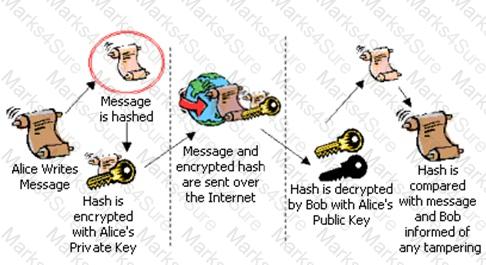
If the message has remained integral during its transit (i.e. it has not been tampered with), when compared the two hashes will be identical.
However, if the two hashes differ when compared then the integrity of the original message has been compromised. If the original message is tampered with it will result in Bob ' s computer calculating a different hash value. If a different hash value is created, then the original message will have been altered. As a result the verification of the Digital Signature will fail and Bob will be informed.
Origin, Integrity, Non-Repudiation, and Preventing Men-In-The-Middle (MITM) attacks
Eve, who wants to impersonate Alice, cannot generate the same signature as Alice because she does not have Alice ' s Private Key (needed to sign the message digest). If instead, Eve decides to alter the content of the message while in transit, the tampered message will create a different message digest to the original message, and Bob ' s computer will be able to detect that. Additionally, Alice cannot deny sending the message as it has been signed using her Private Key, thus ensuring non-repudiation.
creating and validating a digital signature

Due to the recent Global adoption of Digital Signature law, Alice may now sign a transaction, message or piece of digital data, and so long as it is verified successfully it is a legally permissible means of proof that Alice has made the transaction or written the message.
The following answers are incorrect:
- Public / Private: This is the opposite of the right answer.
- Symmetric / Asymmetric: Not quite. Sorry. This form of crypto is asymmetric so you were almost on target.
- Private / Symmetric: Well, you got half of it right but Symmetric is wrong.
The following reference(s) was used to create this question:
The CCCure Holistic Security+ CBT, you can subscribe at: http://www.cccure.tv
and
http://www.comodo.com/resources/small-business/digital-certificates3.php
Which protocol makes USE of an electronic wallet on a customer ' s PC and sends encrypted credit card information to merchant ' s Web server, which digitally signs it and sends it on to its processing bank?
Options:
SSH ( Secure Shell)
S/MIME (Secure MIME)
SET (Secure Electronic Transaction)
SSL (Secure Sockets Layer)
Answer:
CExplanation:
As protocol was introduced by Visa and Mastercard to allow for more credit card transaction possibilities. It is comprised of three different pieces of software, running on the customer ' s PC (an electronic wallet), on the merchant ' s Web server and on the payment server of the merchant ' s bank. The credit card information is sent by the customer to the merchant ' s Web server, but it does not open it and instead digitally signs it and sends it to its bank ' s payment server for processing.
The following answers are incorrect because :
SSH (Secure Shell) is incorrect as it functions as a type of tunneling mechanism that provides terminal like access to remote computers.
S/MIME is incorrect as it is a standard for encrypting and digitally signing electronic mail and for providing secure data transmissions.
SSL is incorrect as it uses public key encryption and provides data encryption, server authentication, message integrity, and optional client authentication.
Reference : Shon Harris AIO v3 , Chapter-8: Cryptography , Page : 667-669
What algorithm was DES derived from?
Options:
Twofish.
Skipjack.
Brooks-Aldeman.
Lucifer.
Answer:
DExplanation:
NSA took the 128-bit algorithm Lucifer that IBM developed, reduced the key size to 64 bits and with that developed DES.
The following answers are incorrect:
Twofish. This is incorrect because Twofish is related to Blowfish as a possible replacement for DES.
Skipjack. This is incorrect, Skipjack was developed after DES by the NSA .
Brooks-Aldeman. This is incorrect because this is a distractor, no algorithm exists with this name.
Which of the following is NOT an asymmetric key algorithm?
Options:
RSA
Elliptic Curve Cryptosystem (ECC)
El Gamal
Data Encryption System (DES)
Answer:
DExplanation:
Data Encryption Standard (DES) is a symmetric key algorithm. Originally developed by IBM, under project name Lucifer, this 128-bit algorithm was accepted by the NIST in 1974, but the key size was reduced to 56 bits, plus 8 bits for parity. It somehow became a national cryptographic standard in 1977, and an American National Standard Institute (ANSI) standard in 1978. DES was later replaced by the Advanced Encryption Standard (AES) by the NIST. All other options are asymmetric algorithms.
Source: HARRIS, Shon, All-In-One CISSP Certification Exam Guide, McGraw-Hill/Osborne, 2002, chapter 8: Cryptography (page 525).
Which of the following type of cryptography is used when both parties use the same key to communicate securely with each other?
Options:
Symmetric Key Cryptography
PKI - Public Key Infrastructure
Diffie-Hellman
DSS - Digital Signature Standard
Answer:
AExplanation:
Symmetric-key algorithms are a class of algorithms for cryptography that use the same cryptographic keys for both encryption of plaintext (sender) and decryption of ciphertext (receiver). The keys may be identical, in practice, they represent a shared secret between two or more parties that can be used to maintain a private information link.
This requirement that both parties have access to the secret key is one of the main drawbacks of symmetric key encryption, in comparison to public-key encryption. This is also known as secret key encryption. In symmetric key cryptography, each end of the conversation must have the same key or they cannot decrypt the message sent to them by the other party.
Symmetric key crypto is very fast but more difficult to manage due to the need to distribute the key in a secure means to all parts needing to decrypt the data. There is no key management built within Symmetric crypto.
PKI provides CIA - Confidentiality (Through encryption) Integrity (By guaranteeing that the message hasn ' t change in transit) and Authentication (Non-repudiation). Symmetric key crypto provides mostly Confidentiality.
The following answers are incorrect:
- PKI - Public Key Infrastructure: This is the opposite of symmetric key crypto. Each side in PKI has their own private key and public key. What one key encrypt the other one can decrypt. You make use of the receiver public key to communicate securely with a remote user. The receiver will use their matching private key to decrypt the data.
- Diffie-Hellman: Sorry, this is an asymmetric key technique. It is used for key agreement over an insecure network such as the Internet. It allows two parties who has never met to negotiate a secret key over an insecure network while preventing Man-In-The-Middle (MITM) attacks.
- DSS - Digital Signature Standard: Sorry, this is an asymmetric key technique.
The following reference(s) was used to create this question:
To learn more about this QUESTION NO: s and 100% of the Security+ CBK, subscribe to our Holistic Computer Based Tutorial (CBT) on our Learning Management System at: http://www.cccure.tv
and
http://en.wikipedia.org/wiki/Symmetric-key_algorithm
Which is NOT a suitable method for distributing certificate revocation information?
Options:
CA revocation mailing list
Delta CRL
OCSP (online certificate status protocol)
Distribution point CRL
Answer:
AExplanation:
The following are incorrect answers because they are all suitable methods.
A Delta CRL is a CRL that only provides information about certificates whose statuses have changed since the issuance of a specific, previously issued CRL.
The Online Certificate Status Protocol (OCSP) is an Internet protocol used for obtaining the revocation status of an X.509 digital certificate.
A Distribution point CRL or CRL Distribution Point, a location specified in the CRL Distribution Point (CRL DP) X.509, version 3, certificate extension when the certificate is issued.
References:
RFC 2459: Internet X.509 Public Key Infrastru
http://csrc.nist.gov/groups/ST/crypto_apps_infra/documents/sliding_window.pdf
http://www.ipswitch.eu/online_certificate_status_protocol_en.html
Computer Security Handbook By Seymour Bosworth, Arthur E. Hutt, Michel E. Kabay http://books.google.com/books?id=rCx5OfSFUPkC & printsec=frontcover & dq=Computer+Security+Handbook#PRA6-PA4,M1
What can be defined as a data structure that enumerates digital certificates that were issued to CAs but have been invalidated by their issuer prior to when they were scheduled to expire?
Options:
Certificate revocation list
Certificate revocation tree
Authority revocation list
Untrusted certificate list
Answer:
CExplanation:
The Internet Security Glossary (RFC2828) defines the Authority Revocation List (ARL) as a data structure that enumerates digital certificates that were issued to CAs but have been invalidated by their issuer prior to when they were scheduled to expire.
Do not to confuse with an ARL with a Certificate Revocation List (CRL). A certificate revocation list is a mechanism for distributing notices of certificate revocations. The question specifically mentions " issued to CAs " which makes ARL a better answer than CRL.
http://rfclibrary.hosting.com/rfc/rfc2828/rfc2828-29.asp
$ certificate revocation list (CRL)
(I) A data structure that enumerates digital certificates that have been invalidated by their issuer prior to when they were
scheduled to expire. (See: certificate expiration, X.509 certificate revocation list.)
http://rfclibrary.hosting.com/rfc/rfc2828/rfc2828-17.asp
$ authority revocation list (ARL)
(I) A data structure that enumerates digital certificates that were issued to CAs but have been invalidated by their issuer prior to when they were scheduled to expire. (See: certificate expiration, X.509 authority revocation list.)
In a few words: We use CRL ' s for end-user cert revocation and ARL ' s for CA cert revocation - both can be placed in distribution points.
Attributes that characterize an attack are stored for reference using which of the following Intrusion Detection System (IDS) ?
Options:
signature-based IDS
statistical anomaly-based IDS
event-based IDS
inferent-based IDS
Answer:
AExplanation:
Source: KRUTZ, Ronald L. & VINES, Russel D., The CISSP Prep Guide: Mastering the Ten Domains of Computer Security, 2001, John Wiley & Sons, Page 49.
Which of the following is NOT a valid reason to use external penetration service firms rather than corporate resources?
Options:
They are more cost-effective
They offer a lack of corporate bias
They use highly talented ex-hackers
They ensure a more complete reporting
Answer:
CExplanation:
Two points are important to consider when it comes to ethical hacking: integrity and independence.
By not using an ethical hacking firm that hires or subcontracts to ex-hackers of others who have criminal records, an entire subset of risks can be avoided by an organization. Also, it is not cost-effective for a single firm to fund the effort of the ongoing research and development, systems development, and maintenance that is needed to operate state-of-the-art proprietary and open source testing tools and techniques.
External penetration firms are more effective than internal penetration testers because they are not influenced by any previous system security decisions, knowledge of the current system environment, or future system security plans. Moreover, an employee performing penetration testing might be reluctant to fully report security gaps.
Source: KRUTZ, Ronald L. & VINES, Russel D., The CISSP Prep Guide: Mastering the Ten Domains of Computer Security, John Wiley & Sons, 2001, Appendix F: The Case for Ethical Hacking (page 517).
In order to enable users to perform tasks and duties without having to go through extra steps it is important that the security controls and mechanisms that are in place have a degree of?
Options:
Complexity
Non-transparency
Transparency
Simplicity
Answer:
CExplanation:
The security controls and mechanisms that are in place must have a degree of transparency.
This enables the user to perform tasks and duties without having to go through extra steps because of the presence of the security controls. Transparency also does not let the user know too much about the controls, which helps prevent him from figuring out how to circumvent them. If the controls are too obvious, an attacker can figure out how to compromise them more easily.
Security (more specifically, the implementation of most security controls) has long been a sore point with users who are subject to security controls. Historically, security controls have been very intrusive to users, forcing them to interrupt their work flow and remember arcane codes or processes (like long passwords or access codes), and have generally been seen as an obstacle to getting work done. In recent years, much work has been done to remove that stigma of security controls as a detractor from the work process adding nothing but time and money. When developing access control, the system must be as transparent as possible to the end user. The users should be required to interact with the system as little as possible, and the process around using the control should be engineered so as to involve little effort on the part of the user.
For example, requiring a user to swipe an access card through a reader is an effective way to ensure a person is authorized to enter a room. However, implementing a technology (such as RFID) that will automatically scan the badge as the user approaches the door is more transparent to the user and will do less to impede the movement of personnel in a busy area.
In another example, asking a user to understand what applications and data sets will be required when requesting a system ID and then specifically requesting access to those resources may allow for a great deal of granularity when provisioning access, but it can hardly be seen as transparent. A more transparent process would be for the access provisioning system to have a role-based structure, where the user would simply specify the role he or she has in the organization and the system would know the specific resources that user needs to access based on that role. This requires less work and interaction on the part of the user and will lead to more accurate and secure access control decisions because access will be based on predefined need, not user preference.
When developing and implementing an access control system special care should be taken to ensure that the control is as transparent to the end user as possible and interrupts his work flow as little as possible.
The following answers were incorrect:
All of the other detractors were incorrect.
Reference(s) used for this question:
HARRIS, Shon, All-In-One CISSP Certification Exam Guide, 6th edition. Operations Security, Page 1239-1240
Harris, Shon (2012-10-25). CISSP All-in-One Exam Guide, 6th Edition (Kindle Locations 25278-25281). McGraw-Hill. Kindle Edition.
Schneiter, Andrew (2013-04-15). Official (ISC)2 Guide to the CISSP CBK, Third Edition : Access Control ((ISC)2 Press) (Kindle Locations 713-729). Auerbach Publications. Kindle Edition.
What ensures that the control mechanisms correctly implement the security policy for the entire life cycle of an information system?
Options:
Accountability controls
Mandatory access controls
Assurance procedures
Administrative controls
Answer:
CExplanation:
Controls provide accountability for individuals accessing information. Assurance procedures ensure that access control mechanisms correctly implement the security policy for the entire life cycle of an information system.
Source: KRUTZ, Ronald L. & VINES, Russel D., The CISSP Prep Guide: Mastering the Ten Domains of Computer Security, John Wiley & Sons, 2001, Chapter 2: Access control systems (page 33).
Which of the following is not a preventive operational control?
Options:
Protecting laptops, personal computers and workstations.
Controlling software viruses.
Controlling data media access and disposal.
Conducting security awareness and technical training.
Answer:
DExplanation:
Conducting security awareness and technical training to ensure that end users and system users are aware of the rules of behaviour and their responsibilities in protecting the organization ' s mission is an example of a preventive management control, therefore not an operational control.
Source: STONEBURNER, Gary et al., NIST Special publication 800-30, Risk management Guide for Information Technology Systems, 2001 (page 37).
What is the essential difference between a self-audit and an independent audit?
Options:
Tools used
Results
Objectivity
Competence
Answer:
CExplanation:
To maintain operational assurance, organizations use two basic methods: system audits and monitoring. Monitoring refers to an ongoing activity whereas audits are one-time or periodic events and can be either internal or external. The essential difference between a self-audit and an independent audit is objectivity, thus indirectly affecting the results of the audit. Internal and external auditors should have the same level of competence and can use the same tools.
Source: SWANSON, Marianne & GUTTMAN, Barbara, National Institute of Standards and Technology (NIST), NIST Special Publication 800-14, Generally Accepted Principles and Practices for Securing Information Technology Systems, September 1996 (page 25).
Which of the following is used to monitor network traffic or to monitor host audit logs in real time to determine violations of system security policy that have taken place?
Options:
Intrusion Detection System
Compliance Validation System
Intrusion Management System (IMS)
Compliance Monitoring System
Answer:
AExplanation:
An Intrusion Detection System (IDS) is a system that is used to monitor network traffic or to monitor host audit logs in order to determine if any violations of an organization ' s system security policy have taken place.
Source: KRUTZ, Ronald L. & VINES, Russel D., The CISSP Prep Guide: Mastering the Ten Domains of Computer Security, 2001, John Wiley & Sons, Page 48.
If an organization were to monitor their employees ' e-mail, it should not:
Options:
Monitor only a limited number of employees.
Inform all employees that e-mail is being monitored.
Explain who can read the e-mail and how long it is backed up.
Explain what is considered an acceptable use of the e-mail system.
Answer:
AExplanation:
Monitoring has to be conducted is a lawful manner and applied in a consistent fashion; thus should be applied uniformly to all employees, not only to a small number.
Source: KRUTZ, Ronald L. & VINES, Russel D., The CISSP Prep Guide: Mastering the Ten Domains of Computer Security, John Wiley & Sons, 2001, Chapter 9: Law, Investigation, and Ethics (page 304).
Which of the following questions are least likely to help in assessing controls covering audit trails?
Options:
Does the audit trail provide a trace of user actions?
Are incidents monitored and tracked until resolved?
Is access to online logs strictly controlled?
Is there separation of duties between security personnel who administer the access control function and those who administer the audit trail?
Answer:
BExplanation:
Audit trails maintain a record of system activity by system or application processes and by user activity. In conjunction with appropriate tools and procedures, audit trails can provide individual accountability, a means to reconstruct events, detect intrusions, and identify problems. Audit trail controls are considered technical controls. Monitoring and tracking of incidents is more an operational control related to incident response capability.
Reference(s) used for this question:
SWANSON, Marianne, NIST Special Publication 800-26, Security Self-Assessment Guide for Information Technology Systems, November 2001 (Pages A-50 to A-51).
NOTE: NIST SP 800-26 has been superceded By: FIPS 200, SP 800-53, SP 800-53A
You can find the new replacement at: http://csrc.nist.gov/publications/PubsSPs.html
However, if you really wish to see the old standard, it is listed as an archived document at:
http://csrc.nist.gov/publications/PubsSPArch.html
Who is responsible for providing reports to the senior management on the effectiveness of the security controls?
Options:
Information systems security professionals
Data owners
Data custodians
Information systems auditors
Answer:
DExplanation:
IT auditors determine whether systems are in compliance with the security policies, procedures, standards, baselines, designs, architectures, management direction and other requirements " and " provide top company management with an independent view of the controls that have been designed and their effectiveness. "
" Information systems security professionals " is incorrect. Security professionals develop the security policies and supporting baselines, etc.
" Data owners " is incorrect. Data owners have overall responsibility for information assets and assign the appropriate classification for the asset as well as ensure that the asset is protected with the proper controls.
" Data custodians " is incorrect. Data custodians care for an information asset on behalf of the data owner.
References:
CBK, pp. 38 - 42.
AIO3. pp. 99 - 104
What setup should an administrator use for regularly testing the strength of user passwords?
Options:
A networked workstation so that the live password database can easily be accessed by the cracking program.
A networked workstation so the password database can easily be copied locally and processed by the cracking program.
A standalone workstation on which the password database is copied and processed by the cracking program.
A password-cracking program is unethical; therefore it should not be used.
Answer:
CExplanation:
Poor password selection is frequently a major security problem for any system ' s security. Administrators should obtain and use password-guessing programs frequently to identify those users having easily guessed passwords.
Because password-cracking programs are very CPU intensive and can slow the system on which it is running, it is a good idea to transfer the encrypted passwords to a standalone (not networked) workstation. Also, by doing the work on a non-networked machine, any results found will not be accessible by anyone unless they have physical access to that system.
Out of the four choice presented above this is the best choice.
However, in real life you would have strong password policies that enforce complexity requirements and does not let the user choose a simple or short password that can be easily cracked or guessed. That would be the best choice if it was one of the choice presented.
Another issue with password cracking is one of privacy. Many password cracking tools can avoid this by only showing the password was cracked and not showing what the password actually is. It is masking the password being used from the person doing the cracking.
Source: National Security Agency, Systems and Network Attack Center (SNAC), The 60 Minute Network Security Guide, February 2002, page 8.
A timely review of system access audit records would be an example of which of the basic security functions?
Options:
avoidance
deterrence
prevention
detection
Answer:
DExplanation:
By reviewing system logs you can detect events that have occured.
The following answers are incorrect:
avoidance. This is incorrect, avoidance is a distractor. By reviewing system logs you have not avoided anything.
deterrence. This is incorrect because system logs are a history of past events. You cannot deter something that has already occurred.
prevention. This is incorrect because system logs are a history of past events. You cannot prevent something that has already occurred.
Knowledge-based Intrusion Detection Systems (IDS) are more common than:
Options:
Network-based IDS
Host-based IDS
Behavior-based IDS
Application-Based IDS
Answer:
CExplanation:
Knowledge-based IDS are more common than behavior-based ID systems.
Source: KRUTZ, Ronald L. & VINES, Russel D., The CISSP Prep Guide: Mastering the Ten Domains of Computer Security, 2001, John Wiley & Sons, Page 63.
Application-Based IDS - " a subset of HIDS that analyze what ' s going on in an application using the transaction log files of the application. " Source: Official ISC2 CISSP CBK Review Seminar Student Manual Version 7.0 p. 87
Host-Based IDS - " an implementation of IDS capabilities at the host level. Its most significant difference from NIDS is intrusion detection analysis, and related processes are limited to the boundaries of the host. " Source: Official ISC2 Guide to the CISSP CBK - p. 197
Network-Based IDS - " a network device, or dedicated system attached to the network, that monitors traffic traversing the network segment for which it is integrated. " Source: Official ISC2 Guide to the CISSP CBK - p. 196
CISSP for dummies a book that we recommend for a quick overview of the 10 domains has nice and concise coverage of the subject:
Intrusion detection is defined as real-time monitoring and analysis of network activity and data for potential vulnerabilities and attacks in progress. One major limitation of current intrusion detection system (IDS) technologies is the requirement to filter false alarms lest the operator (system or security administrator) be overwhelmed with data. IDSes are classified in many different ways, including active and passive, network-based and host-based, and knowledge-based and behavior-based:
Active and passive IDS
An active IDS (now more commonly known as an intrusion prevention system — IPS) is a system that ' s configured to automatically block suspected attacks in progress without any intervention required by an operator. IPS has the advantage of providing real-time corrective action in response to an attack but has many disadvantages as well. An IPS must be placed in-line along a network boundary; thus, the IPS itself is susceptible to attack. Also, if false alarms and legitimate traffic haven ' t been properly identified and filtered, authorized users and applications may be improperly denied access. Finally, the IPS itself may be used to effect a Denial of Service (DoS) attack by intentionally flooding the system with alarms that cause it to block connections until no connections or bandwidth are available.
A passive IDS is a system that ' s configured only to monitor and analyze network traffic activity and alert an operator to potential vulnerabilities and attacks. It isn ' t capable of performing any protective or corrective functions on its own. The major advantages of passive IDSes are that these systems can be easily and rapidly deployed and are not normally susceptible to attack themselves.
Network-based and host-based IDS
A network-based IDS usually consists of a network appliance (or sensor) with a Network Interface Card (NIC) operating in promiscuous mode and a separate management interface. The IDS is placed along a network segment or boundary and monitors all traffic on that segment.
A host-based IDS requires small programs (or agents) to be installed on individual systems to be monitored. The agents monitor the operating system and write data to log files and/or trigger alarms. A host-based IDS can only monitor the individual host systems on which the agents are installed; it doesn ' t monitor the entire network.
Knowledge-based and behavior-based IDS
A knowledge-based (or signature-based) IDS references a database of previous attack profiles and known system vulnerabilities to identify active intrusion attempts. Knowledge-based IDS is currently more common than behavior-based IDS.
Advantages of knowledge-based systems include the following:
It has lower false alarm rates than behavior-based IDS.
Alarms are more standardized and more easily understood than behavior-based IDS.
Disadvantages of knowledge-based systems include these:
Signature database must be continually updated and maintained.
New, unique, or original attacks may not be detected or may be improperly classified.
A behavior-based (or statistical anomaly–based) IDS references a baseline or learned pattern of normal system activity to identify active intrusion attempts. Deviations from this baseline or pattern cause an alarm to be triggered.
Advantages of behavior-based systems include that they
Dynamically adapt to new, unique, or original attacks.
Are less dependent on identifying specific operating system vulnerabilities.
Disadvantages of behavior-based systems include
Higher false alarm rates than knowledge-based IDSes.
Usage patterns that may change often and may not be static enough to implement an effective behavior-based IDS.
What would be considered the biggest drawback of Host-based Intrusion Detection systems (HIDS)?
Options:
It can be very invasive to the host operating system
Monitors all processes and activities on the host system only
Virtually eliminates limits associated with encryption
They have an increased level of visibility and control compared to NIDS
Answer:
AExplanation:
The biggest drawback of HIDS, and the reason many organizations resist its use, is that it can be very invasive to the host operating system. HIDS must have the capability to monitor all processes and activities on the host system and this can sometimes interfere with normal system processing.
HIDS versus NIDS
A host-based IDS (HIDS) can be installed on individual workstations and/ or servers to watch for inappropriate or anomalous activity. HIDSs are usually used to make sure users do not delete system files, reconfigure important settings, or put the system at risk in any other way.
So, whereas the NIDS understands and monitors the network traffic, a HIDS’s universe is limited to the computer itself. A HIDS does not understand or review network traffic, and a NIDS does not “look in” and monitor a system’s activity. Each has its own job and stays out of the other’s way.
The ISC2 official study book defines an IDS as:
An intrusion detection system (IDS) is a technology that alerts organizations to adverse or unwanted activity. An IDS can be implemented as part of a network device, such as a router, switch, or firewall, or it can be a dedicated IDS device monitoring traffic as it traverses the network. When used in this way, it is referred to as a network IDS, or NIDS. IDS can also be used on individual host systems to monitor and report on file, disk, and process activity on that host. When used in this way it is referred to as a host-based IDS, or HIDS.
An IDS is informative by nature and provides real-time information when suspicious activities are identified. It is primarily a detective device and, acting in this traditional role, is not used to directly prevent the suspected attack.
What about IPS?
In contrast, an intrusion prevention system (IPS), is a technology that monitors activity like an IDS but will automatically take proactive preventative action if it detects unacceptable activity. An IPS permits a predetermined set of functions and actions to occur on a network or system; anything that is not permitted is considered unwanted activity and blocked. IPS is engineered specifically to respond in real time to an event at the system or network layer. By proactively enforcing policy, IPS can thwart not only attackers, but also authorized users attempting to perform an action that is not within policy. Fundamentally, IPS is considered an access control and policy enforcement technology, whereas IDS is considered network monitoring and audit technology.
The following answers were incorrect:
All of the other answer were advantages and not drawback of using HIDS
TIP FOR THE EXAM:
Be familiar with the differences that exists between an HIDS, NIDS, and IPS. Know that IDS ' s are mostly detective but IPS are preventive. IPS ' s are considered an access control and policy enforcement technology, whereas IDS ' s are considered network monitoring and audit technology.
Reference(s) used for this question:
Harris, Shon (2012-10-25). CISSP All-in-One Exam Guide, 6th Edition (Kindle Locations 5817-5822). McGraw-Hill. Kindle Edition.
and
Schneiter, Andrew (2013-04-15). Official (ISC)2 Guide to the CISSP CBK, Third Edition : Access Control ((ISC)2 Press), Domain1, Page 180-188 or on the kindle version look for Kindle Locations 3199-3203. Auerbach Publications.
Which of the following is most likely to be useful in detecting intrusions?
Options:
Access control lists
Security labels
Audit trails
Information security policies
Answer:
CExplanation:
If audit trails have been properly defined and implemented, they will record information that can assist in detecting intrusions.
Source: HARRIS, Shon, All-In-One CISSP Certification Exam Guide, McGraw-Hill/Osborne, 2002, Chapter 4: Access Control (page 186).
Which of the following types of Intrusion Detection Systems uses behavioral characteristics of a system’s operation or network traffic to draw conclusions on whether the traffic represents a risk to the network or host?
Options:
Network-based ID systems.
Anomaly Detection.
Host-based ID systems.
Signature Analysis.
Answer:
BExplanation:
There are two basic IDS analysis methods: pattern matching (also called signature analysis) and anomaly detection.
Anomaly detection uses behavioral characteristics of a system’s operation or network traffic to draw conclusions on whether the traffic represents a risk to the network or host. Anomalies may include but are not limited to:
Multiple failed log-on attempts
Users logging in at strange hours
Unexplained changes to system clocks
Unusual error messages
The following are incorrect answers:
Network-based ID Systems (NIDS) are usually incorporated into the network in a passive architecture, taking advantage of promiscuous mode access to the network. This means that it has visibility into every packet traversing the network segment. This allows the system to inspect packets and monitor sessions without impacting the network or the systems and applications utilizing the network.
Host-based ID Systems (HIDS) is the implementation of IDS capabilities at the host level. Its most significant difference from NIDS is that related processes are limited to the boundaries of a single-host system. However, this presents advantages in effectively detecting objectionable activities because the IDS process is running directly on the host system, not just observing it from the network. This offers unfettered access to system logs, processes, system information, and device information, and virtually eliminates limits associated with encryption. The level of integration represented by HIDS increases the level of visibility and control at the disposal of the HIDS application.
Signature Analysis Some of the first IDS products used signature analysis as their detection method and simply looked for known characteristics of an attack (such as specific packet sequences or text in the data stream) to produce an alert if that pattern was detected. For example, an attacker manipulating an FTP server may use a tool that sends a specially constructed packet. If that particular packet pattern is known, it can be represented in the form of a signature that IDS can then compare to incoming packets. Pattern-based IDS will have a database of hundreds, if not thousands, of signatures that are compared to traffic streams. As new attack signatures are produced, the system is updated, much like antivirus solutions. There are drawbacks to pattern-based IDS. Most importantly, signatures can only exist for known attacks. If a new or different attack vector is used, it will not match a known signature and, thus, slip past the IDS. Additionally, if an attacker knows that the IDS is present, he or she can alter his or her methods to avoid detection. Changing packets and data streams, even slightly, from known signatures can cause an IDS to miss the attack. As with some antivirus systems, the IDS is only as good as the latest signature database on the system.
For additional information on Intrusion Detection Systems - http://en.wikipedia.org/wiki/Intrusion_detection_system
Reference(s) used for this question:
Hernandez CISSP, Steven (2012-12-21). Official (ISC)2 Guide to the CISSP CBK, Third Edition ((ISC)2 Press) (Kindle Locations 3623-3625, 3649-3654, 3666-3686). Auerbach Publications. Kindle Edition.
What IDS approach relies on a database of known attacks?
Options:
Signature-based intrusion detection
Statistical anomaly-based intrusion detection
Behavior-based intrusion detection
Network-based intrusion detection
Answer:
AExplanation:
A weakness of the signature-based (or knowledge-based) intrusion detection approach is that only attack signatures that are stored in a database are detected. Network-based intrusion detection can either be signature-based or statistical anomaly-based (also called behavior-based).
Source: KRUTZ, Ronald L. & VINES, Russel D., The CISSP Prep Guide: Mastering the Ten Domains of Computer Security, John Wiley & Sons, 2001, Chapter 2: Access control systems (page 49).
The session layer provides a logical persistent connection between peer hosts. Which of the following is one of the modes used in the session layer to establish this connection?
Options:
Full duplex
Synchronous
Asynchronous
Half simplex
Answer:
AExplanation:
Layer 5 of the OSI model is the Session Layer. This layer provides a logical persistent connection between peer hosts. A session is analogous to a conversation that is necessary for applications to exchange information.
The session layer is responsible for establishing, managing, and closing end-to-end connections, called sessions, between applications located at different network endpoints. Dialogue control management provided by the session layer includes full-duplex, half-duplex, and simplex communications. Session layer management also helps to ensure that multiple streams of data stay synchronized with each other, as in the case of multimedia applications like video conferencing, and assists with the prevention of application related data errors.
The session layer is responsible for creating, maintaining, and tearing down the session.
Three modes are offered:
(Full) Duplex: Both hosts can exchange information simultaneously, independent of each other.
Half Duplex: Hosts can exchange information, but only one host at a time.
Simplex: Only one host can send information to its peer. Information travels in one direction only.
Another aspect of performance that is worthy of some attention is the mode of operation of the network or connection. Obviously, whenever we connect together device A and device B, there must be some way for A to send to B and B to send to A. Many people don’t realize, however, that networking technologies can differ in terms of how these two directions of communication are handled. Depending on how the network is set up, and the characteristics of the technologies used, performance may be improved through the selection of performance-enhancing modes.
Basic Communication Modes of Operation
Let ' s begin with a look at the three basic modes of operation that can exist for any network connection, communications channel, or interface.
Simplex Operation
In simplex operation, a network cable or communications channel can only send information in one direction; it ' s a “one-way street”. This may seem counter-intuitive: what ' s the point of communications that only travel in one direction? In fact, there are at least two different places where simplex operation is encountered in modern networking.
The first is when two distinct channels are used for communication: one transmits from A to B and the other from B to A. This is surprisingly common, even though not always obvious. For example, most if not all fiber optic communication is simplex, using one strand to send data in each direction. But this may not be obvious if the pair of fiber strands are combined into one cable.
Simplex operation is also used in special types of technologies, especially ones that are asymmetric. For example, one type of satellite Internet access sends data over the satellite only for downloads, while a regular dial-up modem is used for upload to the service provider. In this case, both the satellite link and the dial-up connection are operating in a simplex mode.
Half-Duplex Operation
Technologies that employ half-duplex operation are capable of sending information in both directions between two nodes, but only one direction or the other can be utilized at a time. This is a fairly common mode of operation when there is only a single network medium (cable, radio frequency and so forth) between devices.
While this term is often used to describe the behavior of a pair of devices, it can more generally refer to any number of connected devices that take turns transmitting. For example, in conventional Ethernet networks, any device can transmit, but only one may do so at a time. For this reason, regular (unswitched) Ethernet networks are often said to be “half-duplex”, even though it may seem strange to describe a LAN that way.
Full-Duplex Operation
In full-duplex operation, a connection between two devices is capable of sending data in both directions simultaneously. Full-duplex channels can be constructed either as a pair of simplex links (as described above) or using one channel designed to permit bidirectional simultaneous transmissions. A full-duplex link can only connect two devices, so many such links are required if multiple devices are to be connected together.
Note that the term “full-duplex” is somewhat redundant; “duplex” would suffice, but everyone still says “full-duplex” (likely, to differentiate this mode from half-duplex).
For a listing of protocols associated with Layer 5 of the OSI model, see below:
ADSP - AppleTalk Data Stream Protocol
ASP - AppleTalk Session Protocol
H.245 - Call Control Protocol for Multimedia Communication
ISO-SP
OSI session-layer protocol (X.225, ISO 8327)
iSNS - Internet Storage Name Service
The following are incorrect answers:
Synchronous and Asynchronous are not session layer modes.
Half simplex does not exist. By definition, simplex means that information travels one way only, so half-simplex is a oxymoron.
Reference(s) used for this question:
Hernandez CISSP, Steven (2012-12-21). Official (ISC)2 Guide to the CISSP CBK, Third Edition ((ISC)2 Press) (Kindle Locations 5603-5636). Auerbach Publications. Kindle Edition.
and
http://www.tcpipguide.com/free/t_SimplexFullDuplexandHalfDuplexOperation.htm
and
http://www.wisegeek.com/what-is-a-session-layer.htm
Which of the following is required in order to provide accountability?
Options:
Authentication
Integrity
Confidentiality
Audit trails
Answer:
DExplanation:
Accountability can actually be seen in two different ways:
1) Although audit trails are also needed for accountability, no user can be accountable for their actions unless properly authenticated.
2) Accountability is another facet of access control. Individuals on a system are responsible for their actions. This accountability property enables system activities to be traced to the proper individuals. Accountability is supported by audit trails that record events on the system and network. Audit trails can be used for intrusion detection and for the reconstruction of past events. Monitoring individual activities, such as keystroke monitoring, should be accomplished in accordance with the company policy and appropriate laws. Banners at the log-on time should notify the user of any monitoring that is being conducted.
The point is that unless you employ an appropriate auditing mechanism, you don ' t have accountability. Authorization only gives a user certain permissions on the network. Accountability is far more complex because it also includes intrusion detection, unauthorized actions by both unauthorized users and authorized users, and system faults. The audit trail provides the proof that unauthorized modifications by both authorized and unauthorized users took place. No proof, No accountability.
Source: KRUTZ, Ronald L. & VINES, Russel D., The CISSP Prep Guide: Mastering the Ten Domains of Computer Security, John Wiley & Sons, 2001, Page 50.
The Shon Harris AIO book, 4th Edition, on Page 243 also states:
Auditing Capabilities ensures users are accountable for their actions, verify that the secutiy policies are enforced,
and can be used as investigation tools. Accountability is tracked by recording user, system, and application activities.
This recording is done through auditing functions and mechanisms within an operating sytem or application.
Audit trail contain information about operating System activities, application events, and user actions.
Which of the following are additional terms used to describe knowledge-based IDS and behavior-based IDS?
Options:
signature-based IDS and statistical anomaly-based IDS, respectively
signature-based IDS and dynamic anomaly-based IDS, respectively
anomaly-based IDS and statistical-based IDS, respectively
signature-based IDS and motion anomaly-based IDS, respectively.
Answer:
AExplanation:
The two current conceptual approaches to Intrusion Detection methodology are knowledge-based ID systems and behavior-based ID systems, sometimes referred to as signature-based ID and statistical anomaly-based ID, respectively.
Source: KRUTZ, Ronald L. & VINES, Russel D., The CISSP Prep Guide: Mastering the Ten Domains of Computer Security, 2001, John Wiley & Sons, Page 63.
As a result of a risk assessment, your security manager has determined that your organization needs to implement an intrusion detection system that can detect unknown attacks and can watch for unusual traffic behavior, such as a new service appearing on the network. What type of intrusion detection system would you select?
Options:
Protocol anomaly based
Pattern matching
Stateful matching
Traffic anomaly-based
Answer:
DExplanation:
Traffic anomaly-based is the correct choice. An anomaly based IDS can detect unknown attacks. A traffic anomaly based IDS identifies any unacceptable deviation from expected behavior based on network traffic.
Protocol anomaly based is not the best choice as while a protocol anomaly based IDS can identify unknown attacks, this type of system is more suited to identifying deviations from established protocol standards such as HTTP. This type of IDS faces problems in analyzing complex or custom protocols.
Pattern matching is not the best choice as a pattern matching IDS cannot identify unknown attacks. This type of system can only compare packets against signatures of known attacks.
Stateful matching is not the best choice as a statful matching IDS cannot identify unknown attacks. This type of system works by scanning traffic streams for patterns or signatures of attacks.
In an online transaction processing system (OLTP), which of the following actions should be taken when erroneous or invalid transactions are detected?
Options:
The transactions should be dropped from processing.
The transactions should be processed after the program makes adjustments.
The transactions should be written to a report and reviewed.
The transactions should be corrected and reprocessed.
Answer:
CExplanation:
In an online transaction processing system (OLTP) all transactions are recorded as they occur. When erroneous or invalid transactions are detected the transaction can be recovered by reviewing the logs.
As explained in the ISC2 OIG:
OLTP is designed to record all of the business transactions of an organization as they occur. It is a data processing system facilitating and managing transaction-oriented applications. These are characterized as a system used by many concurrent users who are actively adding and modifying data to effectively change real-time data.
OLTP environments are frequently found in the finance, telecommunications, insurance, retail, transportation, and travel industries. For example, airline ticket agents enter data in the database in real-time by creating and modifying travel reservations, and these are increasingly joined by users directly making their own reservations and purchasing tickets through airline company Web sites as well as discount travel Web site portals. Therefore, millions of people may be accessing the same flight database every day, and dozens of people may be looking at a specific flight at the same time.
The security concerns for OLTP systems are concurrency and atomicity.
Concurrency controls ensure that two users cannot simultaneously change the same data, or that one user cannot make changes before another user is finished with it. In an airline ticket system, it is critical for an agent processing a reservation to complete the transaction, especially if it is the last seat available on the plane.
Atomicity ensures that all of the steps involved in the transaction complete successfully. If one step should fail, then the other steps should not be able to complete. Again, in an airline ticketing system, if the agent does not enter a name into the name data field correctly, the transaction should not be able to complete.
OLTP systems should act as a monitoring system and detect when individual processes abort, automatically restart an aborted process, back out of a transaction if necessary, allow distribution of multiple copies of application servers across machines, and perform dynamic load balancing.
A security feature uses transaction logs to record information on a transaction before it is processed, and then mark it as processed after it is done. If the system fails during the transaction, the transaction can be recovered by reviewing the transaction logs.
Checkpoint restart is the process of using the transaction logs to restart the machine by running through the log to the last checkpoint or good transaction. All transactions following the last checkpoint are applied before allowing users to access the data again.
Wikipedia has nice coverage on what is OLTP:
Online transaction processing, or OLTP, refers to a class of systems that facilitate and manage transaction-oriented applications, typically for data entry and retrieval transaction processing. The term is somewhat ambiguous; some understand a " transaction " in the context of computer or database transactions, while others (such as the Transaction Processing Performance Council) define it in terms of business or commercial transactions.
OLTP has also been used to refer to processing in which the system responds immediately to user requests. An automatic teller machine (ATM) for a bank is an example of a commercial transaction processing application.
The technology is used in a number of industries, including banking, airlines, mailorder, supermarkets, and manufacturing. Applications include electronic banking, order processing, employee time clock systems, e-commerce, and eTrading.
There are two security concerns for OLTP system: Concurrency and Atomicity
ATOMICITY
In database systems, atomicity (or atomicness) is one of the ACID transaction properties. In an atomic transaction, a series of database operations either all occur, or nothing occurs. A guarantee of atomicity prevents updates to the database occurring only partially, which can cause greater problems than rejecting the whole series outright.
The etymology of the phrase originates in the Classical Greek concept of a fundamental and indivisible component; see atom.
An example of atomicity is ordering an airline ticket where two actions are required: payment, and a seat reservation. The potential passenger must either:
both pay for and reserve a seat; OR
neither pay for nor reserve a seat.
The booking system does not consider it acceptable for a customer to pay for a ticket without securing the seat, nor to reserve the seat without payment succeeding.
CONCURRENCY
Database concurrency controls ensure that transactions occur in an ordered fashion.
The main job of these controls is to protect transactions issued by different users/applications from the effects of each other. They must preserve the four characteristics of database transactions ACID test: Atomicity, Consistency, Isolation, and Durability. Read http://en.wikipedia.org/wiki/ACID for more details on the ACID test.
Thus concurrency control is an essential element for correctness in any system where two database transactions or more, executed with time overlap, can access the same data, e.g., virtually in any general-purpose database system. A well established concurrency control theory exists for database systems: serializability theory, which allows to effectively design and analyze concurrency control methods and mechanisms.
Concurrency is not an issue in itself, it is the lack of proper concurrency controls that makes it a serious issue.
The following answers are incorrect:
The transactions should be dropped from processing. Is incorrect because the transactions are processed and when erroneous or invalid transactions are detected the transaction can be recovered by reviewing the logs.
The transactions should be processed after the program makes adjustments. Is incorrect because the transactions are processed and when erroneous or invalid transactions are detected the transaction can be recovered by reviewing the logs.
The transactions should be corrected and reprocessed. Is incorrect because the transactions are processed and when erroneous or invalid transactions are detected the transaction can be recovered by reviewing the logs.
References:
Hernandez CISSP, Steven (2012-12-21). Official (ISC)2 Guide to the CISSP CBK, Third Edition ((ISC)2 Press) (Kindle Locations 12749-12768). Auerbach Publications. Kindle Edition.
and
http://en.wikipedia.org/wiki/Online_transaction_processing
and
http://databases.about.com/od/administration/g/concurrency.htm
The fact that a network-based IDS reviews packets payload and headers enable which of the following?
Options:
Detection of denial of service
Detection of all viruses
Detection of data corruption
Detection of all password guessing attacks
Answer:
AExplanation:
Because a network-based IDS reviews packets and headers, denial of service attacks can also be detected.
This question is an easy question if you go through the process of elimination. When you see an answer containing the keyword: ALL It is something a give away that it is not the proper answer. On the real exam you may encounter a few question where the use of the work ALL renders the choice invalid. Pay close attention to such keyword.
The following are incorrect answers:
Even though most IDSs can detect some viruses and some password guessing attacks, they cannot detect ALL viruses or ALL password guessing attacks. Therefore these two answers are only detractors.
Unless the IDS knows the valid values for a certain dataset, it can NOT detect data corruption.
Reference used for this question:
KRUTZ, Ronald L. & VINES, Russel D., The CISSP Prep Guide: Mastering the Ten Domains of Computer Security, 2001, John Wiley & Sons, Page 48.
Which conceptual approach to intrusion detection system is the most common?
Options:
Behavior-based intrusion detection
Knowledge-based intrusion detection
Statistical anomaly-based intrusion detection
Host-based intrusion detection
Answer:
BExplanation:
There are two conceptual approaches to intrusion detection. Knowledge-based intrusion detection uses a database of known vulnerabilities to look for current attempts to exploit them on a system and trigger an alarm if an attempt is found. The other approach, not as common, is called behaviour-based or statistical analysis-based. A host-based intrusion detection system is a common implementation of intrusion detection, not a conceptual approach.
Source: KRUTZ, Ronald L. & VINES, Russel D., The CISSP Prep Guide: Mastering the Ten Domains of Computer Security, John Wiley & Sons, 2001, Chapter 3: Telecommunications and Network Security (page 63).
Also: HARRIS, Shon, All-In-One CISSP Certification Exam Guide, McGraw-Hill/Osborne, 2002, chapter 4: Access Control (pages 193-194).
The viewing of recorded events after the fact using a closed-circuit TV camera is considered a
Options:
Preventative control.
Detective control
Compensating control
Corrective control
Answer:
BExplanation:
Detective security controls are like a burglar alarm. They detect and report an unauthorized or undesired event (or an attempted undesired event). Detective security controls are invoked after the undesirable event has occurred. Example detective security controls are log monitoring and review, system audit, file integrity checkers, and motion detection.
Visual surveillance or recording devices such as closed circuit television are used in conjunction with guards in order to enhance their surveillance ability and to record events for future analysis or prosecution.
When events are monitored, it is considered preventative whereas recording of events is considered detective in nature.
Below you have explanations of other types of security controls from a nice guide produce by James Purcell (see reference below):
Preventive security controls are put into place to prevent intentional or unintentional disclosure, alteration, or destruction (D.A.D.) of sensitive information. Some example preventive controls follow:
Policy – Unauthorized network connections are prohibited.
Firewall – Blocks unauthorized network connections.
Locked wiring closet – Prevents unauthorized equipment from being physically plugged into a network switch.
Notice in the preceding examples that preventive controls crossed administrative, technical, and physical categories discussed previously. The same is true for any of the controls discussed in this section.
Corrective security controls are used to respond to and fix a security incident. Corrective security controls also limit or reduce further damage from an attack. Examples follow:
Procedure to clean a virus from an infected system
A guard checking and locking a door left unlocked by a careless employee
Updating firewall rules to block an attacking IP address
Note that in many cases the corrective security control is triggered by a detective security control.
Recovery security controls are those controls that put a system back into production after an incident. Most Disaster Recovery activities fall into this category. For example, after a disk failure, data is restored from a backup tape.
Directive security controls are the equivalent of administrative controls. Directive controls direct that some action be taken to protect sensitive organizational information. The directive can be in the form of a policy, procedure, or guideline.
Deterrent security controls are controls that discourage security violations. For instance, “Unauthorized Access Prohibited” signage may deter a trespasser from entering an area. The presence of security cameras might deter an employee from stealing equipment. A policy that states access to servers is monitored could deter unauthorized access.
Compensating security controls are controls that provide an alternative to normal controls that cannot be used for some reason. For instance, a certain server cannot have antivirus software installed because it interferes with a critical application. A compensating control would be to increase monitoring of that server or isolate that server on its own network segment.
Note that there is a third popular taxonomy developed by NIST and described in NIST Special Publication 800-53, “Recommended Security Controls for Federal Information Systems.” NIST categorizes security controls into 3 classes and then further categorizes the controls within the classes into 17 families. Within each security control family are dozens of specific controls. The NIST taxonomy is not covered on the CISSP exam but is one the CISSP should be aware of if you are employed within the US federal workforce.
Source: KRUTZ, Ronald L. & VINES, Russel D., The CISSP Prep Guide: Mastering the Ten Domains of Computer Security, John Wiley & Sons, 2001, Chapter 10: Physical security (page 340).
and
CISSP Study Guide By Eric Conrad, Seth Misenar, Joshua Feldman, page 50-52
and
Security Control Types and Operational Security, James E. Purcell, http://www.giac.org/cissp-papers/207.pdf
Which one of the following statements about the advantages and disadvantages of network-based Intrusion detection systems is true
Options:
Network-based IDSs are not vulnerable to attacks.
Network-based IDSs are well suited for modern switch-based networks.
Most network-based IDSs can automatically indicate whether or not an attack was successful.
The deployment of network-based IDSs has little impact upon an existing network.
Answer:
DExplanation:
Network-based IDSs are usually passive devices that listen on a network wire without interfering with the normal operation of a network. Thus, it is usually easy to retrofit a network to include network-based IDSs with minimal effort.
Network-based IDSs are not vulnerable to attacks is not true, even thou network-based IDSs can be made very secure against attack and even made invisible to many attackers they still have to read the packets and sometimes a well crafted packet might exploit or kill your capture engine.
Network-based IDSs are well suited for modern switch-based networks is not true as most switches do not provide universal monitoring ports and this limits the monitoring range of a network-based IDS sensor to a single host. Even when switches provide such monitoring ports, often the single port cannot mirror all traffic traversing the switch.
Most network-based IDSs can automatically indicate whether or not an attack was successful is not true as most network-based IDSs cannot tell whether or not an attack was successful; they can only discern that an attack was initiated. This means that after a network-based IDS detects an attack, administrators must manually investigate each attacked host to determine whether it was indeed penetrated.
How often should a Business Continuity Plan be reviewed?
Options:
At least once a month
At least every six months
At least once a year
At least Quarterly
Answer:
CExplanation:
As stated in SP 800-34 Rev. 1:
To be effective, the plan must be maintained in a ready state that accurately reflects system requirements, procedures, organizational structure, and policies. During the Operation/Maintenance phase of the SDLC, information systems undergo frequent changes because of shifting business needs, technology upgrades, or new internal or external policies.
As a general rule, the plan should be reviewed for accuracy and completeness at an organization-defined frequency (at least once a year for the purpose of the exam) or whenever significant changes occur to any element of the plan. Certain elements, such as contact lists, will require more frequent reviews.
Remember, there could be two good answers as specified above. Either once a year or whenever significant changes occur to the plan. You will of course get only one of the two presented within you exam.
Reference(s) used for this question:
NIST SP 800-34 Revision 1
Controls provide accountability for individuals who are accessing sensitive information. This accountability is accomplished:
Options:
through access control mechanisms that require identification and authentication and through the audit function.
through logical or technical controls involving the restriction of access to systems and the protection of information.
through logical or technical controls but not involving the restriction of access to systems and the protection of information.
through access control mechanisms that do not require identification and authentication and do not operate through the audit function.
Answer:
AExplanation:
Controls provide accountability for individuals who are accessing sensitive information. This accountability is accomplished through access control mechanisms that require identification and authentication and through the audit function. These controls must be in accordance with and accurately represent the organization ' s security policy. Assurance procedures ensure that the control mechanisms correctly implement the security policy for the entire life cycle of an information system.
Source: KRUTZ, Ronald L. & VINES, Russel D., The CISSP Prep Guide: Mastering the Ten Domains of Computer Security, 2001, John Wiley & Sons, Page 33.
Which of the following usually provides reliable, real-time information without consuming network or host resources?
Options:
network-based IDS
host-based IDS
application-based IDS
firewall-based IDS
Answer:
AExplanation:
A network-based IDS usually provides reliable, real-time information without consuming network or host resources.
Source: KRUTZ, Ronald L. & VINES, Russel D., The CISSP Prep Guide: Mastering the Ten Domains of Computer Security, 2001, John Wiley & Sons, Page 48.
What is the primary goal of setting up a honeypot?
Options:
To lure hackers into attacking unused systems
To entrap and track down possible hackers
To set up a sacrificial lamb on the network
To know when certain types of attacks are in progress and to learn about attack techniques so the network can be fortified.
Answer:
DExplanation:
The primary purpose of a honeypot is to study the attack methods of an attacker for the purposes of understanding their methods and improving defenses.
" To lure hackers into attacking unused systems " is incorrect. Honeypots can serve as decoys but their primary purpose is to study the behaviors of attackers.
" To entrap and track down possible hackers " is incorrect. There are a host of legal issues around enticement vs entrapment but a good general rule is that entrapment is generally prohibited and evidence gathered in a scenario that could be considered as " entrapping " an attacker would not be admissible in a court of law.
" To set up a sacrificial lamb on the network " is incorrect. While a honeypot is a sort of sacrificial lamb and may attract attacks that might have been directed against production systems, its real purpose is to study the methods of attackers with the goals of better understanding and improving network defenses.
References
AIO3, p. 213
In what way can violation clipping levels assist in violation tracking and analysis?
Options:
Clipping levels set a baseline for acceptable normal user errors, and violations exceeding that threshold will be recorded for analysis of why the violations occurred.
Clipping levels enable a security administrator to customize the audit trail to record only those violations which are deemed to be security relevant.
Clipping levels enable the security administrator to customize the audit trail to record only actions for users with access to user accounts with a privileged status.
Clipping levels enable a security administrator to view all reductions in security levels which have been made to user accounts which have incurred violations.
Answer:
AExplanation:
Companies can set predefined thresholds for the number of certain types of errors that will be allowed before the activity is considered suspicious. The threshold is a baseline for violation activities that may be normal for a user to commit before alarms are raised. This baseline is referred to as a clipping level.
The following are incorrect answers:
Clipping levels enable a security administrator to customize the audit trail to record only those violations which are deemed to be security relevant. This is not the best answer, you would not record ONLY security relevant violations, all violations would be recorded as well as all actions performed by authorized users which may not trigger a violation. This could allow you to indentify abnormal activities or fraud after the fact.
Clipping levels enable the security administrator to customize the audit trail to record only actions for users with access to user accounts with a privileged status. It could record all security violations whether the user is a normal user or a privileged user.
Clipping levels enable a security administrator to view all reductions in security levels which have been made to user accounts which have incurred violations. The keyword " ALL " makes this question wrong. It may detect SOME but not all of violations. For example, application level attacks may not be detected.
Reference(s) used for this question:
Harris, Shon (2012-10-18). CISSP All-in-One Exam Guide, 6th Edition (p. 1239). McGraw-Hill. Kindle Edition.
and
TIPTON, Hal, (ISC)2, Introduction to the CISSP Exam presentation.
Which of the following is needed for System Accountability?
Options:
Audit mechanisms.
Documented design as laid out in the Common Criteria.
Authorization.
Formal verification of system design.
Answer:
AExplanation:
Is a means of being able to track user actions. Through the use of audit logs and other tools the user actions are recorded and can be used at a later date to verify what actions were performed.
Accountability is the ability to identify users and to be able to track user actions.
The following answers are incorrect:
Documented design as laid out in the Common Criteria. Is incorrect because the Common Criteria is an international standard to evaluate trust and would not be a factor in System Accountability.
Authorization. Is incorrect because Authorization is granting access to subjects, just because you have authorization does not hold the subject accountable for their actions.
Formal verification of system design. Is incorrect because all you have done is to verify the system design and have not taken any steps toward system accountability.
References:
OIG CBK Glossary (page 778)
Who can best decide what are the adequate technical security controls in a computer-based application system in regards to the protection of the data being used, the criticality of the data, and it ' s sensitivity level ?
Options:
System Auditor
Data or Information Owner
System Manager
Data or Information user
Answer:
BExplanation:
The data or information owner also referred to as " Data Owner " would be the best person. That is the individual or officer who is ultimately responsible for the protection of the information and can therefore decide what are the adequate security controls according to the data sensitivity and data criticality. The auditor would be the best person to determine the adequacy of controls and whether or not they are working as expected by the owner.
The function of the auditor is to come around periodically and make sure you are doing what you are supposed to be doing. They ensure the correct controls are in place and are being maintained securely. The goal of the auditor is to make sure the organization complies with its own policies and the applicable laws and regulations.
Organizations can have internal auditors and/ or external auditors. The external auditors commonly work on behalf of a regulatory body to make sure compliance is being met. For example CobiT, which is a model that most information security auditors follow when evaluating a security program. While many security professionals fear and dread auditors, they can be valuable tools in ensuring the overall security of the organization. Their goal is to find the things you have missed and help you understand how to fix the problem.
The Official ISC2 Guide (OIG) says:
IT auditors determine whether users, owners, custodians, systems, and networks are in compliance with the security policies, procedures, standards, baselines, designs, architectures, management direction, and other requirements placed on systems. The auditors provide independent assurance to the management on the appropriateness of the security controls. The auditor examines the information systems and determines whether they are designed, configured, implemented, operated, and managed in a way ensuring that the organizational objectives are being achieved. The auditors provide top company management with an independent view of the controls and their effectiveness.
Example:
Bob is the head of payroll. He is therefore the individual with primary responsibility over the payroll database, and is therefore the information/data owner of the payroll database. In Bob ' s department, he has Sally and Richard working for him. Sally is responsible for making changes to the payroll database, for example if someone is hired or gets a raise. Richard is only responsible for printing paychecks. Given those roles, Sally requires both read and write access to the payroll database, but Richard requires only read access to it. Bob communicates these requirements to the system administrators (the " information/data custodians " ) and they set the file permissions for Sally ' s and Richard ' s user accounts so that Sally has read/write access, while Richard has only read access.
So in short Bob will determine what controls are required, what is the sensitivily and criticality of the Data. Bob will communicate this to the custodians who will implement the requirements on the systems/DB. The auditor would assess if the controls are in fact providing the level of security the Data Owner expects within the systems/DB. The auditor does not determine the sensitivity of the data or the crititicality of the data.
The other answers are not correct because:
A " system auditor " is never responsible for anything but auditing... not actually making control decisions but the auditor would be the best person to determine the adequacy of controls and then make recommendations.
A " system manager " is really just another name for a system administrator, which is actually an information custodian as explained above.
A " Data or information user " is responsible for implementing security controls on a day-to-day basis as they utilize the information, but not for determining what the controls should be or if they are adequate.
References:
Official ISC2 Guide to the CISSP CBK, Third Edition , Page 477
Schneiter, Andrew (2013-04-15). Official (ISC)2 Guide to the CISSP CBK, Third Edition : Information Security Governance and Risk Management ((ISC)2 Press) (Kindle Locations 294-298). Auerbach Publications. Kindle Edition.
Harris, Shon (2012-10-25). CISSP All-in-One Exam Guide, 6th Edition (Kindle Locations 3108-3114).
Information Security Glossary
Responsibility for use of information resources
Network-based Intrusion Detection systems:
Options:
Commonly reside on a discrete network segment and monitor the traffic on that network segment.
Commonly will not reside on a discrete network segment and monitor the traffic on that network segment.
Commonly reside on a discrete network segment and does not monitor the traffic on that network segment.
Commonly reside on a host and and monitor the traffic on that specific host.
Answer:
AExplanation:
Network-based ID systems:
- Commonly reside on a discrete network segment and monitor the traffic on that network segment
- Usually consist of a network appliance with a Network Interface Card (NIC) that is operating in promiscuous mode and is intercepting and analyzing the network packets in real time
" A passive NIDS takes advantage of promiscuous mode access to the network, allowing it to gain visibility into every packet traversing the network segment. This allows the system to inspect packets and monitor sessions without impacting the network, performance, or the systems and applications utilizing the network. "
NOTE FROM CLEMENT:
A discrete network is a synonym for a SINGLE network. Usually the sensor will monitor a single network segment, however there are IDS today that allow you to monitor multiple LAN ' s at the same time.
References used for this question:
KRUTZ, Ronald L. & VINES, Russel D., The CISSP Prep Guide: Mastering the Ten Domains of Computer Security, 2001, John Wiley & Sons, Page 62.
and
Official (ISC)2 Guide to the CISSP CBK, Hal Tipton and Kevin Henry, Page 196
and
Additional information on IDS systems can be found here: http://en.wikipedia.org/wiki/Intrusion_detection_system
Who should direct short-term recovery actions immediately following a disaster?
Options:
Chief Information Officer.
Chief Operating Officer.
Disaster Recovery Manager.
Chief Executive Officer.
Answer:
CExplanation:
The Disaster Recovery Manager should also be a member of the team that assisted in the development of the Disaster Recovery Plan. Senior-level management need to support the process but would not be involved with the initial process.
The following answers are incorrect:
Chief Information Officer. Is incorrect because the Senior-level management are the ones to authorize the recovery plan and process but during the initial recovery process they will most likely be heavily involved in other matters.
Chief Operating Officer. Is incorrect because the Senior-level management are the ones to authorize the recovery plan and process but during the initial recovery process they will most likely be heavily involved in other matters.
Chief Executive Officer. Is incorrect because the Senior-level management are the ones to authorize the recovery plan and process but during the initial recovery process they will most likely be heavily involved in other matters.
Prior to a live disaster test also called a Full Interruption test, which of the following is most important?
Options:
Restore all files in preparation for the test.
Document expected findings.
Arrange physical security for the test site.
Conduct of a successful Parallel Test
Answer:
DExplanation:
A live disaster test or Full interruption test is an actual simulation of the Disaster Recovery Plan. All operations are shut down and brought back online at the alternate site. This test poses the biggest threat to an organization and should not be performed until a successful Parallell Test has been conducted.
1. A Checklist test would be conducted where each of the key players will get a copy of the plan and they read it to make sure it has been properly developed for the specific needs of their departments.
2. A Structure Walk Through would be conducted next. This is when all key players meet together in a room and they walk through the test together to identify shortcoming and dependencies between department.
3. A simulation test would be next. In this case you go through a disaster scenario up to the point where you would move to the alternate site. You do not move to the alternate site and you learn from your mistakes and you improve the plan. It is the right time to find shortcomings.
4. A Parallell Test would be done. You go through a disaster scenario. You move to the alternate site and you process from both sites simultaneously.
5. A full interruption test would be conducted. You move to the alternate site and you resume processing at the alternate site.
The following answers are incorrect:
Restore all files in preparation for the test. Is incorrect because you would restore the files at the alternate site as part of the test not in preparation for the test.
Document expected findings. Is incorrect because it is not the best answer. Documenting the expected findings won ' t help if you have not performed tests prior to a Full interruption test or live disaster test.
Arrange physical security for the test site. Is incorrect because it is not the best answer. why physical security for the test site is important if you have not performed a successful structured walk-through prior to performing a Full interruption test or live disaster test you might have some unexpected and disasterous results.
Which of the following specifically addresses cyber attacks against an organization ' s IT systems?
Options:
Continuity of support plan
Business continuity plan
Incident response plan
Continuity of operations plan
Answer:
CExplanation:
The incident response plan focuses on information security responses to incidents affecting systems and/or networks. It establishes procedures to address cyber attacks against an organization ' s IT systems. These procedures are designed to enable security personnel to identify, mitigate, and recover from malicious computer incidents, such as unauthorized access to a system or data, denial of service, or unauthorized changes to system hardware or software. The continuity of support plan is the same as an IT contingency plan. It addresses IT system disruptions and establishes procedures for recovering a major application or general support system. It is not business process focused. The business continuity plan addresses business processes and provides procedures for sustaining essential business operations while recovering from a significant disruption. The continuity of operations plan addresses the subset of an organization ' s missions that are deemed most critical and procedures to sustain these functions at an alternate site for up to 30 days.
Source: SWANSON, Marianne, & al., National Institute of Standards and Technology (NIST), NIST Special Publication 800-34, Contingency Planning Guide for Information Technology Systems, December 2001 (page 8).
What is called the probability that a threat to an information system will materialize?
Options:
Threat
Risk
Vulnerability
Hole
Answer:
BExplanation:
The Answer: Risk: The potential for harm or loss to an information system or network; the probability that a threat will materialize.
Source: KRUTZ, Ronald L. & VINES, Russel D., The CISSP Prep Guide: Mastering the Ten Domains of Computer Security, 2001, John Wiley & Sons, Pages 16, 32.
Which of the following should be emphasized during the Business Impact Analysis (BIA) considering that the BIA focus is on business processes?
Options:
Composition
Priorities
Dependencies
Service levels
Answer:
CExplanation:
The Business Impact Analysis (BIA) identifies time-critical aspects of the critical business processes, and determines their maximum tolerable downtime. The BIA helps to Identify organization functions, the capabilities of each organization unit to handle outages, and the priority and sequence of functions and applications to be recovered, identify resources required for recovery of those areas and interdependencies
In performing the Business Impact Analysis (BIA) it is very important to consider what the dependencies are. You cannot bring a system up if it depends on another system to be operational. You need to look at not only internal dependencies but external as well. You might not be able to get the raw materials for your business so dependencies are very important aspect of a BIA.
The BIA committee will not truly understand all business processes, the steps that must take place, or the resources and supplies these processes require. So the committee must gather this information from the people who do know— department managers and specific employees throughout the organization. The committee starts by identifying the people who will be part of the BIA data-gathering sessions. The committee needs to identify how it will collect the data from the selected employees, be it through surveys, interviews, or workshops. Next, the team needs to collect the information by actually conducting surveys, interviews, and workshops. Data points obtained as part of the information gathering will be used later during analysis. It is important that the team members ask about how different tasks— whether processes, transactions, or services, along with any relevant dependencies— get accomplished within the organization.
The following answers are incorrect:
composition This is incorrect because it is not the best answer. While the make up of business may be important, if you have not determined the dependencies first you may not be able to bring the critical business processes to a ready state or have the materials on hand that are needed.
priorities This is incorrect because it is not the best answer. While the priorities of processes are important, if you have not determined the dependencies first you may not be able to bring the critical business processes to a ready state or have the materials on hand that are needed.
service levels This is incorrect because it is not the best answer. Service levels are not as important as dependencies.
Reference(s) used for this question:
Schneiter, Andrew (2013-04-15). Official (ISC)2 Guide to the CISSP CBK, Third Edition : Business Continuity and Disaster Recovery Planning (Kindle Locations 188-191). . Kindle Edition.
and
Harris, Shon (2012-10-25). CISSP All-in-One Exam Guide, 6th Edition (Kindle Locations 18562-18568). McGraw-Hill. Kindle Edition.
Which of the following would best describe secondary evidence?
Options:
Oral testimony by a non-expert witness
Oral testimony by an expert witness
A copy of a piece of evidence
Evidence that proves a specific act
Answer:
CExplanation:
Secondary evidence is defined as a copy of evidence or oral description of its contents. It is considered not as reliable as best evidence. Evidence that proves or disproves a specific act through oral testimony based on information gathered through he witness ' s five senses is considered direct evidence. The fact that testimony is given by an expert only affects the witness ' s ability to offer an opinion instead of only testifying of the facts.
Source: KRUTZ, Ronald L. & VINES, Russel D., The CISSP Prep Guide: Mastering the Ten Domains of Computer Security, John Wiley & Sons, 2001, Chapter 9: Law, Investigation, and Ethics (page 310).
Which of the following is NOT a task normally performed by a Computer Incident Response Team (CIRT)?
Options:
Develop an information security policy.
Coordinate the distribution of information pertaining to the incident to the appropriate parties.
Mitigate risk to the enterprise.
Assemble teams to investigate the potential vulnerabilities.
Answer:
AExplanation:
Writing a corporate security policy is normally a task of upper management in an organization. Other tasks would usually be performed by a Computer Incident Response Team.
Source: KRUTZ, Ronald L. & VINES, Russel D., The CISSP Prep Guide: Mastering the Ten Domains of Computer Security, John Wiley & Sons, 2001, Chapter 3: Telecommunications and Network Security (page 64).
Which of the following would be MOST important to guarantee that the computer evidence will be admissible in court?
Options:
It must prove a fact that is immaterial to the case.
Its reliability must be proven.
The process for producing it must be documented and repeatable.
The chain of custody of the evidence must show who collected, secured, controlled, handled, transported the evidence, and that it was not tampered with.
Answer:
DExplanation:
It has to be material, relevant and reliable, and the chain of custody must be maintained, it is unlikely that it will be admissible in court if it has been tampered with.
The following answers are incorrect:
It must prove a fact that is immaterial to the case. Is incorrect because evidence must be relevant. If it is immaterial then it is not relevant.
Its reliability must be proven. Is incorrect because it is not the best answer. While evidence must be relevant if the chain of custody cannot be verified, then the evidence could lose it ' s credibility because there is no proof that the evidence was not tampered with. So, the correct answer above is the BEST answer.
The process for producing it must be documented and repeatable. Is incorrect because just because the process is documented and repeatable does not mean that it will be the same. This amounts to Corroborative Evidence that may help to support a case.
The IP header contains a protocol field. If this field contains the value of 51, what type of data is contained within the ip datagram?
Options:
Transmission Control Protocol (TCP)
Authentication Header (AH)
User datagram protocol (UDP)
Internet Control Message Protocol (ICMP)
Answer:
BExplanation:
TCP has the value of 6
UDP has the value of 17
ICMP has the value of 1
What is the highest amount a company should spend annually on countermeasures for protecting an asset valued at $1,000,000 from a threat that has an annualized rate of occurrence (ARO) of once every five years and an exposure factor (EF) of 30%?
Options:
$300,000
$150,000
$60,000
$1,500
Answer:
CExplanation:
The cost of a countermeasure should not be greater in cost than the risk it mitigates (ALE). For a quantitative risk assessment, the equation is ALE = ARO x SLE where the SLE is calculated as the product of asset value x exposure factor. An event that happen once every five years would have an ARO of .2 (1 divided by 5).
SLE = Asset Value (AV) x Exposure Fact (EF)
SLE = 1,000,000 x .30 = 300,000
ALE = SLE x Annualized Rate of Occurance (ARO)
ALE = 300,000 x .2 = 60,000
Know your acronyms:
ALE -- Annual loss expectancy
ARO -- Annual rate of occurrence
SLE -- Single loss expectancy
The following are incorrect answers:
$300,000 is incorrect. See the explanation of the correct answer for the correct calculation.
$150,000 is incorrect. See the explanation of the correct answer for the correct calculation.
$1,500 is incorrect. See the explanation of the correct answer for the correct calculation.
Reference(s) used for this question:
Mc Graw Hill, Shon Harris, CISSP All In One (AIO) book, Sixth Edition , Pages 87-88
and
Official ISC2 Guide to the CISSP Exam, (OIG), Pages 60-61
What assesses potential loss that could be caused by a disaster?
Options:
The Business Assessment (BA)
The Business Impact Analysis (BIA)
The Risk Assessment (RA)
The Business Continuity Plan (BCP)
Answer:
BExplanation:
The Business Assessment is divided into two components. Risk Assessment (RA) and Business Impact Analysis (BIA). Risk Assessment is designed to evaluate existing exposures from the organization ' s environment, whereas the BIA assesses potential loss that could be caused by a disaster. The Business Continuity Plan ' s goal is to reduce the risk of financial loss by improving the ability to recover and restore operations efficiently and effectively.
Source: BARNES, James C. & ROTHSTEIN, Philip J., A Guide to Business Continuity Planning, John Wiley & Sons, 2001 (page 57).
And: KRUTZ, Ronald L. & VINES, Russel D., The CISSP Prep Guide: Mastering the Ten Domains of Computer Security, John Wiley & Sons, 2001, Chapter 8: Business Continuity Planning and Disaster Recovery Planning (page 276).
Which of the following teams should NOT be included in an organization ' s contingency plan?
Options:
Damage assessment team
Hardware salvage team
Tiger team
Legal affairs team
Answer:
CExplanation:
According to NIST ' s Special publication 800-34, a capable recovery strategy will require some or all of the following functional groups: Senior management official, management team, damage assessment team, operating system administration team, systems software team, server recovery team, LAN/WAN recovery team, database recovery team, network operations recovery team, telecommunications team, hardware salvage team, alternate site recovery coordination team, original site restoration/salvage coordination team, test team, administrative support team, transportation and relocation team, media relations team, legal affairs team, physical/personal security team, procurements team. Ideally, these teams would be staffed with the personnel responsible for the same or similar operation under normal conditions. A tiger team, originally a U.S. military jargon term, defines a team (of sneakers) whose purpose is to penetrate security, and thus test security measures. Used today for teams performing ethical hacking.
Source: SWANSON, Marianne, & al., National Institute of Standards and Technology (NIST), NIST Special Publication 800-34, Contingency Planning Guide for Information Technology Systems, December 2001 (page 23).
Physically securing backup tapes from unauthorized access is obviously a security concern and is considered a function of the:
Options:
Operations Security Domain.
Operations Security Domain Analysis.
Telecommunications and Network Security Domain.
Business Continuity Planning and Disater Recovery Planning.
Answer:
AExplanation:
Physically securing the tapes from unauthorized access is obviously a security concern and is considered a function of the Operations Security Domain.
Source: KRUTZ, Ronald L. & VINES, Russel D., The CISSP Prep Guide: Mastering the Ten Domains of Computer Security, 2001, John Wiley & Sons, Page 71.
Which of the following will a Business Impact Analysis NOT identify?
Options:
Areas that would suffer the greatest financial or operational loss in the event of a disaster.
Systems critical to the survival of the enterprise.
The names of individuals to be contacted during a disaster.
The outage time that can be tolerated by the enterprise as a result of a disaster.
Answer:
CExplanation:
Source: TIPTON, Hal, (ISC)2, Introduction to the CISSP Exam presentation.
What can be defined as a momentary low voltage?
Options:
Spike
Sag
Fault
Brownout
Answer:
BExplanation:
A sag is a momentary low voltage. A spike is a momentary high voltage. A fault is a momentary power out and a brownout is a prolonged power supply that is below normal voltage.
Source: HARRIS, Shon, All-In-One CISSP Certification Exam Guide, McGraw-Hill/Osborne, 2002, chapter 6: Physical security (page 299)
A prolonged complete loss of electric power is a:
Options:
brownout
blackout
surge
fault
Answer:
BExplanation:
A prolonged power outage is a blackout.
From: HARRIS, Shon, All-In-One CISSP Certification Exam Guide, 3rd. Edition McGraw-Hill/Osborne, 2005, page 368.
Recovery Site Strategies for the technology environment depend on how much downtime an organization can tolerate before the recovery must be completed. What would you call a strategy where the alternate site is internal, standby ready, with all the technology and equipment necessary to run the applications?
Options:
External Hot site
Warm Site
Internal Hot Site
Dual Data Center
Answer:
CExplanation:
Internal Hot Site—This site is standby ready with all the technology and equipment necessary to run the applications positioned there. The planner will be able to effectively restart an application in a hot site recovery without having to perform any bare metal recovery of servers. If this is an internal solution, then often the organization will run non-time sensitive processes there such as development or test environments, which will be pushed aside for recovery of production when needed. When employing this strategy, it is important that the two environments be kept as close to identical as possible to avoid problems with O/S levels, hardware differences, capacity differences, etc., from preventing or delaying recovery.
Recovery Site Strategies Depending on how much downtime an organization has before the technology recovery must be complete, recovery strategies selected for the technology environment could be any one of the following:
Dual Data Center—This strategy is employed for applications, which cannot accept any downtime without negatively impacting the organization. The applications are split between two geographically dispersed data centers and either load balanced between the two centers or hot swapped between the two centers. The surviving data center must have enough head room to carry the full production load in either case.
External Hot Site—This strategy has equipment on the floor waiting, but the environment must be rebuilt for the recovery. These are services contracted through a recovery service provider. Again, it is important that the two environments be kept as close to identical as possible to avoid problems with O/S levels, hardware differences, capacity differences, etc., from preventing or delaying recovery. Hot site vendors tend to have the most commonly used hardware and software products to attract the largest number of customers to utilize the site. Unique equipment or software would generally need to be provided by the organization either at time of disaster or stored there ahead of time.
Warm Site—A leased or rented facility that is usually partially configured with some equipment, but not the actual computers. It will generally have all the cooling, cabling, and networks in place to accommodate the recovery but the actual servers, mainframe, etc., equipment are delivered to the site at time of disaster.
Cold Site—A cold site is a shell or empty data center space with no technology on the floor. All technology must be purchased or acquired at the time of disaster.
Reference(s) used for this question:
Hernandez CISSP, Steven (2012-12-21). Official (ISC)2 Guide to the CISSP CBK, Third Edition ((ISC)2 Press) (Kindle Locations 21265-21291). Auerbach Publications. Kindle Edition.
Which of the following is NOT a correct notation for an IPv6 address?
Options:
2001:0db8:0:0:0:0:1428:57ab
ABCD:EF01:2345:6789:ABCD:EF01:2345:6789
::1
2001:DB8::8:800::417A
Answer:
DExplanation:
This is not a correct notation for an IPv6 address because the the " :: " can only appear once in an address. The use of " :: " is a shortcut notation that indicates one or more groups of 16 bits of zeros.
1 is the loopback address using the special notation
The typical computer fraudsters are usually persons with which of the following characteristics?
Options:
They have had previous contact with law enforcement
They conspire with others
They hold a position of trust
They deviate from the accepted norms of society
Answer:
CExplanation:
These people, as employees, are trusted to perform their duties honestly and not take advantage of the trust placed in them.
The following answers are incorrect:
They have had previous contact with law enforcement. Is incorrect because most often it is a person that holds a position of trust and this answer implies they have a criminal background. This type of individual is typically not in a position of trust within an organization.
They conspire with others. Is incorrect because they typically work alone, often as a form of retribution over a percieved injustice done to them.
They deviate from the accepted norms of society. Is incorrect because while the nature of fraudsters deviate from the norm, the fraudsters often hold a position of trust within the organization.
What would BEST define risk management?
Options:
The process of eliminating the risk
The process of assessing the risks
The process of reducing risk to an acceptable level
The process of transferring risk
Answer:
CExplanation:
This is the basic process of risk management.
Risk is the possibility of damage happening and the ramifications of such damage should it occur. Information risk management (IRM) is the process of identifying and assessing risk, reducing it to an acceptable level, and implementing the right mechanisms to maintain that level. There is no such thing as a 100 percent secure environment. Every environment has vulnerabilities and threats to a certain degree.
The skill is in identifying these threats, assessing the probability of them actually occurring and the damage they could cause, and then taking the right steps to reduce the overall level of risk in the environment to what the organization identifies as acceptable.
Proper risk management requires a strong commitment from senior management, a documented process that supports the organization ' s mission, an information risk management (IRM) policy and a delegated IRM team. Once you ' ve identified your company ' s acceptable level of risk, you need to develop an information risk management policy.
The IRM policy should be a subset of the organization ' s overall risk management policy (risks to a company include more than just information security issues) and should be mapped to the organizational security policies, which lay out the acceptable risk and the role of security as a whole in the organization. The IRM policy is focused on risk management while the security policy is very high-level and addresses all aspects of security. The IRM policy should address the following items:
Objectives of IRM team
Level of risk the company will accept and what is considered an acceptable risk (as defined in the previous article)
Formal processes of risk identification
Connection between the IRM policy and the organization ' s strategic planning processes
Responsibilities that fall under IRM and the roles that are to fulfill them
Mapping of risk to internal controls
Approach for changing staff behaviors and resource allocation in response to risk analysis
Mapping of risks to performance targets and budgets
Key indicators to monitor the effectiveness of controls
Shon Harris provides a 10,000-foot view of the risk management process below:
A big question that companies have to deal with is, " What is enough security? " This can be restated as, " What is our acceptable risk level? " These two questions have an inverse relationship. You can ' t know what constitutes enough security unless you know your necessary baseline risk level.
To set an enterprise-wide acceptable risk level for a company, a few things need to be investigated and understood. A company must understand its federal and state legal requirements, its regulatory requirements, its business drivers and objectives, and it must carry out a risk and threat analysis. (I will dig deeper into formalized risk analysis processes in a later article, but for now we will take a broad approach.) The result of these findings is then used to define the company ' s acceptable risk level, which is then outlined in security policies, standards, guidelines and procedures.
Although there are different methodologies for enterprise risk management, the core components of any risk analysis is made up of the following:
Identify company assets
Assign a value to each asset
Identify each asset ' s vulnerabilities and associated threats
Calculate the risk for the identified assets
Once these steps are finished, then the risk analysis team can identify the necessary countermeasures to mitigate the calculated risks, carry out cost/benefit analysis for these countermeasures and report to senior management their findings.
When we look at information security, there are several types of risk a corporation needs to be aware of and address properly. The following items touch on the major categories:
Physical damage Fire, water, vandalism, power loss, and natural disasters
Human interaction Accidental or intentional action or inaction that can disrupt productivity
Equipment malfunction Failure of systems and peripheral devices
Inside and outside attacks Hacking, cracking, and attacking
Misuse of data Sharing trade secrets, fraud, espionage, and theft
Loss of data Intentional or unintentional loss of information through destructive means
Application error Computation errors, input errors, and buffer overflows
The following answers are incorrect:
The process of eliminating the risk is not the best answer as risk cannot be totally eliminated.
The process of assessing the risks is also not the best answer.
The process of transferring risk is also not the best answer and is one of the ways of handling a risk after a risk analysis has been performed.
References:
Shon Harris , AIO v3 , Chapter 3: Security Management Practices , Page: 66-68
and
http://searchsecurity.techtarget.com/tip/Understanding-risk
A business continuity plan should list and prioritize the services that need to be brought back after a disaster strikes. Which of the following services is more likely to be of primary concern in the context of what your Disaster Recovery Plan would include?
Options:
Marketing/Public relations
Data/Telecomm/IS facilities
IS Operations
Facilities security
Answer:
BExplanation:
The main concern when recovering after a disaster is data, telecomm and IS facilities. Other services, in descending priority order are: IS operations, IS support services, market structure, marketing/public relations, customer service & systems support, market regulation/surveillance, listing, application development, accounting services, facilities, human resources, facilities security, legal and Office of the Secretary, national sales.
Source: BARNES, James C. & ROTHSTEIN, Philip J., A Guide to Business Continuity Planning, John Wiley & Sons, 2001 (page 129).
Which of the following backup sites is the most effective for disaster recovery?
Options:
Time brokers
Hot sites
Cold sites
Reciprocal Agreement
Answer:
BExplanation:
A hot site has the equipment, software and communications capabilities to facilitate a recovery within a few minutes or hours following the notification of a disaster to the organization ' s primary site. With the exception of providing your own hot site, commercial hot sites provide the greatest protection. Most will allow you up to six weeks to restore your sites if you declare a disaster. They also permit an annual amount of time to test the Disaster Plan.
The following answers are incorrect:
Cold sites. Cold sites are empty computer rooms consisting only of environmental systems, such as air conditioning and raised floors, etc. They do not meet the requirements of most regulators and boards of directors that the disaster plan be tested at least annually.
Reciprocal Agreement. Reciprocal agreements are not contracts and cannot be enforced. You cannot force someone you have such an agreement with to provide processing to you. Government regulators do not accept reciprocal agreements as valid disaster recovery backup sites.
Time Brokers. Time Brokers promise to deliver processing time on other systems. They charge a fee, but cannot guaranty that processing will always be available, especially in areas that experienced multiple disasters.
The following reference(s) were/was used to create this question:
ISC2 OIG, 2007 p368
Shon Harris AIO v3. p.710
Which of the following would BEST be defined as an absence or weakness of safeguard that could be exploited?
Options:
A threat
A vulnerability
A risk
An exposure
Answer:
BExplanation:
It is a software , hardware or procedural weakness that may provide an attacker the open door he is looking for to enter a computer or network and have unauthorized access to resources within the environment. A vulnerability characterizes the absence or weakness of a safeguard that could be exploited. This vulnerability may be a service running on a server, unpatched applications or operating system software etc.
The following answers are incorrect because:
Threat: A threat is defined as a potential danger to information or systems. The threat is someone or something will identify a specific vulnerability and use it against the company or individual. The entity that takes advantage of a vulnerability is referred to as a ' Threat Agent ' . A threat agent could be an intruder accessing the network through a port on the firewall , a process accessing data that violates the security policy.
Risk:A risk is the likelihood of a threat agent taking advantage of a vulnerability and the corresponding business impact. If a firewall has several ports open , there is a higher likelihood that an intruder will use one to access the network in an unauthorized method.
Exposure: An exposure is an instance of being exposed to losses from a threat agent.
REFERENCES:
SHON HARRIS , ALL IN ONE THIRD EDITION : Chapter 3 : Security Management Practices , Pages: 57-59
Which of the following best describes what would be expected at a " hot site " ?
Options:
Computers, climate control, cables and peripherals
Computers and peripherals
Computers and dedicated climate control systems.
Dedicated climate control systems
Answer:
AExplanation:
A Hot Site contains everything needed to become operational in the shortest amount of time.
The following answers are incorrect:
Computers and peripherals. Is incorrect because no mention is made of cables. You would not be fully operational without those.
Computers and dedicated climate control systems. Is incorrect because no mention is made of peripherals. You would not be fully operational without those.
Dedicated climate control systems. Is incorrect because no mentionis made of computers, cables and peripherals. You would not be fully operational without those.
According to the OIG, a hot site is defined as a fully configured site with complete customer required hardware and software provided by the service provider. A hot site in the context of the CBK is always a RENTAL place. If you have your own site fully equipped that you make use of in case of disaster that would be called a redundant site or an alternate site.
Wikipedia: " A hot site is a duplicate of the original site of the organization, with full computer systems as well as near-complete backups of user data. "
References:
OIG CBK, Business Continuity and Disaster Recovery Planning (pages 367 - 368)
AIO, 3rd Edition, Business Continuity Planning (pages 709 - 714)
AIO, 4th Edition, Business Continuity Planning , p 790.
Wikipedia - http://en.wikipedia.org/wiki/Hot_site#Hot_Sites
Which backup method only copies files that have been recently added or changed and also leaves the archive bit unchanged?
Options:
Full backup method
Incremental backup method
Fast backup method
Differential backup method
Answer:
DExplanation:
A differential backup is a partial backup that copies a selected file to tape only if the archive bit for that file is turned on, indicating that it has changed since the last full backup. A differential backup leaves the archive bits unchanged on the files it copies.
Source: KRUTZ, Ronald L. & VINES, Russel D., The CISSP Prep Guide: Mastering the Ten Domains of Computer Security, John Wiley & Sons, 2001, Chapter 3: Telecommunications and Network Security (page 69).
Also see: http://e-articles.info/e/a/title/Backup-Types/
Backup software can use or ignore the archive bit in determining which files to back up, and can either turn the archive bit off or leave it unchanged when the backup is complete. How the archive bit is used and manipulated determines what type of backup is done, as follows
Full backup
A full backup, which Microsoft calls a normal backup, backs up every selected file, regardless of the status of the archive bit. When the backup completes, the backup software turns off the archive bit for every file that was backed up. Note that " full " is a misnomer because a full backup backs up only the files you have selected, which may be as little as one directory or even a single file, so in that sense Microsoft ' s terminology is actually more accurate. Given the choice, full backup is the method to use because all files are on one tape, which makes it much easier to retrieve files from tape when necessary. Relative to partial backups, full backups also increase redundancy because all files are on all tapes. That means that if one tape fails, you may still be able to retrieve a given file from another tape.
Differential backup
A differential backup is a partial backup that copies a selected file to tape only if the archive bit for that file is turned on, indicating that it has changed since the last full backup. A differential backup leaves the archive bits unchanged on the files it copies. Accordingly, any differential backup set contains all files that have changed since the last full backup. A differential backup set run soon after a full backup will contain relatively few files. One run soon before the next full backup is due will contain many files, including those contained on all previous differential backup sets since the last full backup. When you use differential backup, a complete backup set comprises only two tapes or tape sets: the tape that contains the last full backup and the tape that contains the most recent differential backup.
Incremental backup
An incremental backup is another form of partial backup. Like differential backups, Incremental Backups copy a selected file to tape only if the archive bit for that file is turned on. Unlike the differential backup, however, the incremental backup clears the archive bits for the files it backs up. An incremental backup set therefore contains only files that have changed since the last full backup or the last incremental backup. If you run an incremental backup daily, files changed on Monday are on the Monday tape, files changed on Tuesday are on the Tuesday tape, and so forth. When you use an incremental backup scheme, a complete backup set comprises the tape that contains the last full backup and all of the tapes that contain every incremental backup done since the last normal backup. The only advantages of incremental backups are that they minimize backup time and keep multiple versions of files that change frequently. The disadvantages are that backed-up files are scattered across multiple tapes, making it difficult to locate any particular file you need to restore, and that there is no redundancy. That is, each file is stored only on one tape.
Full copy backup
A full copy backup (which Microsoft calls a copy backup) is identical to a full backup except for the last step. The full backup finishes by turning off the archive bit on all files that have been backed up. The full copy backup instead leaves the archive bits unchanged. The full copy backup is useful only if you are using a combination of full backups and incremental or differential partial backups. The full copy backup allows you to make a duplicate " full " backup—e.g., for storage offsite, without altering the state of the hard drive you are backing up, which would destroy the integrity of the partial backup rotation.
Some Microsoft backup software provides a bizarre backup method Microsoft calls a daily copy backup. This method ignores the archive bit entirely and instead depends on the date- and timestamp of files to determine which files should be backed up. The problem is, it ' s quite possible for software to change a file without changing the date- and timestamp, or to change the date- and timestamp without changing the contents of the file. For this reason, we regard the daily copy backup as entirely unreliable and recommend you avoid using it.
What is the Maximum Tolerable Downtime (MTD)?
Options:
Maximum elapsed time required to complete recovery of application data
Minimum elapsed time required to complete recovery of application data
Maximum elapsed time required to move back to primary site after a major disruption
It is maximum delay businesses can tolerate and still remain viable
Answer:
DExplanation:
The Maximum Tolerable Downtime (MTD) is the maximum length of time a BUSINESS FUNCTION can endure without being restored, beyond which the BUSINESS is no longer viable
NIST SAYS:
The ISCP Coordinator should analyze the supported mission/business processes and with the process owners, leadership and business managers determine the acceptable downtime if a given process or specific system data were disrupted or otherwise unavailable. Downtime can be identified in several ways.
Maximum Tolerable Downtime (MTD). The MTD represents the total amount of time the system owner/authorizing official is willing to accept for a mission/business process outage or disruption and includes all impact considerations. Determining MTD is important because it could leave contingency planners with imprecise direction on selection of an appropriate recovery method, and the depth of detail which will be required when developing recovery procedures, including their scope and content.
Other BCP and DRP terms you must be familiar with are:
Recovery Time Objective (RTO). RTO defines the maximum amount of time that a system resource can remain unavailable before there is an unacceptable impact on other system resources, supported mission/business processes, and the MTD. Determining the information system resource RTO is important for selecting appropriate technologies that are best suited for meeting the MTD. When it is not feasible to immediately meet the RTO and the MTD is inflexible, a Plan of Action and Milestone should be initiated to document the situation and plan for its mitigation.
Recovery Point Objective (RPO). The RPO represents the point in time, prior to a disruption or system outage, to which mission/business process data can be recovered (given the most recent backup copy of the data) after an outage. Unlike RTO, RPO is not considered as part of MTD. Rather, it is a factor of how much data loss the mission/business process can tolerate during the recovery process. Because the RTO must ensure that the MTD is not exceeded, the RTO must normally be shorter than the MTD. For example, a system outage may prevent a particular process from being completed, and because it takes time to reprocess the data, that additional processing time must be added to the RTO to stay within the time limit established by the MTD.
References used for this question:
KRUTZ, Ronald L. & VINES, Russel D., The CISSP Prep Guide: Mastering the Ten Domains of Computer Security, John Wiley & Sons, 2001, Page 276.
and
http://csrc.nist.gov/publications/nistpubs/800-34-rev1/sp800-34-rev1_errata-Nov11-2010.pdf
Which of the following statements pertaining to disk mirroring is incorrect?
Options:
Mirroring offers better performance in read operations but writing hinders system performance.
Mirroring is a hardware-based solution only.
Mirroring offers a higher fault tolerance than parity.
Mirroring is usually the less cost-effective solution.
Answer:
BExplanation:
With mirroring, the system writes the data simultaneously to separate drives or arrays.
The advantage of mirroring are minimal downtime, simple data recovery, and increased performance in reading from the disk.
The disadvantage of mirroring is that both drives or disk arrays are processing in the writing to disks function, which can hinder system performance.
Mirroring has a high fault tolerance and can be implemented either through a hardware RAID controller or through the operating system. Since it requires twice the disk space than actual data, mirroring is the less cost-efficient data redundancy strategy.
Source: SWANSON, Marianne, & al., National Institute of Standards and Technology (NIST), NIST Special Publication 800-34, Contingency Planning Guide for Information Technology Systems, December 2001 (page 45).
Why would a memory dump be admissible as evidence in court?
Options:
Because it is used to demonstrate the truth of the contents.
Because it is used to identify the state of the system.
Because the state of the memory cannot be used as evidence.
Because of the exclusionary rule.
Answer:
BExplanation:
A memory dump can be admitted as evidence if it acts merely as a statement of fact. A system dump is not considered hearsay because it is used to identify the state of the system, not the truth of the contents. The exclusionary rule mentions that evidence must be gathered legally or it can ' t be used. This choice is a distracter.
Source: ANDRESS, Mandy, Exam Cram CISSP, Coriolis, 2001, Chapter 10: Law, Investigation, and Ethics (page 187).
In which of the following phases of system development life cycle (SDLC) is contingency planning most important?
Options:
Initiation
Development/acquisition
Implementation
Operation/maintenance
Answer:
AExplanation:
Contingency planning requirements should be considered at every phase of SDLC, but most importantly when a new IT system is being conceived. In the initiation phase, system requirements are identified and matched to their related operational processes, allowing determination of the system ' s appropriate recovery priority.
Source: SWANSON, Marianne, & al., National Institute of Standards and Technology (NIST), NIST Special Publication 800-34, Contingency Planning Guide for Information Technology Systems, December 2001 (page 12).
and
The Official ISC2 Guide to the CBK, Second Edition, Application Security, page 180-185
To protect and/or restore lost, corrupted, or deleted information, thereby preserving the data integrity and availability is the purpose of:
Options:
Remote journaling.
Database shadowing.
A tape backup method.
Mirroring.
Answer:
CExplanation:
The purpose of a tape backup method is to protect and/or restore lost, corrupted, or deleted information, thereby preserving the data integrity and ensuring availability.
All other choices could suffer from corruption and it might not be possible to restore the data without proper backups being done.
This is a tricky question, if the information is lost, corrupted, or deleted only a good backup could be use to restore the information. Any synchronization mechanism would update the mirror copy and the data could not be recovered.
With backups there could be a large gap where your latest data may not be available. You would have to look at your Recovery Point Objective and see if this is acceptable for your company recovery objectives.
The following are incorrect answers:
Mirroring will preserve integrity and restore points in all cases of drive failure. However, if you have corrupted data on the primary set of drives you may get corrupted data on the secondary set as well.
Remote Journaling provides Continuous or periodic synchronized recording of transaction data at a remote location as a backup strategy. (http://www.businessdictionary.com/definition/remote-journaling.html) With journaling there might be a gap of time between the data updates being send in batch at regular interval. So some of the data could be lost.
Database shadowing is synonymous with Mirroring but it only applies to databases, but not to information and data as a whole.
Reference(s) used for this question:
KRUTZ, Ronald L. & VINES, Russel D., The CISSP Prep Guide: Mastering the Ten Domains of Computer Security, 2001, John Wiley & Sons, Page 68.
Which of the following statements pertaining to the maintenance of an IT contingency plan is incorrect?
Options:
The plan should be reviewed at least once a year for accuracy and completeness.
The Contingency Planning Coordinator should make sure that every employee gets an up-to-date copy of the plan.
Strict version control should be maintained.
Copies of the plan should be provided to recovery personnel for storage offline at home and office.
Answer:
BExplanation:
Because the contingency plan contains potentially sensitive operational and personnel information, its distribution should be marked accordingly and controlled. Not all employees would obtain a copy, but only those involved in the execution of the plan.
All other statements are correct.
NOTE FROM CLEMENT:
I have received multiple emails stating the explanations contradict the correct answer. It seems many people have a hard time with negative question. In this case the Incorrect choice (the one that is not true) is the correct choice. Be very carefull of such questions, you will get some on the real exam as well.
Reference(s) used for this question:
SWANSON, Marianne, & al., National Institute of Standards and Technology (NIST), NIST Special Publication 800-34, Contingency Planning Guide for Information Technology Systems
What is the PRIMARY goal of incident handling?
Options:
Successfully retrieve all evidence that can be used to prosecute
Improve the company ' s ability to be prepared for threats and disasters
Improve the company ' s disaster recovery plan
Contain and repair any damage caused by an event.
Answer:
DExplanation:
This is the PRIMARY goal of an incident handling process.
The other answers are incorrect because :
Successfully retrieve all evidence that can be used to prosecute is more often used in identifying weaknesses than in prosecuting.
Improve the company ' s ability to be prepared for threats and disasters is more appropriate for a disaster recovery plan.
Improve the company ' s disaster recovery plan is also more appropriate for disaster recovery plan.
Reference : Shon Harris AIO v3 , Chapter - 10 : Law, Investigation, and Ethics , Page : 727-728
Under United States law, an investigator ' s notebook may be used in court in which of the following scenarios?
Options:
When the investigator is unwilling to testify.
When other forms of physical evidence are not available.
To refresh the investigators memory while testifying.
If the defense has no objections.
Answer:
CExplanation:
An investigator ' s notebook cannot be used as evidence is court. It can only be used by the investigator to refresh his memory during a proceeding, but cannot be submitted as evidence in any form.
The following answers are incorrect:
When the investigator is unwilling to testify. Is incorrect because the notebook cannot be submitted as evidence in any form.
When other forms of physical evidence are not available. Is incorrect because the notebook cannot be submitted as evidence in any form.
If the defense has no objections. Is incorrect because the notebook cannot be submitted as evidence in any form.
Out of the steps listed below, which one is not one of the steps conducted during the Business Impact Analysis (BIA)?
Options:
Alternate site selection
Create data-gathering techniques
Identify the company’s critical business functions
Select individuals to interview for data gathering
Answer:
AExplanation:
Selecting and Alternate Site would not be done within the initial BIA. It would be done at a later stage of the BCP and DRP recovery effort. All of the other choices were steps that would be conducted during the BIA. See below the list of steps that would be done during the BIA.
A BIA (business impact analysis ) is considered a functional analysis, in which a team collects data through interviews and documentary sources; documents business functions, activities, and transactions ; develops a hierarchy of business functions; and finally applies a classification scheme to indicate each individual function’s criticality level.
BIA Steps
1. Select individuals to interview for data gathering.
2. Create data-gathering techniques (surveys, questionnaires, qualitative and quantitative approaches).
3. Identify the company’s critical business functions.
4. Identify the resources these functions depend upon.
5. Calculate how long these functions can survive without these resources.
6. Identify vulnerabilities and threats to these functions.
7. Calculate the risk for each different business function.
8. Document findings and report them to management.
Reference(s) used for this question:
Harris, Shon (2012-10-18). CISSP All-in-One Exam Guide, 6th Edition (p. 905-909). McGraw-Hill. Kindle Edition.
Which of the following is the most complete disaster recovery plan test type, to be performed after successfully completing the Parallel test?
Options:
Full Interruption test
Checklist test
Simulation test
Structured walk-through test
Answer:
AExplanation:
The difference between this and the full-interruption test is that the primary production processing of the business does not stop; the test processing runs in parallel to the real processing. This is the most common type of disaster recovery plan testing.
A checklist test is only considered a preliminary step to a real test.
In a structured walk-through test, business unit management representatives meet to walk through the plan, ensuring it accurately reflects the organization ' s ability to recover successfully, at least on paper.
A simulation test is aimed at testing the ability of the personnel to respond to a simulated disaster, but not recovery process is actually performed.
Source: KRUTZ, Ronald L. & VINES, Russel D., The CISSP Prep Guide: Mastering the Ten Domains of Computer Security, John Wiley & Sons, 2001, Chapter 8: Business Continuity Planning and Disaster Recovery Planning (page 289).
Contracts and agreements are often times unenforceable or hard to enforce in which of the following alternate facility recovery agreement?
Options:
hot site
warm site
cold site
reciprocal agreement
Answer:
DExplanation:
A reciprocal agreement is where two or more organizations mutually agree to provide facilities to the other if a disaster occurs. The organizations must have similiar hardware and software configurations. Reciprocal agreements are often not legally binding.
Reciprocal agreements are not contracts and cannot be enforced. You cannot force someone you have such an agreement with to provide processing to you.
Government regulators do not accept reciprocal agreements as valid disaster recovery sites.
Cold sites are empty computer rooms consisting only of environmental systems, such as air conditioning and raised floors, etc. They do not meet the requirements of most regulators and boards of directors that the disaster plan be tested at least annually.
Time Brokers promise to deliver processing time on other systems. They charge a fee, but cannot guaranty that processing will always be available, especially in areas that experienced multiple disasters.
With the exception of providing your own hot site, commercial hot sites provide the greatest protection. Most will allow you up to six weeks to restore your sites if you declare a disaster. They also permit an annual amount of time to test the Disaster Plan.
References:
OIG CBK Business Continuity and Disaster Recovery Planning (pages 368 - 369)
The following answers are incorrect:
hot site. Is incorrect because you have a contract in place stating what services are to be provided.
warm site. Is incorrect because you have a contract in place stating what services are to be provided.
cold site. Is incorrect because you have a contract in place stating what services are to be provided.
Which of the following groups represents the leading source of computer crime losses?
Options:
Hackers
Industrial saboteurs
Foreign intelligence officers
Employees
Answer:
DExplanation:
There are some conflicting figures as to which group is a bigger threat hackers or employees. Employees are still considered to the leading source of computer crime losses. Employees often have an easier time gaining access to systems or source code then ousiders or other means of creating computer crimes.
A word of caution is necessary: although the media has tended to portray the threat of cybercrime as existing almost exclusively from the outside, external to a company, reality paints a much different picture. Often the greatest risk of cybercrime comes from the inside, namely, criminal insiders. Information security professionals must be particularly sensitive to the phenomena of the criminal or dangerous insider, as these individuals usually operate under the radar, inside of the primarily outward/external facing security controls, thus significantly increasing the impact of their crimes while leaving few, if any, audit trails to follow and evidence for prosecution.
Some of the large scale crimes committed agains bank lately has shown that Internal Threats are the worst and they are more common that one would think. The definition of what a hacker is can vary greatly from one country to another but in some of the states in the USA a hacker is defined as Someone who is using resources in a way that is not authorized. A recent case in Ohio involved an internal employee who was spending most of his day on dating website looking for the love of his life. The employee was taken to court for hacking the company resources.
The following answers are incorrect:
hackers. Is incorrect because while hackers represent a very large problem and both the frequency of attacks and overall losses have grown hackers are considered to be a small segment of combined computer fraudsters.
industrial saboteurs. Is incorrect because industrial saboteurs tend to go after trade secrets. While the loss to the organization can be great, they still fall short when compared to the losses created by employees. Often it is an employee that was involved in industrial sabotage.
foreign intelligence officers. Is incorrect because the losses tend to be national secrets. You really can ' t put t cost on this and the number of frequency and occurances of this is less than that of employee related losses.
Reference(s) used for this question:
Hernandez CISSP, Steven (2012-12-21). Official (ISC)2 Guide to the CISSP CBK, Third Edition ((ISC)2 Press) (Kindle Locations 22327-22331). Auerbach Publications. Kindle Edition.
Which of the following rules pertaining to a Business Continuity Plan/Disaster Recovery Plan is incorrect?
Options:
In order to facilitate recovery, a single plan should cover all locations.
There should be requirements to form a committee to decide a course of action. These decisions should be made ahead of time and incorporated into the plan.
In its procedures and tasks, the plan should refer to functions, not specific individuals.
Critical vendors should be contacted ahead of time to validate equipment can be obtained in a timely manner.
Answer:
AExplanation:
The first documentation rule when it comes to a BCP/DRP is " one plan, one building " . Much of the plan revolves around reconstructing a facility and replenishing it with production contents. If more than one facility is involved, then the reader of the plan will find it difficult to identify quantities and specifications of replacement resource items. It is possible to have multiple plans for a single building, but those plans must be linked so that the identification and ordering of resource items is centralized. All other statements are correct.
Source: BARNES, James C. & ROTHSTEIN, Philip J., A Guide to Business Continuity Planning, John Wiley & Sons, 2001 (page 162).
A momentary power outage is a:
Options:
spike
blackout
surge
fault
Answer:
DExplanation:
A momentary power outage is a fault.
Power Excess
Spike -- > Too much voltage for a short period of time.
Surge -- > Too much voltage for a long period of time.
Power Loss
Fault -- > A momentary power outage.
Blackout -- > A long power interruption.
Power Degradation
Sag or Dip -- > A momentary low voltage.
Brownout -- > A prolonged power supply that is below normal voltage.
Reference(s) used for this question:
HARRIS, Shon, All-In-One CISSP Certification Exam Guide, 3rd. Edition McGraw-Hill/Osborne, 2005, page 368.
and
https://en.wikipedia.org/wiki/Power_quality
Which of the following protection devices is used for spot protection within a few inches of the object, rather than for overall room security monitoring?
Options:
Wave pattern motion detectors
Capacitance detectors
Field-powered devices
Audio detectors
Answer:
BExplanation:
Capacitance detectors monitor an electrical field surrounding the object being monitored. They are used for spot protection within a few inches of the object, rather than for overall room security monitoring used by wave detectors. Penetration of this field changes the electrical capacitance of the field enough to generate and alarm. Wave pattern motion detectors generate a frequency wave pattern and send an alarm if the pattern is disturbed as it is reflected back to its receiver. Field-powered devices are a type of personnel access control devices. Audio detectors simply monitor a room for any abnormal sound wave generation and trigger an alarm.
Source: KRUTZ, Ronald L. & VINES, Russel D., The CISSP Prep Guide: Mastering the Ten Domains of Computer Security, John Wiley & Sons, 2001, Chapter 10: Physical security (page 344).
Passwords can be required to change monthly, quarterly, or at other intervals:
Options:
depending on the criticality of the information needing protection
depending on the criticality of the information needing protection and the password ' s frequency of use
depending on the password ' s frequency of use
not depending on the criticality of the information needing protection but depending on the password ' s frequency of use
Answer:
BExplanation:
Passwords can be compromised and must be protected. In the ideal case, a password should only be used once. The changing of passwords can also fall between these two extremes. Passwords can be required to change monthly, quarterly, or at other intervals, depending on the criticality of the information needing protection and the password ' s frequency of use. Obviously, the more times a password is used, the more chance there is of it being compromised.
Source: KRUTZ, Ronald L. & VINES, Russel D., The CISSP Prep Guide: Mastering the Ten Domains of Computer Security, 2001, John Wiley & Sons, Page 36 & 37.
Which of the following would be an example of the best password?
Options:
golf001
Elizabeth
T1me4g0lF
password
Answer:
CExplanation:
The best passwords are those that are both easy to remember and hard to crack using a dictionary attack. The best way to create passwords that fulfil both criteria is to use two small unrelated words or phonemes, ideally with upper and lower case characters, a special character, and/or a number. Shouldn ' t be used: common names, DOB, spouse, phone numbers, words found in dictionaries or system defaults.
Source: ROTHKE, Ben, CISSP CBK Review presentation on domain 1.
What physical characteristic does a retinal scan biometric device measure?
Options:
The amount of light reaching the retina
The amount of light reflected by the retina
The pattern of light receptors at the back of the eye
The pattern of blood vessels at the back of the eye
Answer:
DExplanation:
The retina, a thin nerve (1/50th of an inch) on the back of the eye, is the part of the eye which senses light and transmits impulses through the optic nerve to the brain - the equivalent of film in a camera. Blood vessels used for biometric identification are located along the neural retina, the outermost of retina ' s four cell layers.
The following answers are incorrect:
The amount of light reaching the retina The amount of light reaching the retina is not used in the biometric scan of the retina.
The amount of light reflected by the retina The amount of light reflected by the retina is not used in the biometric scan of the retina.
The pattern of light receptors at the back of the eye This is a distractor
The following reference(s) were/was used to create this question:
Controls to keep password sniffing attacks from compromising computer systems include which of the following?
Options:
static and recurring passwords.
encryption and recurring passwords.
one-time passwords and encryption.
static and one-time passwords.
Answer:
CExplanation:
To minimize the chance of passwords being captured one-time passwords would prevent a password sniffing attack because once used it is no longer valid. Encryption will also minimize these types of attacks.
The following answers are correct:
static and recurring passwords. This is incorrect because if there is no encryption then someone password sniffing would be able to capture the password much easier if it never changed.
encryption and recurring passwords. This is incorrect because while encryption helps, recurring passwords do nothing to minimize the risk of passwords being captured.
static and one-time passwords. This is incorrect because while one-time passwords will prevent these types of attacks, static passwords do nothing to minimize the risk of passwords being captured.
Which of the following statements pertaining to biometrics is false?
Options:
Increased system sensitivity can cause a higher false rejection rate
The crossover error rate is the point at which false rejection rate equals the false acceptance rate.
False acceptance rate is also known as Type II error.
Biometrics are based on the Type 2 authentication mechanism.
Answer:
DExplanation:
Authentication is based on three factor types: type 1 is something you know, type 2 is something you have and type 3 is something you are. Biometrics are based on the Type 3 authentication mechanism.
Source: KRUTZ, Ronald L. & VINES, Russel D., The CISSP Prep Guide: Mastering the Ten Domains of Computer Security, John Wiley & Sons, 2001, Chapter 2: Access control systems (page 37).
What is one disadvantage of content-dependent protection of information?
Options:
It increases processing overhead.
It requires additional password entry.
It exposes the system to data locking.
It limits the user ' s individual address space.
Answer:
AExplanation:
Source: TIPTON, Hal, (ISC)2, Introduction to the CISSP Exam presentation.
In stateful inspection firewalls, packets are:
Options:
Inspected at only one layer of the Open System Interconnection (OSI) model
Inspected at all Open System Interconnection (OSI) layers
Decapsulated at all Open Systems Interconnect (OSI) layers.
Encapsulated at all Open Systems Interconnect (OSI) layers.
Answer:
BExplanation:
Many times when a connection is opened, the firewall will inspect all layers of the packet. While this inspection is scaled back for subsequent packets to improve performance, this is the best of the four answers.
When packet filtering is used, a packet arrives at the firewall, and it runs through its ACLs to determine whether this packet should be allowed or denied. If the packet is allowed, it is passed on to the destination host, or to another network device, and the packet filtering device forgets about the packet. This is different from stateful inspection, which remembers and keeps track of what packets went where until each particular connection is closed. A stateful firewall is like a nosy neighbor who gets into people’s business and conversations. She keeps track of the suspicious cars that come into the neighborhood, who is out of town for the week, and the postman who stays a little too long at the neighbor lady’s house. This can be annoying until your house is burglarized. Then you and the police will want to talk to the nosy neighbor, because she knows everything going on in the neighborhood and would be the one most likely to know something unusual happened.
" Inspected at only one Open Systems Interconnetion (OSI) layer " is incorrect. To perform stateful packet inspection, the firewall must consider at least the network and transport layers.
" Decapsulated at all Open Systems Interconnection (OSI) layers " is incorrect. The headers are not stripped ( " decapsulated " if there is such a word) and are passed through in their entirety IF the packet is passed.
" Encapsulated at all Open Systems Interconnect (OSI) layers " is incorrect. Encapsulation refers to the adding of a layer ' s header/trailer to the information received from the above level. This is done when the packet is assembled not at the firewall.
Reference(s) used for this question:
CBK, p. 466
Harris, Shon (2012-10-25). CISSP All-in-One Exam Guide, 6th Edition (pp. 632-633). McGraw-Hill. Kindle Edition.
In a SSL session between a client and a server, who is responsible for generating the master secret that will be used as a seed to generate the symmetric keys that will be used during the session?
Options:
Both client and server
The client ' s browser
The web server
The merchant ' s Certificate Server
Answer:
BExplanation:
Once the merchant server has been authenticated by the browser client, the browser generates a master secret that is to be shared only between the server and client. This secret serves as a seed to generate the session (private) keys. The master secret is then encrypted with the merchant ' s public key and sent to the server. The fact that the master secret is generated by the client ' s browser provides the client assurance that the server is not reusing keys that would have been used in a previous session with another client.
Source: ANDRESS, Mandy, Exam Cram CISSP, Coriolis, 2001, Chapter 6: Cryptography (page 112).
Also: HARRIS, Shon, All-In-One CISSP Certification Exam Guide, McGraw-Hill/Osborne, 2001, page 569.
Which of the following packets should NOT be dropped at a firewall protecting an organization ' s internal network?
Options:
Inbound packets with Source Routing option set
Router information exchange protocols
Inbound packets with an internal address as the source IP address
Outbound packets with an external destination IP address
Answer:
DExplanation:
Normal outbound traffic has an internal source IP address and an external destination IP address.
Traffic with an internal source IP address should only come from an internal interface. Such packets coming from an external interface should be dropped.
Packets with the source-routing option enabled usually indicates a network intrusion attempt.
Router information exchange protocols like RIP and OSPF should be dropped to avoid having internal routing equipment being reconfigured by external agents.
Source: STREBE, Matthew and PERKINS, Charles, Firewalls 24seven, Sybex 2000, Chapter 10: The Perfect Firewall.
Which layer of the DoD TCP/IP Model ensures error-free delivery and packet sequencing?
Options:
Internet layer
Network access layer
Host-to-host
Application layer
Answer:
CExplanation:
This layer of the DoD Model is also sometimes called Transport in some books but the proper name is Host-to-Host as per the RFC document.
The host-to-host layer provides for reliable end-to-end communications, ensures the data ' s error-free delivery, handles the data ' s packet sequencing, and maintains the data ' s integrity.
It is comparable to the transport layer of the OSI model.
Reference(s) used for this question:
http://en.wikipedia.org/wiki/Internet_protocol_suite
and
http://technet.microsoft.com/en-us/library/cc786900%28v=ws.10%29.aspx
and
KRUTZ, Ronald L. & VINES, Russel D., The CISSP Prep Guide: Mastering the Ten Domains of Computer Security, John Wiley & Sons, 2001, Chapter 3: Telecommunications and Network Security (page 85).
Secure Electronic Transaction (SET) and Secure HTTP (S-HTTP) operate at which layer of the OSI model?
Options:
Application Layer.
Transport Layer.
Session Layer.
Network Layer.
Answer:
AExplanation:
The Secure Electronic Transaction (SET) and Secure HTTP (S-HTTP) operate at the Application Layer of the Open Systems Interconnect (OSI) model.
Source: KRUTZ, Ronald L. & VINES, Russel D., The CISSP Prep Guide: Mastering the Ten Domains of Computer Security, 2001, John Wiley & Sons, Page 89.
Address Resolution Protocol (ARP) interrogates the network by sending out a?
Options:
broadcast.
multicast.
unicast.
semicast.
Answer:
AExplanation:
ARP interrogates the network by sending out a broadcast seeking a network node that has a specific IP address, and asks it to reply with its hardware address. A broadcast message is sent to everyone whether or not the message was requested. A traditional unicast is a " one-to-one " or " narrowcast " message. A multicast is a " one-to-many " message that is traditionally only sent to those machine that requested the information. Semicast is an imposter answer.
Source: KRUTZ, Ronald L. & VINES, Russel D., The CISSP Prep Guide: Mastering the Ten Domains of Computer Security, 2001, John Wiley & Sons, Page 87.
Which of the following is NOT true about IPSec Tunnel mode?
Options:
Fundamentally an IP tunnel with encryption and authentication
Works at the Transport layer of the OSI model
Have two sets of IP headers
Established for gateway service
Answer:
BExplanation:
IPSec can be run in either tunnel mode or transport mode. Each of these modes has its own particular uses and care should be taken to ensure that the correct one is selected for the solution:
Tunnel mode is most commonly used between gateways, or at an end-station to a gateway, the gateway acting as a proxy for the hosts behind it.
Transport mode is used between end-stations or between an end-station and a gateway, if the gateway is being treated as a host—for example, an encrypted Telnet session from a workstation to a router, in which the router is the actual destination.
As Figure 1 shows, basically transport mode should be used for end-to-end sessions and tunnel mode should be used for everything else. (Refer to the figure for the following discussion.)
Figure 1 Tunnel and transport modes in IPSec.
Figure 1 displays some examples of when to use tunnel versus transport mode:
Tunnel mode is most commonly used to encrypt traffic between secure IPSec gateways, such as between the Cisco router and PIX Firewall (as shown in example A in Figure 1). The IPSec gateways proxy IPSec for the devices behind them, such as Alice ' s PC and the HR servers in Figure 1. In example A, Alice connects to the HR servers securely through the IPSec tunnel set up between the gateways.
Tunnel mode is also used to connect an end-station running IPSec software, such as the Cisco Secure VPN Client, to an IPSec gateway, as shown in example B.
In example C, tunnel mode is used to set up an IPSec tunnel between the Cisco router and a server running IPSec software. Note that Cisco IOS software and the PIX Firewall sets tunnel mode as the default IPSec mode.
Transport mode is used between end-stations supporting IPSec, or between an end-station and a gateway, if the gateway is being treated as a host. In example D, transport mode is used to set up an encrypted Telnet session from Alice ' s PC running Cisco Secure VPN Client software to terminate at the PIX Firewall, enabling Alice to remotely configure the PIX Firewall securely.
AH Tunnel Versus Transport Mode
Figure 2 shows the differences that the IPSec mode makes to AH. In transport mode, AH services protect the external IP header along with the data payload. AH services protect all the fields in the header that don ' t change in transport. The header goes after the IP header and before the ESP header, if present, and other higher-layer protocols.
In tunnel mode, the entire original header is authenticated, a new IP header is built, and the new IP header is protected in the same way as the IP header in transport mode.
Figure 2 AH tunnel versus transport mode.
AH is incompatible with Network Address Translation (NAT) because NAT changes the source IP address, which breaks the AH header and causes the packets to be rejected by the IPSec peer.
ESP Tunnel Versus Transport Mode
Figure 3 shows the differences that the IPSec mode makes to ESP. In transport mode, the IP payload is encrypted and the original headers are left intact. The ESP header is inserted after the IP header and before the upper-layer protocol header. The upper-layer protocols are encrypted and authenticated along with the ESP header. ESP doesn ' t authenticate the IP header itself.
NOTE
Higher-layer information is not available because it ' s part of the encrypted payload.
When ESP is used in tunnel mode, the original IP header is well protected because the entire original IP datagram is encrypted. With an ESP authentication mechanism, the original IP datagram and the ESP header are included; however, the new IP header is not included in the authentication.
When both authentication and encryption are selected, encryption is performed first, before authentication. One reason for this order of processing is that it facilitates rapid detection and rejection of replayed or bogus packets by the receiving node. Prior to decrypting the packet, the receiver can detect the problem and potentially reduce the impact of denial-of-service attacks.
Figure 3 ESP tunnel versus transport mode.
ESP can also provide packet authentication with an optional field for authentication. Cisco IOS software and the PIX Firewall refer to this service as ESP hashed message authentication code (HMAC). Authentication is calculated after the encryption is done. The current IPSec standard specifies SHA-1 and MD5 as the mandatory HMAC algorithms.
The main difference between the authentication provided by ESP and AH is the extent of the coverage. Specifically, ESP doesn ' t protect any IP header fields unless those fields are encapsulated by ESP (tunnel mode). Figure 4 illustrates the fields protected by ESP HMAC.
Figure 4 ESP encryption with a keyed HMAC.
IPSec Transforms
An IPSec transform specifies a single IPSec security protocol (either AH or ESP) with its corresponding security algorithms and mode. Example transforms include the following:
The AH protocol with the HMAC with MD5 authentication algorithm in tunnel mode is used for authentication.
The ESP protocol with the triple DES (3DES) encryption algorithm in transport mode is used for confidentiality of data.
The ESP protocol with the 56-bit DES encryption algorithm and the HMAC with SHA-1 authentication algorithm in tunnel mode is used for authentication and confidentiality.
Transform Sets
A transform set is a combination of individual IPSec transforms designed to enact a specific security policy for traffic. During the ISAKMP IPSec security association negotiation that occurs in IKE phase 2 quick mode, the peers agree to use a particular transform set for protecting a particular data flow. Transform sets combine the following IPSec factors:
Mechanism for payload authentication—AH transform
Mechanism for payload encryption—ESP transform
IPSec mode (transport versus tunnel)
Transform sets equal a combination of an AH transform, plus an ESP transform, plus the IPSec mode (either tunnel or transport mode).
This brings us to the end of the second part of this five-part series of articles covering IPSec. Be sure to catch the next installment.
Cisco Press at: http://www.ciscopress.com/articles/printerfriendly.asp?p=25477
and
Source: TIPTON, Harold F. & KRAUSE, MICKI, Information Security Management Handbook, 4th Edition, Volume 2, 2001, CRC Press, NY, Pages 166-167.
Which OSI/ISO layer is the Media Access Control (MAC) sublayer part of?
Options:
Transport layer
Network layer
Data link layer
Physical layer
Answer:
CExplanation:
The data link layer contains the Logical Link Control sublayer and the Media Access Control (MAC) sublayer.
Source: KRUTZ, Ronald L. & VINES, Russel D., The CISSP Prep Guide: Mastering the Ten Domains of Computer Security, John Wiley & Sons, 2001, Chapter 3: Telecommunications and Network Security (page 83).
As per RFC 1122, which of the following is not a defined layer in the DoD TCP/IP protocol model?
Options:
Application layer
Session layer
Internet layer
Link/Network Access Layer
Answer:
BExplanation:
As per RFC, The DoD TCP/IP protocol model defines four layers, with the layers having names, not numbers, as follows:
Application (process-to-process) Layer:
This is the scope within which applications create user data and communicate this data to other processes or applications on another or the same host. The communications partners are often called peers. This is where the " higher level " protocols such as SMTP, FTP, SSH, HTTP, etc. operate.
Transport (host-to-host) Layer:
The Transport Layer constitutes the networking regime between two network hosts, either on the local network or on remote networks separated by routers. The Transport Layer provides a uniform networking interface that hides the actual topology (layout) of the underlying network connections. This is where flow-control, error-correction, and connection protocols exist, such as TCP. This layer deals with opening and maintaining connections between internet hosts.
Internet (internetworking) Layer:
The Internet Layer has the task of exchanging datagrams across network boundaries. It is therefore also referred to as the layer that establishes internetworking; indeed, it defines and establishes the Internet. This layer defines the addressing and routing structures used for the TCP/IP protocol suite. The primary protocol in this scope is the Internet Protocol, which defines IP addresses. Its function in routing is to transport datagrams to the next IP router that has the connectivity to a network closer to the final data destination.
Link (network access) Layer:
This layer defines the networking methods with the scope of the local network link on which hosts communicate without intervening routers. This layer describes the protocols used to describe the local network topology and the interfaces needed to affect transmission of Internet Layer datagrams to next-neighbor hosts.
The DoD tcp/ip model DoD model Osi Model
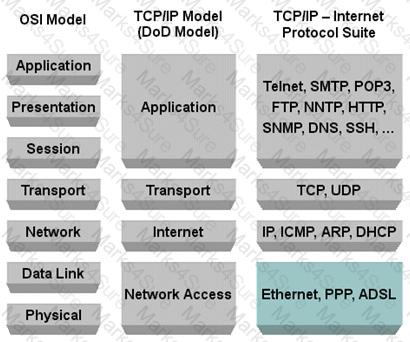
Graphic above from: http://bit.kuas.edu.tw/
REALITY VERSUS THE STANDARD
In real life today, this is getting very confusing. Many books and references will not use exactly the same names as the initial RFC that was published. For example, the Link layer is often times called Network Access. The same applies with Transport which is often times called Host-to-Host and vice versa.
The following answer is incorrect:
The session layer is defined within the OSI/ISO model but not within the DOD model. Being incorrect it made it the best answer according to the question. It does not belong to the DoD TCP/IP Model.
Reference(s) Used for this question:
http://www.freesoft.org/CIE/RFC/1122/
http://bit.kuas.edu.tw/~csshieh/teach/np/tcpip/
Which of the following is true related to network sniffing?
Options:
Sniffers allow an attacker to monitor data passing across a network.
Sniffers alter the source address of a computer to disguise and exploit weak authentication methods.
Sniffers take over network connections.
Sniffers send IP fragments to a system that overlap with each other.
Answer:
AExplanation:
The following answers are incorrect: Sniffers alter the source address of a computer to disguise and exploit weak authentication methods. IP Spoofing is a network-based attack, which involves altering the source address of a computer to disguise the attacker and exploit weak authentication methods.
Sniffers take over network connections. Session Hijacking tools allow an attacker to take over network connections, kicking off the legitimate user or sharing a login.
Sniffers send IP fragments to a system that overlap with each other. Malformed Packet attacks are a type of DoS attack that involves one or two packets that are formatted in an unexpected way. Many vendor product implementations do not take into account all variations of user entries or packet types. If software handles such errors poorly, the system may crash when it receives such packets. A classic example of this type of attack involves sending IP fragments to a system that overlap with each other (the fragment offset values are incorrectly set. Some unpatched Windows and Linux systems will crash when the encounter such packets.
The following reference(s) were/was used to create this question:
Source: TIPTON, Harold F. & KRAUSE, MICKI, Information Security Management Handbook, 4th Edition, Volume 2, Auerbach, NY, NY 2001, Chapter 22, Hacker Tools and Techniques by Ed Skoudis.
ISC2 OIG, 2007 p. 137-138, 419
The IP header contains a protocol field. If this field contains the value of 1, what type of data is contained within the IP datagram?
Options:
TCP.
ICMP.
UDP.
IGMP.
Answer:
BExplanation:
If the protocol field has a value of 1 then it would indicate it was ICMP.
The following answers are incorrect:
TCP. Is incorrect because the value for a TCP protocol would be 6.
UDP. Is incorrect because the value for an UDP protocol would be 17.
IGMP. Is incorrect because the value for an IGMP protocol would be 2.
Which of the following services relies on UDP?
Options:
FTP
Telnet
DNS
SMTP
Answer:
CExplanation:
DNS relies on connectionless UDP whereas services like FTP, Telnet and SMTP rely on TCP.
Source: ROTHKE, Ben, CISSP CBK Review presentation on domain 2, August 1999.
Within the OSI model, at what layer are some of the SLIP, CSLIP, PPP control functions provided?
Options:
Data Link
Transport
Presentation
Application
Answer:
AExplanation:
RFC 1661 - The Point-to-Point Protocol (PPP) specifies that the Point-to-Point Protocol (PPP) provides a standard method for transporting multi-protocol datagrams over point-to-point links. PPP is comprised of three main components:
1 A method for encapsulating multi-protocol datagrams.
2 A Link Control Protocol (LCP) for establishing, configuring, and testing the data-link connection.
3 A family of Network Control Protocols (NCPs) for establishing and configuring different network-layer protocols.
Asynchronous Communication transfers data by sending:
Options:
bits of data sequentially
bits of data sequentially in irregular timing patterns
bits of data in sync with a heartbeat or clock
bits of data simultaneously
Answer:
BExplanation:
Asynchronous Communication transfers data by sending bits of data in irregular timing patterns.
In asynchronous transmission each character is transmitted separately, that is one character at a time. The character is preceded by a start bit, which tells the receiving end where the character coding begins, and is followed by a stop bit, which tells the receiver where the character coding ends. There will be intervals of ideal time on the channel shown as gaps. Thus there can be gaps between two adjacent characters in the asynchronous communication scheme. In this scheme, the bits within the character frame (including start, parity and stop bits) are sent at the baud rate.
The START BIT and STOP BIT including gaps allow the receiving and sending computers to synchronise the data transmission. Asynchronous communication is used when slow speed peripherals communicate with the computer. The main disadvantage of asynchronous communication is slow speed transmission. Asynchronous communication however, does not require the complex and costly hardware equipments as is required for synchronous transmission.
Asynchronous communication is transmission of data without the use of an external clock signal. Any timing required to recover data from the communication symbols is encoded within the symbols. The most significant aspect of asynchronous communications is variable bit rate, or that the transmitter and receiver clock generators do not have to be exactly synchronized.
The asynchronous communication technique is a physical layer transmission technique which is most widely used for personal computers providing connectivity to printers, modems, fax machines, etc.
An asynchronous link communicates data as a series of characters of fixed size and format. Each character is preceded by a start bit and followed by 1-2 stop bits.
Parity is often added to provide some limited protection against errors occurring on the link.
The use of independent transmit and receive clocks constrains transmission to relatively short characters ( < 8 bits) and moderate data rates ( < 64 kbps, but typically lower).
The asynchronous transmitter delimits each character by a start sequence and a stop sequence. The start bit (0), data (usually 8 bits plus parity) and stop bit(s) (1) are transmitted using a shift register clocked at the nominal data rate.
When asynchronous transmission is used to support packet data links (e.g. IP), then special characters have to be used ( " framing " ) to indicate the start and end of each frame transmitted.
One character (none as an escape character) is reserved to mark any occurrence of the special characters within the frame. In this way the receiver is able to identify which characters are part of the frame and which are part of the " framing " .
Packet communication over asynchronous links is used by some users to get access to a network using a modem.
Most Wide Area Networks use synchronous links and a more sophisticated link protocol
Source: KRUTZ, Ronald L. & VINES, Russel D., The CISSP Prep Guide: Mastering the Ten Domains of Computer Security, 2001, John Wiley & Sons, Page 100.
and
http://en.wikipedia.org/wiki/Asynchronous_communication
and
http://www.erg.abdn.ac.uk/users/gorry/course/phy-pages/async.html
and
http://www.ligaturesoft.com/data_communications/async-data-transmission.html
Unshielded Twisted Pair cabling is a:
Options:
four-pair wire medium that is used in a variety of networks.
three-pair wire medium that is used in a variety of networks.
two-pair wire medium that is used in a variety of networks.
one-pair wire medium that is used in a variety of networks.
Answer:
AExplanation:
Unshielded Twisted Pair cabling is a four-pair wire medium that is used in a variety of networks.
Source: KRUTZ, Ronald L. & VINES, Russel D., The CISSP Prep Guide: Mastering the Ten Domains of Computer Security, 2001, John Wiley & Sons, Page 101.
What enables a workstation to boot without requiring a hard or floppy disk drive?
Options:
Bootstrap Protocol (BootP).
Reverse Address Resolution Protocol (RARP).
Address Resolution Protocol (ARP).
Classless Inter-Domain Routing (CIDR).
Answer:
AExplanation:
Bootstrap Protocol (BootP) is an Internet Layer protocol that enables a workstation to boot without requiring a hard or floppy disk drive. Reverse Address Resolution Protocol (RARP) is a TCP/IP protocol that permits a physical address, such as an Ethernet address, to be translated into an IP address. Address Resolution Protocol (ARP) is a TCP/IP protocol that permits an IP address to be translated into a physical address. Classless Inter-Domain Routing (CIDR) is a new IP addressing scheme.
Source: KRUTZ, Ronald L. & VINES, Russel D., The CISSP Prep Guide: Mastering the Ten Domains of Computer Security, 2001, John Wiley & Sons, Page 88.
Which of the following statements pertaining to IPSec is incorrect?
Options:
IPSec can help in protecting networks from some of the IP network attacks.
IPSec provides confidentiality and integrity to information transferred over IP networks through transport layer encryption and authentication.
IPSec protects against man-in-the-middle attacks.
IPSec protects against spoofing.
Answer:
BExplanation:
IPSec provides confidentiality and integrity to information transferred over IP networks through network (not transport) layer encryption and authentication. All other statements are correct.
Source: TIPTON, Harold F. & KRAUSE, Micki, Information Security Management Handbook, 4th edition (volume 1), 2000, CRC Press, Chapter 6, Extranet Access Control Issues (page 110).
Which OSI/ISO layer does a SOCKS server operate at?
Options:
Session layer
Transport layer
Network layer
Data link layer
Answer:
AExplanation:
A SOCKS based server operates at the Session layer of the OSI model.
SOCKS is an Internet protocol that allows client-server applications to transparently use the services of a network firewall. SOCKS is an abbreviation for " SOCKetS " . As of Version 5 of SOCK, both UDP and TCP is supported.
One of the best known circuit-level proxies is SOCKS proxy server. The basic purpose of the protocol is to enable hosts on one side of a SOCKS server to gain access to hosts on the other side of a SOCKS Server, without requiring direct “IP-reachability”
The protocol was originally developed by David Koblas, a system administrator of MIPS Computer Systems. After MIPS was taken over by Silicon Graphics in 1992, Koblas presented a paper on SOCKS at that year ' s Usenix Security Symposium and SOCKS became publicly available. The protocol was extended to version 4 by Ying-Da Lee of NEC.
SOCKS includes two components, the SOCKS server and the SOCKS client.
The SOCKS protocol performs four functions:
Making connection requests
Setting up proxy circuits
Relaying application data
Performing user authentication (optional)
Source:
KRUTZ, Ronald L. & VINES, Russel D., The CISSP Prep Guide: Mastering the Ten Domains of Computer Security, John Wiley & Sons, 2001, Chapter 3: Telecommunications and Network Security (page 96).
and
http://en.wikipedia.org/wiki/SOCKS
and
http://www.faqs.org/rfcs/rfc1928.html
and
The ISC2 OIG on page 619
All hosts on an IP network have a logical ID called a(n):
Options:
IP address.
MAC address.
TCP address.
Datagram address.
Answer:
AExplanation:
All hosts on a network have a logical ID that is called an IP address. An IP address is a numeric identifier that is assigned to each machine on an IP network. It designates the location of a device on a network. A MAC address is typically called a hardware address because it is " burned " into the NIC card. TCP address and Datagram address are imposter answers.
Source: KRUTZ, Ronald L. & VINES, Russel D., The CISSP Prep Guide: Mastering the Ten Domains of Computer Security, 2001, John Wiley & Sons, Page 87.
Similar to Secure Shell (SSH-2), Secure Sockets Layer (SSL) uses symmetric encryption for encrypting the bulk of the data being sent over the session and it uses asymmetric or public key cryptography for:
Options:
Peer Authentication
Peer Identification
Server Authentication
Name Resolution
Answer:
AExplanation:
SSL provides for Peer Authentication. Though peer authentication is possible, authentication of the client is seldom used in practice when connecting to public e-commerce web sites. Once authentication is complete, confidentiality is assured over the session by the use of symmetric encryption in the interests of better performance.
The following answers were all incorrect:
" Peer identification " is incorrect. The desired attribute is assurance of the identity of the communicating parties provided by authentication and NOT identification. Identification is only who you claim to be. Authentication is proving who you claim to be.
" Server authentication " is incorrect. While server authentication only is common practice, the protocol provides for peer authentication (i.e., authentication of both client and server). This answer was not complete.
" Name resolution " is incorrect. Name resolution is commonly provided by the Domain Name System (DNS) not SSL.
Reference(s) used for this question:
CBK, pp. 496 - 497.
Authentication Headers (AH) and Encapsulating Security Payload (ESP) protocols are the driving force of IPSec. Authentication Headers (AH) provides the following service except:
Options:
Authentication
Integrity
Replay resistance and non-repudiations
Confidentiality
Answer:
DExplanation:
AH provides integrity, authentication, and non-repudiation. AH does not provide encryption which means that NO confidentiality is in place if only AH is being used. You must make use of the Encasulating Security Payload if you wish to get confidentiality.
IPSec uses two basic security protocols: Authentication Header (AH) and Encapsulation Security Payload.
AH is the authenticating protocol and the ESP is the authenticating and encrypting protocol that uses cryptographic mechanisms to provide source authentication, confidentiality and message integrity.
The modes of IPSEC, the protocols that have to be used are all negotiated using Security Association. Security Associations (SAs) can be combined into bundles to provide authentication, confidentialility and layered communication.
Source:
TIPTON, Harold F. & KRAUSE, MICKI, Information Security Management Handbook, 4th Edition, Volume 2, 2001, CRC Press, NY, page 164.
also see:
Shon Harris, CISSP All In One Exam Guide, 5th Edition, Page 758
The Logical Link Control sub-layer is a part of which of the following?
Options:
The ISO/OSI Data Link layer
The Reference monitor
The Transport layer of the TCP/IP stack model
Change management control
Answer:
AExplanation:
The OSI/ISO Data Link layer is made up of two sub-layers; (1) the Media Access Control layer refers downward to lower layer hardware functions and (2) the Logical Link Control refers upward to higher layer software functions. Other choices are distracters.
Source: ROTHKE, Ben, CISSP CBK Review presentation on domain 2, August 1999.
Which of the following is a token-passing scheme like token ring that also has a second ring that remains dormant until an error condition is detected on the primary ring?
Options:
Fiber Distributed Data Interface (FDDI).
Ethernet
Fast Ethernet
Broadband
Answer:
AExplanation:
FDDI is a token-passing ring scheme like a token ring, yet it also has a second ring that remains dormant until an error condition is detected on the primary ring.
Fiber Distributed Data Interface (FDDI) provides a 100 Mbit/s optical standard for data transmission in a local area network that can extend in range up to 200 kilometers (124 miles). Although FDDI logical topology is a ring-based token network, it does not use the IEEE 802.5 token ring protocol as its basis; instead, its protocol is derived from the IEEE 802.4 token bus timed token protocol. In addition to covering large geographical areas, FDDI local area networks can support thousands of users. As a standard underlying medium it uses optical fiber, although it can use copper cable, in which case it may be refer to as CDDI (Copper Distributed Data Interface). FDDI offers both a Dual-Attached Station (DAS), counter-rotating token ring topology and a Single-Attached Station (SAS), token bus passing ring topology.
Ethernet is a family of frame-based computer networking technologies for local area networks (LANs). The name came from the physical concept of the ether. It defines a number of wiring and signaling standards for the Physical Layer of the OSI networking model as well as a common addressing format and Media Access Control at the Data Link Layer.
In computer networking, Fast Ethernet is a collective term for a number of Ethernet standards that carry traffic at the nominal rate of 100 Mbit/s, against the original Ethernet speed of 10 Mbit/s. Of the fast Ethernet standards 100BASE-TX is by far the most common and is supported by the vast majority of Ethernet hardware currently produced. Fast Ethernet was introduced in 1995 and remained the fastest version of Ethernet for three years before being superseded by gigabit Ethernet.
Broadband in data can refer to broadband networks or broadband Internet and may have the same meaning as above, so that data transmission over a fiber optic cable would be referred to as broadband as compared to a telephone modem operating at 56,000 bits per second. However, a worldwide standard for what level of bandwidth and network speeds actually constitute Broadband have not been determined.[1]
Broadband in data communications is frequently used in a more technical sense to refer to data transmission where multiple pieces of data are sent simultaneously to increase the effective rate of transmission, regardless of data signaling rate. In network engineering this term is used for methods where two or more signals share a medium.[Broadband Internet access, often shortened to just broadband, is a high data rate Internet access—typically contrasted with dial-up access using a 56k modem.
Dial-up modems are limited to a bitrate of less than 56 kbit/s (kilobits per second) and require the full use of a telephone line—whereas broadband technologies supply more than double this rate and generally without disrupting telephone use.
Source:
KRUTZ, Ronald L. & VINES, Russel D., The CISSP Prep Guide: Mastering the Ten Domains of Computer Security, 2001, John Wiley & Sons, Page 72.
also see:
http://en.wikipedia.org/
Which of the following is NOT a characteristic or shortcoming of packet filtering gateways?
Options:
The source and destination addresses, protocols, and ports contained in the IP packet header are the only information that is available to the router in making a decision whether or not to permit traffic access to an internal network.
They don ' t protect against IP or DNS address spoofing.
They do not support strong user authentication.
They are appropriate for medium-risk environment.
Answer:
DExplanation:
Packet filtering firewalls use routers with packet filtering rules to grant or deny access based on source address, destination address, and port.
They offer minimum security but at a very low cost, and can be an appropriate choice for a low-risk environment.
Source: TIPTON, Harold F. & KRAUSE, Micki, Information Security Management Handbook, 4th edition (volume 1), 2000, CRC Press, Chapter 3, Secured Connections to External Networks (page 60).
Which of the following statements is NOT true of IPSec Transport mode?
Options:
It is required for gateways providing access to internal systems
Set-up when end-point is host or communications terminates at end-points
If used in gateway-to-host communication, gateway must act as host
When ESP is used for the security protocol, the hash is only applied to the upper layer protocols contained in the packet
Answer:
AExplanation:
Source: TIPTON, Harold F. & KRAUSE, MICKI, Information Security Management Handbook, 4th Edition, Volume 2, 2001, CRC Press, NY, Pages 166-167.
Telnet and rlogin use which protocol?
Options:
UDP.
SNMP.
TCP.
IGP.
Answer:
CExplanation:
TCP allows for reliabilty in connections which would be required for terminal emulation.
The following answers are incorrect:
UDP. Is incorrect because with User Datagram Protocol (UDP) you don ' t have a reliable transmission, datagrams could arrive out of sequence.
SNMP. Is incorrect because it is a network management protocol, Simple Network Management Protocol (SNMP).
IGP. Is incorrect because Interior Gateway Protocol (IGP) is used interally on a network.
Which of the following would be used to detect and correct errors so that integrity and confidentiality of transactions over networks may be maintained while preventing unauthorize interception of the traffic?
Options:
Information security
Server security
Client security
Communications security
Answer:
DExplanation:
Communications security is the discipline of preventing unauthorized interceptors from accessing telecommunications in an intelligible form, while still delivering content to the intended recipients. In the United States Department of Defense culture, it is often referred to by the abbreviation COMSEC. The field includes cryptosecurity, transmission security, emission security, traffic-flow security and physical security of COMSEC equipment.
All of the other answers are incorrect answers:
Information security
Information security would be the overall program but communications security is the more specific and better answer. Information security means protecting information and information systems from unauthorized access, use, disclosure, disruption, modification, perusal, inspection, recording or destruction.
The terms information security, computer security and information assurance are frequently incorrectly used interchangeably. These fields are interrelated often and share the common goals of protecting the confidentiality, integrity and availability of information; however, there are some subtle differences between them.
These differences lie primarily in the approach to the subject, the methodologies used, and the areas of concentration. Information security is concerned with the confidentiality, integrity and availability of data regardless of the form the data may take: electronic, print, or other forms. Computer security can focus on ensuring the availability and correct operation of a computer system without concern for the information stored or processed by the computer.
Server security
While server security plays a part in the overall information security program, communications security is a better answer when talking about data over the network and preventing interception. See publication 800-123 listed in the reference below to learn more.
Client security
While client security plays a part in the overall information security program, communications security is a better answer. Securing the client would not prevent interception of data or capture of data over the network. Today people referred to this as endpoint security.
References:
http://csrc.nist.gov/publications/nistpubs/800-123/SP800-123.pdf
and
https://en.wikipedia.org/wiki/Information_security
and
https://en.wikipedia.org/wiki/Communications_security
PDF + Testing Engine

Testing Engine
PDF (Q&A)