- Home
- NCCT
- Surgical Technology
- TS-C
- Tech in Surgery - Certified (NCCT), TS-C (NCCT) Questions and Answers
Free Practice Questions for the NCCT Surgical Technology TS-C Exam (2026 Updated)
At Marks4sure, we are dedicated to providing IT professionals with the most accurate and reliable preparation materials for the NCCT TS-C exam. To support your certification journey, we have made a selection of our premium 2026 Surgical Technology practice questions and answers available completely free. You can take this practice test as many times as you need. Every question includes a detailed, expertly verified explanation to ensure you fully grasp the core security concepts before test day.
When performing a 10-minute gravity-displacement steam sterilization cycle, what is the appropriate temperature range?
Options:
220–230°F
270–275°F
250–255°F
290–300°F
Answer:
BExplanation:
The appropriate examination answer is 270–275°F , corresponding to the temperature range associated with high-temperature steam sterilization cycles.
The Centers for Disease Control and Prevention identifies a 10-minute exposure at 270°F (132°C) for specified immediate-use steam sterilization loads processed in gravity-displacement sterilizers, particularly mixed loads containing porous items or instruments with lumens.
CDC
Gravity-displacement sterilizers introduce saturated steam into the chamber, displacing cooler air through the drain. Effective sterilization requires adequate removal of air and direct contact between saturated steam and all instrument surfaces.
At the appropriate temperature, moist heat destroys microorganisms through protein denaturation and disruption of essential cellular processes.
Option A is incorrect because 220–230°F is below the temperature required for the specified 10-minute cycle.
Option C is incorrect because a temperature near 250°F requires a substantially longer exposure period for conventional gravity-displacement sterilization.
Option D is incorrect because 290–300°F exceeds the standard temperature range identified in the examination scenario.
Sterilization parameters depend on the sterilizer configuration, instrument design, packaging, and manufacturer ' s validated instructions. A 10-minute exposure should not be applied indiscriminately to every load.
Immediate-use sterilization also requires appropriate monitoring, aseptic transport, and compliance with institutional policies.
When setting up for the first surgical case of the day, what should be the FIRST item on the surgical technologist ' s checklist?
Options:
Wipe down the operating room with soap and water.
Make sure all equipment is present for the case.
Open sterile supplies for the procedure.
Make sure the surgical lights are functioning.
Answer:
BExplanation:
The surgical technologist should verify that all equipment required for the scheduled procedure is present and available before opening sterile supplies .
Effective operating room preparation begins with reviewing the surgeon ' s preference card, identifying the required instruments and specialty equipment, and confirming that essential supplies are available.
Equipment verification allows shortages, malfunctions, and incompatibilities to be identified before the patient enters the operating room or sterile supplies are opened.
The Association of periOperative Registered Nurses (AORN) recommends reviewing the preference card, ensuring required supplies are available, and verifying that equipment is functioning before proceeding with sterile setup.
Aorn.org+1
Option A is not the best answer because operating room environmental cleaning must follow an approved cleaning and disinfection protocol. Soap and water alone do not necessarily provide the required environmental disinfection.
Option C is incorrect because sterile supplies should not be opened before the operating room environment and necessary equipment have been verified.
Option D identifies an important equipment-safety check. Surgical lights must be functioning correctly; however, this check forms part of the broader assessment of equipment readiness.
The technologist should also verify suction, electrosurgical equipment, patient positioning devices, and specialty systems according to the operative requirements.
The surgical hand scrub is intended to remove which of the following microorganisms from the skin?
Options:
Opportunistic
Resident
Transient
Indigenous
Answer:
CExplanation:
The principal objective of surgical hand antisepsis is to eliminate transient microorganisms and substantially reduce resident microbial flora on the hands and forearms before sterile gowning and gloving.
Transient microorganisms are organisms acquired through contact with patients, contaminated objects, environmental surfaces, and other external sources. They predominantly occupy superficial skin layers and are more readily removed through appropriate handwashing and antiseptic preparation.
Option C is correct because transient microorganisms are the population most directly targeted for removal during surgical hand preparation.
Option B is incorrect as the best single answer because resident flora colonize deeper structures, including hair follicles and sebaceous glands. Surgical antisepsis reduces their numbers but does not completely eliminate them.
Option D is incorrect because indigenous microorganisms generally represent normal resident skin flora.
Option A is incorrect because opportunistic describes a microorganism ' s capacity to cause infection under favorable conditions, rather than its classification according to duration of skin colonization.
The World Health Organization distinguishes the two principal objectives of surgical hand preparation: removal of transient flora and substantial reduction of resident flora.
NCBI
Maintaining antimicrobial activity throughout surgery is important because microorganisms remaining beneath surgical gloves may contribute to contamination if gloves become perforated.
Reference Topics: NCCT TS-C Detailed Test Plan — Preoperative Care and Preparation, Section 2C2: Surgical Hand Scrub Sequence; Aseptic Technique; Microbiology; Infection Prevention.
A pregnant patient presents to the emergency department with right upper quadrant abdominal pain and is scheduled for surgery. She is currently in the third trimester of pregnancy. Which of the following procedures should the surgical technologist anticipate?
Options:
Splenectomy
Gastrectomy
Bowel resection
Appendectomy
Answer:
DExplanation:
Appendectomy is the most appropriate examination answer because acute appendicitis may present with right upper quadrant abdominal pain during advanced pregnancy.
During pregnancy, enlargement of the uterus alters the position and relationships of abdominal organs. The appendix may be displaced upward, resulting in pain outside the conventional right lower quadrant location.
Acute appendicitis remains an important nonobstetric surgical emergency during pregnancy. Delayed diagnosis or treatment may increase the risk of appendiceal perforation, peritonitis, maternal sepsis, and adverse fetal outcomes.
The British Journal of Surgery ' s guidelines on general surgical emergencies in pregnancy recognize that the enlarging uterus can alter appendiceal position and produce right upper quadrant pain. However, right lower quadrant pain remains common, and diagnosis requires appropriate clinical assessment and imaging.
OUP Academic+1
Option A is incorrect because splenectomy primarily concerns the spleen, which lies in the left upper abdomen.
Option B is incorrect because gastrectomy involves removal of all or part of the stomach.
Option C is incorrect because bowel resection cannot be predicted from pain location alone.
The surgical technologist should anticipate appropriate appendectomy instrumentation, laparoscopic or open surgical equipment, and pregnancy-specific positioning requirements.
Clinical qualification: Right upper quadrant pain during pregnancy has several possible causes, including gallbladder disease and preeclampsia-related hepatic complications. Appendectomy is the best answer among those provided, not a diagnosis established by the symptom alone.
Sterile items that are protected from the environment have been proven to remain sterile:
Options:
Indefinitely
1 year
28 days
6 months
Answer:
AExplanation:
Under the principle of event-related sterility , appropriately sterilized, packaged, handled, and stored medical items may remain sterile indefinitely, provided no event compromises the integrity of their sterile barrier.
The Centers for Disease Control and Prevention recognizes event-related rather than strictly time-related sterility for appropriately packaged sterile supplies. The duration of sterility depends on packaging integrity, storage conditions, handling, and environmental exposure.
CDC
Option A is correct because intact packaging maintained under appropriate conditions can preserve sterility without a universal predetermined expiration period.
Options B, C, and D are incorrect because they assign arbitrary time limits that do not reflect the event-related sterility principle.
Examples of events that may compromise sterility include torn packaging, punctures, moisture exposure, broken seals, excessive handling, and storage in contaminated environments.
Before introducing an item to the sterile field, the surgical technologist must inspect its packaging, verify applicable sterilization indicators, and assess whether the item remains suitable for use.
A critical distinction exists between sterility and product expiration. Even if a sterile barrier remains intact, a manufacturer-assigned expiration date for the product or packaging system must still be observed.
Therefore, indefinite sterility applies only when the sterile barrier remains effective and relevant manufacturer and institutional requirements are satisfied.
Which of the following are types of surgical drains? (Select the three correct answers.)
Options:
Hemovac
Vessel loop
T-tube
Penrose
Endotracheal (ET) tube
Answer:
A, C, DExplanation:
Surgical drains are devices used to evacuate accumulated blood, bile, serous fluid, purulent material, or other secretions from operative sites. Their function is to prevent unwanted fluid accumulation, facilitate monitoring, and support postoperative recovery.
Option A — Hemovac: A closed-suction drainage system that uses negative pressure to remove blood and serous fluid from operative wounds. It is commonly associated with orthopedic and other procedures requiring postoperative fluid evacuation.
Option C — T-tube: A specialized biliary drainage device inserted into the common bile duct, typically following duct exploration. Its transverse segment lies within the duct, while the longitudinal segment permits bile to drain externally.
Option D — Penrose: A soft, flexible, passive drainage device that allows fluid to escape through gravity and capillary action. It is commonly used for selected superficial wounds and surgical spaces.
ACS+2
Option B is not classified as a conventional surgical drain in this question. Vessel loops are primarily used to identify, isolate, or retract vessels and other structures, although they can also be employed as temporary loop drains in selected abscess procedures.
Option E is incorrect because an endotracheal tube maintains airway access and facilitates ventilation rather than draining a surgical wound.
Reference Topics: NCCT TS-C Detailed Test Plan, Section 3A3 — Preparation of Surgical Devices, Including Drains, Catheters, and Tubing; Surgical Instrumentation and Postoperative Care.
ncctinc.com
At the end of a surgical procedure, the surgical technologist should begin the turnover process by:
Options:
Applying sterile dressings to the wound.
Wiping down the furniture with a disinfectant.
Preparing instruments for transport to decontamination.
Counting sponges, needles, and instruments after skin closure.
Answer:
CExplanation:
Preparing contaminated surgical instruments for transport to the decontamination department is the most appropriate initial turnover activity among the listed options.
Following completion of the procedure and transfer of the patient from the operating room, the surgical technologist begins systematic breakdown of the sterile field. Proper instrument management is essential to prevent occupational injuries, preserve instrument functionality, and reduce microbial contamination.
The Association of Surgical Technologists (AST) emphasizes point-of-use instrument treatment as an integral component of sterile-field breakdown. Instruments should be inspected for damage, gross contamination should be removed, and instruments should be kept appropriately moist using a manufacturer-approved pretreatment method. Sharps must be segregated and disposed of safely following count reconciliation.
Option A is incorrect because application of sterile wound dressings occurs before patient transfer and formal room turnover.
Option B is incorrect because environmental disinfection follows the removal and appropriate segregation of contaminated instruments and supplies.
Option D is incorrect because required surgical counts must be completed at appropriate stages of closure, not deferred until after skin closure.
The AST additionally requires sterile instruments to remain available until the patient leaves the operating room. Formal breakdown should therefore not begin prematurely.
ast.org
Which of the following is necessary to have on the sterile field when assisting with a gynecological procedure using an Nd:YAG laser?
Options:
Normal saline
Matte-finished instruments
Surgical-grade titanium instruments
Reflective instruments
Answer:
BExplanation:
Matte-finished surgical instruments are specifically recommended for laser procedures because their nonreflective surfaces reduce the potential for unintended laser beam reflection.
The neodymium-doped yttrium aluminum garnet (Nd:YAG) laser produces concentrated optical energy that may be used for tissue coagulation and other selected surgical applications. When laser energy strikes polished metallic instruments, reflected energy can potentially injure adjacent tissues or surgical personnel.
Matte, anodized, or appropriately coated instruments reduce specular reflection. AORN ' s laser safety guidelines recommend nonreflective instruments near the laser application site.
content.yudu.com
Option A is not inherently incorrect clinically because sterile saline or water should be readily available for laser fire response and protection of adjacent tissues. However, it does not address the specific instrument-surface requirement.
Option C is incorrect because surgical-grade titanium alone does not guarantee a nonreflective surface. Material composition and surface finish must both be evaluated.
Option D is incorrect because highly reflective instruments increase the potential for unintended laser energy reflection.
The surgical technologist must verify instrument compatibility, inspect protective coatings, confirm laser-specific eye protection, and ensure that appropriate fire-safety precautions are established.
Which of the following is an example of a sentinel event?
Options:
High traffic in the operating room during surgery.
The electronic documentation system becomes unavailable during surgery.
Fire on the surgical field.
The surgical technologist hands the surgeon a local anesthetic instead of heparin solution.
Answer:
CExplanation:
A fire occurring on the surgical field is a sentinel event because it represents a serious, potentially preventable patient-safety incident that can cause burns, airway injuries, respiratory complications, and death.
Operating room fires involve three essential elements: an ignition source, a fuel source, and an oxidizer. Electrosurgical devices and lasers commonly provide ignition energy, while surgical drapes, sponges, and alcohol-based preparations may serve as fuel. Supplemental oxygen can substantially increase combustion risk.
The Joint Commission includes fires occurring during patient care within its sentinel event framework. Its 2025 policy recognizes fires and related hazardous thermal events caused by equipment used during direct patient care. The expanded reporting criteria scheduled for January 1, 2027, explicitly include qualifying fires regardless of patient harm.
digitalassets.jointcommission.org+1
Option A is incorrect because excessive operating room traffic is an infection prevention and environmental safety concern rather than an automatic sentinel event.
Option B is incorrect because temporary electronic documentation failure is an operational disruption unless it contributes to a qualifying serious safety event.
Option D represents a potentially serious medication error or near miss. Its classification depends on whether the medication was administered and the resulting patient harm.
The surgical technologist must understand fire prevention, participate in fire-risk assessment, and assist with immediate emergency procedures when necessary.
Which of the following retractors is considered atraumatic?
Options:
Skin hook
Deaver
Weitlaner
Gelpi
Answer:
BExplanation:
The Deaver retractor is considered an atraumatic surgical retractor because its broad, smooth, curved blade allows gentle displacement of soft tissues and abdominal organs without penetrating them with sharp hooks or pointed prongs.
Deaver retractors are frequently used during abdominal, thoracic, and pelvic procedures to maintain exposure of deeper anatomical structures. Their curved configuration enables the surgical assistant to retract the abdominal wall, liver, bowel, or other internal structures while distributing pressure over a relatively broad surface.
Atraumatic retraction is particularly important when manipulating delicate or highly vascular tissues because excessive pressure or penetration may cause bruising, ischemia, tearing, or hemorrhage. Nevertheless, even a smooth retractor can cause tissue injury if excessive force is applied or retraction is prolonged.
OUP Academic+1
Option A is incorrect because skin hooks use pointed tips to engage superficial tissues.
Option C is incorrect because the Weitlaner is a self-retaining retractor with multiple prongs, which may be sharp or blunt, depending on the instrument configuration.
Option D is incorrect because the Gelpi is a self-retaining retractor with opposing pointed hooks designed to maintain wound exposure.
The surgical technologist must recognize retractor configurations, anticipate the surgeon ' s exposure requirements, and select instruments appropriate to the tissue being manipulated.
Which of the following information would be found on a surgeon ' s preference card? (Select the three correct answers.)
Options:
Anesthesia medications needed for the case
Supplies needed for the case
Sutures needed for the case
Surgical instruments needed for the case
Patient preferences needed for the case
Answer:
B, C, DExplanation:
The surgeon ' s preference card provides procedure-specific information used to prepare the operating room and establish an efficient surgical setup.
Option B — Supplies needed for the case: Preference cards identify required disposable supplies, sterile drapes, sponges, irrigation materials, dressings, and specialty items.
Option C — Sutures needed for the case: The card may specify preferred suture materials, sizes, needle configurations, quantities, and other wound closure requirements.
Option D — Surgical instruments needed for the case: Instrument trays, specialized retractors, clamps, powered equipment, and other procedure-specific instruments are commonly listed.
AORN identifies preference cards as essential preparation tools that support standardized equipment selection, accurate supply preparation, and efficient surgical workflow.
Aorn.org+1
Option A is not one of the intended responses because anesthetic medication selection and administration are primarily directed by the anesthesia provider. Although some preference cards contain information concerning local medications or other medications used by the surgeon, anesthesia drug requirements are managed separately.
Option E is incorrect because individual patient preferences are documented through patient assessment, consent, and other clinical records rather than the surgeon ' s standard procedural preference card.
Accurate preference cards reduce unnecessary interruptions, prevent missing supplies, and support appropriate surgical preparation.
Upon opening a double peel-pack pouch containing hemostats, the surgical technologist ' s finger touches the inside of the packaging. Which of the following should the surgical technologist do?
Options:
Open the inner wrapped package onto the sterile field.
Flash-sterilize the inner wrapped package of hemostats.
Send the package to the Sterile Processing Department (SPD) for reprocessing.
Discard both wrappers and the instruments.
Answer:
AExplanation:
The most appropriate examination answer is to continue with the intact inner sterile package , provided the finger contacted only the inside of the outer packaging and did not contaminate the inner pouch or its contents.
Double peel packaging consists of an inner sterilization pouch enclosed within an outer pouch. When validated by the manufacturer, this packaging arrangement can facilitate aseptic presentation of instruments to the sterile field.
If the outer pouch becomes contaminated during opening, the intact inner pouch can continue to provide a sterile barrier. However, the person opening the package must avoid transferring contamination to the exterior of the inner pouch during removal and presentation.
Option B is incorrect because immediate-use steam sterilization is not indicated simply because the outer packaging has been touched, provided the inner sterile barrier remains uncompromised.
Option C becomes appropriate if the inner package is contaminated or its integrity cannot be established.
Option D is incorrect because reusable hemostats generally undergo validated reprocessing rather than disposal.
STERIS explains that double-pouch packaging may be used to facilitate aseptic presentation, but the arrangement must comply with the manufacturer ' s validated instructions.
steris.com
Important distinction: The question does not specify whether the finger contacted the inner pouch. If it did, the inner pouch should not automatically be considered sterile. Safe use requires confirmation that the remaining sterile barrier is intact and uncontaminated.
Who directs the move when transferring a patient following surgery?
Options:
Circulator
Surgeon
Surgical technologist
Anesthesia provider
Answer:
DExplanation:
The anesthesia provider directs the transfer of a patient following surgery because this professional is responsible for assessing the patient ' s anesthetic recovery, protecting the airway, and coordinating movement when the patient ' s physiological condition permits safe transfer.
During the immediate postoperative period, patients may remain sedated, partially anesthetized, intubated, or physiologically unstable. Moving the patient prematurely can result in airway obstruction, accidental dislodgement of an endotracheal tube, loss of intravenous access, or injury to the patient and healthcare personnel.
The Association of Surgical Technologists ' patient transportation guidelines specify that the anesthesia provider indicates when an immobile patient may be moved and maintains responsibility for protecting the head, neck, and airway during transfer.
ast.org
Option A is incorrect because the circulating nurse coordinates equipment, verifies the safety of lines and drains, and assists with transfer but does not ordinarily direct movement when the anesthesia provider is managing the airway.
Option B is incorrect because the surgeon ' s primary responsibility concerns surgical management and postoperative surgical orders.
Option C is incorrect because the surgical technologist assists with positioning and transfer but does not independently authorize patient movement.
Before transfer, the team must secure the stretcher and operating table, manage attached devices, and use appropriate transfer equipment. Movement should occur on a clearly communicated command.
A geriatric patient with compromised nervous and integumentary systems arrives in the operating room. The circulating nurse asks the surgical technologist to pad the ulnar nerve and place a protective dressing over the sacral wound. Where should the surgical technologist place the pad and dressing?
Options:
Dress the gluteal cleft and pad the elbow.
Pad the gluteal cleft and dress the elbow.
Dress the axilla and pad the elbow.
Dress the elbow and pad the axilla.
Answer:
AExplanation:
The appropriate intervention is to apply the prescribed wound dressing over the sacral region near the gluteal cleft and provide protective padding at the elbow to safeguard the ulnar nerve .
The ulnar nerve passes posterior to the medial epicondyle of the humerus, where it is relatively superficial and vulnerable to compression. Prolonged pressure, excessive elbow flexion, or inappropriate arm positioning can produce perioperative ulnar neuropathy.
Appropriate elbow padding, neutral forearm positioning, and avoidance of excessive pressure help protect the nerve.
The sacral region is a common site of pressure-related skin injury, particularly in older patients with fragile skin, impaired sensation, restricted mobility, or compromised tissue perfusion.
An existing sacral wound requires assessment, an appropriate protective dressing, and positioning that minimizes direct pressure over the affected region.
Published perioperative positioning guidance identifies the elbow as a critical location for ulnar nerve protection and the sacrum as an important pressure-injury site.
PubMed Central (PMC)+1
Option B reverses the necessary interventions. Option C incorrectly identifies the axilla as the sacral wound location. Option D incorrectly assigns both interventions.
The surgical technologist should collaborate with the circulating nurse to ensure that protective measures do not interfere with circulation, patient positioning, or surgical access.
A patient is brought to the operating room for an emergency appendectomy. Which of the following describes the appropriate perimeter for surgical skin preparation?
Options:
Mid-chest to umbilicus and laterally
Midline to umbilicus and laterally
Mid-chest to thighs and laterally
Midline to thighs and laterally
Answer:
CExplanation:
The most appropriate answer is mid-chest to thighs and laterally , representing a broad abdominal surgical preparation intended to accommodate the anticipated incision and possible extension of the operative approach.
An emergency appendectomy may be performed through an open abdominal incision or laparoscopically. The operative approach may need modification when the surgeon encounters perforation, extensive inflammation, an appendiceal abscess, adhesions, or unexpected intra-abdominal pathology.
Preparing a sufficiently broad area provides flexibility for additional trocar placement, abdominal exploration, or conversion from laparoscopy to an open procedure.
Option A is incorrect because preparation extending only to the umbilicus excludes the right lower quadrant, where the appendix is typically located.
Option B is incorrect because the described preparation is insufficient for appropriate abdominal exposure.
Option D is incorrect because it does not clearly include adequate preparation of the superior abdominal region.
Option C provides the broadest appropriate field among the available responses.
The surgical technologist must assist with patient preparation while maintaining aseptic technique, observing antiseptic contact times, and ensuring alcohol-containing preparation solutions have dried before electrosurgery.
Published appendectomy guidance supports wide abdominal preparation extending from above the costal margins to the pubic region and laterally toward both flanks.
NCBI
Which of the following considerations are used to determine the appropriate surgical dressing type? (Select the three correct answers.)
Options:
Manufacturer brand
Patient allergies
Physician preference
Patient age
Location of the wound
Answer:
B, C, EExplanation:
Selection of an appropriate postoperative surgical dressing requires consideration of patient-specific safety factors, the surgeon ' s procedural requirements, and the anatomical characteristics of the wound.
Option B — Patient allergies: Dressing materials may contain adhesives, latex, antimicrobial agents, or other components capable of producing hypersensitivity reactions. Documented allergies must be reviewed to prevent contact dermatitis and other adverse reactions.
PubMed Central (PMC)
Option C — Physician preference: The surgeon may specify a particular dressing based on the operative procedure, method of wound closure, expected drainage, and postoperative management plan. These requirements are often documented on the surgeon ' s preference card.
Option E — Location of the wound: Anatomical location influences dressing size, flexibility, absorption, adhesion, and fixation. Dressings over joints must accommodate movement, while abdominal and irregularly contoured wounds may require different coverage methods.
PubMed
Option A is incorrect because manufacturer brand alone is not an appropriate clinical determinant. Product selection should primarily reflect clinical suitability, safety, and performance.
Option D is not one of the three intended examination responses. However, age can influence dressing selection in clinical practice, particularly for neonates and older adults with fragile skin.
The surgical technologist must ensure that selected dressings are sterile when required, compatible with the patient ' s condition, and available before surgical closure.
Intraoperatively, the surgeon asks the surgical technologist to assist with hemostasis of a bleeding vessel near the median nerve. Which of the following should the surgical technologist anticipate passing to the surgeon?
Options:
Electrosurgical pencil and forceps without teeth
Forceps with teeth and electrosurgical pencil
Bipolar forceps and forceps without teeth
Forceps with teeth and bipolar forceps
Answer:
CExplanation:
Bipolar forceps and atraumatic forceps without teeth are the most appropriate instruments for controlled hemostasis near the median nerve.
The median nerve supplies motor and sensory innervation to important structures of the forearm and hand. Injury can produce sensory loss, weakness, impaired thumb opposition, and functional disability.
Bipolar electrosurgery delivers electrical current between two closely positioned electrode tips. This confines the current pathway primarily to tissue held between the forceps, allowing relatively localized coagulation.
Compared with monopolar electrosurgery, bipolar instrumentation provides greater control when operating near delicate nerves and vascular structures. AORN identifies bipolar energy as particularly useful in procedures involving delicate tissues.
Aorn.org
Option A is less appropriate because a conventional monopolar electrosurgical pencil produces a broader current pathway.
Option B is incorrect because toothed forceps may traumatize delicate neural or vascular tissues, while monopolar electrosurgery presents additional thermal risk.
Option D includes the appropriate bipolar device but combines it with toothed forceps rather than the preferred atraumatic tissue-handling instrument.
The surgical technologist must anticipate precision instruments, appropriate electrosurgical settings, and irrigation when required.
Bipolar electrosurgery can still cause thermal injury. Published research emphasizes careful electrode positioning and irrigation when coagulating close to neural structures.
PubMed
The surgeon asks the surgical technologist to adduct the patient ' s leg. This requires the surgical technologist to:
Options:
Move the patient ' s leg away from the midline of the body.
Move the patient ' s leg toward the midline of the body.
Rotate the patient ' s leg externally.
Rotate the patient ' s leg internally.
Answer:
BExplanation:
Adduction is the anatomical movement of a body part toward the midline of the body. When the surgeon instructs the surgical technologist to adduct the patient ' s leg, the leg should be moved medially toward the body ' s central axis.
Adduction primarily occurs at the hip joint and is produced by muscles including the adductor longus, adductor brevis, adductor magnus, gracilis, and pectineus.
Understanding anatomical movement terminology is essential for safe surgical positioning, particularly during orthopedic, gynecological, urological, and vascular procedures.
Option A is incorrect because movement away from the body ' s midline is called abduction.
Option C is incorrect because external rotation involves turning the femur outward around its longitudinal axis.
Option D is incorrect because internal rotation involves turning the femur inward around its longitudinal axis.
OpenStax Anatomy and Physiology defines adduction as movement toward or across the body ' s midline and distinguishes it from abduction and rotational movements.
OpenStax
During positioning, the surgical technologist must support the extremity, maintain appropriate anatomical alignment, and avoid excessive force that could damage joints, muscles, or peripheral nerves.
Movement should be coordinated with the circulating nurse and anesthesia provider, particularly when the patient is anesthetized.
When should a surgical Time Out be performed?
Options:
After the first incision is made.
Before intubation of the patient.
Before the first incision is made.
After intubation of the patient.
Answer:
CExplanation:
The surgical Time Out must be performed immediately before the surgical incision or initiation of the invasive procedure , ensuring that critical patient-safety information is confirmed by the participating surgical team.
The Joint Commission ' s Universal Protocol requires the Time Out to be conducted immediately before the procedure begins, with active involvement from all immediate members of the procedural team.
Pre procedure Verification
During this verification, the surgical team confirms the correct patient, intended surgical procedure, operative site, and laterality when applicable. The team also addresses relevant safety information, equipment readiness, and unresolved discrepancies.
Option A is incorrect because performing the Time Out after incision defeats its primary purpose of preventing wrong-patient, wrong-site, and wrong-procedure surgery.
Option B is not the correct answer because preanesthetic verification is a separate safety activity, although patient identity and procedural details should also be checked before anesthesia.
Option D is incomplete because the final surgical Time Out is determined by the timing of the invasive procedure, not simply by whether intubation has occurred.
The surgical technologist must stop other activities, participate actively, and communicate any discrepancy involving instruments, implants, procedural laterality, or equipment.
The operation must not proceed until identified inconsistencies have been resolved.
If a biological indicator shows bacterial growth, any instrument sets processed at the same time can be located using the:
Options:
Lot control number
Julian date of processing
Initials of the processor
Name of the item
Answer:
AExplanation:
The lot control number provides essential traceability for instrument sets processed within a particular sterilization load. It enables sterile processing personnel to identify and investigate items potentially affected by a sterilization failure.
Biological indicators contain highly resistant bacterial spores used to assess the effectiveness of sterilization processes. A positive biological indicator demonstrates survival of the test microorganisms and requires investigation according to the sterilization method and institutional protocols.
Lot control identification typically incorporates information identifying the sterilizer, processing date, and cycle or load number. This allows personnel to trace instruments from a specific sterilization cycle and determine which sets require quarantine, recall, investigation, or reprocessing.
The Centers for Disease Control and Prevention recommends labeling sterilized items with a load number identifying the sterilizer, cycle, and processing date.
CDC+1
Option B is incorrect because the Julian date identifies a calendar day but does not independently distinguish individual sterilization loads.
Option C is incorrect because processor initials establish personnel accountability rather than complete load traceability.
Option D is incorrect because an instrument ' s name does not identify its sterilization history.
The surgical technologist must understand biological monitoring, package identification, and appropriate reporting procedures when sterilization integrity is questioned.
A single positive steam-sterilization biological indicator does not automatically require recalling every nonimplantable item; the CDC specifies investigation and recall criteria according to the circumstances.
Which of the following surgical procedures is MOST likely to require the use of a wound drain?
Options:
Cataract extraction
Laparotomy
Bunionectomy
Vaginal hysterectomy
Answer:
BExplanation:
Laparotomy is the most appropriate answer because certain open abdominal procedures may require surgical drains to evacuate fluid collections, monitor postoperative drainage, or manage specific intra-abdominal complications.
A laparotomy involves surgically opening the abdominal cavity to examine, repair, remove, or reconstruct abdominal structures. Depending on the underlying pathology, the operation may involve infection, abscess drainage, anastomotic reconstruction, bleeding, or other conditions requiring postoperative monitoring.
Drains may be selected to evacuate blood, bile, pancreatic secretions, or infected fluid. Examples include Jackson-Pratt drains, Blake drains, and other drainage systems appropriate to the surgical indication.
Option A is incorrect because routine cataract extraction does not require a surgical wound drain.
Option C is incorrect because bunionectomy generally involves bone correction and soft-tissue repair without routine postoperative drainage.
Option D is less likely because uncomplicated vaginal hysterectomy does not routinely require drainage, although drains may be used in selected complicated cases.
The surgical technologist must anticipate the appropriate drain, collection reservoir, fixation suture, and dressing materials.
Clinical distinction: Routine prophylactic drainage is not recommended for every laparotomy. Enhanced Recovery After Surgery guidance discourages unnecessary abdominal drains because they may increase complications and impede mobilization.
PubMed Central (PMC)+1
Therefore, B is the best examination selection, but drain placement must be determined by the actual operative findings and clinical indication.
At the completion of the surgical procedure, any unused portions of medication should always be:
Options:
Discarded
Verified
Counted
Saved
Answer:
AExplanation:
Unused portions of medications that have been opened, prepared, or transferred onto the sterile surgical field must be discarded appropriately at the completion of the procedure , unless a specific validated medication-handling protocol provides otherwise.
This practice reduces the risk of medication contamination, incorrect administration, cross-patient exposure, and inappropriate reuse. Medication remaining in an opened syringe, sterile basin, or other prepared container should not be retained for subsequent patients.
The surgical technologist must accurately communicate the amount of medication or solution used during the procedure to the circulating nurse. Medication disposal should follow institutional policies, hazardous pharmaceutical waste requirements, and applicable controlled-substance regulations.
Option B is incorrect because verification is necessary for medication identification and administration but does not replace appropriate disposal.
Option C is incorrect because controlled medications may require reconciliation and documentation, but counting alone does not fulfill the disposal requirement.
Option D is incorrect because opened or prepared medication remaining on the sterile field should not be saved for subsequent surgical procedures.
The Agency for Healthcare Research and Quality emphasizes appropriate disposal of partially used medications, documentation of waste, and additional safeguards for controlled substances.
PSNet
Clinical distinction: Unopened, uncontaminated medications with intact manufacturer packaging may be returned to secure inventory according to pharmacy policy. The requirement to discard applies to unused portions remaining from opened or prepared medications, not automatically to every unopened product.
Reference Topics: NCCT TS-C Detailed Test Plan — End of Procedure Tasks and Postoperative Care, Section 4A5: Report Total Amounts of Medications and Solutions Used; Perioperative Medication Safety; Pharmaceutical Waste Management.
Which of the following are nonabsorbable sutures? (Select the three correct answers.)
Options:
Nylon
Silk
Polypropylene
Monofilament
Surgical gut
Answer:
A, B, CExplanation:
Nonabsorbable sutures are materials that resist enzymatic degradation and hydrolysis within the body. They are commonly selected when prolonged tissue support, permanent fixation, or durable vascular and soft-tissue approximation is required.
Option A — Nylon: A synthetic polyamide suture available in monofilament and multifilament forms. Nylon is classified as nonabsorbable and is commonly used for skin closure and selected soft-tissue repairs.
Option B — Silk: A natural, braided or twisted suture classified as nonabsorbable. Although silk gradually loses tensile strength in tissue, its handling properties and knot security make it useful for selected ligatures.
Option C — Polypropylene: A synthetic, monofilament, nonabsorbable suture widely used for vascular anastomoses and procedures requiring durable tissue support.
The FDA classifies nylon, silk, and polypropylene as nonabsorbable surgical sutures.
FDA
Option D is incorrect because monofilament describes a single-strand suture construction, not absorbability. Both absorbable and nonabsorbable sutures may be monofilament.
Option E is incorrect because surgical gut is an absorbable collagen-based material that undergoes enzymatic degradation.
The surgical technologist must distinguish material composition, construction, absorption characteristics, tensile strength, and tissue reactivity when selecting sutures for a specific procedure.
Which of the following is the BEST way for two sterile surgical team members to pass one another during a Whipple procedure with three instrument tables arranged in an L-shaped configuration?
Options:
Front to front
Back to back
Side by side
Back to front
Answer:
AExplanation:
Front-to-front passage is an acceptable sterile technique when two scrubbed surgical personnel must move past one another within the operative environment. However, the question is ambiguous because back-to-back passage is also recognized as acceptable.
Maintaining sterile boundaries is essential during a Whipple procedure, which involves complex pancreatic, biliary, and gastrointestinal reconstruction. Multiple instrument tables may be arranged around the operative field to accommodate specialized instruments and supplies.
The anterior portions of surgical gowns are considered sterile within defined boundaries, whereas the posterior portions are nonsterile. Passing front to front permits the sterile team members to maintain visual awareness of each other ' s movements while minimizing unintended contact.
Option B is also acceptable under recognized aseptic standards. Back-to-back passage places the nonsterile backs of the gowns toward one another, provided adequate clearance is maintained and neither person contacts a sterile surface.
Option C does not specifically establish an acceptable sterile-to-sterile passage orientation. Option D is inappropriate because the nonsterile back of one gown could contact the sterile front of another.
The AST surgical technology curriculum expressly recognizes both face-to-face and back-to-back passage. The arrangement of instrument tables does not invalidate either method.
ast.org
Place the following options in the correct order for removal of surgical drapes after a laparotomy procedure.
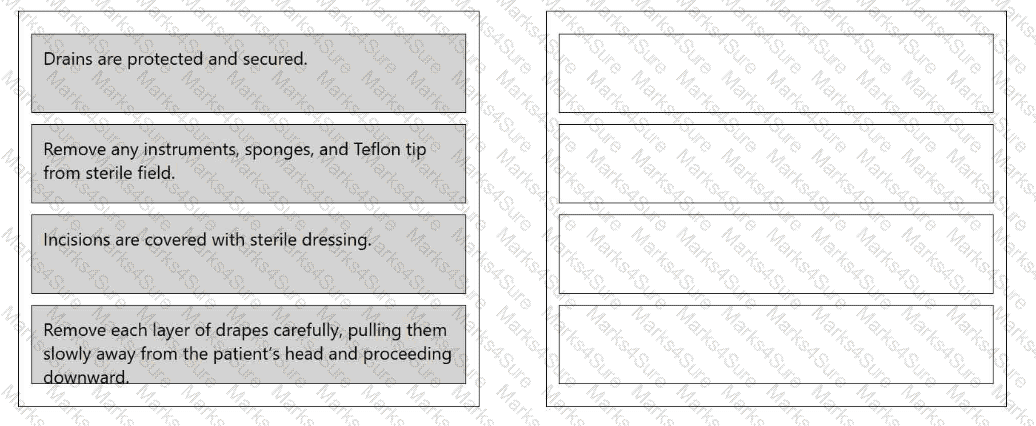
Options:
Answer:
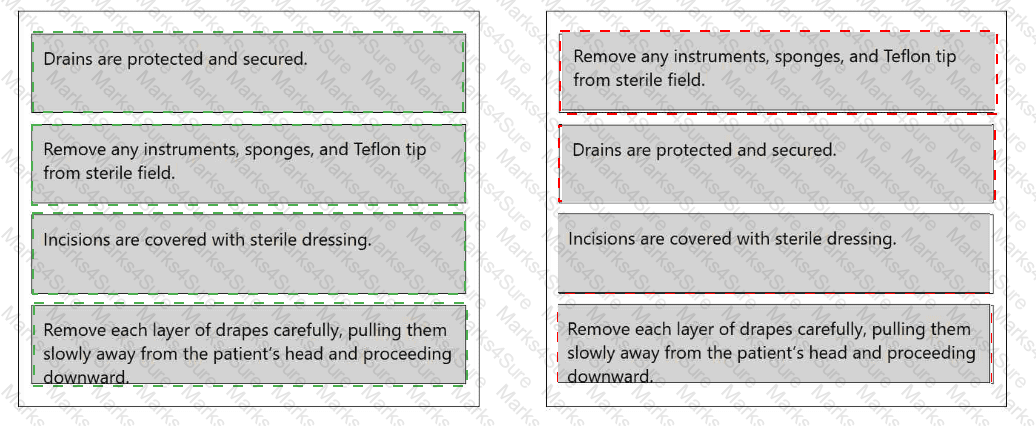
Explanation:
1
Remove any instruments, sponges, and Teflon tip from the sterile field.
2
Drains are protected and secured.
3
Incisions are covered with sterile dressings.
4
Remove each layer of drapes carefully, pulling them slowly away from the patient ' s head and proceeding downward.
Following a laparotomy, surgical drapes must be removed in a controlled sequence to prevent surgical site contamination, accidental drain displacement, and injuries from retained sharp instruments.
First, remove instruments, sponges, and the Teflon electrosurgical tip from the patient-associated sterile field. This prevents surgical equipment or sharps from becoming trapped within discarded drapes. The Association of Surgical Technologists recommends clearing instruments, sharps, and nondisposable items before applying the sterile dressing.
Second, protect and secure surgical drains. Drains must remain correctly positioned and secured to prevent accidental dislodgement during drape removal. Drain tubing should be identified and protected from traction or compression.
Third, cover the surgical incisions with sterile dressings. The surgical technologist assists in cleaning and drying the surrounding skin and applying the prescribed wound dressing. This protects the incision from contamination during subsequent handling.
Fourth, carefully remove the surgical drapes , working slowly away from the patient ' s head toward the lower body as described in the question. Drapes should be gathered and rolled inward to contain contaminated surfaces and prevent blood or body fluid splashing.
The fundamental safety principles are to clear hazardous items, protect drains and the wound, and remove drapes without disturbing the patient or spreading contamination.
ast.org+1
The circulating nurse accidentally leans on the sterile back table with their hand before the surgical procedure begins. What should be done NEXT?
Options:
Avoid opening items on that area, but continue opening supplies.
Stop opening and ask the surgeon how to proceed.
Continue opening supplies and cover the contaminated area with a sterile towel.
Break down the setup and restart.
Answer:
DExplanation:
The appropriate action is to break down the contaminated sterile setup and establish a new sterile field . When an unsterile individual touches the prepared sterile back table, the affected area is considered contaminated, compromising the integrity of the surgical environment.
The circulating nurse is not scrubbed, gowned, and gloved as a sterile member of the surgical team. Consequently, direct contact between the nurse ' s unsterile hand and the prepared sterile field introduces potential microbial contamination.
The Association of periOperative Registered Nurses (AORN) recommends removing compromised instruments and supplies and reestablishing the sterile field when significant contamination is identified before surgery begins.
Aorn.org
Option A is incorrect because simply avoiding the affected area does not reliably address contamination of the prepared table.
Option B is incorrect because the contamination must be addressed immediately according to established aseptic protocols rather than waiting for the surgeon to determine whether sterile technique should be maintained.
Option C is incorrect because covering an already contaminated surface with another sterile towel does not restore the underlying sterile barrier.
The surgical technologist should promptly communicate the contamination, remove affected supplies and draping, and prepare replacement sterile materials. A new sterile setup must be verified before the procedure proceeds.
During vascular surgery, a severe leak occurs at the anastomotic site. Which of the following actions should the surgical technologist take?
Options:
Prepare Hemoclips for clipping off vessels to achieve hemostasis.
Prepare a nonabsorbable suture to improve hemostasis.
Prepare a hemostat.
Prepare a hemostatic agent.
Answer:
BExplanation:
A severe leak at a vascular anastomosis requires prompt surgical intervention to control hemorrhage and restore the integrity of the vascular connection. The surgical technologist should anticipate the surgeon ' s need for nonabsorbable vascular suture , commonly polypropylene, to reinforce or repair the anastomotic suture line.
Vascular anastomoses require secure, durable approximation capable of withstanding intravascular pressure. Polypropylene monofilament sutures are frequently selected because they offer permanent tensile strength, relatively low tissue reactivity, and suitable handling characteristics for delicate vascular repair.
When bleeding develops at an anastomosis, the surgeon may initially apply direct pressure, temporary vascular occlusion, or another appropriate technique to control blood flow. Additional sutures can then be placed to close gaps or defects in the anastomotic line. Published vascular repair techniques describe supplementary suturing as a method of correcting anastomotic leakage.
PubMed Central (PMC)+1
Option A is inappropriate because Hemoclips should not be applied indiscriminately to a major vascular anastomosis.
Option C is less appropriate because a standard hemostat may damage delicate vascular tissue.
Option D is insufficient for severe bleeding caused by structural failure of the anastomosis. Hemostatic agents may supplement repair but cannot reliably replace definitive suturing.
The surgical technologist should prepare suitable vascular sutures, needle holders, suction, vascular clamps, and other supplies requested by the surgeon.
Reference Topics: NCCT TS-C Detailed Test Plan — Intraoperative Care and Preparation; Section 3A1, Suture Selection; Section 3B1, Instrument Anticipation; Section 3B5, Suture Handling; Hemostasis and Vascular Surgery.
What pharmacological agent is used for the treatment of malignant hyperthermia?
Options:
Fentanyl
Dantrolene
Desflurane
Sevoflurane
Answer:
BExplanation:
Dantrolene sodium is the specific pharmacological treatment for malignant hyperthermia (MH), a potentially life-threatening hypermetabolic reaction triggered by certain anesthetic agents in genetically susceptible individuals.
Malignant hyperthermia involves abnormal calcium release from the sarcoplasmic reticulum of skeletal muscle cells, primarily associated with dysfunction of the ryanodine receptor (RYR1). Excessive intracellular calcium produces sustained muscle contraction, increased oxygen consumption, elevated carbon dioxide production, metabolic acidosis, and potentially severe hyperthermia.
Dantrolene inhibits excessive calcium release from skeletal muscle, reducing the hypermetabolic response. Current European Malignant Hyperthermia Group guidance recommends an initial intravenous dose of 2–2.5 mg/kg, with repeated administration according to clinical response.
European Malignant Hyperthermia Group+1
Option A is incorrect because fentanyl is an opioid analgesic and does not reverse malignant hyperthermia.
Options C and D are incorrect because desflurane and sevoflurane are volatile inhalational anesthetics capable of triggering malignant hyperthermia.
Emergency management also includes immediate discontinuation of triggering agents, administration of 100% oxygen, correction of metabolic abnormalities, active cooling when indicated, and continuous physiological monitoring.
The surgical technologist must recognize the emergency, locate the malignant hyperthermia cart, and assist the anesthesia team with obtaining and preparing dantrolene.
Which of the following procedures requires the use of a phacoemulsification machine?
Options:
Total pelvic exenteration
Thyroidectomy
Cataract extraction
Blepharoplasty
Answer:
CExplanation:
A phacoemulsification machine is used during cataract extraction to fragment and remove the eye ' s clouded natural crystalline lens using ultrasonic energy.
A cataract develops when the crystalline lens becomes progressively opaque, impairing the transmission of light to the retina and reducing visual acuity. Phacoemulsification is a widely used surgical technique for cataract removal because it allows lens extraction through a relatively small corneal incision.
During the procedure, the surgeon creates a capsulorrhexis in the anterior lens capsule. The phacoemulsification handpiece delivers controlled ultrasonic energy to break up the cataractous lens nucleus. An integrated irrigation and aspiration system maintains anterior chamber stability and removes fragmented lens material.
After removal, a foldable intraocular lens is commonly implanted within the remaining capsular bag. The American Academy of Ophthalmology recognizes phacoemulsification as a principal technique for modern cataract surgery.
AAO Journal
Option A is incorrect because total pelvic exenteration involves extensive removal of pelvic organs for selected advanced malignancies.
Option B is incorrect because thyroidectomy involves excision of thyroid tissue using conventional surgical and energy-based instruments.
Option D is incorrect because blepharoplasty involves reconstructive or cosmetic surgery of the eyelids.
The surgical technologist should prepare the phaco handpiece, tubing, irrigation solution, aspiration components, and compatible ophthalmic instruments according to the surgeon ' s preference card.
Instruments that come into contact with the interior of the small bowel should be:
Options:
Left out on the field
Isolated in a basin
Placed on the back table
Placed on the Mayo stand
Answer:
BExplanation:
Instruments that contact the interior of the small bowel must be isolated from clean surgical instruments , with a designated contaminated basin representing the most appropriate option provided.
The intestinal lumen contains microorganisms capable of contaminating surgical instruments during gastrointestinal procedures. Once the bowel is opened, instruments, sponges, suction tips, and other equipment contacting its contents are considered contaminated under bowel isolation principles.
The Association of Surgical Technologists recommends separating instruments used on the open gastrointestinal tract from those reserved for clean dissection and abdominal closure. Its bowel technique guidelines describe the use of a contaminated Mayo setup and designated basin to support isolation and specimen transfer.
ast.org
Option A is incorrect because leaving contaminated instruments in the general operative field increases the potential for cross-contamination.
Option C is incorrect because placing contaminated instruments directly on the clean back table compromises the integrity of the closure instruments.
Option D is incorrect if it refers to the clean Mayo stand. A separate, designated contaminated Mayo stand is acceptable within a validated bowel isolation protocol.
Following closure of the gastrointestinal tract, contaminated instruments must remain segregated, and the surgical team should implement the required gown and glove changes before clean closure.
The objective is to reduce microbial transfer to the abdominal incision and prevent postoperative surgical site infection.
Which of the following are purposes of pressure dressings? (Select the three correct answers.)
Options:
To eliminate dead space
To prevent dehiscence of an abdominal wound
To dress a wound around a drain
To seal a colostomy bag
To reduce the formation of hematomas
Answer:
A, B, EExplanation:
Pressure dressings provide external compression over selected surgical wounds to support tissue approximation, minimize fluid accumulation, and reduce postoperative bleeding complications.
Option A — Eliminate dead space: Controlled compression may bring adjacent tissue planes into closer contact, reducing potential spaces where blood or serous fluid can accumulate. Pressure dressings are particularly useful following extensive tissue dissection.
Option B — Prevent abdominal wound dehiscence: An appropriately selected supportive dressing can provide supplementary external support, reduce movement-related tension, and help protect the healing incision. However, a conventional pressure dressing does not reliably prevent fascial dehiscence, which depends primarily on secure surgical closure and patient-related factors.
Option E — Reduce hematoma formation: External compression may help reduce low-volume postoperative bleeding and limit the accumulation of blood within operative spaces.
Clinical wound-management literature supports the use of compressive dressings to reduce hematoma formation and dead space.
Clinical Gate+1
Option C is not a conventional primary indication for a pressure dressing. Drain sites are generally covered using appropriate drain sponges or other dressings that permit drainage without obstructing the device.
Option D is incorrect because colostomy appliances require an appropriate adhesive skin barrier and pouching system rather than a pressure dressing.
Excessive compression must be avoided because it can compromise perfusion and increase the risk of tissue injury.
In what order are medications received onto the sterile field? Arrange the following steps in their correct sequence.
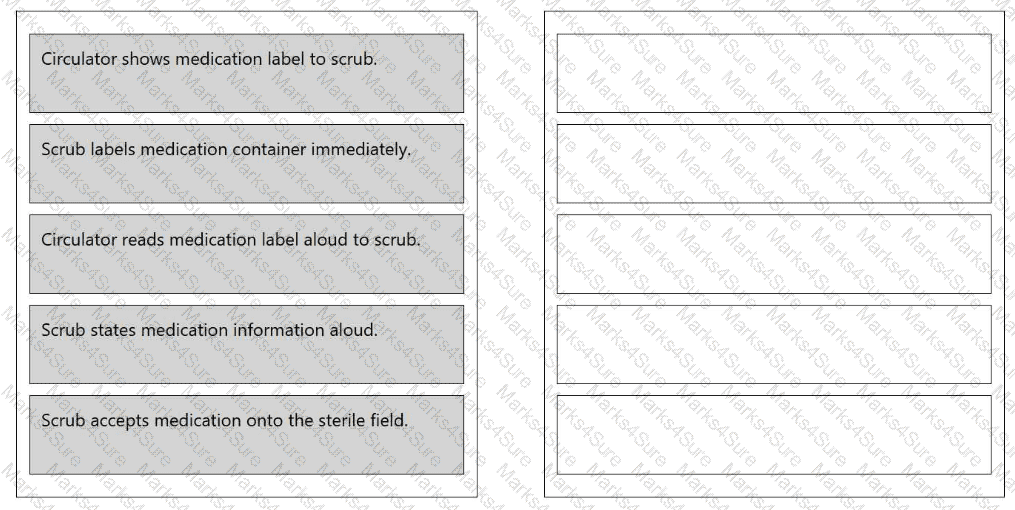
Options:
Answer:
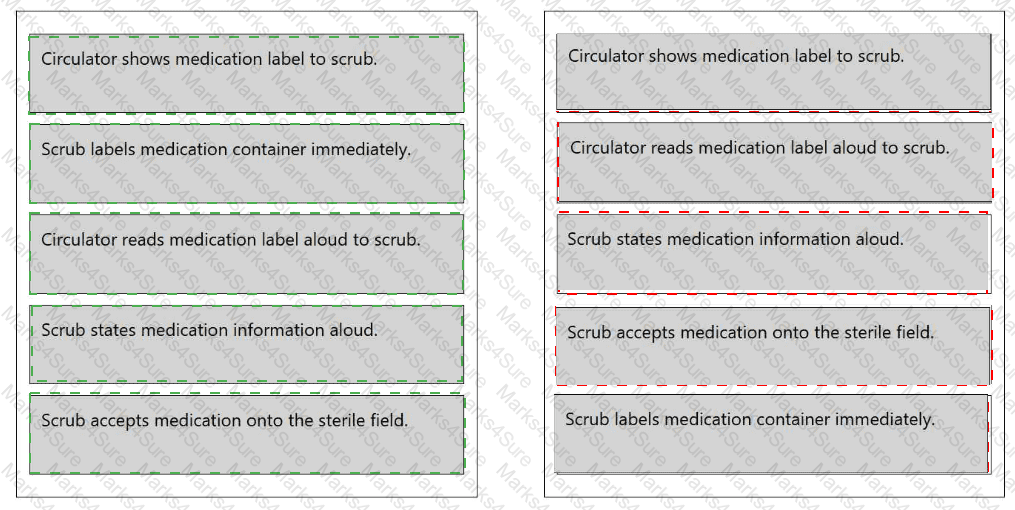
Explanation:
1
Circulator shows medication label to scrub.
2
Circulator reads medication label aloud to scrub.
3
Scrub states medication information aloud.
4
Scrub accepts medication onto the sterile field.
5
Scrub labels medication container immediately.
Safe medication transfer onto the sterile field requires coordinated verification between the circulating nurse and surgical technologist. The objective is to prevent medication identification errors, incorrect dosing, and accidental administration of improperly labeled substances.
First, the circulating nurse displays the original medication label so the scrubbed surgical technologist can independently identify the medication.
Second, the circulating nurse reads the medication information aloud, including its name, concentration, dosage, and expiration information.
Third, the surgical technologist repeats the medication information aloud, confirming agreement with the original label. This read-back process provides an additional verification safeguard.
Fourth, the surgical technologist receives the medication into an appropriate sterile container using a validated aseptic transfer method.
Finally, the surgical technologist immediately labels the receiving container before another medication is transferred.
The Association of Surgical Technologists requires confirmation of medication identity, dosage, and expiration information during transfer. AORN guidance similarly requires concurrent verification by the transferring and receiving personnel and immediate labeling of secondary containers.
ast.org+1
All medications must be handled within the surgical technologist ' s authorized responsibilities and according to institutional medication-safety protocols.
Upon transfer of medications and solutions to the sterile field, the surgical technologist should immediately label each with which of the following information?
Options:
Medication concentration and amount
Medication name and concentration
Medication name and date of procedure
Medication amount and date of procedure
Answer:
BExplanation:
The medication name and concentration are essential identification elements that must appear on medications and solutions transferred to secondary containers on the sterile field.
Correct medication labeling prevents errors involving the administration of incorrect drugs or concentrations. Such errors are particularly dangerous when medications with markedly different potencies are used during the same surgical procedure.
When the circulating nurse transfers medication to the sterile field, the surgical technologist must verify the medication name, strength, and other applicable details through an appropriate verbal and visual verification process.
The Joint Commission requires medications and solutions in syringes, basins, medication cups, and other containers to be labeled when transferred from their original packaging.
jointcommission.org
Option A is incorrect because concentration and amount alone do not identify the medication.
Option C is incorrect because the date of the procedure does not replace medication concentration.
Option D is incorrect because amount and procedure date provide insufficient medication identification.
Although B is correct among the available options, a complete label may also require the medication amount, diluent name and volume, and expiration date and time.
The surgical technologist should label the container immediately after preparation and before another medication is introduced, according to institutional policy.
When passing an " armed " needle holder, the surgical technologist must do which of the following?
Options:
Pass it to the surgeon when the circulating nurse says the surgeon is ready.
Pass it to the surgeon so that the surgeon may reposition it for its intended use.
Pass it to the surgeon so that the needle does not have to be repositioned.
Pass it to the surgeon only when the surgeon is looking and ready.
Answer:
CExplanation:
An armed needle holder is a needle-driving instrument loaded with a surgical suture needle. The surgical technologist must ensure that the needle is correctly positioned and securely grasped within the jaws of the needle holder before transferring it for surgical use.
The needle should be oriented according to the surgeon ' s handedness, operative approach, and intended direction of suturing. Correct positioning enables the surgeon to begin the suturing maneuver immediately without unnecessary manipulation or repositioning.
The Association of Surgical Technologists specifically emphasizes correct needle positioning and secure clamping to prevent the surgeon from having to reposition the needle holder. This improves procedural efficiency and reduces avoidable handling of sharp instruments.
Guideline_Neutral_Zone
Option A is incorrect because the circulating nurse ' s announcement does not independently establish readiness for a safe transfer. Option B is incorrect because unnecessary repositioning increases instrument handling and potential needlestick exposure. Option D describes an important safety consideration for direct hand-to-hand transfer, but visual attention alone does not address the correct preparation and orientation of the armed needle holder.
Current sharps-safety guidance favors using a designated neutral zone whenever clinically feasible. When direct transfer is necessary, clear communication and appropriate instrument orientation are essential.
Which of the following factors increase the risk of surgical site infections? (Select the three correct answers.)
Options:
Obesity
Duration of the surgical procedure
Eating before surgery
Compromised immune systems
Height
Answer:
A, B, DExplanation:
Surgical site infections (SSIs) develop when microorganisms contaminate the operative site and overcome the patient ' s local and systemic immune defenses. Several patient-related and procedure-related factors influence this risk.
Option A — Obesity: Excess adipose tissue may impair wound oxygenation and perfusion, increase incision depth, and contribute to wound complications. Obesity can also complicate antimicrobial dosing and surgical exposure.
Option B — Duration of the surgical procedure: Longer operations increase exposure time, tissue manipulation, and the opportunity for microbial contamination. Prolonged procedures may also increase physiological stress and contribute to tissue hypoperfusion.
Option D — Compromised immune systems: Immunosuppression reduces the patient ' s ability to recognize and eliminate microorganisms. Conditions associated with impaired immune function and certain immunosuppressive therapies increase susceptibility to postoperative infection.
The 2022 update to the Strategies to Prevent Surgical Site Infections in Acute-Care Hospitals identifies obesity, immunosuppressive therapy, and operative duration as recognized SSI risk factors.
PMC
Option C is incorrect because eating before surgery primarily raises concerns regarding aspiration during anesthesia rather than independently establishing an SSI risk.
Option E is incorrect because patient height is not an established independent SSI risk factor.
The surgical technologist helps reduce infection risk by maintaining aseptic technique, protecting sterile supplies, minimizing contamination, and supporting appropriate surgical preparation.
Which of the following steps should be included in the application of a surgical wound dressing?
Options:
Count all dressings and document the sizes and numbers used.
Place a temporary dressing to verify its size.
Tape off the dressing area.
Clean and dry the surgical site before the dressing is placed.
Answer:
DExplanation:
Before applying a postoperative surgical dressing, the surgical technologist should clean and dry the incision and surrounding skin using appropriate sterile materials .
Following surgical closure, blood, irrigation fluid, antiseptic residue, or other substances may remain around the operative site. Removing these materials minimizes unnecessary contamination and promotes effective adhesion of the prescribed dressing.
The Association of Surgical Technologists ' guidelines for breaking down the sterile field recommend gently cleaning the skin around the incision with a saline-moistened sponge, followed by drying with a separate sponge before dressing application.
ast.org
Option A is incorrect because the primary surgical count concerns accountable items such as sponges, needles, instruments, and miscellaneous supplies. Dressing materials must be managed appropriately, but recording every dressing size and number is not a universal application step.
Option B is incorrect because placing and removing a temporary dressing is unnecessary and may increase handling of the wound.
Option C is incorrect because adhesive fixation may be appropriate for some dressings but is not required for every dressing system.
The surgical technologist must verify that the incision is appropriately closed, ensure drains remain protected, prepare the prescribed sterile dressing, and assist with application without compromising aseptic technique.
Who is responsible for initiating the preoperative surgical Time Out?
Options:
Certified Registered Nurse Anesthetist (CRNA)
Anesthesiologist
Surgical technologist
Nurse
Answer:
DExplanation:
The circulating nurse is commonly responsible for initiating and coordinating the surgical Time Out immediately before incision.
The Time Out is a formal communication process intended to verify the correct patient, operative procedure, surgical site, and other critical safety requirements. It requires active participation from every member of the surgical team.
The circulating nurse generally announces the Time Out, facilitates verification of the relevant information, and documents completion according to institutional policy.
The Joint Commission requires a designated team member to initiate the Time Out, while AORN identifies the circulating nurse as the person who most often performs this function.
Aorn.org+1
Option A is incorrect as the conventional examination answer because the CRNA primarily manages anesthetic care and participates in the verification process.
Option B is incorrect because the anesthesiologist participates in confirming readiness and relevant anesthetic considerations but is not universally responsible for initiating the Time Out.
Option C is incorrect because the surgical technologist participates in the verification process but does not ordinarily coordinate it.
The surgical team must resolve discrepancies before proceeding. No individual should remain silent when an inconsistency involving patient identity, surgical site, procedure, or equipment is identified.
What is another term for sterile technique?
Options:
DeBakey Crohn ' s Technique
Surgical Technique
Aseptic Technique
Conscious Surgical Technique
Answer:
CExplanation:
Aseptic technique is the intended examination answer because sterile technique is a form of surgical asepsis designed to prevent microorganisms from contaminating the operative field.
Surgical asepsis involves a collection of practices used to establish and maintain the sterility of instruments, supplies, personnel attire, and the operative environment.
These practices include surgical hand antisepsis, sterile gowning and gloving, sterile draping, aseptic instrument transfer, appropriate movement around sterile fields, and immediate correction of contamination.
A fundamental distinction exists between medical asepsis and surgical asepsis. Medical asepsis reduces the number and spread of microorganisms, whereas surgical asepsis is intended to prevent microorganisms from entering sterile tissues or equipment.
NCBI
Option A is incorrect because DeBakey and Crohn ' s are associated with surgical instrumentation and medical terminology, not an established sterile-technique method.
Option B is incorrect because surgical technique describes the methods used to perform an operation and includes many activities beyond infection prevention.
Option D is incorrect because conscious surgical technique is not an established term for maintaining sterility.
The surgical technologist must apply aseptic principles continuously, recognizing that sterile technique is not limited to preparing instruments before incision.
Terminology distinction: Surgical aseptic technique or surgical asepsis is more precise than the broader expression aseptic technique , which can also describe nonsterile medical asepsis.
A surgeon ' s preference card indicates that antibiotics should be added to the irrigation solution on the sterile back table. How should the solution be labeled?
Options:
Bacitracin 50,000 mg in 500 cc normal saline
Bacitracin 50,000 mg in 500 mL normal saline
Bacitracin 50,000 units in 500 cc normal saline
Bacitracin 50,000 units in 500 mL normal saline
Answer:
DExplanation:
The correct examination answer is Bacitracin 50,000 units in 500 mL normal saline , because medication labeling must accurately identify the medication, its quantity, the diluent, and the solution volume using standardized units of measurement.
Bacitracin potency is conventionally expressed in units rather than milligrams. Therefore, options A and B are incorrect because they use an inappropriate measurement unit.
Although cubic centimeters (cc) and milliliters (mL) represent equivalent volumes, the Institute for Safe Medication Practices recommends using mL rather than cc. The abbreviation cc may be misinterpreted as another medication-related abbreviation, increasing the risk of medication errors. Consequently, option C is less appropriate than option D.
ECRI
The Joint Commission requires medications and solutions transferred to containers on the sterile field to be appropriately labeled. Labels must identify the medication name, strength, relevant quantity, diluent, and applicable expiration information. Medication information must also be verified according to institutional policy.
jointcommission.org
Important clinical update: This examination question reflects an outdated bacitracin irrigation practice. On January 31, 2020, the FDA requested withdrawal of bacitracin for injection from the United States market because of serious safety risks, including nephrotoxicity and anaphylaxis. Bacitracin irrigation should not be prepared solely because it appears on an old preference card.
Canada.ca
Which of the following pieces of equipment should be used during a diagnostic cystoscopy?
Options:
Holmium laser
Camera monitor
Cautery machine
Prone positioner
Answer:
BExplanation:
A camera monitor is a standard component of a modern video cystoscopy system because it enables visualization of the urethra, urinary bladder, and associated anatomical structures.
Diagnostic cystoscopy is an endoscopic examination performed using a rigid or flexible cystoscope introduced through the urethra into the bladder. It is commonly used to investigate hematuria, recurrent urinary symptoms, bladder lesions, and suspected abnormalities of the lower urinary tract.
A conventional video cystoscopy system consists of the cystoscope, camera or imaging unit, light source, irrigation equipment, and monitor. The monitor displays magnified images, allowing the surgeon to examine the bladder mucosa, ureteral orifices, and bladder neck.
Modern diagnostic cystoscopy systems incorporate digital imaging and external displays to support endoscopic visualization.
Urology Endoscopy Kit+1
Option A is incorrect because a holmium laser is used for selected therapeutic procedures, including urinary stone fragmentation, rather than routine diagnostic cystoscopy.
Option C is incorrect because electrocautery equipment is not routinely needed for examination alone.
Option D is incorrect because diagnostic cystoscopy generally uses an appropriate supine, lithotomy, or modified position rather than prone positioning.
The surgical technologist must ensure that the imaging system, irrigation connections, endoscopic instruments, and sterile accessories are functioning correctly before the examination begins.
At the end of a surgical case, the surgical technologist notices a small hole in the back-table cover underneath an instrument tray. What should the surgical technologist do NEXT?
Options:
Ignore the hole because the procedure is already finished.
Notify the surgeon.
Cover the hole with a Tegaderm dressing.
Notify the charge nurse.
Answer:
BExplanation:
The surgical technologist must immediately notify the surgeon of the discovered breach in sterile technique , even though the operation has been completed.
A hole in the sterile back-table covering compromises the protective barrier separating sterile instruments from potentially contaminated surfaces. When an instrument tray rests over the damaged area, contamination may have occurred during instrument handling.
The Association of periOperative Registered Nurses (AORN) emphasizes immediate communication of suspected contamination to the surgical team. When contamination is discovered after surgery has begun, the surgeon must be informed so that the potential consequences can be assessed.
Aorn.org
Option A is incorrect because completion of the procedure does not eliminate the need to report a possible contamination event.
Option C is incorrect because placing an adhesive dressing over the hole after the procedure cannot reverse any contamination that may already have occurred.
Option D may be appropriate for subsequent escalation and incident reporting, but notifying the charge nurse should not replace informing the surgeon responsible for the patient ' s operative care.
The surgical team should evaluate the possible exposure, document the circumstances, and follow institutional infection prevention and incident-reporting protocols.
Which of the following patient populations is at the HIGHEST risk of deep vein thrombosis?
Options:
Adolescent
Geriatric
Neonatal
Pediatric
Answer:
BExplanation:
Geriatric patients have the highest general risk of developing deep vein thrombosis (DVT) among the populations listed because advancing age is an established risk factor for venous thromboembolism (VTE).
DVT occurs when a thrombus forms within the deep venous system, most commonly in the lower extremities. The pathophysiology is associated with Virchow ' s triad: venous stasis, endothelial injury, and hypercoagulability.
Older surgical patients frequently experience reduced mobility, chronic cardiovascular disease, venous insufficiency, malignancy, or other medical conditions that increase thrombotic risk. Prolonged surgery, anesthesia, and postoperative immobility may further contribute to venous stasis.
The Centers for Disease Control and Prevention identifies increasing age as a significant VTE risk factor. Hospitalization, surgery, and restricted movement further increase risk.
CDC+1
Option A is incorrect because adolescents generally have a lower baseline DVT risk than older adults. Option C is incorrect because neonatal thrombosis is often associated with specific conditions, including central venous catheterization. Option D is incorrect because pediatric patients generally experience lower rates of DVT than geriatric patients.
The surgical technologist supports prevention by assisting with appropriate positioning, avoiding unnecessary venous compression, and preparing intermittent pneumatic compression devices when prescribed.
Pharmacological prophylaxis, when indicated, is determined by the responsible licensed clinician.
An 85-year-old patient is undergoing a posterior total hip arthroplasty. The surgeon makes the skin incision and splits the muscle. Which self-retaining retractor should be placed to assist with visualization?
Options:
Charnley
Mayfield
Goulet
Balfour
Answer:
AExplanation:
The Charnley retractor is specifically designed for orthopedic procedures, particularly total hip arthroplasty, and provides stable self-retaining exposure of the hip joint.
During a posterior total hip arthroplasty, the surgeon makes an incision over the posterolateral hip and divides the fascia lata and gluteus maximus fibers to access deeper anatomical structures.
The Charnley retractor consists of adjustable blades connected by a self-retaining mechanism. It maintains separation of muscular and fascial tissues, allowing the surgeon to visualize the short external rotators, posterior capsule, and proximal femur.
Published surgical techniques specifically describe placement of a Charnley retractor following splitting of the gluteus maximus during posterior hip arthroplasty.
PubMed Central (PMC)+1
Option B is incorrect because Mayfield equipment is primarily associated with cranial stabilization and selected neurological procedures.
Option C is incorrect because a Goulet retractor is not the characteristic self-retaining device used for posterior hip exposure.
Option D is incorrect because the Balfour retractor is principally designed to provide abdominal wall retraction during laparotomy.
For an elderly patient, careful retraction is particularly important because reduced muscle mass, tissue fragility, and compromised vascular supply can increase susceptibility to injury.
The surgical technologist should ensure that the Charnley retractor is assembled correctly and that blade placement does not create excessive pressure on surrounding tissues.
A surgical technologist is being relieved during a procedure by another surgical technologist. Which of the following describes the correct procedure for conducting the surgical count?
Options:
The two surgical technologists conduct the count together.
Either of the surgical technologists conducts the count with the circulating nurse.
The last count conducted by the original team is sufficient for a shift change.
The circulating nurse is solely responsible for a change-of-shift count.
Answer:
BExplanation:
A surgical count must be performed through a coordinated verification process involving the scrub person and circulating nurse. When one surgical technologist relieves another during an operation, a relief count must be completed to establish accountability for instruments, sponges, needles, and other countable items.
Option B is the best answer among the choices because it preserves the requirement for a count involving the circulating nurse rather than allowing the scrub personnel to count independently.
During the handoff, the departing and incoming surgical technologists should participate in reconciling the existing count with the circulating nurse, according to institutional policy. This ensures that the incoming technologist understands the location and status of accountable items before assuming responsibility for the sterile field.
Option A is incomplete because two surgical technologists counting without the circulating nurse do not satisfy the usual two-role verification requirement.
Option C is incorrect because an earlier count does not establish accountability following a permanent personnel change.
Option D is incorrect because the circulating nurse should not independently perform and verify the surgical count.
AORN identifies permanent relief of the scrub person or circulating nurse as an indication for an additional count. The count must be performed systematically, communicated clearly, and documented in the intraoperative record.
PubMed Central (PMC)+1
How many inches above the elbow is a sterile surgical gown considered sterile?
Options:
4 inches
1 inch
2 inches
3 inches
Answer:
CExplanation:
The sterile portion of a surgical gown extends from approximately 2 inches above the elbow to the cuff seam , according to the Association of Surgical Technologists (AST) Standards of Practice for Gowning and Gloving. This anatomical boundary is essential for maintaining sterile technique and preventing contamination during surgical procedures.
The front of the gown is considered sterile from approximately mid-chest to the level of the sterile field or waist. The sleeves are considered sterile within the specified region, while the axillary areas, back of the gown, and stockinette cuffs are not considered sterile surfaces.
Maintaining these boundaries minimizes the transfer of microorganisms from potentially contaminated gown surfaces to surgical instruments, sterile supplies, or the operative site.
Surgical technologists must ensure that their sterile sleeves remain within the appropriate working area. Raising the arms excessively, placing the hands beneath the sterile field, or allowing unsterile gown surfaces to contact sterile equipment may compromise aseptic technique.
Options A, B, and D are incorrect because none represents the established two-inch boundary above the elbow.
The AST standard explicitly identifies the two-inch measurement as the proximal limit of sleeve sterility. Correct application of this principle is fundamental to sterile gowning, surgical assistance, and prevention of surgical site infections.
ast.org
When breaking down the sterile field to prepare the operating room for another case, what is the FIRST action the surgical technologist should take?
Options:
Throw all drapes away.
Start the turnover of the room.
Place all sharps in the sharps container.
Spray the instruments with enzymatic spray.
Answer:
CExplanation:
Securing and disposing of contaminated sharps is the first equipment-handling action among the available choices when dismantling the sterile surgical field after completion of a procedure.
Surgical sharps include scalpel blades, suture needles, hypodermic needles, and other devices capable of puncturing the skin. Improper disposal exposes surgical personnel and sterile processing staff to accidental injury and bloodborne pathogens.
Before disposal, all countable sharps must be reconciled according to institutional surgical counting procedures. Following final count verification, disposable sharps should be placed into appropriate puncture-resistant containers.
The Association of Surgical Technologists ' guidelines for breaking down the sterile field emphasize safe sharps handling, appropriate personal protective equipment, and systematic instrument processing.
ast.org
Option A is incorrect because drapes should not be discarded before instruments and sharps have been removed.
Option B is incorrect because environmental turnover should proceed only after the patient has been transferred and the sterile field has been safely dismantled.
Option D is incorrect as the first listed action because enzymatic instrument pretreatment should follow appropriate sharps segregation.
AST guidance also specifies that the scrubbed technologist must maintain sterile readiness until the patient leaves the operating room. Formal breakdown involves removal of the sterile gown, appropriate glove management, hand hygiene, and donning protective equipment before handling contaminated instruments.
Therefore, option C is the correct first action among the four listed equipment-handling tasks .
Which of the following retractors requires someone to physically hold it?
Options:
Gelpi
Weitlaner
Senn
Spring
Answer:
CExplanation:
The Senn retractor is a handheld surgical instrument that requires continuous manual support to maintain tissue retraction. It is commonly used for superficial incisions and small operative fields, particularly during orthopedic, plastic, and general surgical procedures.
The instrument typically has two functional ends: a three-pronged rake and a small right-angled blade. The rake may have sharp or blunt tips, depending on the design, allowing the surgical assistant to retract skin, subcutaneous tissue, or superficial fascia.
Handheld retractors require the surgeon or surgical assistant to maintain the appropriate position and degree of tension throughout their use. The surgical technologist must recognize these instruments and anticipate the need for assistance with operative exposure.
Option A is incorrect because a Gelpi retractor uses a self-retaining ratchet mechanism to maintain tissue separation.
Option B is incorrect because the Weitlaner is also self-retaining and typically uses multiple prongs with a locking mechanism.
Option D is incorrect because spring retractors use spring tension to maintain retraction, depending on their design.
Unlike these self-retaining instruments, the Senn does not maintain its position independently.
The Egyptian Health Council ' s surgical instrumentation material distinguishes Senn retractors as handheld instruments and Gelpi and Weitlaner retractors as self-retaining devices.
Egyptian Health Council
PDF + Testing Engine

Testing Engine
PDF (Q&A)