
Free Practice Questions for the VMware VCP-VCF Architect 2V0-13.24 Exam (2026 Updated)
At Marks4sure, we are dedicated to providing IT professionals with the most accurate and reliable preparation materials for the VMware 2V0-13.24 exam. To support your certification journey, we have made a selection of our premium 2026 VCP-VCF Architect practice questions and answers available completely free. You can take this practice test as many times as you need. Every question includes a detailed, expertly verified explanation to ensure you fully grasp the core security concepts before test day.
An architect decided to deploy an NSX Edge cluster using SDDC Manager. These Edges will be used by a Tier-0 Gateway configured with BGP to provide North-South connectivity in the Management Domain. Which statement justifies this design decision?
During a transformation project kick-off meeting, an architect highlights specific areas on which to focus while developing the new conceptual design. Which statement is the business requirement?
2V0-13.24 Report Card
An architect is documenting the design for a new VMware Cloud Foundation solution. Which statement would be an example of a conceptual model for this solution?
An architect is designing a new VCF solution to meet the following requirements:
The solution must be deployed across two availability zones.
The physical hosts must be installed in a single rack per availability zone.
Workloads running in the cluster must be able to run on hosts in either availability zone.
The architect has decided that to meet these requirements, the solution will be deployed using the Single Instance - Multiple Availability Zones VCF Topology. When considering the design for the network, what should the architect include in the logical design to meet these requirements?
An architect is sizing the workloads that will run in a new VMware Cloud Foundation (VCF) Management Domain. The customer has a requirement to use Aria Operations to provide effective monitoring of the new VCF solution. What is the minimum Aria Operations Analytics node size requirement when Aria Suite Lifecycle is in VCF-aware mode?
A customer is designing a new VMware Cloud Foundation stretched cluster using L2 non-uniform connectivity, where due to a past incident an attacker was able to inject some false routes into their dynamic global routing table. What design decision can be taken to prevent this when configuring the Tier-0 gateway?
Which Operating System (OS) is not supported by Aria Operations for OS and Application Monitoring?
A customer has a requirement to use isolated domains in VMware Cloud Foundation but is constrained to a single NSX management pane. What should the architect recommend satisfying this requirement?
A customer has stated the following requirements for Aria Automation within their VCF implementation:
• Users must have access to specific resources based on their company organization
• Developers must only be able to provision to the Development environment
• Production workloads can be placed on DMZ or Production clusters
What two design decisions must be implemented to satisfy these requirements? (Choose two.)
An architect is designing a VMware Cloud Foundation (VCF)-based private cloud solution for a customer. During the requirements gathering workshop, the customer provided the following requirement:
All SSL certificates should be provided by the company’s certificate authority.
When creating the design, how should the architect classify this stated requirement?
During a requirement capture workshop, the customer expressed a plan to use Aria Operations Continuous Availability. The customer identified two datacenters that meet the network requirements to support Continuous Availability; however, they are unsure which of the following datacenters would be suitable for the Witness Node.
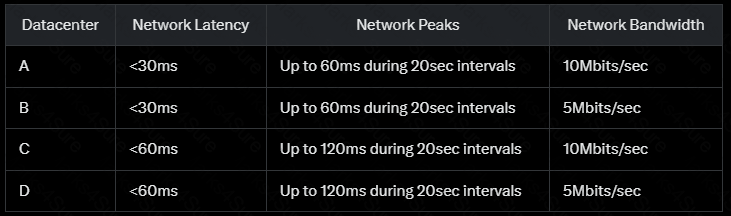
Which datacenter meets the minimum network requirements for the Witness Node?
A customer defined a requirement for the newly deployed SDDC infrastructure which will host one of the applications responsible for video streaming. Application will run as part of a VI Workload Domain with dedicated NSX instance and virtual machines. Required network throughput was defined as 250 Gb/s. Additionally, the application should provide the lowest possible latency. Which design decision should be recommended by an architect for the NSX Edge deployment?
An administrator is documenting the design for a new VMware Cloud Foundation (VCF) solution. During discovery workshops with the customer, the following information was shared with the architect:
All users and administrators of the solution will need to be authenticated using accounts in the corporate directory service.
The solution will need to be deployed across two geographically separate locations and run in an Active/Standby configuration where supported.
The management applications deployed as part of the solution will need to be recovered to the standby location in the event of a disaster.
All management applications will need to be deployed into a management tooling zone of the network, which is separated from the corporate network zone by multiple firewalls.
The corporate directory service is deployed in the corporate zone.
There is an internal organization policy that requires each application instance (management or end user) to detail the ports that access is required on through the firewall separately.
Firewall rule requests are processed manually one application instance at a time and typically take a minimum of 8 weeks to complete.
The customer also informed the architect that the new solution needs to be deployed and ready to start the organization’s acceptance into service process within 3 months, as it is a dependency in the deployment of a business-critical application. When considering the design for the Cloud Automation and Operations products within the VCF solution, which three design decisions should the architect include based on this information? (Choose three.)
The following storage design decisions were made:
DD01: A storage policy that supports failure of a single fault domain being the server rack.
DD02: Each host will have two vSAN OSA disk groups, each with four 4TB Samsung SSD capacity drives.
DD03: Each host will have two vSAN OSA disk groups, each with a single 300GB Intel NVMe cache drive.
DD04: Disk drives capable of encryption at rest.
DD05: Dual 10Gb or higher storage network adapters.
Which two design decisions would an architect include in the physical design? (Choose two.)
During a security-focused design workshop for a new VMware Cloud Foundation (VCF) solution, a key stakeholder described the current and potential future approach to user authentication within their organization. The following information was captured by an architect:
All users within the organization currently have Active Directory-backed user accounts.
A separate project is planned to evaluate the use of different 3rd-party identity solutions to enforce Multi-Factor Authentication (MFA) on all user accounts.
The MFA project will only provide a recommendation on which identity solution the organization should implement.
The MFA project will need to request budget for any licenses that need to be procured for the recommended identity solution.
The new VCF environment may be deployed before the MFA project has completed and therefore must be able to integrate with both the current and any proposed future identity solutions.
Which TWO items should the architect include in their design documentation? (Choose TWO.)
The following requirements were identified in an architecture workshop for a VMware Cloud Foundation (VCF) design project using vSAN as the primary storage solution:
REQ001: The application must maintain a minimum of 1,000 transactions per second (TPS) during business hours, excluding disaster recovery (DR) scenarios.
REQ002: Automatic DRS and HA must be utilized.
REQ003: Planned maintenance must be performed outside of business hours.
While monitoring the TPS of the application, which of the following is NOT a valid test case to validate these requirements?
A customer has stated the following requirements for Aria Automation within their VCF implementation:
Users must have access to specific resources based on their company organization.
Developers must only be able to provision to the Development environment.
Production workloads can be placed on DMZ or Production clusters.
What two design decisions must be implemented to satisfy these requirements? (Choose two.)
During a design discussion, the VMware Cloud Foundation Architect was presented with a requirement to reduce power utilization across all workload domains including management. The architect has suggested to use vSphere Distributed Power Management (DPM) to satisfy this requirement. Which recommendation should the architect provide?
An architect is evaluating a requirement for a Cloud Management self-service solution to offer its users the ability to migrate their own workloads using VMware vMotion. Which component could the architect include in the solution design that will help satisfy the requirement?
An architect is collaborating with a client to design a VMware Cloud Foundation (VCF) solution required for a highly secure infrastructure project that must remain isolated from all other virtual infrastructures. The client has already acquired six high-density vSAN-ready nodes, and there is no budget to add additional nodes throughout the expected lifespan of this project. Assuming capacity is appropriately sized, which VCF architecture model and topology should the architect suggest?
A design requirement has been specified for a new VMware Cloud Foundation (VCF) instance. All managed workload resources must be lifecycle managed with the following criteria:
• Development resources must be automatically reclaimed after two weeks
• Production resources will be reviewed yearly for reclamation
• Resources identified for reclamation must allow time for review and possible extension
What capability will satisfy the requirements?
Due to limited budget and hardware, an administrator is constrained to a VMware Cloud Foundation (VCF) consolidated architecture of seven ESXi hosts in a single cluster. An application that consists of two virtual machines hosted on this infrastructure requires minimal disruption to storage I/O during business hours. Which two options would be most effective in mitigating this risk without reducing availability? (Choose two.)
An architect is working on higher-scale NSX Grouping and security design requirements for Management and VI Workload Domains in VMware Cloud Foundation. Which NSX Manager appliance size will be considered for use?
An architect was requested to recommend a solution for migrating 5000 VMs from an existing vSphere environment to a new VMware Cloud Foundation infrastructure. Which feature or tool can be recommended by the architect to minimize downtime and automate the process?
PDF + Testing Engine

Testing Engine
PDF (Q&A)