
Free Practice Questions for the SAS Institute Base Programmer A00-231 Exam (2026 Updated)
At Marks4sure, we are dedicated to providing IT professionals with the most accurate and reliable preparation materials for the SAS Institute A00-231 exam. To support your certification journey, we have made a selection of our premium 2026 Base Programmer practice questions and answers available completely free. You can take this practice test as many times as you need. Every question includes a detailed, expertly verified explanation to ensure you fully grasp the core security concepts before test day.
Given the following SAS data set WORK.TOYS:
Product Group Price
--------- ----------- -----
Cards Indoors 9.99
Marbles Indoors 8.99
Drum Instruments 12.99
Hula-Hoop Outdoors 12.99
Ball Outdoors 8.49
The following SAS program is submitted:
data WORK.GROUPS;
set WORK.TOYS;
if Group="Outdoors" then Price_Gp="C";
if Price ge 12.99 then Price_Gp="A";
else if Price ge 8.99 then Price_Gp="B";
run;
What will be the value of Price_Gp for Hula-Hoop and Ball? Select one:
Scenario:
This project will use data set cert.input08a and cert.input08b. At
any time, you may save your program
as program08 in cert\programs.
Both data sets contain a common numeric variable named ID.
Write a program that will use a SAS DATA Step to:
o Combine data sets cert.input08a and cert.input08b by
matching values of the ID variable.
o Write only observations that are in both data sets to a
new data set named results.match08.
o Write all other non-matching observations from either
data set to a new data set named results.nomatch08.
o Exclude all variables that begin with
"ex" from results.nomatch08.
How many variables (columns) are in _______________ results.nomatch08
Enter your numeric answer in the space below:
Save your program as ______________ program08.sas in folder cert programs
before continuing with the next project.
Given the following data set:

Which type of statement was included as a component of a transpose procedure step to produce the following data set?
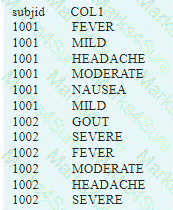
Select one:
Scenario:
Continuing with the previous program (program27), add a PROC SORT step that satisfies the following criteria:
o Creates the output dataset results.output27b
o Sorts the observations by order.
o Removes duplicate values of the first occurrence found during the sort.
What is the value of Employee_ID for observation 98 inresults.output27b?
This project will use data set cert.input08a and cert.input08b. At
any time, you may save your program
as program08 in cert\programs.
Both data sets contain a common numeric variable named ID.
Write a program that will use a SAS DATA Step to:
o Combine data sets cert.input08a and cert.input08b by
matching values of the ID variable.
o Write only observations that are in both data sets to a
new data set named results.match08.
o Write all other non-matching observations from either
data set to a new data set named results.nomatch08.
o Exclude all variables that begin with
"ex" from results.nomatch08.
How many observations (rows) are inresults.match08?
Enter your numeric answer in the space below:
Scenario:
This project will use data set cert.input27. At any time, you may
save your program as program27 in cert\programs. You will use
this program in the next project.
Write a SAS program that will:
o Create output data set results.output27a as a subset
of cert.input27 where the country variable's value is
"US" (any variation of case, such as US or us).
o Sort results.output27a:
" first by the variable state in ascending order
" then by Postal_Code in descending order
" and finally by employee_ID in ascending order.
Run the program and use the results to answer the question below.
What is the value of Employee_ID for observation 100 in results.output27a?
Scenario:
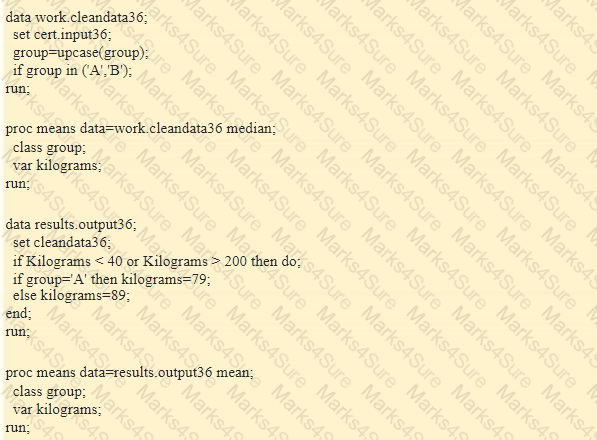
This project will use data setcert.input36. At any time, you may save your program asprogram36 in cert\programs. Write a SAS program that will clean the data incert.input36as follows:
Step 1:
create a temporary data set, cleandata36.
In this data set, convert all case.
Then keep only observations with group equal to 'A' or 'B'.
Step 2:
Determine the MEDIAN value for the Kilograms variable for each group(A,B) in the cleandata36
data set. Round MEDIAN to the nearest whole number.
Step 3:
Create results.output36 from cleandata36
Ensure that all values for variable Kilogramsare between 40 and 200, inclusively.
If the value is missing or out of range, replace the value with the MEDIAN Kilograms value for the respectivegroup(A,B) calculated in step 2
 A yellow background with black text
Description automatically generated
A yellow background with black text
Description automatically generatedPDF + Testing Engine

Testing Engine
PDF (Q&A)