
Free Practice Questions for the Android Certified Trainer AND-803 Exam (2026 Updated)
At Marks4sure, we are dedicated to providing IT professionals with the most accurate and reliable preparation materials for the Android AND-803 exam. To support your certification journey, we have made a selection of our premium 2026 Android Certified Trainer practice questions and answers available completely free. You can take this practice test as many times as you need. Every question includes a detailed, expertly verified explanation to ensure you fully grasp the core security concepts before test day.
When you configure your app to receive adds from Ad mediation, you should add the following code:
< meta-data android:name= " com.google.android.gms.version "
android:value= " @integer/google_play_services_version " / >
Which of the following files you should add this code to?
CPM stands for “cost per thousand impressions” which is a measurement of how much money you will pay to Google Play if adverting in your app reaches 1milion viewers or visitors.
Which of the following choices is correct about the types of ads you allow to be shown to app users? (Select three)
Which of the following choices is considered a purpose of app test usability by participants?
Which of the following choices represents exactly the following monetize Android applications technique?
It is recommended that you offer a free version of your application that comes with advertisements, limited features, or even offer a trial version of your app for a limited time. Then, you can build a premium paid version of the same app which would be advertised-free with extra unleashed features.
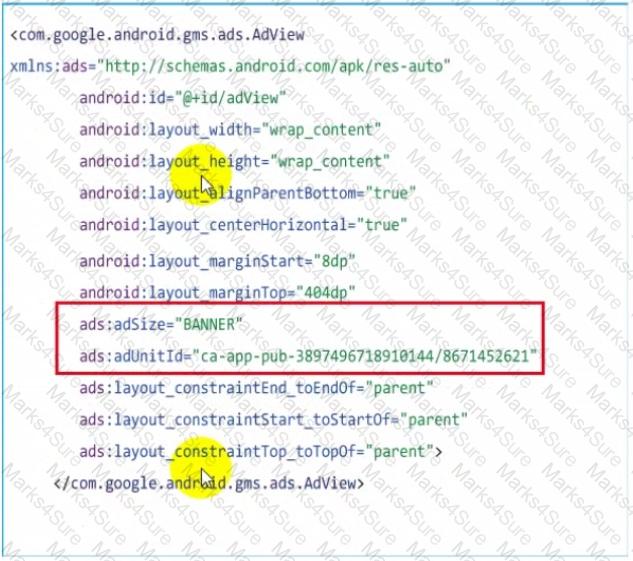
You should add the following XML code illustrated in the following image to AdView widget in order to add an Ad to your activity:
Which two choices of the following are correct about adUnitId ? (Select two)
Which of the following is NOT among the UX designer responsibilities? (Select one choice only)
To publish your Android app at Google Play, you should create an account which will allow you to publish as many applications as you want on Google Play. This account’s fee is:
Which of the following is among the UX designer responsibilities? (Select three)
Google Play In-app billing is a monetization technique that allows you to sell products through your application during its run-time. Whether free of paid, your application can be used to sell some products to users. These products can be game items or any other product that can be processed within your application.
Google Play licensing service does not determine itself if a given user with a given license was granted access to your application. Rather, this responsibility is left to a Policy implementation that you provide in your application.
PDF + Testing Engine

Testing Engine
PDF (Q&A)