Free Practice Questions for the Paloalto Networks Network Security Administrator NetSec-Architect Exam (2026 Updated)
At Marks4sure, we are dedicated to providing IT professionals with the most accurate and reliable preparation materials for the Paloalto Networks NetSec-Architect exam. To support your certification journey, we have made a selection of our premium 2026 Network Security Administrator practice questions and answers available completely free. You can take this practice test as many times as you need. Every question includes a detailed, expertly verified explanation to ensure you fully grasp the core security concepts before test day.
A global manufacturing organization has a strategic plan for rapid growth through mergers and acquisitions. Several components acquired by the organization are considered large deployments with existing IP address schemas and allocations that conflict with those of the parent organization. The manufacturing organization requires access to the resources before a re-IP initiative can be completed.
All deployments contain a variety of IoT devices. Leadership requires protection of vulnerable assets and identification of any known CVEs associated with the IoT devices. The governance, risk, and compliance (GRC) team requires comprehensive, non-repudiable logs to identify every IoT device reporting "Critical (9.0+) CVE scores" for mandatory remediation.
Throughput must exceed the current 1 Gbps trending rate and, with anticipated growth, will soon scale to 5 Gbps.
Segmentation is mandatory, with enclaves based on region, device type, and function.
A firewall has been configured in tap mode to provide traffic visibility for profiling. Inconsistencies in profiling have been observed, with a mix of behaviors.
What are two possible root causes of this behavior? (Choose two.)
A global manufacturing organization has a strategic plan for rapid growth through mergers and acquisitions. Several components acquired by the organization are considered large deployments with existing IP address schemas and allocations that conflict with those of the parent organization. The manufacturing organization requires access to the resources before a re-IP initiative can be completed.
All deployments contain a variety of IoT devices. Leadership requires protection for vulnerable assets and identification of any known CVEs associated with the IoT devices. The governance, risk, and compliance (GRC) team requires comprehensive, non-repudiable logs to identify all IoT devices reporting "Critical (9.0+) CVE scores" for mandatory remediation.
Throughput must exceed the current 1 Gbps trending rate and, with expected growth, will soon scale to 5 Gbps.
Segmentation is mandatory, with enclaves based on region, device type, and function.
In which two ways should the organization architect IoT isolation with groupings based on device types? (Choose two.)
A global organization has fully adopted Prisma Access to secure its mobile workforce and remote offices, while Okta manages user identity. The security team wants to create consistent Security policies that allow access to particular SaaS applications according to users' departments, whether they work from home or from a branch office connected through an SD-WAN device.
Which architecture makes consistent user-to-group mapping available to Prisma Access for policy enforcement in this scenario?
An organization is building a cloud-first network infrastructure. Part of its revised architecture includes Prisma Access, as shown below. The organization has selected Strata Cloud Manager (SCM) as the management method for Prisma Access and NGFWs deployed at the data center and in public-cloud environments. There are 150 NGFWs in place that terminate service connections, segment networks, and secure the data center and public-cloud resources.
One resilience requirement is to provide highly available directory services and authentication for the NGFW and Prisma Access deployment.
The organization wants to track Prisma Access users on the on-premises firewalls and remote networks.
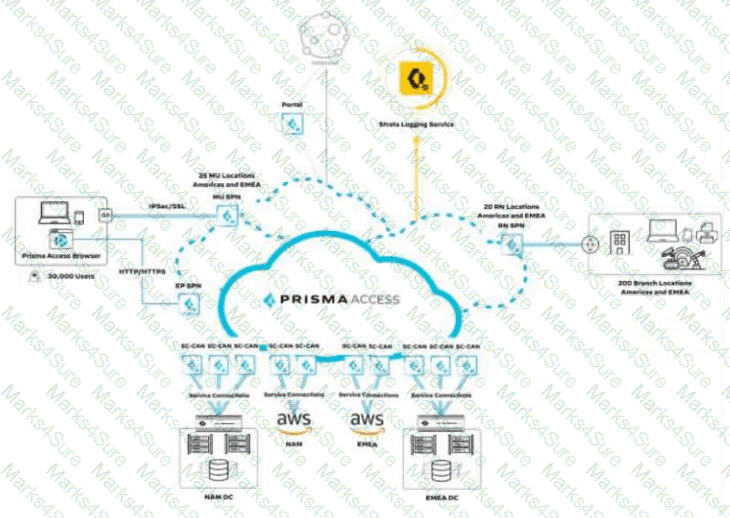
Which configuration meets the design and organization requirements?
An organization has chosen Prisma SD-WAN ION devices for branch-office use and is developing a low-level design for its sites. A typical branch site includes a 10 Mbps MPLS circuit with fiber LC-SR and an RJ-45 Ethernet 50 Mbps DIA internet circuit.
There are 75 workstations, and a stacked core switch that supports LACP, M-LAG, BGP, and OSPF will be used. The core switch serves as the default gateway for all local VLANs. The final design will determine the appropriate model and accessories for the site.
Which statement applies to the Prisma SD-WAN architecture in this use case?
A multinational organization has a large, global population of remote users. This population includes several persona types with distinct requirements and concerns about adopting a Zero Trust Network Access (ZTNA) solution.
Developers need to temporarily bypass security controls for business reasons, but the security team considers this a potential risk. Developers commonly access development servers on premises in private data centers and in the public cloud. These development applications use web (HTTP/HTTPS), API, RPC, and SMB-based applications.
Sales staff travel frequently and connect to the network through many different connection types, but they are generally limited to SaaS-based web applications. They often report performance issues whenever an agent is installed and want the ability to temporarily disable those agents. Data exfiltration and insider risk have been identified as the primary threats for this user class.
Executives are concerned about being high-value targets. Security must be consistent across multiple endpoint types, including mobile and desktop devices. Executive team members have stated that their primary objective is for the solution to be responsive and easy to troubleshoot.
Which two solutions will help mitigate risk to the sales staff? (Choose two.)
An organization plans to modernize its legacy branch architecture. The current architecture is rigid, complex, and poorly suited to a cloud-first strategy, resulting in high operational costs and latency.
The four core data centers are strategically located in Dallas, Toronto, London, and Tokyo. They are interconnected through a dedicated MPLS backbone that provides reliable connectivity but has significant costs and limited bandwidth scalability.
Branches use MPLS or site-to-site VPN to connect to the geographically nearest data center. All branch internet-bound traffic is backhauled to the data-center egress firewalls, causing SaaS-application latency and additional bandwidth pressure on the MPLS links.
The organization needs a proposed WAN architecture for branch connectivity that improves security posture and SaaS application access, while supporting local internet breakout for every branch device, including IoT.
Which two implementations will meet the goal of modernizing the branch architecture? (Choose two.)
Which custom component can reduce the risk of an organization’s sales staff completing a customer-intake PDF form that includes corporate confidential information?
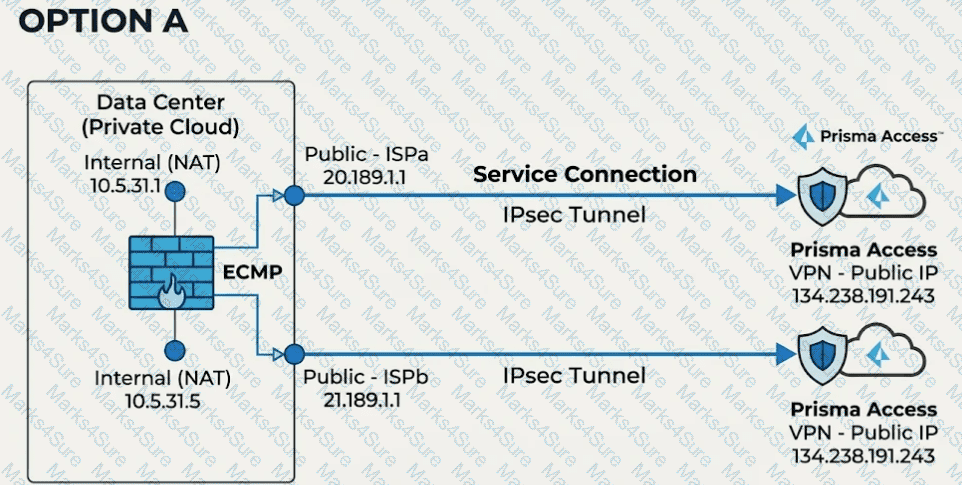
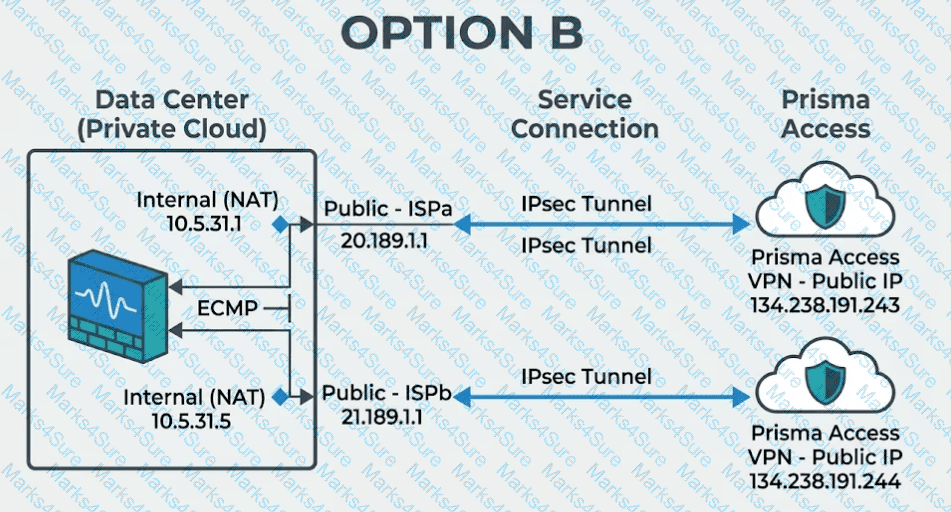
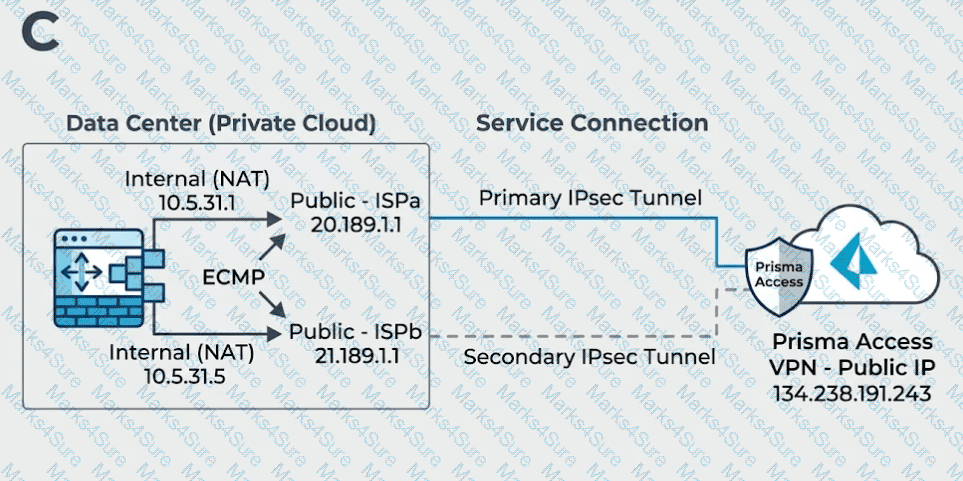
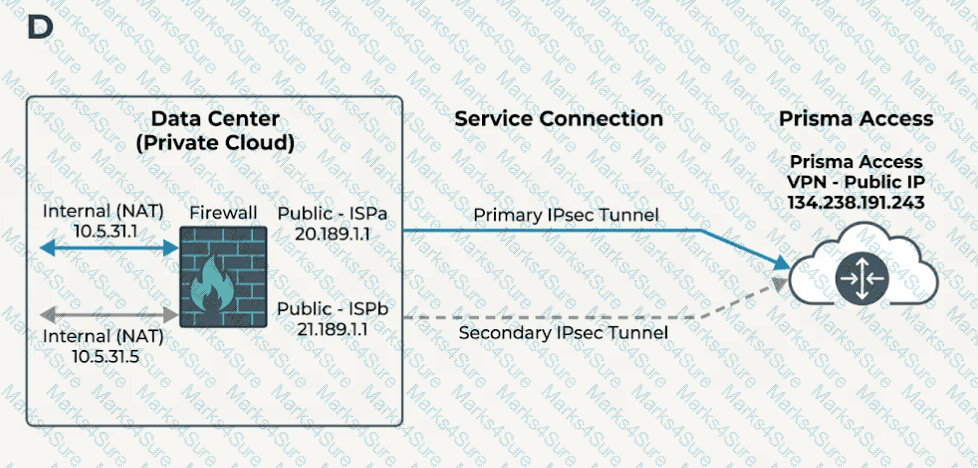
An organization is designing Prisma Access service connections for its data centers. Each data center has redundant 10 Gb internet links and must support at least 1.5 Gbps of throughput for Prisma Access-connected users and branches.
Which diagram shows a solution that satisfies these use-case requirements?
For comprehensive profiling coverage, an IoT sensor should be deployed in the path between the IoT device and which infrastructure component?
PDF + Testing Engine

Testing Engine
PDF (Q&A)