
Free Practice Questions for the Paloalto Networks Security Operations XSIAM-Analyst Exam (2026 Updated)
At Marks4sure, we are dedicated to providing IT professionals with the most accurate and reliable preparation materials for the Paloalto Networks XSIAM-Analyst exam. To support your certification journey, we have made a selection of our premium 2026 Security Operations practice questions and answers available completely free. You can take this practice test as many times as you need. Every question includes a detailed, expertly verified explanation to ensure you fully grasp the core security concepts before test day.
SCENARIO:
A security analyst has been assigned a ticket from the help desk stating that users are experiencing errors when attempting to open files on a specific network share. These errors state that the file format cannot be opened. IT has verified that the file server is online and functioning, but that all files have unusual extensions attached to them.
The security analyst reviews alerts within Cortex XSIAM and identifies malicious activity related to a possible ransomware attack on the file server. This incident is then escalated to the incident response team for further investigation.
Upon reviewing the incident, the responders confirm that ransomware was successfully executed on the file server. Other details of the attack are noted below:
• An unpatched vulnerability on an externally facing web server was exploited for initial access
• The attackers successfully used Mimikatz to dump sensitive credentials that were used for privilege escalation
• PowerShell was used on a Windows server for additional discovery, as well as lateral movement to other systems
• The attackers executed SystemBC RAT on multiple systems to maintain remote access
• Ransomware payload was downloaded on the file server via an external site "file io"
QUESTION STATEMENT:
The incident responders are attempting to determine why Mimikatz was able to successfully run during the attack.
Which exploit protection profile in Cortex XSIAM should be reviewed to ensure it is configured with an Action Mode of Block?
Which pane in the User Risk View will identify the country from which a user regularly logs in, based on the past few weeks of data?
When a sub-playbook loops, which task tab will allow an analyst to determine what data the sub-playbook used in each iteration of the loop?
An incident in Cortex XSIAM contains the following series of alerts:
10:24:17 AM - Informational Severity - XDR Analytics BIOC - Rare process execution in organization
10:24:18 AM - Low Severity - XDR BIOC - Suspicious AMSI DLL load location
10:24:20 AM - Medium Severity - XDR Agent - WildFire Malware
11:57:04 AM - High Severity - Correlation - Suspicious admin account creation
Which alert was responsible for the creation of the incident?
While investigating an alert, an analyst notices that a URL indicator has a related alert from a previous incident. The related alert has the same URL but it resolved to a different IP address.
Which combination of two actions should the analyst take to resolve this issue? (Choose two.)
A Cortex XSIAM analyst is reading a blog that references an unfamiliar critical zero-day vulnerability. This vulnerability has been weaponized, and there is evidence that it is being exploited by threat actors targeting a customer's industry. Where can the analyst go within Cortex XSIAM to learn more about this vulnerability and any potential impacts on the customer environment?
For a critical incident, Cortex XSIAM suggests several playbooks which should have been executed automatically.
Why were the playbooks not executed?
Which attribution evidence will have the lowest confidence level when evaluating assets to determine if they belong to an organization’s attack surface?
How would Incident Context be referenced in an alert War Room task or alert playbook task?
Based on the image below, which two additional steps should a SOC analyst take to secure the endpoint? (Choose two.)
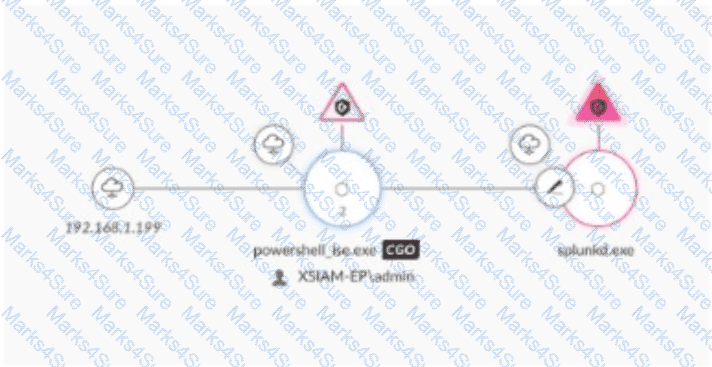
An on-demand malware scan of a Windows workstation using the Cortex XDR agent is successful and detects three malicious files. An analyst attempts further investigation of the files by right-clicking on the scan result, selecting "Additional data," then "View related alerts," but no alerts are reported.
What is the reason for this outcome?
A Cortex XSIAM analyst in a SOC is reviewing an incident involving a workstation showing signs of a potential breach. The incident includes an alert from Cortex XDR Analytics Alert source "Remote service command execution from an uncommon source." As part of the incident handling process, the analyst must apply response actions to contain the threat effectively.
Which initial Cortex XDR agent response action should be taken to reduce attacker mobility on the network?
PDF + Testing Engine

Testing Engine
PDF (Q&A)